
The modern word “express” originates from the Latin “pressare,” which is where we also get the word “pressure.” It refers to the action of pressing or creating pressure. Of course, the prefix “ex” simply means “out.” So, roughly speaking, express means to press outward, or onward, at considerable speed and without pausing. When applied as an adjective to transportation, and more specifically rail transportation, express implies a locomotive that makes few intermediate stops and reaches its destination quickly. According to multiple sources, the Shanghai Maglev in China, also known as the Shanghai Transrapid, is the fastest train in the world with a maximum operating speed of 460km/h or 268 mph. And who claims the dubious ranking for the slowest express train in the world, averaging just 42 km/h or 26 mph? That would be the Glacier Express in Switzerland, and it is a record they are proud to hold.

As a highlight of a vacation my wife and I took to Paris and Switzerland in late summer 2024, we booked a ride on this magnificent train that travels through the Swiss Alps, skirting along just north of the Swiss-Italian border between the two cities of Zermatt and St. Moritz. Our major goal of discretionary spending and travel in retirement centers on creating memorable experiences, and if we think it is warranted, we will make financial sacrifices to take those once-in-a-lifetime trips. The eight-hour excursion on the Glacier Express definitely fell into this category.
We decided to take full advantage of the journey by upgrading to Excellence Class, a single car of the locomotive that accommodates only twenty people. Nestled in reclining seats positioned next to large windows, we were facing each other across a small table where, during the 180-mile ride, two wait staff served us a five-course Alpine meal prepared on board the train, complete with champagne and a selection of wine paired with each course. The food was quite good, served on china with silver cutlery and plated as elegantly as one would find in any fine restaurant. My wife wisely passed on the steak tartare, which is a French term for raw ground beef sprinkled with Worcestershire sauce. I ate one bite and immediately decided hamburger is best served at least at medium temperature for my taste. Otherwise, everything was really tasty.
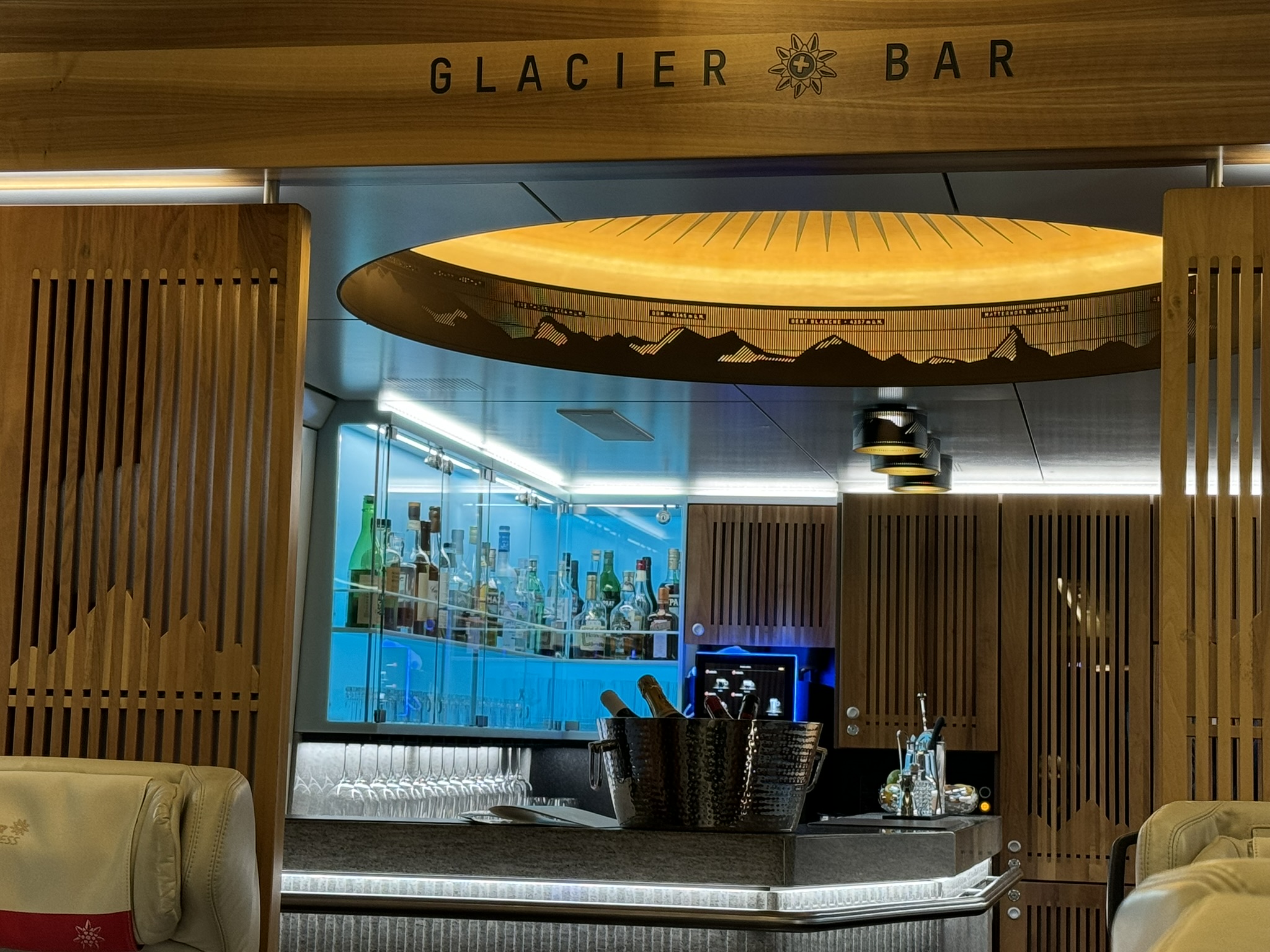
Excellence Class provides each passenger an electronic tablet and headphones loaded with information about the train, history of the Glacier Express, relevant maps, and points of interest along the route. Onboard wi-fi is also available on the device. Guests have access to dedicated concierge service, luggage handling and storage, and a private bar. The car is roomy with a large central aisle and small space behind each seat for small carryon luggage like the backpacks we had with us. Souvenirs are available for purchase and delivered to passengers at the end of the journey. We treated ourselves to a magnet and two cute tilted glasses embossed with the train’s logo.
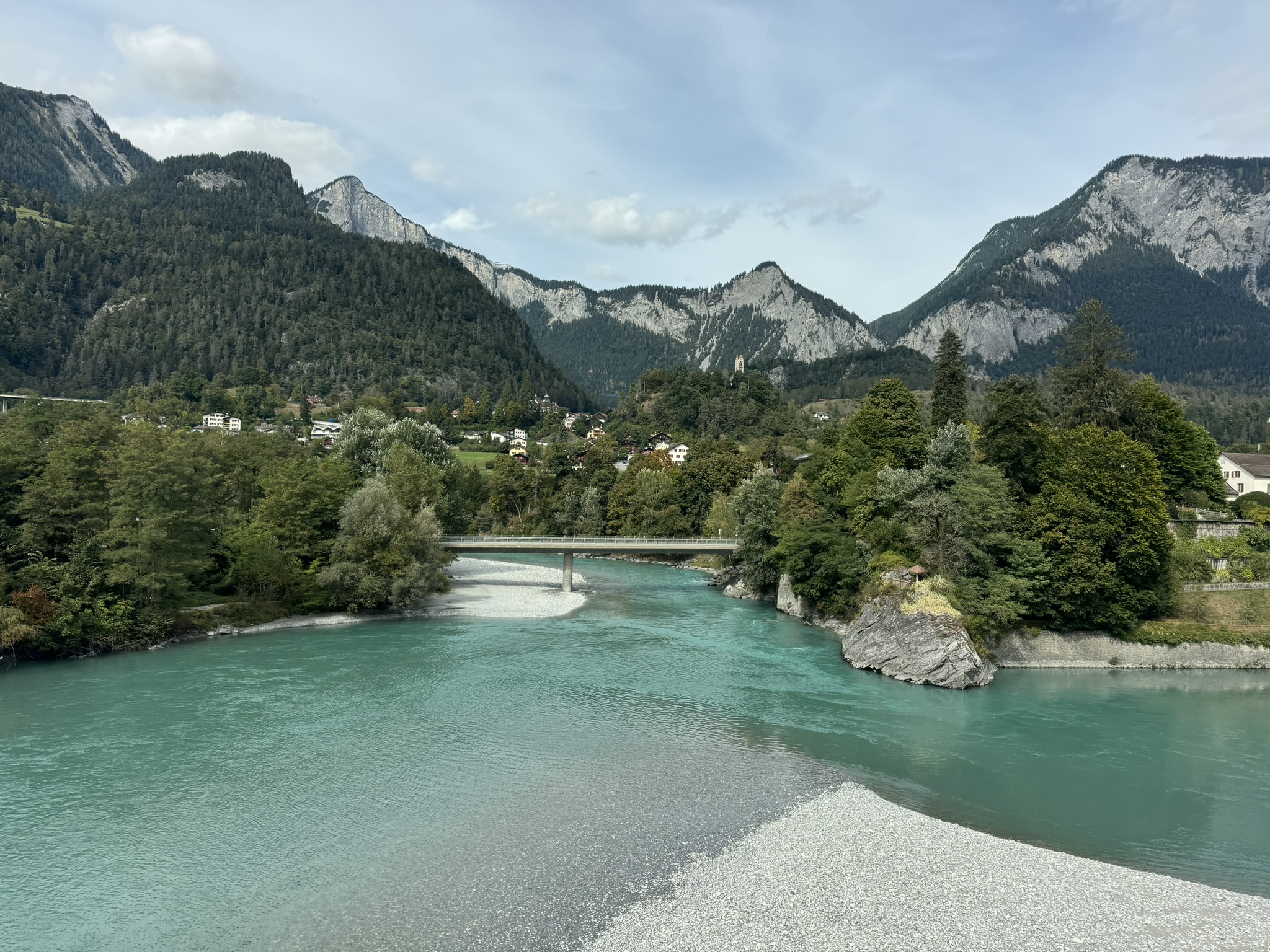
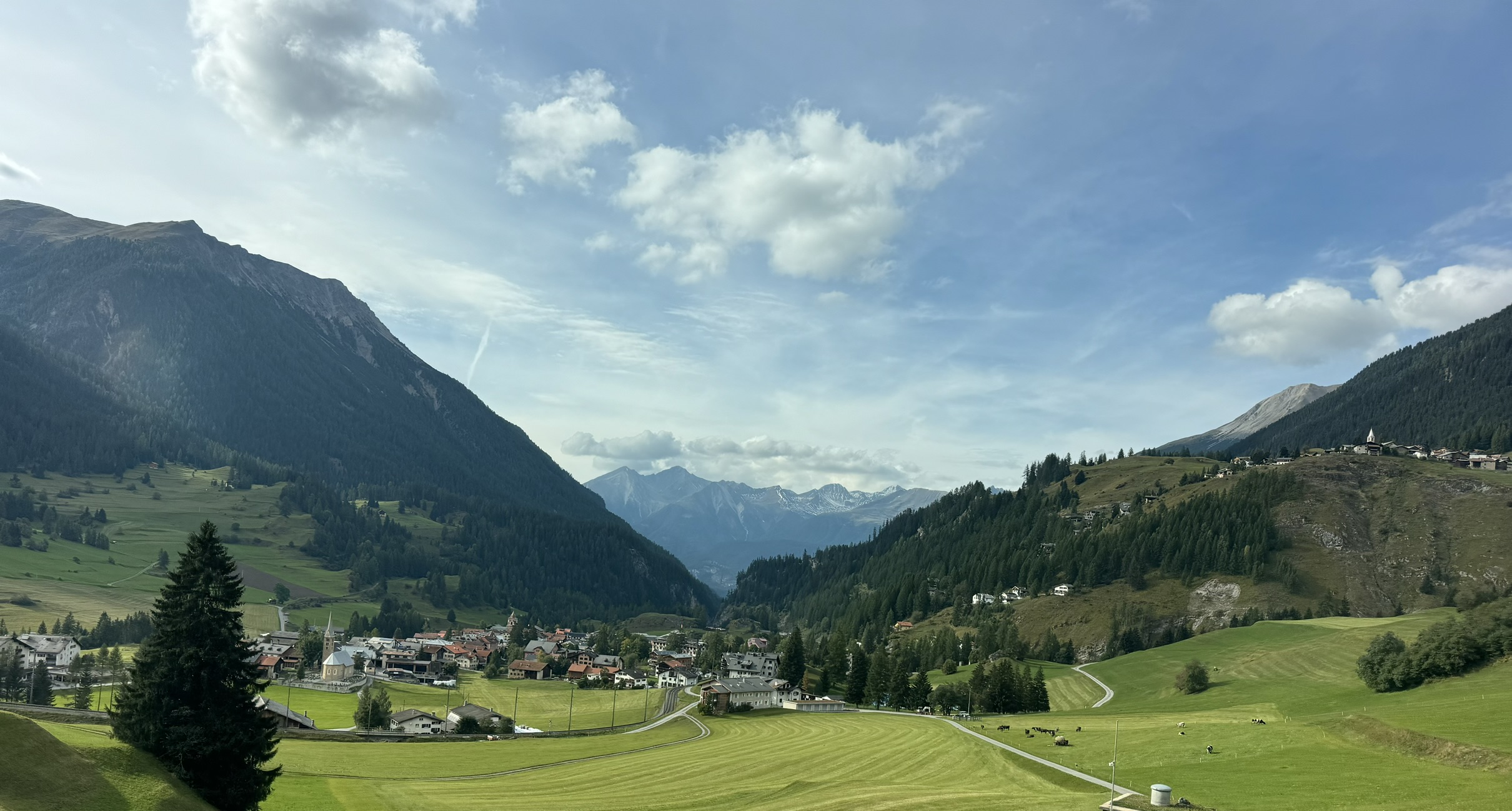
When we originally began contemplating a ride on the Glacier Express, I envisioned tracks running through flat valleys, offering us panoramic views of the Swiss Alps from a distance. While that scenario was indeed part of the trip, this train ends up traveling from a low point of 1,919 feet and climbing to an elevation of 6,670 feet at the highest point at Oberalp Pass. In other words, we were gazing up through our windows at soaring peaks just above us, some of which were covered in snow. At other times our eyes were treated to enormous green hillsides and valleys dotted with quaint villages and farmland populated by sheep. There was an abundance of ponds and waterfalls, along with cascading streams, creeks, and rivers.
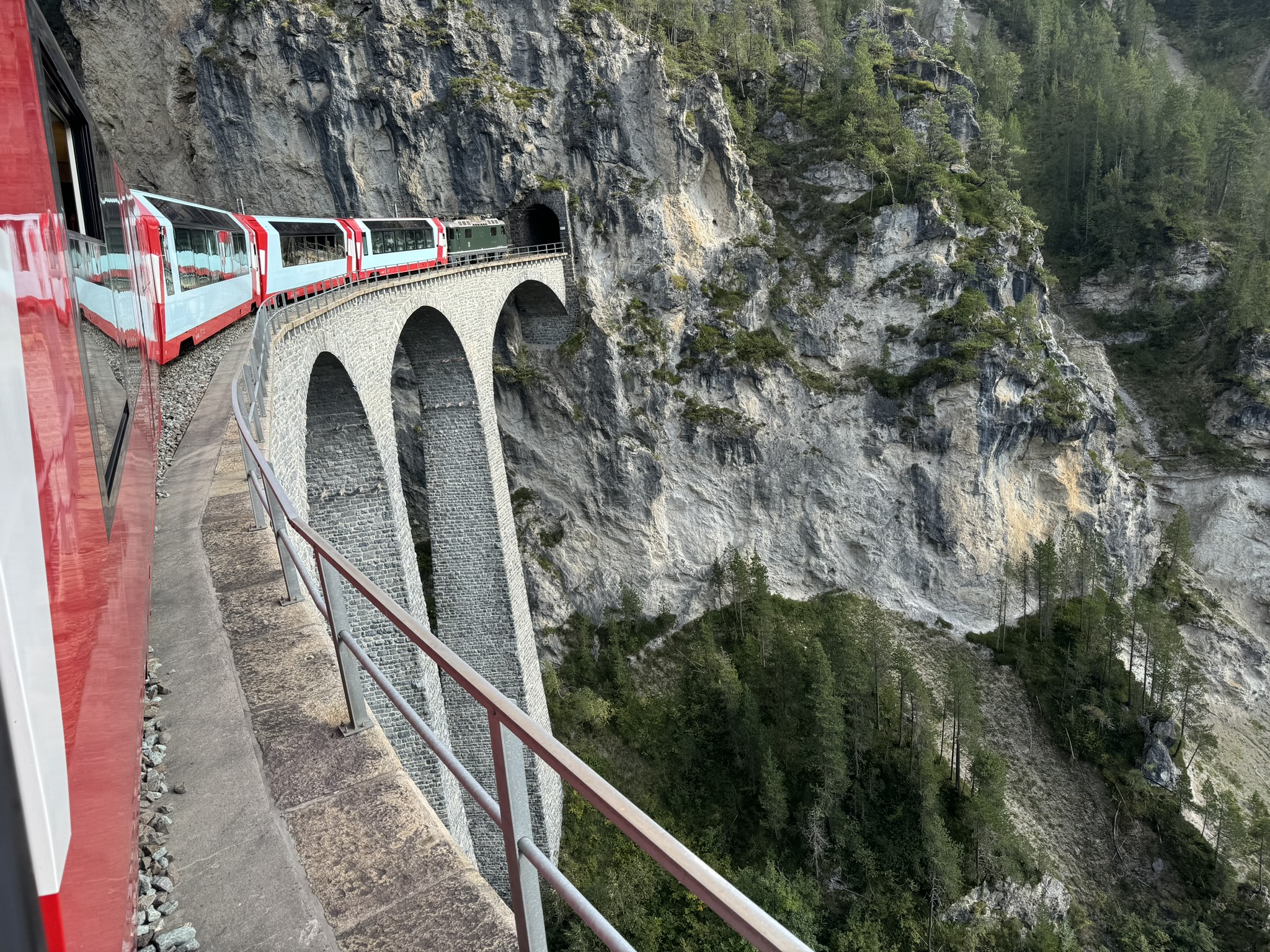
My wife is not a big fan of bridges, so of course, she was thrilled to learn that the Glacier Express crosses over a total of 291 bridges along the way, including the world famous Landwasser Viaduct. This single-track limestone railway passage is constructed of six tall arches rising 213 feet above the ravine with a span of over 1,500 feet. As we approached the viaduct, our train began to slow down considerably, which we expected. Several of us in Excellence Class (my wife not included) walked a few cars down where our concierge told us we could get a better view to take photos from the train’s open windows. As the train started over the bridge, the concierge clapped her hands and excitedly announced to my wife and those passengers remaining in our car, “Oh, this is the first time in my three years on the Glacier Express that the train is actually going to stop on the viaduct!” My traveling companion was not amused.
The Albula Line first opened in 1903, and the Glacier Express made its debut journey on the track in 1930. With the opening of the Furka Base Tunnel in 1982, which protected against avalanches, the Express was able to run year-round. The company began offering Excellence Class in 2019 and are continuing to add amenities into the future. The train excursion is wonderful as a stand-alone opportunity, but considering how enchanting both Zermatt and St. Moritz are as bookends to the trip, riding the Glacier Express makes for an unforgettable travel experience.
 If You Want My Opinion