The Evolution of the Library

The industrialist and philanthropist Andrew Carnegie wrote, “There is not such a cradle of democracy upon the earth as the Free Public Library, this republic of letters, where neither rank, office, nor wealth receives the slightest consideration.” An avid reader for most of his life, Carnegie was responsible through his generous financial support for opening hundreds of public libraries across the country in the early 20th century. Although they disagreed on significant policy issues, Andrew Carnegie and President Franklin D. Roosevelt both recognized and publicly expressed how important libraries are to the health of a society. Libraries have a responsibility to their patrons to provide the resources for developing information literacy skills necessary to participate in the democratic process.

Having grown up in Macon, Georgia, in the 1960s and 70s, I can recall my mother driving me downtown to the main branch of the public library where I could roam through the stacks to find books to read. At the time I had no real appreciation for the privilege this simple activity represented, but when I left home to attend college and worked toward completing degrees in English and history, the value of library resources became much clearer. With an MA in history, my first full-time job was working as a cataloger in the public library of a small town in middle Georgia. Over the next two years, I commuted to Emory University in Atlanta to complete a Master of Librarianship degree. I continued in the profession for the next twelve years, eventually becoming the director of that same library.

To say that libraries have changed since my childhood is an obvious understatement to anyone who has benefitted from these institutions. There is no shortage of literature about how the advent of the Internet and electronic resources has transformed the way libraries operate. Several standard textbooks have been available for over ten years that cover library services in the context of the information explosion of recent decades. Some studies are now focusing completely on nontraditional library sources — collections that have only existed in electronic format. In their 2016 book titled Discover Digital Libraries: Theory and Practice, authors Iris Xie and Krystyna Matusiak explore different digital library issues and synthesize theoretical and practical perspectives relevant to researchers, practitioners, and students.

Library stacks
Library stacks

The breadth of Internet resources is mind-boggling; however, the depth of those same resources can sometimes be deceiving, which has created a false panacea for information illiteracy. In past generations, library patrons viewed librarians as the trained sentinels of printed resources, the official concierges that users needed for reading recommendations, research assistance, facts, figures, dates, and answers to almost any conceivable question. One could argue that this sense of importance was a bit exaggerated; nevertheless, librarians had a clearly defined function and role in their organizations and the communities they served. Affordable computers and mobile devices with Internet access have been challenging the significance of librarians, and even libraries, over the last fifteen years.

In a recent article in the magazine American Libraries titled “Ten Reasons Libraries Are Still Better Than the Internet,” Marcus Banks explains that these institutions still provide tangible services along with less obvious benefits such as access, privacy, and intellectual freedom. While Banks sees the Internet as “an indispensable and irreplaceable tool for modern living,” he argues that “it is not a library and will not replace the work of librarians.” Of course, what should we expect to read in a trade magazine for this profession, right? No surprise either that I tend to agree with Banks. Professional librarians have always taken seriously their responsibility to lead patrons to the most accurate and reliable information available, either in their own libraries or in those with which they have reciprocal lending privileges. The introduction of the Internet has not altered that mission at all. Only the methods of delivery have changed. As Banks observes, “a conversation with a librarian can clarify exactly what you are looking for and figure out the best way to use Google — or many other resources — to find it.”

One of the major impacts electronic resources are having on libraries is in the use of space. The average desktop computer connected to the Internet, including subscription services provided by the library, gives the user access to resources that thirty years ago could not have been contained in a building the size of the Pentagon. Libraries no longer need stacks and stacks of reference books and bound periodicals. Certainly, many readers still want “real” books — the kind with bindings and paper pages. Reading an e-book will never replace the experience of holding a traditional book in their hands that requires no machine, no batteries, and no WiFi connection to download. But, as library budgets continue to shrink and librarians are forced to become even more creative and innovative in allocating the limited funds at their disposal, they will stop purchasing many print sources that are so readily available in a more cost-effective electronic format. They will also convert sections of the library that were once occupied by stacks to other high-demand options such as public-access computer stations, study rooms, audio/video booths, leisure reading areas, and even coffee lounges.

I recently read a Facebook exchange by my friends and mentors who are also retired college professors.  They were bemoaning the changing landscape of libraries. One of them expressed her conviction that libraries to a certain degree should be “rather intimidating, evocative of all of the great minds whose ideas reside in books therein, yet nonetheless something of a magnet to all of us who want to know things.” I absolutely understood her sense of loss when she pined for browsing the stacks and even smelling the pages of old books. The sensory pleasures of reading are understandably treasured by so many people. At the same time, this “discussion” about libraries and books and nostalgia was taking place on a social media platform that was born and has lived its entire life exclusively in the realm of the Internet. FaceBOOK has never had a single association with pages and bindings. The irony was palpable.

As the platform for the creation, exchange, and storage of information continues to evolve, and even more rapidly in the age of electronic media, perhaps the differences in function of libraries and archives are becoming more relevant and more distinct. To my way of thinking, libraries are designed to provide information created in the present and the recent past. As such, electronic sources will naturally continue taking the place of more traditional print sources. Also, weeding out books that are no longer read by patrons has been a normal task of librarians for ages. Archives offer access to sources that have more historical value and are still considered useful for research and institutional documentation. Considering the fact that archival collections are moving to digital formats at blazing speeds, even these resources will soon be available more by computers than a trip to a physical repository. As for the nostalgia of holding an old book in our hands, doing so in the future may involve visiting a place that functions more like a museum than a library or archive. As sad as that may sound, I would rather see ancient books placed in acid-free storage containers than scanned and made available only as an image on my monitor.

Decorating for Christmas

Aside from gorging on turkey and football, one of the strongest impulses generated by Thanksgiving Day among so many Americans is the urge to head to the attic, basement, or garage and pull out the holiday decorations. At this time of year, any sense of good taste is tossed out like moldy green-bean casserole that was pushed to the back of the refrigerator and forgotten for two weeks. Thanks to the development of inexpensive plastic, PVC, fiberglass, large-scale inflatable statuary, and sophisticated electrical components, some American homes and properties are transformed into dazzling spectacles that almost put to shame the illuminated facades of Las Vegas casino resorts.

The amount of time, energy, and financial resources that families dedicate to decorating varies considerably, but I suspect those who celebrate Christmas tend to be a bit more profuse than their Jewish counterparts. Muslims and Hindus use much less extravagant decorations for their special celebrations at other times of the year. Even among the folks who celebrate Christmas, the amount and type of decorations are quite diverse, with everything from simple nativity scenes to the construction of a North Pole Reindeer Flight School in the front yard that backs up neighborhood traffic for several blocks. The true zealots start their decorating activities the week before Thanksgiving, perhaps even earlier, and it can take them up to two weeks to get the job completely finished. I know a family that puts up a Christmas tree in every single room of the house, including miniature versions in all three bathrooms.

Such enthusiasts have a difficult time giving any decoration a well-deserved sabbatical or even retirement. They have an attachment to or fondness of every piece they ever purchased, so decorating through the years has a cumulative effect. At some point, all surfaces of the house are adorned with festive accessories in an attempt to display every single item they have accumulated. It can be a tad overwhelming. Some manage to pull it off better than others. Lest I be perceived as a decorating snob, I hastily confess that I have in years past clearly fallen into the camp of the unrestrained and over-exuberant. My wife has done an admirable job of intervening and helping me understand that less is better when it comes to Christmas ornamentation.

Christmas Tree and decorations

For most of its history, Christianity has been a remarkably adaptable religion, which partly explains its rapid expansion after the 4th century and its durability throughout a good portion of the western world and across many different cultures. A fine example of this adaptability can be found in Christmas decorations. Ancient Romans brought evergreen trees into their homes to celebrate the winter solstice. They also hung bright metal ornaments on trees around their homes. Pagan societies believed that the holly bush had magical qualities to repel evil spirits. Even beyond decorations, Christians managed to incorporate customs from other faith traditions into the celebration of Christmas.

Americans are a population heavily influenced by capitalism and commercialism. We market everything, including Christmas. We are also a flexible bunch, and we don’t mind bending the truth a little to sell the product. Again, we can see this characteristic exhibited in a fairly common holiday decoration: the nativity scene. We like to portray this pivotal point in human history as a nice package that can easily fit on a small side table or night stand. So we take all the elements of the story — the baby Jesus in the manger, Mary, Joseph, angels, the shepherds, the ox, the donkey, the star, and the wise men with their camels — and we fold them altogether into one, compact decoration. It is irrelevant that the wise men were not there on the night of the Christ child’s birth but at least a month or so later (perhaps much later) after he was presented at the Temple by his parents. We cannot be expected to have a separate set of figurines in the house to represent this part of the story. After all, we need to make room somewhere for a sleigh and eight or nine reindeer too!

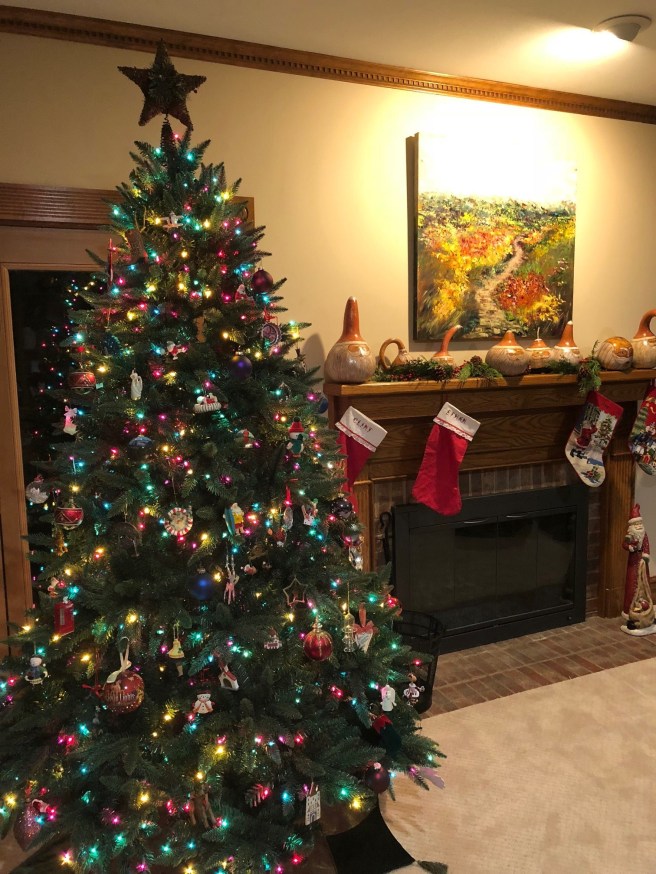
The older I get, the more I appreciate celebrating the spirit of Christmas with simplicity and humility. Over the decades I have purchased, displayed, and discarded any number of decorations. I have suffered through finding just the right tree at a farm in the country, cutting it down, paying way too much for it, and hauling it home only to find that once we wrestled it into the stand, it was as crooked as a Washington politician. We have gone through several different artificial trees and are thrilled with the two we have now, one inside and one on our back porch, that came with lights already installed. Over the last few years we have started buying what my wife calls “timeless” decorations — pieces that are reminiscent of generations past. Some people would refer to them as classic decorations. A close friend of ours paints marvelous Santa faces on gourds, and we include our collection of them on the living room mantel every year.

There are two decorations that my wife and I cherish perhaps more than any others, and we put them out every year then carefully store them away until the next Christmas. One is a small, resin angel that her parents gave her when she was a child. It is beautiful and precious. The other is a little plastic illuminated church that houses a manually-wound chime player that plays “Silent Night.” It belonged to my mother, a woman to whom the Christmas story was fundamental and factual. The miraculous birth of Jesus was a mystery she embraced without question, with little or no struggle. She has been gone now for over a dozen Christmases, but that little church keeps the memory of her fresh and close for me. I am grateful to have this modest decoration that is somehow a perfect expression of her faith and this holiday.

Church and angel
Church and angel

Book Reviews: Two by Ta-Nehisi Coates

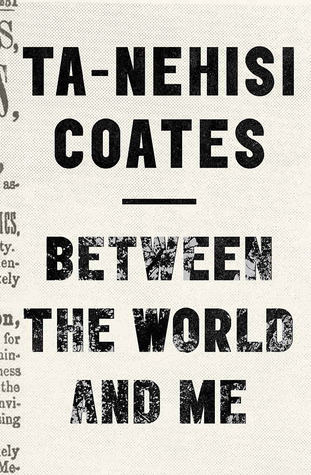
Between the World and Me

Ta-Nehisi Coates won the National Book Award for Between the World and Me. Some readers will criticize him for his lack of attention to a few basic grammatical rules. Okay, he needs to brush up on the mechanics, as many journalists do. Others may not like his style — the book takes the form of a long message to his son about what it means to be a black man in America. I think it is the perfect approach for his subject, making the book personal, emotional, and thoughtful. It reminds me of the innovation with narrative that the white civil-rights advocate Lillian Smith used in books like Killers of the Dream and Our Faces, Our Words. Coates could do a whole lot worse than follow Smith’s example. In our deeply divided society, this book will be rejected by many readers who have lost patience with what they perceive as a hypersensitive generation coddled by American universities where almost everyone is a victim of mistreatment and therefore has an excuse for irresponsibility. I don’t think Coates has fallen into that trap, either real or imagined. I highly recommend this title to anyone who wants some insights into the struggles of what an African-American colleague described once as “waking up everyday, looking in the mirror, and knowing you are wearing black skin.”

We Were Eight Years In Power

Coates is one of the most powerful voices in the country on identity politics and its ill effects on social justice, most especially for African-Americans. In interviews, Coates has made it clear that he sees little hope for conditions in America to improve with regard to the plight of African-Americans. We Were Eight Years In Power: An American Tragedy is a collection of essays, many appearing previously in The Atlantic, that reaffirms that opinion. His vision is definitely pessimistic and perhaps depressing. It would be easy to dismiss Coates as a man made bitter by his own struggles to be heard and to overcome the legacy of bondage that characterizes the black experience in America. But, his analysis is careful and calculating, and to some degree even objective. He is relentless in shining the scorching light on white supremacy and how it has systematically crushed the spirit of African-Americans, even during the Obama administration. Coates now sees white supremacy back on full exhibit, in the open, and he dubs Donald Trump as the “first white president.” The election of Barack Obama clearly set a standard and was perceived by his supporters to alter the course of American history. However, many white Americans distorted that monumental watermark into perversion: “If a black man can be president, then any white man — no matter how fallen — can be president.”

Flannery O’Connor: A Born Writer

“He’s a born politician.” “She’s a born actress.” “He’s a born preacher.” “She’s a born lawyer.” These are examples of an expression I heard often when I was a young man describing someone who seems to possess an innate talent or skill for a profession or avocation. People who excel in this fashion often exhibited certain predispositions at an early age that their family and friends recall and associate with their success. I am not qualified to comment on the influences of DNA over environment in determining aptitude, but most of us can remember that one child who seemed almost obsessed with a certain activity, pursuit, or area of interest and eventually grew up to turn that fixation into a lifelong career.

  • The librarian who as a child organized into collections and sub-collections every single book, DVD, and CD in the house
  • The biology teacher who as a child captured and studied every living creature within a one-mile radius of home and could spout off a half dozen facts about almost any major species
  • The information technologist and software architect who as a child voraciously read encyclopedias and was fascinated by computers and programming (think young Bill Gates)

When I served as the director of the Flannery O’Connor-Andalusia Foundation in Milledgeville, Georgia, I frequently gave presentations about O’Connor, which included a brief overview of her life that was cut short at the age of 39 from the effects of lupus. Along with many others who have studied her life and work, I perceived that Flannery O’Connor was indeed a born writer. I’m sure the same case could be made for any number of writers, but I know much more about the childhood of Flannery O’Connor than any other author.

Mary Flannery O’Connor (her full name) was born in 1925 in Savannah, Georgia, and was the only child of Edward and Regina O’Connor.  She was raised by a Catholic family that sometimes viewed children much like small versions of adults, a perspective largely abandoned by the 19th century. Young Mary Flannery thrived in this atmosphere. She was a bold, precocious little girl who took herself quite seriously. She referred to her parents by their first names, not “Daddy” or “Momma.” When he was away from home, her father wrote her affectionate letters that he playfully addressed to “Lord Flannery,” and she would sign her correspondence to him with the same title, addressing them to “King of Siam.”

Young Mary Flannery was encouraged to read, and perhaps the most recognizable photograph from her childhood shows her in profile sitting with a large book in her lap, staring down at the page with a look of determined concentration. She would later use that same fierce gaze to observe the world around her and depict it through a grotesque and outrageous filter. As a young reader she collected a small library of familiar children’s titles and took the liberty of writing brief reviews on the flyleaf or title page of the books. Always assertively opinionated, the young critic praised some books as “First rate,” while others, such as Georgina Finds Herself, she dismissed as “the worst book I have read next to Pinnochio.” It is worth noting that, at the height of her career, Flannery O’Connor wrote more than a hundred book reviews for two Catholic diocesan newspapers in Georgia. Also, she carried to adulthood her sharp words in assessing the value of books, as is illustrated in her acidic comments about the works of other southern writers such as Carson McCullers, Truman Capote, and Tennessee Williams. To put it in today’s vernacular, she was savage.

Not unlike many bright children, Mary Flannery wrote stories from her own imagination. Some of them were about animals with human characteristics, which is a typical theme explored by aspiring young writers. However, she went a few steps further than most children. Not only did she write clever and often hilarious stories, she also illustrated them, bound them with yarn, and made multiple copies of them to distribute to friends and family.  She was absolutely fascinated by the whole process of both writing and publishing, which later translated to a keen understanding of writing as a profession. The volume of her published letters, The Habit of Being, includes correspondence to her agent, editors, publishers, and other professionals in the book industry where O’Connor demonstrated shrewd business acumen.

As a high school and undergraduate college student, Mary Flannery turned her artistic energy to cartoons, which she created through sketching and drawing but more elaborately through printing with linoleum blocks. Although she ended up in the Iowa Writers’ Workshop under the direction of Paul Engle, she initially entered graduate school at Iowa thanks to a scholarship in journalism — she intended to pursue a career as a cartoonist. O’Connor’s biting satire and wicked humor were clearly developing even as a cartoonist, not just in the illustrations, but perhaps even more so in the captions. Some critics have argued that, as a mature fiction writer, Flannery O’Connor continued to exhibit the eye of a cartoonist in the creation of her most exaggerated characters. Little wonder that, when asked why her stories were so shocking, O’Connor explained “for the almost blind, you draw large and starling figures.”

In the private journals Flannery O’Connor kept as a college student, she undoubtedly believed that being an artist was so much more than a career choice.  It was a vocation. As she focused her attention toward writing, O’Connor yearned for her work to be used by God. She wanted to craft stories that would miraculously reveal God’s grace. As she matured into one of the greatest writers of the 20th century, she became less sentimental, but she never lost her appreciation for the mystery of art as it is interpreted by the Church, to which she remained devoted for the rest of her life. Perhaps she returned to the intensity of her younger years. She certainly became much more confident. When repeatedly asked why she decided to become a writer, without hesitation O’Connor always replied, “Because I’m good at it.”

Most of us get some level of education and eventually find a job that, with any luck, will get us out of our parents’ hair and their bank accounts. We will end up with about five different full-time jobs before we finally clock out for the last time, and our career paths will largely be determined by factors such as education, employment opportunities, salary, family obligations, and just plain old simple fate. But for a select few, a seed will be planted at a very early age that will germinate into a thriving métier that brings with it fulfillment and a deep sense of purpose. The term from my Southern Baptist heritage was “a calling.” The vocation of writing for Flannery O’Connor required serious devotion, discipline, sacrifice, and a form of genius that appears only a few times in each generation of artists. She was born with an incredible gift, which she carefully and skillfully nurtured, and her readers are the fortunate beneficiaries.

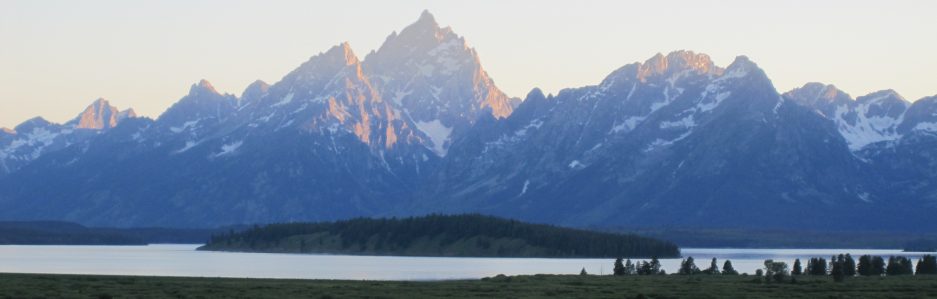
My Favorite Hike . . . So Far

My wife and I have had the good fortune to walk and hike in some spectacular locations over the last ten years including England, France, and Italy. I have written a few posts about our treks in Montana, Arizona, New Mexico, Connecticut, Massachusetts, and California. I maintain that some of the best scenic walks or hikes in the United States are in California: around San Francisco, along the Pacific coast, and in the wine country, just to name a few. If pressed to choose my favorite hiking experience to date, that distinction would have to go to Yosemite in the Sierra Nevada mountains of California. Yosemite Valley is the most familiar destination in this region to so many visitors, but Yosemite National Park covers 1,200 square miles. First protected in 1864 by the federal government and the state of California, Yosemite is best known for its waterfalls, deep valleys, grand meadows, ancient giant sequoias, and vast wilderness.

We were at Yosemite for several days during July, 2013. A close friend who lives in California frequently visits Yosemite to relax, hike, and take fantastic photographs — a hobby that has in recent years almost become a vocation. She was generous enough to be our guide, taking us to some of her favorite places to hike and witness the beauty of this amazing place. We stayed in a comfortable cabin about 45 minutes south of the valley near the village of Mariposa. For our first outing, we explored the meadows around the Merced River between Sentinel Beach and Cathedral Beach, which offered stunning views of the rocky cliffs of El Capitan and Cathedral Spires. The meadows with their lush riverbanks are large enough to provide some privacy and a good place to escape the crowds that gather near the camping sites and the more popular attractions in the park. We spent the early afternoon taking photographs and wading in the cool waters of the Merced River where it pools in the numerous bends as it winds its way through the valley.

Wading after hiking at Yosemite

On our second day, we spent some time at two of the most familiar waterfalls in the valley. Bridalveil Fall is the thin, tall spray that is visible on the right from the famous Tunnel View, the place where Wawona Road exits the tunnel and the place where most visitors get their first glimpse and photographs of the breathtaking vista of Yosemite Valley. There is a trail that leads to the base of the fall, where the water crashes against gigantic boulders and disperses a fine mist over an area about an acre in size. The best time to view the falls at Yosemite is the spring, when the melting snow creates the largest volume of water spilling over the soaring rock cliffs. Even in July that year the water was still running enough to make for a spectacular performance. We also walked up to the base of Lower Yosemite Fall, and then treated ourselves to afternoon cocktails in the courtyard of the Ahwahnee Hotel, now called the Majestic Yosemite Hotel. While sipping our drinks under the umbrellas, my eyes were drawn upward to the cliffs rising from the valley floor. Our friend identified the peak as Glacier Point, and I asked, “Can we get up there?” She explained that Glacier Point Road takes off from Wawona Road and leads to an observation point with a picnic area and restrooms. We decided that we would have enough energy by the next morning to explore the hiking trails around Glacier Point.

When we arrived at around 9:00, the crowds had not yet started to gather at this famous lookout point, which offers one of the best views of Yosemite’s iconic Half Dome rock formation. We wandered around the site, experiencing the valley from a completely different perspective than the previous two days. Similar to standing on the rim of the Grand Canyon, words fail to describe the spectacle. Even explorers like John Muir had difficulty. Our friend, who is twelve years our senior, challenged us to take the hike from Glacier Point up to Sentinel Dome, which rises about 900 feet from the trail head and peaks out at over 8,100 feet above sea level. “I won’t be happy unless I’m at the top,” I said. We strapped on our backpacks, which included our lunches, and headed up the winding trail through the evergreens toward the summit. When there were breaks in the trees, the views along the way were fabulous. The last hundred feet of the trail opened up to bare rock and was fairly steep. The reward for making it to the top was well worth the effort. Sentinel Dome presented far-reaching vistas in all directions: to the west down the valley to the Merced River canyon and to the north the massive expanse of El Capitan and Yosemite Falls. At this elevation, the peak of Half Dome is in clear sight and is only 700 feet higher. I couldn’t resist hopping up on the large rock that crowns the dome for a selfie with Half Dome to commemorate the occasion.

On the peak of Sentinel Dome at Yosemite

To employ poor puns to the fullest extent, how do you top such an uplifting experience? On our way back down the trail, we stopped for lunch on some large rocks at an opening looking out to the east. We could just make out the remaining snow on the High Sierra peaks in the distance. Below our perch across a considerable expanse, we could see Nevada Fall making its contribution to the Merced River. At the brief intervals when there was no wind through the trees, we could just barely hear the distant roar of the water crashing down the crag to the huge rocks at the fall’s base. With tired legs and sore feet, we refueled on sandwiches and fruit, realizing that we were totally immersed in one of those wonderful moments where friendships, nature, and a deep appreciation of life converge to present memories that never fade. My wife and I continue to travel and look for opportunities to hike, especially at locations where we can enjoy beautiful scenery. Perhaps at some point I will have an outdoor encounter that impresses me even more than the morning at Sentinel Dome did. I truly look forward to it.

Nevada Fall at Yosemite

Southern Word of the Day (Part 5)

Here is the latest installment of my favorite Southern words, and perhaps Jeff Foxworthy has used these too.  No plagiarism is intended here; I can only plead ignorance, which for me is not a stretch at all.

Pressure. Usage: “You can see inside the window better if you pressure face right up to the glass.”

Turnip. Usage: “Will you please turnip the volume on that TV so I can hear what they’re sayin’.”

Mare. Usage: “Billy Bob is thinking about running for mare in the next city election.”

Manure. Usage: “I like manure truck better than my old one “cause it’s got 4-wheel drive and a gun rack.”

Meander. Usage: “Charlene went with meander momma down to the Wal-mart to look for some curtains for the trailer.”

Entity. Usage: “If you pour a little oil entity pot of spaghetti the noodles won’t stick together.”

Binary. Usage: “I didn’t binary one of them undershirts at the yard sale ’cause they had stains in the arm pits.”

Trauma. Usage: “I’m gonna trauma best to be at the rodeo this Saturday night if I can get back in time.”

Eclipse. Usage: “I like this new barber because eclipse the hair growing out of my ears.”

Pumpkin. Usage: “If the basement floods again, that new pumpkin get the water out in a hurry.”

Southern Word of the Day (Part 4)
Southern Word of the Day (Part 3)
Southern Word of the Day (Part 2)
Southern Word of the Day (Part 1)

Our Mountain Getaway

In the early 1970s, my parents purchased a small, three-bedroom house a few blocks from the downtown section of a sleepy little hamlet in the north Georgia mountains.  They intended to use the house as a vacation spot for their family, relatives, and close friends.  The house was about seventy years old and had been abandoned and neglected for quite a long time. As a skilled electrician and carpenter, my father was able to take what was an almost uninhabitable shack and, with the help of family and friends, turn it into a comfortable summer cabin. With all her characteristic love and gentle kindness, my mother turned the cabin into a second home.  When my parents first bought the house, there were two large oak trees growing in the front yard, so they decided to call the place “Twin Oaks.”  Even though one of the trees had to come down several years later, the name had already become so associated with the house that they decided to keep using it. 

Over the years, Twin Oaks provided four generations with a great place to escape and relax, to enjoy the beauty of the Georgia mountains, and to have SO much fun.  My sister and I continued to maintain the house and property as best we could after our parents could no longer make the trips to the mountain getaway.  Unfortunately, a house like this one was never intended to last for a very long time, and as a new century approached, Twin Oaks began to suffer from wear and tear and too many cold winters. In the fall of 2015 my wife and I, as the current owners, decided to demolish our little mountain vacation house and build something new in its place. I wrote a post in December of that year about our decision titled Letting It Go. We had some apprehension at the time, and it was not an easy decision to make. But, there was no doubt that we loved the location and wanted to continue having a place of our own for family and friends.

We contracted with a builder who is also a family member to construct a three-bedroom, two bath house, which was completed in December, 2016.  The wood frame house with a rock foundation is built basically on the same footprint as the original house.  It is still conveniently located within walking distance of the ever-expanding and vibrant downtown area.  However, this house came with a few significant upgrades: central heat and air, modern kitchen appliances, wireless Internet, and DISH TV.  It can be enjoyed year-round and doesn’t have to be “put to bed” for the winter. For over four decades, Twin Oaks was a place to create wonderful memories.  That tradition continues with a new house — Twin Oaks 2! 

Twin Oaks 2
Twin Oaks 2

Pledging Allegiance

I started pledging allegiance to the flag when I was a small child in elementary school, a ritual that I never questioned and that was just as much a part of the daily routine as lunch, recess, and reading from a primer about the riveting adventures of Dick, Jane, and Spot. I can vaguely remember that there were one or two students who were exempt from “saying the pledge,” and we were told that their religion forbade them from participating. At the time, I couldn’t begin to fathom the meaning behind such a religious restriction, having no exposure to any faith traditions outside rural Southern Baptist churches. You can’t get more patriotic than Southern Baptists. I don’t recall reciting the pledge in class when I attended a white-flight, church-sponsored private high school, which strikes me now as most ironic. Maybe we did and I was just too preoccupied with friends, girls, and turbulent hormones to give it any thought at all. Even as young children we could all rattle off the run-on sentence with no regard whatsoever to its intent of inspiring devotion to the homeland. When Francis Bellamy penned the original pledge in 1892, it was generic enough to be adopted by any republic with a flag, not just the United States, and it had no mention of God even though its author was a minister. The pledge was given official recognition by Congress in 1942. The divine creator was inserted in 1954 by a request of President Eisenhower and an act of Congress in reaction to atheism associated with the spread of Communism.

The United States didn’t have an official patriotic song until 1931 when Congress passed a law formally designating “The Star-Spangled Banner” as the national anthem. Fast forward almost a century and now we find ourselves in a national debate over the proper respect for this song and that waving banner it praises. Of all places, the most high-profile test of true patriotism in this country apparently takes place just before kick-off at televised football games in the National Football League. The suggestion is that respect for a song and respect for the United States are of equal importance. I cannot quite agree with that premise. Should American citizens respect the National Anthem? Perhaps, but I don’t necessarily consider such respect to be a qualification of patriotism. Should they respect the flag? Well, they should be encouraged to respect the flag, although pledging allegiance to it should never be required by law.  Furthermore, I don’t think demonstrations of allegiance to the National Anthem or the American flag should be a requirement of employment either, even for athletes, but that isn’t my decision to make.  Disrespect of the flag is a right protected by our constitutional government and demonstrates the price of democracy and free speech. Without this protection, waving a flag that represents the Confederacy — a failed attempt to disband the government of the United States — would be an illegal act. The mere display of a Confederate flag is a blatant disrespect of the Republic, but we permit it. In certain parts of the country, flying the Confederate flag is encouraged, even by elected officials who have sworn allegiance to the Constitution over and over again. Somehow, this paradox wreaks of hypocrisy to me.

Do we show respect for the country by habitually standing for a song while giving little or no thought to its lyrics? Is there any evidence that daily recitation of the Pledge of Allegiance to the flag by children later produced within their adult hearts and minds some measure of undying loyalty to their country, upstanding moral character, or compliance to the law? I wonder how many people in the stadium seats could actually write the lyrics of the first verse of the National Anthem (much less the other long-forgotten stanzas). I wonder how many Americans think about the fact that this country was not “the land of the free” for over a million people in bondage at the time the song was written. I wonder how many times before April 19, 1995 Timothy McVeigh stood for the National Anthem and pledged his allegiance to the flag.

Before anyone can honestly be expected to honor the flag, he or she needs to be able to respect the Republic for which it stands. In truth, we all know that recent developments around this issue aren’t really about a 19th-century song or a piece of red, white, and blue cloth. They are just symbols of a collective dream that cannot come true for too many of our citizens who don’t have the privilege afforded those of European descent. Perhaps, some day, when America truly is a unified Republic that is “indivisible, with liberty and justice for ALL,” everyone will be proud to pledge allegiance to the flag that waves over a land of free and brave patriots.

Wildlife In Our Garden

One of the great benefits of a home garden is the diversity of life that it supports, which includes fauna as well as flora. Depending upon the plants growing in the space and its overall size, the garden may have both temporary and permanent residents. With the right mix of food, clean water, and cover, the gardener may play host to a wide variety of species. Of course, gardeners may not roll out the welcome mat to all wildlife, especially the kind that feast on our plants. Some we can deter; others we may choose to eliminate altogether. Slugs and Japanese beetles come to mind in our own garden.

Butterfly on cherry blossoms

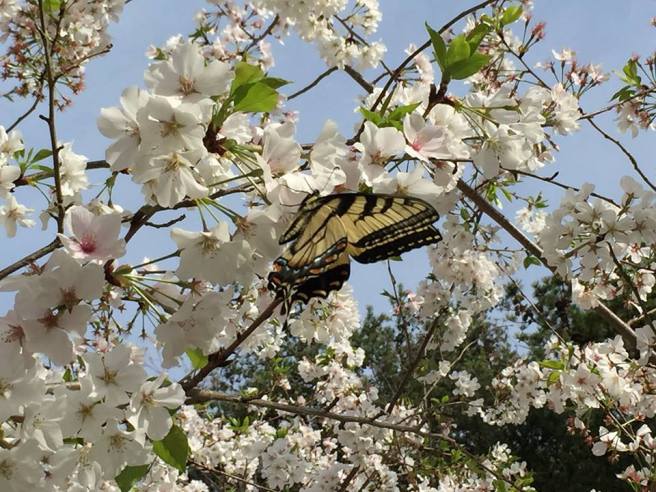
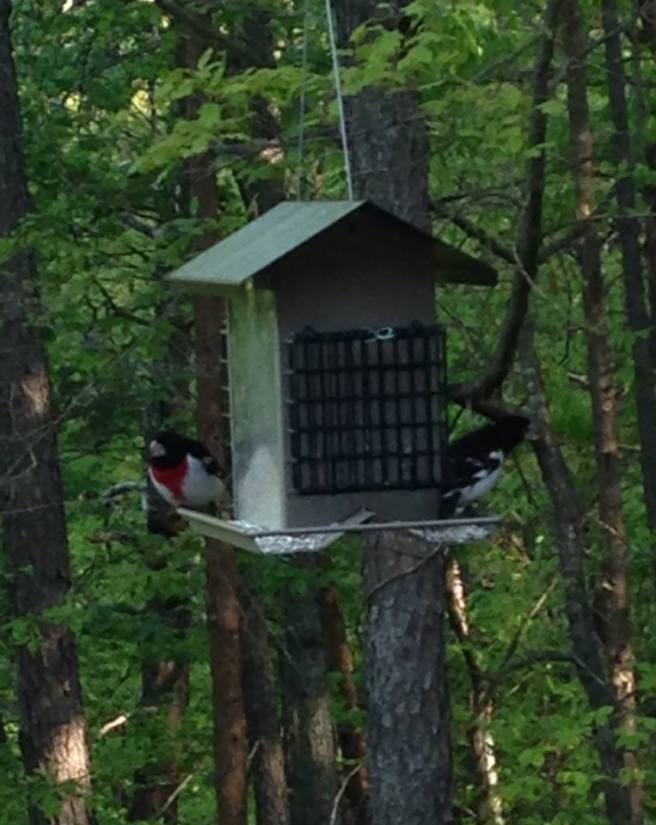
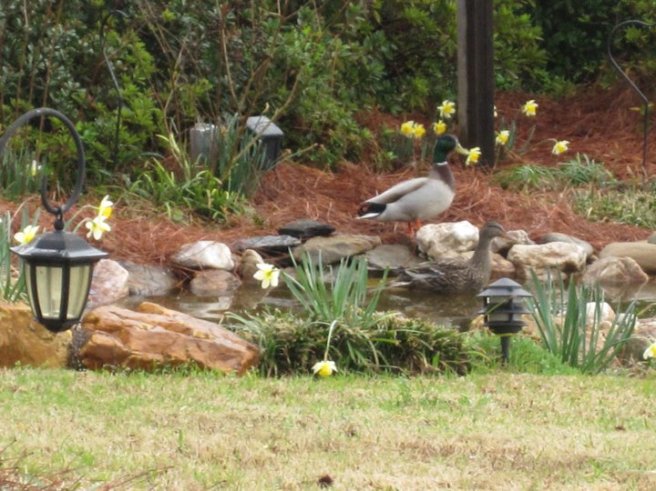
I am fascinated by the members of the animal kingdom that have frequented our yard over many seasons. Our current home is bordered by a national forest, which means there are plenty of nesting spaces and protection from predators. Our garden serves as a small oasis and a source of food for many of the animals that venture out into the open. Each spring, our ornamental cherry tree is covered in butterflies that appear to dance around the branches as they feed on the nectar from the blossoms. As the season progresses, they are joined by moths and bees, making their way through the bloom cycles of the chaste tree, lantana, and the butterfly bushes. Everywhere we have lived we included bright-colored annuals in the summer landscape, which attract hummingbirds. I am continually mesmerized by their aerial acrobatics. For other avian species, both permanent residents and migrants, we offer a gurgling bird bath, a waterfall, and a seed feeder. At our previous residence on a lake, a pair of male and female ducks would occasionally come ashore, cross our lawn, and splash in our garden pond.

Rose-breasted Grosbeaks at our feeder
Ducks at our pond
Ducks at our pond

Watching animals in the garden has provided me with countless hours of entertainment for most of my life. Photographing them has almost become an avocation. I plan and develop sections of the garden specifically with animals in mind, considering what they need, what will draw them, and how I can best observe them. I set up trail cameras to catch a glimpse of them in action.

Our photo-bombing squirrel
Praying Mantis on our fence

Our garden is home to insects, birds, amphibians, reptiles, and mammals. The frogs are in a class all to themselves, at least when it comes to their most noticeable contribution to the garden — sound. During the warm months of the year, they gather in and around our pool and fill the air with responsive croaking that is at times almost deafening. By contrast, the reptiles are so quiet and subtle. I came very close to stepping on a turtle before seeing it and walked past a snake resting on top of a shrub three times before noticing it all.

Black rat snake resting on our holly shrub

Admittedly, I don’t give all animals free access to the entire garden. Unfortunately, the deer and rabbits will take far more than their fair share. They will eat the plants they like all the way to the ground. I use Liquid Fence to deter them from my annuals, perennials, and flowering shrubs, but they have plenty of grass and border foliage to sustain them. It wouldn’t be polite to completely bar them from the yard. After all, the name of our street is Running Deer Road. This is their home too.

Deer across the street

A New Steward for Andalusia

My wife and I were invited to a ceremony on August 9, 2017 making official the transfer of ownership and stewardship of Andalusia, the home of Flannery O’Connor, to her alma mater, Georgia College, in Milledgeville. The great American novelist and short story writer lived on this farm with her mother, Regina, for the last thirteen years of her life. In her first-floor bedroom, O’Connor worked faithfully every morning for several hours, struggling on her manual typewriter to construct sentences and paragraphs that would not only entertain her readers but help them envision the action of grace on characters who were often violently resistant to it.

Andalusia transfer ceremony 8-9-17

We were invited to this special occasion because I served for thirteen years as the founding director of the Flannery O’Connor-Andalusia Foundation, the nonprofit organization that gifted the 544-acre site to the College. The current chair of the Foundation, Donna Barwick, explained to the people gathered that rainy August morning how she and her fellow board members arrived at this decision. “We would never, as a small organization, be able to raise the amount of money that it will take to maintain this place in the way it should be for Flannery’s legacy,” she said. “So we’re confident that this place will be treated properly.” Sadly, she is absolutely correct. Private entities that are responsible for the care and preservation of historic homes have an extremely difficult time raising the capital to do the job — in many cases, it is an insurmountable task. Andalusia is no exception. With a sizable two-story Plantation Plain house and a dozen outbuildings, this literary landmark will require millions of dollars to completely restore it and then a respectable annual budget to maintain it and keep it open to the public.

When I first began as the director of the Foundation, I had unrealistic expectations of how much money we could raise to restore the farm. I was sure that wealthy benefactors would be eager to drop thousands, if not millions, of dollars into our lap in honor of such a great writer. After all, she has friends in high places, at least financially. Celebrities like Bruce Springsteen, Tommy Lee Jones, Bono, Jerry Bruckheimer, and the Coen Brothers have all publicly paid verbal tribute to the author. We made overtures to all of these people, but they either never responded or indicated that they were focusing their charitable giving on other causes, like world hunger.  It’s hard to trump world hunger.

Toward the end of my tenure at Andalusia, I had a meeting with the incoming President of Georgia College, Dr. Steve Dorman, and we spent considerable time then and later discussing the ways in which our Foundation and the College could collaborate. We even toyed with the idea of the College taking over the operation of the site, although we never truly talked about any specific plans or what such an arrangement might look like. Now that the mantle has officially been passed, I am giving some thoughtful consideration to this next chapter for Andalusia. I feel a certain allegiance to Georgia College because it is the place where I earned my BA in English and my MA in History. Naturally, I will always have an emotional attachment to Andalusia, the home of the author whose work I so admire and the place that I devoted so many years to preserving.

I believe that Georgia College is the most logical beneficiary for this remarkable treasure. The College has the staff, resources, and state-wide support needed to protect and preserve Andalusia. I would imagine that Flannery O’Connor and her mother considered other colleges for the future writer to attend, but they decided on Georgia State College for Women, which is now Georgia College. As the state’s designated liberal arts college for the University System of Georgia, this institution is also home to the world’s preeminent Flannery O’Connor studies program, which was cultivated for many years by Dr. Sarah Gordon and is now directed by Dr. Marshal Bruce Gentry. The College publishes the Flannery O’Connor Review, edited by Dr. Gentry, which is the longest running journal devoted to a female author in the world. I am convinced that the administration understands the value of this donation, which was expressed by President Dorman at the signing ceremony: “We are grateful to the Andalusia Foundation for entrusting us with its future and look forward to continuing to share this piece of American history with the world.”

I had the pleasure of spending an afternoon with a good friend of Flannery O’Connor, Marion Montgomery, who taught English at the University of Georgia for thirty years. He shared with me a conversation he had with Regina O’Connor not long after after her talented daughter had died. She may not have completely comprehended what Flannery was doing in her fiction, but Mrs. O’Connor understood the importance of the work and that Flannery’s professional papers needed to be preserved for scholars who were already exploring her genius and many more that would follow. Mrs. O’Connor confided to Professor Montgomery that she was struggling with the decision about where the papers should be reposited. Colleges and universities in various locations around the country were expressing deep interest in acquiring the archive, including Georgia College. Professor Montgomery asked her where she thought the material belonged. “At the College here in Milledgeville,” Mrs. O’Connor replied. Mr. Montgomery said, “I agree.” Since that time, hundreds and hundreds of scholars have spent countless hours poring over the O’Connor Collection at Georgia College, the place where a young woman’s talents as a cartoonist began to evolve into drawing startling figures with words instead of pictures. And now, some fifty years later, the care of the landscape that sparked a brilliant artist’s imagination is exactly with whom it belongs.