Godless Ethics

Good Without God by Greg M. Epstein is a nice overview of how people who do not believe in God live an ethical life, how they are charitable, loving, compassionate, fulfilled, and inspired without religion as their primary motivation. Epstein is obviously trying to soften the message of the irreligious that has been expressed by leading atheists with sarcasm, indignation, and even rudeness. In some sense, he is playing the role of a modern Thomas Aquinas, the Angelic Doctor who is trying to find consensus between the religious and the secular world.

It does seem to me, especially toward the end of the book, that Epstein is attempting to find ways in which humanists can enjoy the worldly fruits of religion through culture and ritual, as if living a humanist life without the type of community that faith offers is empty or disconnected. No doubt, his Jewish heritage is coming into play here, which he fully discloses. Perhaps this perspective also comes out of his role as a humanist chaplain (still an odd title for a humanist in my opinion) at Harvard.

I get the sense that he thinks the creation of humanists organizations that look and function like churches, synagogues, or mosques will somehow make humanism more “competitive” or more attractive or perhaps even more palatable to the skeptics or the indecisive. It reminds me of vegetarians and vegans who eat foods that are considered meat substitutes because they crave meat but won’t eat it. I think humanists can find community and social interaction outside organizations that look and sound like religious ones. In fact, I would venture to say that plenty of believers find their most meaningful connections outside their religious circles.

This is a very accessible book that is well written, thoughtful, and completely unoffensive to left-leaning, progressive readers. Evangelicals and other orthodox or fundamentalist faithful will hate it. There is no doubt that Epstein was very encouraged by the election of Obama, which occurred one year before the book was published. For people who were raised in strong religious environments but now find themselves in the camp with agnostics or even atheists, Epstein’s conclusions can be reaffirming, perhaps even comforting.

.

Deciding Where To Stay

A significant part of the expense of traveling is the cost of lodging, especially if you are in a large city or a popular destination.  It really is worth the time and effort to find a place that suits your needs and fulfills your expectations.  Sometimes hotels are the best option, especially if you are staying for only a night or two.  There are times when the hotel itself may be what attracted you in the first place, which was the case when my wife and I decided to spend our most recent anniversary weekend at the luxurious Four Seasons Hotel in Atlanta.  We looked forward to having dinner in the hotel’s restaurant, hanging out in the bar, and relaxing in a plush bed covered in sheets that, in retrospect, must have been imported from Turkey.  We also stayed in an over-the-top place when we visited Carmel, California.  The name would suggest a cheesy roadside motor lodge, but our room at Tickle Pink Inn had a small balcony looking out over the rocky cliffs of the Pacific and was equipped with a canopy bed and word-burning fireplace.  It was incredible, even for the one night we were there.  We don’t usually splurge like that, but in both cases, the experience was worth the extra money.  And, the experience is what we’re really after when we travel.

If your travels take you to major cultural centers, such as large cities or places of historical significance, then I suggest skipping the hotels and seeking out accommodations that will permit you to be immersed in the locale.  This option is especially preferable if you plan to stay for more than two nights.  It would appear that more travelers are embracing this idea with the rapid rise in popularity of Airbnb, VRBO, and many other agencies that provide listings of homes, apartments, villas, condos, and cabins for rent.  If you want a taste of what it is like to live in a particular place, then staying in a neighborhood or borough or barrio among the people who do actually live there is the best choice, especially if you are in an area where the language and customs are quite different from your own.  Shopping in local markets, eating in nearby cafes, strolling the streets and the parks, and taking in the local entertainment affords you the opportunity to get more integrated with the surroundings, to embrace your temporary milieu.

On our recent trip to Paris, my wife and I stayed in a lovely studio apartment in Le Marais, a trendy historic district that spreads across parts of the 3rd and 4th arrondissements.  The area was in terrible shape by the 1950s but was revitalized in the 1960s and is now the section of the city known for a high concentration of Jewish residents and also of gay and lesbian Parisians. It also hosts some of the most popular small, independent clothing and fashion shops in Paris.  We found out about this particular apartment from a friend in the states who had stayed there the previous summer and loved it.  So did we.  Our fourth-floor room was tucked away in a collection of early twentieth-century buildings between a busy thoroughfare and a side street about two blocks from the right bank of the Seine River.  The first floors of several of the buildings housed offices that looked out to a lovely courtyard, and the whole complex was somewhat secured by combination-code locked gates.  One of the entrances was less than fifty yards from a Metro station, which was most convenient.  Our apartment had a fair-sized bathroom and a small kitchen in addition to a spacious (by European standards) bedroom/sitting area.  It was accessible by a circular wooden staircase that wound its way around an elevator shaft with a car just large enough for two people with healthy BMI frames — it was tiny by American standards but typical for Paris.  The only times we used the elevator were to haul our luggage up when we arrived and back down when we departed.

Apartment complex courtyard

We walked to one of the local markets as soon as we got settled into our apartment and bought all the provisions we would need for the five days we were staying in Paris.  That grocery shopping experience alone is worth another blog entry — a human comedy.  We walked to local bistros several nights that were quaint and wonderful.  We had breakfast almost every morning at a little bakery just a quick walk down the street.  The chocolate-banana pastries were like edible heaven.  We were within easy walking distance of the Seine, Notre Dame, and several museums, including the Picasso Museum and the Bastille.  On our last morning in Paris we strolled down to the Seine and walked up and down the banks of the river.  Other than the shopkeepers and other people who provided us with assistance, I don’t think we ever heard a single word of English while we were in the neighborhood where we were staying, which is such an important part of the experience of traveling to a foreign country.  From the window of our room we could hear people talking and laughing at the café four floors below our windows.  We could hear children playing on the sidewalks.  We could hear people going to and coming home from work or school.  For a brief time, we almost felt like Parisians — well, a little.  Do yourself a favor.  On your next trip, find a place to stay in a great neighborhood and soak up the atmosphere you find there.

Views from our windows in Paris

How About an Early Election?

Many voting precincts around the country allow people to vote early for elections, which is a dandy idea if you ask me.  I get to avoid a line even if there aren’t any real crowds (sadly), and I take care of my civic responsibility at a time that suits my schedule.  Early voting is a wonderful convenience.  Given the current political climate leading up to what is likely the most controversial and divisive presidential election of my lifetime, I would like to carry the concept one step further.  Let’s get this over with by having an early election.  If social media is any indication of the current volatility of emotion and anxiety surrounding the election, we need to blow the lid off this pressure cooker as soon as possible.  Is there really anybody left out there who hasn’t made a decision about the candidates?

If we’re honest with each other and ourselves, which hardly ever happens on social media, we know that what we all do is accentuate the negative news about the candidate we oppose and ignore the damning news about the one we support. After a while, most of the “breaking news” about the candidates just becomes sound and fury, signifying nothing. The latest scandal is just another bug on the windshield — hit the spray switch and the wipers and in a few seconds it’s gone. It doesn’t change the course, it certainly doesn’t change anybody’s mind, and it doesn’t get us any closer to being one nation indivisible.

Members of Congress will continue to thwart the efforts of the President no matter who wins the White House, and the President will continue to use executive orders and other powers to bypass Congress. With this model now firmly established in Washington, the federal government will get very little good work accomplished, which for some of the remnants of the Tea Party, will be just fine. The chances of the federal government shrinking any time soon are practically nonexistent, so the next best thing for the anti-government crowd is for the train to stall on the tracks. Of course, that means that horrible abuses of the system and wasteful spending of tax money will continue to escalate, and both of the controlling parties are equally out of control with spending.

I don’t know what it will take for Americans to overcome their deep differences. We may be too far gone. Even an attack on our own soil only produces a temporary and superficial sense of unity that is quickly forgotten when the partisan rhetoric machine cranks up again. I certainly don’t hold out any hope that Trump, Clinton, or Johnson will be able to bring the nation together. If the model of Darwinian evolution’s survival of the fittest can be applied to the U.S., perhaps we simply aren’t the fittest.

Galveston Beach Deserves Better Press

Being a lover of the seashore and all things beach-related, I take every opportunity to dig my toes in the sand and soak up the salt and sun.  We try to make a trip to the beach at least once a year if possible.  I even play the sounds of waves on my computer at work for background noise.  It’s better than music sometimes.  For a good portion of my life, the highlight of my summers was a trip to Florida, usually to Daytona Beach, for a family vacation.  I have also visited beaches in Alabama, South Carolina, California, and southern England.  I know people who drive 24 hours from Texas just to spend a couple of weeks on the beach in Daytona, passing by numerous other locations along the Gulf to get there.  They say that Texas beaches are dirty and run-down.  They claim there’s no entertainment.  Specifically, they are talking about Galveston Island.

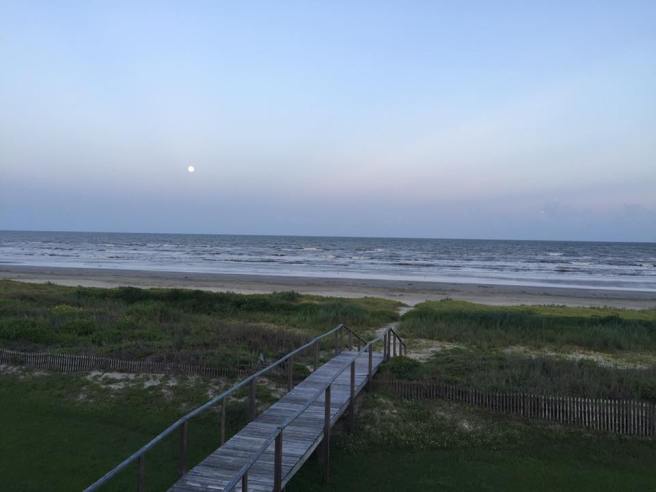
This summer, my wife and I were invited to spend a week at Galveston Island with some close family who live in Kansas.  We don’t get to see them very often and really enjoy spending time with them.  The plan involved them driving down to the Gulf in a couple of vehicles, loaded down with everything we could possibly need for a week at the beach.  We flew into Houston, rented a car, and made the short trip down to meet them at a large, rambling house on the beach we had all rented for the week.  I was expecting to be underwhelmed when we got there; however, I was pleasantly surprised to find Galveston’s beaches full of life with plenty of attractions.  There are water parks, an impressive amusement park on a huge pier, gardens, theaters, historic areas, some good restaurants, and more.  The beaches are clean, the waves are better than the Florida Gulf, and the house was perfect for our group of ten people, which included two children under the age of three!

Galveston Beach
Galveston Beach

The house was separated from the beach by a lawn and a some grassy dunes, but the sand was easily accessible by a raised, wooden walkway.  There was plenty of beach area to set up a permanent tent canopy for relief from the mid-day sun.  The porch looking out to the ocean extended the entire width of the house.  There was a large kitchen/eating area, numerous bedrooms, three bathrooms, two televisions on either end of the house set far enough apart to avoid any bleed-over effect.  It was such a relaxing place that was well maintained and nicely furnished.  We had a wonderful time with people we love in a setting that was just perfect.

Before heading back to Houston to the airport, we drove around the more developed area of the beach.  The hotels and condos looked very nice.  Most were probably built after Hurricane Ike devastated the area in 2008.   There are even a few resorts on the far east section of the island and what looks like a residential community development that is just getting started.  The old downtown section of Galveston is full of character typical of a port town.  There are even a few structures that predate the huge storm of 1900,  America’s worst-recorded hurricane disaster, that brought a massive surge across the island killing at least 8,000 people. Now there is a substantial sea wall that serves as the foundation for the major highway that runs along the beach, which helps protect the town from surges.  The highway separates the hotels from the beach, but it is a necessary barrier in case of storms.  For those who still think Galveston is not such a great destination, I suspect they are thinking of an older Galveston that doesn’t exist anymore.  The place has reinvented itself, and it is definitely worth considering.  Galveston is too far away from us for regular beach trips, but if this opportunity came open again, I would definitely want to go back.

Kayaking on Lake Burton

My wife and I took our Hobie kayaks out on Lake Burton recently, putting in at a shady little cove at Moccasin Creek State Park near Clarkesville, Georgia.  Lake Burton is considered one of the highest demand lakes in the country for real estate, and on its shores are fabulous homes owned by celebrities, athletes, and wealthy entrepreneurs.  Some of the two-storey boat houses are grander than most middle class homes in America.  The 2800-acre lake is nestled in the mountains of northeast Georgia, about 100 miles northeast of Atlanta.  It is one of several Georgia Power Company lakes created by a series of dams on the Tallulah River.

Kayaking on Lake Burton

I have bragged on Georgia’s state park system several times, and Moccasin Creek is one of the reasons.  In addition to providing access to a beautiful mountain lake, the park is a perfect setting for camping, and the campground is one of the best I’ve seen in the state. It has a large pavilion, a big playground, a general store, a fishing dock, a boat ramp, and several boat slips.  Activities at the park include picnicking, fishing, canoeing, hiking, and geocaching.  There are good restaurants close by, and it’s a short drive from destinations like Helen, Georgia too.

We got out on the lake a little after 9:00 on a Saturday morning and stayed out for about 90 minutes.  One of the most enjoyable aspects of kayaking on a lake like Burton is the leisurely pace and close proximity to the shoreline afforded by these boats.  You get to see so much more detail than you would on a motor boat or jet ski.  Some of the houses we saw just in the small portion of the lake we traveled were incredible.  Of course, we also appreciate the exercise we get from peddling the Hobies.  We plan to explore more lakes in north Georgia on the kayaks, and there are quite a few from which to choose.

We’ll Always Have Paris

My wife and I recently took another one of those “trips-of-a-lifetime,” to a place neither one of us had ever visited: Paris.  After we had been married for a couple of years we began planning a trip to Paris for our fifth wedding anniversary; however, we changed jobs and moved to a new place.  We had to start over banking vacation time, plus we needed a year or two to get adjusted in our new location.  So we postponed the Paris trip but continued to keep it on our short list.  Then an opportunity presented itself to us last year when the president of the college where we both work announced that he would be giving an organ recital (he is a highly-acclaimed concert organist) at Westminster Abbey in London.  We decided right then that we would be in London for the event, which was scheduled for a Sunday afternoon, and then we would head over to Paris to enjoy the rest of the week as tourists.  We spent the better part of a year making arrangements: learning as much as we could about the city, finding accommodations, deciding what we wanted to see and do, purchasing tickets, arranging transportation, and booking flights.

We have never flown first or business class, except once when we were upgraded on our flight back from Jamaica last December.  For the trans-Atlantic journey to Europe though, we decided to cash in all of my wife’s Delta Sky Miles and splurge on first class, where the seats completely recline to a vertical position.  I have a difficult time sleeping upright in the typical less-than-comfortable seats on a plane, and we really needed to sleep during the overnight flight to London.  What a luxury first class was for this trip, going both ways.  With a little bit of help from a half-dose of Dramamine, I slept pretty well flying over Iceland and the north Atlantic.  I really wish we could fly first class all the time, but alas, we are travelers on a budget.  And, I’m not complaining because our budget allows us to go places that the majority of Americans only dream about or see in movies.  I am grateful.

Paris exceeded all our expectations.  It is a beautiful city with so much history, character, personality, and charm.  In London and Rome, we were never too impressed with the food, but in Paris, every meal was amazing and delicious.  The bistros and cafes are usually small, but each has its own signature appeal.  You can’t walk a hundred yards in the center of Paris without passing some place to eat.  We had breakfast every morning at a bakery just down the street from our apartment.  The pastries were so delicate, and the banana-chocolate one was to die for!  Every night we tried something different for dinner and were never disappointed.  I ate escargot for the first time and was surprised how similar it was to fresh clams.  Swimming in salty pesto, it was truly a delicacy.

Eiffel Tower and River Seine

Writing about our trip to Paris will certainly take more than one post.  At this point, suffice it to say that this is one of those places where it is almost impossible to take a bad photograph.  I took this shot with my cell phone, standing on the platform on the Pont de Bir Hakeim, one of many bridges that cross the River Seine that bisects the city.  I think it is one of the best places to get a good view of the Eiffel Tower and the Seine.  The tower is so tall and commanding that you really have to be a little distance away to appreciate its magnificence.  Paris is filled with scenes that present themselves to the visitor and beg to be recorded in a photograph.  It is an irresistible city on so many levels.  I look forward to many more traveling adventures, and we are already making plans for future trips.  Still, it will be difficult to top our week in the City of Love.  If we never get to return to Europe, and I certainly hope we do return someday, I will look back on this time with such fond memories and shamelessly steal Rick’s line from Casablanca, “We’ll always have Paris.”


Southern Word of the Day (Part 3)

Here is the latest installment of my favorite Southern words, and perhaps Jeff Foxworthy has used these too.  No plagiarism is intended here; I can only plead ignorance, which for me is not a stretch at all.

Iota.  Usage: “Just heard from the accountant that iota IRS some more money for 2015.”

Fawn.  Usage: “I never woulda believed it could happen, but I think Billy Bob is fawn in love with Charlene.”

Defensive.  Usage: “The deer ain’t able to jump defensive you make it high enough.”

Napkin.  Usage: “If I get drowsy after lunch, taking a quick napkin usually get me through the rest of the day.”

Conjure.  Usage: “Billy Bob, I can’t believe you conjure way out of going shopping with Charlene this weekend. What kinda story did you make up this time?”

Urinal.  Usage:  “Charlene heard about us going out last night, Billy Bob, and now urinal lot of trouble dude.”

Foamy.  Usage: “It’s gettin’ cold in here.  How about shuttin’ that door foamy.”

Avenue.  Usage: “I heard they avenue ride at the fair this year that’s making everybody puke!”

Southern Word of the Day (Part 2)
Southern Word of the Day (Part 1)

The Terrorist Name Game

I have understood all along why President Obama has resisted using terms like “Muslim extremists” or “radical Muslims” to identify terrorists who pervert Islam for evil purposes. Peaceful Muslims in this country are in a precarious state. However, his resistance to associate some terrorists acts with fundamentalist Muslims denies the very real danger presented by radical religious practice everywhere. Islam does not have a monopoly on terrorists who claim to be part of a religion. Peace-loving Christians have no trouble distinguishing the faith they practice from the hate-filled ideology of the Westboro Baptists or the KKKs of this country, but they rarely deny that these groups are identified with Christianity. They may call them fundamentalists, evangelicals, zealots, nutcases, or even ultra-conservatives, or they may use quotation marks to imply they are not truly “Christians” at all, but they don’t call them atheists or agnostics either. Bands of Hindu radicals have been responsible for murdering scores of Muslims and Christians. We need to accept the fact that evil people use religions — all religions — as excuses to carry out horrific acts of violence.

I tend to agree with some commentators lately who have started identifying ISIS as a cult, a term that typically has negative connotations for most people, especially people of faith. Just to clarify, I am thinking in terms of the ISIS organization. Even though the recent Orlando shooter apparently invoked the name of Allah in his 911 call, that doesn’t necessarily put him in the league with ISIS, and it certainly doesn’t qualify him to be a Muslim as it is defined by millions of members of that faith around the world. I am quite sure that assassins throughout history have shouted “God’s will be done” before committing similar acts of cowardliness and evil. Doing so did not make them Christians in my view. At the same time, the only real difference between a cult and a religion is the number of people who claim allegiance. I do think we need to recognize that some of these attacks on our soil are inspired by maniacs with a warped, perverted sense of religion. Sometimes it’s Christianity; other times it’s Islam. Ignoring that fact doesn’t help us understand the motivations any better and may actually hinder us from addressing this global problem.

I don’t really think that the labels the President or anyone else chooses to use to describe these monsters are going to diminish their zeal and their thirst for blood, but I do think understanding their identification with the religion can be helpful in combating them. Rather than marginalizing peaceful Muslims, perhaps we can get more of them to help us stamp out the “cult.” Peace-loving Christians sat in church with KKK members for decades, and probably still do now. The KKK certainly fits the description of a cult in my mind, and I would bet my next paycheck that a lot of people outside the Christian faith would identify the KKK as a Christian cult or a perverted Christian organization because of the language and symbols used by the organization. I have never heard anyone claim that the KKK was an independent cult that has no identification with Christianity. They would have said the same about Koresh’s clan. I can remember growing up in a Baptist church and being taught that Mormons were members of a cult, yet almost any scholarly treatment of Mormonism identifies it as a Protestant denomination. In other words, it is very difficult to define what a cult is, and most cults historically have had their roots in existing religions. We ignore what inspires young people to join radical, hateful groups at our peril, and a perverted affiliation with a major world religion is a strong incentive for a weak, impressionable mind.

The way many people distinguish violent religious fanatics from the mainstream practitioners is by claiming that the fanatics aren’t practicing the “true” faith. And yet, the pro-lifer who turns murderer by bombing an abortion clinic may embrace all the trappings of Christian practice: attending church regularly, giving to Christian charitable causes, praying every day, reading the Bible, etc. He believes that he is doing God’s will by sacrificing the evil doctor who, in his mind, is murdering the unborn. As twisted as he is in his thinking, he still identifies with fundamental Christian beliefs, many of which he will justify with the Bible. His friends and acquaintances will identify him as a Christian, and some of them will continue to do so after he commits murder, even though they may not condone his actions. They will say things like “his convictions were strong, but he went about it the wrong way.” The real irony is that the abortion doctor may actually believe many of the same tenants of the faith that his killer does. I think this same paradigm is sometimes at play with ISIS members and their sympathizers. Most peaceful Muslims are horrified by their actions and are in fact victims of their evil deeds. But I don’t think we can escape that a perverted interpretation of Islam is what drives ISIS and what attracts sympathizers.  Again, as peaceful people, we ignore that unavoidable truth at our own risk and by doing so hinder our ability to overcome terrorism in all its manifestations.

Playing With Fire

When I was eleven years old, I got burned. At the time it happened, the injuries seemed horrific, although none of the burns probably exceeded the 2nd degree and covered only a small portion of my body: face, chest, one arm and hand. The incident occurred at my cousin’s house, who lived a few blocks from my house with his maternal grandmother, divorced mother, and a younger brother. My two cousins and another younger neighborhood boy were playing early on a Saturday afternoon in my cousin’s backyard. So many adolescents are mesmerized by fire. Perhaps there is some element born and nurtured deep in our evolutionary past that drives us to create fire, master it, and even flirt with its dangers. Fire is one of the key tools that allowed our genus to survive the Stone Age and to eventually dominate all other animals. My cousins and I were certainly not thinking about paleoanthropology on that particular Saturday, even if “shadows of forgotten ancestors” were influencing our actions.

We decided that afternoon it would be great fun to build a bonfire. Keep in mind this was summer in middle Georgia, where temperatures frequently climb to and above 100 degrees F. In evolutionary terms, we were not exhibiting behavior of a species that is the fittest to survive. We began gathering into a pile an impressive collection of pine straw, leaves, and sticks from around the yard, and for good measure we even threw in a few charcoal briquettes we found in a bag in the crawl space under the house. The heap was probably between two and three feet high.  I don’t remember who had the matches nor who lit one and strategically placed it at the bottom edge of the dry fuel mound we had sculpted. I do remember all four of us standing in a circle watching with giddy anticipation as a thin cloud of blueish-gray smoke began drifting up from the pyre. And then nothing happened. At least, nothing discernible happened. The smoke became thinner until it all but disappeared. There was no cracking or popping sound, no flames dancing toward the sky. We were greatly insulted.

I recalled seeing a can of gasoline next to the lawnmower that was just barely tucked under the backside of the house at the edge of the open crawlspace. I had watched my father pour gasoline on charcoal to start fires for grilling. I was aware of its combustible qualities. We could not stand by patiently and hope that fire would grace us with its presence. We had to summon it with the magic of fossil fuel. I remember the gas can was heavy and thus probably near full. I brought it over to our faux alter, opened the top of the tubular spout, grabbed the handle and lifted the can about chest high in front of me, and then bent straight over to pour gas on the pile.

The combustion was instantaneous and violent, shooting hot flames toward my chest and face. Even a smoldering spark when paired with gasoline can at once be transformed into a raging inferno.  Perhaps the “swooshing” sound of the ignition gave my reflexes a nanosecond of time to tightly shut my eyes, but I could not escape the fumes that had already penetrated my shirt, which immediately burst into flames as a I dropped the gas can. One of the boys had enough presence of mind to grab the can and quickly move it away from the mound, which was now engulfed in flames. We had succeeded with building a fire, but at a considerable cost.  I can still remember turning to run in the opposite direction of the burning pile and hearing the characteristic sound of flames whipping up from my shirt, across the right side of my face, and over my shoulder. And, I distinctly remember hearing my own screams. Then I suddenly stopped, reached down to the bottom of my shirt, and ripped it over my head, throwing it to the ground. I had escaped the fire, but not before it had peeled the skin from my right cheek, the middle of my chest, and several patches on my right arm and hand. My eye lashes and brows and much of my hair were singed.  My right ear managed to catch much of the flame’s wrath and later that evening would swell to almost twice its normal size. I ran over to a water spigot, turned it on, and splashed water on my face, which did not have the soothing effect I had hoped for at all.  It stung like hell.

The entire mishap probably lasted ten seconds, fifteen at the most. The little neighborhood boy left immediately, no doubt horrified. My cousins and I went inside the house where their mother, upon seeing my condition, was visibly frightened and probably concerned that she had somehow failed in keeping me safe while I was visiting their house. Of course, she was not at fault. Children are curious and do dangerous things. Most survive; some sadly do not. I was lucky. My cousin’s mother quickly got on the telephone and called my father, who was at home making lunch for himself. Otherwise, he would have been outside on a Saturday and would not have received the call. My mother, sister, and grandmother were not at home at the time.

My father called our pediatrician, who met us at his office to assess the damage. He decided I could forgo the hospital, and he applied ointment and bandages and sent us home. The women of the house were back home by then, waiting with dread to see how badly scarred the accident had left the youngest child and only boy of our extended family. In fact, I still do have at least one scar from the burns, on the inside of my right arm near the armpit. I suspect the scar was the result of skin that didn’t heal smoothly because the bandage could not be secured well enough in that location. The other scars would eventually fade, although some of them on my arm and hand took years to completely disappear. Other mental scars have perhaps never gone away. I was probably too cautious with my sons out of fear that they might suffer a similar calamity, and that may have made me overprotective at times. I hope my fears didn’t inflict too much hardship on their childhood. I am thankful that my brush with fire never made me fearful of it in general.  In fact, I never stopped being drawn to its light, warmth, sounds, and magical qualities. As an adult, I have never lived in a home without a fireplace or outdoor fire pit.  I respect the potential danger of fire, but I will always like playing with it.

Gardens for Everyone

Thomas Jefferson purportedly wrote these words: “No occupation is so delightful to me as the culture of the earth, and no culture comparable to that of the garden.” Thinking of the word “garden” brings to mind so many different images and activities, probably because there are so many definitions and far too many types to list. A few examples will suffice: flower gardens, vegetable gardens, herb gardens, rock gardens, fairy gardens, cottage gardens, formal gardens, private gardens, and public gardens. It is this final variation that I turn my attention to so many times when I am traveling. Large cities almost always have botanical gardens that are usually enclosed and often charge admission to explore; however, cities also frequently have open access gardens that are situated among the towering buildings or incorporated into larger parks. London, Paris, and other European cities have magnificent public gardens that are as famous as any other attractions, drawing millions of tourists each year. The United States also boasts some splendid examples as well.

Public Garden, Boston, MA

Perhaps the oldest public garden in the country is appropriately called the Public Garden located in the heart of Boston on the southwest side of the famous Boston Commons. Designed by George F. Meacham in the mid-19th century, the Public Garden now has paved trails that wind around the pond, under the trees, and through the floral displays that change with the seasons. We were there in September when the summer blooms were still dazzling. This park is enjoyed by so many people, both Bostonians and visitors to the city. It is a wonderful oasis between the famous historic district and the bustling urban center.

Golden Gate Bridge Park
Golden Gate Bridge Park, San Francisco, CA

Monuments and landmarks present a fine opportunity for the placement of public gardens. The Golden Gate Bridge Park is another example of a space that brings together locals and tourists. The abundance of moisture from the San Francisco Bay and the humid, foggy air sweeping in from the Pacific provides a near-perfect environment for a green-space. We spent several minutes wandering around this garden before taking a trek out on the most recognizable bridge in America.

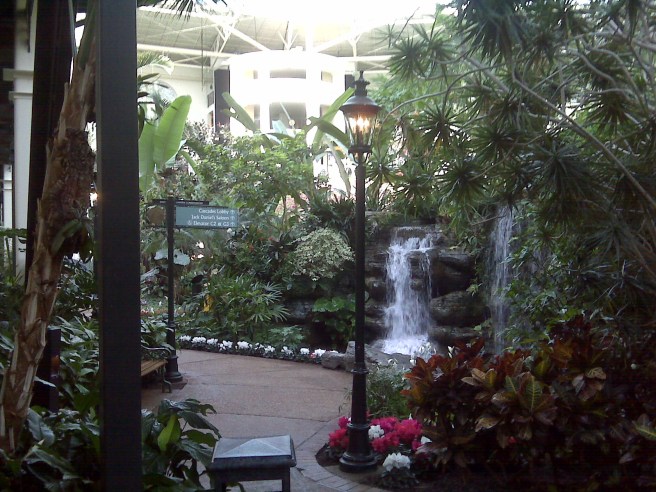
Opryland Hotel Gardens
Opryland Hotel Gardens, Nashville, TN

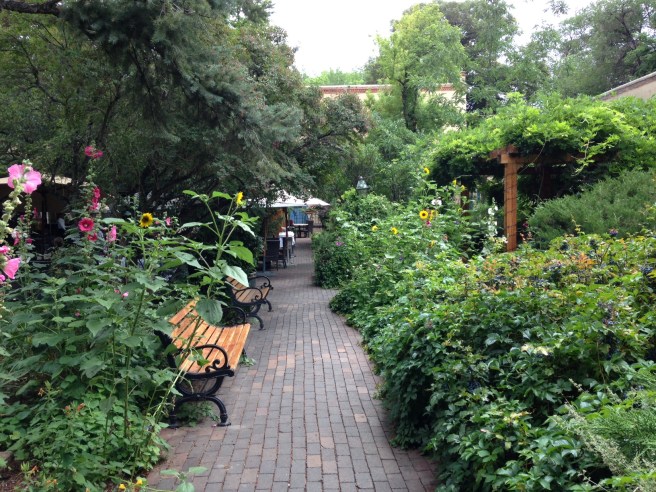
Sometimes gardens that are owned and maintained by private entities are still made available to the public at no charge. Hotels, office complexes, and shopping centers usually have, at bare minimum, some level of landscaping. Occasionally these establishments go far beyond the obligatory curb dressing to create extensive gardens and observatories, such as the Opryland Hotel in Nashville. In tourist towns, several retailers may collaborate to install and maintain plantings, beds, boxes, and pots to attract shoppers to their doors. These private gardens are not only accessible to the public but are specifically designed to attract people passing through the area. I have seen some beautiful examples of this type of garden in destinations such as Gatlinburg (Tennessee), Sedona (Arizona), St. Simons Island (Georgia), and Santa Fe (New Mexico).

Shopping courtyard garden
Garden at a shopping courtyard in Santa Fe, NM

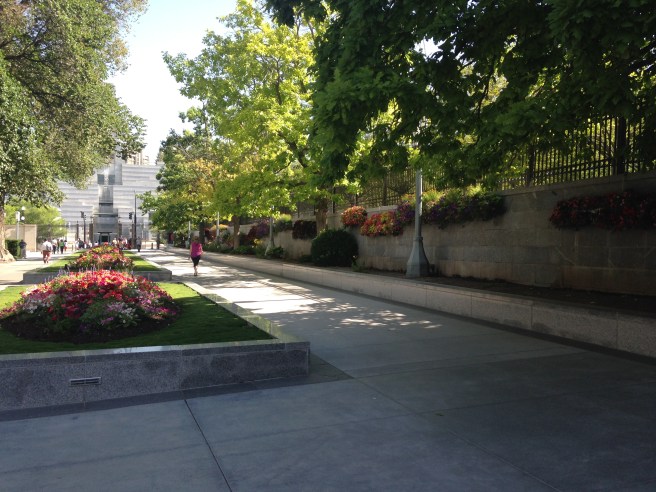
Places of worship are also a good source for gardens that can be enjoyed by everyone.  Usually maintained by a small band of devoted gardeners in the organization, these spaces welcome visitors and encourage them to take a few moments to be still, contemplate,  meditate, or pray. Some of these gardens are small and simple, but still lovely.  Others are huge and elaborate, attracting thousands of visitors each year. Some are not free and open to the general public, such as the Gardens of Vatican City, although guided tours are available. The Gardens at Temple Square of the LDS Church represent an over-the-top horticultural exhibit that is enjoyed by anyone who wants to pass through the church’s massive complex in Salt Lake City, Utah.

Temple Square Gardens
Gardens at Temple Square, LDS Church headquarters, Salt Lake City, UT

As an amateur gardener, I have a deep appreciation for the integration of beautiful plants into the built environment. Public gardens address a basic need that so many people have of staying connected to nature. They are also a haven for birds and other small wildlife that share real estate with humans. They filter the air, enrich it with oxygen, and lace it with their perfumes. They tantalize our eyes with various shades of green and a wide array of vibrant colors. Public gardens tempt us to pause, relax, and reflect. The familiar phrase of “stop and smell the roses” is a cliché for a reason.  It’s based on a fundamental human need to slow down and appreciate very simple pleasures.  Take the opportunity to do so the next time you pass a public garden.