Opportunity of a Lifetime

As I have indicated before, I began my career as a librarian in a medium-sized public library in a small county of around 42,000 people.  As is typical in small communities, there were plenty of personal interconnections.  When I graduated with an MA in History in 1985 from a state college in this same county, I started work shelving and cataloging books in the public library.  With the encouragement, patience, and generous assistance from the library director, I and another worker in the library commuted to Emory University twice a week for two years to complete our Masters degrees in Librarianship (MLn).  I served as a reference librarian for most of my fifteen years there, but when the director left during my twelfth year, I was offered the position.  I served as the library’s director for three years.

One morning, during the spring of my last year, the husband of our children’s librarian walked into my office to say he had a proposition for me.  His wife was serving in this position at the library before I began there.  Her husband was a local attorney.  I knew them both very well — we attended social events and my first wife and I had even house-sat for them and had taken care of their two children for a weekend.  As it happened, he was the lawyer for the estate of a major American writer, who also was (and still is) one of my favorite authors: Flannery O’Connor.  She had lived a good portion of her life in this town where her family had deep roots going back to the early 19th century.  She spent the last thirteen years of her life at the family’s farm, called Andalusia, located on the north end of town.

foc_eberhart_photo
Flannery O’Connor
His clients were two sisters who were also first cousins of O’Connor.  Flannery O’Connor died in 1964, but her mother, Regina, lived until 1995.  As executors of Regina O’Connor’s estate, these two women were also in charge of Flannery O’Connor’s literary estate, which was primarily administered through a trust that had been established by Regina O’Connor’s will.  As co-executors and co-trustees, one of their responsibilities was to establish a non-profit foundation to maintain Andalusia as a proper memorial to O’Connor and also to perpetuate her legacy as a writer.  They needed someone to help establish this organization.  They also needed someone to work with a sizable archive of personal papers, correspondence, writings, photographs, memorabilia, and artifacts belonging to Flannery O’Connor.  The archive needed to be organized, cataloged, and properly stored for preservation purposes.  The co-executors asked the lawyer to find someone who might be interested and capable of doing both of these tasks.  He came to my office in the library that spring day, explained the proposition from the estate, and asked me if I would consider taking the job as an independent consultant working for the co-executors.  I accepted, which changed almost everything for me.

I will no doubt dedicate several future posts recounting my experiences as a consultant and then later the director of the Flannery O’Connor-Andalusia Foundation that I assisted in establishing.  I was there for thirteen years — as long as Flannery O’Connor lived there.  That was long enough, or arguably, a bit too long.  While I can look back and think about plenty of mistakes I made and how I should have made different decisions, I don’t have any real regrets.  With a BA in English, an MA in History, and an MLn, I don’t think I could have been any better suited for the job with regard to my education and training.  I had the help of some talented and dedicated mentors, board members, volunteers, colleagues, and for a few years, a trusted co-worker and friend.  What I can state with absolute certainty is that this path that departed from my expected trajectory led me to some of the richest experiences I have ever had and offered me opportunities that other people with my education and training will, sadly, never enjoy.  I am humbly grateful, and hope that Flannery O’Connor would be pleased with the work we accomplished at Andalusia.

Macy’s in Bloom

Four years ago, my wife and I took my younger son and a girlfriend for a short trip to New York City for spring break.  Although my wife had been to the city before, for the rest of us it was the first time.  New York is iconic and so over the top.  I can’t imagine any first-time visitor not being impressed, or at least astounded.  Of course, we hit several of the top tourist sites, such as the Statue of Liberty and Times Square, but we also took in the major stores on Madison Avenue and Fifth Avenue.  We even made a few small purchases just for the bragging rights.

Oddly enough, the most beautiful and stunning site I saw on the trip was not one of the traditional NYC landmarks but was inside Macy’s Department Store.  The Flower Show, with its elaborate gardens and beautiful arrangements, has been a Macy’s spring tradition for the past 41 years.  Every available space was like an oasis of color and foliage.  Plants were all arranged on the tops of display cases, tucked into shelves, and scattered on counters throughout the entire store.  Corners were transformed into mini gardens.  There were exotic plants from around the world, and Macy’s brings in some of the top arrangers to put it all together.  It is a spectacular event that I highly recommend.

Macys flowers
Macy’s Flower Show, 2011

As I was wandering around from one department to the next, I kept imagining how much work it would take to pull off something like this show.  The set up must go on for days, and the clean up afterwards has to be a nightmare.  Macy’s has a special page on their website devoted to the annual event, which includes a fascinating time-lapse video of the installation of the show.  It’s truly amazing to watch.

The Poet’s Journey

I was talking with a friend of mine yesterday who is an award-winning poet with several collections published by a prestigious academic press.  She talks frequently about being depressed and frustrated as a writer, so I finally asked her about the source of the frustration.  Her reply was very intriguing.  She said her frustration comes from knowing that her words never get her quite to the place deep inside herself that she wants to find, explore, and reveal.  She gets close, but never has a sense of fulfillment.  The depression comes from the fear that she never will get there.

Perhaps her work is actually so good (and it is) because she is on a quest for something that will continue to elude her for the rest of her life, and she is not a young woman.  I am not suggesting that she is fighting the proverbial windmills, but I do think she is on a magnificent journey without necessarily knowing the intended destination.  Maybe that is, and always has been, the case with all good artists — the final destination is determined not by the traveler, but by the observers of the voyage after it is over.

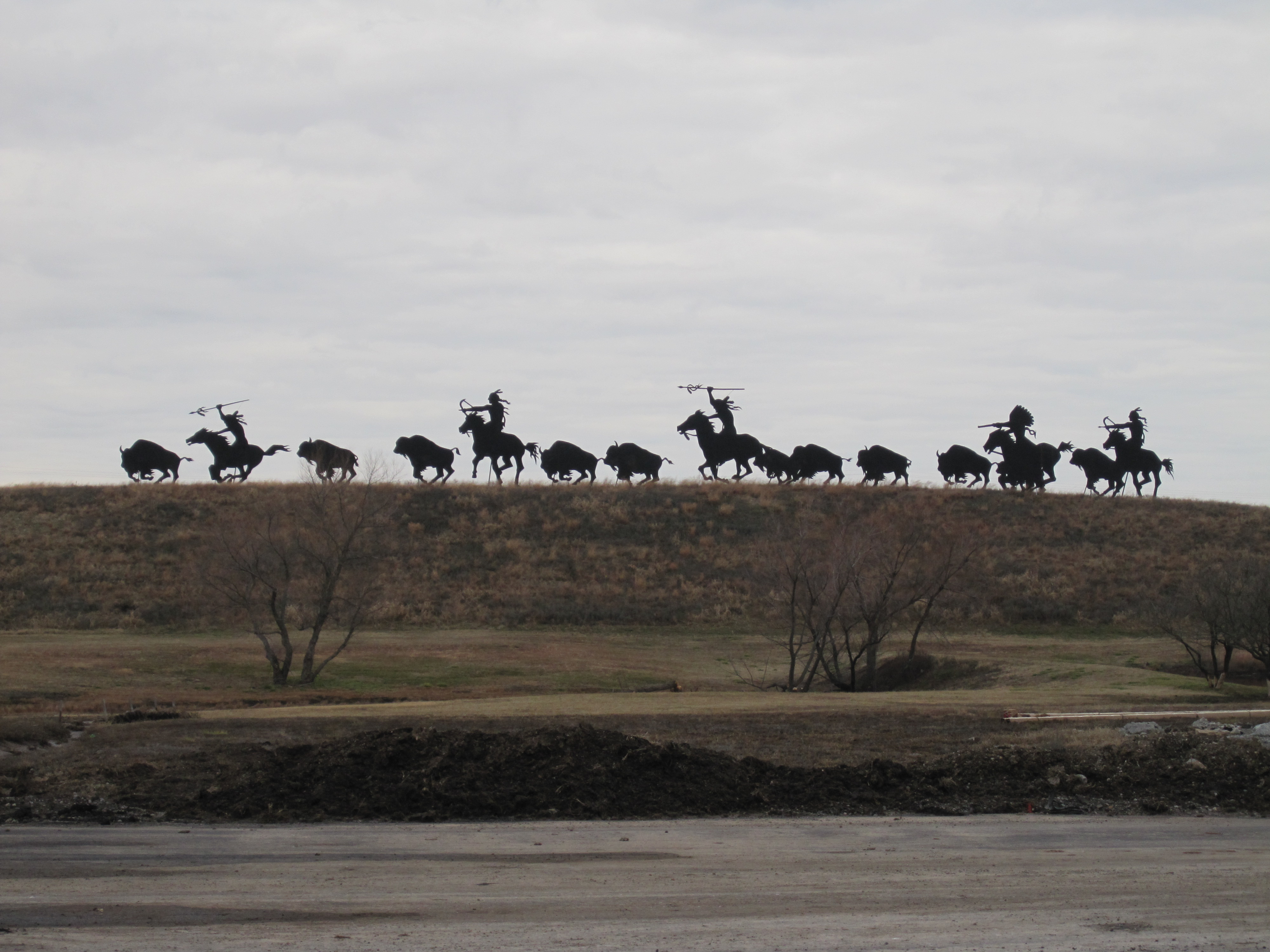
Otoe-Missouria Buffalo Hunt in Silhouette

Buffalo Hunt Silhouette

This metal sculpture is on a hillside behind one of the new casinos in northern Oklahoma, just south of Arkansas City, Kansas.   The Otoe-Missouria Tribe was encountered by Lewis & Clark on their epic expedition of 1804, when the inhabitants were still living in their Nebraska tribal home.  So the story goes, the tribe was on a buffalo hunt, making Lewis & Clark wait on them to return to their village.  There are statues in front of the casino commemorating that “First Council” meeting.  The metal outdoor artwork obviously recalls the hunt.

I find the sculpture particularly striking because it produces a silhouette effect regardless of the outdoor lighting.  On an overcast day, like the one when I took this photo, the effect is quite pronounced.  The individual pieces are large, and in a photograph, you can almost be convinced that they are real.  I gasped when I first saw it and wondered why it was visible only from the back parking lot of the casino.  I think it is magnificent.  I hope that this fine display of art is not offensive to Native Americans, especially those in this particular area near the northern border of Oklahoma.  I hope it is considered a tribute to a culture and way of life now buried deeply in our country’s past, with all its beauty and its scars.

Defining Art

Yes, I realize the title of this post is about as vague as it gets.  Nevertheless, how we define what is, and isn’t, art as a worldwide culture is something that puzzles me.  In America at least, so many of us seem to have no real criteria by which to judge if a work can be considered art — no standard.  I understand how subjective the appreciation of art is, and I suspect survival from generation to generation has played a major role in determining what has been defined as art throughout human history.  In my lifetime, Americans have become less and less prescribed in their definition of art, and to my way of thinking, this is an unfortunate trend.  We tend to use the terms “art” and “artist” to describe almost any form of creativity.  I am the first to admit that I don’t have a true appreciation for a great deal of modern art, which includes painting, sculpture, poetry, and a few other mediums.  Okay, those are perhaps my own shortcomings and limitations due to a lack of education or sensibility.  


What I’m referring to here, though, is how modern culture seems to lump all creativity into one huge basket, with very little discernment or discrimination.  We use the term “artist” so loosely.  We consider Leonardo da Vinci to be an artist, but we also use the same word to describe Thomas Kinkade.  Most people would recognize Beethoven as an artist, but we hear the same word used to describe Taylor Swift.  Really?  What happened to words like “entertainer?”  I play the guitar a little, the piano a bit more, and I sing well enough that people have paid me to do so at weddings, funerals, parties, etc.  I have even written a handful of songs that I think are pretty good.  Am I an artist?  I would be embarrassed if someone referred to me that way or called my creations art.  I am an amateur musician, singer, and composer.  There are plenty of people who have made a very good living doing the same thing, only a whole lot better than I do.  Are they artists?  Well, not in my mind.  I would call them professionals, and that goes for many of my musical idols.

I am not advocating that, as a culture, we have to have some kind of hard and fast rule to define art and identify artists.  But I would like to see a little more differentiation to show respect to those among us who have exceptional gifts of creativity — timeless, perhaps.  I suppose we all know that Michelangelo is actually a great artist or even a master, and that his work is not comparable to the images of Elvis we see painted on velvet canvases for sale at roadside stands.  Or do we?