They started appearing on our television during the first hour of prime time, usually beginning in early December and lasting until a few days before Christmas. They were advertised heavily because they were only aired once a year. They were typically thirty minutes long, but a few stretched out for an hour. Some were fully animated in the Disneyesque style, but the oldest one was actually a puppet based production using a technic called stop motion animation. These timeless Christmas specials, broadcast every year during my formative years in the 1960s, were as important in heralding in the holiday season as the Macy’s Thanksgiving Day Parade and the Norelco commercial featuring Santa completely airborne before sliding into a village on an electric shaver. Some of my earliest Christmas memories involve making sure my homework and chores were all finished by 8:00 p.m. so I could plop on the floor in front of a television the size of a modern compact car to watch these simple but wonderful programs, in living color, no less.
“Rudolph the Red-Nosed Reindeer” was probably my favorite television Christmas special and happens to be the longest running of its kind in history, dating back to 1964. It was a groundbreaking production, introducing the stop motion animation mentioned earlier and the use of a recently invented LED light bulb capable of emitting visible red light, Rudolph’s incredible nose, of course. Sponsored by General Electric, the show was the brainchild of filmmaker Arthur Rankin, Jr., who went on to produce several other classic Christmas specials. With a cast of characters including Rudolph, Hermey, Yukon Cornelius, Bumble (the Abominable Snowman), and Santa Claus, the show came to life at the hands of Tadahito Mochinaga, a Japanese filmmaker inspired by Disney’s Mickey Mouse who invented the special type of animation used in the program. I can still remember feeling so sorry for the misfits of this story, from Rudolph and the dysfunctional unwanted toys to the poor elf whose dream was to become a dentist. Critics have argued that the story and the song written by Robert May and Johnny Marks on which the show is based are plagued by troubling ethical issues, but that was not my interpretation at all. I thought “Rudolph the Red-Nosed Reindeer” was a delightful morality tale about diversity, inclusion, and empathy. God knows we could use a little more of all of that these days.
“Rudolph the Red-Nosed Reindeer”
A close second Christmas special for me was the 1966 fully animated “How the Grinch Stole Christmas,” based on the children’s book with the same title by Dr. Seuss. Featuring the unmistakable voice of Boris Karloff as the Grinch, this is another one of those classics that is still running each season on network television. Like most of these television specials, this book and show were designed to teach children of all ages an important lesson: the joy of Christmas doesn’t come from material things but from community and love for one another. I certainly received that message as a child, but what I remember most about the show was the incredibly creative and hilarious song, “You’re a Mean One, Mr. Grinch,” with lyrics by Dr. Seuss, musical composition by Albert Hague, and performance by Thurl Ravenscroft, best known for the voice of Kellogg’s Frosted Flakes hero, Tony the Tiger – “They’re GREAT!” Every year in early December on Facebook, I post a few lines from this memorable song to help usher in the Christmas season for my Friends.
“How the Grinch Stole Christmas” (photo credit: Common Media)
Third in line is another fully animated production by Arthur Rankin, Jr. “Frosty the Snowman” first aired in 1969 and has been a Christmas standard every year since. It features the recognizable narrative voice of Jimmy Durante and was his final film role. It also includes the unique voices of Billy De Wolfe as the selfish Professor Hinkle and comic actor Jackie Vernon as Frosty. One point of trivia about the animation is the fact that the narrator’s and Hinkle’s characters were drawn to look like their real-life counterpart actors. Once again, here is another Christmas special adapted from a song, which was written by Jack Rollins and Steve Nelson and first recorded by Gene Autry and the Cass County Boys in 1950 and later recorded by Jimmy Durante that same year. By the end of the show, we all know that greediness doesn’t pay and that there is a certain magic associated with Christmastime.
“Frosty the Snowman” (Photo credit: TV Guide)
My final favorite is likely at the top of many viewers’ lists and is perhaps quoted more than all the others combined. The fully animated 1965 production of “A Charlie Brown Christmas” features all the most familiar characters from the imagination of Charles Schulz and his long-running Peanuts comic strip. In addition to its memorable lines and scenes, the special also includes a very fine soundtrack by American jazz pianist Vince Guaraldi. The show received both Emmy and Peabody awards and is firmly implanted in holiday memories of millions of Americans. After all, who hasn’t looked at a pathetic Christmas tree and dubbed it a “Charlie Brown tree?” Like the lesson the Grinch learned, the Peanuts kids teach us that the true meaning of Christmas is about love, respect, and friendship.
“A Charlie Brown Christmas” (Photo credit: Wikipedia)
To celebrate my 65th birthday this year, which included qualifying for Medicare (woo hoo!), my wife and I took a short trip to the charming town of Hermann, Missouri. We spent two nights and the better part of two days exploring this tourist “dorf” located on the south bank of the Missouri River, a place that is influenced by its German heritage in food, drink, architecture, place names, and to some extent, culture. Founded as a colony in 1836 by the German Settlement Society of Philadelphia, Hermann was named for a northern European Germanic warrior who led an army in 9 CE to oppose the intrusion of three Roman legions into their homeland at the Battle of the Teutoburg Forest. By 1849, the village had established a German newspaper and a German school. Hermann became a river shipping point where viticulture and wineries flourished, which is still an important part of the town’s economy today.
Hermann, Missouri
Based on a friend’s recommendation, we booked a room at Hermann Hill Vineyard Inn and Spa. This lovely boutique hotel has eight guest rooms overlooking a small vineyard with magnificent views of the valley below where the main part of the town is situated. From our corner room we could even see a small portion of the Missouri River in the distance. The service and amenities at Hermann Hill are amazing. We were treated with wine, bread, cheese, and grapes in our room upon arrival after a brief tour of the facility. The inn has a spa (we didn’t take advantage of that service), a small gift shop, a cozy sitting area, a dining room, a kitchen with free snacks and drinks for guests, and outside spaces with grills, tables, and chairs. There are frozen margarita machines in the kitchen!
Hermann Hill Vineyard Inn and Spa
We stayed in one of the nicest rooms the inn offers, on the top floor with a small balcony. Our room had a gas fireplace, small glass table with two swivel chairs, a desk and chair, a spacious closet, a comfy king-size bed with soft sheets (we bought a set down in the gift shop), and a spacious bathroom with a spa tub and a steamer shower. A staff member brings ice cream and cookies to all the rooms in the evening around 8:00 p.m.
We were required to order breakfast ahead of our arrival, which we only took advantage of the first morning we were there. A staff member brought coffee and tea to our room at 7:45 that morning, and then we were served a full breakfast at 9:00 in the downstairs dining room, which we had to ourselves on a Monday. Other guests were eating on the outside deck. Hermann Hill exceeded our expectations, and before checking out the next morning, we booked a room for October 2026, when we hope to see fall color and enjoy cooler temperatures.
Hermann, Missouri
For the 45 hours we spent in Hermann, we essentially scouted the town for a quick getaway but also to determine if we wanted to return sometime in the future. Our first stop was Sunday lunch and a wine tasting at Stone Hill Winery, located toward the south end of town. We were impressed enough with a couple of the wines to buy a bottle of each and a few other fun items in the winery gift shop. In the early afternoon, we strolled around the downtown area shops and restaurants and took a walk through a park on the banks of the river. The weather was incredibly pleasant that day for early August.
Missouri River at Hermann, Missouri
We checked into our room at Hermann Hill around 3:00. Once we discovered there was pizza, drinks, and snacks in the kitchen and that we were going to be served dessert later, we decided to just hang out on the property for the rest of the evening. The view from our room made us feel like we were gazing out at a European village, especially as the sun went down and the lights from the valley began to appear. It was enchanting. My wife and I are perhaps more content than some travelers to spend time relaxing in hotels wherever we go, especially if we have a room with a view. I can spend hours reading on a balcony or at a window.
Hermann, Missouri
After breakfast the next morning, we headed back downtown to check out some of the shops while getting some good walking exercise. Later we had lunch before visiting the Black Shire Distillery tasting room. Out on a shaded patio, we sampled several different varieties of gin, bourbon, and blended whiskey. Some of them were quite good. We bought a bottle of gin to take home. We drove around a bit and spent more time back at the hotel before returning later for an early dinner at a downtown deli. We needed to get back home by around noon the next day, so we rose early, checked out of our room, and made a quick stop at a coffee shop for caffeine and some of the best scones I have ever tasted. Then we took the bridge and crossed “the wide Missouri,” to make our way back home. We look forward to returning next year.
“It’s not going to be as bad as you think.” A close friend said this to me shortly after Donald J. Trump was elected for a second term as President of the United States in November 2024. I wanted to believe him. I wanted to believe that the storming of the U.S. Capitol by a mob of the President’s devoted supporters on January 6, 2021, was in the final analysis a step too far even for someone as desperate for a second consecutive term as Trump apparently was. After all, he finally told them to stand down and go home, right?
I should have known better. Even though he had previously stated that he would look at presidential pardons on a case-by-case basis, on his first day back in office in 2025 he granted a full and unconditional pardon to 1500 individuals convicted of offenses related to events at or near the Capitol on that dark day. He also commuted the sentences of 14 criminals, including prominent members of radical groups like the Oath Keepers and Proud Boys, who were convicted of seditious conspiracy. In spite of my friend’s reassurance, it was going to be worse than I thought.
Before going further, I must admit that I am disappointed in the leadership of the Democratic Party, who are as much responsible as anyone for the return of Trump to the White House. Joe Biden’s cognitive decline during his term must have been obvious to plenty of people: his cabinet, his advisors, VP Harris, his good friends in Congress, and the party executives and strategists. He probably couldn’t admit it to himself, and his family would have had a difficult time convincing him to surrender the remainder of his term to Kamala Harris or even to announce early in his presidency that he would not seek a second term.
Everyone waited to change course until after Biden’s dismal and embarrassing performance in the debates with Trump. There was no choice but to seek another Democratic candidate for the White House. It was much too late in the game, and it was abundantly clear that the party rapidly pushed through the nomination of Kamala Harris to oppose Donald Trump in the 2024 election. And while she only lost by less than 2% of the popular vote, Trump swept the Electoral College, an outdated and unrepresentative system for electing the highest office in the country. States are political entities, not people. Our presidents don’t answer to our governors. States shouldn’t select our President – individual voters should. Alas, this is a topic for another post sometime, maybe.
From day one in office for his second term, Trump’s top priority was to surround himself with people who would be loyal first and foremost to him personally. A major test of that loyalty was an admission or declaration that the 2020 election was stolen and that he should have returned then for a second term. Furthermore, his appointees were all expected to support his decisions without question, even if those decisions and subsequent actions might violate existing laws, longstanding precedents, or even the U.S. Constitution. He has even extended his demands for allegiance to Republican members of Congress, threatening to replace them in future elections with candidates more in line with his administration.
From the rhetoric he spouts on social media and to the Press, Trump has repeatedly communicated his belief that any restriction on his authority as the President is illegitimate. He does not accept the concepts of Balance of Power or Checks and Balances that are firmly embedded in our representative style of government. Apparently, he is convinced that his authority is superior to both the legislative and judicial branches of the federal government. Sadly, some members of Congress and perhaps even some of our judges agree with him, along with plenty of American citizens.
Many of the people who voted for Trump believe our Republic form of government has failed them, and as a result, they are willing to grant Trump carte blanche, even at the risk of ushering in authoritarianism. They see the federal government as inefficient, ineffective, and oppressive. Trump has promised he can fix it, but only if the American people let him have complete control of the country. They truly believe that he will “Make America Great Again,” in whatever ways they define “great.”
Right-wing media have convinced a lot of people that undocumented immigrants from south of the border are a threat to national security. With his reptilian intelligence, Trump played on those fears and has placed purging the country of these “outsiders” at the top of his agenda. Illegal immigration has gone from being a problem to be addressed by the whole nation to a perceived crisis that only Trump is willing to face by defending our borders and saving our country from invasion. Trump and his sympathetic media outlets have essentially demonized millions of people living and working in the United States, turning them into enemies of the state. This is a move that comes right out of the fascist playbook, one that the Nazis used to great advantage against the Jews in their takeover of Germany.
I have grown so weary of the pseudo patriotism I see swelling across the country, with its flag waving nationalists (mostly white) whose entire proclamation of American idealism is encapsulated in a tired, worn-out country song by Lee Greenwood that includes the line, “Where at least I know I’m free,” as if the United States is the only free nation on the planet. Precious few of the proud folks who sing along have ever or will ever “stand up” and truly defend the country and the principles upon which it was founded. They either forgot them, never knew them, or have abandoned them altogether for ones they find more suitable for their vision of the future. Oh, they certainly understand the phrase “America First,” because they know what Trump really means is “America Only.” It reeks of selfishness, greed, arrogance, vanity, and narcissism – the very characteristics embodied by their chosen leader.
Call it a return to the “good old days.” Call it a revival of “Christian values.” Call it standing up for “the people.” Call it anything you want, but it looks and sounds a whole lot like fascism to me. Evil rarely manifests itself as ugly or frightening. It comes cloaked in righteousness. It wears the most attractive clothes. It says what you want to hear. It promises security and makes you feel comfortable. It delineates between Us and Them. It tricks you into believing you have been mistreated. It understands how you feel. It seeps in almost imperceptibly, as if it doesn’t really exist at all. Even now, it is slouching towards America to be born.
I have written about gardens several times in this blog. They are among my most favorite places in the world. I love them in all their many forms: small residential gardens, larger private ones, arboretums, botanical gardens, public gardens, and those you find at houses of worship, city parks, river walks, and even businesses. They brighten up any space with texture, structure, color, and incredible beauty. They are places of refuge and contemplation. There are so many features to enjoy, including ponds, streams, waterfalls, varying terrain, rocks, boulders, statuary, fountains, and other built structures. Whenever my wife and I travel, we almost always look for gardens to visit or revisit.
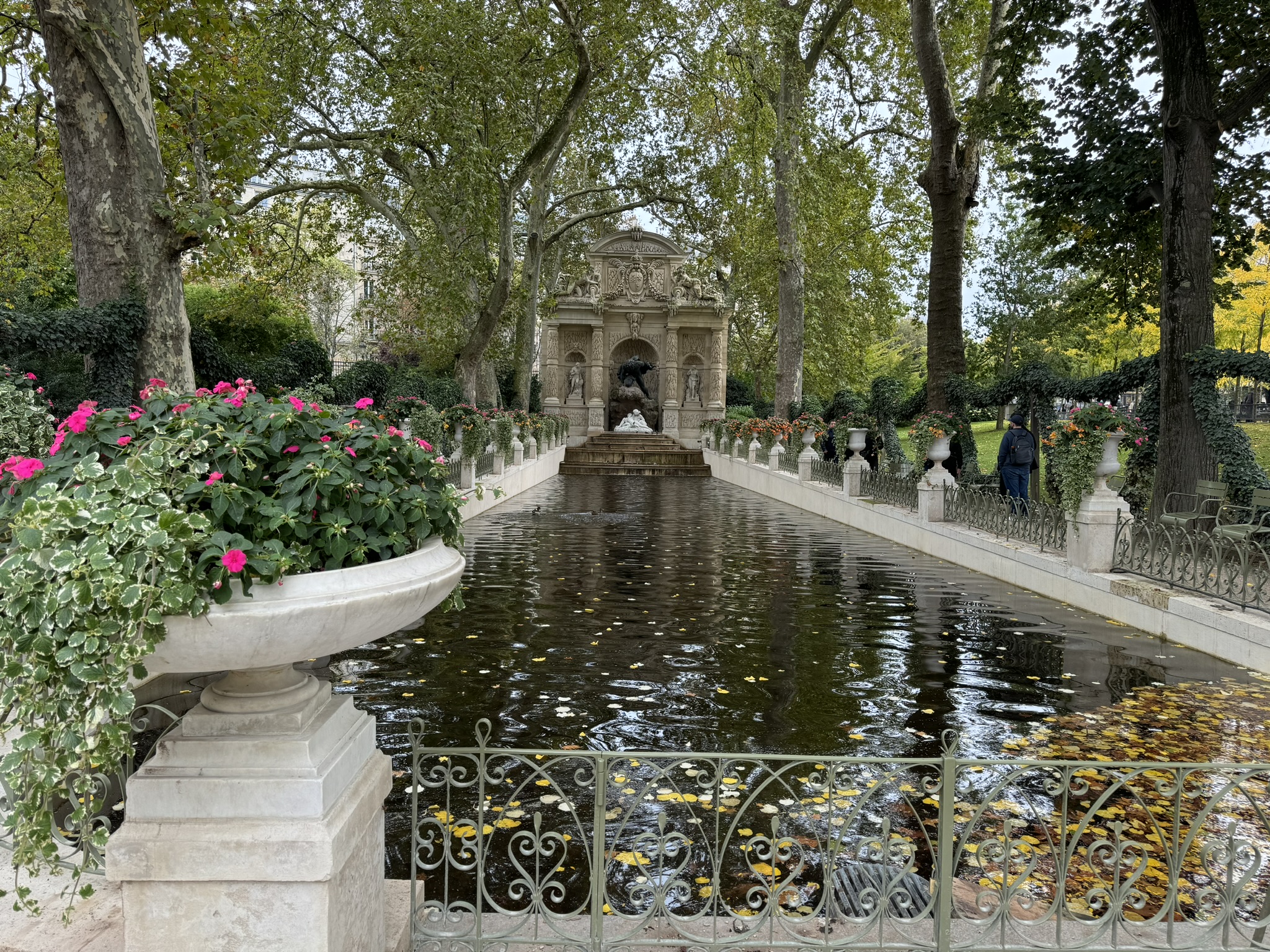
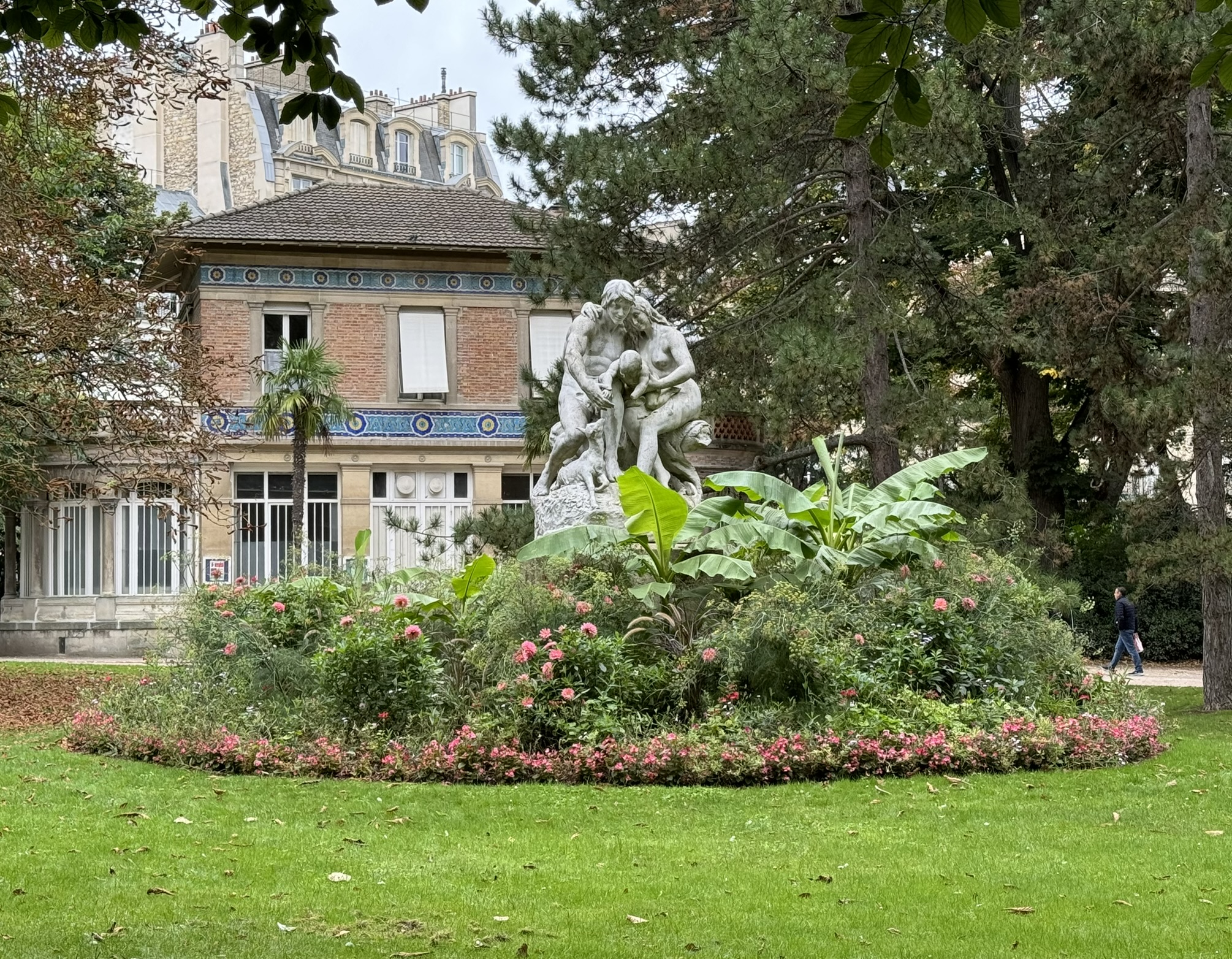
In September 2024, we took a two-week trip to Paris and various locations in Switzerland. On our last day in Paris, we spent the better part of the morning wandering around one of the most spectacular spots in the city, Luxembourg Garden. Located in the 6th arrondissement in an artsy part of the city, the Jardin du Luxembourg comprises 25 hectares (56.8 acres) adjacent to the grand building that houses the French Senate, thus its more familiar name for Parisians, Jardin du Sénat. The Luxembourg Garden comprises formal English gardens, 3,000 trees of various species, 5,000 square meters of flower beds, an orchard containing more than 500 old varieties of pear and apple trees, a collection of exceptional orchids, and 102 statues and monuments, including the famous Médicis fountain.
French Senate building at Luxembourg Garden
The garden’s origins date back to the 17th century when Marie de Médicis, the widow of Henry IV, built an Italian palace on property once owned by François, Duke of Piney-Luxembourg. The French Senate took over ownership of the garden in the early 1800s after the palace became the home of the governing body in 1799. It wasn’t until the last half of the 19th century with the restoration projects in Paris under Napolean III that the garden began to take its more modern shape. Luxembourg Garden has appeared in numerous works of literature by authors such as Victor Hugo, Henry James, and William Faulkner.
Médicis fountain at Luxembourg Garden
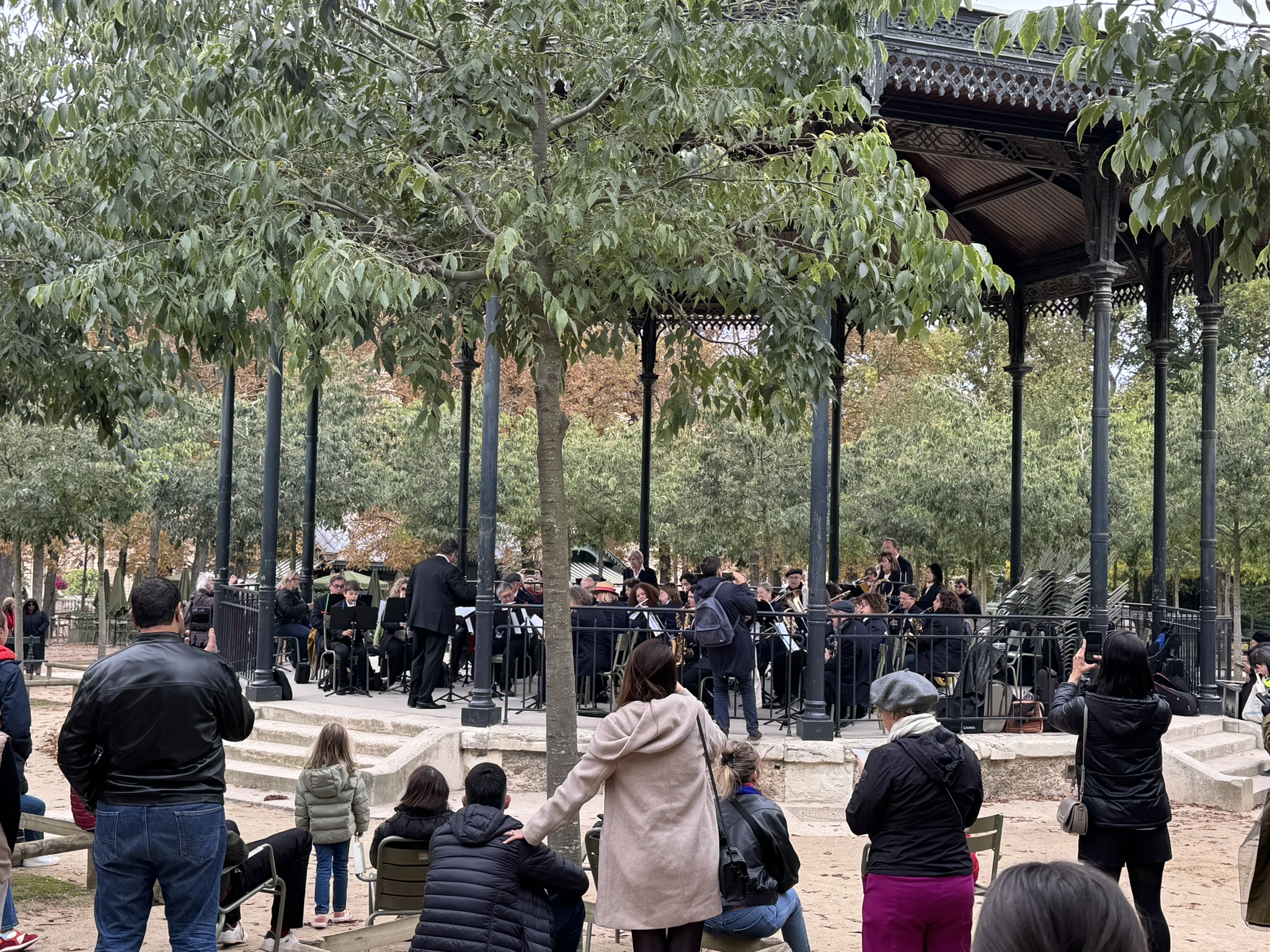
As we entered the garden that Sunday morning at the Porte Gay-Lussac, we were greeted by the sounds of music coming from what appeared to be a small community orchestra at the nearby Kiosque à musique. We made our way counterclockwise to the Médicis fountain and then past the Senate building, protected by a high metal fence and guards with firearms. We continued around the perimeter of the garden, making side trips into the interior from time to time. Before leaving, we spent a few moments near the Grand Bassin, a large octagonal basin of water surrounded by raised balustraded terraces adorned with a series of statues of former French queens, saints, and other historical figures.
Orchestra at Luxembourg GardenLuxembourg Garden
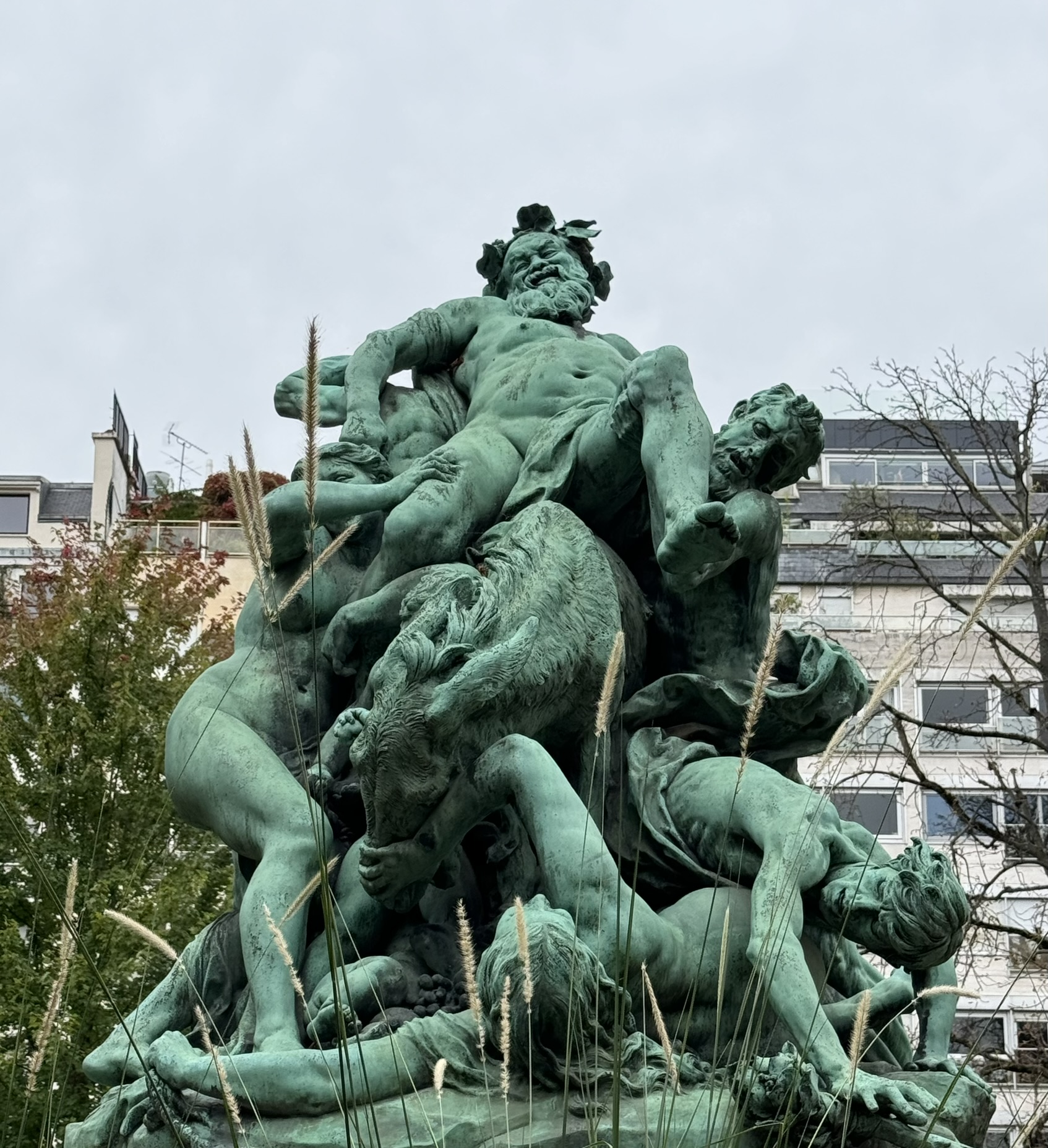
What impressed me most about this garden is how brilliantly the built environment blends with and enhances the horticultural surroundings. Walkways wind through trees, hedges, shrubs, lawns, and planted beds, encouraging us to meander and gaze. Statues, sculpture, and other features are spaced out and in the open or tucked neatly into nooks and crannies, inviting us to explore and pause to appreciate and learn. Luxembourg Garden is truly an oasis we can enjoy simply for its beauty and design. However, it’s also an outdoor classroom for aspiring students of all ages who wish to be schooled in botany, art, architecture, history, and so much more.
Bacchus (Dionysus) statue at Luxembourg GardenLuxembourg GardenGrand Bassin at Luxembourg Garden
I have known for years about the importance of Sylvia Beach’s little American bookstore in Paris called Shakespeare and Company. Her membership-supported enterprise was so much more than just a book shop. It served as a refuge and haven for some of the most gifted expatriates and writers of the early 20th century, including Ernest Hemingway, F. Scott and Zelda Fitzgerald, Ezra Pound, T. S. Eliot, and most especially James Joyce. Until I read her memoir (with the same title as her store) early in 2024, I had no idea that she was the first publisher of Joyce’s monumental novel, Ulysses. She really was a remarkable human being, one who made great sacrifices to support an amazing and historical intellectual community. She even risked her own life during the Nazi occupation of Paris by refusing to compromise her standards or cater to the monstrous regime that swept across Europe before and during World War II.
In addition to presenting valuable historical information about her store and its many patrons in her 1959 book, Beach shares some side-splitting anecdotes about her customers, friends, and acquaintances. Some of her own experiences at and away from the store are just hilarious. I laughed myself silly at her account of the performance of the Ballet Mecanique at the Theatre des Champs Elysees (1925), which included the use of plane propellers generating such a strong wind current that it “blew the wig off the head of a man . . . and whisked it all the way to the back of the house.”
James Joyce was clearly Beach’s most favored member, client, and dear friend. She turned out to be his most valued benefactor. As such, readers of her memoir learn more about the Irish novelist, poet, and literary critic than any other person she encountered. She offers insights into his personality, quirkiness, brilliance, innovation, and talent, as well as his tragic flaws and his greatest fears. He was deathly afraid of dogs, and Beach includes a story about an occasion when Joyce was the object of a rather large dog’s affection at a luncheon. Observing Joyce’s fearful reaction, the woman who owned the dog had it removed and told the guests that the canine had once chased a plumber out the window and that she had to buy the man a new pair of trousers. Joyce shuddered and whispered to Sylvia Beach, “She’s going to have to do the same thing for me.” Again, I laughed myself to tears.
The address of her bookstore was 12 Rue de l’Odeon in the 6th arrondissement on the Left Bank. She was forced to close the store in 1941 because of the Nazi occupation of France during WWII, but she continued to live in her upstairs apartment, surrounded by her treasured book collection. Sylvia Beach died in 1962. Over the decades since her death, the first-floor location of the bookstore has been the home of various retail establishments. There is currently a Shakespeare and Company bookstore in Paris inspired by Beach’s store, but it is not at the original address. Even when my wife and I were in Paris in 2016, I decided it would not be worth our time to locate the original address since it was no longer a bookstore.
Original location of Shakespeare and Company Bookstore in Paris
Fast forward to September 2024 when we were back in Paris again. Something almost miraculous happened to us on our last full day in the city. We visited the Luxembourg Garden and then strolled over to a nearby restaurant for lunch called the Le Hibou. We weren’t even paying attention to where we were walking after lunch, but we passed by a small clothing shop, Moicani, with some beautiful scarfs and decided to go in for a look. Jean Helfer, the affable proprietor, asked where we were from, and I said, “The States, in Missouri.” He replied in an almost reverential tone, “Do you know where you are standing right now?”
Original location of Shakespeare and Company Bookstore in Paris
He pointed to a photograph of Sylvia Beach with Ernest Hemingway, in the very place I was standing! Totally by accident, we had stumbled on to the location of the original Shakespeare and Company bookstore. He handed me a brochure he has created giving a brief history of the bookstore, along with other addresses on the street of famous historical figures such as Gustave Flaubert and Thomas Paine. He was so gracious and kind. I was almost speechless the whole time we were in his shop.
What an incredible way to end our wonderful vacation in France. And yes, my wife bought a beautiful scarf!
My wife and I took a brief trip to Cleveland, Ohio in August, 2024. We had hoped to do so in 2020 while my wife was working temporarily in Fort Wayne, Indiana, when I could fly in, and we could then drive over to Cleveland. But the world shut down when COVID struck. We both love rock music, and as an amateur rock and pop musician, I was interested in visiting one of the top destinations the city has to offer: the Rock & Roll Hall of Fame. However, we both agreed that we would need more than a single objective to justify flying from our home in Springfield, Missouri, through O’Hare airport in Chicago, and then on to Cleveland. We found one. We discovered that one of our favorite bands, Hootie and the Blowfish, was touring in 2024 and that Cleveland was one of their stops. They were going to be playing at the magnificent Blossom Music Center in Cuyahoga Falls, Ohio, about 20 minutes south of Cleveland. We had a twofer and were good to go!
Neither one of us knew much about Cleveland and didn’t have high expectations beyond what we planned to do while in the city. We were pleasantly surprised. Situated on the southwestern shore of Lake Erie, Cleveland is taking advantage of tourism with great parks and beaches right on the water. The views are breathtaking. With a scenic skyline, good hotels and restaurants, stadiums, arenas, and several major attractions, Cleveland really is a place to explore. The city claims to be the birthplace of Rock & Roll music, primarily because radio station WJW disc jockey Alan Freed coined the phrase “Rock & Roll” to describe the upbeat black rhythm and blues music he was playing in 1951. Of course, the Rock & Roll Hall of Fame was ground zero for us, and it also exceeded our expectations.
Rock & Roll Hall of Fame, Cleveland, OH
The building is a modern structure with a huge glass atrium at the entrance. It has six levels beginning on the entrance floor, but the tour starts one level below with the Ahmet Ertegun Main Exhibit Hall, which carries visitors from rock’s earliest stars to those newly emerging contemporary musicians. There are thousands of items on display, along with feature films, videos, interactive kiosks, reading material, and plenty of music. This exhibit has the museums largest displays devoted to single artists, bands, subgenres, and movements of Rock & Roll history and the industry: Revolutionary Women in History, Hip Hop, Roots of Rock, Pioneers of Rock, Sun Records, Cities & Sounds, the music of Cleveland and the Midwest, and so much more.
Rock & Roll Hall of Fame, Cleveland, OH
Level 1 has a ticket booth, a café, large museum store, and the Klipsch Stage where performances are scheduled throughout the year. Level 2 is called “The Garage” where visitors can sign up to play various instruments with or without a house band in a setting that looks very much like a real garage. I played an electric guitar (something I never do) and sang “Midnight Rider” by the Allman Brothers Band with the help of a house drummer and a bass player, who also sang harmony with me. Although it wasn’t my best performance of that song, it was still fun to play in such an iconic venue. This level also has a large collection of different types of instruments and sound booths for visitors to jam on their own. The Les Paul exhibit is on this floor too, paying homage to the American jazz, country, and blues guitarist, songwriter, luthier, and inventor. He was one of the pioneers of the solid-body electric guitar, and his prototype served as inspiration for the Gibson Les Paul guitar.
Level 3 is focused almost completely on the Hall of Fame inductees, with the Inductee Signature Gallery, New Inductee exhibit, and the Connor Theater featuring the Power of Rock Experience. Visitors can look through alphabetic lists of inductees and a large chronological display of the all the inductees going back to the Hall of Fame’s inception in 1986. This floor also has the New Inductee and the In Memoriam exhibits. The Connor Theater is on this floor, where visitors can watch a 15-minutes video highlighting the Hall of Fame induction nights from the past.
Level 4 features the Pink Floyd tour replica of The Wall, designed to mirror the Berlin performance in July 21, 1990. This level is also the location of the Foster Theater, which is used for onsite education programs or private rentals. The theater has hosted hundreds of rock star talks and legendary rock films over the years. Level 5, along with some of the ramps in the museum, has individual display cases devoted to the legends of Rock & Roll, from the Bee Gees and the Doobie Brothers to Public Enemy to Tom Petty.
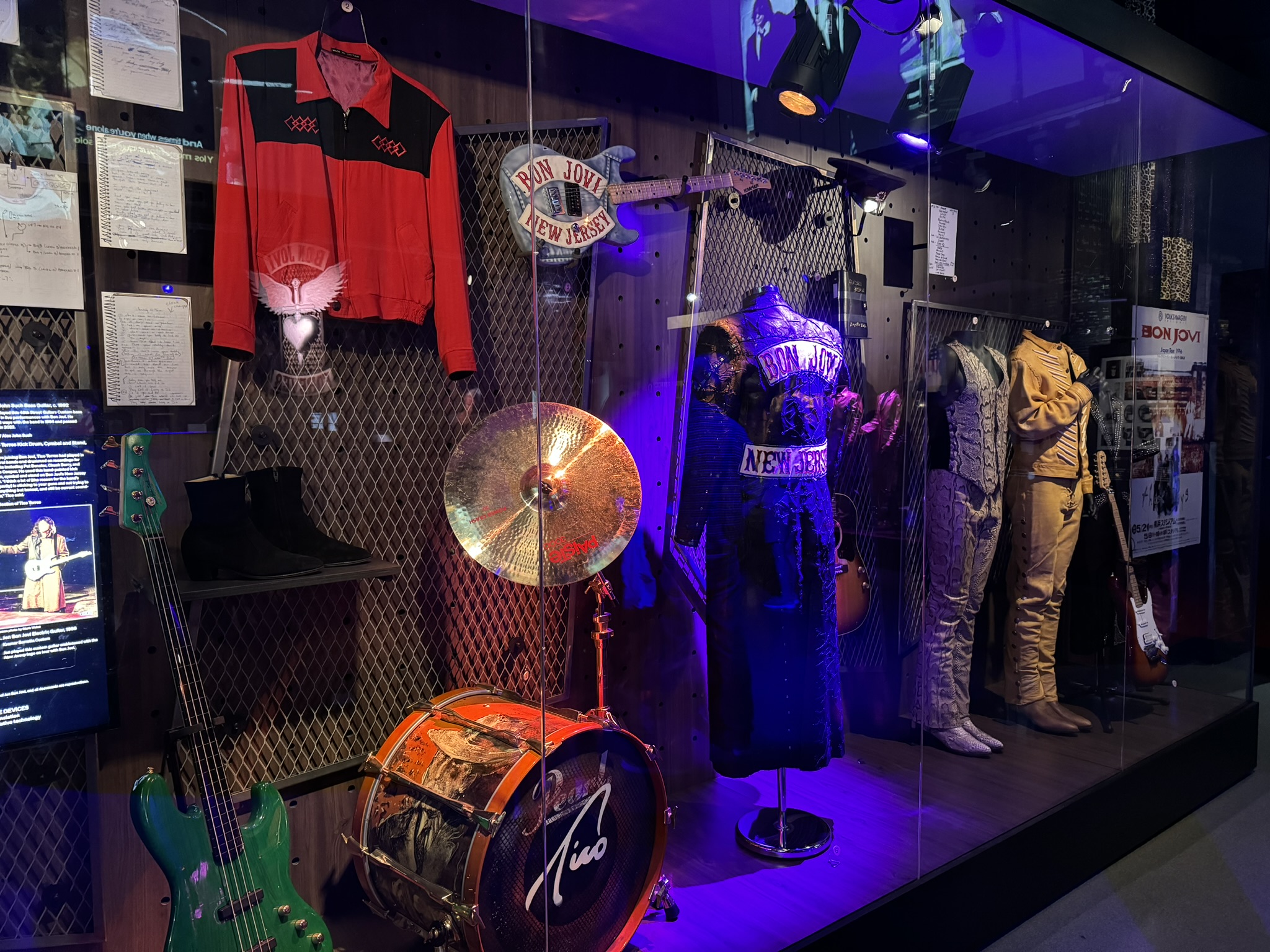
Level 6 is devoted to an exclusive exhibit that Bon Jovi unveiled with the museum in 2018. This full-floor showcase spans four decades of the band’s career along with never-before-seen artifacts from each of the band members. Visitors are immersed in the band’s story and music from inception to the present. Huge video presentations are joined by text panels and display cases filled with musical instruments, clothing, and loads of memorabilia from the band.
Rock & Roll Hall of Fame, Cleveland, OH
Organizations like the Rock & Roll Hall of Fame that establish themselves as authorities of a particular subject area all have one thing in common. They always stir up controversy, mostly about who or what is included, but more contentiously, excluded from their lists. This museum obviously recognizes this dilemma and even seeks to address it by allowing visitors to submit names of performers or bands they think should be inducted into the Hall of Fame. Many writers over the years have discussed this topic, and some of them have challenged the Hall of Fame on its choices of inductees through the decades. One of the most ironic exclusions is Huey Lewis and the News, the band that had a major hit with “The Heart of Rock & Roll,” which actually mentions Cleveland at the very end of the song!
Rock & Roll Hall of Fame, Cleveland, OH
I certainly had my share of questions come to mind as we strolled through each level of the museum. I was disappointed to see how much more space and almost reverential attention was given to Elvis Presley on one wall, while on the opposite wall a smaller display featured Chuck Berry, often considered the Father of Rock & Roll. I think those two positions should have been swapped. One of my favorite wall displays was for Jimi Hendrix, probably the greatest guitarist in rock history. I was baffled to learn that bands with place names such as Chicago were inducted fairly late in the game and that the bands Kansas and Boston still haven’t made it. At the same time, I was delighted to see so much attention given to Wanda Jackson, an Oklahoma native who got her start on ABC Television’s “Ozark Jubilee” broadcast out of Springfield, Missouri from 1955 to 1960. She later became known as the Queen of Rockabilly, a title she still holds to this day. As of this post date, she is still with us.
Rock & Roll Hall of Fame, Cleveland, OH
We were able to pack a lot in just two full days while still having some down time walking along the shore of Lake Erie, enjoying some great meals and drinks, and exploring the public spaces on the water around the Hall of Fame. On top of all that, we were lucky enough to catch Hootie and the Blowfish back together again for a national tour. Oh, and their opening acts were Edwin McClain and Collective Soul. For people who love rock music, it just doesn’t get much better than our quick trip to Cleveland.
Hootie and the Blowfish at Blossom Music Center (Ohio)
I have never been a big fan of Johnny Cash, which in some circles brands me as a heretic. I didn’t enjoy hearing him sing. No one ever credited him with being a skilled musician, and he likely would not have argued the point. I did not agree with so many musicians, critics, and fans who thought his song lyrics were profound. There were a few that rose to the occasion, but most of them were rather simple. Many of his fans and even a few biographers have painted him as a scholar — I have my doubts. I also thought the whole “man in black” persona was rather cheesy and contrived.
I do, however, recognize the impact he had on so many other musicians and entertainers. It is amazing how many people in the industry collaborated with him, especially later in his life. He helped launch the career of Kris Kristofferson, one of the best songwriters of popular music in the 20th century. I know Cash is a bit of a legend in the entertainment world, a reputation he spent a good deal of time cultivating. He was certainly a man of conviction, and on multiple levels.
Johnny Cash was also very close to evangelist Billy Graham, and the minister apparently admired the entertainer for his public testimony about his faith. Cash devoted much of his creative output to gospel music, often times at the risk of falling out of favor with record labels, producers, television executives, and some of his fans. He loved deeply, believed passionately, and endured incredible heartache and pain at times, including the physical kind. I don’t think he was as much of an outlaw as he portrayed himself to be or as the media depicted him. But he was definitely an outlier.
Most people who know anything about him understand that Johnny Cash had his share of flaws: addictions, infidelities, mental instability. He was also plagued with constant inner struggles. He was a troubled soul who clung to the faith of his Christian upbringing, even though it seemed impossible for him to follow a righteous path. The vices always seemed to get the best of him, even by his own admission. I suspect guilt played a huge role in his religious convictions, especially the death of his brother at a young age and the fact that his father blamed him for the unfortunate accident that took his brother’s life.
In the context of 20th century music, Johnny Cash is a name that is as immediately recognized as Elvis Presley, Bob Dylan, Bruce Springsteen, or Willie Nelson. He is indeed a legend, a celebrity who crossed multiple genres in the world of entertainment. I have recently started performing a Johnny Cash song in my solo shows. The one I selected is “Ring of Fire,” which has one of the most complicated and imbalanced rhythms of any song ever written in American popular music. I certainly don’t play it in the odd time signature that was produced in the studio. I doubt very seriously if I could even come close. Hmmm. Maybe old Johnny’s music wasn’t as simple as I once thought.
(This post is based on an oral history study funded by a 2022 Center for Missouri Studies Fellowship, a program of the State Historical Society of Missouri. It is also adapted from a paper I presented at the 2023 Ozarks Studies Symposium in West Plains, Missouri.)
Carlos Sosa was born in Monterrey, Mexico in 1981. He moved to the United States when he was seventeen to live with his mother who had migrated from Mexico and was working at a poultry processing plant in Noel, Missouri, located in McDonald County. Neither Carlos nor his mother spoke much English. Carlos worked in the plant too. The income and benefits were good, but for Carlos the chicken business was just a job. He wanted something more.
Carlos made friends in Noel, and they helped him learn to speak English. One of his friends suggested he apply for the maintenance supervisor job at the local Housing Authority. The director offered Carlos the position in 2013 and gave him a year to pass his high school equivalency exam, which he did. He went on to become a U.S. citizen too. In 2021, he was recognized for his hard work with a “Maintenance Man of the Year” award from the National Association of Housing and Redevelopment Officials. It was a long journey, but Carlos carved out a new life in the Ozarks for himself and his family. To appreciate his story, it’s essential to understand the monumental changes that occurred at the turn of the twenty-first century in the place Carlos calls home.
McDonald County is at the southwest corner of Missouri. With over a dozen small townships and villages scattered throughout its border, the county in 2020 had a population of just over 23,000. Pineville, one of the smaller towns, is the county seat and is located just east of Interstate 49 that winds its way north to south through the county. Entrepreneurs began to take advantage of the area’s natural beauty in the early twentieth century by opening tourist resorts, an economic driver that was further facilitated by the construction of US Highway 71 in 1926, which brought visitors right to the banks of the Elk River that flows through the county. Local recognition of tourism as a lifeline was clearly and humorously demonstrated in 1961 when a group of citizens announced to the State of Missouri that McDonald County was “seceding” to form an independent territory in response to the state highway department’s decision to omit key tourist spots in the county from a Missouri vacation map.
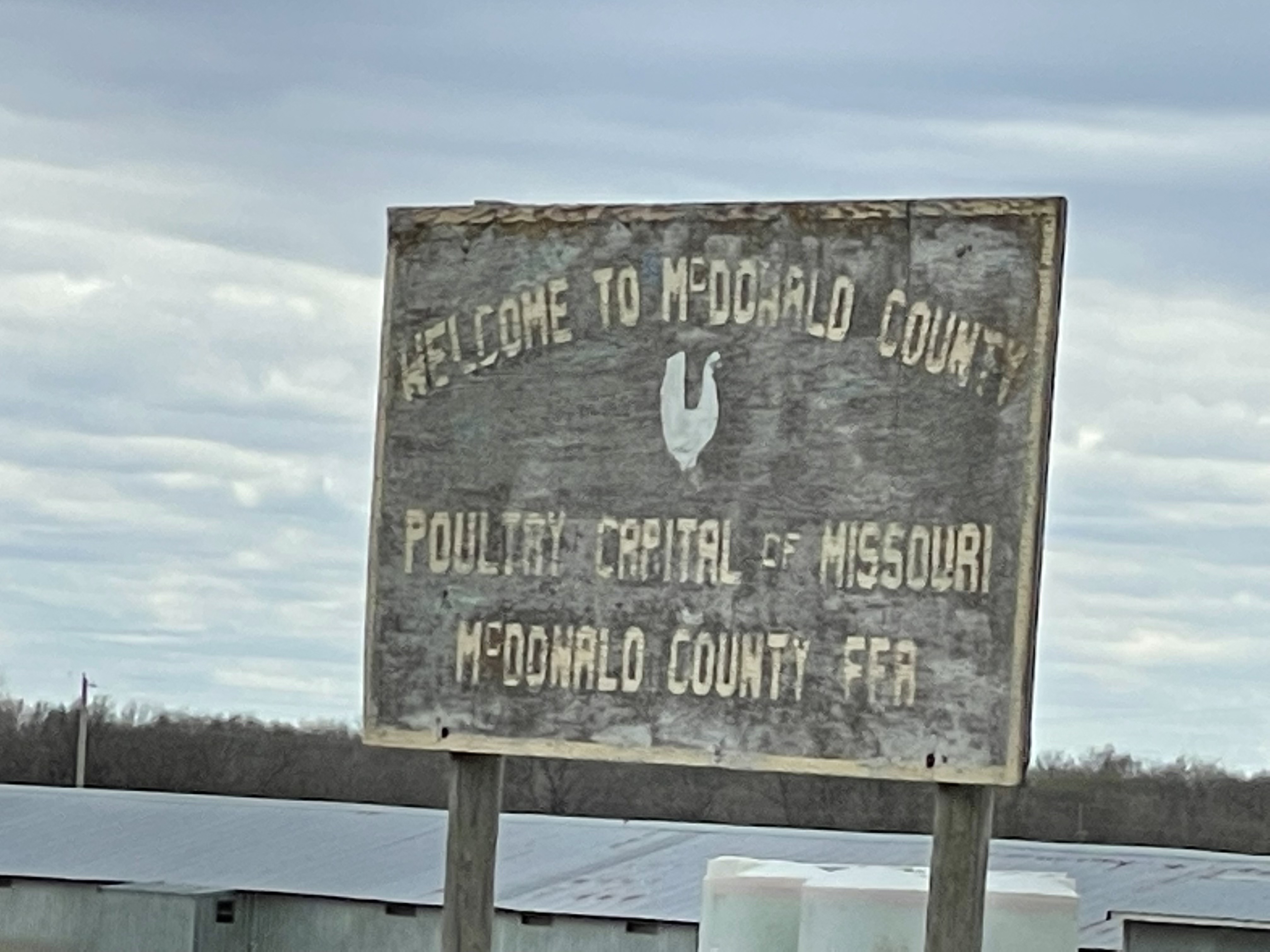
By the mid-1900s, industry began to emerge in McDonald County, especially large-scale poultry production. Generations of small farmers in the Ozarks had been raising chickens for sustenance, but broader investment for income was a risky proposition because of market uncertainty and production expenses. The nationwide frugality brought on by World War II increased demand for cheaper sources of protein, and chicken quickly became the nation’s top source of meat.
Several industry leaders began to rise in northwest Arkansas in the 1960s and 70s and eventually expanded their operations into Missouri, including Simmons Foods, Lane Processing, Hudson Foods, and Tyson Foods. By the 1990s, Tyson Foods was the top poultry producer in the country after acquiring several of its competitors, including Lane Processing and Hudson Foods. One of the Hudson facilities Tyson took over in 1997 was in Noel. Also, Simmons Foods had been operating a processing plant since the 1980s in Southwest City, a township aptly named for its location at the southwest corner of the county and the state.
Poultry Capital, McDonald County, Missouri
As the poultry industry evolved from farm-based to manufacturing operations, the need to secure labor became paramount. Local workers became increasingly dissatisfied with the grueling demands of high-capacity chicken processing, especially at the prevailing wages. Manufacturers began to look elsewhere for labor, preferably the nonunion variety. High school diplomas, advanced technical skills, and the ability to speak English were not necessary for many of these jobs, attracting immigrants with little formal education. Chicken plants located eight hundred miles from the nearest U.S. border often flew under the radar of immigration officers and were motivated to hire undocumented immigrants who would resist joining labor organizations, endure brutal working conditions, and file few workers’ compensation claims.
By the mid-1990s, the huge influx of Latin American immigrants into the U.S. began to reshape the workforce at Tyson Foods. The company aggressively recruited undocumented workers whose questionable legal status made them much more compliant than native-born laborers. Tyson’s hiring practices came under scrutiny in 2001 when the U.S. Immigration and Naturalization Service charged the company with conspiracy to import and transport illegal workers from the southwest border to fifteen of its processing facilities across the country, including the plant in Noel. Two years later, a jury acquitted Tyson and spared the company penalties that by some estimates would have exceeded $100 million.
In the third volume of his comprehensive study, A History of the Ozarks, Brooks Blevins draws attention to the changing face of the region’s population at the turn of the twenty-first century. He specifically points to the dynamic impact of immigrants that moved into northwest Arkansas and southwest Missouri seeking jobs in the poultry industry. Blevins includes McDonald County as one of four counties at the center of the poultry processing district where the nonwhite and Hispanic population has dramatically increased over the last thirty years. The results of this trend in McDonald County were most acutely exhibited in the two towns where processing plants were located: Tyson in Noel and Simmons in Southwest City.
Between 1990 and 2000, McDonald County had the second-highest growth in Hispanic population in Missouri, an increase from 121 to 2,030. The population distribution for Noel and Southwest City reflected an even starker contrast, which is directly related to in-migration of workers to the chicken plants. With Tyson’s acquisition of Hudson Foods, the operation at the Noel plant continued to expand into the twenty-first century. By 2001, the facility employed about 87 percent of the town’s total population. Over one-third of the town was Hispanic, although many long-time Noel residents were convinced that immigrants accounted for almost half the town’s population.
Tyson Chicken Plant in Noel, Missouri
Noel’s ethnic diversity expanded further in 2008 when the closure of a Tyson beef-processing plant in Kansas prompted a group of Somali refugees working there to find new jobs in the southwest Missouri town. Within four years, Somalis accounted for 20 percent of Noel’s population. Soon they were joined by workers born in other parts of the world also seeking employment at the Noel plant, including Kenya, Sudan, the Pacific Islands, Laos, and Myanmar. Refugees from overseas were a safe bet for Tyson because their legal status was typically already established.
As was the case with Tyson in Noel, Simmons offered year-round jobs with acceptable wages for an area with a low cost of living, which attracted immigrants. Most of the foreign-born people who migrated into Southwest City in the early 21st century were Hispanic or Latin American and worked at the Simmons plant. Although white native-born people became a minority in both Southwest City and Noel, there was much more ethnic diversity among the foreign-born residents in Noel. By hiring liaisons and interpreters, Tyson made it possible for international refugees who didn’t speak or read English to function in their Noel plant.
While a certain amount of resistance to change was clearly present, especially in the 1990s and early 2000s, some business owners saw opportunities to profit from their new neighbors. Established stores were changing inventory to include products that would better appeal to Hispanic shoppers while new businesses were popping up that catered specifically to Spanish speaking customers. Even jukeboxes in the local bar began offering selections from south of the border.
In Noel, sales tax revenue is critically important because it is a primary source of funding for the town’s administration, especially the police department. Therefore, any increase in retail activity contributes to the town’s success. Immigrants and refugees used their wages to pay for goods and services, and many of them shopped locally. Some businesses were owned and operated by people who migrated to the county beginning in the mid-1990s.
Carlos Sosa, introduced at the beginning of this post, continued working for the Noel Housing Authority, but he also became a real estate developer and manager with both commercial and residential properties in McDonald County. His wife, Marlene, opened Sosa’s Hairdressing in Noel, where she built an impressive customer base of multiple races, including white people. The couple purchased several storefronts on Main Street in Noel occupied by successful retailers and were very engaged in the community.
Ann Harmon is a woman with deep family roots in the southwest Missouri Ozarks going back to the nineteenth century. She has owned and managed several businesses and continues to own multiple buildings in Noel. One day a Somali man named Muhammad Abdi approached Harmon and told her he wanted to rent one of her vacant buildings on Main Street. In 2010, Abdi and his wife, Luul Ahkmed, opened the African Grocery Store in Harmon’s building. In addition to specialty foods and household goods, the store also carried traditional attire for its Muslim customers. The owners even served meals in the back of the building. Muhammad and Luul later established the town’s first mosque in another of Harmon’s buildings next door to the store. Unfortunately, tragedy struck on December 28, 2021, when a fire destroyed both the African Grocery Store and the mosque, leaving behind only the stone walls of the structures.
Noel, Missouri – Main Street
Non-native residents have opened several businesses in the county over the last thirty years. A smaller African store opened on Main Street in Noel after the fire, which was also a location for money transfer services for Somali immigrants. Rosa’s Mexican Supermarket located across the road from the Tyson plant in Noel stocked an array of fruits, vegetables, specialty items, baked goods, and prepared foods that most grocery stores in the area didn’t have. Online reviews of Rosa’s were overwhelmingly positive. Another Mexican grocery store located a block off Main Street had one of the most attractive storefronts in town and a beautiful mural painted on the north side of the building. An Hispanic couple owned and operated a convenient store right next to the Tyson plant in Noel.
Although outdoor tourism was an economic pillar for Noel, it took a serious hit in August 1960, when U.S. Highway 71 was rerouted away from town and the recreational spots along the river there. Ann Harmon recalls how important the highway was to Noel. “We had tremendous flow of traffic,” she says. “We had a lot of motels and restaurants. And then the road changed. The motels went out of business; the restaurants diminished. We lost almost all the bars. We used to have more bars than churches.”She said the place went to hell when that ratio reversed.
When immigrants and refugees began to move into Noel, many people were worried that tourism would suffer. However, some longtime residents believed the solution to boosting tourism, perhaps on a year-round basis, could actually be found in the town’s ethnic diversity. Terry Lance, the mayor of Noel, admitted that having a chicken plant next to a major campground on the Elk River isn’t exactly a tourist attraction, but he was convinced the local immigrant population could be an asset. Getting different people from different backgrounds in business would be the best thing that ever happened in the town, in his opinion.
When new workers first began moving into the county, one of the most immediate needs was securing affordable housing, which created both a crisis and an opportunity. Rental houses quickly filled beyond capacity in the late 1990s. Old motels and apartment complexes in poor repair that had struggled to stay open were suddenly packed with fulltime residents. Empty tourist cabins dotted around the area became homes too. Eventually developers would build more apartments, which created work for builders, contractors, and property managers.
The rapid introduction of multiple ethnic groups and languages into McDonald County ushered in issues with law enforcement. Acquiring a driver’s license is one of the hardest things for immigrants to do. Some of them resorted to using fraudulent documents to get a license. Even after getting one, they often had trouble adjusting to traffic laws and were more likely to be stopped than native drivers. Be that as it may, officials reported that non-native residents were no more likely to commit violent crimes than natives, and most of the incidents that did occur were domestic in nature, which sadly included suicide attempts.
Perhaps the biggest barrier that everyone faced as immigrants poured into the county was language, and the situation was most acute in the schools. The problems were compounded by the rapid growth in population, especially in Noel. Construction on a new elementary school began in 1994 with the expectation that the building would be at 65 percent capacity and would accommodate growth over the next decade. When it opened a year later, Noel Elementary was already completely full, and most of the new students were children of Hispanic workers, who spoke limited English. Some teachers left their jobs, too overwhelmed to continue under the new conditions.
Spanish is difficult, but it’s not insurmountable. However, the introduction of language groups from African countries, the Pacific Islands, and Southeast Asia brought even greater challenges. By some accounts, there were close to a dozen different languages, along with multiple dialects, spoken by various ethnic groups and nationalities in McDonald County at one time. Learning a second language, if not several more, became a priority for some people in the county. The schools received assistance from translators hired by Tyson to help students take exams, but there are no words in some of these languages and dialects that identify the concepts covered in standardized tests. Even the context presented serious issues for children coming from cultural backgrounds so different from those in the U.S. Their fathers had been murdered. They survived refugee camps overseas.
Before the mid-1990s, McDonald County folks had little experience with cultural, ethnic, or racial diversity in their community. Longtime residents were exposed to customs and practices they considered strange, even shocking at times. Joyce Short is a local woman with residential property she has rented to immigrants. She recalls receiving a frantic late-night call from a neighbor of one of her renters who told her something terrible was happening. She arrived to find that her renters were preparing to have a barbecue. She asked them what was going on. The men gathered in the yard told her they were cooking a goat. She let them know that cooking a goat in the yard was one thing; slaughtering it on site was quite another. She said, “It’s interesting what a mature woman in pajamas can do at a barbeque or beer party that’s gotten a little too loud in the middle of the night.”
The county’s social services network was not prepared for the myriad needs of these new arrivals. A nonprofit organization called RAISE, an acronym for Refugee and Immigration Services & Education, incorporated in 2017 with offices in a structure on the Noel Housing Authority property. RAISE received financial support through donations and solicited major gifts, including assistance from the Walmart Foundation. The highest priority for RAISE was education in the areas of English literacy, parenting, health and wellness, computer proficiency, finances, and employment.
How well did immigrants integrate into the community? Some immigrants chose the path toward citizenship, and Hispanic residents began running for office in Noel and Southwest City as early as 2002. In 2022, a man named Feliberto Barrientos was the unchallenged candidate elected to represent the North Ward in Noel. He and his wife operated a food truck and had lived in the area for a decade or more. Mayor Lance encouraged him to run for office, thinking he would be an asset to city governance. The mayor said, “He has a perspective that I don’t have, and I’m sure don’t completely understand. And I think that’s important.”
The role religion played in the cultural transformation of McDonald County cannot be overstated. Before the 1990s, the predominant religious identity in the county was Protestantism. By 2001, attendance at the local Catholic church in Noel went from a handful of white people to an overflowing crowd of mostly Hispanic worshippers participating in a Spanish Mass. As people from Latin America began to make their way into the area, the Catholic population continued to expand. St. Nicholas Episcopal Church in Noel also offered Spanish services. With the arrival of refugees originating in Muslim countries of Africa, Islam was introduced into the religious mix. The primary faith tradition of the Pacific Islanders is Christianity, some of whom participated in local Protestant worship services. But it is important to note that religious diversity was not nearly as great as ethnic and linguistic differences in Noel.
After more than a decade of living in Noel, Muslim residents may not have necessarily felt embraced with open arms by everyone, but the circumstances definitely improved. After the fire that destroyed the mosque on Main Street, local and outside fundraising efforts made it possible in 2022 to open a new mosque in a building behind the original one. The ceremony to open the new facility was a public event, and dignitaries invited to speak included Muslim elders and leaders along with the mayor, the city marshal, the fire chief, and a management representative from the local Tyson plant. Other community members worked diligently to dispel myths and clear up misunderstandings about the Muslim people in Noel, especially educators, landlords, and retailers who interacted with these residents.
No other church in the county was more inclusive and welcoming to immigrants than Community Baptist Church in Noel. Joshua Manning became the pastor there in September, 2017, serving a multilingual congregation including Hispanics, Native Americans, and members of the minority Karen population from Myanmar. Eventually the church began offering worship services in at least four different languages. They also established a clothing bank and hosted English classes for nearby Crowder College. During the COVID pandemic, the church began a food pantry ministry. Tyson donated $7,000 in 2022 for the purchase of a walk-in freezer for the pantry, which was regularly serving an average of 150-175 families.
McDonald County underwent drastic changes between the early 1990s and 2023. To the outside observer, the county may have looked quite segregated, with ethnic and language groups largely keeping to themselves outside of work and school. But there were a few places where cultural blending was encouraged, such as a few community-wide celebrations and festivals, and some retail establishments. In 2021, Tony and Emily Savage opened The Common Cup, a coffee shop in Noel on Main Street in a building owned by Carlos and Marlene Sosa. Tony and Emily wanted to create an atmosphere where people from vastly different traditions could gather and become acquainted while enjoying a cup of coffee or tea. They served beverages inspired by some of the nationalities represented in Noel, and they built a racially diverse staff for the shop. A sign on the wall in The Common Cup was a visual reminder of the Savages’ business model: “We Filter Coffee, Not People.”
The Common Cup in Noel, Missouri
There were still people in the county who were dissatisfied with the level of diversity where they lived, and some would have been perfectly happy if the chicken plants closed immediately and took their workers with them. Others had a more positive view. Angie Brewer, the principal of McDonald County High School, embraced a theological perspective. “It’s a mission field,” she said. “I always did think when I was a kid, I might be a missionary. But I didn’t have to go to Africa. It came to me. I didn’t have to go to Burma. It came to me.”
What would indeed happen to Noel and Southwest City if the chicken plants closed? As it turns out, this is not a hypothetical question. Tyson shuttered its Noel plant in October, 2023, along with several other locations in the region. Over 70 percent of Noel’s population would have to find work elsewhere. By the end of 2023, many of the immigrants and refugees had left Noel, much in the same way they left other places to come to McDonald County looking for jobs. The impact on the community had a ripple effect. The owners of the Common Cup sold out to new owners who renamed the coffee shop, moved it to a new location, and eliminated the ethnic-inspired beverages from the menu. Community Baptist Church closed in late November as Pastor Manning saw a sizeable portion of his congregation move away from McDonald County.
For people like Carlos Sosa, who left the chicken business behind for what he considers better opportunities, McDonald County is not a placeholder until something else comes along. It is a home for him and his family. Like a few other foreign-born residents, Carlos reshaped the place where he lives in southwest Missouri, from teaching children in his church to being a community activist and building businesses. However, this latest development could have an adverse effect on his family’s financial future in Noel. For the individuals whose sole source of income was the Tyson plant, there were very few options other than to leave the town to find work elsewhere. Local officials are exploring various options for the vacant plant with Tyson and potential buyers in hopes of finding a new employer that can bring back some of the jobs. Even so, the situation in Noel looks mighty bleak in early 2024.
Sources
Interviews
Angie Brewer (Principal, McDonald County High School), in discussion with the author at McDonald County High School in Anderson, Missouri, April 8, 2022
Carey Ellison (Noel branch public library manager), in discussion with the author at the Noel branch public library in Noel, Missouri, April 8, 2022
Kara Gebre (Program Director for RAISE) and Mike Newman (Executive Director for RAISE), in discussion with the author at RAISE office in Joplin, Missouri, November 21, 2022
Ann Harmon (former business owner and property lessor), in discussion with the author at Noel Housing Authority in Noel, Missouri, August 29, 2022
Rosie Hartley (Director, Noel Housing Authority), in discussion with the author at Noel Housing Authority in Noel, Missouri, July 12, 2022
Terry Lance (Mayor, City of Noel), in discussion with the author at Noel City Hall in Noel, Missouri, May 25, 2022
Joshua Manning (Pastor, Community Baptist Church in Noel, Missouri), Facebook direct message to author, February 25, 2022
Mike Newman (Executive Director for RAISE), email messages to author, December 11-12, 2022
Sheila Owens (Media Specialist, Noel Elementary School), in discussion with the author at Noel Elementary School in Noel, Missouri, May 25, 2022
Lisa Reece (Manager, Dollar General), in discussion with the author at Dollar General in Noel, Missouri, July 12, 2022
Hazel Sheets (Director, McDonald County Public Library), in discussion with the author at McDonald County Public Library main branch in Pineville, Missouri, August 29, 2022
Joyce Short (Noel Housing Authority Board), in discussion with the author at Noel Housing Authority in Noel, Missouri, August 10, 2022
Carlos Sosa (maintenance supervisor at Noel Housing Authority), in discussion with author at Noel Housing Authority in Noel, Missouri, July 12, 2022
Randy Wilson (Noel City Marshal) in discussion with the author at Noel City Marshal office in Noel, Missouri, July 12, 2022
Other Sources
Oscar Avila, “Cultures Blend When Ozarks Town has Influx of Hispanic Factory Workers.” Knight Ridder/Tribune Business News, October 27, 1997, Gale Business
Brooks Blevins, A History of the Ozarks, Volume 3: The Ozarkers (Urbana: University of Illinois Press, 2021) 242
Donald Bradley, “In small-town Missouri, a collision of cultures,” The Kansas City Star, June 10, 2012, A1, A18-A19, Newspapers.com
Gregory Cancelada, “Not everyone is shocked by charges at Tyson Foods,” St. Louis Post-Dispatch, December 23, 2001, 52, Newspapers.com
“Compacts of Free Association: Populations in U.S. Areas Have Grown, with Varying Reported Effects,” United States Government Accountability Office, June 15, 2020 (web page)
“Explore Census Data,” United States Census Bureau (website)
Thomas Gounley, “Somalis Find Safe Refuge,” The Springfield News-Leader, February 6, 2017, A1, A6, Newspapers.com
David Griffith, “Consequences of Immigration Reform for Low-Wage Workers in the Southern U.S.: The Case of the Poultry Industry,” Urban Anthropology and Studies of Cultural Systems and World Economic Development, 19, No. ½, Immigrants in U.S. Cities (Spring-Summer 1990): 161
Frank Griffiths, “Hispanics entering politics in McDonald Co.,” The Springfield News-Leader, March 31, 2002,1,8, Newspapers.com
Perla M. Guerrero, Nuevo South: Latinas/os, Asians, and the Remaking of Place (Austin: University of Texas Press, 2017), 114
Kimberly Harper, “McDonald County,” Missouri Encyclopedia, The State Historical Society of Missouri (web page)
Kimberly Harper, White Man’s Heaven: The Lynching and Expulsion of Blacks in the Southern Ozarks, 1894-1909, (Fayetteville: University of Arkansas Press, 2010), xxii, 253
Kaylea M. Hutson-Miller, “Noel Church Reaches Out to Immigrants from Around the World,” Joplin Globe, September 1, 2019, joplinglobe.com
Kaitlyn McConnell, “Noel coffee shop starts to bring cultures together,” Ozarks Alive (website), May 23, 2021
Kaitlyn McConnell, “Ozarks Notebook: Tyson, the Grinch Who Upended Christmas City,” The Daily Yonder (website), December 22, 2023
William McQuillen, “Tyson Acquitted of Plotting to Hire Illegal Workers,” Bloomberg, (March 26, 2003), Institute for Agriculture & Trade Policy (web page)
“Noel Approves New Insurance Agency, Passes Ordinance,” McDonald County Press, August 13, 2020, nwaonline.com
“Noel Fire Cause ‘Undetermined,’” McDonald County Press, March 4, 2021, nwaonline.com
Phillip O’Connor, “Hispanics Transform Rural Missouri Town,” St. Louis Post-Dispatch, March 18, 2001, 1, 9, Newspapers.com
Susan Pozo, ed., The Human and Economic Implications of Twenty-first Century Immigration Policy (Kalamazoo, Michigan: W. E. Upjohn Institute, 2018), 110-111, EBSCOhost
“Reporting Terminology and Definitions,” United States Department of Homeland Security (web page)
Brent Riffel, “The Feathered Kingdom: Tyson Foods and the Transformation of American Land, Labor, and Law, 1930-2005” (PhD diss., University of Arkansas, 2008), 259, ProQuest LLC
Steve Striffler, Chicken: The Dangerous Transformation of America’s Favorite Food, Yale Agrarian Studies Series (New Haven and London: Yale University Press, 2005), 42-45
Karen Testa, “Mexican-American Makes Inroads In Missouri Town,” St. Louis Post-Dispatch, July 5, 1997, 20, Newspapers.com
“Train Explosion Wrecks Noel; One Dies, 40 Hurt,” Moberly Monitor-Index, August 4, 1969, 1, Newspapers.com
Tyson Foods, “Tyson Foods Commits More Than $1 Million to Expand Legal and Citizenship Support for Team Members,” news release, April 12, 2022
Alexus Underwood, “Tyson Donates $7,000 to Community Baptist Church in Noel,” McDonald County Press, July 14, 2022, nwaonline.com
United States Census Bureau (website)
Sylvia R. Lazos Vargas, “Missouri, the War on Terrorism, and Immigrants: Legal Challenges Post 9/11,” Missouri Law Review, 67, no. 4 (Fall 2002): 808
As I write this last blog post of 2023, a new year is only days away. Another Christmas has passed, along with the hopes and wishes every Christmas inspires. I am still hoping for something this year that I thought would never be on my wish list. I hope the American experiment doesn’t fail. I hope the Republic that was the vision of a group of enlightened thinkers almost 250 years ago doesn’t crumble. I hope the U.S. Constitution isn’t replaced with a less representative form of government. I hope the democratic principles that have guided this nation’s trajectory for so many generations aren’t cast aside, even if we have never honestly embraced or implemented them holistically. I hope we don’t give up on the dream of liberty and justice for all.
What concerns me most as we head into 2024, the year of our next presidential election, is the fact that a sizeable minority of our population no longer supports the concept of a limited, restrained government. Oh, they certainly say they do. In fact, they scream it. Some of them think the only function of government should be defense of the borders, so they have no respect for the legislative or judicial branches of government. They constantly espouse the virtue of state’s rights, but that’s only because they don’t believe the federal government has a role in governing the affairs of the population. When it comes down to it, many of them would be perfectly happy if they never heard from their state capitals again, especially in the form of a tax bill every year. Not only is all politics local for them, but just about everything else is too, and that’s the way they prefer it.
However, there is one branch of government that they have decided should be virtually untouchable: the executive branch. They want this branch to be untethered by legislators, judges, law enforcement, or even laws for that matter. They believe this branch should essentially be above the law. They think this branch should have the power and authority to do whatever it deems necessary for the nation to achieve greatness and superiority over all other nations. Most importantly, they want this type of omnipotence concentrated in the hands of one individual, the person they wish to see occupying the White House, and no one else. They are convinced that only one person is qualified for this totalitarian position. They earnestly believe this person has the skills, experience, knowledge, and determination to transform the country into what they want it to be. They just don’t quite understand that authoritarianism is not an example of small government. History has taught us that it is quite the opposite.
This minority of the population has been building, organizing, communicating, and planning for many years. The exact origin of the movement is debatable. It has mostly existed underground and on the fringes of society, and in modern times, it has taken advantage of the Internet, empowered especially through social media. Perhaps it has waxed and waned over most of U.S. history, sweeping across both sides of the political spectrum; however, in the 21st century it surfaced and became extremely vocal among the ultra-conservative right. The movement’s members were like a volatile collection of chemicals, just waiting for the right catalyst to come along and fully activate them.
By definition, a catalyst causes or magnifies a reaction without ever undergoing any permanent change itself. The catalyst in this case had been a larger-than-life personality in American society for decades. Born into wealth, he was groomed to be an entrepreneur, rising to celebrity status while building a commercial empire with the assistance of domestic and foreign credit and always grabbing the attention of mass media. He built relationships with some of the wealthiest and most powerful members of society in the U.S. and around the world. His business ethics and methods were often the target of scrutiny, if not serious accusation of wrongdoing, but his reptilian instinct served him well as he maneuvered through the legal system emerging mostly unscathed. His devoted fans have often admitted that he may not be eloquent, but he always speaks his mind and means what he says, which they really admire. Of course, when he said something that sounded dangerous or immoral, they were quick to backtrack and say that you can’t pay attention to what he says, just focus on what he does. Makes perfect sense.
The qualities and characteristics that made him most appealing to the movement were his apparent great wealth, his arrogance, his boastful nature, his dissatisfaction with the federal government, and his insistence that the nation was on the wrong path primarily because it could not protect its borders and because it repeatedly made bad deals with foreign powers that never put America first. Nevertheless, he promised that he, and he alone, could rescue the country. He would rid the nation’s capital of the corrupt bureaucrats and lobbyists, or “drain the swamp,” a phrase often used by Benito Mussolini as he rose to power in Italy in the 1920s. The catalyst would secure the southern border with Mexico by building a massive wall, promising to make the Mexican government pay for it. He would remove all government regulations and restrictions that hindered business pursuits and the accumulation of wealth. He wanted patriots to join him in the noble cause to Make America Great Again. The catalyst’s name was Donald J. Trump, who ran for President of the United States and was elected in 2016 with the help of this growing political and social movement.
History will judge how successful Trump’s administration was in fulfilling his promises to his base and to the population at large, but there is no real debate about what happened when he was defeated in his attempt to win a second term in office. He didn’t just claim that the election was stolen, which other candidates before him had done (including Hillary Clinton when she lost to Trump). He went much further. He used those claims to support his attempts to stay in office, even to the point of trying to overturn the election results. When Vice-President Mike Pence proceeded to certify the election on January 6, 2021, despite Trump’s demand that the process be halted, a subset of this movement’s members stormed the U.S. Capitol, a mob that had been encouraged by Trump. He publicly praised their efforts to interrupt the peaceful transfer of power from his administration to that of the newly elected President, Joe Biden.
Over 1,100 rioters who invaded and vandalized the Capitol (resulting in several deaths) from all fifty states were charged with a variety of crimes associated with the incident, and close to 400 people were sentenced to prison for their actions. Other indictments and lawsuits have been filed for alleged crimes involving attempts to overthrow the election, some committed by close associates of President Trump. His most loyal supporters still deny that Trump lost the election, including elected and appointed state officials, Republicans in Congress, lawyers, some of Trump’s former cabinet members, journalists, radio talk show personalities, and Fox News program hosts. Thus far, no evidence brought before any state or federal court that I’m aware of has offered conclusive proof of interference, tampering, or fraud sufficient to overthrow or reconsider the election results. And yet, millions of people across the country still believe that Trump actually won his bid for reelection.
Over the last twelve months as individuals began to solidify support for their candidacy for the Republican primary leading up to the next presidential election, it became abundantly clear that Donald Trump was going to be the frontrunner. Now at the end of the year, his numbers across a wide spectrum of polling organizations far exceed any other Republican hopeful. He has been noticeably absent at all Republican debates. He doesn’t need to be there. He is winning by a long shot. And just as he did leading up to the last election, he is pounding a clear message home to his base: if he doesn’t win this election in 2024, then the election will be fraudulent. To his loyal base, there will be only one conclusion if he doesn’t win. The election was stolen. They will accept no alternative outcome other than a victory for Donald Trump, a man who now faces numerous federal and state indictments for alleged crimes associated with the last election and attempts to overthrow it.
Here’s where it gets frightening. Trump’s base, the movement for which he served as a catalyst, has illustrated it is willing to resort to violence to achieve the agenda of overthrowing the government to give Donald Trump total control. They are also likely among the most heavily armed civilians in the country. Over the years, especially during his presidency, Trump demonstrated his admiration and respect for totalitarian leaders around the world, including Vladimir Putin in Russia, Kim Jong Un in North Korea, and Xi Jinping of China. He even committed the embarrassing diplomatic faux pas of saluting Kim Jong Un during an official meeting with the supreme leader. In a recent town hall session hosted by Sean Hannity of Fox News, Trump stated that he would be a dictator for one day once he was reelected. This type of authoritarian rhetoric has become more common for Trump, and his base seems perfectly happy with it. To my way of thinking, these folks are ravenous for a dictator, as long as his name is Donald J. Trump.
So, I am concerned about our Republic’s future. I dread the turbulent political landscape that lies ahead leading up to the 2024 election in November. I am troubled over the lack of conviction among Republican lawmakers who continue to feed into the conspiracies and lies about the last election. I am saddened that the handful of men and women in Congress who had the spine to stand up to Trump and the election deniers were publicly castigated by the former President and their own colleagues, then promptly voted out of office. Most of all, I am worried that no matter the outcome of the election, the system of law and order that distinguishes us as a nation may be threatened.
Chuck Berry statue in the Delmar Loop in St. Louis, MO
In the spirit of giving credit where credit is due, no one deserves the title “The Father of Rock-n-Roll” more than Chuck Berry. So many of the legends of the genre revered him and covered his hits, including The Beatles and The Rolling Stones. Keith Richards said if rock-n-roll had a name, it would have to be Chuck Berry. Even that white boy from Tupelo, referred so often to as the “King” of rock-n-roll, covered Berry’s tunes.
Chuck Berry’s life is not really a rags-to-riches story as he was born into a middle-class family in St. Louis where he lived his whole life. Growing up just beyond the eastern boundary of the Ozarks region, Berry was heavily influenced by rock-a-billy and country music, elements of which would end up in many of his greatest hits. Of course, Berry also grew up during the era of Jim Crow in a part of the country that had a dark past with race relations. Sadly, according to R. J. Smith in his brutally honest biography (Chuck Berry: An American Life, Hachette Books, 2022), Berry apparently carried his response of anger, resentment, and frustration to extremes at times, taking opportunities to insult and humiliate people, even those who adored him, and telling them, “Now you know how it feels to be black.”
Smith does a good job of balancing the artistry, intelligence, talent, and even the charm of Berry with the ugly side of his personality. Some of the stories about Berry make me think that he may have had some kind of serious psychological illness, like bipolar disorder. To say he was a womanizer would be to let him off the hook. He demonstrated signs of being what many folks in the post-MeToo era would define as a sexual predator and even a pedophile. At the very least, it is fair to say he had strong sexual appetites that wandered into the realm of the taboo and even aberrant.
His sexual deviance, along with his violent tendencies and his resistance to authority, including the IRS and government in general, got him into legal trouble on several occasions. He was sentenced to jail time more than once. One could argue that he shared this path with many of the outlaw country stars like Johnny Cash, Merle Haggard, Willie Nelson, and many others. Some rap and hip-hop performers who were no doubt influenced by Berry on some level would also be plagued with legal problems and prison terms.
No matter how bad the news was for Berry, he was still highly respected by the biggest names in the music business, including Bruce Springsteen. He was an early cross-over musician, infiltrating white homes with his unique style of playing and singing long before black performers were even allowed to eat in many restaurants or stay in hotels when they were on tour. He was beloved by millions of fans all over the world, even when he continued to attempt to perform in his 80s as dementia began to claim his mind and memory. His impact on 20th century music and beyond cannot be overemphasized, complete with his flaws and his brilliance.

















 If You Want My Opinion