

Original Songs, Volume One

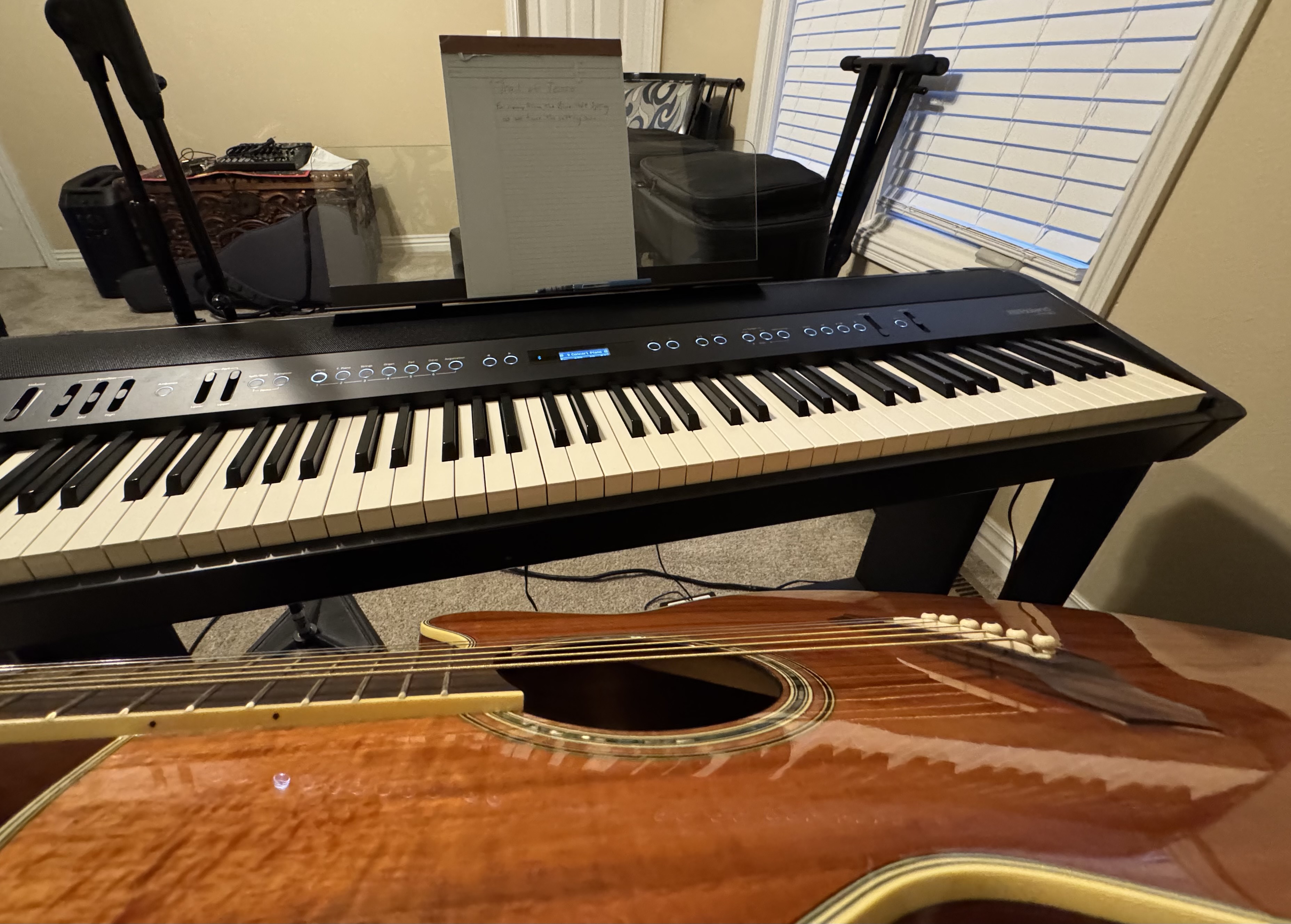
Guitar and keyboard
Guitar and keyboard

As an amateur musician who started playing the guitar in my teens in the early 1970s, I was influenced by the singer/songwriter wave that swept popular music during that time, especially with folks like John Denver and James Taylor. I wanted to write my own songs, to create music that expressed my thoughts and emotions. I am not a prolific songwriter by any means. I have friends who are much younger than I am who have written dozens, if not hundreds of songs. I am lucky if I push out a couple in five years. I have to catch some type of inspiration to make tunes and lyrics come together. I have written many more melodies than lyrics, so when the two merge into a song, I always feel a sense of accomplishment. I’m grateful when it happens.

The following is a list of my original songs that I think are worth keeping and occasionally performing at my solo shows. They span a period of roughly 45 years. Most of them were composed on the guitar, but a few of them came to me on the keyboard. I will try to place them in chronological order, but I may miss the order on one or two. I have written posts in this blog on several of them individually where I included the lyrics and links to performances. Some of them have been copyrighted with the Library of Congress.

Samples of my songs and studio recordings of several originals are posted on the music playlist of my YouTube channel at https://www.youtube.com/playlist?list=PL74BhqvI0f_6J2yedZde9Ldhp76h53JFH

“Skipper” – Perhaps my most cerebral song was one of my first attempts just after high school, sometime around 1979. It has some interesting chord and key changes that produce a rather ethereal atmosphere. I always thought this was just a ballad about a young sailor learning from his skipper how to handle a ship in a storm; however, the older I get the more I realize it is an analogy for any mentor-apprentice relationship, or perhaps a father-son dynamic. Some would argue it could have a religious undercurrent. I think it is one of the best songs I have ever written, and I still perform it from time to time.

“Missing You” – I wrote this not-so-original song around 1981 while I was at college away from home and close friends, modeling it after several popular tunes from the period written from the perspective of a touring musician who is missing the woman he loves. It has a pop country sound, and it goes over well with audiences. The theme is so common in pop and country music, such as the 1983 power ballad by Journey, “Faithfully,” written by Jonathan Cain. Another example is the 1997 hit recorded by Tim McGraw, “Everywhere,” written by Mike Reid and Craig Wiseman.

“I Return To You” – This is a sentimental love song I wrote during my last year of college as an undergrad student. The lyrics are nothing to brag about, but it has a catchy tune, so I still perform it every now and then. And I get compliments on it – go figure.

“Remember Me” – I was raised as a Southern Baptist, where music (and performing it) is appreciated as a central part of worship, right up there with preaching. Naturally, I wrote songs that I performed in church. Some were okay; others were endurable; most were awful. I would like to think “Remember Me” is the exception. I’m still proud of the lyrics, which take the form of the imaginary final words of the repentant thief spoken to Jesus as they are both hanging on their respective crosses. It is his confession and his plea for Jesus to remember him after he has died. The lyrics and music evoke raw emotion, desperation, sorrow, regret, and a culminating sense of peace. Because I no longer perform in churches, I never sing this one in public. I do still sing it at home for myself. It is the first song I can remember composing on the keyboard.

“We Liked Grandma So Much Better Without Teeth” – My grandmother had an incredible sense of humor, a trait I would like to think I inherited. She received a great deal of pleasure from making my sister and cousins laugh to the point of losing our breath. She would stop at nothing to entertain us, including removing her teeth, putting a nylon stocking over her head, and then pulling it up while dragging the skin of her face up with it to distort her features to almost frightening proportions. Some years after her death, my memory of these times became almost nostalgic, and I decided to write a funny song about her. It must be fairly entertaining, as I have been asked to perform it many times for groups of people who never knew my grandmother or any other members of my extended family. The song is a tribute to someone whose impact on my life was far greater than I realized when she was still with me.

“You Have My Heart” – It isn’t my best work, but it has an interesting chord progression that incorporates different keys for the verses and the chorus, with a minor-based bridge that all comes together nicely. The lyrics are based on the familiar theme of lost love or having to give up a love relationship.

“Walk Into My Arms” – Some songs are born out of pain, and I would imagine every songwriter has at least one. Some writers even specialize in songs about heartache. This is mine. The strength of this song is how the melancholy melody matches the sadness of the lyrics. “Don’t make me wait much longer; I ain’t gettin’ any stronger; Walk into my arms or just walk away.” This was composed completely on the keyboard, although I quite often play it on the guitar.

“The One You Call” – Rather than calling it a sappy love song, I’d like to think this is a sweet song about unrequited and unconditional love. It is definitely meant to be romantic. Oddly enough, I came up with the idea after telling a young woman who was going through a rough patch that she could call me anytime she needed me – to pick her up from somewhere, to drive her home, to listen to her, or whatever she needed. We were not at all involved (she was more like a daughter to me), but our conversation sent me in the mental direction of a romantic situation for the purpose of this song, mainly because I thought it would be more popular and relatable. This is another one of those I composed completely on the keyboard.

“I Just Don’t Fit” – During the early stages of the COVID pandemic in 2020, I wrote a pop song as a tribute to Flannery O’Connor’s brilliant short story, “A Good Man Is Hard to Find.” She is my favorite author, and I think she was a comic genius – far ahead of her time. If Flannery O’Connor and Cormac McCarthy had a love child delivered by Neil Young, I can imagine this is what it would sound like when the baby cried. I decided on a western-style tune to give it some distance from O’Connor’s South, but the darkness is still there. It’s probably enough to turn Bruce Springsteen’s stomach, but it’s the best I can do with what I have.

“Gone” – Here’s a sassy tune about a familiar subject: moving on after being mistreated by someone close. The speaker never actually identifies what kind of relationship has come to an end, but there are hurt feelings and a strong dose of good riddance. The musical composition is as complicated as anything I’ve written, with slight variations on all the verses and the inclusion of a bridge. It really is upbeat, which adds to the coming-out-on-top attitude. It’s fun!

“Music City Heartache” – I have only collaborated on writing songs twice. A fellow musician friend from my youth contacted me a few years back to say he had written some lyrics and would like me to compose some music for them. He is a big fan of Nashville music and visits the Grand Ole Opry several times a year. He wrote lyrics that draw an analogy between the heartache of never making it in Nashville and never making it in love. I think the music evokes the feelings of sad reality that are present in the words.

“Moon City Rock-n-Roll” – The first place I performed on stage after moving to Springfield, Missouri was a small bar on Commercial Street, or C-Street as it is often called locally. A young talented musician named Justin Larkin was hosting an open mic night at Moon City Pub. I had heard about the weekly session and decided to put myself out there with a familiar song for a Georgia guy: “Melissa” by The Allman Brothers Band. I started singing at open mic there almost every week. I also began checking out local performers and bands that played shows there on the weekends. A few years later I decided to pay tribute to the bar, Justin, the bar owners, and the people who frequented the place by writing a banger about gathering with friends to enjoy music at the bar. I have even had the pleasure of performing that song at a solo show at Moon City Pub.

“Miles of Time” – This is my only other collaboration so far besides “Music City Heartache.” I teamed up with Justin Larkin, mentioned above, to write the lyrics and parts of the melody to this ballad about the emotional toll of being far away from the familiar and the anguish caused by mistakes, wrong turns, isolation, and deep loneliness. I’m particularly happy with this line that Justin perfected: “Every faded fortune that I followed left me feeling all alone, all alone.” It may be a sad song, but I think it has some grit.

“Eternity” – Easily my saddest song to date, this is written from the perspective of a guy (at least in my mind) who is grieving the death of the woman he loves, probably his wife. It was born out of my imagined profound sadness if I were to lose my own spouse, the keeper of my heart. The song contains images, ideas, and fragments of conversations we have had over the years we have been together. The opening verse makes an allusion to the place where we want to be buried, the Grand Tetons. Perhaps writing this song is somehow my way of confronting the inevitable and trying to find comfort in a circumstance where it cannot exist. I think it’s one of the best songs I’ve ever written.

“I’m Gonna Ask That Girl to Dance” – I’m the first to argue that the most authentic music is often forged in the fire of pain and sorrow. But some of the best songs are fun! This is my attempt at a rockabilly tune inspired by one of the most common themes in popular music, especially rock and country: the shy dude who has trouble meeting women, especially in a bar. The lyrics are simple and not exactly original, but even the memorable hit songs about the same subject over the last 75 years haven’t been models of profundity. What I really like about this song is the scratchy, syncopated rhythm and how the lyrical phrases alternate between being tightly packed and more evenly spaced.

“On This Trail” – Finished only a few days before publishing this post, this is not the type of song I typically write, which is based on actual historical events. It is my tribute to the Cherokee Indians who endured and survived the infamous Trail of Tears, the removal of indigenous people from the hills of North Georgia and Tennessee to the newly established Indian Territory (later to become the State of Oklahoma) between 1838 and 1839. Historians estimate that approximately 4,000 Cherokee people died “on this trail,” which represented about one-fourth of the total number who traveled west during the forced migration by the United States government. I wanted this song to honor the Cherokee Nation, so I specifically incorporated phrases from first-hand accounts of survivors and from the poem, “The Trail of Tears,” by Cherokee poet Ruth Margaret Muskrat Bronson (1897-1982).

The Last Day

The last day was November 13, 2024. The thought of it filled me with excitement, relief, happiness, and maybe just a hint of anxiety. I have contemplated this date for decades but only gave it serious thought during the last five years or so. I have been preparing for this moment over a good portion of my adult life. My ideas about how it would look and the impact it would have on me have changed over the years. I’m extremely grateful to be reaching such a pivotal point in my life, and I am even more thankful that I got to celebrate the occasion with my spouse/best friend. November 13, 2024, was the day my professional career ended, and retirement began.

time clock
time clock (source: Wikimedia Commons)

My wife retired earlier in 2024, and although I cut back to halftime hours for my final year, I still went to work several days a week, every week. The thought of never again having to drag out of bed at dawn, down a cup of coffee, grab a bite to eat, shower, shave, get dressed, and head out the door for work is just lovely, if not a bit scary. No work means no paycheck. Yes, like many Americans we will have sources of retirement income, including social security. No, it’s not the same as a regular earned paycheck, which is more a difference in the mind than the wallet. For many people, retirement is a huge shift in thinking and practice; in short, we transition from spending and saving what we are earning to spending what we saved, either on our own or through our employers and/or the government. It takes some getting used to for most of us, I suspect.

The joys of being retired are slowly revealing themselves with each passing week. The stress that comes from adhering to a daily schedule and meeting deadlines pretty much disappeared on day one. The luxury of rarely setting an alarm for waking in the morning is heaven, although I still tend to wake up between 5:30 and 6:30 a.m., although there have been a few mornings I have slept past 8:00, especially in a hotel with blackout curtains. Retirement offers so many scheduling options, such as traveling and vacationing on whatever days of the week that works best for our planned activities, assuming we have set plans. Sometimes we just get a whim and go off on an adventure, which is so liberating and fun. We can book flights now based on the optimum prices, availability, airline, time of year, and choice of destination, rather than how we can fit air travel into a work week.

Money can buy so many things, but the most precious commodity we cannot purchase for any amount of cash is more time. However, retirement puts more of the time we have back in our hands to do with as we please. I love to read, and during the years I was working, I typically would get up early enough to spend at least 30 minutes to an hour reading with my first cup of coffee. Reading at night has never been a good option for me because I tend to lose attention and retention after dinner. Now, I can read for hours on end at almost any time of the day that works for me, which is heavenly. I am also devoting more time to reading online subscriptions to newspapers like the New York Times and Wall Street Journal. One slight downside of not driving back and forth to work each day is less time spent listening to audiobooks, so I will need to carve out time each week for that relaxing and engaging activity too.

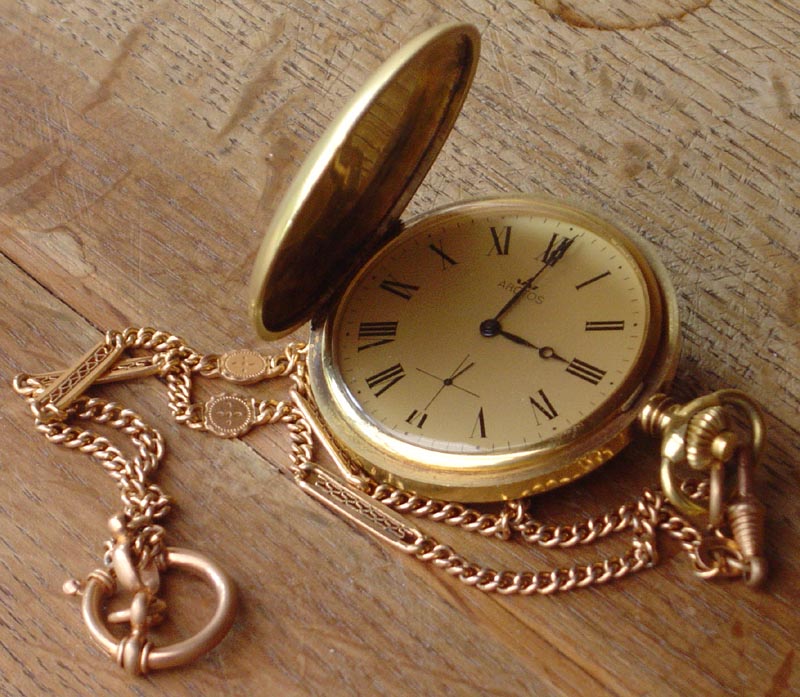
pocket watch
pocket watch (source: Wikimedia Commons)

I have been an amateur musician for over fifty years, and another huge benefit to retirement is the amount of time devoted to learning new music, improving my skills, and performing more often. I am even spending an hour each week working with a friend and gifted guitar player who is expanding my knowledge and abilities on that instrument. I also have more opportunities now to sit down for blocks of time to work on the keyboard, learning new songs and getting better at playing in general. I am hoping that retirement will free up more time for songwriting too. Being able to sleep in also means I can stay out later to participate in open mic and jam sessions around town or take in live music shows in the area. My wife and I love going out in the evenings to live music shows.

Another benefit that is more related to our ages than retirement specifically is our eligibility for Medicare, the federal government’s medical insurance program for people age 65 and over. We will save a bundle on premiums and on most medical services and procedures in the coming years, which will free up more money for travel and the many other interests we have. I am baffled by people who tell me that retirement did not meet up to their expectations. Some of them even went back to work. I suppose there are retirees out there who fill up their days watching hours and hours of television. Yes, we do watch television, but mostly we watch sports programming (Go CHIEFS!!!) and a few series now and again. We also love the idea that we can now catch matinee movies at the cinemas during the week and get better deals on admission and concessions. Speaking of discounts, we have become much more aware of lower prices for seniors at restaurants, grocery stores, and other retailers. Those savings really add up over time.

Admittedly, I have become quite obnoxious about the freedom retirement affords. When I’m shopping for seed at our local Wild Birds Unlimited store around mid-day, I often look around at some of the other shoppers and think, “Damn, I bet you’re here on your lunch break, aren’t you?” Or if I’m driving around town mid-morning and the traffic is heavy, I find myself saying out loud in my car, “Why aren’t all you people at work?” I know, I know. I’m a terribly smug person. Eventually I’ll settle in to this wonderful rhythm of retired life, and in so doing, perhaps I will become a bit more humble and gracious. But for now, let me rub it in just a tiny bit.

My Best Books of 2024

Book shelves
Book shelves

Admittedly, I let this month slip up on me and am rushing to get a post in today before December and 2024 are gone for good. So, here is a list of my favorite books from the past year. Who knows, this year-end review may become a tradition, not as a substitute for a monthly post but perhaps as an addition.

The Nickel Boys by Colson Whitehead

Based on an actual reform “school” for juvenile boys in Florida during the Jim Crow era, Whitehead’s prize-winning novel is a heartbreaking, maddening story told by one of the most talented young American writers. It is not just a story about racial discrimination and inequality, but both loom large in the plot. The backstory of the protagonist, Elwood Curtis, is touching and sets the stage for the tragic turn of events that leads to his incarceration. With emotional integrity that never even gets close to being sentimental, the author takes the reader on a horrifying tour of the school’s campus: dormitories, cafeteria, utility facilities, and the one building where unbearable acts of cruelty occur. I get the sense that Whitehead may have conflicting feelings about the passivity of early civil rights leaders, most especially Martin Luther King, Jr., who is heroic and inspirational to Elwood, especially as a young boy. I like this book much better than Whitehead’s other blockbuster hit, The Underground Railroad, which was a fine book but allegorical and thus not as engaging for me as this powerful story.

Dear Regina: Flannery O’Connor’s Letters from Iowa edited by Monica Carol Miller

I worked for almost two years as a consultant, hired by the literary estate of Flannery O’Connor, to create an inventory of the archive of her manuscripts, letters, photos, journals, and other personal effects. During the course of that project, I read each of the letters included in this collection, and it was a real treat to go back and read them again. The relationship between Flannery and her mother is complex, unusual, and in so many ways fascinating, especially considering the number of stories the author wrote where the main characters are a mother and a child.

Among the most interesting developments we find in these letters is how, in a matter of only two years, Flannery becomes much more independent and driven. In the beginning, the young graduate student seems to be nervous about being so far away from home and family for the first time in her life. As time goes by and Flannery is introduced to established writers and publishers who admire her work as a student at Iowa, she becomes more confident in her abilities, which results in a more bold attitude toward Regina. She is willing to rebuke her mother if she senses that Regina is overstepping her bounds or commenting inappropriately about matters she doesn’t understand.

On the darker side, readers can’t help seeing O’Connor’s deeply ingrained racism, her sense of moral superiority, her callous reaction to the suffering of others, and sometimes a general misanthropic nature. Some would argue that she simply resisted the social conventions of her time, especially expectations of young “ladies.” I think it’s more than that. I think she felt terribly awkward in most social situations and preferred to limit human interaction with only a few people. This personality trait may have helped her in the end as a writer and even on a more personal level when her lupus diagnosis forced her to live the last third of her life with her mother in the rural Deep South of middle Georgia.

Miller provides some commentary in her introduction to the book and at the beginning of the phases of Flannery’s tenure at Iowa. I think the book could have been stronger with a deeper analysis of the correspondence, but perhaps the literary estate placed restrictions on the editor. Given the executor’s reputation for such tight control on what has been published in the past, this is a valid speculation. Nevertheless, the estate did permit the letters to be published, which means they are now widely available to readers and scholars of O’Connor’s work. That’s a good thing.

Eve: How the Female Body Drove 200 Million Years of Evolution by Cat Bohannon

What a valuable book that almost serves as an updated edition of Natalie Angier’s classic study titled Woman: An Intimate Geography. Bohannon comes out swinging from the first page, observing how medical science has committed egregious errors and arrived at faulty conclusions because it has considered the needs of males and females to be the same when it comes to developing pharmaceuticals and treatments. The differences between the sexes go far beyond their genitals and mammary glands. The author explains why the most common use of male subjects only (human or other animals) for medical research is terribly shortsighted, sometimes resulting in catastrophic and even deadly consequences. And that’s just the first chapter!

Building on the complexities of the female body (while also giving plenty of attention to the difference between sex and gender along the way), Bohannon traces millions of years of evolution to draw some startling and perhaps controversial conclusions about human origins, female anatomy, reproduction, childbirth and child rearing, language, sociological patterns, human achievement, and so much more. The chapter on breastfeeding alone is worth the price of the book — good heavens, I learned so much! 

She makes solid arguments for why some of the great discoveries and advances in early human development may be attributed to women as opposed to men, who have historically taken the credit. Her practice of demonstrating the similarities and intersections of female characteristics across species in the animal kingdom – from orcas to mice, from ducks to our primate cousins — helps to reinforce the evolutionary evidence she produces to explain why women are specifically equipped for all the roles they fill as an equal half of homo sapiens.

I highly recommend it to just about everyone. Women will benefit from knowing more about what makes them tick and how they became the marvelous wonders they are. Men NEED to read it to better appreciate all the women in their lives, beginning with the ones that brought them to life and gave them a fighting chance to survive.

Shakespeare and Company by Sylvia Beach

What a delicious book! I have known about the importance of Sylvia Beach’s little American bookstore in Paris for a while but was not aware that she wrote such a wonderful memoir about her experiences as the owner and storekeeper of Shakespeare and Company. Her membership-supported enterprise was so much more than just a bookshop. It served as a refuge and haven for some of the most gifted expatriates and writers of the early 20th century, including Ernest Hemingway, F. Scott and Zelda Fitzgerald, Ezra Pound, T. S. Eliot, and most especially James Joyce. I had no idea that she was the first publisher of Joyce’s monumental novel, Ulysses. She really was a remarkable human being, one who made great sacrifices to support an amazing and historical intellectual community. She even risked her own life during the Nazi occupation of Paris by refusing to compromise her standards or cater to the monstrous regime that swept across Europe before and during World War II.

Grandma Gatewood’s Walk: The Inspiring Story of the Woman Who Saved the Appalachian Trail by Ben Montgomery

For anyone who needs a story of inspiration, endurance, and good old fashion intestinal fortitude, look no further than Ben Montgomery’s well written account of Emma Gatewood’s adventures on the Appalachian Trail and her other treks across the country on foot. It is estimated that this grandmother and great-grandmother ended up walking more than 14,000 miles, the distance of half the globe, all after she turned 67 years old. Included in these pedestrian journeys were two thru-hikes on the Appalachian Trail and a third time in sections, back in the late 1950s when the trail was not so popular or populated by hikers. Oh, and she also walked the Oregon Trail, literally, from Independence, Missouri to Portland, Oregon. She was in her seventies when she completed that one. Anybody want to complain about being tired now? Ever again?

Grandma Gatewood overcame terrible conditions on the Appalachian Trail, from rattlesnake encounters to raging storms, from extreme temperatures to blown out shoes (she wore only sneakers!), from fallen trees to flooded creeks, and injuries to her feet, ankles, and knees that would have spelled defeat for most men half her age attempting what she succeeded in doing several times. Her amazing stamina was born out of tragic circumstances: years of mental, emotional, and physical abuse from a monster of a husband.

Walking in the forest in solitude gave Emma Gatewood great joy and satisfaction, although she struggled to remain alone in her quest many times as her story spread during the months she was on the trails. She became a celebrity, and her time walking was interrupted more and more by journalists, photographers, and curious onlookers. For the most part she remained humble and patient, although she did lose her temper a few times with the rudest of the bunch. And then she felt remorse and asked them to forgive her! What an example she set for just about everyone on how to pursue dreams, overcome adversity, and live your best life.

If Beale Street Could Talk by James Baldwin

This is a powerful novel for several reasons, not the least of which is how it captures the sense of despair among African Americans over injustice from the legal system specifically and from the society at large. The narrative is impressive to me considering it is written by someone who lived his later life as a gay man but elected to employ a first-person voice of a young woman. The family dynamics and conflicts that drive the story are made more intense by Baldwin’s skill with descriptive language and dialogue. It’s all so believable. Along the way, he inserts little nuggets of gold that transform this book from a good to a great novel. Here is one fine example.

“Only a man can see in the face of a woman the girl she was. It is a secret which can be revealed only to a particular man, and, then, only at his insistence. But men have no secrets, except from women, and never grow up in the way that women do. It is very much harder, and it takes much longer, for a man to grow up, and he could never do it at all without women.”

The remainder of that paragraph is just as profound as this passage. There is a lot going on in this novel, including the tension that exists among the sexes and how love is exhibited and expressed in such diverse ways. If Beale Street could indeed talk, it would testify to the struggles of black America, as would the streets of Harlem, Birmingham, Montgomery, Atlanta, Detroit, and Tulsa, just to name a few. Baldwin was so familiar with such places, and he courageously explored every square foot of them.

Grace Saves All: The Necessity of Christian Universalism by David Artman

I have read other books on Christian Universalism, but this is the best so far. Artman is a minister who has struggled with the concept of hell and eternal damnation for most of his life, but in recent years he has found a spiritual path that changed his perspective on the Christian faith. He was able to do so with plenty of evidence from Biblical scripture and the guidance of some of the pioneers in the theological study of universal salvation or the idea that, in the end, God saves all humanity. No one is punished forever and ever in the lake of fire, gnashing their teeth, so forth and so on.

Artman explains early on in his book that Christian Universalism is nothing new and that many early Christians embraced this theological position and promoted it. Once he began to look at universalism closely, it just made sense in the context of a loving creator God. For Artman, “it is the only approach to Christian theology which can successfully defend the goodness of God; and therein lies its necessity.” In some ways, Artman and his readers come to universalism through the back door, as if it is the only option left. As he explains it: “Once someone fully grasps the concept that God knows the end from the beginning and is not controlled or regulated by any outside forces, the following realization strikes home – the outcome of all things will inevitably be what God intended from the beginning.”

Artman still believes in the free will of humanity. He just posits that ultimately God will win over even the strongest deniers, the faithless, the atheists, criminals, etc. Now, it may take a very long time to bring them back into the fold, but Artman’s God is more patient than Job, and will not stop pursuing the lost until they are found. The one issue I have with this concept is the admission by universalists that punishment is still very much a part of God’s plan, and God will use it if necessary to bring the wayward back to God, where they belong. The punishment is not forever and it isn’t revenge. It is just a tool God uses to achieve the goal. Artman believes “there is coming a time envisioned in which everyone will happily acknowledge the salvation of God which has come through Christ.” I’m not sure that punishment through torture is ever effective in producing true repentance, and certainly not a happy acknowledgement.

Artman remains close to his Christian faith with his belief that Jesus Christ is still the proper pathway to salvation. He doesn’t directly address how unfair it may be for people who live outside the boundaries of Christian tradition to find and board the Jesus bus headed to heaven. This is a book of Christian Universalism, and therefore, very Jesus centered, which may prove frustrating to those outside that faith tradition. To his credit, Artman recognizes there is scriptural evidence that contradicts some of his findings and conclusions. “Since all theologies end up facing passages of Scripture which are hard to deal with, the question is not if these passages will be dealt with, but how. All theological approaches must face this dilemma. No theology gets a free pass.” He reconciles scriptural contradictions wearing “Jesus-colored glasses,” taking comfort in the fact that Jesus ate with criminals and refused to throw stones at adulterers, so he cannot imagine that God doesn’t possess the same compassion and forgiveness.

In the end, Artman looks at the spirit of the Bible and the life of Jesus to reach a rational theory of how God operates, and universal salvation is the only outcome that makes sense. For those who would question his rationale, he replies: “Making an overall interpretation of the Bible is a difficult thing to do. There is no single biblical approach that doesn’t run into scriptural problems. And so, we must finally ask which biblical approach aligns most closely with the goodness of God, the character of Jesus, and the overall narrative arc of the Bible. On the whole I believe the Inclusive approach offers the best solution.” Good answer, Dr. Artman. Good answer.

Flannery at the Grammys by Irwin H. Streight

Professor Streight has written a very fine and thoroughly researched study of Flannery O’Connor’s impact and influence on songwriters in the pop music genre. I have long been interested in this topic, and I frequently made mention of those connections to visitors at Andalusia, O’Connor’s farm home in Milledgeville, Georgia, during my 13-year tenure as the director there. I still remember vividly sitting in a rocking chair on the front porch at Andalusia the day singer/songwriters Jim White and Mary Gauthier made their field recording of “Fruit of the Vine,” which Streight mentions in this book. They both exhibited such a sense of reverence during their visit.

O’Connor’s body of work is a Comstock Lode for songwriters, composers, playwrights, screenplay writers, and visual artists, which I consider a testament to her genius and durability as a writer. Streight focuses most of his attention on the more familiar and acclaimed rock and folk artists/groups who have paid homage to O’Connor in their work, such as Bruce Springsteen, R.E.M., U2, Lucinda Williams, Mary Gauthier, and Kate Campbell. But he digs even deeper to discuss songwriters in the alternative genres of metal, punk, and a few other less definable types.

Streight pushes toward the exhaustive in his study as he devotes a chapter to how often O’Connor’s themes and language show up in song lyrics, even though there may be no direct correlation between the author and the lyricist. He admits to the stretch in these cases, but the observations are interesting, and the connections are certainly worth acknowledging. The “Bonus Track” chapter on stage names from O’Connor’s novel, Wise Blood, and her characters is fascinating although probably not a strong connection to the author in most cases. All in all, Streight’s book should be of great interest to anyone interested in how pop culture reflects and reacts to serious fiction. This is a valuable contribution to O’Connor scholarship.

Stumbling Upon a Treasure in Paris

I have known for years about the importance of Sylvia Beach’s little American bookstore in Paris called Shakespeare and Company. Her membership-supported enterprise was so much more than just a book shop. It served as a refuge and haven for some of the most gifted expatriates and writers of the early 20th century, including Ernest Hemingway, F. Scott and Zelda Fitzgerald, Ezra Pound, T. S. Eliot, and most especially James Joyce. Until I read her memoir (with the same title as her store) early in 2024, I had no idea that she was the first publisher of Joyce’s monumental novel, Ulysses. She really was a remarkable human being, one who made great sacrifices to support an amazing and historical intellectual community. She even risked her own life during the Nazi occupation of Paris by refusing to compromise her standards or cater to the monstrous regime that swept across Europe before and during World War II.

In addition to presenting valuable historical information about her store and its many patrons in her 1959 book, Beach shares some side-splitting anecdotes about her customers, friends, and acquaintances. Some of her own experiences at and away from the store are just hilarious. I laughed myself silly at her account of the performance of the Ballet Mecanique at the Theatre des Champs Elysees (1925), which included the use of plane propellers generating such a strong wind current that it “blew the wig off the head of a man . . . and whisked it all the way to the back of the house.”

James Joyce was clearly Beach’s most favored member, client, and dear friend. She turned out to be his most valued benefactor. As such, readers of her memoir learn more about the Irish novelist, poet, and literary critic than any other person she encountered. She offers insights into his personality, quirkiness, brilliance, innovation, and talent, as well as his tragic flaws and his greatest fears. He was deathly afraid of dogs, and Beach includes a story about an occasion when Joyce was the object of a rather large dog’s affection at a luncheon. Observing Joyce’s fearful reaction, the woman who owned the dog had it removed and told the guests that the canine had once chased a plumber out the window and that she had to buy the man a new pair of trousers. Joyce shuddered and whispered to Sylvia Beach, “She’s going to have to do the same thing for me.” Again, I laughed myself to tears.

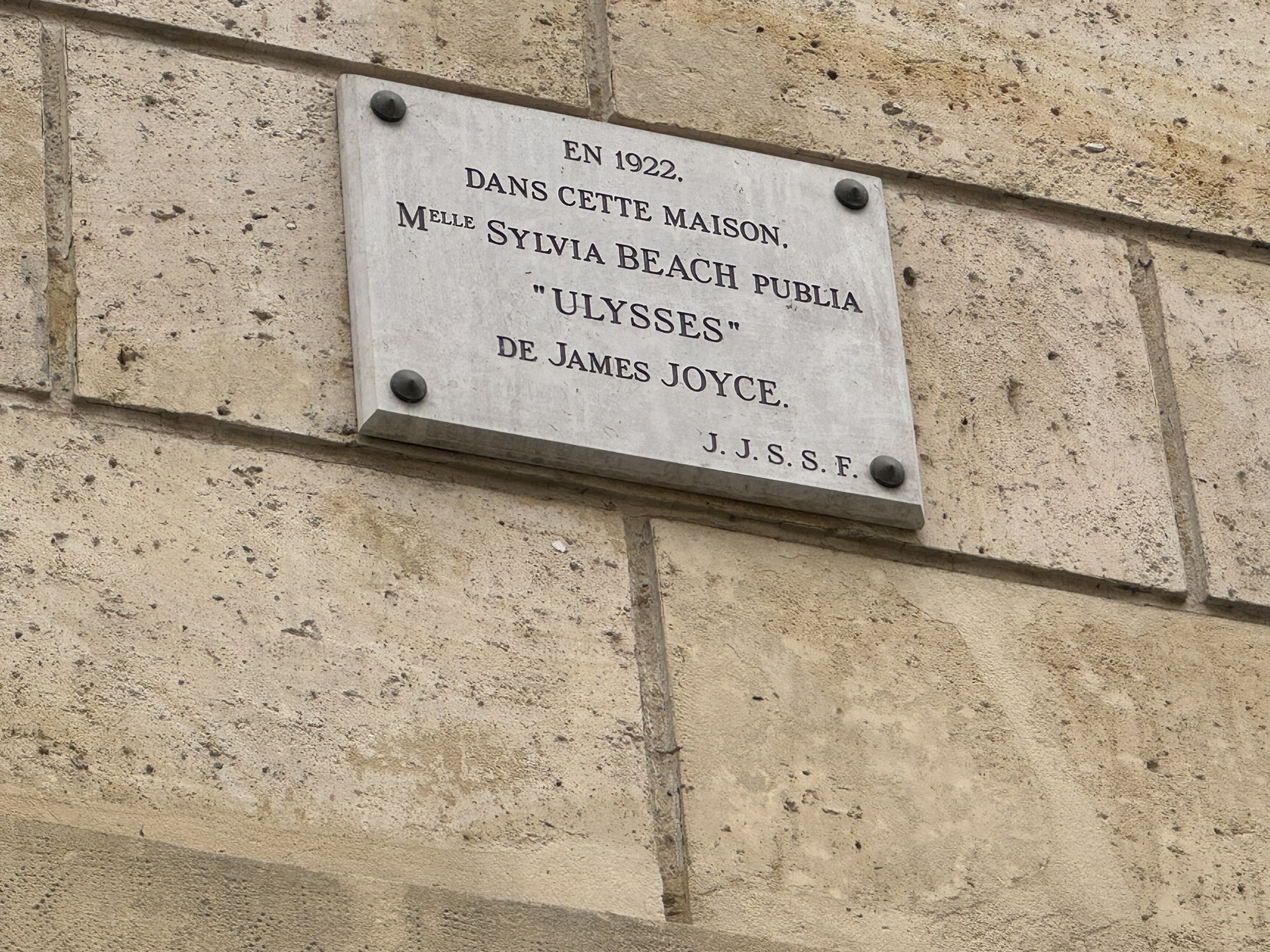
The address of her bookstore was 12 Rue de l’Odeon in the 6th arrondissement on the Left Bank. She was forced to close the store in 1941 because of the Nazi occupation of France during WWII, but she continued to live in her upstairs apartment, surrounded by her treasured book collection. Sylvia Beach died in 1962. Over the decades since her death, the first-floor location of the bookstore has been the home of various retail establishments. There is currently a Shakespeare and Company bookstore in Paris inspired by Beach’s store, but it is not at the original address. Even when my wife and I were in Paris in 2016, I decided it would not be worth our time to locate the original address since it was no longer a bookstore.

Original location of Shakespeare & Company Bookstore in Paris
Original location of Shakespeare and Company Bookstore in Paris

Fast forward to September 2024 when we were back in Paris again. Something almost miraculous happened to us on our last full day in the city. We visited the Luxembourg Garden and then strolled over to a nearby restaurant for lunch called the Le Hibou. We weren’t even paying attention to where we were walking after lunch, but we passed by a small clothing shop, Moicani, with some beautiful scarfs and decided to go in for a look. Jean Helfer, the affable proprietor, asked where we were from, and I said, “The States, in Missouri.” He replied in an almost reverential tone, “Do you know where you are standing right now?”

Original location of Shakespeare & Company Bookstore in Paris
Original location of Shakespeare and Company Bookstore in Paris

He pointed to a photograph of Sylvia Beach with Ernest Hemingway, in the very place I was standing! Totally by accident, we had stumbled on to the location of the original Shakespeare and Company bookstore. He handed me a brochure he has created giving a brief history of the bookstore, along with other addresses on the street of famous historical figures such as Gustave Flaubert and Thomas Paine. He was so gracious and kind. I was almost speechless the whole time we were in his shop.

What an incredible way to end our wonderful vacation in France. And yes, my wife bought a beautiful scarf!

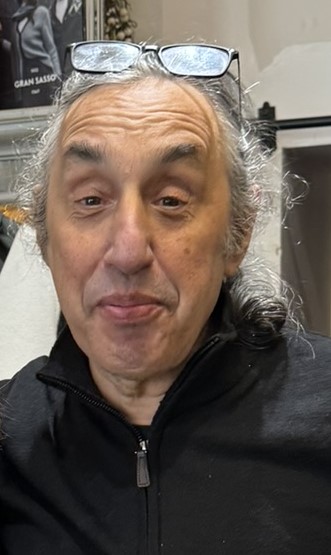
Jean Helfer - Moicani, Paris
Jean Helfer – Moicani, Paris

A Reading List for Library Nerds

The reason I can get away with such a derogatory title for this post is because I am a librarian, or at least I am by training, and for much of my career, by practice as well. Over the last few years, I have picked up several books, both fiction and nonfiction, that feature libraries or librarians as the primary subject. Here is an annotated list of these books, which I highly recommend to librarians, library patrons, or bibliophiles in general. Enjoy!

Library stacks
Library stacks

Nonfiction

The Library: A Fragile History by Andrew Pettigrew

In this dense and comprehensive history of libraries, the author also tells the story of the evolution of the book: its creation, distribution, preservation, and impact on civilization. He devotes considerable time discussing how private collections were the norm for libraries during most of recorded history and that public access is a relatively new phenomenon.

The fragile part of the history is illustrated by the many threats to books and the libraries that contain them, from natural disasters to warfare, from censorship to reduced support by private and government sources. The book begins and ends with perhaps the most famous library of the ancient world at Alexandria, which in some ways serves as a model for all libraries that followed. Written language is one of the hallmarks that separates our species from all the rest; therefore, the institutions that serve as repositories of written language must be considered as instrumental in documenting and preserving that distinction.

One of the more interesting takeaways from this book is how, at least until the modern era, fiction was held with such little regard by the literate elite of western society (and this book focuses on libraries of western civilization). Novels were even considered a corruptive force, especially as they were in such demand by women as a form of escape from the drudgery of living in subservience to their husbands, taking care of children, and maintaining the home.

The author contemplates the impact the digital age will have on books, which could be perceived as another threat to the library. It is reassuring that he observes how radio, movies, television, and computers may have competed for the attention of readers, but books and libraries continue to survive and at times even thrive in the age of mass media.

Overdue: Reckoning with the Public Library by Amanda Oliver

Public libraries and the services they provide usually reflect the communities where they are located. The public library where I was the director was medium sized in a county of about 43,000. We had our share of quirky folks, unruly adolescents, crusty curmudgeons, and houseless citizens among the day-to-day users who came in regularly to check out books or bring their children to story time. Also, our town had the state’s mental institution, which had been decentralized in the 1960s resulting in plenty of mentally ill people in government subsidized houses, or sometimes, just wandering the streets. As expected, many of them found their way to the library.

My public library was probably typical for a rural community in central Georgia — plenty of challenges but nothing too much out of the ordinary. By contrast, Amanda Oliver spent several years working in a public library in one of the toughest trenches a government employee can work: Washington DC. If there is a common thread running through her book, it is a sense of conflict the author feels about knowing how desperate many of her patrons were for help just to survive and trying to preserve her own mental health and physical safety while trying to assist them with their needs. She bemoans the fact that this country is woefully unable to take care of the poor and mentally ill, who have to rely on help wherever they can find it.

By their very nature, public libraries are places of refuge for the marginalized, and librarians are first responders, sometimes in the most literal sense. Oliver shares stories of having to administer first aid and other medical procedures for people with addiction and a whole host of health problems. She calls into question the role of the public library in a society that has abandoned those who are at most risk from economic insecurity and mental illness, including those with violent tendencies. She offers some chilling reports about librarians who have been injured or killed by crazed individuals who come through their doors. She reports how installing security equipment and hiring public safety personnel have become top priorities in many public libraries around the country.

On the bright side, it is clear that Oliver believes strongly in the mission of the public library to provide information services, very broadly defined, and to assist patrons with needs that have little or nothing to do with reading. In spite of how difficult her job was, she stayed committed to directing people to information, resources, and agencies they needed, sometimes just to survive. She effectively offers her readers a healthy, though not copious, collection of statistics to drive home her points. Perhaps the most encouraging stat of all for me was that the number of public libraries in America is greater than the number of Starbucks. We must be doing something right here.

The World’s Strongest Librarian by Josh Hanagarne

Hanagarne managed to write the funniest and the saddest book in this category at the same time. It is sad because the author has struggled so many years with a disorder that is so misunderstood and at times terribly debilitating. It is funny because Hanagarne manages to find humor even in the worst circumstances. His comic timing is quite good, with prose that reminds me so much of David Sedaris. Hanagarne makes his father sound remarkably similar to the way Sedaris makes his father sound. They both come off as crusty, no-nonsense guys who were forever trying to toughen up their children to face the “real world.”

Hanagarne’s memoir doesn’t focus nearly as much attention on his work as a librarian as it does his upbringing in a Mormon family facing the embarrassing and humiliating symptoms of Tourette Syndrome, which he personified by giving it a name – Misty (as in Miss T). His determination and tenacity in wrestling with his condition is inspiring. He never gave up. On the contrary, he often pushed himself into situations that anyone else with Tourette Syndrome would avoid, like choosing a profession that is traditionally associated with being quiet. And then he continued to bust open stereotypes by being a librarian AND a fitness enthusiast. It is not surprising that Hanagarne has found fitness regimens to be among the most successful tools in battling Tourettes.

From a confused childhood to the discovery and love of reading, from the awkwardness of making friends and dating to pushing through as a high school athlete, from pulling away from the faith of his parents to finding happiness in marriage and being a father, Hanagarne’s story is touching, heart wrenching, fascinating, and funny. And his use of Dewey Decimal System call numbers and subject headings as chapter leads is brilliant. Josh Hanagarne is a remarkable human being.

The Library Book by Susan Orlean

The author cleverly uses the Los Angeles Central Library fire in 1986 as her main hub to explore the history and culture of libraries. Her focus is generally on the Los Angeles system, but throughout the book she takes a few side roads to include libraries, past and present, in other locations in this country and around the world. Her deep appreciation of this ancient institution is abundantly evident throughout the book. She manages to take what so many people would consider a deadly boring topic and make it intriguing, fascinating even. Although at times the chapters read more like separate essays, some of which could easily stand alone, Orlean manages to make them flow together and connect as she unravels the mysteries surrounding the disaster in L.A. However, the real reason the book is a bestseller is because Orlean is such a good writer. The Library Book is a wonderful combination of biography, history, mystery, and investigative reporting.

I Was a Stripper Librarian by Kristy Cooper

Okay, yes, the title is titillating, the cover looks just a tad risque, and this is a self-published book. But, let’s immediately set aside our bibliographic elitism, decide we are NOT going to judge a book by its cover, and take an honest look at this memoir from someone who worked in two professions that, at least on the surface, seem like polar opposites. Kristy Cooper argues that being a stripper and a librarian are not nearly as different than most of us would think, and she provides enough examples to be convincing. Admittedly, this book cannot be taken as seriously as some of the other titles in this list — the authors are not trying to do the same thing here.

I suspect most Americans would be surprised to learn how many women and men enter the sex industry, as the author labels it (although stripping seems to stretch the definition to my way of thinking), in order to make ends meet or to get out of debt, especially student loans. A simple Google search on the topic brings up numerous TV spots and articles posted over the last few years about young folks who pay their way through college by stripping. Cooper is unapologetic about her decision to do the same — it was simply pragmatic. She tried other more conventional jobs, but none paid as well for the amount of time and labor required.

This book is well-written and interesting. Cooper does not come across as some bubble-headed babe trying to impress us with her lap-dancing talents, although some of the stories she shares are fascinating, troubling, and at times hilarious. Her vocabulary is impressive. Her writing style is rather simple and straightforward, but it works fine for this type of book. She assures her readers that there are plenty of people in the adult entertainment industry who are extremely intelligent, some of whom have advanced degrees like she does. Although she is no longer in the industry, she certainly advocates for it. She is also a remarkable champion for the library profession and has even established a nonprofit organization to facilitate her philanthropic work, especially for librarians.

Ultimately, readers will either approve or disapprove of Cooper’s dual occupational choice, but no one can deny that she made it work for her circumstances. She implies that stripping never made her feel dirty or immoral, but I have to wonder if the objectification factor eventually did a number on her. The best example, and perhaps the saddest to me, was when she was considering whether or not to get implants because her breasts were smaller than that of the average female strippers with whom she worked. Even though some of her male customers recommended she leave them alone, she knew that a bigger chest in a topless bar translated to more income. At one point she decided that her breasts were not really a part of her body as much as they were a commodity or resource for her craft. As true as that may be, I hated to hear it.

Fiction

The Midnight Library by Matt Haig

I read this book for an online book club I helped moderate for the university where I work, but I was intrigued by it when I first saw it reviewed in the New York Times Book Review. My honest assessment of this novel is that it is entertaining, but it still has more of a juvenile style to it, probably because Haig has written several books for children. The subject matter and language are clearly for an adult audience, but the plot and rhythm still feel more like a fairy tale to me, perhaps like a C. S. Lewis children’s novel.

The premise of The Midnight Library is very similar to the film “It’s a Wonderful Life.” The name of the town in the timeless holiday classic film is Bedford Falls; Nora’s album is called Pottersville; a character in the novel has the last name Bailey. (The author tweeted about this to a fan.) If we give too much thought to the mechanics behind the story – the impossible challenges presented by being inserted into the middle of an unfamiliar life – the novel doesn’t exactly “work” so well. I had to employ a type of dissociation to make it through.

Nora and Hugo discuss Schrödinger’s cat, the popular thought experiment that illustrates an apparent paradox of quantum superposition – alternate possibilities happening simultaneously. Is there a deeper meaning that Haig is trying to get at with this novel or is it just supposed to be an entertaining read? Is this a story that explores the concept of quantum mechanics and string theory? At any rate, Haig’s novel prompts readers to think (or rethink) how different their lives might have been had they made different choices along the way.

I am surprised at how much attention it received from major review sources, but then again, Haig is a journalist too, so there could be some professional courtesy going on as well. Haig does a good job of pulling the reader into the story. Most of us can imagine ourselves in Nora’s shoes and are compelled to speculate what decisions we would make given the circumstances.

The Personal Librarian by Marie Benedict and Victoria Christopher Murray

This may not be a great novel, but it is a good story based on the life of a real person. Belle da Costa Greene was J. P. Morgan’s personal librarian, an amazing African-American woman who was forced to hide her true identity and pass as white in order to succeed at an incredibly important job. Using biographies, personal papers, and secondary sources, the authors attempt to recreate the life and accomplishments of Greene, complete with her romantic relationships, her hardships, her family life, her savvy business dealings, and the struggles she faced through it all in keeping such a huge secret. In the category of historical fiction, this novel ranks among the best I have read. 

“The Rescue Mission”

The old woman in charge receives a call on the 
infernal cell phone she needs but curses daily
from the only person in town worthy of her friendship. 
“Someone told me your mule is out of her pen.”

A concerned resident whose property backs up
to the boundary of the farm’s north hayfield 
has seen the wayward beast grazing in his backyard.
“We thought she’d want to know where it is.”

The upsetting news comes late on this August day,
but if she follows the well-worn tractor path,
perhaps she will find her beloved companion in time.
“It’s dangerous for her to be out there after dark.”

Leaving her spirited dog at home, she sets out alone,
locking the gates behind her when she arrives
just as the sun punches holes through the line of trees.
“You’ll follow me back to your pasture if you see my car.”

Past the farmhouse, the utility shed, and the cow barn,
she steers through limbs heavy with green leaves 
reaching out and down, gently swaying as if to woo her.
“A good car is just what I need to help find my lost girl.”

She drives along the perimeter of the large rolling hayfield
but sees only a small gathering of whitetail deer 
grazing obliviously near the protection of the pine forest.
“Have you headed into the woods looking for water?” 

She notices a small clearing at the field’s northeast corner,
a red-clay trail sloping down into darkness and
just wide enough for her vehicle to clear the towering trunks.
“Poachers with their four-wheelers trespassing again.”

Gripping the wheel tightly, she creeps and descends deeper
now as dusk races toward her, distorting her sense
of distance and filling her with an inconceivable revelation.
“Is it really possible that I have made a mistake here?”

She is startled when the front of her car drops suddenly and
jolts her so violently that her glasses fall to the floor,
filling her field of vision with hazy, undistinguishable shapes.
“I should just go in reverse and back to where I started.”

She leans forward, and her fingers crawl over the floorboard
until she finds the glasses, slightly bent now at an
odd angle and no longer fitting properly over her cloudy eyes.
“Can you see the lights, girl? It’s time to go back home.”

The car won’t budge because the front wheels are buried
to the axle in a large trench caused by heavy rains,
and vulnerability wraps around her like a large blanket.
“I can call my man to bring his tractor and pull me out.”

The reality of her predicament rushes in when she sees
that her phone shows no cell signal at all out here
so far from the highway, and she is alone in the darkness.
“The horn will only attract strangers, if they even hear it.”

She turns off the car’s engine, fully reclining her seat and
closing her eyes to settle in for the night with one
final thought occupying her mind as the headlights cut off.
“I have nothing to fear because, after all, this is my place.”

She falls into fitful sleep infested with startling dreams
and unfamiliar noises of nocturnal creatures that
wander like restless spirits around her stranded chariot.
“I hope you found a safe place to rest tonight, sweet girl.”

An orange ball of fire on the horizon shoots soft beams
between the conifers and the dense morning fog,
piercing the windshield to bathe her face in warm light.
“If I start walking due east, I should find my way out.”

Grabbing her cane, she carefully exits the useless car,
then follows the sun and struggles up the hill until
she hears traffic and finally reaches the busy highway.
“I need to rest a bit and then decide what to do next.”

The salesman smoking outside at the used car lot across
the highway can’t quite believe his eyes as he sees
what looks like a mythical creature emerging from the trees.
“Who is that and where in hell did she come from?”

How Flannery O’Connor Became Human to Me

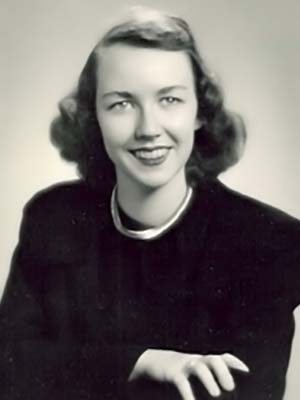
In an earlier blog post, I wrote about the day I accepted an offer from the lawyer representing the executors of the estate of the late author, Flannery O’Connor, to work for the executors to establish the Flannery O’Connor-Andalusia Foundation. Among other objectives, this nonprofit organization would be charged with preserving Andalusia, the farm where O’Connor lived the last 13 years of her life and where she completed her published books. The year was 2000, and I was serving as the director of the local public library. I had been a devoted fan of O’Connor from the time I had studied her work as an undergraduate English major at her alma mater, Georgia College. The institution was called Georgia State College for Women during the time Mary Flannery O’Connor was there in the 1940s. She was larger than life, as so many writers of fine literature are to me. I was in complete awe that someone could write a novel like Wise Blood at the age of 27. She is considered an artistic genius by critics, an intellectual force by most scholars, and even a candidate for sainthood by some of her fellow Catholics. She was almost mythical in my imagination.

Flannery O'Connor
Flannery O’Connor

I spent most of 2001 working with memorabilia and artifacts associated with O’Connor’s life and career as a writer. O’Connor’s mother, Regina Cline O’Connor, donated a collection of material to Georgia College six years after the author died. This gift included many of the manuscripts from O’Connor’s published works, along with much of her personal library. However, Regina O’Connor held onto a considerable archive of books, manuscripts, published and unpublished letters, photographs, visual art, cartoons, sketches, journals, notebooks, business and personal records, and juvenilia. I was charged with sorting through and organizing the archive, creating an inventory, and preserving the items using archival containers and methods of storage. The vast majority of that remaining archive is now reposited at Emory University in Atlanta.

I sifted through hundreds of images of O’Connor in posed and candid photographs from infancy to shortly before her death from lupus at age 39. Particularly touching were pictures of her as a young child with her father, Edward, who also died from lupus when she was only 15 years old. I held in my hands the cartoons and sketches that O’Connor created while she was in high school and college, with characters and captions that foreshadowed the wicked humor so central to her fiction as a seasoned writer. I read every letter to her mother when O’Connor was away at graduate school in Iowa, some of which revealed strong emotions as she seemed to be searching for her own voice and an identity independent of the Cline family based in Georgia and Massachusetts. I read through her personal journals where she articulated deep feelings, thoughts, and struggles. I suspect she would be more than embarrassed to know that one of those journals has been published as a monograph.

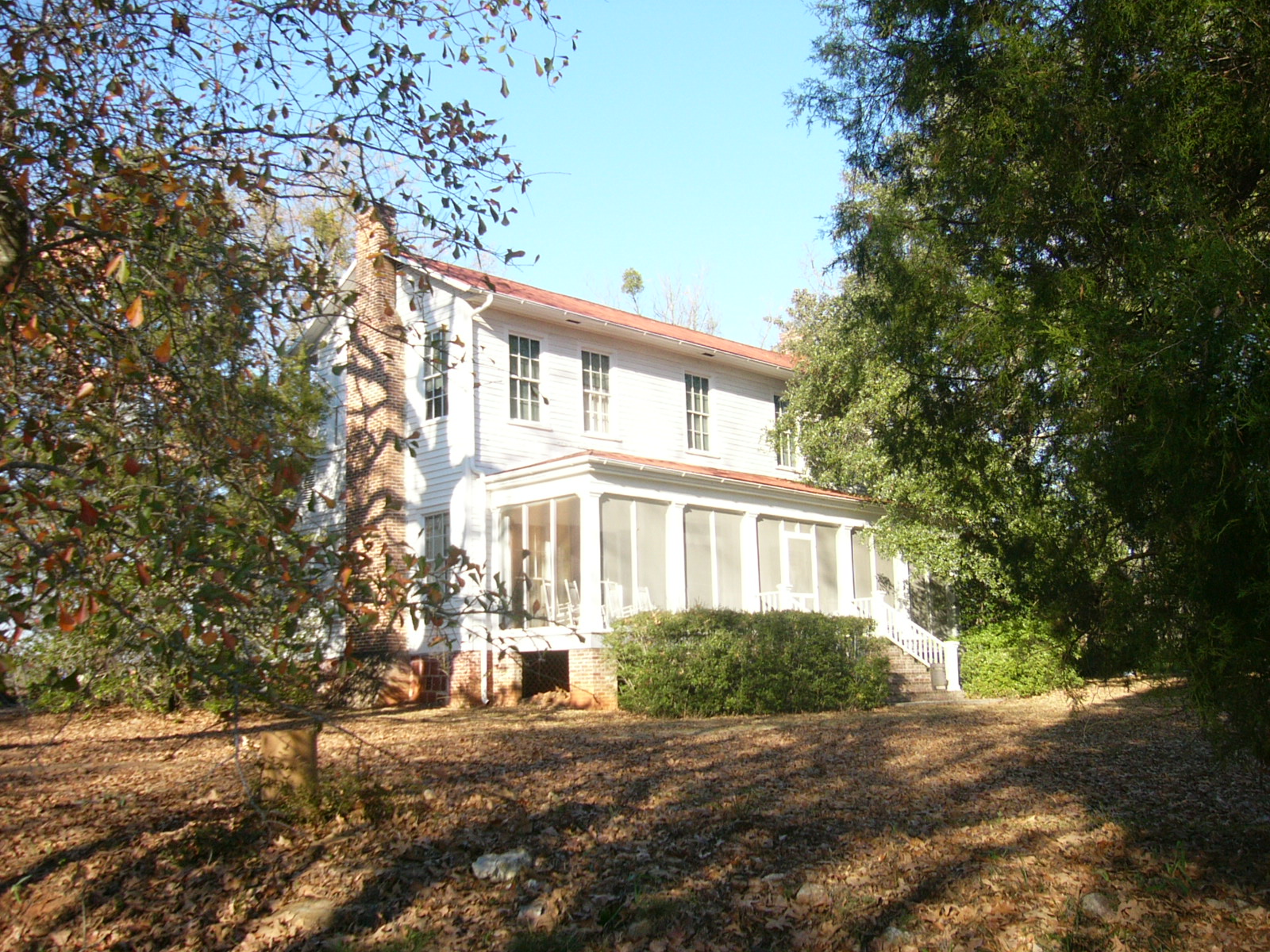
When the Flannery O’Connor-Andalusia Foundation was officially established in 2002, the board of directors hired me as the organization’s executive director. I collaborated with professionals to design plans for restoring and preserving the farm and launched a campaign to raise money for the work ahead, which was monumental considering the farm was 544 acres with a main house that was not exactly in stellar shape and a dozen outbuildings in various stages of serious deterioration. While preparing the main house for public tours, I touched or picked up almost every object in the two-story 19th century structure, including many of Flannery O’Connor’s personal effects that had been left in the house for over three decades: medicine bottles, paint brushes, clothing, furniture, furnishings, Catholic paraphernalia, and of course, her crutches.

Main house at Andalusia

Honestly, I felt a bit uncomfortable at times in O’Connor’s private space, even decades after her death. I always tried to be respectful and mindful of the intrusion, necessary as it was. I arranged her bedroom/study as much as possible to the way Robert Fitzgerald described it in his introduction to O’Connor’s posthumous short story collection, Everything That Rises Must Converge. He had visited Andalusia shortly after the author died. He described the austere conditions under which O’Connor had written some of the best fiction of the 20th century. Indeed, I always sensed a certain ascetic atmosphere whenever I walked into that room.

Sadly enough, when a diagnosis of lupus forced her back from Connecticut to live at Andalusia with her mother, Flannery O’Connor faced a situation where privacy was almost impossible.  A plaster wall with a connecting door separated her bedroom from her mother’s. The young writer had to adapt the first-floor sitting room on the main floor into her bedroom/study because the steep steps would have made walking upstairs an insurmountable challenge for her. The two women shared the only bathroom on the first floor. They ate almost every meal together, many of which were at the kitchen table. During the time I was working at the property, the kitchen was still equipped with the same table, sink, stove, cupboard, and the Hotpoint refrigerator O’Connor purchased with proceeds from the sale of the television rights to her short story, “The Life You Save May Be Your Own.”

Andalusia Farm kitchen

The house still contained much of what the O’Connors had when they lived there. The curtains that her mother had sewn while O’Connor was away on a speaking engagement were still covering the tall windows, clearly a hasty job performed by an otherwise gifted seamstress to avoid objections by the room’s unamenable occupant. On the mantle above the room’s fireplace, small photographs of grandparents in tarnished frames were nestled in with an assortment of novelties and knickknacks, several of which may have been gifts from some of her more unconventional long-distance friends.

Still hanging precariously in the bedroom window was the heavy air conditioner that O’Connor told one of her correspondents was an office supply, which she intended to write off her taxes. If the IRS questioned her, she had decided to argue that it “supplied” her office with cool air and was therefore a legitimate deduction. The humid summers of middle Georgia can be brutal and oppressive without air conditioning. Installed at the opening of the fireplace was a propane gas heater, which likely produced insufficient warmth on the coldest nights of the year to comfort O’Connor’s aching joints, under constant assault from disease and the effect of steroid treatments. She hated bitter cold temperatures, not only because of the physical pain they brought, but because they often resulted in frozen and burst pipes – no water, no plumbing. I can personally attest to the inadequacy of space heaters, which we were still using to heat the drafty old house while I was working there. The frigid air seeping in around the windows and doors and up through the hardwood floors chilled me to the bone. On some days, I wore two pairs of socks and thermal underwear in my office, formerly Regina O’Connor’s bedroom.

Mrs. O’Connor moved back into the Cline family home in town shortly after her daughter’s death, and the main house at Andalusia was never fully occupied again. No one was attempting to keep it clean or regulate the temperature. Regular maintenance was no longer a priority, although family members renovated the back portion of the house, replaced the roof, and rebuilt the front porch in the 1990s. The two-over-two spacious front rooms of the house, which included O’Connor’s bedroom, were mostly closed off for about 35 years. Time was not kind to the interior. Paint peeled and chipped away from the surfaces. The walls cracked, and in some places chunks of the horsehair plaster fell on furniture or to the floor. Insects took up permanent residence, along with the spiders who fed upon them and filled curtains and corners with cobwebs.

Flannery O'Connor's bed
Flannery O’Connor’s bed

I worked at Andalusia for 13 years, the same amount of time that Flannery O’Connor lived there. I was alone in the main house a lot of that time, especially before the visitor traffic picked up and the foundation hired a part-time staff member to assist with tours and other tasks. His name is Mark Jurgensen, and he was a lifesaver. During those 13 years, I don’t know how many times, probably hundreds, I paused at the doorway of O’Connor’s bedroom and contemplated what her life must have been like at Andalusia. My eyes wandered around that room with its small bed, beautiful barrister bookcases, reading chair, and the crutches leaning against the wardrobe. O’Connor stared at the back panels of that piece of wooden furniture that served as her closet for several hours each morning at her typewriter, with only a brilliant imagination to assist her in crafting such powerful stories, letters, essays, and speeches.

I thought about the physical challenges she faced, the emotional and mental anguish she must have endured, perhaps the occasional sense of despair, the hopes and dreams she shared with no one, the doubts that surely surfaced, and the questions that remained unanswered to the very end. I am not superstitious. I tend to discount the metaphysical. I could never embrace the faith that was central to O’Connor’s understanding of the universe. And yet, there were moments when I genuinely sensed her presence in that place, not as a spirit or a ghost as so many visitors to Andalusia were ever hopeful to encounter. For me, the presence was a memory of someone I had never met. It was the manifestation of a courageous woman with an unusual name whose fictional characters were so bizarre, yet I recognized them immediately. It was the reflection of a living, breathing person, with all the flaws and imperfections inherent in our species, but one with a remarkable gift that is rarely exhibited or nurtured. For so many of us who have trouble hearing and seeing clearly, what she left behind is extraordinary.

Note: Andalusia is now one of several historic properties of Georgia College, which is responsible for its preservation and interpretation. Learn more at https://www.gcsu.edu/andalusia

Georgia College is also host to the Andalusia Institute, a public arts and humanities center that supports Flannery O’Connor scholarship, nourishes writing and the creative arts, and engages community members with the arts and humanities. Learn more at https://www.gcsu.edu/andalusiainstitute

A Surprising Concurrence of Events

Perci Diaconis and Frederick Mosteller are two mathematicians who published a study in 1989 exploring the science behind coincidence, which they defined as “a surprising concurrence of events, perceived as meaningfully related, with no apparent causal connection.” They observed how coincidences “can alter the course of our lives; where we work and at what, whom we live with, and other basic features of daily existence . . . .” Lately, I have been contemplating the surprising concurrence of events that has led me to where I am now in 2020, at the age of 60, and approaching what I hope will be the final third of my life.

I have happily admitted on many occasions that I am the luckiest man I have ever met. Usually, I am referring to the good fortune of being married to my amazing wife, whom I adore and cherish. I also know that a series of key events and decisions over the last 55 years has determined the path I have taken in my career, and I couldn’t have predicted at an early age how rewarding this journey would be. Of course, there are plenty of people who have had similar experiences and have advanced so much further in their professions than I ever will. I also know that the success I have enjoyed is not completely due to my knowledge, talent, and skills – not by a long shot. Again, I am a lucky guy.

I can almost see my vocational journey as a hiking trail, with switchbacks and long winding stretches, ups and downs, a few chance encounters, forks in the path, even a few rocky sections, all of which have led me to this place. How much is serendipity and how much is deliberate, I can’t say with any certainty. Perhaps the trailhead took the form of a set of The World Book encyclopedia our family purchased in the early 1960s, when I was a young child. I can’t remember how old I was when I started thumbing through the pages to look at the photographs and illustrations, but it was definitely before I started school. The World Book gave me an early appreciation for books and reading, for independent learning, and even for order – the set was arranged alphabetically, as were the articles within each bound volume.

The first marker on the trail was likely my assignment as a library assistant in elementary school. I have no recollection why either my teacher or our school librarian selected me for this responsibility, but I vividly remember removing cards from the pockets of books checked out by my classmates, using a stamp to imprint the due date on the card and the slip in the book, and filing the card in an oblong wooden box (likely with the librarian’s help). At an early age, I was granted opportunities to fall in love with books and reading, which I did. Like many adolescent boys of my generation, I became an enthusiastic fan of science fiction books by writers who defined the genre for the 20th century, such as Isaac Asimov, Robert A. Heinlein, and Clifford D. Simak.

My love of libraries mirrored my love for reading at an early age, and I visited them as often as I could. I must have had a natural appreciation for language, and the classes in high school where I performed best were in English. I was fortunate to have three outstanding English teachers from 7th through 12th grade. I attended a small high school, and I had each of these teachers for two years. They made grammar interesting for me, and they helped me appreciate the power of the written word. Under their instruction, I discovered the difference between writing that only entertains and that which enlightens, enriches, and provokes the reader.

I also had a true fascination for the natural sciences, probably nurtured by hours of emersion in The World Book. When I started at the local community college, I had big dreams of someday working in the field of medical technology. I knew hardly anything about it. I thought working in a hospital would equate to lots of money and prestige, but I knew I wasn’t ambitious enough to slug through medical school to become a doctor. Turns out I wasn’t even ambitious enough to pass college chemistry – it looked too much like algebra, which to this day baffles me.

With encouragement from advisors and after a careful look at the curriculum requirements, I decided an Associate’s Degree in Journalism would be my best hope of staying in school. This switchback in the trail also prompted me to start writing for the college newspaper, and one of my assignments was to report on a lecture being presented by a woman who had recently edited a collection of letters by a Georgia author. I was painfully immature and had virtually no appreciation for academic scholarship. My first draft of the article reflected my stupidity and shallowness, which my journalism professor was quick to point out to me. I had no idea what an important contribution the visiting scholar, Sally Fitzgerald, had made to the world of American literature nor how her work would impact my own world in the years ahead.

After graduating from the community college, my trail took me on an uphill stretch to a state college located about 45 minutes from my hometown. By then I had decided that a degree in English was a logical choice, although I was clueless about how I was going to find a career after graduating. I can’t imagine how concerned my parents must have been. However, I was becoming more serious about academics and was confident that I was a good writer – foolish boy. A few seasoned students in the English department had warned me about one professor, a woman with a reputation for pounding the ignorance right out of you. I signed up for one of her classes my second term there, having at least enough self-awareness that I needed discipline and a challenge. The first paper she returned to me looked as if she had slit an artery and bled out on the page. Clearly, I wasn’t such a gifted writer after all.

Meeting this professor was one of those life-changing chance encounters. I was not aware when I first arrived at this institution that its most famous graduate was Flannery O’Connor. I also did not know that the library was the steward of her most valuable personal and professional archive. My fellow English majors had informed me that the demanding professor was also the O’Connor scholar on campus and that she taught a course concentrating on the author’s work. She was the editor of the Flannery O’Connor Bulletin, a journal published by the college and the longest running scholarly publication devoted to a female writer in the country. Perhaps as an act of academic penance and atonement, I signed up for the O’Connor course for the summer session, which meant covering the author’s two novels, two collections of short stories, a volume of essays, and the letters edited by Sally Fitzgerald (the scholar I encountered just two years earlier), all in four weeks.

I had no memory of reading O’Connor in high school and didn’t know what to expect. In this class, I quickly realized her fiction was dark, perhaps even demented to my naïve way of thinking. The Catholicism was lost on this Southern Baptist lad, at least in the beginning, but I immediately recognized the backwoods Protestants that populated her stories. They could have been my relatives. The stories were violent and filled with strange and twisted characters – no happy endings, no riding off into the sunset. People sometimes came to gruesome ends. And yet, it was laugh-out-loud funny to me. The best part of all? It was literature. I was unequivocally hooked. This course truly stretched me, and I was proud to get a B when it was over. I requested to change advisors, wanting to be under this professor’s guidance for the remainder of my undergraduate tenure. I could not have known at that time the central role she and her O’Connor course were to play in my professional journey.

I took history courses as electives in the humanities for my major, enough to earn a minor in the field. Knowing I really didn’t want to teach high school English, I decided to stay on at the college and work toward an M.A. in history. I was a much more serious student now, and my grade point average reflected it. On-campus jobs opened up for me too, like working at a small education museum and archive. This college gave M.A. students an option to earn their degrees by either writing a thesis or by taking additional course work. Maybe I wanted to prove to myself, my professors, and my parents who had sacrificed so much to send me to school that I could write something worthy of a graduate degree, even from a small state college. So, I climbed that steep slope by writing about the desegregation of the county school system where my college was located, using a collection of oral history interviews I conducted with local educators, both white and black.

My graduate school adviser and the supervisor of my thesis was a member of the local public library board. Upon my graduation, he was kind enough to get my foot in the door with the library’s director, who was planning to hire a cataloger. After working a year at the public library, the director encouraged me and another employee to apply for library school at Emory University. It was a two-hour drive from where we lived, but our boss was generous and supportive enough to allow us to work four days a week and commute to Atlanta two days a week over the next two years to earn what the university called a Master of Librarianship. I will always be grateful to her for this opportunity, which launched my professional career. I eventually became the assistant director of the library, and after 12 years I was appointed the director when my boss left the position. I have written another post about some of the more memorable and bizarre experiences during my time working at the public library.

I stayed connected with the O’Connor scholar on campus and worked with her on several projects, the most ambitious being the Flannery O’Connor symposium in 1994. This four-day conference featured celebrated scholars, writers, visual artists, and performers, including Joyce Carol Oates, Lee Smith, Jill McCorkle, Louise Erdrich, Barry Moser, Polly Holliday, Leo Kottke, and once again, Sally Fitzgerald. People from the community who knew me at all were aware that Flannery O’Connor was my favorite writer, including the lawyer for the literary estate of the author, whose wife also happened to work with me as our children’s librarian. In a blog post from 2015, I wrote about another life-altering event – the day this lawyer walked into my office with a proposal for me to work for the executors of the estate to establish the Flannery O’Connor-Andalusia Foundation. I accepted the offer. This fork in the path allowed me to use my English and history degrees, my library training, and my administrative experience to help preserve and promote the legacy of a great American writer — what a privilege.

My mentor at the state college eventually retired, but she joined the board of directors of the O’Connor foundation, along with the man who followed her in the position. Both people have influenced and enhanced my life in ways I could never express, and I am forever in their debt. One of the grant-funded projects I initiated as the director of the foundation was a book publication, co-edited by the new O’Connor scholar. At Home with Flannery O’Connor is a collection of oral histories of people who knew the author during the time she lived at her family’s farm home, the headquarters for the foundation that we also operated as a historic house museum. Fortunately, I was familiar with oral history as a research tool from my master’s thesis work.

Flannery O’Connor lived at Andalusia for 13 years, which is exactly how long I remained there as the foundation’s director. In 2017, the property was transferred to O’Connor’s alma mater; however, by that time I had moved on to another job because my wife took a vice-president position at a small private college in northeast Georgia. Earlier that year, the president of this college had accepted a gift of property just north of the campus owned by a foundation of relatives and close friends of another Georgia writer named Lillian Smith. The organization was operating the Lillian E. Smith Center as an artist retreat and a literary landmark while also sponsoring programs for students and community members. The college president wanted to continue these activities and expand the center as an educational facility for his students, faculty, and staff. He had no one to manage the center, and I was as close to a perfect fit for the job as he was going to find.

We stayed at our respective jobs with this college for five years. I am still amazed at how much of what I had learned during the previous 30 years prepared me for this position: from property management to programming, from cataloging to curating, from historic research to historic restoration and preservation. I was even able to resurrect some of my early work experience serving as the college archivist for the president and working with the dean of libraries. I have written posts about Lillian Smith and her encounter with Flannery O’Connor – so many surprising connections and convergences that have touched my life.

In 2018, other opportunities took us away from my home state to Missouri. Through a friend of a friend, I met the dean of libraries at a state college in southwest Missouri where we live now. I find myself once again in a place where I can tap into several decades of professional experience to work on meaningful and rewarding projects, and it all just fell in my lap. I am a special projects coordinator working for the dean. I arrange author visits, public readings, and lectures. I also help install exhibits in the library. I conduct interviews for the library’s growing oral history collection. I am moderating a virtual book club for the alumni of the institution. Contrary to popular opinion, librarians do not just sit around a read all day. I always dreamed of a job where I could get paid to read. How lucky am I that part of my responsibilities are to read for a book club? Even better, I am learning new skills involved with editing videos that the library publishes through its YouTube channel, including the oral history interviews.

My father had several common refrains that contribute to the good memories I have about him. For the most part, he was a man of unquestioning faith, instilled and confirmed by a long life of Southern Baptist doctrine. When he recognized a surprising concurrence of events, he rarely wrote it off as coincidence, especially if the events had serious implications. Instead, he would declare, “As far as I’m concerned, the Lord arranges these things.” With pseudo sophistication and agnostic arrogance, many times I just shook my head and said, “I guess so, Dad,” not really agreeing with his assessment of how the universe works. In retrospect, given how my career path has carried me through the years to such wonderful destinations, maybe I need to hold out the possibility that Dad was right.

Andalusia’s Outdoor Learning Center

When the Flannery O’Connor-Andalusia Foundation decided it was time in 2002 to make the author’s farm home in Milledgeville, Georgia, available for public tours, we began exploring various ways we could attract visitors to return to the property after they had already seen the house and outbuildings. Of course, the almost-worshipful fans of O’Connor would travel great distances to make the pilgrimage multiple times and never tire of standing at the door of her bedroom/study, strolling around the farm complex, or sitting in the rockers on the wide front porch to read, chat, or simply gaze across the lawn at the line of trees in the distance. I wrote a post about these folks several years back. However, as the director of the organization, I was charged with developing activities, programs, and attractions that would bring less-devoted visitors back to Andalusia, including locals.

During the thirteen years I was at Andalusia, we developed an annual lecture series, brought authors to the farm, hosted an annual Bluegrass concert, and worked with other institutions and organizations to sponsor various programs on site and around town. We also opened a gift shop that would bring local residents out to the farm, especially near the holidays. We welcomed groups to the property for school field trips, college classes, book club meetings, and even a wedding. Our ongoing restoration projects attracted people from around the state interested in historic preservation.

Bluegrass concert at Andalusia

All these efforts paid off and boosted the annual visitation numbers, which also increased revenue through sales, fees, and donations. The most ambitious project we undertook toward this end was designed to attract visitors who may not have much interest in O’Connor or her work at all – hard to imagine. Beginning in 2003, the Foundation applied for and received a series of grants from private organizations to develop an outdoor learning center. This long-term project helped us expand the interpretation of Andalusia by making the natural connection between O’Connor’s work and the landscape that inspired so much of it.

A good portion of Andalusia is covered in trees, with open fields interspersed across the property. In some areas, the forest is dense enough to act as a buffer from the encroaching development that surrounds Andalusia. A common image in many of O’Connor’s stories is a line of trees, which often serves as a metaphorical passageway to revelation. The woods can be an area of sanctuary or the place for terrifying encounters. At other times, trees are personified, like witnesses to the events unfolding in the story.

The first phase of the outdoor learning center was the renovation of a half-acre livestock pond located down the hill and in view from the front porch of the main house. The pond dated back to the 1950s when the farm was operating as a dairy. Understandably, when in 1976 the PBS producers were looking for a location to shoot their film adaptation of O’Connor’s short story, “The Displaced Person,” they selected Andalusia. Both the opening and closing scenes of that movie were filmed from the dam of the pond, looking back up the hill at the main house. We hired a local independent contractor who had retired from the U.S. Soil and Conservation Department. His team drained the old pond and completely rebuilt the dam with a new drainage pipe. It took several months for the spring fed pond to completely fill again. It was beautiful.

Restored pond and main house at Andalusia

All visitors to O’Connor’s home could appreciate this easily accessible water feature, but for her readers, the pond may have taken on even greater significance. As a devout Roman Catholic, Flannery O’Connor understood the symbolic importance of water, especially the Sacrament of Baptism, and incorporated the theme in her fiction. To many of O’Connor’s characters, water represents purity, initiation, sanctuary, and salvation.  Water provides both literal and figurative cleansing. Some of the most climactic scenes in her fiction involve water.

Restored pond at Andalusia

The second phase of the project took several years to fully accomplish and consisted of two nature trails. The first was a short trail around the pond. The second was a much longer trail through the forest taking off on either side of the dam of the pond. Again, we hired our local pond builder to design the trail and cut the eight-foot wide path through the trees. In two places it crossed Tobler Creek, which runs through the middle of the 544-acre property. In the following years after the trail’s completion, we installed bridges over the creek, other foot bridges over wet areas, benches and picnic tables, and interpretive signs. We were fortunate to have plenty of volunteers from the community, from Georgia College in Milledgeville, and from boy scout troops to help with these enhancements to the trail.

Bridge over Tobler Creek at Andalusia

Again, this feature of the property is attractive to a broad audience, including school groups and locals looking for a place to enjoy the outdoors and perhaps to get a glance at wildlife. Andalusia is home to a variety of birds, mammals, reptiles, and amphibians.  Natural stands of pine and hardwoods, along with the open field areas, are ideal habitats for deer, songbirds, dove, quail, turkey, and squirrels.  The undergrowth in the forest offers an environment suitable for smaller animals such as rabbits, chipmunks, armadillos, lizards, and snakes.  The waterways and floodplains provide food and shelter for beavers, frogs, turtles, and aquatic birds, including the great blue heron.  Natural predators on the property include foxes, coyotes, and birds of prey such as hawks and owls.

Nature trail at Andalusia

In 2010, the Foundation decided to name the outdoor learning center after Dr. Bernard McHugh Cline, an uncle of Flannery O’Connor. Dr. Cline was a physician who practiced in Atlanta and acquired the Andalusia property in the early 1930s. He enjoyed raising and riding horses on the farm when he came down from Atlanta on the weekends. Dr. Cline also purchased wooded tracts to the north of the farm from other owners, which remained undeveloped for many years as a wildlife preserve.

Nature trail at Andalusia

The development of the outdoor learning center added to the aesthetic value of Andalusia, but it also provided funding opportunities from grants and donations that even extended beyond the outdoor resources. A major organization that supported the nature trail’s construction later made a significant gift toward the restoration of one of the outbuildings at the farm. Professors and students used the pond and trails to conduct various experiments and to identify and catalog the flora and fauna there. The Foundation hosted workshops, lectures, and other programs exploring the natural resources of the center. I was as pleased with the outcome of this project as I was with any of our accomplishments at Andalusia.


In Memory of My Good Friend, Joyce

I met Joyce in “The Commuter” office at the junior college where I began my tenure in higher education. “The Commuter” was the student newspaper, aptly named because there were no residential students at the institution. As I recall, the office was just a small interior room in the student union building, which also housed the offices of student services, a short-order grill, and a room with several billiard tables where I spent way too much time as a freshman resulting in a quarter marked with the stigma of scholastic probation.

By the time I met Joyce, I was gaining clarity and getting more serious about academics, learning to accept some of the responsibility that accompanied the freedom of the college experience. I had also given up on the dream of majoring in biology after encountering chemistry at the college level and discovering it was nothing more than higher math hiding behind glass beakers and Bunsen burners. English classes were always my favorite in high school and where I consistently made the best grades. With encouragement from advisors and after a careful look at the curriculum requirements, I decided an Associate’s Degree in Journalism would be my best hope of staying in school. A wonderful benefit from choosing that path was the friendship I developed with Joyce.

Joyce must have been about 40 years old when I met her. She would have been labeled as a non-traditional student by the college faculty. I’m almost certain she was divorced by then and had several sons, probably ranging from teenagers to young adults. I do not recall if she was returning to school or if she had just decided later in life to pursue a college education. I also don’t remember if she were actually seeking a degree in journalism or just liked writing for the newspaper. I don’t know if she ever received a degree. Our friendship started in 1979, so my recollection of details that long ago is foggy.

Joyce was a contemporary of the two professors, a man and a woman, who ran the journalism program. It was a new experience for me to have a classmate who was halfway in age between me and my parents (I was a “late” child). Junior colleges and community colleges tend to attract nontraditional students, and our institution was no exception. I knew several others by name, but I didn’t associate with them outside our mutual classes, nor did I stay in touch with them after graduating. I knew at the time that Joyce’s life was not an easy one, a stark contrast to my own. She had challenges that I simply could not appreciate at the time – a single mother trying to make ends meet while going to college and taking care of the mundane frustrations of adulthood. Honestly, I will never fully comprehend how tough her journey must have been.

After graduating from the junior college, I left my hometown to pursue my education further at another state school about 45 minutes away; however, I continued to come home on the weekends to work at a grocery store, go out with a girlfriend from high school, wash clothes, and attend church. Being raised in a Southern Baptist church, that last part of the routine was expected and not even questioned. When I wasn’t out on a weekend date, I would often visit Joyce, usually after I left work at 9:00 or 10:00 in the evening. She lived in an apartment complex not far from my home. Perhaps she still had a son living with her at that time, but I don’t recall seeing anyone regularly.

When I arrived, Joyce would ask if I wanted her to put on a pot of coffee, and I imagine the answer was “please” most of the time. She typically drank instant iced tea during my visits. Even though I was of legal age by then, I was always under the influence of Baptist temperance and never alcohol. I don’t remember ever seeing Joyce imbibe. We would sit at her kitchen table sipping our drinks and smoking cigarettes. Joyce was practically a professional smoker, never letting more than a few minutes pass without lighting up. By comparison, I was a novice, only picking up smoking while being around it so much at work and with the journalism students. Although I never would smoke around my parents (my father had quit when I was a child), my mother knew I was doing it and was greatly disappointed.

I’m sure there were plenty of times when Joyce would rather have been alone or was too exhausted to spend a late evening with me, but she never failed to open the door. I probably never called in advance – just showed up like the impertinent, clueless guy I was back then. I don’t know how many times I stayed past midnight, but it was more than once or twice. We sat at that kitchen table and had conversations deeper than my green intellect and Bible-saturated head could properly process. We talked about life, death, love, sex, religion, and more. She was widely read and had a sharp, critical mind. She was full of compassion and never judgmental, but she hated injustice and had no time for moral superiority. Although I don’t remember, I must have taken my guitar with me a few times and sang for Joyce – probably to get her opinion on songs I was composing. I shudder to imagine what she thought of my efforts, but I’m certain she smiled and encouraged me just the same.

Sometimes Joyce would tell me about the latest trouble one of her sons had landed in, which usually involved an arrest and charges for violations associated with drug use. Her eldest son was the one who no doubt kept her up at night when I wasn’t around. She spent so much time pleading with law enforcement officers, prosecutors, lawyers, and influential friends, always defending him unconditionally regardless of the circumstances. Her love was true and unwavering.

After earning my B.A. in English, I decided to stay on at the same college and work towards an M.A. in history. I started working on campus and had no reason to return home every weekend, which meant my visits to see Joyce eventually ended. However, we stayed in touch through correspondence after I graduated, got married, and started a family. I can recall getting thick envelopes with multiple pages of hand-written letters from her, filled mostly with her thoughts about current events and books or the latest news, good or bad, about her sons. She was a much better correspondent than I was. I kept her letters in a box for many years, and I painfully regret that at some point I disposed of them, probably during a move to a new house.

In the mid-1990s, Joyce was diagnosed with an inoperable brain tumor that would ultimately take her life. She got in touch with me and asked me to sing two songs at her memorial service that was going to be held at the Unitarian church. I have no idea if Joyce was a member there or ever attended, but Unitarianism would have been about the only brand of Christianity Joyce could have tolerated. Up to that point, death was more of an abstraction to me, manifested primarily in family visitations and funerals. Joyce’s death was perhaps my first real confrontation with mortality. I visited her once while she was in the hospital to talk about the songs. I was woefully unprepared to fathom the finality she was facing, and I remember asking her, “How are you doing?” She could have easily shot back with, “How the hell do you think I’m doing? I am dying for Christ’s sake!” Instead, she told me she was having a lot of anxiety but that the doctor was giving her medication to help. Gracious, as ever.

Her request was that I accompany myself on the guitar and create two medleys of four songs in the following combinations: “Graceland” by Paul Simon and “In Your Time” by Bob Seger along with “Circle” by Harry Chapin and “Will the Circle Be Unbroken,” a popular Christian hymn written by Ada R. Habershon in 1907. I was more nervous singing those songs than I had ever been up to that point. I had to get it right – no mistakes. I suppose I did. I was honored that Joyce had asked this favor of me. But now, 25 years later, I understand clearly that I didn’t do Joyce a favor at all. Like so many times in the past with our late-night conversations, her sage advice, her endless patience, and her enduring friendship, Joyce was giving me one last gift. She was confirming that I mattered to her, and that my modest musical talent was a worthy expression of my love for her. I am forever grateful, and I am a better human being because of Joyce.