
Schooled by the President

My wife and I joined a group of people from our community to mark off another travel experience bucket list item. In this case, the distance from home was short enough for a road trip. We traveled through pines and vast farmland to the little village of Plains, Georgia, where we gathered with a couple of hundred other people before sunrise in anticipation of the big event: Sunday School at Maranatha Baptist Church. Okay, I haven’t attended Sunday School in over twelve years, and we could have easily found a class to attend much closer to home, but the teacher wouldn’t have been the 39th President of the United States.

Jimmy Carter has been teaching Sunday School for most of his life, reportedly even during his presidency (1977-1981). However, in recent years his class at Maranatha Baptist Church has been drawing capacity crowds, especially after his diagnosis of brain cancer in 2015. This health scare may have interrupted his teaching, but it didn’t stop it. He teaches his class in the church’s sanctuary that seats about 350 people when filled to capacity, and there is an overflow adjacent room that seats 100 more people who watch  via video feed. The 93-year-old former Commander in Chief is still greeting anywhere from several dozen to a few hundred pilgrims multiple times throughout the year for a 45-minute session, although there are rumors that he will scale back if not completely stop teaching sometime this year (2018).

The charming little red-brick church is tucked in a pecan grove a couple of miles outside the center of Plains, a hamlet of less than 800 people where Jimmy Carter was born and raised and the place he and First Lady, Rosalynn, still call home. No part of the state defines “rural Georgia” better than its southwest section, and Plains is a bonafide representative. Maranatha Baptist Church looks like so many other little churches I have seen and visited during my life. The members are equally familiar: genuine, proud, polite, but above all in this case, fiercely respectful and protective of their world-famous congregant. Those who are charged with orchestrating this unusual ministry of the church do so with humility, humor, grace, and above all, efficiency.

The church’s website advises attendees to arrive no later than 6:00 a.m. in case the crowd is large. We arrive at ten after the hour. Entrance to the sanctuary is based on a simple numbering system. When we pull into the dirt driveway of the property, a friendly fellow welcomes us and hands us through the car window a slip of paper with a sequential number indicating what will later be our place in the lineup to file into the church. We are number 58 — obviously not quite as committed as 57 other sojourners, the earliest of which we later learn arrived at 4:00 a.m.

Like many activities that combine religious practice with celebrity status, the President’s Sunday School class attracts an eclectic assembly that writers like Chaucer would find fascinating, as do we. One notable example is the chap who arrives in a mint-condition Model-T, sporting the requisite hat/goggle combination and accompanied by an extraordinarily tall tabby cat that he walks among the pecan trees on a leash. We learn that he is just beginning a long journey across the country to visit various attractions, an adventure he will record in a travelogue — think Steinbeck’s Travels with Charley, the feline version.

On the Sundays the Carters are attending, the glaring distinction of this church is the early and abundant presence of law enforcement, which includes local sheriff deputies and at least six Secret Service agents, complete with bomb-sniffing dogs canvassing the exterior of the church building and weaving their way through the herd of vehicles parked under the trees behind the church. A member of our group observes what a misnomer “Secret Service” is to describe a team of people at a little country church dressed all in black with sunglasses and ear pieces, handguns clearly visible. Their service is no secret whatsoever. During the hour of worship that follows his class, President Carter sits in a pew next to one of the two center aisles (the Carters are indeed members at Maranatha). There are agents at the entrances to the building and one agent sitting directly behind him. Every time President Carter stands with the rest of the congregation, the agent stands and shifts his own position slightly out into the aisle just behind Carter’s left shoulder — an added measure of protection. Without a doubt, we are attending the safest worship service in the state that morning.

On the Sunday we attend, illness has descended upon a significant portion of the congregation, including Rosalynn Carter who is recovering from surgery in Atlanta. A few of the members are having to pull double duty. Jan is the fearless and funny woman, school teacher turned event coordinator, who lines everyone up outside and gets them ready to go through security and enter the church. She is joined by several other members inside who provide instructions for the Presidential encounter, all the dos and don’ts that are expected, including no applause for the President. We are reminded this is church, not a campaign rally. Jan also plays the piano later in the morning for the worship service. Shortly before the teacher enters the sanctuary, the recently-installed pastor, at the ripe age of 23, provides a Q&A about himself, his family, the church, and the Carters. Another woman who helps with the orientation before the President’s arrival identifies herself with the last name “Carter,” and someone in the audience asks if there is any relation. She replies, “Yes. Billy Carter was my father.” Later that morning, this jovial niece of the President returns to the podium to lead the singing — the music minister is out that day involved in a church-related activity out of town. They are a resourceful and flexible church family.
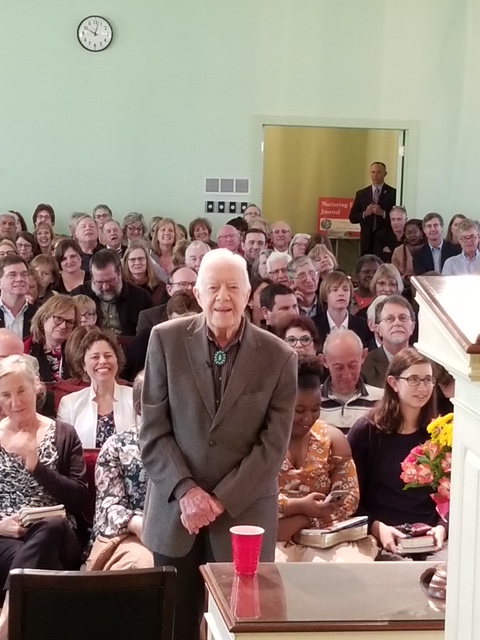
President Jimmy Carter


President Carter could not be more charming. We just barely make the cut to get in the sanctuary and are sitting in the choir loft behind him, but he graciously turns around to include us. He spends the first few minutes greeting everyone and asking, by sections of pews, “where are ya’ll from?” Place names are shouted out: Maine, Texas, Canada, Illinois, Kentucky, Colorado, and many others. We are amazed by the distance some of these folks have traveled to hear a great statesman with humble beginnings speak of a faith that has no doubt sustained him through trials that would crumble most of us.

Jimmy Carter is judged harshly these days by so many of our population who consider his presidency to be lackluster at best and a dismal failure at its worst. He faced insurmountable challenges and horrible crises while in office, and admittedly some of his decisions perhaps did not serve the country well. Many of his accomplishments in the White House are overlooked now, but he should always be remembered for brokering a peaceful resolution demonstrated by a handshake between a Jewish prime minister and a Muslim president that undoubtedly saved many, many lives in the Middle East and beyond. Also, no one denies his decades of post-Presidential humanitarian achievements with Habitat for Humanity, the Carter Center, monitoring elections around the world, and so much more. To my way of thinking, he is a remarkable testimony to the charity and love most often identified with Jesus, the one he calls Savior. In the end, his Sunday School lesson always comes back to that simple but profound profession of faith.

Decorating for Christmas

Aside from gorging on turkey and football, one of the strongest impulses generated by Thanksgiving Day among so many Americans is the urge to head to the attic, basement, or garage and pull out the holiday decorations. At this time of year, any sense of good taste is tossed out like moldy green-bean casserole that was pushed to the back of the refrigerator and forgotten for two weeks. Thanks to the development of inexpensive plastic, PVC, fiberglass, large-scale inflatable statuary, and sophisticated electrical components, some American homes and properties are transformed into dazzling spectacles that almost put to shame the illuminated facades of Las Vegas casino resorts.

The amount of time, energy, and financial resources that families dedicate to decorating varies considerably, but I suspect those who celebrate Christmas tend to be a bit more profuse than their Jewish counterparts. Muslims and Hindus use much less extravagant decorations for their special celebrations at other times of the year. Even among the folks who celebrate Christmas, the amount and type of decorations are quite diverse, with everything from simple nativity scenes to the construction of a North Pole Reindeer Flight School in the front yard that backs up neighborhood traffic for several blocks. The true zealots start their decorating activities the week before Thanksgiving, perhaps even earlier, and it can take them up to two weeks to get the job completely finished. I know a family that puts up a Christmas tree in every single room of the house, including miniature versions in all three bathrooms.

Such enthusiasts have a difficult time giving any decoration a well-deserved sabbatical or even retirement. They have an attachment to or fondness of every piece they ever purchased, so decorating through the years has a cumulative effect. At some point, all surfaces of the house are adorned with festive accessories in an attempt to display every single item they have accumulated. It can be a tad overwhelming. Some manage to pull it off better than others. Lest I be perceived as a decorating snob, I hastily confess that I have in years past clearly fallen into the camp of the unrestrained and over-exuberant. My wife has done an admirable job of intervening and helping me understand that less is better when it comes to Christmas ornamentation.

Christmas Tree and decorations

For most of its history, Christianity has been a remarkably adaptable religion, which partly explains its rapid expansion after the 4th century and its durability throughout a good portion of the western world and across many different cultures. A fine example of this adaptability can be found in Christmas decorations. Ancient Romans brought evergreen trees into their homes to celebrate the winter solstice. They also hung bright metal ornaments on trees around their homes. Pagan societies believed that the holly bush had magical qualities to repel evil spirits. Even beyond decorations, Christians managed to incorporate customs from other faith traditions into the celebration of Christmas.

Americans are a population heavily influenced by capitalism and commercialism. We market everything, including Christmas. We are also a flexible bunch, and we don’t mind bending the truth a little to sell the product. Again, we can see this characteristic exhibited in a fairly common holiday decoration: the nativity scene. We like to portray this pivotal point in human history as a nice package that can easily fit on a small side table or night stand. So we take all the elements of the story — the baby Jesus in the manger, Mary, Joseph, angels, the shepherds, the ox, the donkey, the star, and the wise men with their camels — and we fold them altogether into one, compact decoration. It is irrelevant that the wise men were not there on the night of the Christ child’s birth but at least a month or so later (perhaps much later) after he was presented at the Temple by his parents. We cannot be expected to have a separate set of figurines in the house to represent this part of the story. After all, we need to make room somewhere for a sleigh and eight or nine reindeer too!

The older I get, the more I appreciate celebrating the spirit of Christmas with simplicity and humility. Over the decades I have purchased, displayed, and discarded any number of decorations. I have suffered through finding just the right tree at a farm in the country, cutting it down, paying way too much for it, and hauling it home only to find that once we wrestled it into the stand, it was as crooked as a Washington politician. We have gone through several different artificial trees and are thrilled with the two we have now, one inside and one on our back porch, that came with lights already installed. Over the last few years we have started buying what my wife calls “timeless” decorations — pieces that are reminiscent of generations past. Some people would refer to them as classic decorations. A close friend of ours paints marvelous Santa faces on gourds, and we include our collection of them on the living room mantel every year.

There are two decorations that my wife and I cherish perhaps more than any others, and we put them out every year then carefully store them away until the next Christmas. One is a small, resin angel that her parents gave her when she was a child. It is beautiful and precious. The other is a little plastic illuminated church that houses a manually-wound chime player that plays “Silent Night.” It belonged to my mother, a woman to whom the Christmas story was fundamental and factual. The miraculous birth of Jesus was a mystery she embraced without question, with little or no struggle. She has been gone now for over a dozen Christmases, but that little church keeps the memory of her fresh and close for me. I am grateful to have this modest decoration that is somehow a perfect expression of her faith and this holiday.

Church and angel
Church and angel

Flannery O’Connor: A Born Writer

“He’s a born politician.” “She’s a born actress.” “He’s a born preacher.” “She’s a born lawyer.” These are examples of an expression I heard often when I was a young man describing someone who seems to possess an innate talent or skill for a profession or avocation. People who excel in this fashion often exhibited certain predispositions at an early age that their family and friends recall and associate with their success. I am not qualified to comment on the influences of DNA over environment in determining aptitude, but most of us can remember that one child who seemed almost obsessed with a certain activity, pursuit, or area of interest and eventually grew up to turn that fixation into a lifelong career.

  • The librarian who as a child organized into collections and sub-collections every single book, DVD, and CD in the house
  • The biology teacher who as a child captured and studied every living creature within a one-mile radius of home and could spout off a half dozen facts about almost any major species
  • The information technologist and software architect who as a child voraciously read encyclopedias and was fascinated by computers and programming (think young Bill Gates)

When I served as the director of the Flannery O’Connor-Andalusia Foundation in Milledgeville, Georgia, I frequently gave presentations about O’Connor, which included a brief overview of her life that was cut short at the age of 39 from the effects of lupus. Along with many others who have studied her life and work, I perceived that Flannery O’Connor was indeed a born writer. I’m sure the same case could be made for any number of writers, but I know much more about the childhood of Flannery O’Connor than any other author.

Mary Flannery O’Connor (her full name) was born in 1925 in Savannah, Georgia, and was the only child of Edward and Regina O’Connor.  She was raised by a Catholic family that sometimes viewed children much like small versions of adults, a perspective largely abandoned by the 19th century. Young Mary Flannery thrived in this atmosphere. She was a bold, precocious little girl who took herself quite seriously. She referred to her parents by their first names, not “Daddy” or “Momma.” When he was away from home, her father wrote her affectionate letters that he playfully addressed to “Lord Flannery,” and she would sign her correspondence to him with the same title, addressing them to “King of Siam.”

Young Mary Flannery was encouraged to read, and perhaps the most recognizable photograph from her childhood shows her in profile sitting with a large book in her lap, staring down at the page with a look of determined concentration. She would later use that same fierce gaze to observe the world around her and depict it through a grotesque and outrageous filter. As a young reader she collected a small library of familiar children’s titles and took the liberty of writing brief reviews on the flyleaf or title page of the books. Always assertively opinionated, the young critic praised some books as “First rate,” while others, such as Georgina Finds Herself, she dismissed as “the worst book I have read next to Pinnochio.” It is worth noting that, at the height of her career, Flannery O’Connor wrote more than a hundred book reviews for two Catholic diocesan newspapers in Georgia. Also, she carried to adulthood her sharp words in assessing the value of books, as is illustrated in her acidic comments about the works of other southern writers such as Carson McCullers, Truman Capote, and Tennessee Williams. To put it in today’s vernacular, she was savage.

Not unlike many bright children, Mary Flannery wrote stories from her own imagination. Some of them were about animals with human characteristics, which is a typical theme explored by aspiring young writers. However, she went a few steps further than most children. Not only did she write clever and often hilarious stories, she also illustrated them, bound them with yarn, and made multiple copies of them to distribute to friends and family.  She was absolutely fascinated by the whole process of both writing and publishing, which later translated to a keen understanding of writing as a profession. The volume of her published letters, The Habit of Being, includes correspondence to her agent, editors, publishers, and other professionals in the book industry where O’Connor demonstrated shrewd business acumen.

As a high school and undergraduate college student, Mary Flannery turned her artistic energy to cartoons, which she created through sketching and drawing but more elaborately through printing with linoleum blocks. Although she ended up in the Iowa Writers’ Workshop under the direction of Paul Engle, she initially entered graduate school at Iowa thanks to a scholarship in journalism — she intended to pursue a career as a cartoonist. O’Connor’s biting satire and wicked humor were clearly developing even as a cartoonist, not just in the illustrations, but perhaps even more so in the captions. Some critics have argued that, as a mature fiction writer, Flannery O’Connor continued to exhibit the eye of a cartoonist in the creation of her most exaggerated characters. Little wonder that, when asked why her stories were so shocking, O’Connor explained “for the almost blind, you draw large and starling figures.”

In the private journals Flannery O’Connor kept as a college student, she undoubtedly believed that being an artist was so much more than a career choice.  It was a vocation. As she focused her attention toward writing, O’Connor yearned for her work to be used by God. She wanted to craft stories that would miraculously reveal God’s grace. As she matured into one of the greatest writers of the 20th century, she became less sentimental, but she never lost her appreciation for the mystery of art as it is interpreted by the Church, to which she remained devoted for the rest of her life. Perhaps she returned to the intensity of her younger years. She certainly became much more confident. When repeatedly asked why she decided to become a writer, without hesitation O’Connor always replied, “Because I’m good at it.”

Most of us get some level of education and eventually find a job that, with any luck, will get us out of our parents’ hair and their bank accounts. We will end up with about five different full-time jobs before we finally clock out for the last time, and our career paths will largely be determined by factors such as education, employment opportunities, salary, family obligations, and just plain old simple fate. But for a select few, a seed will be planted at a very early age that will germinate into a thriving métier that brings with it fulfillment and a deep sense of purpose. The term from my Southern Baptist heritage was “a calling.” The vocation of writing for Flannery O’Connor required serious devotion, discipline, sacrifice, and a form of genius that appears only a few times in each generation of artists. She was born with an incredible gift, which she carefully and skillfully nurtured, and her readers are the fortunate beneficiaries.

The Omega Point: Where Science and Religion Converge

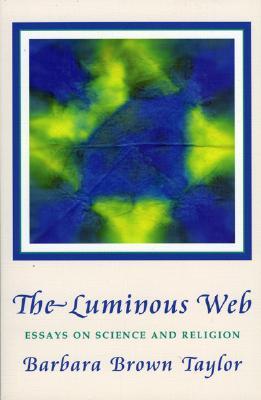
I just finished reading The Luminous Web by Barbara Brown Taylor. This is the fourth book I have read by Taylor, and although it is not her best-known work, I think this short essay collection is very fine. Admittedly, my praise of the book comes out of my deep interest in the intersection (or polarization) of science and religion. Most scientists will not find it as compelling as those who are sympathetic to religious belief or even spirituality. Published in 2000, the book is perhaps somewhat dated now, but the principle thesis and the keen observations are still perfectly relevant. Taylor is a priest and a professor of religion with a sincere interest in science, which places her in good company with some of the greatest minds in history, going back to the Middle Ages with Thomas Aquinas and up to the 20th century with people like Pierre Teilhard de Chardin, who was both a priest and a scientist. I think Rev. Dr. Taylor believes in and is always searching for what Teilhard de Chardin named the “Omega Point,” that evolutionary conclusion where God and the physical universe are united, or as some have phrased it, a “divine unification.” To Taylor, God is not superseded by science nor is God made irrelevant by the scientific method.  She clings to the idea that science and religion are equally in pursuit of the truth — the former in its exploration and explanation of the physical universe and the latter in its attempts to find meaning and purpose.

The Luminous Web by Barbara Brown Taylor

I have been reading popular books on science and religion for about thirty years. I am drawn to authors who tend to challenge or even shatter long-held assumptions about religion, mainly Christianity since that is the faith of my heritage. In addition to Barbara Brown Taylor, a few that come to mind are Marcus Borg, John Dominic Crossan, Bart D. Ehrman, Philip Gulley, and James Mulholland. In recent years I have also been reading books by the modern atheists and humanists, like Carl Sagan, Stephen J. Gould, Richard Dawkins, Christopher Hitchens, Greg M. Epstein, Edward O. Wilson, Eugenie C. Scott, and Jerry A. Coyne. All of these writers have addressed the friction created where science and religion meet.

I certainly have issues with organized religion, although I am a member of the Episcopal Church. I am repelled by evangelical Christianity, fundamentalist factions across the globe, radical sects of all faiths, and any religious practice that results in division, discrimination, sexism, racism, and superiority. At the same time, I cannot agree with some of the modern atheists who have decided that all religion is superstitious nonsense with no purpose, no value to humanity. Some of these scholars claim that religion is not just a benign fantasy but a dangerous threat to the survival of humanity.  To judge religion based on the manner in which it is too often adulterated by immoral clergy, zealots, dictators, and politicians, to my way of thinking, is similar to faulting science when technology is used by power-hungry leaders to make weapons of mass destruction.

Some scientists posit that, since the beginning of the Enlightenment, science has been rapidly replacing religion as a unified explanation for all existence. In other words, we don’t need religion anymore. As much as Dawkins and others have tried to make the case of science’s ability to answer all our questions, I believe there will always be significant gaps. My argument for the existence and validity of religion is primarily built on its longevity, that it has been a hallmark of hominids at least as far back as the Neanderthals. Evolutionary theory teaches us that nature selects what will and will not survive based on characteristics such as fitness, adaptability, necessity, and the ability to pass on vital information from one generation to the next.  It works for genes, language, technology, and yes, religion. Humans have passed down faith and myth for thousands of years, not because they are entertained by them, but because they need them.

As contemplative animals who are consciously aware of their existence, their past, and their possible future, humans have evolved a thirst for answers to questions about our place in the universe, how it all began, and the meaning of life. But, we also need a practice to help us appreciate and absorb emotion, beauty, and a whole host of other experiences. Sometimes science falls short, not because of what is yet undiscovered, but because so many people need the most treasured part of life to remain a mystery. Is religion nothing more than a panacea? Is it “the opium of the people” as Karl Marx observed? Is it a vestige that we will eventually slough off like dead skin? I suppose it’s possible, but I don’t think that we will see that next stage in our evolutionary development nearly as soon as some of our atheist friends are predicting.

Godless Ethics

Good Without God by Greg M. Epstein is a nice overview of how people who do not believe in God live an ethical life, how they are charitable, loving, compassionate, fulfilled, and inspired without religion as their primary motivation. Epstein is obviously trying to soften the message of the irreligious that has been expressed by leading atheists with sarcasm, indignation, and even rudeness. In some sense, he is playing the role of a modern Thomas Aquinas, the Angelic Doctor who is trying to find consensus between the religious and the secular world.

It does seem to me, especially toward the end of the book, that Epstein is attempting to find ways in which humanists can enjoy the worldly fruits of religion through culture and ritual, as if living a humanist life without the type of community that faith offers is empty or disconnected. No doubt, his Jewish heritage is coming into play here, which he fully discloses. Perhaps this perspective also comes out of his role as a humanist chaplain (still an odd title for a humanist in my opinion) at Harvard.

I get the sense that he thinks the creation of humanists organizations that look and function like churches, synagogues, or mosques will somehow make humanism more “competitive” or more attractive or perhaps even more palatable to the skeptics or the indecisive. It reminds me of vegetarians and vegans who eat foods that are considered meat substitutes because they crave meat but won’t eat it. I think humanists can find community and social interaction outside organizations that look and sound like religious ones. In fact, I would venture to say that plenty of believers find their most meaningful connections outside their religious circles.

This is a very accessible book that is well written, thoughtful, and completely unoffensive to left-leaning, progressive readers. Evangelicals and other orthodox or fundamentalist faithful will hate it. There is no doubt that Epstein was very encouraged by the election of Obama, which occurred one year before the book was published. For people who were raised in strong religious environments but now find themselves in the camp with agnostics or even atheists, Epstein’s conclusions can be reaffirming, perhaps even comforting.

.

The Terrorist Name Game

I have understood all along why President Obama has resisted using terms like “Muslim extremists” or “radical Muslims” to identify terrorists who pervert Islam for evil purposes. Peaceful Muslims in this country are in a precarious state. However, his resistance to associate some terrorists acts with fundamentalist Muslims denies the very real danger presented by radical religious practice everywhere. Islam does not have a monopoly on terrorists who claim to be part of a religion. Peace-loving Christians have no trouble distinguishing the faith they practice from the hate-filled ideology of the Westboro Baptists or the KKKs of this country, but they rarely deny that these groups are identified with Christianity. They may call them fundamentalists, evangelicals, zealots, nutcases, or even ultra-conservatives, or they may use quotation marks to imply they are not truly “Christians” at all, but they don’t call them atheists or agnostics either. Bands of Hindu radicals have been responsible for murdering scores of Muslims and Christians. We need to accept the fact that evil people use religions — all religions — as excuses to carry out horrific acts of violence.

I tend to agree with some commentators lately who have started identifying ISIS as a cult, a term that typically has negative connotations for most people, especially people of faith. Just to clarify, I am thinking in terms of the ISIS organization. Even though the recent Orlando shooter apparently invoked the name of Allah in his 911 call, that doesn’t necessarily put him in the league with ISIS, and it certainly doesn’t qualify him to be a Muslim as it is defined by millions of members of that faith around the world. I am quite sure that assassins throughout history have shouted “God’s will be done” before committing similar acts of cowardliness and evil. Doing so did not make them Christians in my view. At the same time, the only real difference between a cult and a religion is the number of people who claim allegiance. I do think we need to recognize that some of these attacks on our soil are inspired by maniacs with a warped, perverted sense of religion. Sometimes it’s Christianity; other times it’s Islam. Ignoring that fact doesn’t help us understand the motivations any better and may actually hinder us from addressing this global problem.

I don’t really think that the labels the President or anyone else chooses to use to describe these monsters are going to diminish their zeal and their thirst for blood, but I do think understanding their identification with the religion can be helpful in combating them. Rather than marginalizing peaceful Muslims, perhaps we can get more of them to help us stamp out the “cult.” Peace-loving Christians sat in church with KKK members for decades, and probably still do now. The KKK certainly fits the description of a cult in my mind, and I would bet my next paycheck that a lot of people outside the Christian faith would identify the KKK as a Christian cult or a perverted Christian organization because of the language and symbols used by the organization. I have never heard anyone claim that the KKK was an independent cult that has no identification with Christianity. They would have said the same about Koresh’s clan. I can remember growing up in a Baptist church and being taught that Mormons were members of a cult, yet almost any scholarly treatment of Mormonism identifies it as a Protestant denomination. In other words, it is very difficult to define what a cult is, and most cults historically have had their roots in existing religions. We ignore what inspires young people to join radical, hateful groups at our peril, and a perverted affiliation with a major world religion is a strong incentive for a weak, impressionable mind.

The way many people distinguish violent religious fanatics from the mainstream practitioners is by claiming that the fanatics aren’t practicing the “true” faith. And yet, the pro-lifer who turns murderer by bombing an abortion clinic may embrace all the trappings of Christian practice: attending church regularly, giving to Christian charitable causes, praying every day, reading the Bible, etc. He believes that he is doing God’s will by sacrificing the evil doctor who, in his mind, is murdering the unborn. As twisted as he is in his thinking, he still identifies with fundamental Christian beliefs, many of which he will justify with the Bible. His friends and acquaintances will identify him as a Christian, and some of them will continue to do so after he commits murder, even though they may not condone his actions. They will say things like “his convictions were strong, but he went about it the wrong way.” The real irony is that the abortion doctor may actually believe many of the same tenants of the faith that his killer does. I think this same paradigm is sometimes at play with ISIS members and their sympathizers. Most peaceful Muslims are horrified by their actions and are in fact victims of their evil deeds. But I don’t think we can escape that a perverted interpretation of Islam is what drives ISIS and what attracts sympathizers.  Again, as peaceful people, we ignore that unavoidable truth at our own risk and by doing so hinder our ability to overcome terrorism in all its manifestations.

Evangelicals and the Problem of Free Will

Having been raised as a Southern Baptist, I was taught from a very early age that the Bible is God’s holy word, that it is infallible, and that it presents humanity with essentially a road map of how to live on earth and how to ensure one’s soul goes to be with God in heaven for all eternity after life on earth is over.  The central truth of the Bible is the work of God’s only son, Jesus, on the cross.  The only source of salvation and forgiveness of sins is through his death and resurrection.  This is still the basic creed of all Christian evangelicals, not just Baptists.  As the Christian fundamentalist movement swept through the South in the 1970s, the dogma became more emphatic, especially the concept of the Bible being inerrant.  I can remember pastors only half-joking when they stood in their pulpits, held the Bible up over their heads, and said, “I believe every word of this book.  Even when it says ‘genuine leather’ on the cover, I believe it!”

Evangelicals believe that God loves his creation and that he also has desires, the strongest of which is for humanity to return his love.  Humans express this love by obeying God’s commandments.  But, above all, humans demonstrate their devotion to God by believing that Jesus is his only son and that accepting his sacrificial death as atonement for their natural sinful state miraculously repairs the fallen relationship with God (Adam, Eve, rotten fruit, etc.).  Again, for evangelicals this part of the plan is crucial.  It is only the cleansing power of the blood of Jesus that can bring God and humanity together, which not only empowers humans to obey God’s commandments but also grants their souls an eternity with Jesus, who is actually God in human form just to complicate matters further.  The alternative is rejecting God and facing an eternity in hell — complete separation from God with a whole lot of torture, anguish, teeth gnashing, ill-tempered serpents, and the like.  God wants humans to love him, and by its very definition, love is something that has to be voluntary.  God doesn’t force humans to love him, which wouldn’t be genuine love.  Humans have the freedom to either love God or reject him, another key component of the whole arrangement.

Another part of the Baptist training was embracing the perfect nature of God.  The Bible is infallible because it is inspired, if not ghost authored, by God himself.  God is omnipotent and omniscient — there is nothing God cannot do, although he certainly elects not to do plenty of things.  All options are open to him.  He knows everything that has ever happened and will happen, past and future.  In fact, everything that happens ultimately conforms to God’s will.  So even the most mortal sins committed by humanity, although contrary to God’s wishes, eventually fold into the greater plan of God for the universe.  God’s will is unavoidable.  When I was growing up, it would have been inconceivable that there could be anything that God didn’t already know.  The evidence for this concept for evangelicals is found in the Bible in Jeremiah 1:5. “Before I formed you in the womb I knew you, before you were born I set you apart; I appointed you as a prophet to the nations.”  Putting aside the fact that this verse refers specifically to the Hebrew prophet Jeremiah, my fellow Baptists cited this verse as proof that God knows individuals, and individual souls, before they are conceived and born.  Remember, time is irrelevant for God. Past, present, and future are all in his command.

Now we come to the problem that is free will.  As stated earlier, evangelicals adhere to the principle that God loves humanity and wants his love returned.  John 3:16 is probably the most important verse in the entire Bible to evangelicals: “For God so loved the world that he gave his one and only Son, that whoever believes in him shall not perish but have eternal life.”  People are given the option to believe that Jesus is God’s son and that his sacrifice is the source of their salvation and relationship with God. However, it is painfully obvious that millions, if not billions, of people do not accept Jesus as their savior and therefore miss the salvation boat altogether.  Which brings us to the troubling question about the true personality of God.  If indeed God knows everything, and if he is not constrained by time, and if he knows all that is going to happen, then it reasonably follows that he knows which individuals will return his love and which ones will reject him, before they are even born.  Given this premise, it follows that the God who can do anything actually chooses to allow people to be born even though he knows they will ultimately reject him and thus be cursed to an eternity in hell.  Is this lais·sez-faire approach the only means by which God can secure the love of humanity?  Do billions of people have to be cast into hell to gather a minority of people who will love God, accept his gift of salvation, and share eternity with him?

Evangelicals who adopt this paradigm are faced with a God who is at once all-loving while also being extremely negligent of the majority of those he apparently loves.  In the case of humanity’s free will, God is obviously electing not to impose his omnipotence and letting humanity chart its eternal course.  Is this a situation where God is simply choosing not to know something?  Keeping secrets from himself?  If we think about this for more than a minute or two, we must come to terms with a God who is “writing off” a significant portion of the population as damned, when he could have easily spared them an eternity of torment by not allowing them to be born in the first place.  As a father, I would do anything within my power to prevent my son from committing suicide, especially if I could ensure that he had a bright future.  What kind of father would I be if I didn’t attempt to intervene?  Given the same circumstances, most fathers would do the same.  If parents could know, without a shadow of a doubt, that they were going to conceive a child who would suffer horrific pain for an entire lifetime, would they elect to have such a child just for the sake of starting a family?  Are we more compassionate than God?  Free will doesn’t seem like such a valuable gift when we consider the stakes.  If this is God’s plan for getting the love he wants, what does this really tell us about God?  Something’s missing here.  It’s a problem.

Worship Without Music

As stated previously in this blog, I was raised in a Southern Baptist Church (SBC).  Generally speaking, Southern Baptist worship, especially during the main service on Sunday mornings, could be described as a passive experience by the majority of people present, namely the congregation.  There are a couple of exceptions.  In recent decades, it has become popular to insert a time of greeting around the midway point of the service, which involves handshaking, hugging, some folks walking all around the sanctuary to apparently greet as many people as possible until forced by embarrassment to finally get back to their seat.  This practice is not limited to the Baptists either.  The only other part of a SBC service that encourages participation by everyone in the sanctuary is music, and for Baptists, music is a central part of worship.  SBCs give music a lot of space and time, from large pianos and organs for traditional worship services, to full-scale bands for “praise” services, and even small orchestras for the mega-churches.  They include several hymns for the congregation to join together singing.  SBCs also tend to employ full-time ministers of music, who typically are paid better than other support staff in most denominations with comparable-sized churches.  They typically have choirs for all age groups, along with an adult choir that practices weekly to present calls-to-worship, anthems, benedictions, etc.  Some churches even have special musical groups like hand-bell choirs, vocal or instrumental ensembles, and pop bands.

The format of worship in a SBC was certainly a suitable environment for my development with respect to the central role of music.  I was raised in a family that appreciated music, had some musical abilities, but above all encouraged musical skill and performance in my generation of youngsters.  My sister and I both took music lessons — she with the piano and I with the guitar.  I was brought up to sing church songs from a very early age, even before I can remember.  My earliest memory of singing was when my mother and grandmother took me out in the countryside to visit a bedridden relative of my grandmother (a sister or cousin, I’m not sure which), and I was instructed to sing a short song I had learned in Sunday School.  The song was titled “He’s Able.”  I still remember the words and the tune to this day:

He’s able, He’s able, I know He’s able
I know my Lord is able to carry me through
He healed the broken hearted, and he set the captive free
He made the lame to walk again, and He caused the blind to see
He’s able, He’s able, I know He’s able
I know my Lord is able to carry me through

As I became a teenager, my guitar skills developed enough that I could accompany myself singing, and could also play for youth group gatherings in my church.  My voice also matured to a fairly solid tenor, perhaps with a higher range than most guys my age.  I sang in choirs, performed at church functions (often with my sister and a cousin), and eventually reached what some would have considered the pinnacle of the music scene in a SBC — presenting “the special” during Sunday morning worship.  This song, typically a solo but sometimes a duet or trio, was usually placed in the service just before the pastor’s sermon.  For the 40+ years I was in a SBC, that part of the music service was always referred to by ministers and congregants as “the special” or “special music.”  Unfortunately, a label like that can encourage a certain sense of pride, if not arrogance, by the person offered such a place of distinction.

My love for music at an early age, combined with the ability to play the guitar (fair, but not very skilled) and a voice that my friends and family thought was pleasant, presented me with the opportunity to be a regular part of the special music rotation, almost always as a solo.  As I grew to adulthood, moved away from home, and started a family, I settled in another SBC where I continued with this practice.  I taught myself to play the piano and eventually began to accompany myself with that instrument.  It is with humility and perhaps some shame now that I look back on the decades of my musical contributions as a soloist because I realize that, all too often, I know what I was doing more than anything else was performing.  More than providing a meaningful worship experience for myself and the congregation, I was seeking to be an entertainer, to impress an audience, to attract their attention, to win their love.  So many people in SBCs will tell you that music is essential to their worship experience.  They will boast about their choir and exalt their music ministers.  But, they usually reserve their highest admiration for the people who perform special music, posting or sharing videos of them on their social media pages.  I enjoyed this kind of adulation all the time, and it was a rush.  My fellow church members were kind and gracious, and I have no doubt they were perfectly sincere when they told me how much a song I sang or wrote meant to them and enhanced their worship experience. I was touched by their encouragement, but what I craved was to amaze them.  Alas, I am vain.

After a divorce and a time of transitioning away from the Baptist church (I had left it theologically many years before), I met a beautiful Episcopalian.  And then I married her.  Everything changed, and for the better — much better.  I found a home in the Episcopal Church, with a theology that I could embrace without too much difficulty.  My wife introduced me to an early morning service at our small town church that she really liked because it was quiet, peaceful, reverent, and completely without music.  I had never been to such a service, and much to my surprise, I loved this style of worship.  After decades of being in churches where music was so central and where I was such a visible participant, it took me a while to understand why I was attracted to a service without music.  I think it is because I know that music was too often a distraction for me.  Instead of helping me get beyond myself to seek communion with the divine, it fed my ego and kept me in the foreground.  Performing caused me to focus on technique, style, quality, and even appearance.  It was way too much about me.

My wife and I have moved and are at another parish now.  They don’t have a service without music yet, although the priest has talked about introducing one.  There is resistance from the parish, which is to be expected.  I hope we can try it at some point. I will never stop loving music, and that includes church music.  And, I can certainly enjoy a worship service with music, even if I’m not at all familiar with so many of the songs from the Episcopal tradition.  In a way, that’s a good place to be.  It’s awfully hard to perform a song you don’t know very well.

God is a Gambler. Who Knew? (Part 2)

(continued from January 29, 2016)

If you tell students that the Book of Job illustrates how human beings are easily dispensable to God, who is quite willing to use them to prove a point, they don’t exactly embrace this vision too comfortably.  Nevertheless, it is difficult to read this story and not come away with a less-than-flattering description of God’s nature.  When God turns Job over to Satan, the evil one goes to work quickly.  In short order, all of Job’s livestock and servants are killed, along with ten of his children.  Poor Job tears his clothes and shaves his head in mourning, but he still blesses God in his prayers, which prompts Satan to return to God to increase the stakes.  To further prove how strong Job’s faith really is, God allows Satan to inflict physical torment on the poor guy.  Afflicted with horrible skin sores, Job is in so much misery that his wife encourages him to curse God, give up the struggle, and die.  Still Job stands fast and continues to honor God.

You can push a person so far though, and Job comes close to reaching his limit.  His close friends offer him philosophical rhetoric to bring him comfort and to explain his horrible predicament, and they even try to convince him that he must have done something to anger God — repent and all will be well.  One of his pals, Elihu, explains that physical suffering helps the victim to comprehend God’s love and forgiveness when he finally is well again, knowing that God has rescued him from misery.  Again, what a disturbing view of God’s relationship to humanity!  Job doesn’t buy it.  He is confident in his righteousness and refuses to admit to uncommitted sins.  Still, he grows weary and finally gets a bit demanding of God, and goes so far as to express his wish that he had never been born.  From an ancient Hebrew perspective, this just may be where he crosses the line and prompts God to blast him with what could be the best poetry in the Bible, even though much is certainly lost in the translation.

Out of a mighty whirlwind, God poses a series of blistering, rhetorical questions to Job, most of which begin with the phrase “Where were you . . . ,” which are designed to show Job how ignorant he is of the majesty of creation and how magnificent God truly is.  After he picks himself up out of a heap, good old Job admits to the limitations of his human knowledge, a response that apparently pleases God.  According to many Biblical scholars, the original story (which is one of the oldest in the Bible) ends at this point.  However, in the Biblical narrative, the plot continues, and God returns Job’s health and even more property than he had before.  God blesses Job with new children and gives him an extremely long life as an added bonus.  Of course, one could argue that property can easily be replaced, but ten children?  In the end, God won the bet and proved Satan wrong, which is the most important thing to remember, right?  As I stated before, a tad disconcerting.

The reason that the Book of Job is so important in Hebrew literature, or any literature for that matter, is because it creatively explores the age-old question of why an omnipotent God allows good people to suffer.  After all, Job isn’t selected as the pawn in this contest between God and Satan because he is bad, but because he is the best.  For modern Christians, especially those who espouse the prosperity gospel so popular in America, Job’s story presents quite a quandary.  If you follow God’s commands and live a life of righteousness, you just may come to ruin as a reward for your faithfulness!  Somehow I doubt Joel Osteen preaches from Job very often — I could be wrong.

Considering that the ancient Hebrews had no concept of personal eternity and were convinced that, as God’s chosen people, they were fulfilling God’s plan for creation and living up to their side of the covenant with God, this story becomes somewhat more palatable for the modern reader.  The Hebrews were commanded by God to be fruitful and multiply, to spread across the land, and to bear witness to God’s preeminence among all other deities.  There is no room in this arrangement for the wish of never having been born.  The survival and well-being of the individual was vastly overshadowed by the importance of the survival and fruition of the Hebrew nation.  The suggestion is that human beings should not dare question God’s divine justice because they cannot possibly appreciate its complexity.

What I find particularly fascinating is how the Book of Job serves as an excellent foreshadow for the coming of Christ and his sacrificial death to save humanity.  Jesus wasn’t chosen to face horrible agony because he was a rotten sinner.  Jesus was sent by God to suffer because he was the spotless lamb.  With all respect and deference to the modern descendants of the Hebrew nation and culture, the story of the New Testament messiah conveniently “resurrects” the suffering servant, who even has his own moments of doubt and questioning in the garden.  This is the same Jesus who charges those who profess to love him to take up their cross and follow him.  I guess you could say that’s just part of the deal.

God is a Gambler. Who Knew? (Part 1)

For ten years, I taught a freshman course covering the first half of world history as an adjunct instructor at a small public liberal arts college.  I knew that a good portion of my students had been raised in Protestant homes, and most were probably very active in their home churches.  Because so much of early world history ends up being a class in comparative religions, I thought it only fair to give my students the following disclaimer on the first day of class: “I am the college teacher your preacher warned you about.”  I knew that much of what I was going to cover about the origins of the world’s major religions, including Christianity, was going to be met with some resistance.  A few students probably thought I was an agent of Satan.  Having come out of a fundamentalist Christian background (Southern Baptist), I could certainly sympathize with that position.

What I thought would be particularly helpful was to spend quality time talking about a book from the Old Testament in the Bible, the work that is raised to the level of idolatry by so many pastors and their congregants.  By looking at the book as both a work of literature and as holy scripture, I attempted to help them see some basic tenants of their faith from a different angle than what they were exposed to in church.  I hoped to offer a bit more historical context too, helping my students understand the genesis of three of the world’s religions: Judaism, Christianity, and Islam.  The book I chose is my favorite of the wisdom literature from the Biblical Hebrew tradition and one that I think is most representative of that tradition.  This book does such a good job of exploring the complexity of the human condition, especially as it is impacted by faith.  The book I selected was Job.

The major reason that Job is such a good book to teach to students who are familiar with Bible stories from church is because it presents all kinds of challenges to the traditional image of God and the accepted nature of God’s relationship to humanity.  Here we have the story the takes off with a discussion between God and Satan about a man named Job.  God is obviously very proud of Job, who seems to be the model of human creation.  In a little chat with Satan, God says, “Have you considered my servant Job? There is no one on earth like him; he is blameless and upright, a man who fears God and shuns evil.”  Of course, this is taken as a direct challenge to God’s adversary, Satan, who claims that Job is such a swell guy only because God is taking very good care of him.  After all, Job is wealthy, has a large family, and performs purification rituals for his family even when he knows of nothing they have done wrong.  He is described as the greatest man among all the people of the region.

So Satan decides to make a little bet with God, just to prove God wrong.  Satan presents God with this challenge concerning Job’s welfare: “Stretch out your hand and strike everything he has, and he will surely curse you to your face.”  And how does the creator of all the universe, including Job but also Satan and his minions, respond to this challenge?  Does God dismiss it as petty?  Does God make clear to Satan that God doesn’t need to prove anything to anyone?  Well, no.  Essentially God’s response to Satan is, “Oh yea?  Is that what you think?  Fine then!  You’re on!!”  In verse twelve of the Book of Job, we read:  “The Lord said to Satan, ‘Very well, then, everything he has is in your power, but on the man himself do not lay a finger.’”  The deck may be stacked in God’s favor, but still, God apparently likes to play the game!  Who knew?  And, the events that unfold after this exchange between God and Satan present us with a view of the deity that is both unexpected and just a tad disconcerting.