Near a place called Blood Mountain in the Chattahoochee National Forest in north Georgia, the Appalachian Trail makes a steep descent south towards a place called Neels Gap. The Trail crosses Highway 19/129 just a few miles south of Vogel State Park at a historic site called Walasi-Yi Interpretive Center. The stone façade of the Center has been standing at Neels Gap since 1937. Originally a log structure, the building took its present form when it was rebuilt by the Civilian Conservation Corps (CCC) and was a living quarters for corpsman working to reforest the Chattahoochee National Forest. It later served as a restaurant and inn until 1965, when it was abandoned. By the mid-1970s the building was slated for demolition, but a group of conservation-minded locals lobbied successfully for its inclusion on the National Register of Historic Places in 1977. Spared from destruction, the building served as an irregular store to hikers and tourists until 1983 when Jeff and Dorothy Hansen took over management of what became known as Mountain Crossings at Walasi-Yi. Although the store has changed hands several times, it still operates as a premiere full service outfitter on the Trail for thru hikers offering gear, large resupply options, lodging, and an array of gifts.
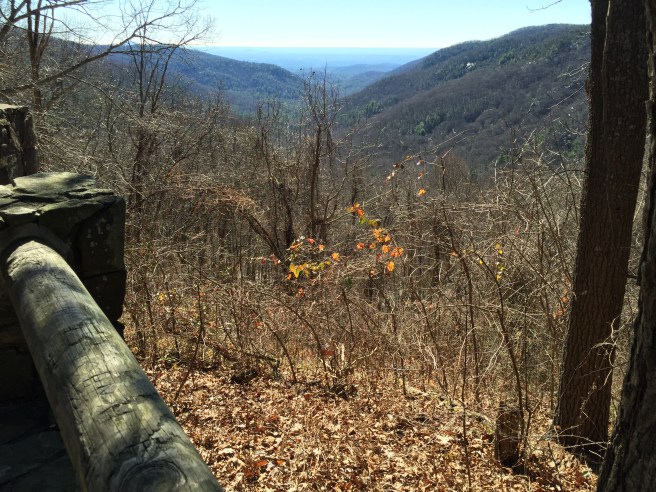
View from Neel Gap
Walasi-Yi Interpretive Center boasts a couple of interesting features. It is the only place where the Appalachian Trail passes through a man-made structure. It is also the home of what I call the tree of blown-out hiking shoes. For years, hikers have been slinging their badly-worn shoes up into the branches of a tree located just outside the store’s entrance. It caught me by surprise the first time I looked up and noticed what was hanging from the limbs. I’m sure the tree stands as a monument to those who have passed through this section of the Appalachian Trail, whether they started in Georgia, Maine, or a thousand points in between. Having one’s shoes included in the tree must surely be a badge of honor. It almost serves as a footwear mausoleum, and perhaps a warning to those who think hiking the Trail is not so difficult.
In recent years, the literature about travel has been focusing on the importance of creating or taking advantage of experiences rather than seeking the traditional rewards such as entertainment or relaxation. Of course, how we define a memorable experience is all over the board. Foodies may be looking for something much different than hikers, and history buffs may not appreciate the same experience that is meaningful to a photographer or painter. Then again, there may be significant overlap. In any case, if we want to learn as much as we can about a destination while we are there, we have to be willing to invest. We have to spend time doing some research before we ever leave home, but even so, that preparation may not be enough in some cases to get a true appreciation for what we are seeing, hearing, smelling, and touching.
If we want to make sure we are doing the best we possibly can with our financial investments, we seek the advice of an expert. If we want to take full advantage of the time we have to exercise and stay fit, we may pay a trainer or an instructor. We may also pay teachers to help us learn particular skills or develop our hobbies. And, there are times when it makes sense to pay someone to ensure that our travel experience is as rich as it can possibly be. Yes, travel agents come to mind, but web-based services have almost made this profession obsolete, although they do still offer a valuable service for many individuals and groups. I’m thinking of a service that is a bit more, well, personal. On several occasions, we have paid to have a guide at special places of interest. Some places are just impossible to completely enjoy even with such assistance because of poor crowd control, cheap audio equipment, or an inexperienced guide. The Vatican Museum comes to mind — they pack way too many people in at a time, and it becomes a real challenge just to stay with your guided group.
For the most part, we have been very pleased with the guides we have had and felt that this investment provided us with a deeper appreciation for what we were seeing. The two best examples that come to mind of where guides were invaluable to us are the Colosseum and Forum in Rome and Versailles Palace outside Paris. In Rome it would be almost impossible in a short time to see the most historically-significant parts of the Colosseum and the Forum without an experienced guide. I don’t remember her name, but our guide’s knowledge of these two attractions was certainly impressive. We hired her for an individual tour, which was not cheap but worth every Euro. She was able to answer in detail each question we asked. She spoke fluent English. She had a sense of humor without being silly. She took us on a walking tour, and she managed to cover essential ground, literally and figuratively, while also adding interesting anecdotes, myths, and fascinating details. It was such a rich experience.
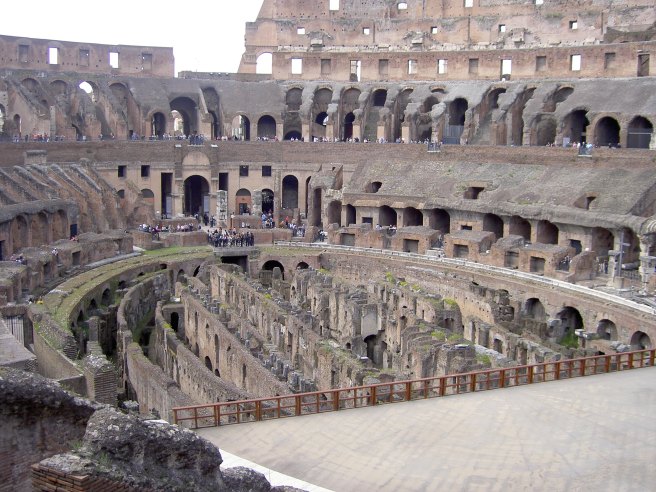
Colosseum in Rome
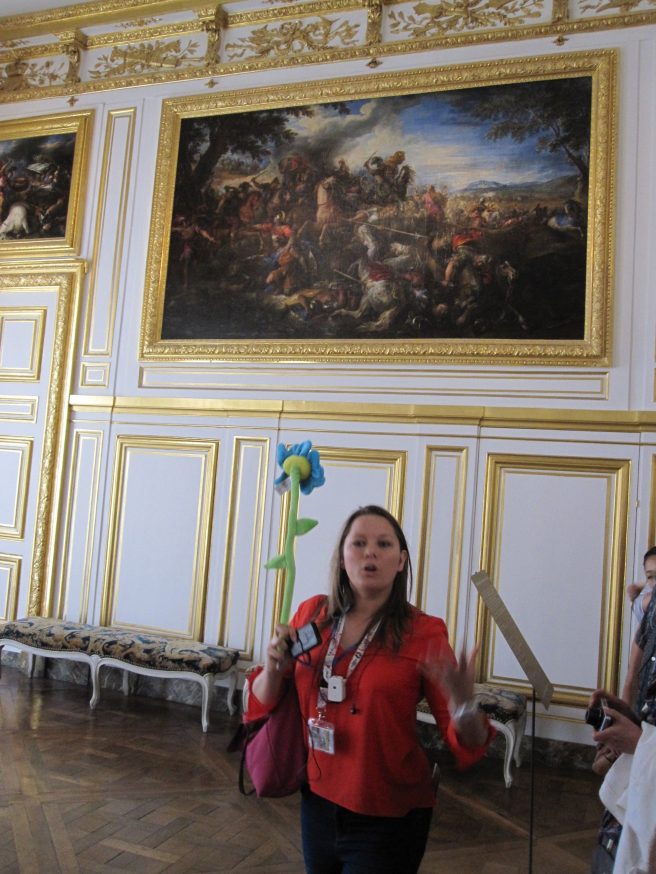
The Palace at Versailles is a short 30 minute train ride to the west of Paris and well worth the time and effort to get there. Because the Palace is so huge and we only had about four hours to spend there, we decided to pay for a guided tour. This time, we were part of a group. We still had bad memories of being shuffled through the Vatican Museum, shoulder to shoulder, like cows being herded to the slaughter. We were prepared for the worst at Versailles. Pauline was our host, and we could not have been more pleased. She met our group at a building where tickets are sold about three blocks from the entrance to the Palace grounds. She held in her hand a brightly-colored cloth blue flower on a tall green stalk, which she held up high enough for everyone to see to make following her a bit easier. As is usually the case with guided tours, Pauline was able to bypass the longer general admission line and get us in the Palace promptly, which is almost worth the price of the tour alone.
Pauline distributed our audio headsets shortly after we entered the Palace and tested them all. The technology was much better this time than when we were at the Vatican Museum, and our ear phones allowed us to hear every word she said. Taking us through each of the rooms of the Palace that are open to visitors, Pauline not only explained the significance of the rooms, but she was always careful and creative about weaving the information back into her chronological theme of the royal families that resided at the Palace. Her approach was similar to that of a school teacher, asking questions from the group and using responses to deliver her narrative. She managed to do so without dumbing down the story so that people of all ages and education levels could appreciate the tour. She was really talented. Another skill Pauline exhibited was aggressiveness. There are always rude people in museums who will insist on edging their way in front of others to get a better view or to take a photograph, or even worse, the obligatory selfie. Incidentally, selfie sticks are prohibited in the Versailles Palace and in many museums and galleries in Paris, thank goodness. When our group encountered anyone attempting to push in front of us at the railings while Pauline was talking to us, she would quickly and firmly say, “Excuse me, this is a group tour, would you please step aside? Thank you!” It worked every time.
Pauline, our guide at Versailles
Traveling is a luxury that many people cannot afford, which is unfortunate. However, there are ways to make tourism more affordable. There is a considerable range of prices for transportation, lodging, meals, attractions, and incidentals. It usually makes sense to pay for many services in advance, including admission. The Paris Pass is highly recommended for visitors to the city who plan to be there a few days and want to see multiple museums and galleries. Other major cities have similar deals, and they are definitely worth considering. Most of the time, we don’t feel a need to have a personal guide or to even join a group tour, both of which can be expensive. We tend to like the freedom of seeing what interests us most and skipping the rest, which is practically impossible with a guided tour. But there are times when having a knowledgeable narrator can provide that memorable and meaningful experience that so many travelers seek.
My wife and I were in London this past summer for a few days. We had some scheduled work-related activities on the Sunday after we arrived, but our morning was free. The day was overcast, as so many are in London. We decided to spend the morning strolling through Hyde Park, one of eight Royal Parks in the city. Seized by Henry VIII from the monks of Westminster Abbey in 1536 as a private hunting grounds for the monarch, this 350-acre property was not made available to the general public until 1637. In the late 17th century, William and Mary purchased Nottingham House on the western edge of the park and renamed it Kensington Palace, which is where the royal family made its home. During the 18th century, the park began to take on many of the features that distinguish it today, thanks to the efforts and creativity of Queen Caroline. Two of the most striking landscape elements she introduced were Kensington Gardens and Serpentine Lake.
Serpentine Lake in Hyde Park, London
Through the centuries Hyde Park has been a site for national celebrations and a sanctuary of free speech, illustrated by the famous Speakers’ Corner, where anyone is allowed to stand up and openly speak on any subject, including grievances against the state. Karl Marx, Vladimir Lenin, and George Orwell are among the most famous orators who have expressed their views at Speakers’ Corner. The park is also a haven for wildlife, and the Serpentine Lake offers a rich habitat for a wide variety of water fowl and other aquatic animals. Of course, maneuvering through a patchwork of goose poop is an issue if you choose to get too close to the water! As one might expect, the park is filled with statues, memorials, fountains, artwork, pavilions, walkways, and concessions.
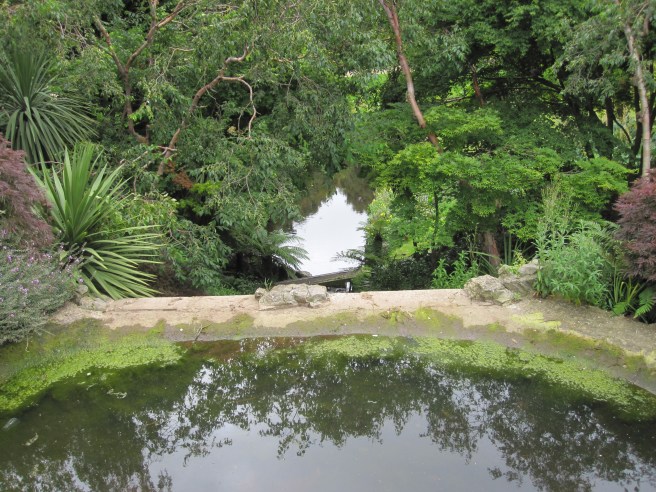
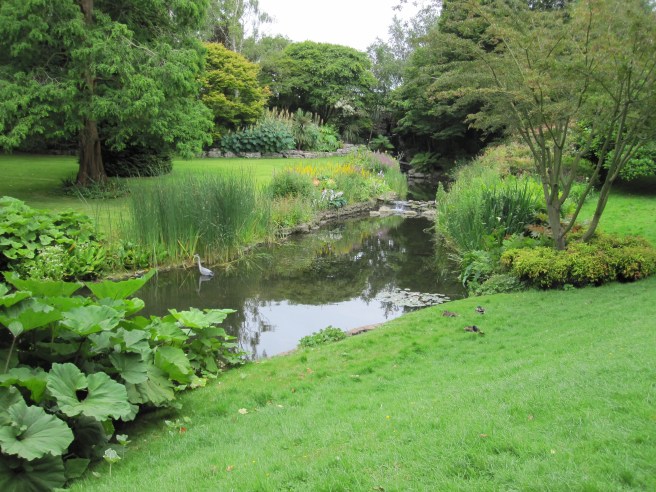
Water garden in Hyde Park, London
On the morning of our stroll, we entered the park through the Marble Arch on the northeast, next to Speakers’ Corner. Immediately we were greeted with people taking advantage of the weekend with their exercise routines: running, walking, tai chi, yoga, martial arts, and more. A major portion of this section of the park was currently occupied by the British Summer Time festival of music, but we made our way around it toward the large section of Serpentine Lake, intersecting with West Carriage Drive and crossing Serpentine Bridge. We passed by the Princess Diana Memorial Fountain to reach the Lido Restaurant, where we bought some hot drinks to warm us up a bit — it was chilly morning for July. We continued leisurely along one of the walkways within view of the lake and headed back toward the southeast part of the park to the Serpentine Waterfall and the enchanting water garden just beyond it.
Water garden in Hyde Park, London
On the southeast corner of the park, we spent some time wandering through the Rose Garden, a spectacular oasis featuring roses mixed with herbaceous plants that were exploding with color while we were there. We were joined by parents carrying babies in strollers and older children asking a thousand questions. I have written on public gardens before, and this is absolutely one of the finest I have ever visited. I cannot begin to imagine how much money the city, and perhaps the Crown, invests in this amazing display of natural beauty. The vistas are breathtaking.
Flower garden in Hyde Park, London
Like most of the major international cities, London is filled with attractions and history. It would be foolish to suggest bypassing all of those places to take a stroll through the park. You have to see the Houses of Parliament, Big Ben, Westminster Abbey, St. Paul’s Cathedral, etc. At the same time, don’t cheat yourself by missing the opportunity to immerse yourself in the local environment, and public parks are a great place to do so. Sure, there are tourists wandering around in Hyde Park — we were among that category. But, there were also plenty of locals enjoying the simple pleasures of this treasured and historic resource. The conversations we overheard between couples and companions and among parents and children gave us a superficial but satisfying sense of being British just for a couple of hours. We never want to miss those kinds of opportunities when we travel.
A significant part of the expense of traveling is the cost of lodging, especially if you are in a large city or a popular destination. It really is worth the time and effort to find a place that suits your needs and fulfills your expectations. Sometimes hotels are the best option, especially if you are staying for only a night or two. There are times when the hotel itself may be what attracted you in the first place, which was the case when my wife and I decided to spend our most recent anniversary weekend at the luxurious Four Seasons Hotel in Atlanta. We looked forward to having dinner in the hotel’s restaurant, hanging out in the bar, and relaxing in a plush bed covered in sheets that, in retrospect, must have been imported from Turkey. We also stayed in an over-the-top place when we visited Carmel, California. The name would suggest a cheesy roadside motor lodge, but our room at Tickle Pink Inn had a small balcony looking out over the rocky cliffs of the Pacific and was equipped with a canopy bed and word-burning fireplace. It was incredible, even for the one night we were there. We don’t usually splurge like that, but in both cases, the experience was worth the extra money. And, the experience is what we’re really after when we travel.
If your travels take you to major cultural centers, such as large cities or places of historical significance, then I suggest skipping the hotels and seeking out accommodations that will permit you to be immersed in the locale. This option is especially preferable if you plan to stay for more than two nights. It would appear that more travelers are embracing this idea with the rapid rise in popularity of Airbnb, VRBO, and many other agencies that provide listings of homes, apartments, villas, condos, and cabins for rent. If you want a taste of what it is like to live in a particular place, then staying in a neighborhood or borough or barrio among the people who do actually live there is the best choice, especially if you are in an area where the language and customs are quite different from your own. Shopping in local markets, eating in nearby cafes, strolling the streets and the parks, and taking in the local entertainment affords you the opportunity to get more integrated with the surroundings, to embrace your temporary milieu.
On our recent trip to Paris, my wife and I stayed in a lovely studio apartment in Le Marais, a trendy historic district that spreads across parts of the 3rd and 4th arrondissements. The area was in terrible shape by the 1950s but was revitalized in the 1960s and is now the section of the city known for a high concentration of Jewish residents and also of gay and lesbian Parisians. It also hosts some of the most popular small, independent clothing and fashion shops in Paris. We found out about this particular apartment from a friend in the states who had stayed there the previous summer and loved it. So did we. Our fourth-floor room was tucked away in a collection of early twentieth-century buildings between a busy thoroughfare and a side street about two blocks from the right bank of the Seine River. The first floors of several of the buildings housed offices that looked out to a lovely courtyard, and the whole complex was somewhat secured by combination-code locked gates. One of the entrances was less than fifty yards from a Metro station, which was most convenient. Our apartment had a fair-sized bathroom and a small kitchen in addition to a spacious (by European standards) bedroom/sitting area. It was accessible by a circular wooden staircase that wound its way around an elevator shaft with a car just large enough for two people with healthy BMI frames — it was tiny by American standards but typical for Paris. The only times we used the elevator were to haul our luggage up when we arrived and back down when we departed.
Apartment complex courtyard
We walked to one of the local markets as soon as we got settled into our apartment and bought all the provisions we would need for the five days we were staying in Paris. That grocery shopping experience alone is worth another blog entry — a human comedy. We walked to local bistros several nights that were quaint and wonderful. We had breakfast almost every morning at a little bakery just a quick walk down the street. The chocolate-banana pastries were like edible heaven. We were within easy walking distance of the Seine, Notre Dame, and several museums, including the Picasso Museum and the Bastille. On our last morning in Paris we strolled down to the Seine and walked up and down the banks of the river. Other than the shopkeepers and other people who provided us with assistance, I don’t think we ever heard a single word of English while we were in the neighborhood where we were staying, which is such an important part of the experience of traveling to a foreign country. From the window of our room we could hear people talking and laughing at the café four floors below our windows. We could hear children playing on the sidewalks. We could hear people going to and coming home from work or school. For a brief time, we almost felt like Parisians — well, a little. Do yourself a favor. On your next trip, find a place to stay in a great neighborhood and soak up the atmosphere you find there.
Being a lover of the seashore and all things beach-related, I take every opportunity to dig my toes in the sand and soak up the salt and sun. We try to make a trip to the beach at least once a year if possible. I even play the sounds of waves on my computer at work for background noise. It’s better than music sometimes. For a good portion of my life, the highlight of my summers was a trip to Florida, usually to Daytona Beach, for a family vacation. I have also visited beaches in Alabama, South Carolina, California, and southern England. I know people who drive 24 hours from Texas just to spend a couple of weeks on the beach in Daytona, passing by numerous other locations along the Gulf to get there. They say that Texas beaches are dirty and run-down. They claim there’s no entertainment. Specifically, they are talking about Galveston Island.
This summer, my wife and I were invited to spend a week at Galveston Island with some close family who live in Kansas. We don’t get to see them very often and really enjoy spending time with them. The plan involved them driving down to the Gulf in a couple of vehicles, loaded down with everything we could possibly need for a week at the beach. We flew into Houston, rented a car, and made the short trip down to meet them at a large, rambling house on the beach we had all rented for the week. I was expecting to be underwhelmed when we got there; however, I was pleasantly surprised to find Galveston’s beaches full of life with plenty of attractions. There are water parks, an impressive amusement park on a huge pier, gardens, theaters, historic areas, some good restaurants, and more. The beaches are clean, the waves are better than the Florida Gulf, and the house was perfect for our group of ten people, which included two children under the age of three!
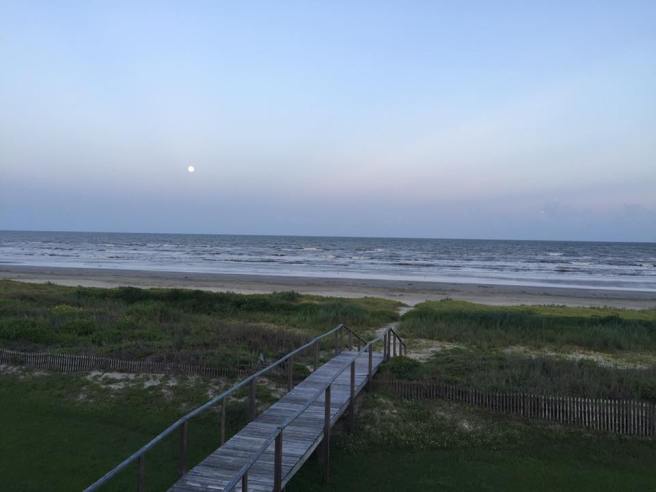
Galveston Beach
The house was separated from the beach by a lawn and a some grassy dunes, but the sand was easily accessible by a raised, wooden walkway. There was plenty of beach area to set up a permanent tent canopy for relief from the mid-day sun. The porch looking out to the ocean extended the entire width of the house. There was a large kitchen/eating area, numerous bedrooms, three bathrooms, two televisions on either end of the house set far enough apart to avoid any bleed-over effect. It was such a relaxing place that was well maintained and nicely furnished. We had a wonderful time with people we love in a setting that was just perfect.
Before heading back to Houston to the airport, we drove around the more developed area of the beach. The hotels and condos looked very nice. Most were probably built after Hurricane Ike devastated the area in 2008. There are even a few resorts on the far east section of the island and what looks like a residential community development that is just getting started. The old downtown section of Galveston is full of character typical of a port town. There are even a few structures that predate the huge storm of 1900, America’s worst-recorded hurricane disaster, that brought a massive surge across the island killing at least 8,000 people. Now there is a substantial sea wall that serves as the foundation for the major highway that runs along the beach, which helps protect the town from surges. The highway separates the hotels from the beach, but it is a necessary barrier in case of storms. For those who still think Galveston is not such a great destination, I suspect they are thinking of an older Galveston that doesn’t exist anymore. The place has reinvented itself, and it is definitely worth considering. Galveston is too far away from us for regular beach trips, but if this opportunity came open again, I would definitely want to go back.
My wife and I recently took another one of those “trips-of-a-lifetime,” to a place neither one of us had ever visited: Paris. After we had been married for a couple of years we began planning a trip to Paris for our fifth wedding anniversary; however, we changed jobs and moved to a new place. We had to start over banking vacation time, plus we needed a year or two to get adjusted in our new location. So we postponed the Paris trip but continued to keep it on our short list. Then an opportunity presented itself to us last year when the president of the college where we both work announced that he would be giving an organ recital (he is a highly-acclaimed concert organist) at Westminster Abbey in London. We decided right then that we would be in London for the event, which was scheduled for a Sunday afternoon, and then we would head over to Paris to enjoy the rest of the week as tourists. We spent the better part of a year making arrangements: learning as much as we could about the city, finding accommodations, deciding what we wanted to see and do, purchasing tickets, arranging transportation, and booking flights.
We have never flown first or business class, except once when we were upgraded on our flight back from Jamaica last December. For the trans-Atlantic journey to Europe though, we decided to cash in all of my wife’s Delta Sky Miles and splurge on first class, where the seats completely recline to a vertical position. I have a difficult time sleeping upright in the typical less-than-comfortable seats on a plane, and we really needed to sleep during the overnight flight to London. What a luxury first class was for this trip, going both ways. With a little bit of help from a half-dose of Dramamine, I slept pretty well flying over Iceland and the north Atlantic. I really wish we could fly first class all the time, but alas, we are travelers on a budget. And, I’m not complaining because our budget allows us to go places that the majority of Americans only dream about or see in movies. I am grateful.
Paris exceeded all our expectations. It is a beautiful city with so much history, character, personality, and charm. In London and Rome, we were never too impressed with the food, but in Paris, every meal was amazing and delicious. The bistros and cafes are usually small, but each has its own signature appeal. You can’t walk a hundred yards in the center of Paris without passing some place to eat. We had breakfast every morning at a bakery just down the street from our apartment. The pastries were so delicate, and the banana-chocolate one was to die for! Every night we tried something different for dinner and were never disappointed. I ate escargot for the first time and was surprised how similar it was to fresh clams. Swimming in salty pesto, it was truly a delicacy.
Eiffel Tower and River Seine
Writing about our trip to Paris will certainly take more than one post. At this point, suffice it to say that this is one of those places where it is almost impossible to take a bad photograph. I took this shot with my cell phone, standing on the platform on the Pont de Bir Hakeim, one of many bridges that cross the River Seine that bisects the city. I think it is one of the best places to get a good view of the Eiffel Tower and the Seine. The tower is so tall and commanding that you really have to be a little distance away to appreciate its magnificence. Paris is filled with scenes that present themselves to the visitor and beg to be recorded in a photograph. It is an irresistible city on so many levels. I look forward to many more traveling adventures, and we are already making plans for future trips. Still, it will be difficult to top our week in the City of Love. If we never get to return to Europe, and I certainly hope we do return someday, I will look back on this time with such fond memories and shamelessly steal Rick’s line from Casablanca, “We’ll always have Paris.”
Here is the latest installment of my favorite Southern words, and perhaps Jeff Foxworthy has used these too. No plagiarism is intended here; I can only plead ignorance, which for me is not a stretch at all.
Iota. Usage: “Just heard from the accountant that iota IRS some more money for 2015.”
Fawn. Usage: “I never woulda believed it could happen, but I think Billy Bob is fawn in love with Charlene.”
Defensive. Usage: “The deer ain’t able to jump defensive you make it high enough.”
Napkin. Usage: “If I get drowsy after lunch, taking a quick napkin usually get me through the rest of the day.”
Conjure. Usage: “Billy Bob, I can’t believe you conjure way out of going shopping with Charlene this weekend. What kinda story did you make up this time?”
Urinal. Usage: “Charlene heard about us going out last night, Billy Bob, and now urinal lot of trouble dude.”
Foamy. Usage: “It’s gettin’ cold in here. How about shuttin’ that door foamy.”
Avenue. Usage: “I heard they avenue ride at the fair this year that’s making everybody puke!”
Thomas Jefferson purportedly wrote these words: “No occupation is so delightful to me as the culture of the earth, and no culture comparable to that of the garden.” Thinking of the word “garden” brings to mind so many different images and activities, probably because there are so many definitions and far too many types to list. A few examples will suffice: flower gardens, vegetable gardens, herb gardens, rock gardens, fairy gardens, cottage gardens, formal gardens, private gardens, and public gardens. It is this final variation that I turn my attention to so many times when I am traveling. Large cities almost always have botanical gardens that are usually enclosed and often charge admission to explore; however, cities also frequently have open access gardens that are situated among the towering buildings or incorporated into larger parks. London, Paris, and other European cities have magnificent public gardens that are as famous as any other attractions, drawing millions of tourists each year. The United States also boasts some splendid examples as well.
Public Garden, Boston, MA
Perhaps the oldest public garden in the country is appropriately called the Public Garden located in the heart of Boston on the southwest side of the famous Boston Commons. Designed by George F. Meacham in the mid-19th century, the Public Garden now has paved trails that wind around the pond, under the trees, and through the floral displays that change with the seasons. We were there in September when the summer blooms were still dazzling. This park is enjoyed by so many people, both Bostonians and visitors to the city. It is a wonderful oasis between the famous historic district and the bustling urban center.
Golden Gate Bridge Park, San Francisco, CA
Monuments and landmarks present a fine opportunity for the placement of public gardens. The Golden Gate Bridge Park is another example of a space that brings together locals and tourists. The abundance of moisture from the San Francisco Bay and the humid, foggy air sweeping in from the Pacific provides a near-perfect environment for a green-space. We spent several minutes wandering around this garden before taking a trek out on the most recognizable bridge in America.
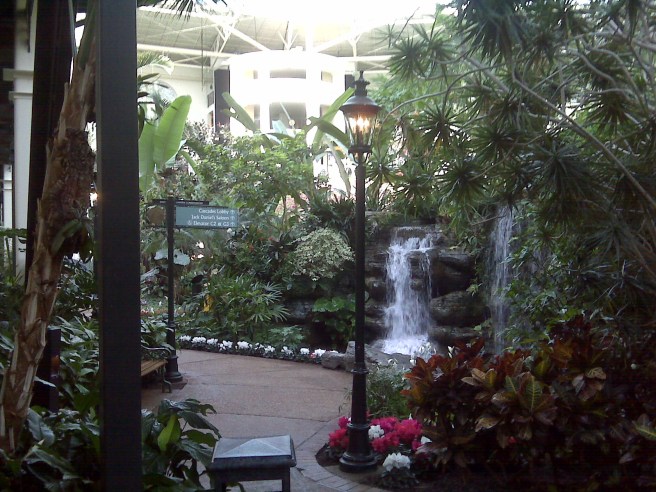
Opryland Hotel Gardens, Nashville, TN
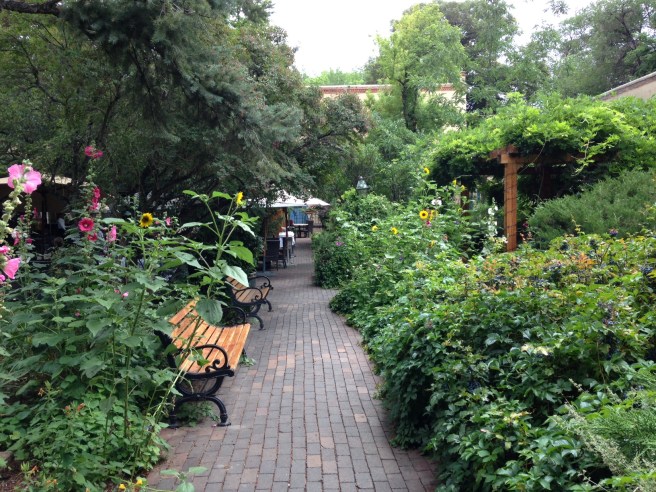
Sometimes gardens that are owned and maintained by private entities are still made available to the public at no charge. Hotels, office complexes, and shopping centers usually have, at bare minimum, some level of landscaping. Occasionally these establishments go far beyond the obligatory curb dressing to create extensive gardens and observatories, such as the Opryland Hotel in Nashville. In tourist towns, several retailers may collaborate to install and maintain plantings, beds, boxes, and pots to attract shoppers to their doors. These private gardens are not only accessible to the public but are specifically designed to attract people passing through the area. I have seen some beautiful examples of this type of garden in destinations such as Gatlinburg (Tennessee), Sedona (Arizona), St. Simons Island (Georgia), and Santa Fe (New Mexico).
Garden at a shopping courtyard in Santa Fe, NM
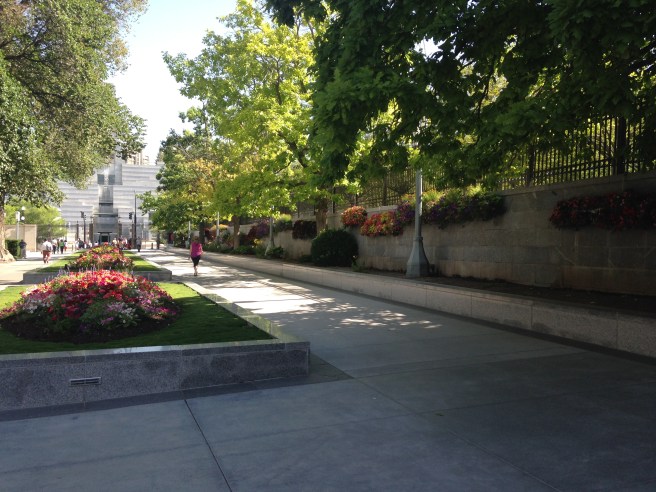
Places of worship are also a good source for gardens that can be enjoyed by everyone. Usually maintained by a small band of devoted gardeners in the organization, these spaces welcome visitors and encourage them to take a few moments to be still, contemplate, meditate, or pray. Some of these gardens are small and simple, but still lovely. Others are huge and elaborate, attracting thousands of visitors each year. Some are not free and open to the general public, such as the Gardens of Vatican City, although guided tours are available. The Gardens at Temple Square of the LDS Church represent an over-the-top horticultural exhibit that is enjoyed by anyone who wants to pass through the church’s massive complex in Salt Lake City, Utah.
Gardens at Temple Square, LDS Church headquarters, Salt Lake City, UT
As an amateur gardener, I have a deep appreciation for the integration of beautiful plants into the built environment. Public gardens address a basic need that so many people have of staying connected to nature. They are also a haven for birds and other small wildlife that share real estate with humans. They filter the air, enrich it with oxygen, and lace it with their perfumes. They tantalize our eyes with various shades of green and a wide array of vibrant colors. Public gardens tempt us to pause, relax, and reflect. The familiar phrase of “stop and smell the roses” is a cliché for a reason. It’s based on a fundamental human need to slow down and appreciate very simple pleasures. Take the opportunity to do so the next time you pass a public garden.
The title of this entry may at first seem like a mistake. “Perhaps he really meant ‘The Dessert Garden,’ which conjures up images of fruit trees.” Most people don’t associate gardens with deserts. By definition, deserts are empty places. They are barren, usually having sandy or rocky soil and little or no vegetation. When we say a place is deserted, we mean it is empty or uninhabited. By contrast, we often think of gardens as lush, green spaces teeming with life. Until I married someone who had lived for almost two decades in the Southwest, I didn’t think I would like spending much time in that region of the country. I don’t mind hot weather that much, especially if the humidity is low. But green is my favorite color, and I love gardening. Nothing grows in a desert, right?
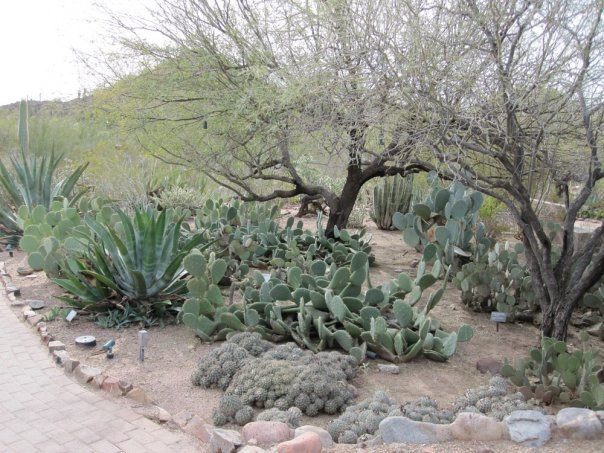
Ridiculous. The desert is full of life, and the diversity of plant species is staggering. There are about 2,000 different kinds of cacti alone. The six cactus genera with the largest number of plants, and hence most likely to be encountered, are cereus, cylindropuntia, echinocereus, ferocactus, mammillaria and opuntia. In addition to cacti, there are grasses, shrubs, trees, and wildflowers. One of the best places to get a clear picture of the desert’s splendor is the Desert Botanical Garden in Phoenix, Arizona. With more than 4,000 species and approximately 27,650 individual plants, the Desert Botanical Garden is home to one of the world’s most spectacular living collections of the world’s desert plants.
Desert Botanical Garden, Phoenix, Arizona
We spent some time several years ago during a visit to Phoenix to wander through the Garden. Perhaps the most striking feature is the endless forms and shapes that the plants in the desert take. They have evolved over millions of years to take full advantage of the limited resources available, and water conservation dictates so much of the characteristics of desert flora. Flowers tend to be less numerous but so much more striking in color, shape, and size than those found in other environments. The Garden offers permanent trailside exhibits, temporary art exhibitions, and seasonal activities too.
Desert Botanical Garden, Phoenix, Arizona
Sometimes it’s difficult to look beyond the familiar and seek the undiscovered, and I certainly found that to be true about the desert. There’s green everywhere! I have visited the Southwest several times now, and I am always ready to return. It is wild, rugged, and even harsh, but it possesses a charm that can be found nowhere else in the country. The Desert Botanical Garden is not to be missed.
Public art is a standard feature in most large cities across the U.S. and in much of the world. Art that is made freely available for everyone to enjoy in public places takes many forms: painting, photography, architecture, sculpture, graffiti, and even performance. Like many tourists, I tend to take photographs of public art when I am visiting cities, and I have collected images from New York, San Francisco, Phoenix, Seattle, Washington, D.C., Rome, and London to name a few. One of the more interesting pieces I found may not be so well known, although the artist is rather prolific. One evening in 2011 when my wife and I were walking the streets of Chicago headed out for dinner, we wondered through a section of the city known as Streeterville, a neighborhood roughly east of the Magnificent Mile that serves as the gateway to the Navy Pier. I was struck by a piece of bronze sculpture we saw at the northern end of Streeterville, at E. Chestnut Street next to the landmark Hancock Center.
Self Portrait with Tree, Jaume Plensa
When I first saw Jaume Plensa’s “Self Portrait with Tree” on the sidewalk, my first thought was to make a joke, an annoying habit of mine. I turned to my wife and said, “Now that is truly a man of letters.” My apologies — please keep reading. Plensa is one of the featured artists of the Richard Gray Gallery. With its main location on North Michigan Avenue and another on Madison Avenue in New York, Richard Gray Gallery is mostly a collector’s gallery and focuses its attention on attracting buyers. According to the gallery’s website, Plensa is one of the world’s foremost sculptors working in the public space, with over 30 projects spanning the globe in such cities as Chicago, Dubai, London, Liverpool, Nice, Tokyo, Toronto, and Vancouver. He was born in 1955 in Barcelona, where he studied at the Llotja School of Art and Design and at the Sant Jordi School of Fine Art. A significant part of Plensa’s work is in the field of sculpture in the public space. Installed in cities in Spain, France, Japan, England, Korea, Germany, Canada, USA, etc., these pieces have won many prizes and citations, including the Mash Award for Excellence in Public Sculpture.
Plensa has used the theme of the seated figure for many installments, and he has repeated the tree-hugging sculpture in various locations around the world. Some of the pieces are colossal. Another thread running through Plensa’s work is the use of letters and symbols to fabricate the figure. For these particular pieces, he works in an assortment of materials including bronze, stainless steel, and stone. The Self Portrait in Streeterville is especially interesting because of the letters in full relief on the seated figure’s body, like the type hammers of an old manual typewriter. The technique lends a bit of nostalgia to the piece. You can learn more about the work of Jaume Plensa at his website at http://www.jaumeplensa.com/.










 If You Want My Opinion