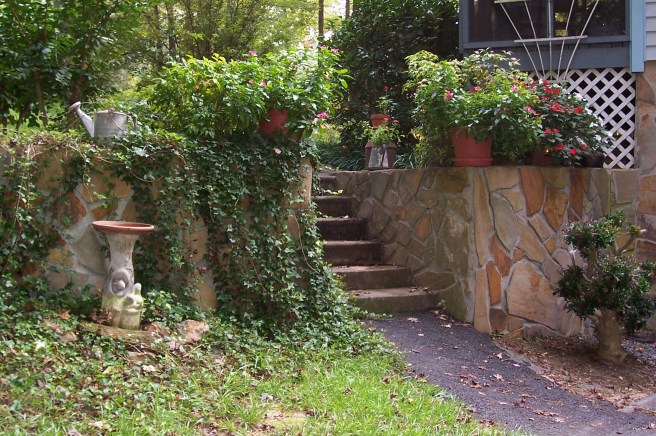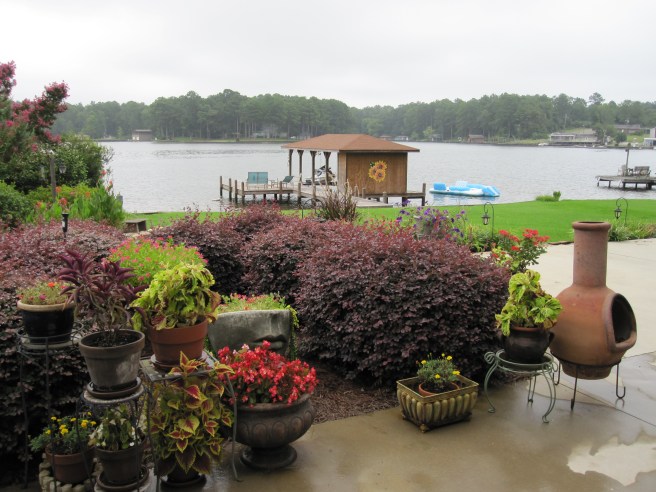
Visitors to Paris will often want to include in their itinerary a side trip to the Palace of Versailles, which is about a thirty-minute train ride from the city. The round trip isn’t so time-consuming, but actually seeing the palace and grounds takes a minimum of half a day, even more if one truly explores the garden, which is 800 hectares (over 1,900 acres) in size. Unfortunately, some travelers are on a tight schedule and hardly have enough time to see the major attractions in Paris, much less places outside the city. There is no substitute for seeing the Palace of Versailles, which is quite magnificent and offers a visual representation of the wealth and power of the monarchy in the 17th and 18th centuries. The garden is certainly spectacular and difficult to match; however, if there is a substitute in Paris that can serve as a rival, albeit on a smaller scale, the garden at the Musée Rodin must be near the top of the list.
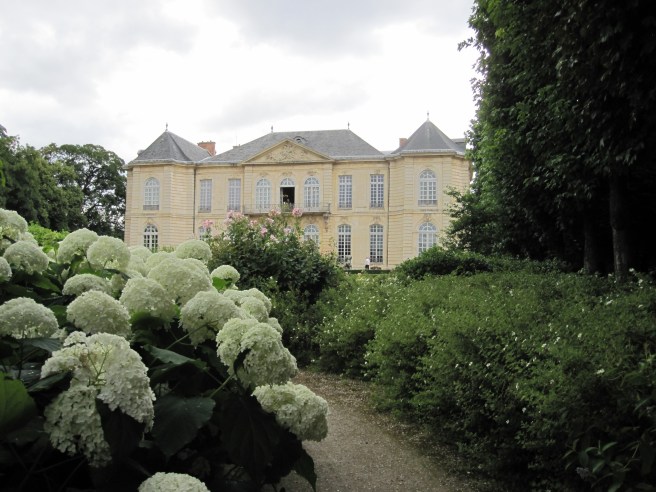
Rodin gardens from mansion balcony
The Musée Rodin is housed in a mansion, formerly called the Hôtel Peyrenc de Moras, now known as the Hôtel Biron. Auguste Rodin was a 19th-century French sculptor who is known for creating several iconic works, including “The Age of Bronze,” “The Thinker,” “The Kiss,” and “The Burghers of Calais.” The collection in the restored mansion is interesting for the novice and probably a treasure for artists and art historians, but almost everyone can appreciate the beauty of the garden. Its size is minuscule compared to Versailles, but it is still impressive. The grounds are divided into a rose garden, north of the mansion, and a large ornamental garden, to the south, while a terrace and hornbeam hedge backing onto a trellis conceal a relaxation area, at the bottom of the garden. Two thematic walks are also part of the garden: the “Garden of Orpheus,” on the east side, and the “Garden of Springs”on the west side.
Rodin garden roses and shrubs
In addition to the abundance of plants, the garden is also decorated with some of Rodin’s sculpture. Rodin started to place selected works in the garden in 1908, together with some of the antiques from his personal collection. Male and female torsos, copies made in the Roman or modern period, after Greek works, were presented in these natural surroundings. Other pieces were added after his death. The first bronzes were erected in the gardens before World War I. Since 1993, they have been regularly cleaned and treated so as to preserve their original patinas.
Anyone who has visited Paris knows the frustration of wanting to see more, to do more, than limited time will allow. Tourists have to be selective, discriminating, and reasonable about what they will be able to cover during the time they are in the city. Any attraction that offers more than one type of experience is probably worth including. The Musée Rodin fits that description with historic architecture and provocative sculpture but also a landscape that is in itself a work of art, offering the visitor an opportunity to rest and reflect.
Do artists have a social responsibility? That was the question posed for discussion to participants in lunch breakout sessions at the recent Symposium on Arts and Social Change sponsored by the Lillian E. Smith Center of Piedmont College, a small private liberal arts college in Demorest, Georgia. The Symposium, titled “Between Dream and Reality,” focused on public art as an inspiration for social change and was held at the college’s second campus in Athens, a town dominated by the presence of the University of Georgia. Each breakout session had no more than a dozen people, so the conversations were manageable but lively.
Jen Delos Reyes
The Symposium featured keynote speaker Jen Delos Reyes, Associate Director of the School of Art and Art History at the University of Illinois Chicago. Reyes is a creative laborer, educator, writer, and radical community arts organizer. Her practice is as much about working with institutions as it is about creating and supporting sustainable artist-led culture. She is the director and founder of Open Engagement, an international annual conference on socially-engaged art that has been active since 2007 and hosted conferences in two countries at locations including the Queens Museum in New York. In her early-morning presentation, she highlighted three artists who are also community activists, people who have used creative approaches to address serious challenges in their neighborhoods with projects such as restoring row houses to safe, habitable homes that had become drug-infested death traps.
Other featured speakers at the Symposium included Ellen Elmes, a retired college art instructor who has painted twenty-five plus murals in several different states that celebrate community. Another presenter was Hope Hilton, an Athens-based artist, educator, designer, and writer who works with communities and students of all ages to inspire and facilitate a sense of place, history, and agency. Broderick Flanigan is a freelance artist in Athens who is a community activist and the founder of Flanigan’s Portrait Studios. The event was moderated by Barbara Brown Taylor, the Butman Professor of Religion at Piedmont College and author of thirteen books, including the New York Times bestsellers Learning to Walk in the Dark and An Altar in the World. All of the presenters at this Symposium are devoting significant time and energy in their capacity as artists to promote, encourage, and facilitate positive social change.
Symposium logo
Throughout her career as a writer and humanitarian, Lillian Smith examined how the arts engage people around issues of social injustice, segregation, and isolation. Art was her passion, and she held a deep conviction that the artist has a responsibility to engage her audience in the conflicts and struggles of her generation, an opinion not necessarily shared by the students of The New Criticism movement, the literary theory that dominated the mid-20th century. Smith emerged in the 1940s at the forefront of the Southern debate on segregation, where she was at least a decade ahead of other white liberals and stood virtually alone in calling for an immediate end to segregation laws and practices.
During the tumultuous years of the mid-20th century, when lynching, convict labor, and Jim Crow laws were still casting dark shadows across the South and African-Americans all over the country were pleading for justice and equality, there were plenty of elected officials and prominent leaders who were endorsing a patient, moderate approach in addressing the crisis. Lillian Smith was not one of them. In a speech prepared for the Institute on Non-Violence and Social Change on the first anniversary of the Montgomery bus boycott in 1956, Lillian Smith wrote these words: “You have done many good things, down here in Montgomery. But one of the best, one of the most valuable, has been the fact that you have dramatized, for all America to see, that in times of ordeal, in times of crisis, only the extremist can meet the challenge. The question in crisis or ordeal is not: Are you going to be an extremist? The question is: What kind of extremist are you going to be?”
In a powerful essay titled “The Creative Process” written in 1962, James Baldwin made the following observation:
There are, forever, swamps to be drained, cities to be created, mines to be exploited, children to be fed. None of these things can be done alone. But the conquest of the physical world is not man’s only duty. He is also enjoined to conquer the great wilderness of himself. The precise role of the artist, then, is to illuminate that darkness, blaze roads through that vast forest, so that we will not, in all our doing, lose sight of its purpose, which is, after all, to make the world a more human dwelling place.
There can be little doubt that, through her novels and nonfiction works, Lillian Smith was indeed trying “to make the world a more human dwelling place.” Does art exist in a vacuum? Should the artist seek to be completely separated from society, unattached and oblivious to the pressing social issues of the day? The answers to those questions can be debated over and over again with no real resolution. What is clear, however, is that art has the mysterious power to transform minds and emotions, to spark imagination, to inspire collaboration, and to motivate people to act. Once the work is done and that power is unleashed, the artist has very little control over the ultimate impact of what she has created. Perhaps recognizing that indisputable truth is where the responsibility of the artist begins.
“To find the point where hypothesis and fact meet; the delicate equilibrium between dream and reality; the place where fantasy and earthly things are metamorphosed into a work of art . . . this is what man’s journey is about, I think.”–Lillian Smith, The Journey
Hiking is an outdoor activity that covers a lot of ground, literally and figuratively. People who hike do so for a number of different reasons (exercise, health, nature appreciation, social interaction, competition, etc.), and they have so many options of how and where to do this activity. Some folks only think of hiking in terms of backpacking and trekking out into the wilderness for days or even weeks at a time. Others envision hiking as a journey that gets you from point A to point B, or they see it as a test of endurance and distance. Hiking the Appalachian Trail comes to mind.
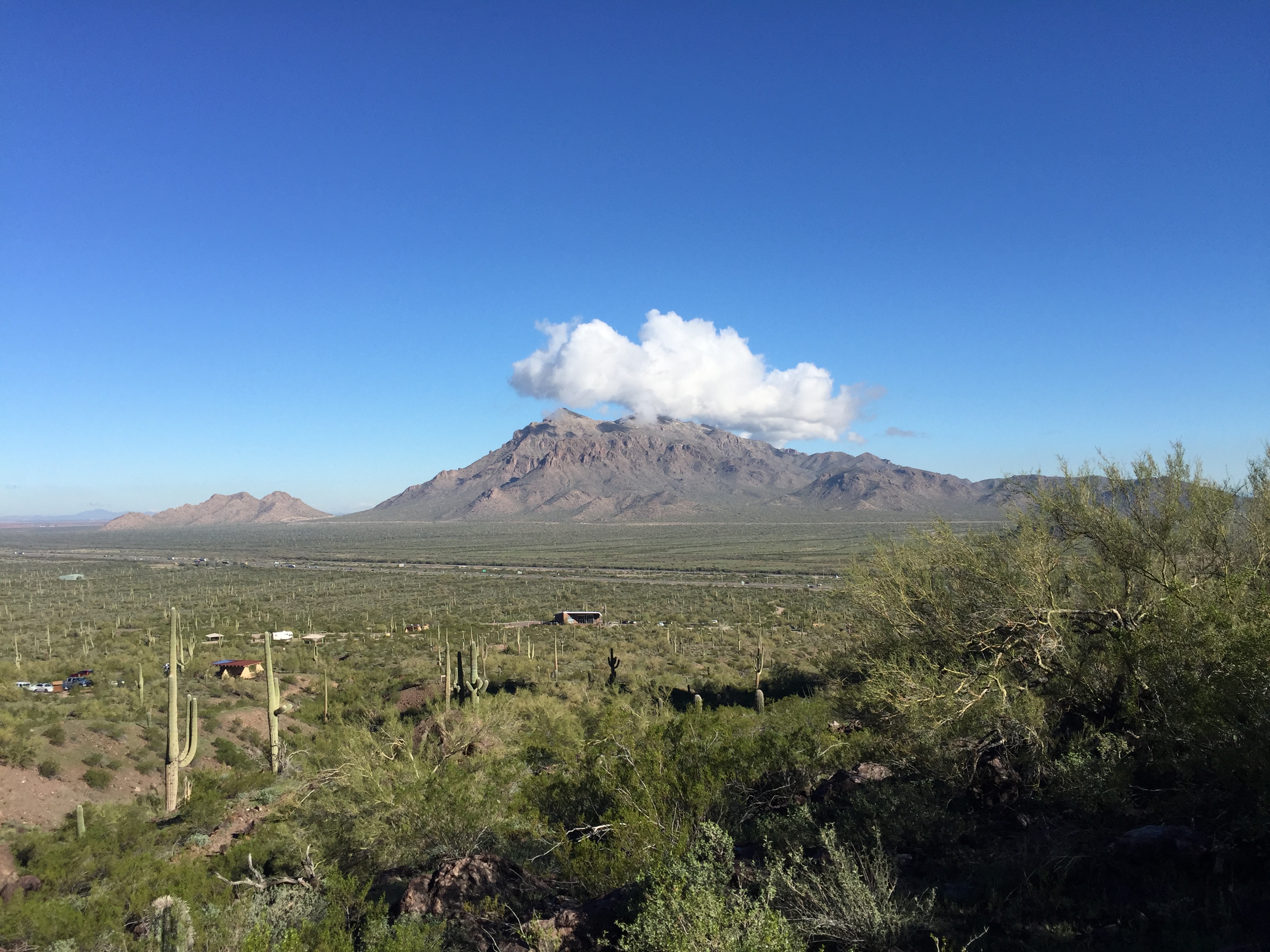
As with any form of recreation, there may be purists out there who maintain a set of standards or criteria for being called a real hiker. I hope not, because we would certainly fall short. When we hike, my wife and I are no longer interested in “pushing through the pain” to break any records of distance, speed, or difficulty. We are simply enjoying the outdoors and the opportunity to see things for the first time while getting a little exercise. As working professionals, we still operate on fairly busy schedules, so we often find ourselves carving out time to hike. This may mean that we only have thirty minutes or an hour, and we often grab these opportunities while in route. A perfect example was a one-hour excursion we took on our way from Phoenix to Tucson, Arizona, for a short up and back down hike at Picacho Peak State Park.
The drive from Phoenix to Tucson typically takes about two hours. We left Phoenix at about 7:45 in the morning and arrived at Picacho Peak State Park at about 8:45. We changed into our boots, pulled hiking polls out of the trunk of the car, grabbed water and hats and took off on the trail that leads from the parking area to the peak. It is a very rocky but well-marked trail that zigzags up the west slope. It is considered moderate in difficulty, which is a fair assessment. With a few quick stops for me to take some photos along the way, we made it to the overlook in just over thirty minutes. It was a sunny morning with temperatures in the upper 50s F, which was just about perfect.
We are not nearly young enough (admittedly a poor excuse), fit enough, or brave enough to climb rock faces, but we were perfectly satisfied to stop our ascent when we reached the overlook at the base of the jagged outcropping that forms the top of the peak. The view was spectacular looking southeast out across the Arizona desert. Of course, we took the obligatory selfie at this location and absorbed the experience for a few minutes before heading back down the slope.
This out-and-back hike took just over an hour. We were back on the road to Tucson by 11:00 and made it to the city to see some close friends for lunch at noon. More often than not, this is our hiking pattern. We have decided that short hikes like this one satisfy our need to get outside and stretch our legs, breathe in the fresh air, and sometimes enjoy spectacular scenery. Someday, when we are retired, we may have more time for longer hikes, but for now, the short ones are just fine.
People travel for a variety of reasons. Even people who travel for pleasure don’t all have the same agenda. We may be looking for simple relaxation, thrilling adventure, outdoor recreation, breathtaking scenery, cultural or historical education, stimulating enlightenment, or something altogether different. Generally, we are looking for an experience that transcends our day-to-day lives. We seek a opportunity to look at the world with fresh eyes, to be somehow transported if only for a brief time. And, we really don’t have to be in some romantic or exotic location. It can happen so unexpectedly, not because of our plans but in spite of them. It can also happen in an unlikely place — not at all where we anticipated “the magic” would occur.
Several years ago, my wife and I took a trip to San Francisco. We stayed for about a week at a good friend’s house in Port Richmond, a neighborhood in Richmond, California overlooking the bay. It was my first time to the west coast, so we acted like true tourists and visited Muir Woods, the wine country, various places in and around the city, and even took a drive down Highway 1 along the Pacific coast and spent the night in Carmel. It was fabulous. On one afternoon during our vacation, we met up with a young man who is a family friend who lives in the city. He took us to some of his favorite hiking spots at Land’s End and other locations around the entrance of the bay. We came back to the Port Richmond house and settled out on the deck overlooking the bay. We had a few drinks and took the time to catch up with him as the afternoon drifted towards evening. We were enjoying each other’s company and the comfortable weather so much that we decided to have pizza delivered instead of going out for dinner.
Sunset over San Francisco Bay
We continued to sit on that deck after the pizza was devoured and talked for hours. As we sipped on drinks, we watched the sun slowly sink behind the top of the distant hills to the west beyond the Richmond–San Rafael Bridge and marveled as the lights of the bridge and its endless stream of vehicles began to glow with evening’s approach. We talked and laughed about life, our memories, our hopes and fears. We soaked up the beauty of the bay at nightfall. There was nothing spectacular about the meal, although the setting was certainly enchanting enough. We were together, enjoying each other’s company, completely immersed in the now — the right then and there. We had not necessarily planned for the day to end this way. There was no remarkable event, no famous landmark, no fanfare at all. Still, it was somehow wonderful, and I knew it would be impossible to replicate. I took a photograph of the sunset from the deck to commemorate the occasion. Anytime I can stumble upon a moment like that, I get the sense that I have done more than travel. I have taken a journey.
Here is the latest installment of my favorite Southern words, and perhaps Jeff Foxworthy has used these too. No plagiarism is intended here; I can only plead ignorance, which for me is not a stretch at all.
Ratified. Usage: “I could have killed that ratified had my pistol with me in the kitchen.”
Fertilize. Usage: “Earl’s gonna pay dearly fertilize he’s been telling about Billy Bob and Charlene.”
Barn. Usage: “Times have been tough lately, and we’ve been barn money from my parents just to make payments on the truck.”
Bayou. Usage: “Do you mind if I sit bayou at Thanksgiving dinner?”
Canopy. Usage: “I know we’re in a hurry, but canopy before we go?”
Nominee. Usage: “I fell off the four-wheeler and nominee is swollen and hurts something awful.”
Doctorate. Usage: “Billy Bob cut his hand, and Charlene needs to doctorate before it gets infected.”
Commodious. Usage: “Quick! Somebody run in there and tell Billy Bob that the commodious on is clogged up!”
Shawls. Usage: “This casserole dish left from homecoming at the church last Sunday isn’t ours, so I guess its shawls.”
Automated. Usage: “It’s almost midnight. Billy Bob and Charlene automated home by now.”
Benefited. Usage: “Billy Bob’s already benefited for his tux, and he’s a-getting real excited about being the best man at my wedding.”
Coffin. Usage: “This summer cold has got me coffin up a storm!”
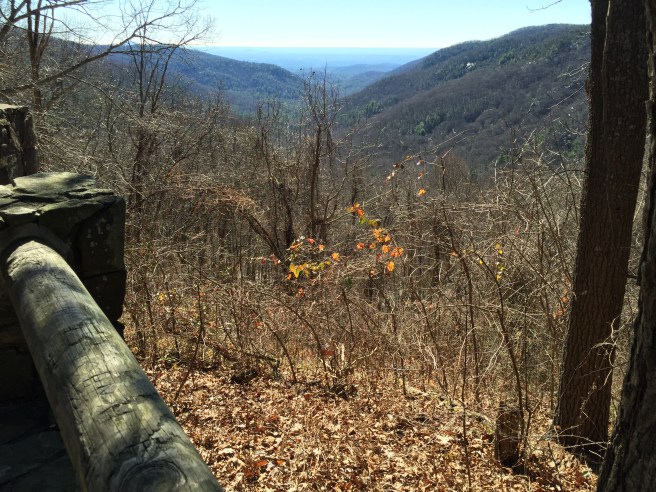
Near a place called Blood Mountain in the Chattahoochee National Forest in north Georgia, the Appalachian Trail makes a steep descent south towards a place called Neels Gap. The Trail crosses Highway 19/129 just a few miles south of Vogel State Park at a historic site called Walasi-Yi Interpretive Center. The stone façade of the Center has been standing at Neels Gap since 1937. Originally a log structure, the building took its present form when it was rebuilt by the Civilian Conservation Corps (CCC) and was a living quarters for corpsman working to reforest the Chattahoochee National Forest. It later served as a restaurant and inn until 1965, when it was abandoned. By the mid-1970s the building was slated for demolition, but a group of conservation-minded locals lobbied successfully for its inclusion on the National Register of Historic Places in 1977. Spared from destruction, the building served as an irregular store to hikers and tourists until 1983 when Jeff and Dorothy Hansen took over management of what became known as Mountain Crossings at Walasi-Yi. Although the store has changed hands several times, it still operates as a premiere full service outfitter on the Trail for thru hikers offering gear, large resupply options, lodging, and an array of gifts.
View from Neel Gap
Walasi-Yi Interpretive Center boasts a couple of interesting features. It is the only place where the Appalachian Trail passes through a man-made structure. It is also the home of what I call the tree of blown-out hiking shoes. For years, hikers have been slinging their badly-worn shoes up into the branches of a tree located just outside the store’s entrance. It caught me by surprise the first time I looked up and noticed what was hanging from the limbs. I’m sure the tree stands as a monument to those who have passed through this section of the Appalachian Trail, whether they started in Georgia, Maine, or a thousand points in between. Having one’s shoes included in the tree must surely be a badge of honor. It almost serves as a footwear mausoleum, and perhaps a warning to those who think hiking the Trail is not so difficult.
Enfield, Connecticut, is often associated with the manufacture of gunpowder and weapons, but it is also the place where Jonathan Edwards preached his famous sermon, “Sinners in the Hands of an Angry God.” Edward Clark Potter, born in 1857, was raised in this small township just across the border from southern Massachusetts. Educated in local schools and at the Williston Seminary in Easthampton, Massachusetts, young Edward defied his mother’s plans for him to enter the ministry and instead enrolled at Amherst College in Massachusetts for three semesters before heading to Boston in 1879 to study art. A few years later he moved to Vermont to work at a marble quarry, overseeing stone cutting there for Daniel Chester French, an established sculptor working in Boston. In the late 1880s Potter studied in Paris with figure sculptor Antonin Mercié and animal specialist Emmanuel Frémiet. He returned to the United States in 1890 and married May Dumont of Washington, D.C. The couple started a family back in Potter’s hometown of Enfield. His friend and mentor Daniel French encouraged Potter’s interest in modeling animals, and the young artist eventually earned a reputation as one of America’s leading animaliers by the turn of the twentieth century.
Potter and French collaborated on numerous commissioned projects, mostly statues of famous personalities on horseback with Potter being responsible for sculpting the horses. Potter’s own five equestrian groups, including those representing Henry Warner Slocum and Philip Kearny, demonstrated his growing talent and ability to express the unity between the rider and his horse. Potter won a gold medal at the Louisiana Purchase Universal Exposition in 1904 for the equestrian De Soto Sighting the “Father of the Waters.” When his statue of a Civil War bugler on horseback was unveiled in 1915 in Brookline, Massachusetts, it was praised as innovative and unconventional.
Edward Clark Potter
Potter and his family preferred to stay in the rural countryside, where he could take care of the animals he raised and used as his subjects for sculpting. However, Potter also enjoyed his proximity to New York where he was involved in the art community. He was a charter member of the National Sculpture Society and took a leadership role in the National Academy of Design. He also made significant original artistic contributions to New York City, including a marble statue of Zoroaster on the cornice of the New York Appellate Court House in Madison Square. Surprisingly, his most famous sculpting contribution to New York, or any place for that matter, did not come in the form of a person or a horse.
Around 1910 Potter received a commission of $8,000 on the recommendation of Augustus Saint-Gaudens, one of America’s foremost sculptors of the day. Potter teamed up with the Piccirilli Brothers, renowned marble carvers, to create two statues constructed of Tennessee pink marble. The two pieces were originally named Leo Astor and Leo Lenox, but sometime in the 1930s, Mayor Fiorello LaGuardia named them Patience and Fortitude, for the qualities he felt the citizens of New York would need to survive the economic depression. Architecture critic Paul Goldberger praised the pieces as “New York’s most lovable public sculpture.” These two majestic lions flank the Fifth Avenue and 42nd Street entrance to the New York Public Library. Patience still guards the south side of the Library’s steps, and Fortitude maintains his position to the north. As a tribute to the Lions’ popularity and all that they stand for, the Library adopted these figures as its mascots. They are trademarked by the Library, represented in its logo, and featured at major occasions.
In recent years, the literature about travel has been focusing on the importance of creating or taking advantage of experiences rather than seeking the traditional rewards such as entertainment or relaxation. Of course, how we define a memorable experience is all over the board. Foodies may be looking for something much different than hikers, and history buffs may not appreciate the same experience that is meaningful to a photographer or painter. Then again, there may be significant overlap. In any case, if we want to learn as much as we can about a destination while we are there, we have to be willing to invest. We have to spend time doing some research before we ever leave home, but even so, that preparation may not be enough in some cases to get a true appreciation for what we are seeing, hearing, smelling, and touching.
If we want to make sure we are doing the best we possibly can with our financial investments, we seek the advice of an expert. If we want to take full advantage of the time we have to exercise and stay fit, we may pay a trainer or an instructor. We may also pay teachers to help us learn particular skills or develop our hobbies. And, there are times when it makes sense to pay someone to ensure that our travel experience is as rich as it can possibly be. Yes, travel agents come to mind, but web-based services have almost made this profession obsolete, although they do still offer a valuable service for many individuals and groups. I’m thinking of a service that is a bit more, well, personal. On several occasions, we have paid to have a guide at special places of interest. Some places are just impossible to completely enjoy even with such assistance because of poor crowd control, cheap audio equipment, or an inexperienced guide. The Vatican Museum comes to mind — they pack way too many people in at a time, and it becomes a real challenge just to stay with your guided group.
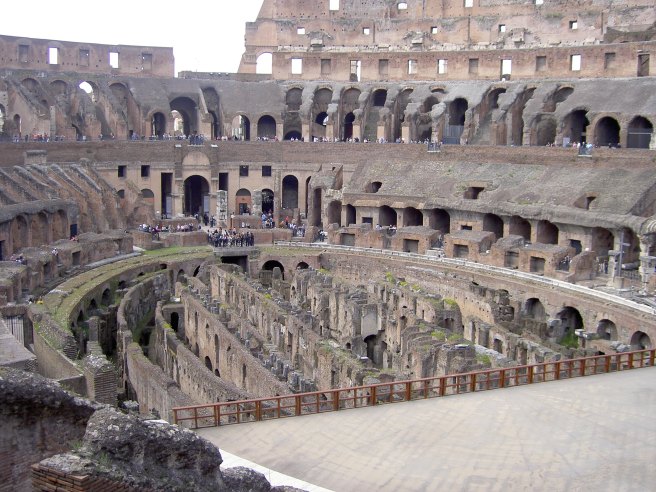
For the most part, we have been very pleased with the guides we have had and felt that this investment provided us with a deeper appreciation for what we were seeing. The two best examples that come to mind of where guides were invaluable to us are the Colosseum and Forum in Rome and Versailles Palace outside Paris. In Rome it would be almost impossible in a short time to see the most historically-significant parts of the Colosseum and the Forum without an experienced guide. I don’t remember her name, but our guide’s knowledge of these two attractions was certainly impressive. We hired her for an individual tour, which was not cheap but worth every Euro. She was able to answer in detail each question we asked. She spoke fluent English. She had a sense of humor without being silly. She took us on a walking tour, and she managed to cover essential ground, literally and figuratively, while also adding interesting anecdotes, myths, and fascinating details. It was such a rich experience.
Colosseum in Rome
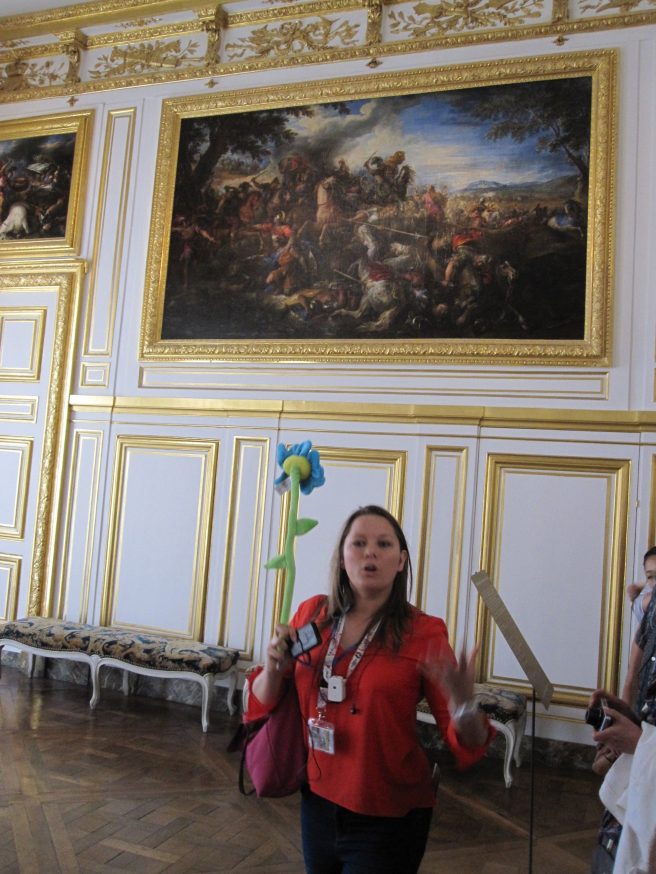
The Palace at Versailles is a short 30 minute train ride to the west of Paris and well worth the time and effort to get there. Because the Palace is so huge and we only had about four hours to spend there, we decided to pay for a guided tour. This time, we were part of a group. We still had bad memories of being shuffled through the Vatican Museum, shoulder to shoulder, like cows being herded to the slaughter. We were prepared for the worst at Versailles. Pauline was our host, and we could not have been more pleased. She met our group at a building where tickets are sold about three blocks from the entrance to the Palace grounds. She held in her hand a brightly-colored cloth blue flower on a tall green stalk, which she held up high enough for everyone to see to make following her a bit easier. As is usually the case with guided tours, Pauline was able to bypass the longer general admission line and get us in the Palace promptly, which is almost worth the price of the tour alone.
Pauline distributed our audio headsets shortly after we entered the Palace and tested them all. The technology was much better this time than when we were at the Vatican Museum, and our ear phones allowed us to hear every word she said. Taking us through each of the rooms of the Palace that are open to visitors, Pauline not only explained the significance of the rooms, but she was always careful and creative about weaving the information back into her chronological theme of the royal families that resided at the Palace. Her approach was similar to that of a school teacher, asking questions from the group and using responses to deliver her narrative. She managed to do so without dumbing down the story so that people of all ages and education levels could appreciate the tour. She was really talented. Another skill Pauline exhibited was aggressiveness. There are always rude people in museums who will insist on edging their way in front of others to get a better view or to take a photograph, or even worse, the obligatory selfie. Incidentally, selfie sticks are prohibited in the Versailles Palace and in many museums and galleries in Paris, thank goodness. When our group encountered anyone attempting to push in front of us at the railings while Pauline was talking to us, she would quickly and firmly say, “Excuse me, this is a group tour, would you please step aside? Thank you!” It worked every time.
Pauline, our guide at Versailles
Traveling is a luxury that many people cannot afford, which is unfortunate. However, there are ways to make tourism more affordable. There is a considerable range of prices for transportation, lodging, meals, attractions, and incidentals. It usually makes sense to pay for many services in advance, including admission. The Paris Pass is highly recommended for visitors to the city who plan to be there a few days and want to see multiple museums and galleries. Other major cities have similar deals, and they are definitely worth considering. Most of the time, we don’t feel a need to have a personal guide or to even join a group tour, both of which can be expensive. We tend to like the freedom of seeing what interests us most and skipping the rest, which is practically impossible with a guided tour. But there are times when having a knowledgeable narrator can provide that memorable and meaningful experience that so many travelers seek.
You might have election obsession (with all kinds of apologies to Mr. Foxworthy):
If 9 out of every 10 posts you share on your Facebook page are “breaking news” stories designed to “expose” the “truth” about one of the candidates, yoooouuuu might have election obsession.
If you can’t have a conversation about something as benign as your last vacation without eventually referring to a political party or a candidate, yoooouuuu might have election obsession.
If your Facebook page has turned into a news feed from sources that have titles including words like liberal, conservative, left, right, progressive, or patriot, yoooouuuu might have election obsession.
If you are convinced that everything that is wrong with America is embodied in one candidate while everything that could be right about the country can be achieved through the efforts of the other candidate, yoooouuuu might have election obsession.
If photos of candidates show up on your Facebook feed more often than your family members or your pets, yoooouuuu might have election obsession.
If you know more about the personal life and background of a candidate than you do about some of your best friends, yoooouuuu might have election obsession.
And finally, if you have contemplated leaving the country if your candidate of choice doesn’t win, yoooouuuu might have election obsession.
The title I selected for this post is a phrase often used by friends and colleagues of someone who is going through or has just recovered from an unusual set of circumstances, often stressful and almost always unexpected. The situation may be a life-threatening, horrifying experience, or it may be extremely bizarre or even comical, at least in hindsight. At any rate, the event seems to be right on the verge of the unbelievable to the individual in question and certainly to outside observers. What has happened sometimes illustrates the phrase “truth is stranger than fiction,” thus the idea and suggestion that the experience would make for an entertaining story. Quite a few people who knew me during my tenure as the director of the Flannery O’Connor-Andalusia Foundation suggested that I should write a book about some of the outrageous things that happened during my thirteen years with the organization. A question I heard over and over was, “So, do you ever feel like you’re in a Flannery O’Connor story?” The answer was always the same: “Well, of course.”
Andalusia historical marker and signs
I was hired by two of O’Connor’s first cousins, who had been selected by O’Connor’s mother, Regina, to serve as executors of the estate (both real and intellectual property) and as trustees of the Mary Flannery O’Connor Charitable Trust, which was charged with making distributions from the estate and controlling the copyrights of O’Connor’s work, among other responsibilities. I worked for them as an independent consultant for two years while a nonprofit foundation was being established to maintain Andalusia, O’Connor’s home in Milledgeville, Georgia. Once the foundation was established, I became its director. About one third of the governing board of the foundation was made up relatives of Flannery O’Connor, all on her mother’s side — the Cline family. O’Connor once wrote in a letter to a friend that irritation was the only respectable emotion in her family, a tradition that continued long after her death. Irritation was a frequent special guest at foundation board meetings.
The chair of the board was the husband of one of the two executors and trustees mentioned above. He was a remarkable biomedical engineer and professor who was credited with developing an early prototype of a bionic prosthetic arm. His wife was a brilliant woman (a trait that did run in O’Connor’s family) with more than one advanced degree. In addition to serving on the board and fulfilling her roles with the estate, she had worked for NASA for a while during the development of the solid-rocket boosters that would eventually propel the shuttle into space. Sadly, she passed away shortly after the foundation was established. As intimidating and as tough as they were, I respected them both and always believed they wanted the foundation to succeed under my leadership. They were very patient with me and supportive. Her husband continued in his role as the board chair, and it was a pleasure to work with him until his death several years later. Her sister became the sole executor after this woman’s death and shared her responsibilities of the Charitable Trust with her brother-in-law, the board chair, who had been named by his wife as her successor for that position. These two in-laws had a rather contentious relationship.
Main house at Andalusia
I have had many years to think about my interaction with the executor, going all the way back to the time she and her sister hired me in the fall of 2000. A Harvard-trained lawyer (among the first females to graduate from the institution with a law degree) who had worked almost her entire career for federal government agencies, she was already well known among the scholarly community as being extremely protective with copyrights and permission requests for publications about O’Connor’s work. She was absolutely devoted to maintaining the reputation of the Cline family, most especially a couple of the patriarchs who had either purchased the Andalusia farm where O’Connor and her mother lived or had helped with its operation as a dairy in the 1950s. The executor was also highly discriminating when it came to who should be considered a part of the family and who should not, regardless of legal relational status.
Board meetings were usually quite tense, especially interactions between the executor and the board chair. For the non-family board members, some of whom had impressive credentials, this type of organizational dysfunction was painful to watch. The executor resisted opening Andalusia farm to the public, and once it was open, she wanted to be directly involved in its daily operation and how the property was interpreted to visitors. At times, I refused to accommodate her in this regard, which drove a thick wedge between us that would continue and grow during the rest of my tenure at the foundation. She considered herself an authority about the history of Andalusia farm, but she refused to acknowledge that the real significance of the site was directly related to Flannery O’Connor’s time there as a writer, the very part of the site’s history she admittedly knew less about because she wasn’t a part of it.
Under the leadership of the next board chair (also a family member), the executor resigned from the board; however, she continued to exert her influence on policy and procedure. In the years that followed, her criticism of my efforts as foundation director became more acute, to the point that she would appear at our public programs or show up unannounced at Andalusia and voice her discontent openly. Of course, devoted fans of O’Connor were always drawn to her and wanted to meet her and talk with her because she was a relative and a contemporary of the writer. She could be extraordinarily charming when she wanted to be, and her sense of humor was wicked. Ironically, she rarely would discuss O’Connor with anyone but elected instead to talk about other family members and her personal memories of the farm going back to her childhood, which had little to do with Flannery O’Connor at all. She didn’t know Flannery O’Connor very well — they were not close, even though their mothers were sisters and the executor and her sisters spent summers with O’Connor when they were young children.
As they left childhood behind, these two women took very different paths. In spite of spending time together as children during the summer months, they lived in two different parts of the country for most of their early years. They earned their respective educations far apart from one another. This cousin’s career took her to the nation’s capital and elsewhere, while O’Connor’s illness took her back home to live the last thirteen years of her life with her mother on a farm in middle Georgia. Long after O’Connor died and her mother became a very old and frail woman, this cousin moved to Milledgeville to handle Regina O’Connor’s affairs and supposedly to protect her from threats outside the Cline family.
Here was a woman who was educated at Harvard, who was among the first females to graduate from there with a law degree, who had worked for the federal government and had even argued before the Supreme Court. Her first cousin happened to be a famous American writer. Not only was her cousin a great writer, but the characters she created were terribly grotesque and some of them had noticeable similarities to people she knew in real life. The language, the plots, and the black humor were shocking for polite society of the mid-20th century and a bit embarrassing to readers whose fictional palates were better suited for Jane Austin, Emily Bronte, or even Eudora Welty.
There is no doubt at all that the Cline family members had a difficult time appreciating, much less discussing, Flannery O’Connor’s novels and short stories when they were first published. It is highly likely that some relatives continued to struggle with her work decades after the author’s death in 1964. The executor made every effort, sometimes successfully, to control how O’Connor’s work was treated, examined, studied, criticized, and made available to the world. I suspect her appreciation for O’Connor had more to do with the author’s role as an apologist for the Catholic Church. How Flannery O’Connor would have reacted to the way in which her literary legacy was handled is anyone’s guess. Would she be irritated or entertained? (NOTE: The executor died in 2023. I am hopeful that going forward the trustees in charge of O’Connor’s literary estate will be less restrictive and controlling and more willing to work with scholars and writers in further exploring the work of this great American writer.)