Forget the Pencil; Bring Your Pistol

As of today’s date, the “campus carry” bill has already passed the house and senate in Georgia and has been sent to the Governor for his signature.  If the bill becomes law, it will allow students who are 21 or older to carry a concealed weapon on the campuses of state colleges and universities.  Although I have many concerns about students carrying handguns around campus, I do understand the circumstances and fears that led to the push for such legislation.  One of my major concerns is the rhetoric that always seems to surround issues and legislation about weapons in Georgia and around the country.  For instance, when asked why he was supporting this particular bill, a Georgia state legislator purportedly said, “In general, the only people laws affect are those who obey the law.  What we put into law is not going to have any impact on criminals.”

I actually have respect for this legislator, although we are not in the same political camp. This statement no doubt expresses his philosophy and that of many of his constituents where this bill is concerned.  But, is this how we are to regard legislation and laws in our state in general?  If so, then why should the state ever pass any law prohibiting any activity ever again.  Why have laws that prohibit the sale of cocaine or more lethal drugs if the only people such laws affect are those who wouldn’t use the substance in the first place?  Why have laws against aggravated assault if such laws are only obeyed by nonviolent people.  Why have traffic laws or speed limits?

Indeed, why have laws that prevent people from carrying guns into the state capitol?  I suspect these particular laws will remain because the state will make sure it has the law enforcement presence and power to enforce them.  But securing a college campus with law enforcement officers is much more expensive than securing a few state government buildings, right?

I truly do sympathize with parents of students and the students themselves where campus violence has escalated, especially at places like Georgia Tech.  I’m just not yet convinced that encouraging students to arm themselves is the answer.  Incidentally, if the law only allows students 21 and older to carry, then how does this law protect the other 50-75% of students on the campus who will not be able to carry legally?  Have violent crimes only been committed against college students who are over the age of 21?

I fear that when elected officials admit that civility can no longer be maintained by laws, then we have basically given the masses permission to take law enforcement into their own hands.  And, I fear that arming college students sends that message loudly and clearly to young people during a very impressionable period of their lives.  I just hope that Georgians, and Americans for that matter, are not moving toward a paradigm of abandoning the role of law enforcement to serve and protect and moving toward a society where self-defense becomes the expectation rather than the act of last resort.


Santa Fe’s Open-Air Opera

My wife and I made a trip to Santa Fe, New Mexico during the summer of 2014.  She had been to the town several times, but I had not.  We both love art, culture, and the southwest, and Santa Fe is one of those places where all three intersect.  We stayed in a lovely, rambling house just off Canyon Road, which placed us in walking distance from the major downtown attractions and more art galleries than anyone could possibly explore in a year’s time — alas, we were there for less than a week.

We also took some excursions outside the town to places like Taos, a famous haven for artists.  I went out to the center of the Rio Grande Gorge Bridge, the 7th highest bridge in the United States and the 82nd highest bridge in the world.  We ate incredible, authentic Mexican food at a little roadside taco stand.  We flew in and out of Albuquerque, so we were able to see some of the state’s desert landscape on the road between the two locations.

We met up with some friends one evening who live in Albuquerque who routinely make the drive up to Santa Fe to attend the opera located just outside town.  They invited us to go with them.  I was not raised with any exposure, appreciation, or understanding of opera.  I was raised with the music of the Allman Brothers  (outside of church, that is); the singing of Elton John; the acting of Robert Redford.  The closest I came to an opera performance was a Bugs Bunny cartoon or a Disney movie.  Even as an adult, although I am more familiar with famous operas, I still don’t know much about the art form.  Unfortunately, my cultural horizons don’t expand very far beyond literature and the thick forests of popular music, theater, and cinema.

For those who fall into this same category, I have good news.  There is a place you can go to appreciate opera even if you have no interest in it whatsoever.  The Santa Fe Opera House has been attracting audiences to watch performances and take in the magnificent views of the mountain ranges of northern New Mexico since 1957.  According to its website, more than 2,000 performances of 164 different operas have been given here, including fourteen world premieres and 45 American premieres.  Many singers whose names are now found on the rosters of the world’s leading opera houses began their careers in Santa Fe.  The company was founded by the late John Crosby, a young conductor from New York, who had an idea of starting an opera company to give American singers an opportunity to learn and perform new roles in a setting that allowed ample time to rehearse and prepare each production.

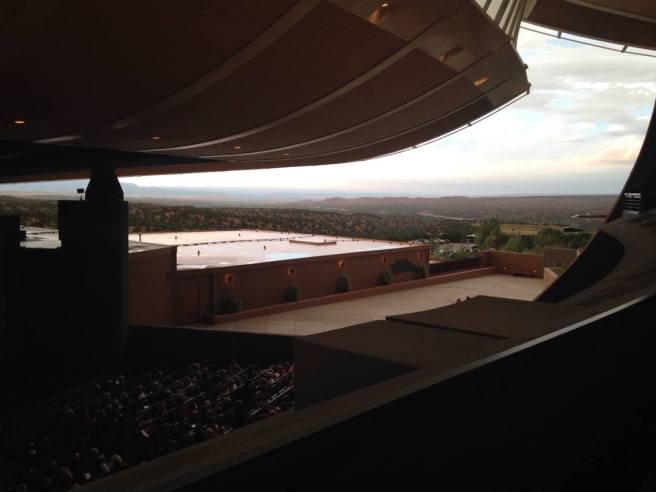
The Crosby Theater was built in 1998 and takes the idea of “open air” to a whole new level.  The modern structure features white sail-like wind baffles, a clerestory window for light, and a backstage that is almost completely open.  The sides of the theater are also open, so the audience can see the mountain peeks rising many miles away.  The breathtaking views are enough to distract even the most devoted opera enthusiast, but for someone like me who is a bit less than enthusiastic, this venue became the attraction.  We had a lovely dinner on the grounds of the opera before the performance.  The show we saw was a comedy, all in another language, of course.  There were hilarious parts, the orchestral music was excellent, and I ended up enjoying it more than I had anticipated.  Still, I can’t imagine a stage performance anywhere in the world that could be more impressive than the setting of the expansive desert as night approaches.  If you love opera, you have to go to the Santa Fe Opera.  If you don’t love opera, this is where you need to go to start appreciating it.

Santa Fe Opera House

A Writer By Any Other Name

One of the most gifted short story writers of the 20th century has a name that is rather unusual, although as a tribute to her talent, it is not as uncommon as it was during her lifetime.  There is a growing population of women, most under the age of thirty I would imagine, with the first name Flannery.  Those who are familiar with the life of the famous Georgia writer know that “Flannery” was a family surname and her middle name.  Her full name was Mary Flannery O’Connor.  However, when she went away to graduate school and eventually enrolled in the Writers’ Workshop at the University of Iowa, she decided to drop her first name and began signing all her work simply as “Flannery.”   Further, she requested that friends, relatives, and even her own mother refrain from calling her Mary Flannery, the double-name style that was so typical of women in the early to mid-20th century in the American South.  From that point on, she would be Flannery O’Connor.

It is impossible to know how much thought or even strategy went into Flannery O’Connor’s decision to abandon her first name.  Considering that she was raised a devout Roman Catholic and was a dutiful daughter of the Church, it would not have been a choice made lightly or carelessly.  Indeed, someone so committed to the faith would need a very good reason to drop the name of the mother of Christ, especially considering that she was adopting a much more masculine forename or Christian name — the irony is obvious.  Her mother, Regina Cline O’Connor, resisted for a while but finally gave in to her daughter’s demands.  Years later, O’Connor claimed that she made the name change primarily for the sake of her career as a writer.  She explained to friends that no one would want to read anything written by someone named Mary O’Connor, which to her sounded like the name of an Irish wash woman.

On second thought, readers of O’Connor know that she was incredibly deliberate in her craft as a writer.  By the time O’Connor hands us a story, there is not a single word or mark of punctuation left on the page that doesn’t need to be there.  Those steel blue eyes served as windows into a brilliant mind with a razor-sharp wit.  Flannery O’Connor had wanted to be a writer from a very early age.  As a child, she wrote stories, illustrated them, bound them with yarn, and made multiple copies of them to distribute to friends and family.  She was absolutely fascinated by the whole process of both writing and publishing, which later translated to a keen understanding of writing as a profession.

I am convinced that when O’Connor began writing in Iowa in the mid-1940s, she also started to envision herself as a successful author.  Knowing that she would soon be sending manuscripts off to prospective agents and publishers, she no doubt understood her disadvantage of being a female who wanted to be taken seriously in a male-dominated profession.  To avoid having her manuscripts ignored or trashed immediately, she needed for editors to think they were reading the work of a man, and a name like Flannery gave her that edge.  Certainly the content of her fiction would not have given her gender away!  The strategy worked.  Letters she received from editors in response to her early submissions were addressed “Dear Mr. O’Connor.”  One early editor, upon learning O’Connor’s identity, still doubted that the stories were written by a woman at all.

Beyond the androgyny factor, a name like Flannery O’Connor gave the writer another distinct advantage, one that is often fabricated now by entertainers from a multitude of genres.  Having an unusual name goes a long way toward establishing memorable identity.  After all, how many writers do you know named Twain?  Poe?  Steinbeck?  Faulkner?  Of course, those are last names, and isn’t it amazing how often readers don’t refer to O’Connor by her more common last name, but by her iconic first name?  Fast forward to the age of pop culture.  It isn’t difficult to remember names like Cher, Sting, Madonna, Eminem, T-Pain, or Beyonce.  Who needs a last name?  Atypical works, and it works well.

Flannery O’Connor died at the young age of 39 from complications of lupus, the disease that had taken her father’s life when she was only 15.  Her mother outlived her by about 30 years.  I don’t know if O’Connor chose the wording for her tombstone or not.  Perhaps Regina O’Connor had the last word with her only child this time.  Maybe the inscription was dictated by the custom of the Church, the community, or family tradition. Whatever the case may be, O’Connor is laid to rest with her full name restored as a memorial to a literary genius.  Those of us who admire her work will always respect her wishes and remember her as Flannery O’Connor.  A writer by any other name is, well, someone else entirely.

Flannery O'Connor's grave
Flannery O’Connor’s grave

Southern Word of the Day (Part 2)

This is the second installment of Southern words.  For the last couple of years, I have been entertaining myself (not difficult) and my Facebook Friends with posts that I have coined “The Southern Word of the Day.”  Obviously, this gig is a direct rip-off of the comedian Jeff Foxworthy’s redneck words, and there is certainly some overlap.  However, I have imposed some rules on myself that Foxworthy didn’t always follow. For instance, I only use legitimate English-language words, which includes the occasional place name but mostly just regular words.  So I would never use Foxworthy’s “widgedidga” because it isn’t a legitimate word, even though it clearly is a phonetically-correct Southern word that translates to “with you did you.”  So Foxworthy’s word “mayonnaise” as a substitute for “man there is” serves as a good example of my method.  I also try to stay away from the simple two-syllable rip-offs like aster = asked her, or cider = beside her, or otter = ought to, or stark = it’s dark.

I have decided to put together a list of my favorite Southern words that I have posted, and perhaps Jeff Foxworthy has used these too.  No plagiarism is intended here; I can only plead ignorance, which for me is not a stretch at all.

Memberships.  Usage: “Back in the day when we was bar hoppin’ on River Street in Savannah, I memberships used to come by on the river so close you thought you could reach out and touch ’em.”

Artichoke.  Usage: “As cold as it’s been lately, you really artichoke that lawnmower engine before you try to crank it.”

Classified.  Usage: “I’d have been early to classified been able to find a parking place on campus.”

Tortoise.  Usage: “It scared me when I saw Billy Bob coming tortoise with that chain saw in his hands.”

Animator.  Usage: “The hamburger would be so much better if you’d put some bacon animator on it.”

Diversity.  Usage: “Earl did a good job singing, but I don’t think I’ve ever heard diversity was singing on that song at the Uncle Ned’s funeral.”

Mariner.  Usage: “I heard Billy Bob was dating Charlene; then the next thing I know he was mariner.  I wonder if she’s in trouble?”

Hibachi.  Usage: “How can you say Billy Bob don’t love you when hibachi that brand new set of steak knives just last month?”

Southern Word of the Day (Part 1)

Grand Doesn’t Touch It

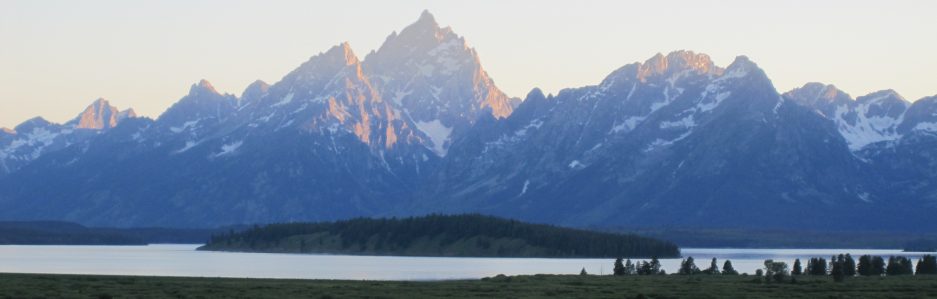
They call the range of mountain peaks at Jackson Hole the Grand Tetons, although there is actually one peak in the range that is identified as “Grand Teton.”  Whether you choose to believe the name is derived from the French term for large breasts or the Native-American Teton Sioux tribe, the adjective is about the best we can come up with to describe this majestic geological feature — GRAND.  But when you are standing on the deck of Jackson Lake Lodge, or sitting inside the lobby with its 60-foot tall windows, peering across the great expanse of land and water at those rocky crags rising thousands of feet into the sky, you soon realize that a word like “grand” doesn’t touch it.  Somehow, this is one of those sights, for me at least, that language fails to describe, that photographs cannot completely reproduce, that videos do not totally capture.  Of course, recognizing all of this did not stop me from making video clips and taking photographs, like the one here.  Grand Teton National Park is another one of those places I have had the joy of visiting where I am reminded how small I am and just how magnificent the natural world is.  Put it on your bucket list.

Grand Tetons from Jackson Lake Lodge

Worship Without Music

As stated previously in this blog, I was raised in a Southern Baptist Church (SBC).  Generally speaking, Southern Baptist worship, especially during the main service on Sunday mornings, could be described as a passive experience by the majority of people present, namely the congregation.  There are a couple of exceptions.  In recent decades, it has become popular to insert a time of greeting around the midway point of the service, which involves handshaking, hugging, some folks walking all around the sanctuary to apparently greet as many people as possible until forced by embarrassment to finally get back to their seat.  This practice is not limited to the Baptists either.  The only other part of a SBC service that encourages participation by everyone in the sanctuary is music, and for Baptists, music is a central part of worship.  SBCs give music a lot of space and time, from large pianos and organs for traditional worship services, to full-scale bands for “praise” services, and even small orchestras for the mega-churches.  They include several hymns for the congregation to join together singing.  SBCs also tend to employ full-time ministers of music, who typically are paid better than other support staff in most denominations with comparable-sized churches.  They typically have choirs for all age groups, along with an adult choir that practices weekly to present calls-to-worship, anthems, benedictions, etc.  Some churches even have special musical groups like hand-bell choirs, vocal or instrumental ensembles, and pop bands.

The format of worship in a SBC was certainly a suitable environment for my development with respect to the central role of music.  I was raised in a family that appreciated music, had some musical abilities, but above all encouraged musical skill and performance in my generation of youngsters.  My sister and I both took music lessons — she with the piano and I with the guitar.  I was brought up to sing church songs from a very early age, even before I can remember.  My earliest memory of singing was when my mother and grandmother took me out in the countryside to visit a bedridden relative of my grandmother (a sister or cousin, I’m not sure which), and I was instructed to sing a short song I had learned in Sunday School.  The song was titled “He’s Able.”  I still remember the words and the tune to this day:

He’s able, He’s able, I know He’s able
I know my Lord is able to carry me through
He healed the broken hearted, and he set the captive free
He made the lame to walk again, and He caused the blind to see
He’s able, He’s able, I know He’s able
I know my Lord is able to carry me through

As I became a teenager, my guitar skills developed enough that I could accompany myself singing, and could also play for youth group gatherings in my church.  My voice also matured to a fairly solid tenor, perhaps with a higher range than most guys my age.  I sang in choirs, performed at church functions (often with my sister and a cousin), and eventually reached what some would have considered the pinnacle of the music scene in a SBC — presenting “the special” during Sunday morning worship.  This song, typically a solo but sometimes a duet or trio, was usually placed in the service just before the pastor’s sermon.  For the 40+ years I was in a SBC, that part of the music service was always referred to by ministers and congregants as “the special” or “special music.”  Unfortunately, a label like that can encourage a certain sense of pride, if not arrogance, by the person offered such a place of distinction.

My love for music at an early age, combined with the ability to play the guitar (fair, but not very skilled) and a voice that my friends and family thought was pleasant, presented me with the opportunity to be a regular part of the special music rotation, almost always as a solo.  As I grew to adulthood, moved away from home, and started a family, I settled in another SBC where I continued with this practice.  I taught myself to play the piano and eventually began to accompany myself with that instrument.  It is with humility and perhaps some shame now that I look back on the decades of my musical contributions as a soloist because I realize that, all too often, I know what I was doing more than anything else was performing.  More than providing a meaningful worship experience for myself and the congregation, I was seeking to be an entertainer, to impress an audience, to attract their attention, to win their love.  So many people in SBCs will tell you that music is essential to their worship experience.  They will boast about their choir and exalt their music ministers.  But, they usually reserve their highest admiration for the people who perform special music, posting or sharing videos of them on their social media pages.  I enjoyed this kind of adulation all the time, and it was a rush.  My fellow church members were kind and gracious, and I have no doubt they were perfectly sincere when they told me how much a song I sang or wrote meant to them and enhanced their worship experience. I was touched by their encouragement, but what I craved was to amaze them.  Alas, I am vain.

After a divorce and a time of transitioning away from the Baptist church (I had left it theologically many years before), I met a beautiful Episcopalian.  And then I married her.  Everything changed, and for the better — much better.  I found a home in the Episcopal Church, with a theology that I could embrace without too much difficulty.  My wife introduced me to an early morning service at our small town church that she really liked because it was quiet, peaceful, reverent, and completely without music.  I had never been to such a service, and much to my surprise, I loved this style of worship.  After decades of being in churches where music was so central and where I was such a visible participant, it took me a while to understand why I was attracted to a service without music.  I think it is because I know that music was too often a distraction for me.  Instead of helping me get beyond myself to seek communion with the divine, it fed my ego and kept me in the foreground.  Performing caused me to focus on technique, style, quality, and even appearance.  It was way too much about me.

My wife and I have moved and are at another parish now.  They don’t have a service without music yet, although the priest has talked about introducing one.  There is resistance from the parish, which is to be expected.  I hope we can try it at some point. I will never stop loving music, and that includes church music.  And, I can certainly enjoy a worship service with music, even if I’m not at all familiar with so many of the songs from the Episcopal tradition.  In a way, that’s a good place to be.  It’s awfully hard to perform a song you don’t know very well.

Little Rock Creek Falls

My wife loves adventures, and she has had quite a few.  My life is all the more richer because of the adventures we have shared in the eight years we have been married.  There have been times when I have “caused” adventures for which we didn’t necessarily make plans, but she has usually faced the challenges with enthusiasm and determination.  She is a gracious soul.  One such occasion happened about five years ago when I decided to search for a hiking trail that terminated at a waterfall — one of my favorite outdoor experiences.  I searched through a trail guide and selected one in north central Georgia in the Chattahoochee National Forest.  Little Rock Creek Falls looked beautiful in all the photographs I saw, which perhaps encouraged me to be a bit too dismissive about the descriptions of the trail leading to the falls that described it as being difficult and dangerous with thick underbrush.

Little Rock Creek
Little Rock Creek

For young folks or very athletic, experienced hikers, this trail would not be a problem.  My wife and I are casual hikers.  We are occasional hikers.  We are quite often paved-trail hikers.  Little Rock Creek trail has no pavement.  The length of the trail from the road to the falls is a little less than a mile, and the elevation is consistent; however, the terrain is quite steep and rocky as the trail makes its way along a sharp embankment following the creek.  The understory is beautiful and thick with mountain laurel and rhododendron.  At this stage of our hiking careers, we were not yet using sticks of any kind (we each have two now).  Under normal conditions, we would have considered this to be a moderately difficult hike, but alas, I had the audacity to take my dear wife on this excursion not too long after she had broken her shoulder, which she guarded carefully along the way.  I was nervous the whole time, fearing that she would slip and reinjure her shoulder or break something else trying to protect it as she fell.

Although we should have waited until she was in better shape to make this hike, I can state with certainty that neither of us was disappointed with the terminus of this trail.  It was one of the most secluded and enchanting waterfalls I have ever seen in Georgia.  We did the obligatory selfie shot with the falls behind us, which became profile pictures for both of us on social media for several months.  I apologized to her profusely for selecting such a treacherous trail, especially considering that she was still recovering from an injury.  As usual, she simply said, “I’m fine.”  She is indeed.

Little Rock Creek big falls

Why Trump Troubles Me

When it comes to politics, I am torn between fiscal responsibility and social justice, which seem to collide, even more violently these days. I am torn between my appreciation for capitalism and protecting those on whose bruised shoulders it really stands and not protecting those who all too often abuse it. I struggle with respecting traditions while making sure they aren’t forced on everyone, or worse yet, enforced by law. I am weary of victimization, the slippery slope syndrome, rudeness, hypersensitivity, and too much testosterone in today’s rhetoric.

However, I will express a concern about the election. What happens when all the people who are putting their faith in Donald Trump to “Make America Great Again” end up seeing absolutely no change in Washington if he is elected to the White House? What then? Is he the last great hope for making government efficient again, functional again, respectable again? Or perhaps we will see even more change than we can actually stomach. Trump is accustomed to getting exactly what he wants because he has the money, resources, and temerity to force through an agenda. During so many of his speeches on the campaign trail, Trump will talk about a change he believes his constituents are demanding, and his favorite phrase in those cases is “It’s gonna happen; it’s gonna happen.” But, what happens when he gets to Washington and encounters obstacles far greater than he has ever experienced in the world of business, namely Congress. Negotiation is not his style, as he has made clear over and over. He is not really interested in making deals; his approach is to always have the upper hand, forcing the other side to cave and submit to demands. What tools will be available to him as President to continue this practice? You think Obama abused the executive order privilege? You think Trump will let the Constitution get in his way?

Stalled on the Tracks

For most of my life I have lived in the rural parts of Georgia.  Of course, some would argue that outside of Atlanta, there’s nothing left except rural parts.  During a good portion of their histories, many small-town businesses in Georgia were supplied by railroads.  Rail tracks often ran right through the middle of town, as they still do.  Most of the freight trains no longer stop in these small towns because those businesses are supplied by the trucking industry, but the trains still travel through the towns quite regularly.  Most small Georgia towns will only have one or two places where roads either go over or under tracks; otherwise, vehicular traffic has to stop for trains as they make their way through town.

I can remember as a child being stopped at a railroad crossing in the car with my parents.  It was exciting and fascinating to hear the whistle of the engine, to feel how it shook the ground as it passed by, and to watch the succession of rail cars as they sped through the crossing.  Counting the rail cars and reading the graffiti painted on their exterior walls was great entertainment.  Then I celebrated my sixteenth birthday and started driving.  The novelty of freight cars roaring through town wore off and was replaced by impatience waiting for the train to pass so that I could get where I was going.  Now as I have aged and live with a more hectic schedule, as most of us do, I find myself dreading the sight of the flashing red lights and the descending black and white striped crossbars that indicate the approach of yet another freight train and just one more delay in my already too-busy schedule.  But, even worse, and something that raises my blood pressure to dangerous levels, is when the passing train slows down until it finally comes to a complete stop, blocking the road.  This is a situation that railroad companies avoid if at all possible because some townships have actually filed suit against railroads for causing significant traffic problems with stopped or even stalled trains.

Freight Train
Freight Train

Thinking about how enraged I have been waiting 10-15 minutes for a train to finally move past a crossing, I can’t help but draw comparisons with the current political climate in the U.S.  Our government, especially on the federal and state levels, is like a train stalled on the tracks at a major crossing. People who are from multiple origins and who have many different objectives are on either side of the crossing. They can’t get to the other side. They can’t even see the other side. They are completely separated by this huge obstruction that refuses to move forward and clear the way for the good of everyone involved.  The real frustration comes from the realization that the train operators don’t seem to care at all that they have brought everyone, and everything, to a stand-still.  A train can carry an incredible amount of materials, or people, from one place to another most efficiently, as long as it keeps moving.  When it slows down, or worse yet, stops, the train is useless. If a train can’t deliver, it has totally lost its value.

Where the Grapes are Grown

About six years ago, my wife and I were on a business trip in Savannah, Georgia, with her boss.  We decided to have dinner at one of the best restaurants in the historic section of the city, a place called the Olde Pink House on Abercorn Street.  We didn’t have reservations but were fortunate enough to get a table in the basement bar, where there was a fire blazing in a large fireplace, and the light in the room was soft and low.  It was a very relaxed setting, with an old world kind of atmosphere, which is exactly what one should expect in one of the South’s oldest cities.  Our waiter was quite knowledgeable about their wine selection, so we asked him to decant a nice, dry wine to go with dinner.  He brought the bottle to the table, poured half the contents through the filter into the large decanter, swirled the liquid to release the bouquet, and allowed us to smell the wine before he poured each of us a glass.  I have now forgotten the variety (probably a merlot), but I do remember that it was just about the best glass of wine I had ever tasted.  We asked him about the brand, and he told us it was a Hess.  We had never heard of it, but we were determined to find out more about the winery.

Hess Winery
Entrance to Hess Winery

The Hess Collection winery is in the Mount Veeder area of Napa Valley in California.  Grapes have been cultivated on the property at least as far back as the 1870s.  From 1900 to 1929, the property was owned by Colonel Theodore Gier, who built a three-story building that would eventually hold the Hess Collection’s historic barrel chai and art gallery.  After a few more owners and continued development and expansion through the 20th century, a man named Donald Hess purchased 900 acres on Mount Veeder to begin the Hess Collection.  Over 600 acres are set aside as undeveloped land to support wildlife corridors, fish-friendly farming practices, and biodiversity.  The Hess Collection opened to the public in June, 1989, following a two-year renovation of the facility which includes 13,000 square feet of Donald Hess’s personal contemporary art collection.

In 2011, my wife and I took a fabulous vacation to San Francisco, which included several side trips.  One of our excursions was a drive up to Napa to pay a visit to the Hess Collection winery.  It was magnificent.  In addition to tasting several varieties and buying a case to take home with us, we also visited the incredible art gallery and gardens.  According to the website, “Donald Hess began collecting art in 1966. Today, the Hess Collection houses less than a quarter of a collection that is shown in museums worldwide. His collecting style is a personal endeavor driven by passion rather than monetary investment or current trends. He develops a close dialogue with an artist to better understand what drives him or her to create and he carefully limits his focus as a collector to 20 living artists whose work he faithfully supports long term. As is evident by the caliber of the collection, he collects with the uncanny ability to acquire works by lesser known artists who often go on to become well known and respected in their disciplines. His typical commitment to an artist spans decades and various stages of his career.”

Hess Winery garden
Gardens at Hess Winery

My wife and I drink wine fairly often.  We are nowhere close to being authorities, and we are certainly not wine snobs.  Grocery store brands work fine for us most of the time.  Our favorable impression of the wine we had that evening at the Olde Pink House may have had more to do with the company and the dining experience than the sophistication of our palates, but we liked it enough to search out where the grapes are grown, which gave us an even deeper appreciation for the brand.  The story of Donald Hess and his enterprise, which he has now passed down to the next generations, is a fascinating one.   Seeing the actual vineyards where a great bottle of wine originates presented us with a wonderful moment of connection that I’m sure we will remember for a long time.