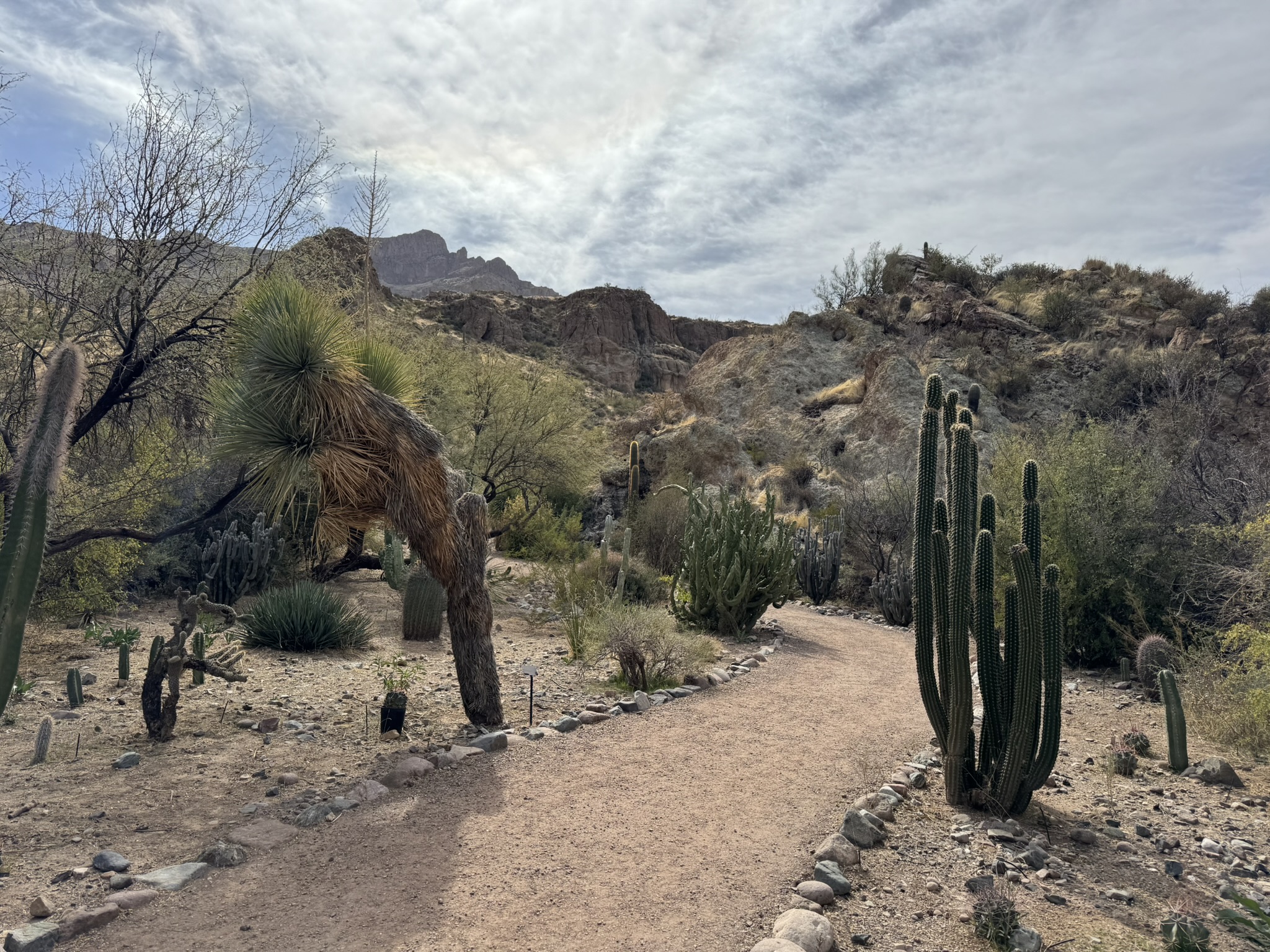
During our annual winter vacation to Arizona for 2025, my wife and I got out of Phoenix for a half day and drove an hour southeast to visit the Boyce Thompson Arboretum. Situated on 372 acres of scenic upland Sonoran Desert, it is Arizona’s oldest and largest botanical garden. The arboretum was founded by William Boyce Thompson, an American engineer, financier, and philanthropist who created his fortune in the mining industry. He built a winter home, the Picket Post House, in the early 1920s overlooking Queen Creek near Superior, Arizona. He then established an arboretum in 1924 on the land surrounding his house. Thompson understood the importance of plants as the ultimate source of our survival and well-being, and even today his appreciation of the power of nature is evident at Boyce Thompson Arboretum State Park.
Boyce Thompson Arboretum, Arizona
The arboretum is the home of desert plant collections from around the world, arranged in clearly defined sections of the park, from the United States, Mexico, Australia, Madagascar, India, China, Japan, Israel, South America, the Middle East, Africa, the Mediterranean, and the Arabian Peninsula. The park contains over 20,000 plants with winding paths leading visitors through trees, shrubs, grasses, cacti, and a cornucopia of flowering species. The signage is just right – not obtrusive but offering plenty of detailed information. The park also includes some beautiful artwork, arbors, shade structures, water features, and benches. There is a lovely gift shop and nice restrooms at the entrance.
Boyce Thompson Arboretum, Arizona
We strolled around the paths and through the various sections of the park, marveling at the incredible diversity of specimens, from tall trees to the tiniest thorny cacti. Most of the plants obviously belong in a desert climate, but some of the trees look like they would be right at home in a city park anywhere in the world. Color abounds, texture is all over the place, and the shades of green seem almost limitless. Everything looked so lush, so alive when we were there. We did notice signs of a drip irrigation system in several areas, which may mean that some of the species require more water than is available in the Sonoran Desert environment. There are even a few endangered species in the park, and plant conservation is a big part of the organization’s mission.
Boyce Thompson Arboretum, Arizona
The drive over to Superior from Phoenix is a pleasant one, with magnificent views of the desert landscape and Superstition Mountains to the north. The park is open most days of the year, with hours of operation changing according to the seasons. They have a great website at https://btarboretum.org/ from which most of the information in this post is gleaned. Arizona is a hiker and cyclist paradise, with thousands of miles of trails throughout the state. Outdoor recreation opportunities are almost endless. I would include the Boyce Thompson Arboretum in the long list of places where visitors can enjoy the beauty of nature in a confined space, where the physical challenge isn’t so great, but the rewards are substantial.
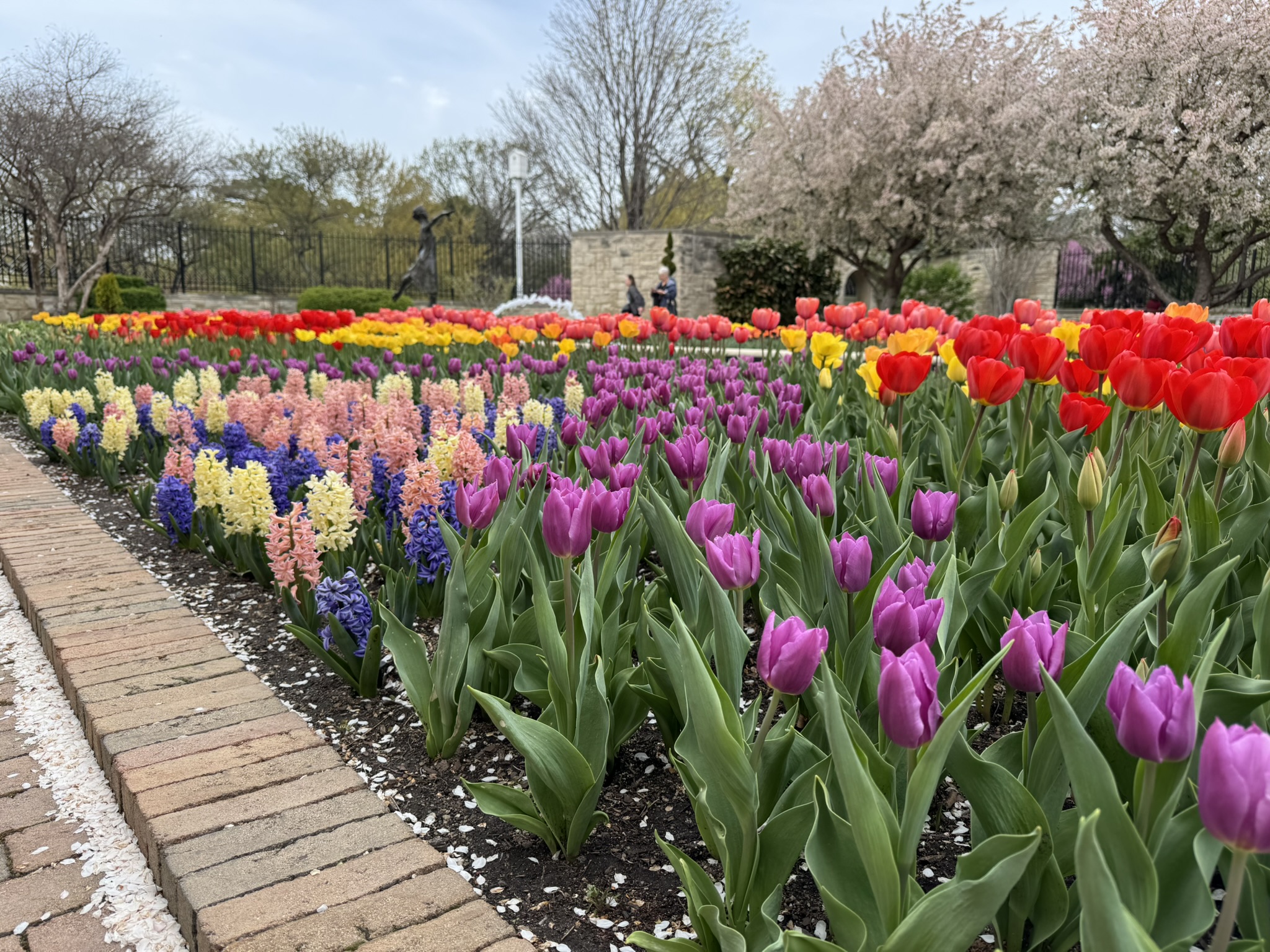
Public gardens have been a topic of this blog on several occasions over the years, primarily because I usually make a point of visiting such places when I am traveling. In April 2025 my wife and I were in Kansas City having lunch with a friend who told us to make sure we stopped by the Kauffman Memorial Garden before heading back home. She mentioned that the tulips and other spring bulbs were in full bloom and that we would be amazed by the displays of color and design. Among the many advantages of being retired is the flexibility of our schedule, which meant we felt no pressure to get back on the road. We took our friend’s advice. She wasn’t exaggerating. The wow factor was in overdrive.
Ewing and Muriel Kauffman Memorial Garden, Kansas City, MO
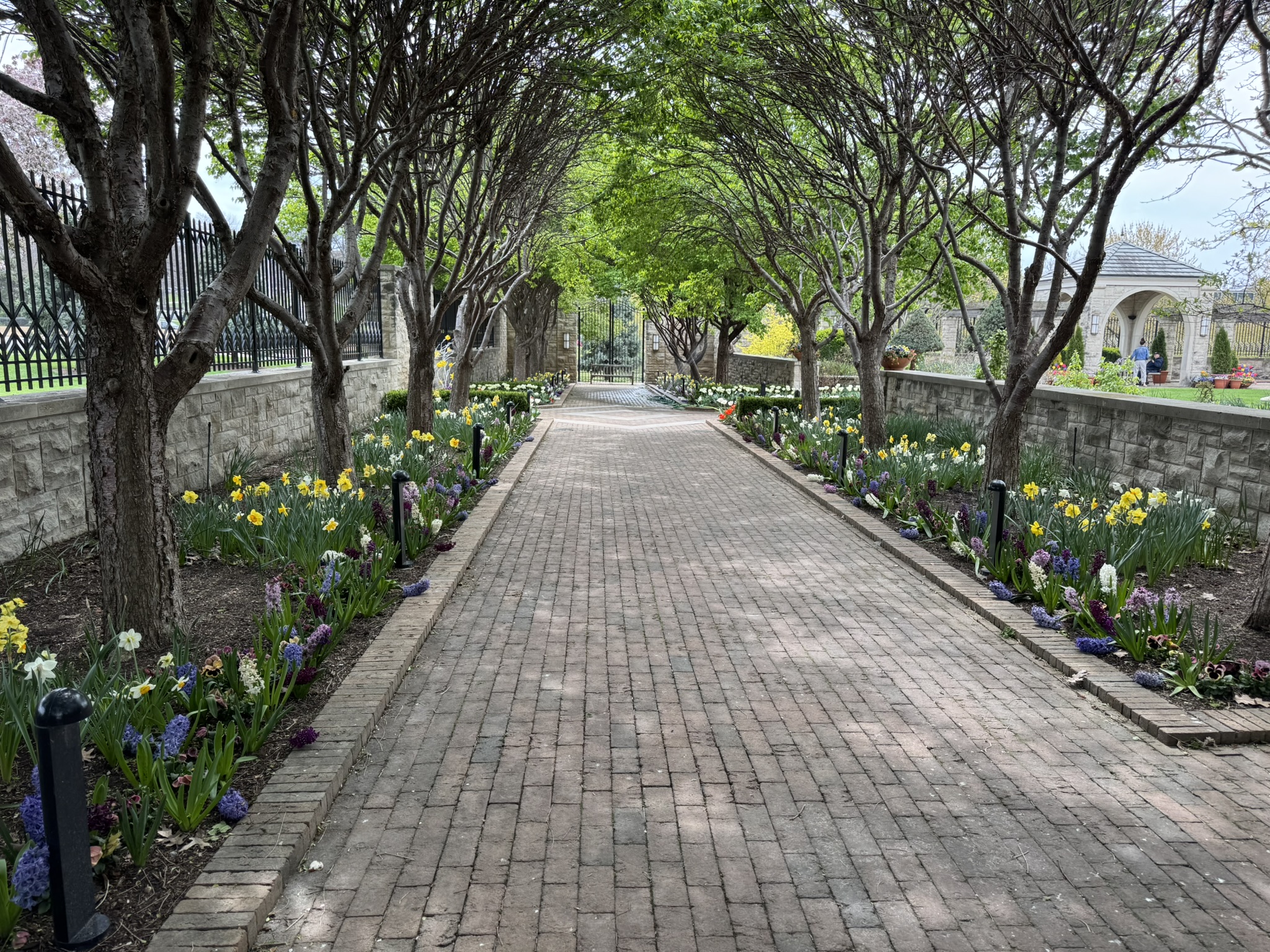
Approximately two acres in size, the Ewing and Muriel Kauffman Memorial Garden is the centerpiece of Legacy Park, an urban greenspace in the historic Rockhill neighborhood of Kansas City that is owned and operated by the Ewing Muriel Kauffman Foundation. There is no charge to enter the garden, and parking is free. The garden is not available for private functions, including weddings, receptions, or parties. Organized photo sessions, including portraits, are also prohibited. Children must be accompanied by adults. Dogs other than service animals are not allowed. Brick pathways make the garden accessible to almost anyone, regardless of limited mobility. This tranquil space is truly an oasis nestled in a metropolitan area of over 2 million people.
Ewing and Muriel Kauffman Memorial Garden, Kansas City, MO
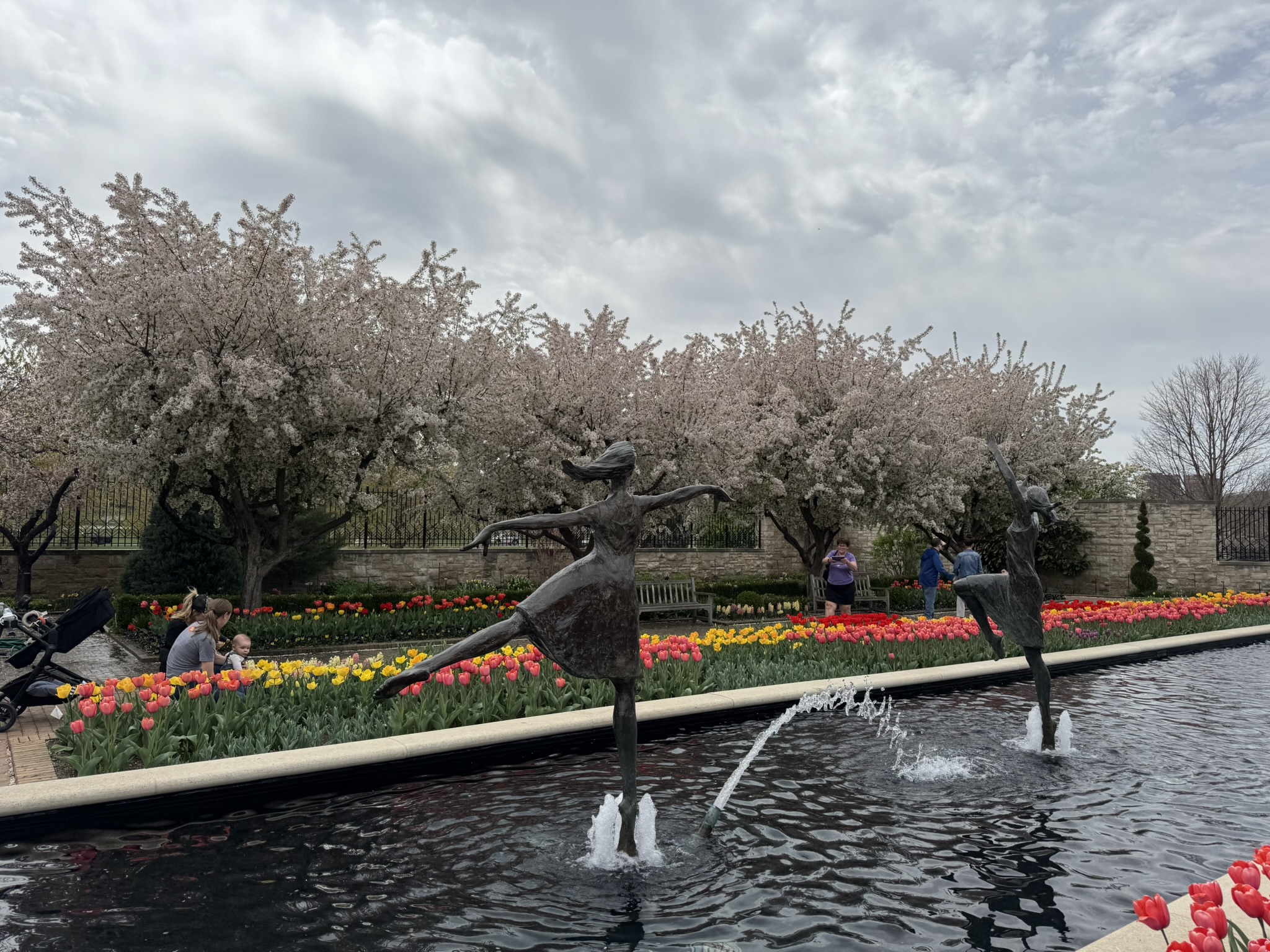
According to the website, the garden opened on Memorial Day weekend in 2000. Its design is inspired by the gardens of Europe, complete with fountains, pools, statuary and other artwork, planting containers, benches, and a greenhouse all enclosed within a stone and wrought-iron wall. It features more than 350 varieties of perennials, a collection of ornamental trees, and numerous annual beds that change seasonally. For our visit, we were greeted by a resplendent display of tulips, daffodils, hyacinths, pansies, crocus, and several other species I couldn’t identify. The colors were spectacular, and the palette design was careful and deliberate.
Ewing and Muriel Kauffman Memorial Garden, Kansas City, MO
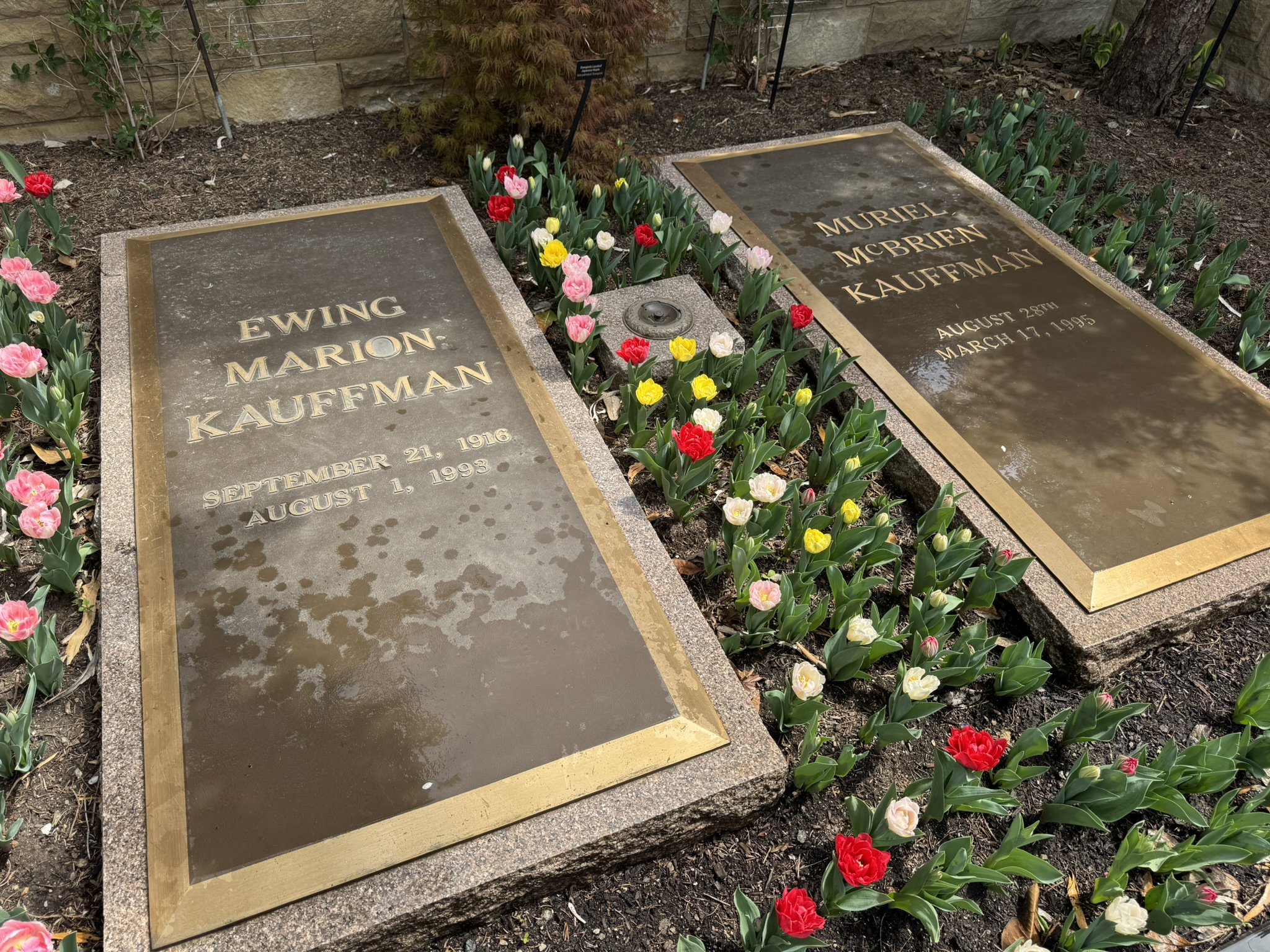
The namesakes of the foundation and the garden have a fascinating and close connection to Kansas City, and their legacy is a large one. Among his many accomplishments, Ewing Marion Kauffman established Marion Laboratories in 1950 and created the Kansas City Royals baseball team as an expansion club in 1968. His wife, Muriel, served as the treasurer and first legal counsel for Marion Laboratories. They started a foundation that would eventually become a powerhouse in funding the performing and visual arts, but the reach of their philanthropy extended to so many other areas. The garden serves quite literally as a memorial to the couple – they are buried on the grounds. They left a remarkable charitable footprint, and this garden is a showcase of their generosity and love for their home, Kansas City.
Ewing and Muriel Kauffman Memorial Garden, Kansas City, MOEwing and Muriel Kauffman Memorial Garden, Kansas City, MOEwing and Muriel Kauffman Memorial Garden, Kansas City, MOEwing and Muriel Kauffman Memorial Garden, Kansas City, MOEwing and Muriel Kauffman Memorial Garden, Kansas City, MO
The modern word “express” originates from the Latin “pressare,” which is where we also get the word “pressure.” It refers to the action of pressing or creating pressure. Of course, the prefix “ex” simply means “out.” So, roughly speaking, express means to press outward, or onward, at considerable speed and without pausing. When applied as an adjective to transportation, and more specifically rail transportation, express implies a locomotive that makes few intermediate stops and reaches its destination quickly. According to multiple sources, the Shanghai Maglev in China, also known as the Shanghai Transrapid, is the fastest train in the world with a maximum operating speed of 460km/h or 268 mph. And who claims the dubious ranking for the slowest express train in the world, averaging just 42 km/h or 26 mph? That would be the Glacier Express in Switzerland, and it is a record they are proud to hold.
Glacier Express
As a highlight of a vacation my wife and I took to Paris and Switzerland in late summer 2024, we booked a ride on this magnificent train that travels through the Swiss Alps, skirting along just north of the Swiss-Italian border between the two cities of Zermatt and St. Moritz. Our major goal of discretionary spending and travel in retirement centers on creating memorable experiences, and if we think it is warranted, we will make financial sacrifices to take those once-in-a-lifetime trips. The eight-hour excursion on the Glacier Express definitely fell into this category.
We decided to take full advantage of the journey by upgrading to Excellence Class, a single car of the locomotive that accommodates only twenty people. Nestled in reclining seats positioned next to large windows, we were facing each other across a small table where, during the 180-mile ride, two wait staff served us a five-course Alpine meal prepared on board the train, complete with champagne and a selection of wine paired with each course. The food was quite good, served on china with silver cutlery and plated as elegantly as one would find in any fine restaurant. My wife wisely passed on the steak tartare, which is a French term for raw ground beef sprinkled with Worcestershire sauce. I ate one bite and immediately decided hamburger is best served at least at medium temperature for my taste. Otherwise, everything was really tasty.
Glacier Express Bar
Excellence Class provides each passenger an electronic tablet and headphones loaded with information about the train, history of the Glacier Express, relevant maps, and points of interest along the route. Onboard wi-fi is also available on the device. Guests have access to dedicated concierge service, luggage handling and storage, and a private bar. The car is roomy with a large central aisle and small space behind each seat for small carryon luggage like the backpacks we had with us. Souvenirs are available for purchase and delivered to passengers at the end of the journey. We treated ourselves to a magnet and two cute tilted glasses embossed with the train’s logo.
Rhine Gorge from the Glacier Express
When we originally began contemplating a ride on the Glacier Express, I envisioned tracks running through flat valleys, offering us panoramic views of the Swiss Alps from a distance. While that scenario was indeed part of the trip, this train ends up traveling from a low point of 1,919 feet and climbing to an elevation of 6,670 feet at the highest point at Oberalp Pass. In other words, we were gazing up through our windows at soaring peaks just above us, some of which were covered in snow. At other times our eyes were treated to enormous green hillsides and valleys dotted with quaint villages and farmland populated by sheep. There was an abundance of ponds and waterfalls, along with cascading streams, creeks, and rivers.
My wife is not a big fan of bridges, so of course, she was thrilled to learn that the Glacier Express crosses over a total of 291 bridges along the way, including the world famous Landwasser Viaduct. This single-track limestone railway passage is constructed of six tall arches rising 213 feet above the ravine with a span of over 1,500 feet. As we approached the viaduct, our train began to slow down considerably, which we expected. Several of us in Excellence Class (my wife not included) walked a few cars down where our concierge told us we could get a better view to take photos from the train’s open windows. As the train started over the bridge, the concierge clapped her hands and excitedly announced to my wife and those passengers remaining in our car, “Oh, this is the first time in my three years on the Glacier Express that the train is actually going to stop on the viaduct!” My traveling companion was not amused.
Landwasser Viaduct from the Glacier Express
The Albula Line first opened in 1903, and the Glacier Express made its debut journey on the track in 1930. With the opening of the Furka Base Tunnel in 1982, which protected against avalanches, the Express was able to run year-round. The company began offering Excellence Class in 2019 and are continuing to add amenities into the future. The train excursion is wonderful as a stand-alone opportunity, but considering how enchanting both Zermatt and St. Moritz are as bookends to the trip, riding the Glacier Express makes for an unforgettable travel experience.
I have written about gardens several times in this blog. They are among my most favorite places in the world. I love them in all their many forms: small residential gardens, larger private ones, arboretums, botanical gardens, public gardens, and those you find at houses of worship, city parks, river walks, and even businesses. They brighten up any space with texture, structure, color, and incredible beauty. They are places of refuge and contemplation. There are so many features to enjoy, including ponds, streams, waterfalls, varying terrain, rocks, boulders, statuary, fountains, and other built structures. Whenever my wife and I travel, we almost always look for gardens to visit or revisit.
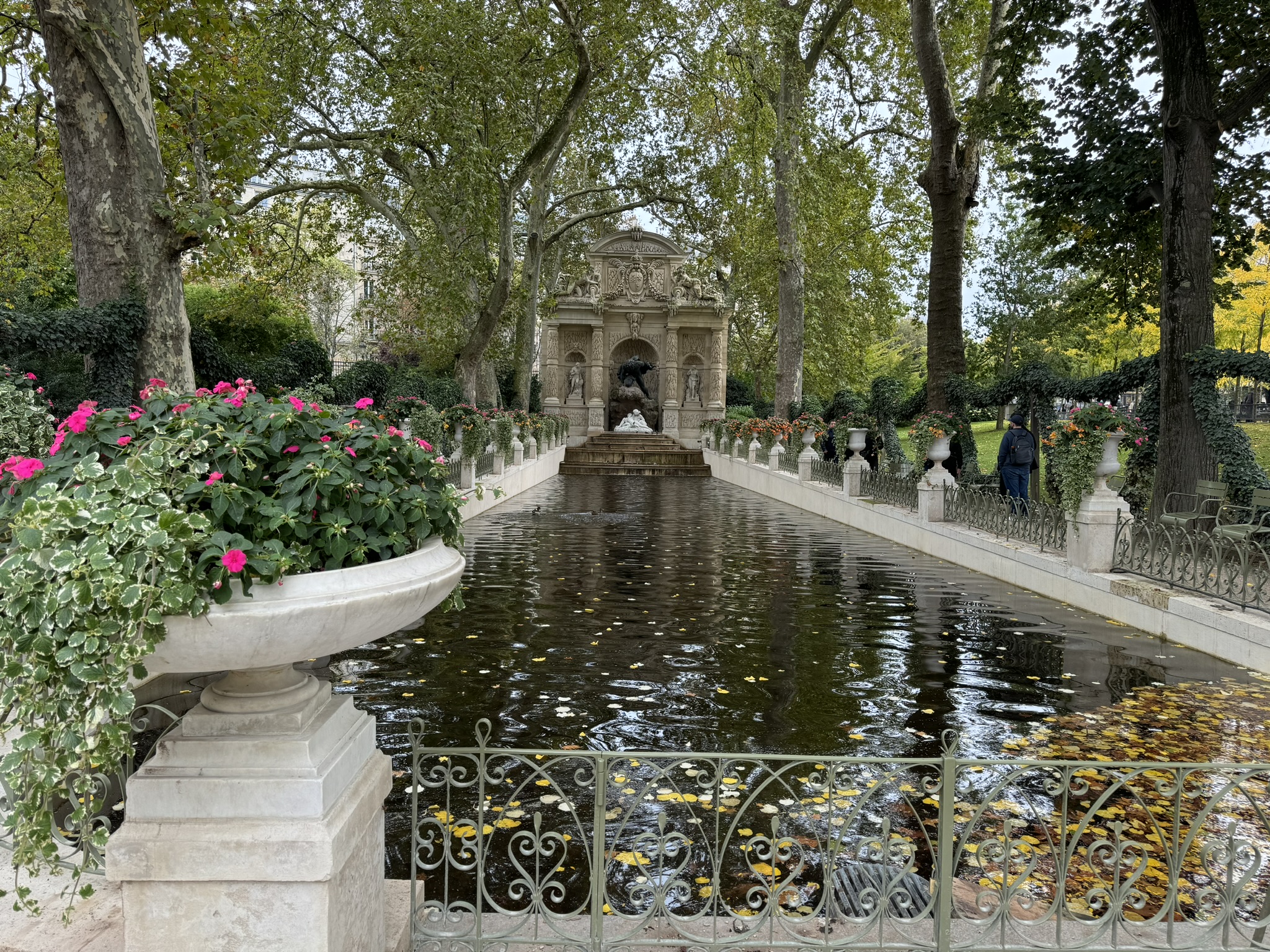
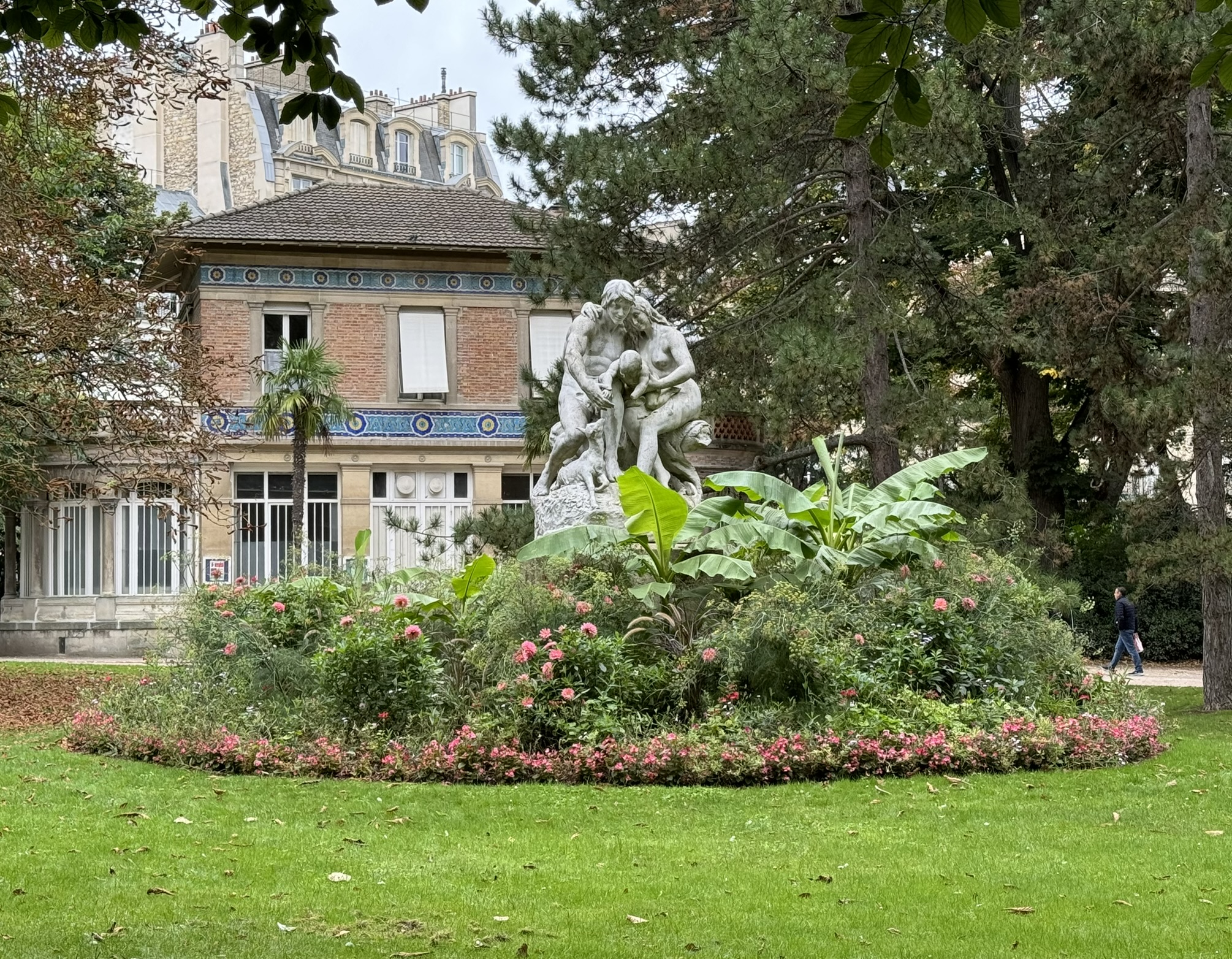
In September 2024, we took a two-week trip to Paris and various locations in Switzerland. On our last day in Paris, we spent the better part of the morning wandering around one of the most spectacular spots in the city, Luxembourg Garden. Located in the 6th arrondissement in an artsy part of the city, the Jardin du Luxembourg comprises 25 hectares (56.8 acres) adjacent to the grand building that houses the French Senate, thus its more familiar name for Parisians, Jardin du Sénat. The Luxembourg Garden comprises formal English gardens, 3,000 trees of various species, 5,000 square meters of flower beds, an orchard containing more than 500 old varieties of pear and apple trees, a collection of exceptional orchids, and 102 statues and monuments, including the famous Médicis fountain.
French Senate building at Luxembourg Garden
The garden’s origins date back to the 17th century when Marie de Médicis, the widow of Henry IV, built an Italian palace on property once owned by François, Duke of Piney-Luxembourg. The French Senate took over ownership of the garden in the early 1800s after the palace became the home of the governing body in 1799. It wasn’t until the last half of the 19th century with the restoration projects in Paris under Napolean III that the garden began to take its more modern shape. Luxembourg Garden has appeared in numerous works of literature by authors such as Victor Hugo, Henry James, and William Faulkner.
Médicis fountain at Luxembourg Garden
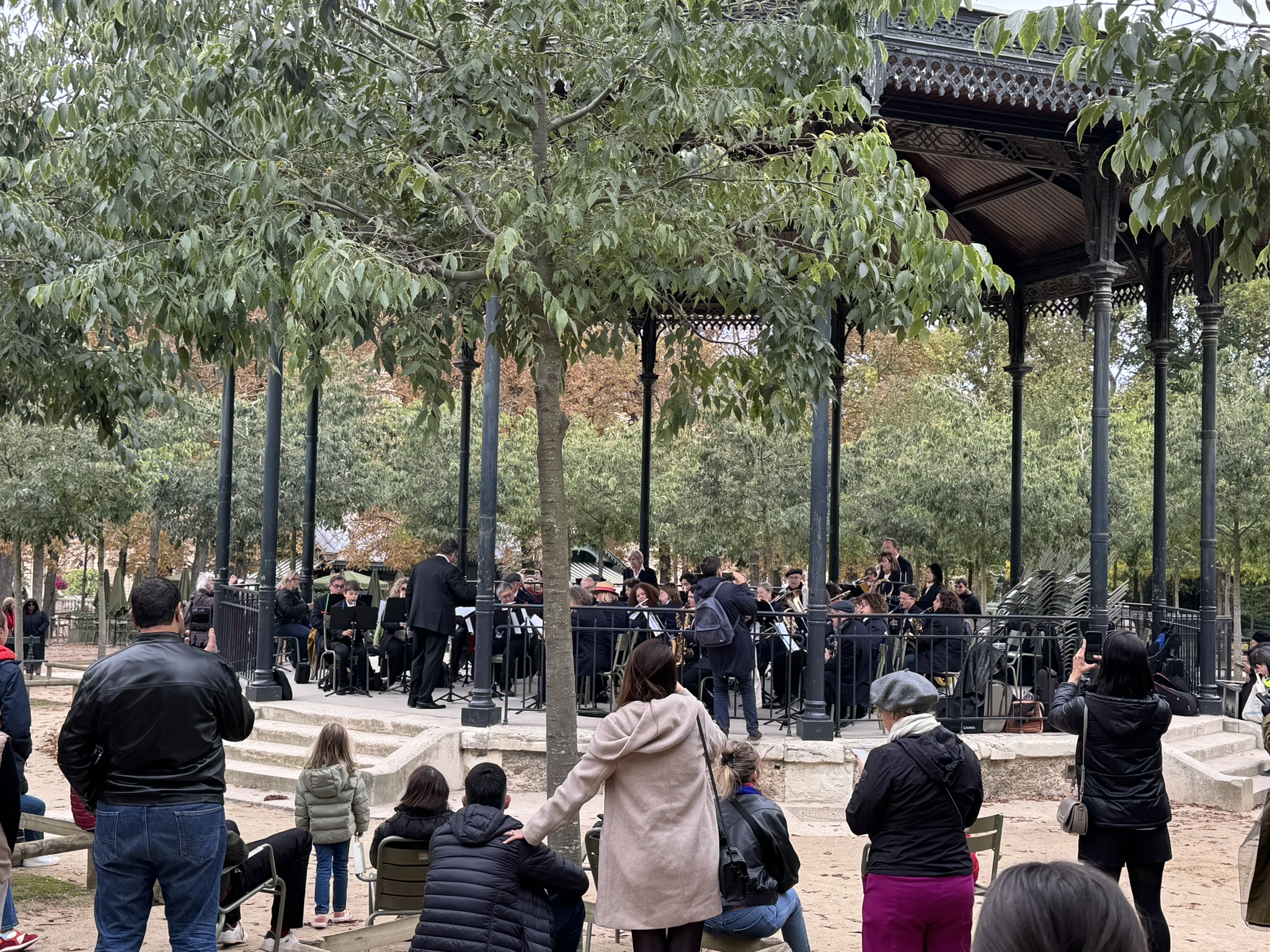
As we entered the garden that Sunday morning at the Porte Gay-Lussac, we were greeted by the sounds of music coming from what appeared to be a small community orchestra at the nearby Kiosque à musique. We made our way counterclockwise to the Médicis fountain and then past the Senate building, protected by a high metal fence and guards with firearms. We continued around the perimeter of the garden, making side trips into the interior from time to time. Before leaving, we spent a few moments near the Grand Bassin, a large octagonal basin of water surrounded by raised balustraded terraces adorned with a series of statues of former French queens, saints, and other historical figures.
Orchestra at Luxembourg GardenLuxembourg Garden
What impressed me most about this garden is how brilliantly the built environment blends with and enhances the horticultural surroundings. Walkways wind through trees, hedges, shrubs, lawns, and planted beds, encouraging us to meander and gaze. Statues, sculpture, and other features are spaced out and in the open or tucked neatly into nooks and crannies, inviting us to explore and pause to appreciate and learn. Luxembourg Garden is truly an oasis we can enjoy simply for its beauty and design. However, it’s also an outdoor classroom for aspiring students of all ages who wish to be schooled in botany, art, architecture, history, and so much more.
Bacchus (Dionysus) statue at Luxembourg GardenLuxembourg GardenGrand Bassin at Luxembourg Garden
The last day was November 13, 2024. The thought of it filled me with excitement, relief, happiness, and maybe just a hint of anxiety. I have contemplated this date for decades but only gave it serious thought during the last five years or so. I have been preparing for this moment over a good portion of my adult life. My ideas about how it would look and the impact it would have on me have changed over the years. I’m extremely grateful to be reaching such a pivotal point in my life, and I am even more thankful that I got to celebrate the occasion with my spouse/best friend. November 13, 2024, was the day my professional career ended, and retirement began.
time clock (source: Wikimedia Commons)
My wife retired earlier in 2024, and although I cut back to halftime hours for my final year, I still went to work several days a week, every week. The thought of never again having to drag out of bed at dawn, down a cup of coffee, grab a bite to eat, shower, shave, get dressed, and head out the door for work is just lovely, if not a bit scary. No work means no paycheck. Yes, like many Americans we will have sources of retirement income, including social security. No, it’s not the same as a regular earned paycheck, which is more a difference in the mind than the wallet. For many people, retirement is a huge shift in thinking and practice; in short, we transition from spending and saving what we are earning to spending what we saved, either on our own or through our employers and/or the government. It takes some getting used to for most of us, I suspect.
The joys of being retired are slowly revealing themselves with each passing week. The stress that comes from adhering to a daily schedule and meeting deadlines pretty much disappeared on day one. The luxury of rarely setting an alarm for waking in the morning is heaven, although I still tend to wake up between 5:30 and 6:30 a.m., although there have been a few mornings I have slept past 8:00, especially in a hotel with blackout curtains. Retirement offers so many scheduling options, such as traveling and vacationing on whatever days of the week that works best for our planned activities, assuming we have set plans. Sometimes we just get a whim and go off on an adventure, which is so liberating and fun. We can book flights now based on the optimum prices, availability, airline, time of year, and choice of destination, rather than how we can fit air travel into a work week.
Money can buy so many things, but the most precious commodity we cannot purchase for any amount of cash is more time. However, retirement puts more of the time we have back in our hands to do with as we please. I love to read, and during the years I was working, I typically would get up early enough to spend at least 30 minutes to an hour reading with my first cup of coffee. Reading at night has never been a good option for me because I tend to lose attention and retention after dinner. Now, I can read for hours on end at almost any time of the day that works for me, which is heavenly. I am also devoting more time to reading online subscriptions to newspapers like the New York Times and Wall Street Journal. One slight downside of not driving back and forth to work each day is less time spent listening to audiobooks, so I will need to carve out time each week for that relaxing and engaging activity too.
pocket watch (source: Wikimedia Commons)
I have been an amateur musician for over fifty years, and another huge benefit to retirement is the amount of time devoted to learning new music, improving my skills, and performing more often. I am even spending an hour each week working with a friend and gifted guitar player who is expanding my knowledge and abilities on that instrument. I also have more opportunities now to sit down for blocks of time to work on the keyboard, learning new songs and getting better at playing in general. I am hoping that retirement will free up more time for songwriting too. Being able to sleep in also means I can stay out later to participate in open mic and jam sessions around town or take in live music shows in the area. My wife and I love going out in the evenings to live music shows.
Another benefit that is more related to our ages than retirement specifically is our eligibility for Medicare, the federal government’s medical insurance program for people age 65 and over. We will save a bundle on premiums and on most medical services and procedures in the coming years, which will free up more money for travel and the many other interests we have. I am baffled by people who tell me that retirement did not meet up to their expectations. Some of them even went back to work. I suppose there are retirees out there who fill up their days watching hours and hours of television. Yes, we do watch television, but mostly we watch sports programming (Go CHIEFS!!!) and a few series now and again. We also love the idea that we can now catch matinee movies at the cinemas during the week and get better deals on admission and concessions. Speaking of discounts, we have become much more aware of lower prices for seniors at restaurants, grocery stores, and other retailers. Those savings really add up over time.
Admittedly, I have become quite obnoxious about the freedom retirement affords. When I’m shopping for seed at our local Wild Birds Unlimited store around mid-day, I often look around at some of the other shoppers and think, “Damn, I bet you’re here on your lunch break, aren’t you?” Or if I’m driving around town mid-morning and the traffic is heavy, I find myself saying out loud in my car, “Why aren’t all you people at work?” I know, I know. I’m a terribly smug person. Eventually I’ll settle in to this wonderful rhythm of retired life, and in so doing, perhaps I will become a bit more humble and gracious. But for now, let me rub it in just a tiny bit.
Admittedly, I let this month slip up on me and am rushing to get a post in today before December and 2024 are gone for good. So, here is a list of my favorite books from the past year. Who knows, this year-end review may become a tradition, not as a substitute for a monthly post but perhaps as an addition.
The Nickel Boys by Colson Whitehead
Based on an actual reform “school” for juvenile boys in Florida during the Jim Crow era, Whitehead’s prize-winning novel is a heartbreaking, maddening story told by one of the most talented young American writers. It is not just a story about racial discrimination and inequality, but both loom large in the plot. The backstory of the protagonist, Elwood Curtis, is touching and sets the stage for the tragic turn of events that leads to his incarceration. With emotional integrity that never even gets close to being sentimental, the author takes the reader on a horrifying tour of the school’s campus: dormitories, cafeteria, utility facilities, and the one building where unbearable acts of cruelty occur. I get the sense that Whitehead may have conflicting feelings about the passivity of early civil rights leaders, most especially Martin Luther King, Jr., who is heroic and inspirational to Elwood, especially as a young boy. I like this book much better than Whitehead’s other blockbuster hit, The Underground Railroad, which was a fine book but allegorical and thus not as engaging for me as this powerful story.
Dear Regina: Flannery O’Connor’s Letters from Iowa edited by Monica Carol Miller
I worked for almost two years as a consultant, hired by the literary estate of Flannery O’Connor, to create an inventory of the archive of her manuscripts, letters, photos, journals, and other personal effects. During the course of that project, I read each of the letters included in this collection, and it was a real treat to go back and read them again. The relationship between Flannery and her mother is complex, unusual, and in so many ways fascinating, especially considering the number of stories the author wrote where the main characters are a mother and a child.
Among the most interesting developments we find in these letters is how, in a matter of only two years, Flannery becomes much more independent and driven. In the beginning, the young graduate student seems to be nervous about being so far away from home and family for the first time in her life. As time goes by and Flannery is introduced to established writers and publishers who admire her work as a student at Iowa, she becomes more confident in her abilities, which results in a more bold attitude toward Regina. She is willing to rebuke her mother if she senses that Regina is overstepping her bounds or commenting inappropriately about matters she doesn’t understand.
On the darker side, readers can’t help seeing O’Connor’s deeply ingrained racism, her sense of moral superiority, her callous reaction to the suffering of others, and sometimes a general misanthropic nature. Some would argue that she simply resisted the social conventions of her time, especially expectations of young “ladies.” I think it’s more than that. I think she felt terribly awkward in most social situations and preferred to limit human interaction with only a few people. This personality trait may have helped her in the end as a writer and even on a more personal level when her lupus diagnosis forced her to live the last third of her life with her mother in the rural Deep South of middle Georgia.
Miller provides some commentary in her introduction to the book and at the beginning of the phases of Flannery’s tenure at Iowa. I think the book could have been stronger with a deeper analysis of the correspondence, but perhaps the literary estate placed restrictions on the editor. Given the executor’s reputation for such tight control on what has been published in the past, this is a valid speculation. Nevertheless, the estate did permit the letters to be published, which means they are now widely available to readers and scholars of O’Connor’s work. That’s a good thing.
Eve: How the Female Body Drove 200 Million Years of Evolution by Cat Bohannon
What a valuable book that almost serves as an updated edition of Natalie Angier’s classic study titled Woman: An Intimate Geography. Bohannon comes out swinging from the first page, observing how medical science has committed egregious errors and arrived at faulty conclusions because it has considered the needs of males and females to be the same when it comes to developing pharmaceuticals and treatments. The differences between the sexes go far beyond their genitals and mammary glands. The author explains why the most common use of male subjects only (human or other animals) for medical research is terribly shortsighted, sometimes resulting in catastrophic and even deadly consequences. And that’s just the first chapter!
Building on the complexities of the female body (while also giving plenty of attention to the difference between sex and gender along the way), Bohannon traces millions of years of evolution to draw some startling and perhaps controversial conclusions about human origins, female anatomy, reproduction, childbirth and child rearing, language, sociological patterns, human achievement, and so much more. The chapter on breastfeeding alone is worth the price of the book — good heavens, I learned so much!
She makes solid arguments for why some of the great discoveries and advances in early human development may be attributed to women as opposed to men, who have historically taken the credit. Her practice of demonstrating the similarities and intersections of female characteristics across species in the animal kingdom – from orcas to mice, from ducks to our primate cousins — helps to reinforce the evolutionary evidence she produces to explain why women are specifically equipped for all the roles they fill as an equal half of homo sapiens.
I highly recommend it to just about everyone. Women will benefit from knowing more about what makes them tick and how they became the marvelous wonders they are. Men NEED to read it to better appreciate all the women in their lives, beginning with the ones that brought them to life and gave them a fighting chance to survive.
Shakespeare and Company by Sylvia Beach
What a delicious book! I have known about the importance of Sylvia Beach’s little American bookstore in Paris for a while but was not aware that she wrote such a wonderful memoir about her experiences as the owner and storekeeper of Shakespeare and Company. Her membership-supported enterprise was so much more than just a bookshop. It served as a refuge and haven for some of the most gifted expatriates and writers of the early 20th century, including Ernest Hemingway, F. Scott and Zelda Fitzgerald, Ezra Pound, T. S. Eliot, and most especially James Joyce. I had no idea that she was the first publisher of Joyce’s monumental novel, Ulysses. She really was a remarkable human being, one who made great sacrifices to support an amazing and historical intellectual community. She even risked her own life during the Nazi occupation of Paris by refusing to compromise her standards or cater to the monstrous regime that swept across Europe before and during World War II.
Grandma Gatewood’s Walk: The Inspiring Story of the Woman Who Saved the Appalachian Trail by Ben Montgomery
For anyone who needs a story of inspiration, endurance, and good old fashion intestinal fortitude, look no further than Ben Montgomery’s well written account of Emma Gatewood’s adventures on the Appalachian Trail and her other treks across the country on foot. It is estimated that this grandmother and great-grandmother ended up walking more than 14,000 miles, the distance of half the globe, all after she turned 67 years old. Included in these pedestrian journeys were two thru-hikes on the Appalachian Trail and a third time in sections, back in the late 1950s when the trail was not so popular or populated by hikers. Oh, and she also walked the Oregon Trail, literally, from Independence, Missouri to Portland, Oregon. She was in her seventies when she completed that one. Anybody want to complain about being tired now? Ever again?
Grandma Gatewood overcame terrible conditions on the Appalachian Trail, from rattlesnake encounters to raging storms, from extreme temperatures to blown out shoes (she wore only sneakers!), from fallen trees to flooded creeks, and injuries to her feet, ankles, and knees that would have spelled defeat for most men half her age attempting what she succeeded in doing several times. Her amazing stamina was born out of tragic circumstances: years of mental, emotional, and physical abuse from a monster of a husband.
Walking in the forest in solitude gave Emma Gatewood great joy and satisfaction, although she struggled to remain alone in her quest many times as her story spread during the months she was on the trails. She became a celebrity, and her time walking was interrupted more and more by journalists, photographers, and curious onlookers. For the most part she remained humble and patient, although she did lose her temper a few times with the rudest of the bunch. And then she felt remorse and asked them to forgive her! What an example she set for just about everyone on how to pursue dreams, overcome adversity, and live your best life.
If Beale Street Could Talk by James Baldwin
This is a powerful novel for several reasons, not the least of which is how it captures the sense of despair among African Americans over injustice from the legal system specifically and from the society at large. The narrative is impressive to me considering it is written by someone who lived his later life as a gay man but elected to employ a first-person voice of a young woman. The family dynamics and conflicts that drive the story are made more intense by Baldwin’s skill with descriptive language and dialogue. It’s all so believable. Along the way, he inserts little nuggets of gold that transform this book from a good to a great novel. Here is one fine example.
“Only a man can see in the face of a woman the girl she was. It is a secret which can be revealed only to a particular man, and, then, only at his insistence. But men have no secrets, except from women, and never grow up in the way that women do. It is very much harder, and it takes much longer, for a man to grow up, and he could never do it at all without women.”
The remainder of that paragraph is just as profound as this passage. There is a lot going on in this novel, including the tension that exists among the sexes and how love is exhibited and expressed in such diverse ways. If Beale Street could indeed talk, it would testify to the struggles of black America, as would the streets of Harlem, Birmingham, Montgomery, Atlanta, Detroit, and Tulsa, just to name a few. Baldwin was so familiar with such places, and he courageously explored every square foot of them.
Grace Saves All: The Necessity of Christian Universalism by David Artman
I have read other books on Christian Universalism, but this is the best so far. Artman is a minister who has struggled with the concept of hell and eternal damnation for most of his life, but in recent years he has found a spiritual path that changed his perspective on the Christian faith. He was able to do so with plenty of evidence from Biblical scripture and the guidance of some of the pioneers in the theological study of universal salvation or the idea that, in the end, God saves all humanity. No one is punished forever and ever in the lake of fire, gnashing their teeth, so forth and so on.
Artman explains early on in his book that Christian Universalism is nothing new and that many early Christians embraced this theological position and promoted it. Once he began to look at universalism closely, it just made sense in the context of a loving creator God. For Artman, “it is the only approach to Christian theology which can successfully defend the goodness of God; and therein lies its necessity.” In some ways, Artman and his readers come to universalism through the back door, as if it is the only option left. As he explains it: “Once someone fully grasps the concept that God knows the end from the beginning and is not controlled or regulated by any outside forces, the following realization strikes home – the outcome of all things will inevitably be what God intended from the beginning.”
Artman still believes in the free will of humanity. He just posits that ultimately God will win over even the strongest deniers, the faithless, the atheists, criminals, etc. Now, it may take a very long time to bring them back into the fold, but Artman’s God is more patient than Job, and will not stop pursuing the lost until they are found. The one issue I have with this concept is the admission by universalists that punishment is still very much a part of God’s plan, and God will use it if necessary to bring the wayward back to God, where they belong. The punishment is not forever and it isn’t revenge. It is just a tool God uses to achieve the goal. Artman believes “there is coming a time envisioned in which everyone will happily acknowledge the salvation of God which has come through Christ.” I’m not sure that punishment through torture is ever effective in producing true repentance, and certainly not a happy acknowledgement.
Artman remains close to his Christian faith with his belief that Jesus Christ is still the proper pathway to salvation. He doesn’t directly address how unfair it may be for people who live outside the boundaries of Christian tradition to find and board the Jesus bus headed to heaven. This is a book of Christian Universalism, and therefore, very Jesus centered, which may prove frustrating to those outside that faith tradition. To his credit, Artman recognizes there is scriptural evidence that contradicts some of his findings and conclusions. “Since all theologies end up facing passages of Scripture which are hard to deal with, the question is not if these passages will be dealt with, but how. All theological approaches must face this dilemma. No theology gets a free pass.” He reconciles scriptural contradictions wearing “Jesus-colored glasses,” taking comfort in the fact that Jesus ate with criminals and refused to throw stones at adulterers, so he cannot imagine that God doesn’t possess the same compassion and forgiveness.
In the end, Artman looks at the spirit of the Bible and the life of Jesus to reach a rational theory of how God operates, and universal salvation is the only outcome that makes sense. For those who would question his rationale, he replies: “Making an overall interpretation of the Bible is a difficult thing to do. There is no single biblical approach that doesn’t run into scriptural problems. And so, we must finally ask which biblical approach aligns most closely with the goodness of God, the character of Jesus, and the overall narrative arc of the Bible. On the whole I believe the Inclusive approach offers the best solution.” Good answer, Dr. Artman. Good answer.
Flannery at the Grammys by Irwin H. Streight
Professor Streight has written a very fine and thoroughly researched study of Flannery O’Connor’s impact and influence on songwriters in the pop music genre. I have long been interested in this topic, and I frequently made mention of those connections to visitors at Andalusia, O’Connor’s farm home in Milledgeville, Georgia, during my 13-year tenure as the director there. I still remember vividly sitting in a rocking chair on the front porch at Andalusia the day singer/songwriters Jim White and Mary Gauthier made their field recording of “Fruit of the Vine,” which Streight mentions in this book. They both exhibited such a sense of reverence during their visit.
O’Connor’s body of work is a Comstock Lode for songwriters, composers, playwrights, screenplay writers, and visual artists, which I consider a testament to her genius and durability as a writer. Streight focuses most of his attention on the more familiar and acclaimed rock and folk artists/groups who have paid homage to O’Connor in their work, such as Bruce Springsteen, R.E.M., U2, Lucinda Williams, Mary Gauthier, and Kate Campbell. But he digs even deeper to discuss songwriters in the alternative genres of metal, punk, and a few other less definable types.
Streight pushes toward the exhaustive in his study as he devotes a chapter to how often O’Connor’s themes and language show up in song lyrics, even though there may be no direct correlation between the author and the lyricist. He admits to the stretch in these cases, but the observations are interesting, and the connections are certainly worth acknowledging. The “Bonus Track” chapter on stage names from O’Connor’s novel, Wise Blood, and her characters is fascinating although probably not a strong connection to the author in most cases. All in all, Streight’s book should be of great interest to anyone interested in how pop culture reflects and reacts to serious fiction. This is a valuable contribution to O’Connor scholarship.
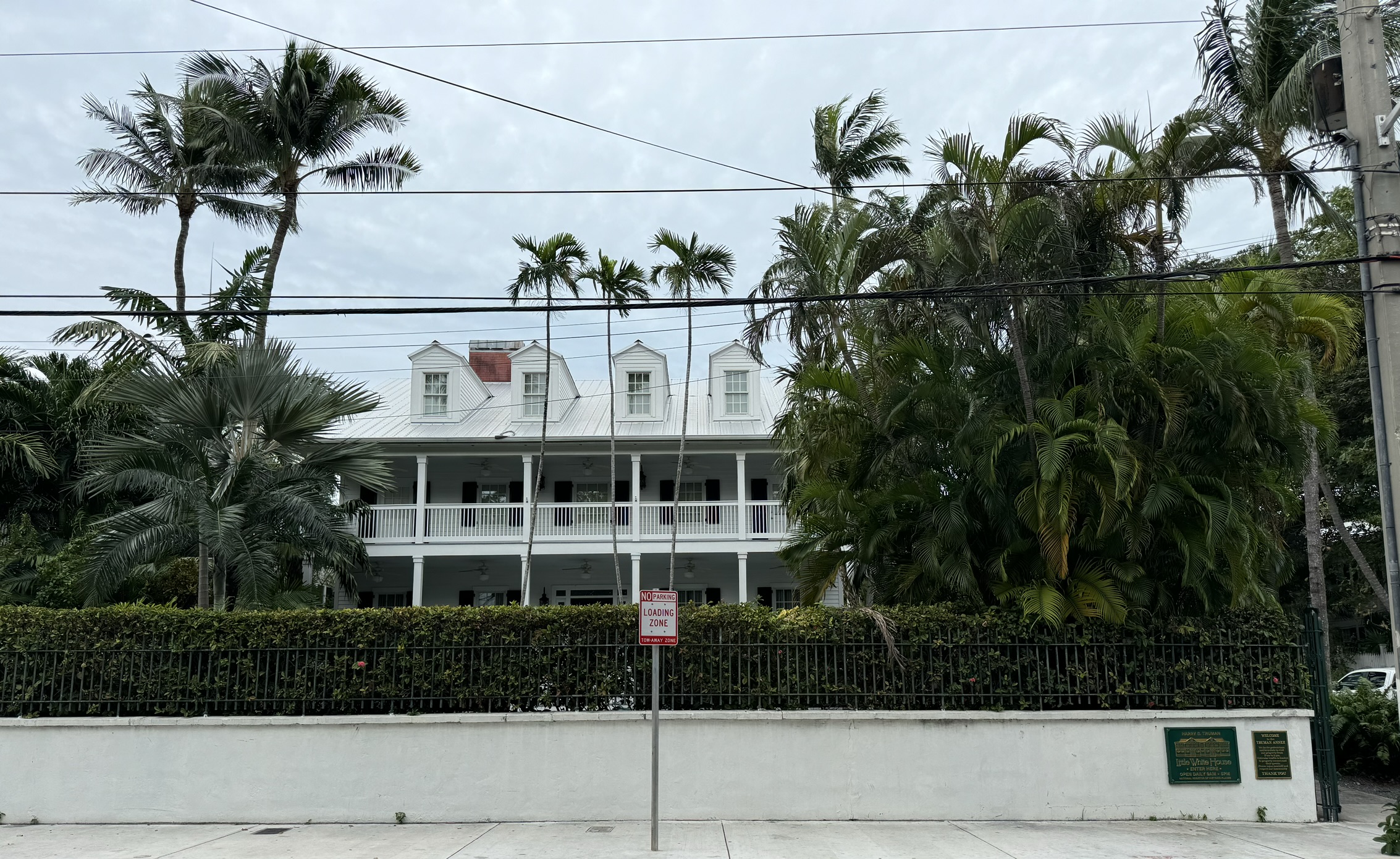
During the week before Thanksgiving in 2024, my wife and I took a four-night vacation to Key West, Florida. Neither of us had ever visited the island, which holds an oversized place in the American cultural imagination. Key West has attracted a wide range of celebrities over the years like Ernest Hemingway, Jimmy Buffett, Tennessee Williams, John James Audubon, several U.S. Presidents, and countless movie stars and musicians. Harry S. Truman was so charmed by the place that he had a Little White House there, where he spent 175 days over eleven visits during his administration.
Key West sunrise from Southernmost ResortKey West – Harry S. Truman Little White House
Most people believe that Key West is as far as you can go south and still be in the country, but the true southernmost point of the continental U.S. is Ballast Key located south and west of Key West. Nevertheless, Key West has adopted the “southernmost” tourism brand for itself, complete with a photo-op concrete buoy and numerous locations using the moniker. The southern tip of the island is a mere 81 nautical miles from the north coast of Cuba. We stayed at a lovely property called Southernmost Beach Resort with a balcony room on the third floor overlooking the ocean. The water was rough for our first two days, and it was wonderful listening to the waves crashing against the massive concrete sea wall just below our room.
Key West – Southernmost Point Buoy
Running four miles long and about two miles wide, Key West is a very walkable island. We walked the entire width, north on historic Duval Street, which carried us from our resort up to the marinas and cruise ship docks. We wandered around the tourist attractions in that area, including the shops at Mallory Square. We also spent some time strolling through the Old Town historic district, which is filled with beautifully restored 19th century homes, some of which are now bed and breakfast accommodations, although many are still private residences. The following is a list of highlights from our trip to this tropical paradise, which truly exceeded our expectations.
Duval Street: Named for the first territorial governor of Florida, William Pope Duval, this is Key West’s main drag and is filled with shops, restaurants, bars, and vintage hotels that are reminiscent of what I think of as “Old Florida” that flourished during the golden age of tourism in the 1950s and 60s. We walked up and down Duval numerous times for shopping, dining, and drinking (as the locals say, “It’s Key West”).
Hemingway Home and Museum: The author of classics such as The Old Man and the Sea and For Whom the Bell Tolls lived with his wife, Pauline Pfeiffer, in this two-story residence during the 1930s. After eight years of residing at the house, Hemingway moved to Cuba in 1939 and divorced Pauline the following year. Pauline lived in the house until her death in 1951. The only full-time residents now are the famous six-toed cats that lounge around the property, in and outside the house.
Key West – Hemingway House Front Entrance
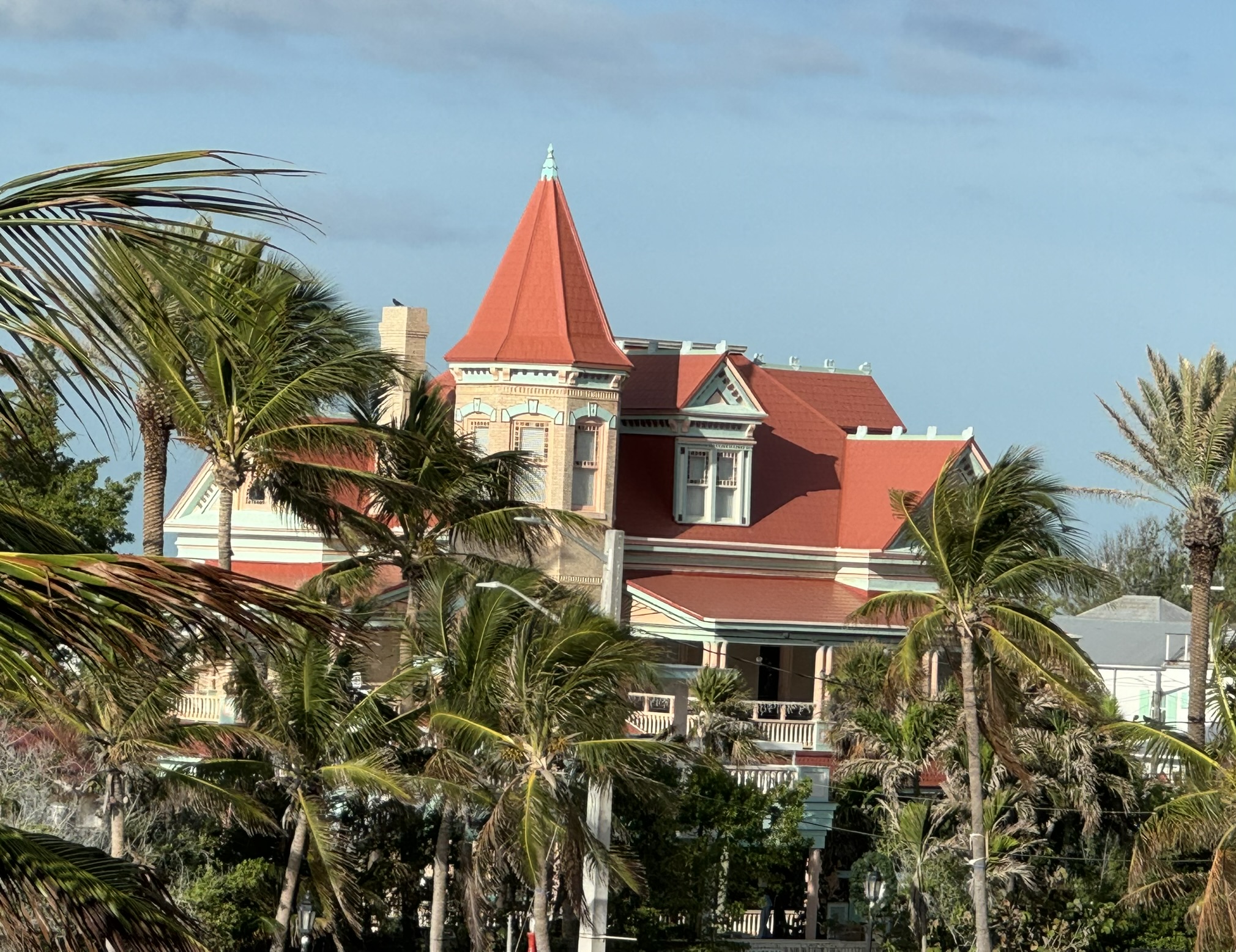
Mansion on the Sea: Built in 1897, the iconic Mansion on the Sea, was originally home to Judge Vining Harris and his wife Florida Curry, the youngest daughter of the state’s first millionaire, William Curry. Wanting only the best for his youngest daughter, Curry commissioned Thomas Edison to install the electricity in the one-bedroom home. Over the years, the Mansion evolved and took on many different purposes. During Prohibition (1919-1933) the Mansion served as a destination for many notorious gangsters and other famous travelers. Five U.S. Presidents, including, Harry S. Truman, Dwight D. Eisenhower, John F. Kennedy, Richard M. Nixon, and James E. Carter, Jr. were guests here. The Mansion is now a boutique inn. We had drinks and coconut shrimp at the outside bar the Mansion our first night on the island.
Key West – Mansion on the Sea – Southernmost House
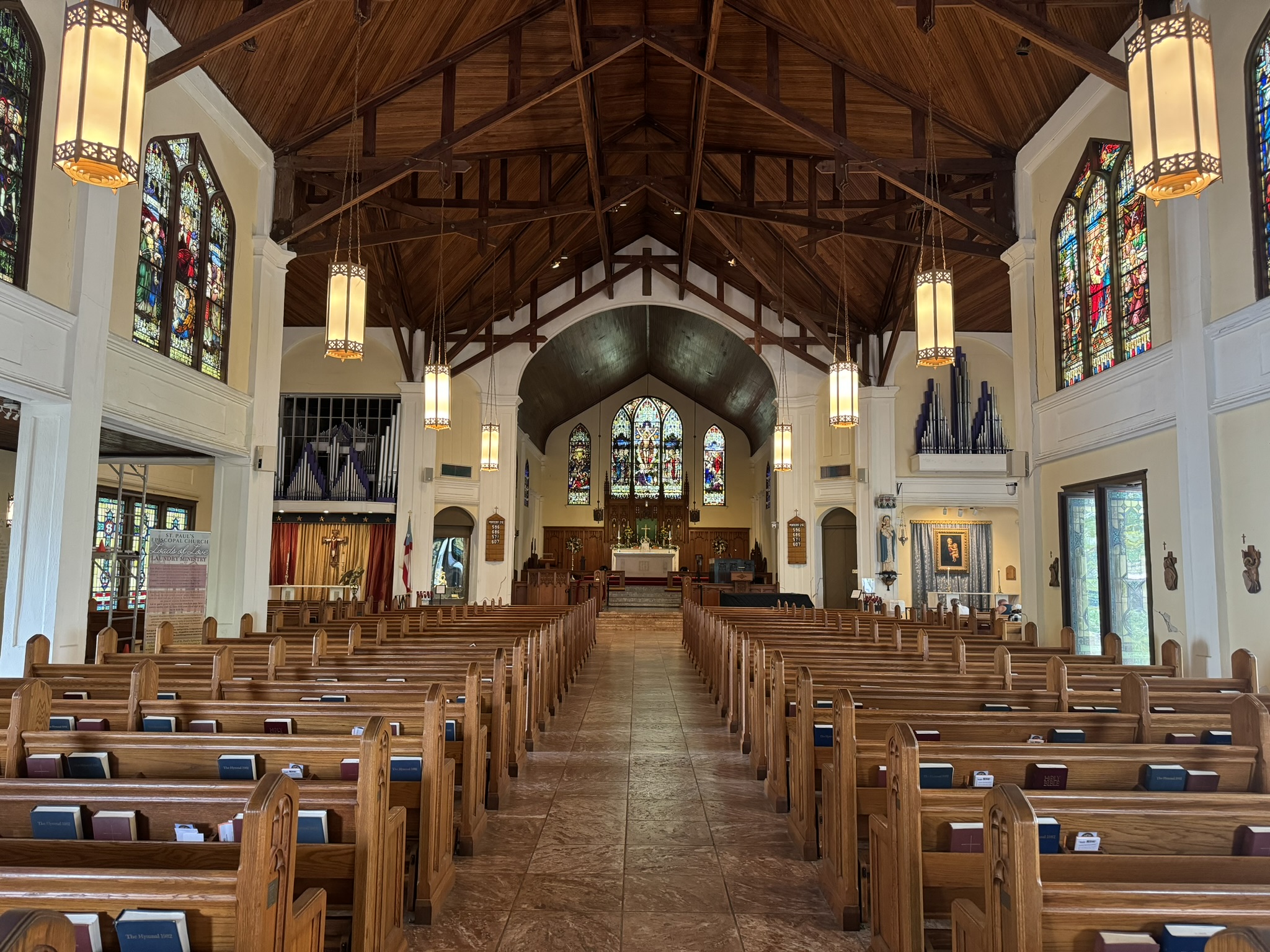
St. Paul’s Episcopal Church: This the fourth building on this site and houses the oldest church in the Florida Diocese. Established in 1832, this oldest U.S. congregation south of St. Augustine has been served by dozens of priests throughout almost two centuries. The church building and grounds at the corner of Duval and Eaton Streets are open daily for prayer, meditation, and visitation.
I have known for years about the importance of Sylvia Beach’s little American bookstore in Paris called Shakespeare and Company. Her membership-supported enterprise was so much more than just a book shop. It served as a refuge and haven for some of the most gifted expatriates and writers of the early 20th century, including Ernest Hemingway, F. Scott and Zelda Fitzgerald, Ezra Pound, T. S. Eliot, and most especially James Joyce. Until I read her memoir (with the same title as her store) early in 2024, I had no idea that she was the first publisher of Joyce’s monumental novel, Ulysses. She really was a remarkable human being, one who made great sacrifices to support an amazing and historical intellectual community. She even risked her own life during the Nazi occupation of Paris by refusing to compromise her standards or cater to the monstrous regime that swept across Europe before and during World War II.
In addition to presenting valuable historical information about her store and its many patrons in her 1959 book, Beach shares some side-splitting anecdotes about her customers, friends, and acquaintances. Some of her own experiences at and away from the store are just hilarious. I laughed myself silly at her account of the performance of the Ballet Mecanique at the Theatre des Champs Elysees (1925), which included the use of plane propellers generating such a strong wind current that it “blew the wig off the head of a man . . . and whisked it all the way to the back of the house.”
James Joyce was clearly Beach’s most favored member, client, and dear friend. She turned out to be his most valued benefactor. As such, readers of her memoir learn more about the Irish novelist, poet, and literary critic than any other person she encountered. She offers insights into his personality, quirkiness, brilliance, innovation, and talent, as well as his tragic flaws and his greatest fears. He was deathly afraid of dogs, and Beach includes a story about an occasion when Joyce was the object of a rather large dog’s affection at a luncheon. Observing Joyce’s fearful reaction, the woman who owned the dog had it removed and told the guests that the canine had once chased a plumber out the window and that she had to buy the man a new pair of trousers. Joyce shuddered and whispered to Sylvia Beach, “She’s going to have to do the same thing for me.” Again, I laughed myself to tears.
The address of her bookstore was 12 Rue de l’Odeon in the 6th arrondissement on the Left Bank. She was forced to close the store in 1941 because of the Nazi occupation of France during WWII, but she continued to live in her upstairs apartment, surrounded by her treasured book collection. Sylvia Beach died in 1962. Over the decades since her death, the first-floor location of the bookstore has been the home of various retail establishments. There is currently a Shakespeare and Company bookstore in Paris inspired by Beach’s store, but it is not at the original address. Even when my wife and I were in Paris in 2016, I decided it would not be worth our time to locate the original address since it was no longer a bookstore.
Original location of Shakespeare and Company Bookstore in Paris
Fast forward to September 2024 when we were back in Paris again. Something almost miraculous happened to us on our last full day in the city. We visited the Luxembourg Garden and then strolled over to a nearby restaurant for lunch called the Le Hibou. We weren’t even paying attention to where we were walking after lunch, but we passed by a small clothing shop, Moicani, with some beautiful scarfs and decided to go in for a look. Jean Helfer, the affable proprietor, asked where we were from, and I said, “The States, in Missouri.” He replied in an almost reverential tone, “Do you know where you are standing right now?”
Original location of Shakespeare and Company Bookstore in Paris
He pointed to a photograph of Sylvia Beach with Ernest Hemingway, in the very place I was standing! Totally by accident, we had stumbled on to the location of the original Shakespeare and Company bookstore. He handed me a brochure he has created giving a brief history of the bookstore, along with other addresses on the street of famous historical figures such as Gustave Flaubert and Thomas Paine. He was so gracious and kind. I was almost speechless the whole time we were in his shop.
What an incredible way to end our wonderful vacation in France. And yes, my wife bought a beautiful scarf!
American popular music has produced some unforgettable female icons during my lifetime: Janis Joplin, Dolly Parton, Cher, Madonna, Janet Jackson, Beyonce, Adele, just to name a few. They have all been influential on their fan base, and to some degree, to the public in general. Joplin gave young women permission to experiment with sex and drugs, often to dangerous excess. She died of a heroin overdose. Dolly Parton has always encouraged women with her words and by example to be strong and independent without sacrificing their femininity or sexual charm. Madonna in some ways paralleled the rise to fame of Michael Jackson. She was definitely the queen of pop for a while, more so than Michael’s own sister, Janet. She still holds the record as the biggest selling female artist to date. All of these women enjoyed success here and around the world.
Perhaps these women prepared the way for the female entertainer who has taken the world by storm in the 21st century and will likely surpass them all at some point. Taylor Swift is so much more than a singer, songwriter, musician, producer, and entertainer. She is a force. With the release of her single “Our Song” in 2006, she became the youngest singer-songwriter to perform an original song and reach the number one spot on the Hot Country Songs chart at the ripe age of seventeen. Two years later she became the youngest person to win the Country Music Association Awards’ top spot. She has won more American Music Awards than anyone else in history. She is the first woman to have four albums in the Billboard 200 chart’s top 10 simultaneously. She also broke Billboard’s record for most number one albums by a female artist. Swift made history again at the 2024 Grammy Awards when she took home the Album of the Year, becoming the first and only person to have won the award four times.
Taylor Swift
These accolades are phenomenal; however, some of her other accomplishments have served to establish her as one of the most influential women in the country, if not the world. According to some sources, the opening night of Swift’s Eras Tour set a record for the most attended concert ever by a female musical entertainer in the U.S. The tour continued to break attendance records across the country and became the first to surpass $1 billion in revenue. According to Forbes magazine, Swift became a billionaire in 2023 and thus the highest-earning female performer in the music industry. Between vinyl, streaming, and other media, Taylor Swift continues to break sales records in various categories every year.
I couldn’t find an estimate of how many people have seen Swift in concert over the course of her career. Based on stats that are available, close to 10 million people worldwide have attended her Eras tour, which ends in December 2024. She has been a dominant figure in the lives of at least two generations: her adoring fans and the many parents who continue to take their young children to her concerts. It is amazing how many of those parents and children (mostly female but certainly not all) sing along to every word of every song Taylor Swift performs. What a rush that must be for her.
Taylor Swift
Swift is an outspoken advocate for progressive causes, especially related to women and the LGBTQ population. She is not afraid to let her fans know through public statements and social media where she stands on controversial issues. She is not overtly political, and she attracts fans from across the political divide. Yes, there are Swifties for Trump – they may not agree with her ideologically, but they still love and identify with her music. She doesn’t shy away from publicly revealing her candidate of choice, even on the national level. She backed Joe Biden in 2020 and Kamala Harris in 2024. She wisely stops short of suggesting who her fans should support, but she strongly encourages them to do their research and vote their conscience. Shortly after the presidential debate between Trump and Harris in September 2024, Taylor Swift sent messages on her social media platforms making her choice known and including a link to a voter registration site. According to multiple sources, over 400,000 people clicked on the link in the 24 hours after Swift posted it. That’s power, and I would guess that very few people in this country have that level of influence.
For those who still think that Taylor Swift’s work is just a bunch of shallow revenge music obsessing over her broken heart, I suspect they haven’t followed her career closely enough. Her latest album, The Tortured Poets Department, has considerable depth thematically in places. Her lyrics really started to show her maturity as a songwriter with the 2020 release of Folklore. Okay, perhaps her musical compositions are not complex or interesting enough for some people, but I maintain she is writing good stuff. The song “This Is Me Trying” from the Folklore album packs a powerful punch that almost channels Bruce Springsteen in my mind. Oh, one more thing. My wife and I live in Missouri and are Kansas City Chiefs fans. We absolutely love seeing Taylor Swift at the football games and think the budding romance between the rock star and Chiefs tight end, Travis Kelce, is a refreshing American celebrity love story. They are adorable. Go ahead, call me a Swiftie. I’m “fearless.”
My wife and I took a brief trip to Cleveland, Ohio in August, 2024. We had hoped to do so in 2020 while my wife was working temporarily in Fort Wayne, Indiana, when I could fly in, and we could then drive over to Cleveland. But the world shut down when COVID struck. We both love rock music, and as an amateur rock and pop musician, I was interested in visiting one of the top destinations the city has to offer: the Rock & Roll Hall of Fame. However, we both agreed that we would need more than a single objective to justify flying from our home in Springfield, Missouri, through O’Hare airport in Chicago, and then on to Cleveland. We found one. We discovered that one of our favorite bands, Hootie and the Blowfish, was touring in 2024 and that Cleveland was one of their stops. They were going to be playing at the magnificent Blossom Music Center in Cuyahoga Falls, Ohio, about 20 minutes south of Cleveland. We had a twofer and were good to go!
Neither one of us knew much about Cleveland and didn’t have high expectations beyond what we planned to do while in the city. We were pleasantly surprised. Situated on the southwestern shore of Lake Erie, Cleveland is taking advantage of tourism with great parks and beaches right on the water. The views are breathtaking. With a scenic skyline, good hotels and restaurants, stadiums, arenas, and several major attractions, Cleveland really is a place to explore. The city claims to be the birthplace of Rock & Roll music, primarily because radio station WJW disc jockey Alan Freed coined the phrase “Rock & Roll” to describe the upbeat black rhythm and blues music he was playing in 1951. Of course, the Rock & Roll Hall of Fame was ground zero for us, and it also exceeded our expectations.
Rock & Roll Hall of Fame, Cleveland, OH
The building is a modern structure with a huge glass atrium at the entrance. It has six levels beginning on the entrance floor, but the tour starts one level below with the Ahmet Ertegun Main Exhibit Hall, which carries visitors from rock’s earliest stars to those newly emerging contemporary musicians. There are thousands of items on display, along with feature films, videos, interactive kiosks, reading material, and plenty of music. This exhibit has the museums largest displays devoted to single artists, bands, subgenres, and movements of Rock & Roll history and the industry: Revolutionary Women in History, Hip Hop, Roots of Rock, Pioneers of Rock, Sun Records, Cities & Sounds, the music of Cleveland and the Midwest, and so much more.
Rock & Roll Hall of Fame, Cleveland, OH
Level 1 has a ticket booth, a café, large museum store, and the Klipsch Stage where performances are scheduled throughout the year. Level 2 is called “The Garage” where visitors can sign up to play various instruments with or without a house band in a setting that looks very much like a real garage. I played an electric guitar (something I never do) and sang “Midnight Rider” by the Allman Brothers Band with the help of a house drummer and a bass player, who also sang harmony with me. Although it wasn’t my best performance of that song, it was still fun to play in such an iconic venue. This level also has a large collection of different types of instruments and sound booths for visitors to jam on their own. The Les Paul exhibit is on this floor too, paying homage to the American jazz, country, and blues guitarist, songwriter, luthier, and inventor. He was one of the pioneers of the solid-body electric guitar, and his prototype served as inspiration for the Gibson Les Paul guitar.
Level 3 is focused almost completely on the Hall of Fame inductees, with the Inductee Signature Gallery, New Inductee exhibit, and the Connor Theater featuring the Power of Rock Experience. Visitors can look through alphabetic lists of inductees and a large chronological display of the all the inductees going back to the Hall of Fame’s inception in 1986. This floor also has the New Inductee and the In Memoriam exhibits. The Connor Theater is on this floor, where visitors can watch a 15-minutes video highlighting the Hall of Fame induction nights from the past.
Level 4 features the Pink Floyd tour replica of The Wall, designed to mirror the Berlin performance in July 21, 1990. This level is also the location of the Foster Theater, which is used for onsite education programs or private rentals. The theater has hosted hundreds of rock star talks and legendary rock films over the years. Level 5, along with some of the ramps in the museum, has individual display cases devoted to the legends of Rock & Roll, from the Bee Gees and the Doobie Brothers to Public Enemy to Tom Petty.
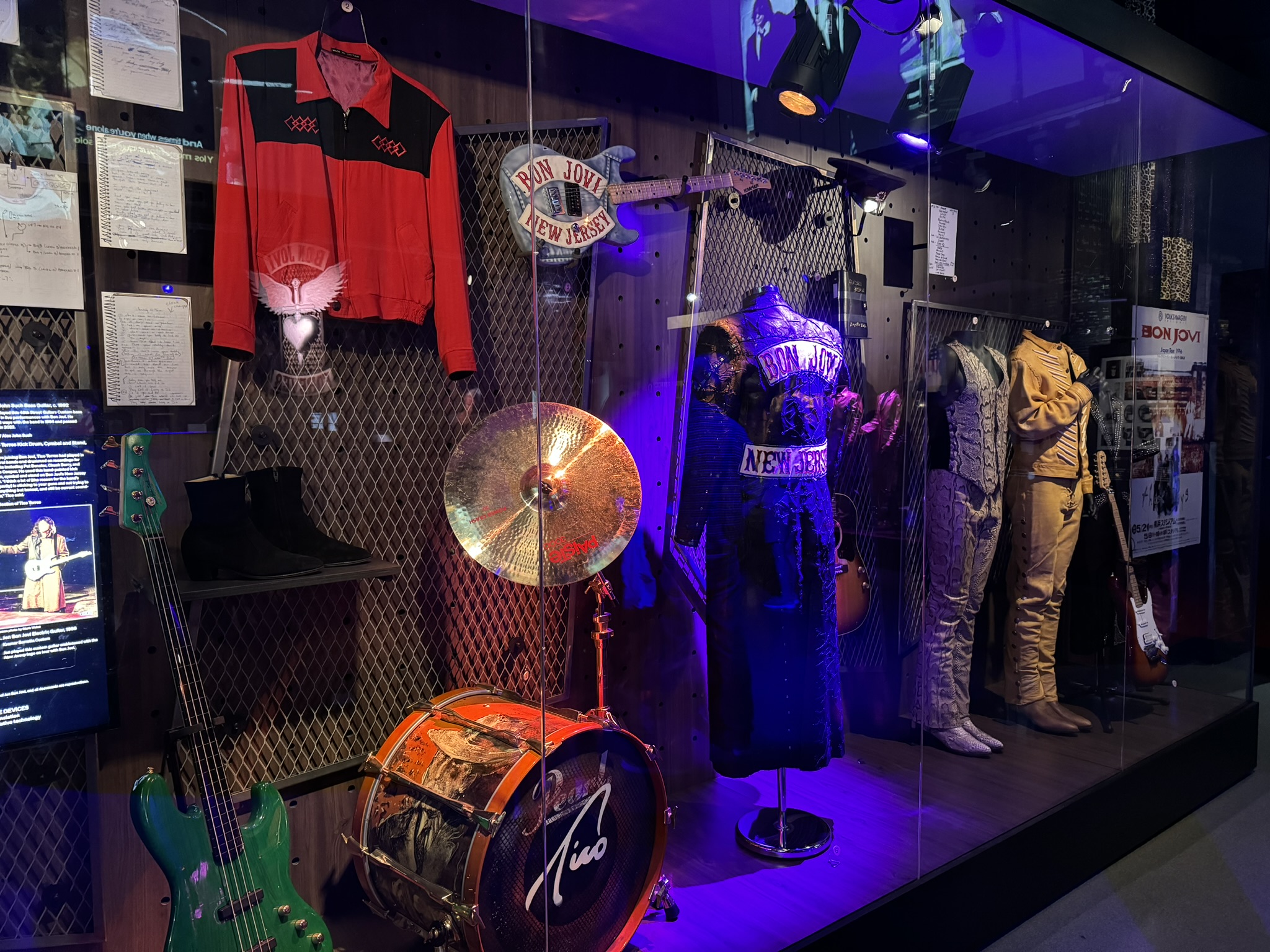
Level 6 is devoted to an exclusive exhibit that Bon Jovi unveiled with the museum in 2018. This full-floor showcase spans four decades of the band’s career along with never-before-seen artifacts from each of the band members. Visitors are immersed in the band’s story and music from inception to the present. Huge video presentations are joined by text panels and display cases filled with musical instruments, clothing, and loads of memorabilia from the band.
Rock & Roll Hall of Fame, Cleveland, OH
Organizations like the Rock & Roll Hall of Fame that establish themselves as authorities of a particular subject area all have one thing in common. They always stir up controversy, mostly about who or what is included, but more contentiously, excluded from their lists. This museum obviously recognizes this dilemma and even seeks to address it by allowing visitors to submit names of performers or bands they think should be inducted into the Hall of Fame. Many writers over the years have discussed this topic, and some of them have challenged the Hall of Fame on its choices of inductees through the decades. One of the most ironic exclusions is Huey Lewis and the News, the band that had a major hit with “The Heart of Rock & Roll,” which actually mentions Cleveland at the very end of the song!
Rock & Roll Hall of Fame, Cleveland, OH
I certainly had my share of questions come to mind as we strolled through each level of the museum. I was disappointed to see how much more space and almost reverential attention was given to Elvis Presley on one wall, while on the opposite wall a smaller display featured Chuck Berry, often considered the Father of Rock & Roll. I think those two positions should have been swapped. One of my favorite wall displays was for Jimi Hendrix, probably the greatest guitarist in rock history. I was baffled to learn that bands with place names such as Chicago were inducted fairly late in the game and that the bands Kansas and Boston still haven’t made it. At the same time, I was delighted to see so much attention given to Wanda Jackson, an Oklahoma native who got her start on ABC Television’s “Ozark Jubilee” broadcast out of Springfield, Missouri from 1955 to 1960. She later became known as the Queen of Rockabilly, a title she still holds to this day. As of this post date, she is still with us.
Rock & Roll Hall of Fame, Cleveland, OH
We were able to pack a lot in just two full days while still having some down time walking along the shore of Lake Erie, enjoying some great meals and drinks, and exploring the public spaces on the water around the Hall of Fame. On top of all that, we were lucky enough to catch Hootie and the Blowfish back together again for a national tour. Oh, and their opening acts were Edwin McClain and Collective Soul. For people who love rock music, it just doesn’t get much better than our quick trip to Cleveland.
Hootie and the Blowfish at Blossom Music Center (Ohio)































 If You Want My Opinion