Walking Through Luxembourg Garden in Paris

I have written about gardens several times in this blog. They are among my most favorite places in the world. I love them in all their many forms: small residential gardens, larger private ones, arboretums, botanical gardens, public gardens, and those you find at houses of worship, city parks, river walks, and even businesses. They brighten up any space with texture, structure, color, and incredible beauty. They are places of refuge and contemplation. There are so many features to enjoy, including ponds, streams, waterfalls, varying terrain, rocks, boulders, statuary, fountains, and other built structures. Whenever my wife and I travel, we almost always look for gardens to visit or revisit.

In September 2024, we took a two-week trip to Paris and various locations in Switzerland. On our last day in Paris, we spent the better part of the morning wandering around one of the most spectacular spots in the city, Luxembourg Garden. Located in the 6th arrondissement in an artsy part of the city, the Jardin du Luxembourg comprises 25 hectares (56.8 acres) adjacent to the grand building that houses the French Senate, thus its more familiar name for Parisians, Jardin du Sénat. The Luxembourg Garden comprises formal English gardens, 3,000 trees of various species, 5,000 square meters of flower beds, an orchard containing more than 500 old varieties of pear and apple trees, a collection of exceptional orchids, and 102 statues and monuments, including the famous Médicis fountain.

French Senate building at Luxembourg Garden

The garden’s origins date back to the 17th century when Marie de Médicis, the widow of Henry IV, built an Italian palace on property once owned by François, Duke of Piney-Luxembourg. The French Senate took over ownership of the garden in the early 1800s after the palace became the home of the governing body in 1799. It wasn’t until the last half of the 19th century with the restoration projects in Paris under Napolean III that the garden began to take its more modern shape. Luxembourg Garden has appeared in numerous works of literature by authors such as Victor Hugo, Henry James, and William Faulkner.

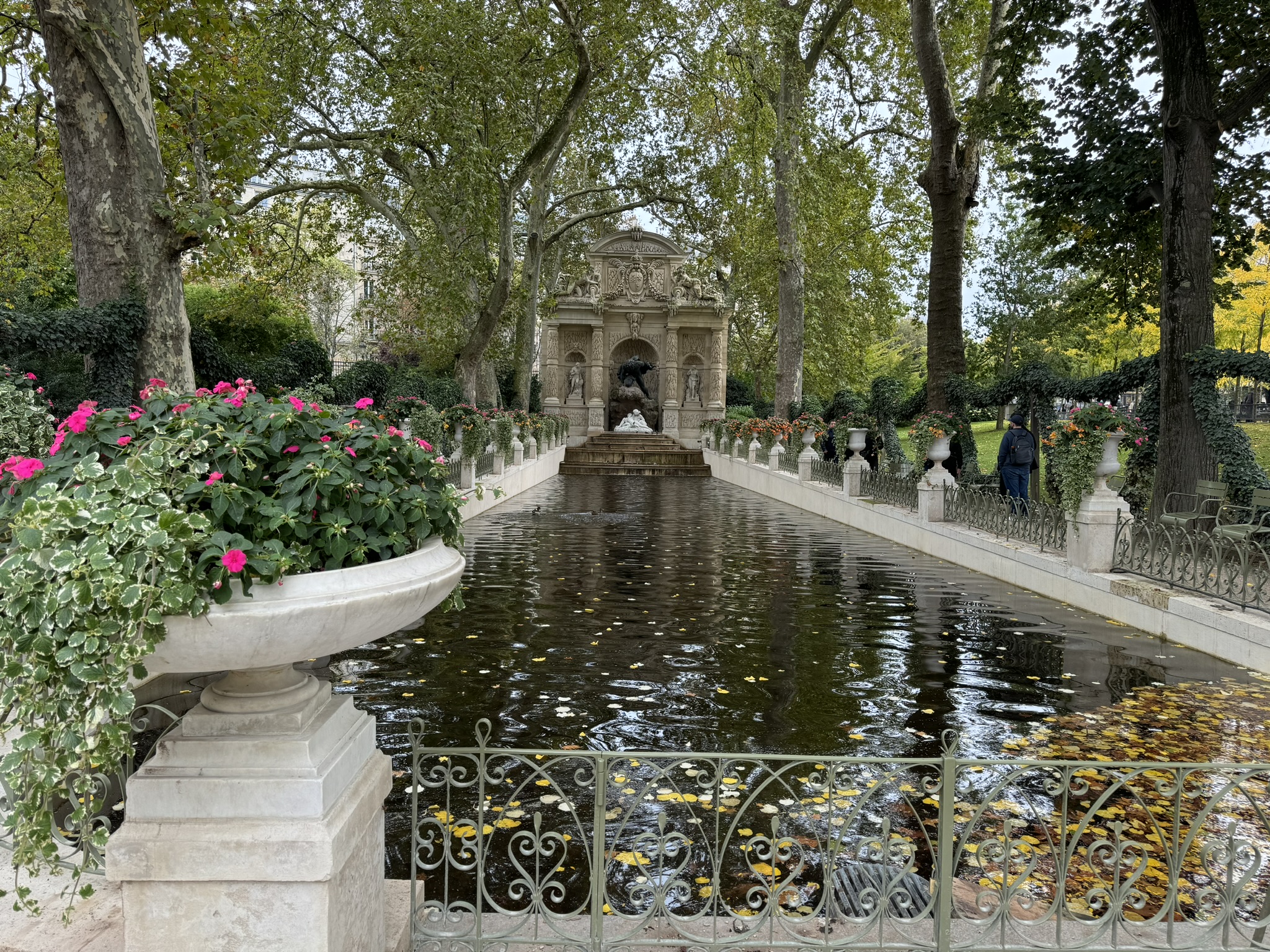
Médicis fountain at Luxembourg Garden

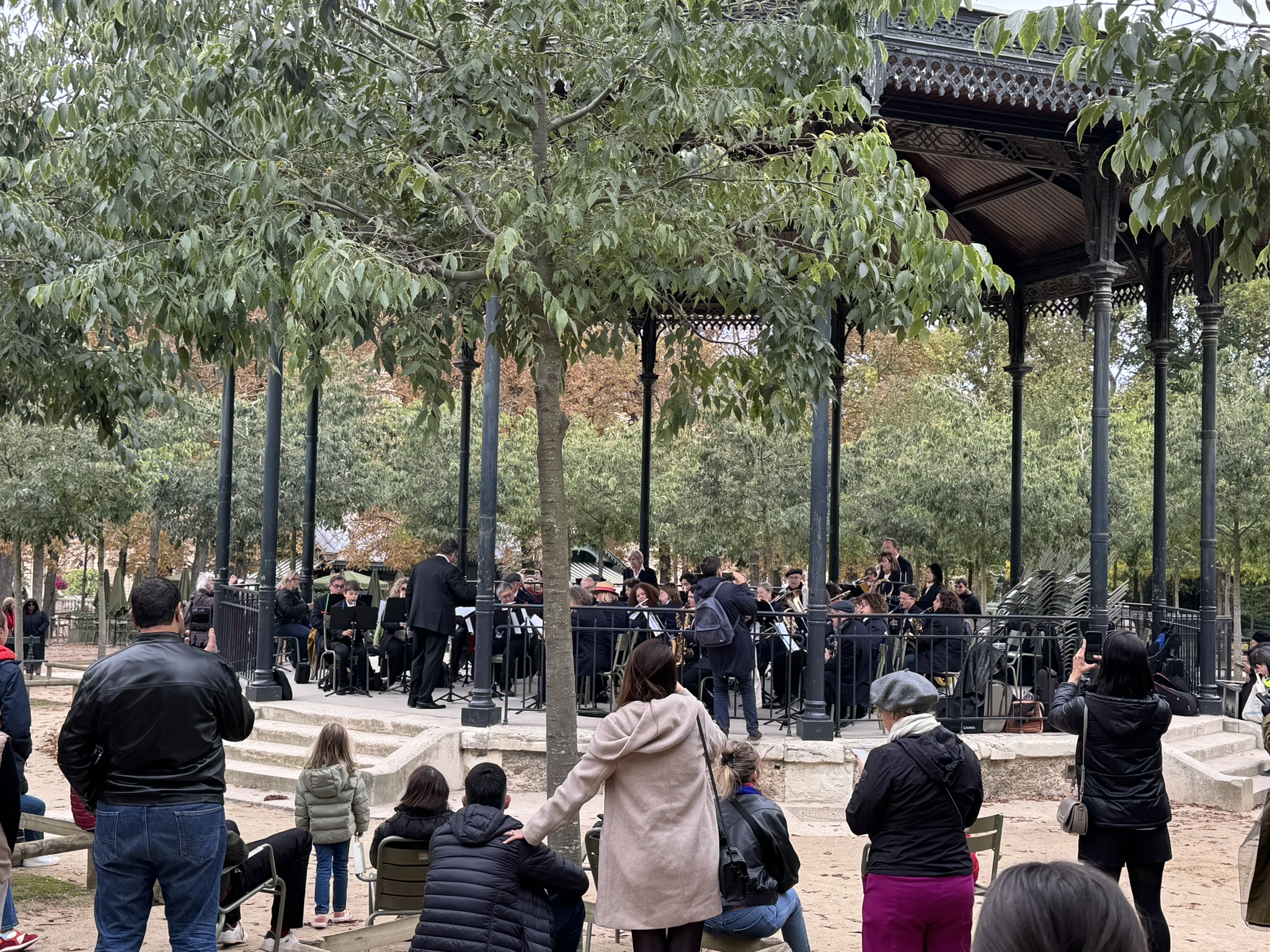
As we entered the garden that Sunday morning at the Porte Gay-Lussac, we were greeted by the sounds of music coming from what appeared to be a small community orchestra at the nearby Kiosque à musique. We made our way counterclockwise to the Médicis fountain and then past the Senate building, protected by a high metal fence and guards with firearms. We continued around the perimeter of the garden, making side trips into the interior from time to time. Before leaving, we spent a few moments near the Grand Bassin, a large octagonal basin of water surrounded by raised balustraded terraces adorned with a series of statues of former French queens, saints, and other historical figures.

Orchestra at Luxembourg Garden
Luxembourg Garden
Luxembourg Garden

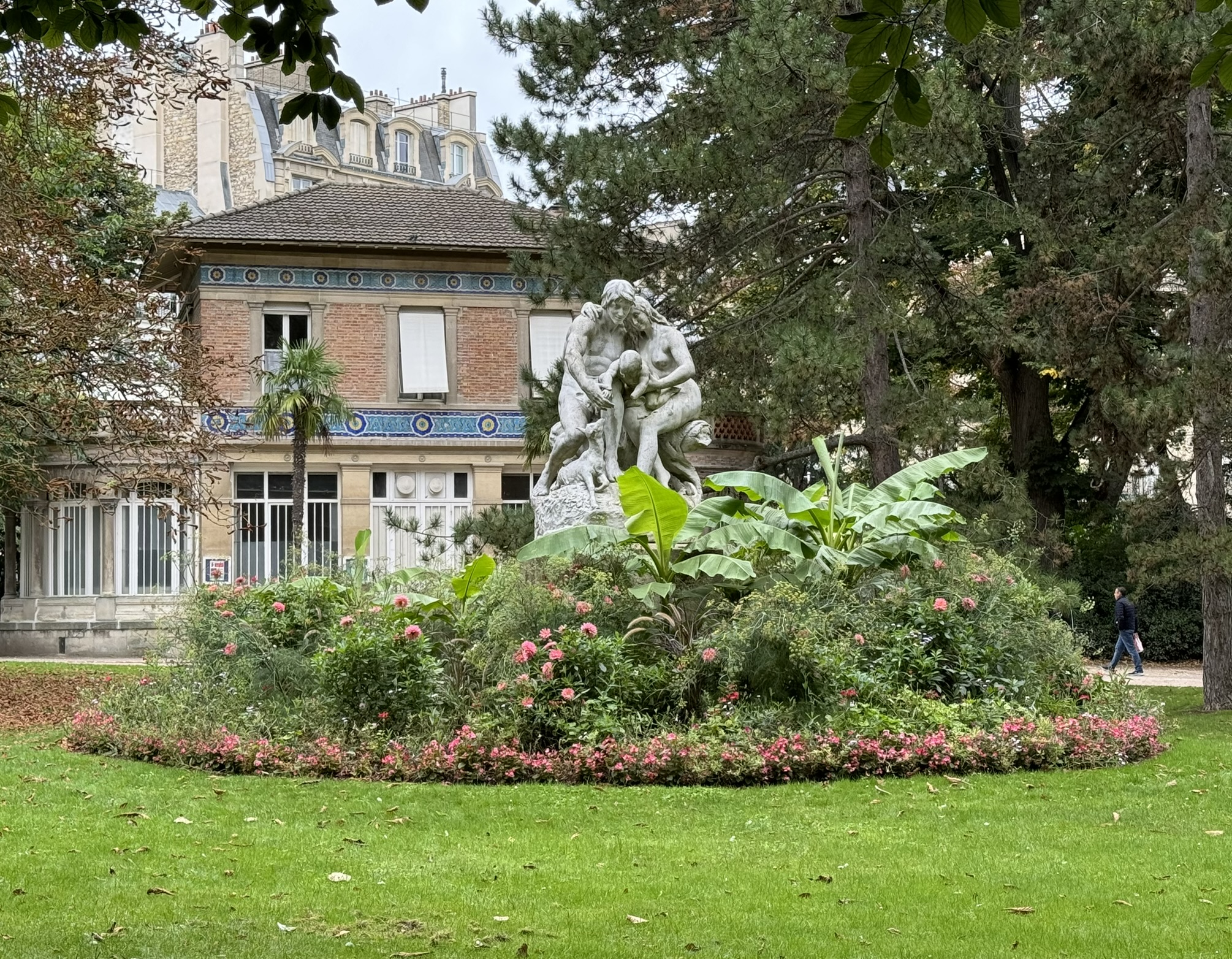
What impressed me most about this garden is how brilliantly the built environment blends with and enhances the horticultural surroundings. Walkways wind through trees, hedges, shrubs, lawns, and planted beds, encouraging us to meander and gaze. Statues, sculpture, and other features are spaced out and in the open or tucked neatly into nooks and crannies, inviting us to explore and pause to appreciate and learn. Luxembourg Garden is truly an oasis we can enjoy simply for its beauty and design. However, it’s also an outdoor classroom for aspiring students of all ages who wish to be schooled in botany, art, architecture, history, and so much more.

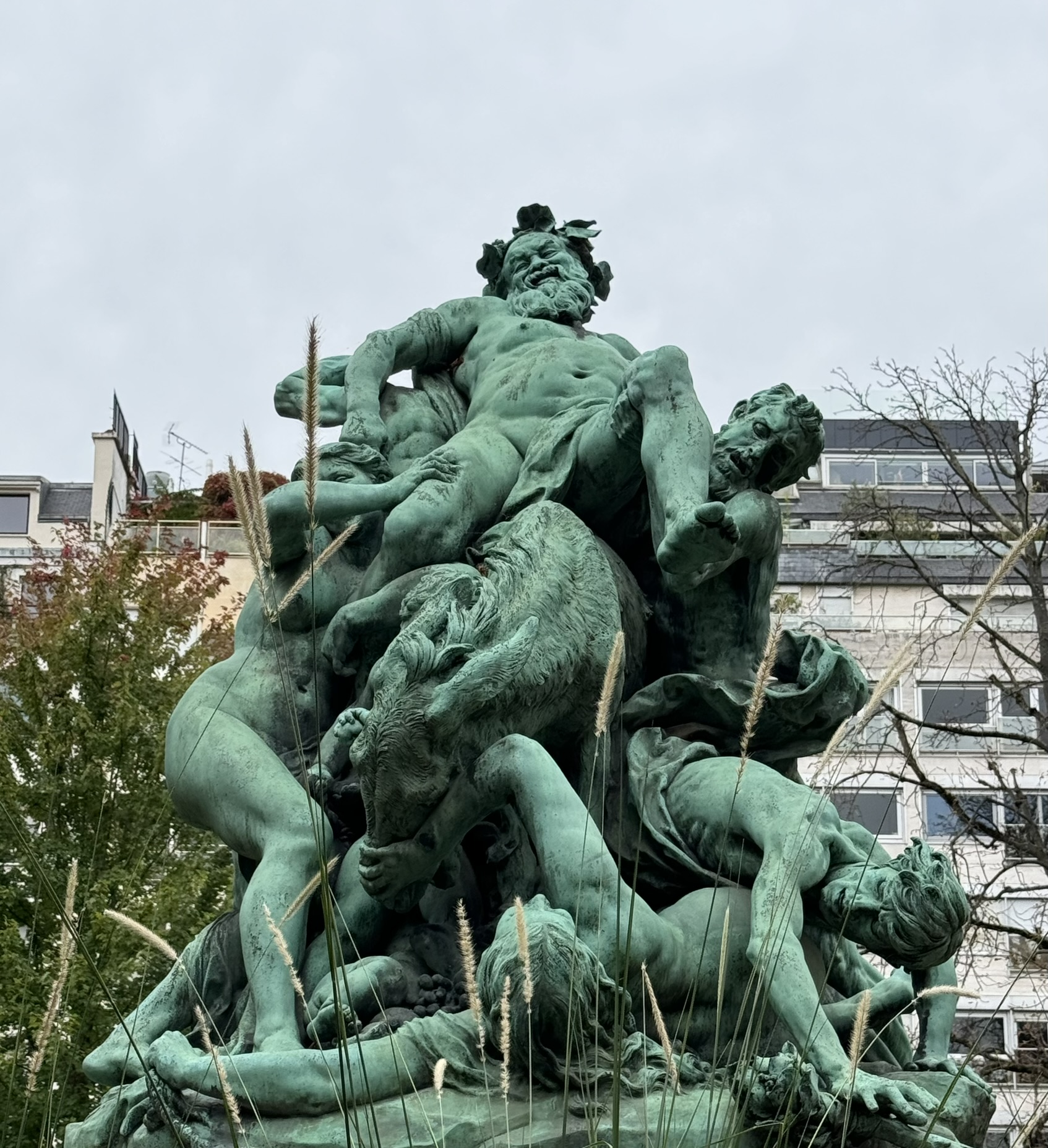
Bacchus (Dionysus) statue at Luxembourg Garden
Luxembourg Garden
Luxembourg Garden
Grand Bassin at Luxembourg Garden

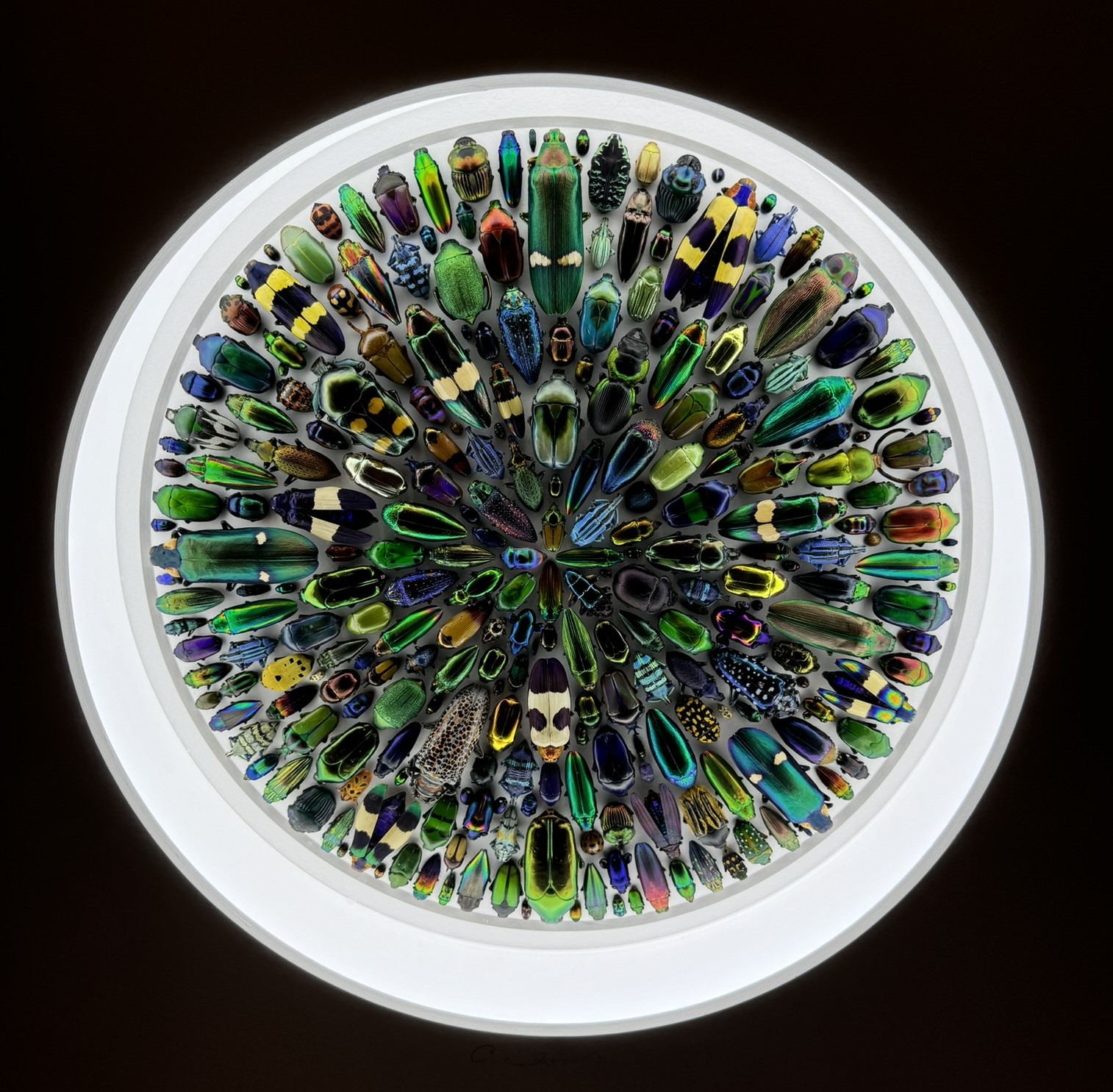
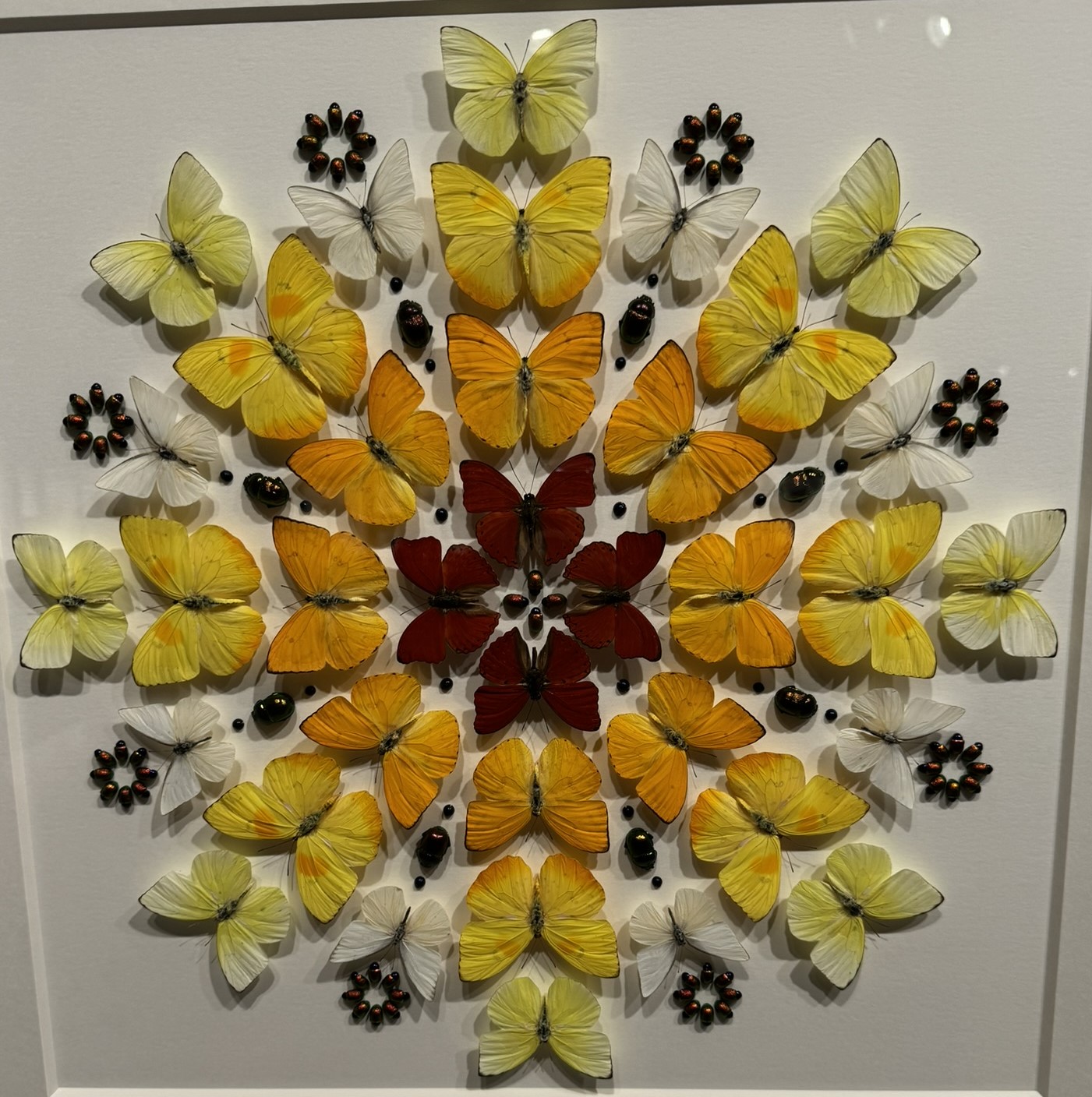
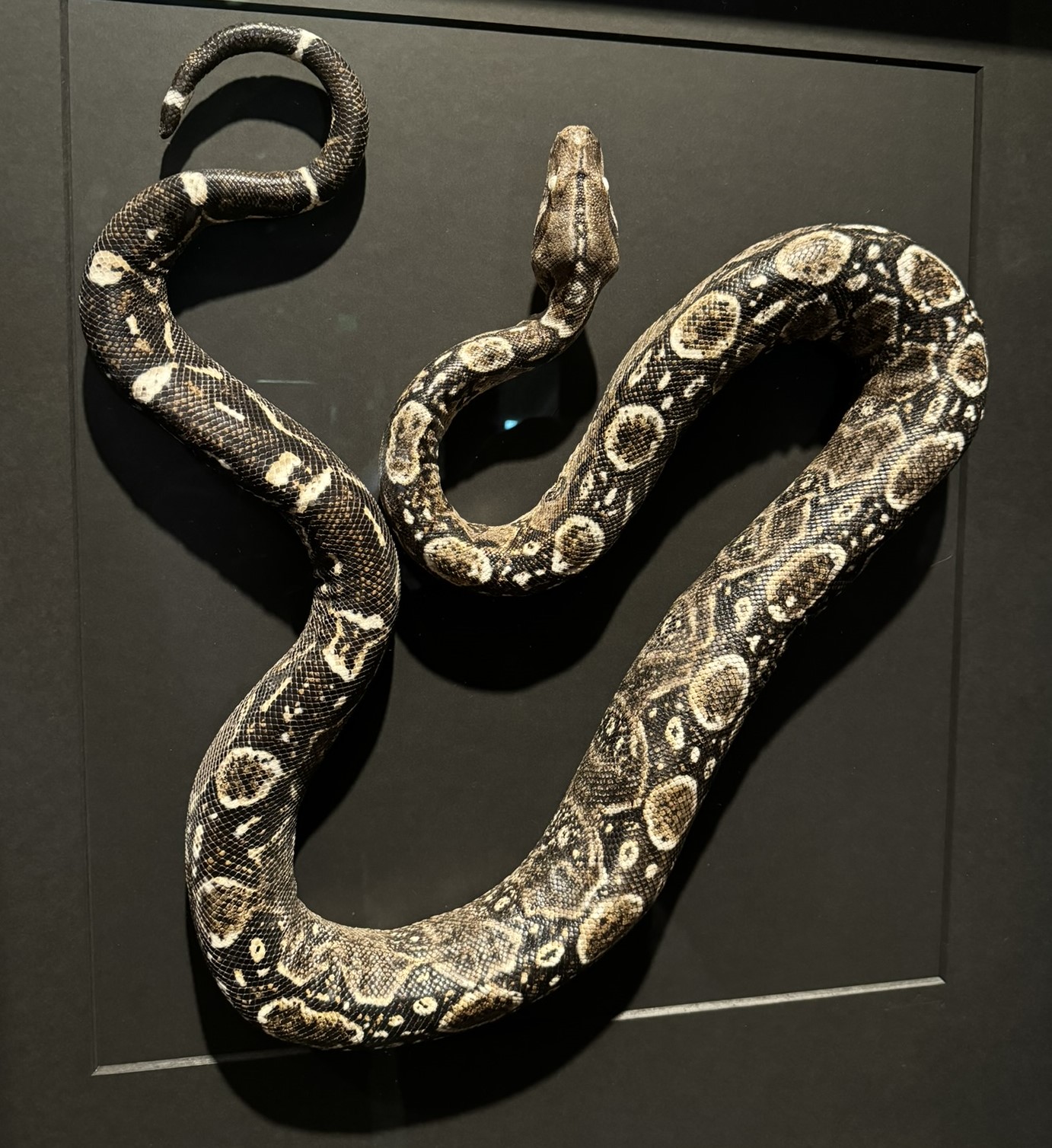
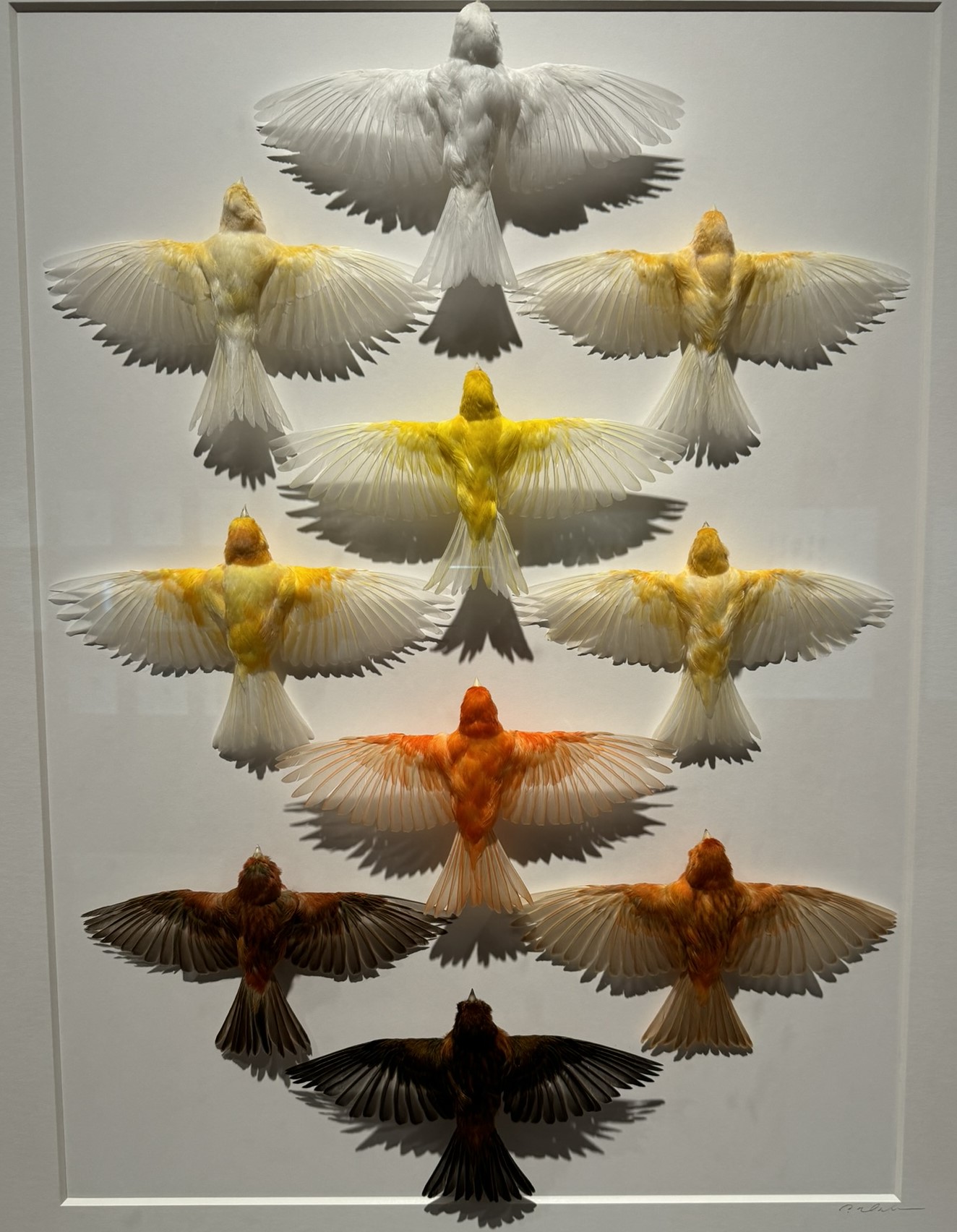
Exquisite Creatures: Christopher Marley’s Eye for Beauty in Death

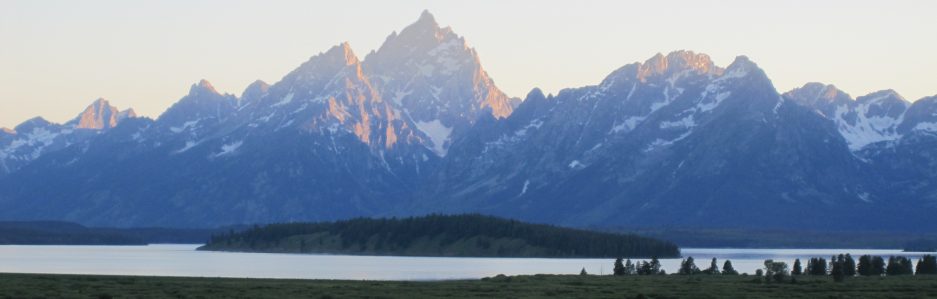
In my experience, people tend to be a bit too generous in their descriptions of deceased friends and loved ones laid out in caskets. “She looks so peaceful.” “He looks like he’s sleeping, doesn’t he?” Or my personal favorite, “They made her look so beautiful, didn’t they?” Oh please. No disrespect intended, but I have never liked the idea of the obligatory viewing of the body at funeral homes and have avoided it as much as possible, even with relatives. Dead people always look like they are missing something essential, and they are. They are missing the look of life, which can even be perceived in those who are in a deep sleep. I have no intention of being on display upon my own death, which is one of the reasons I will be cremated and sent on my merry way to the Grand Tetons National Park. Ashes to ashes, dust to dust, and I will be nourishing plants and animals until I am completely and efficiently recycled back into the biosphere.

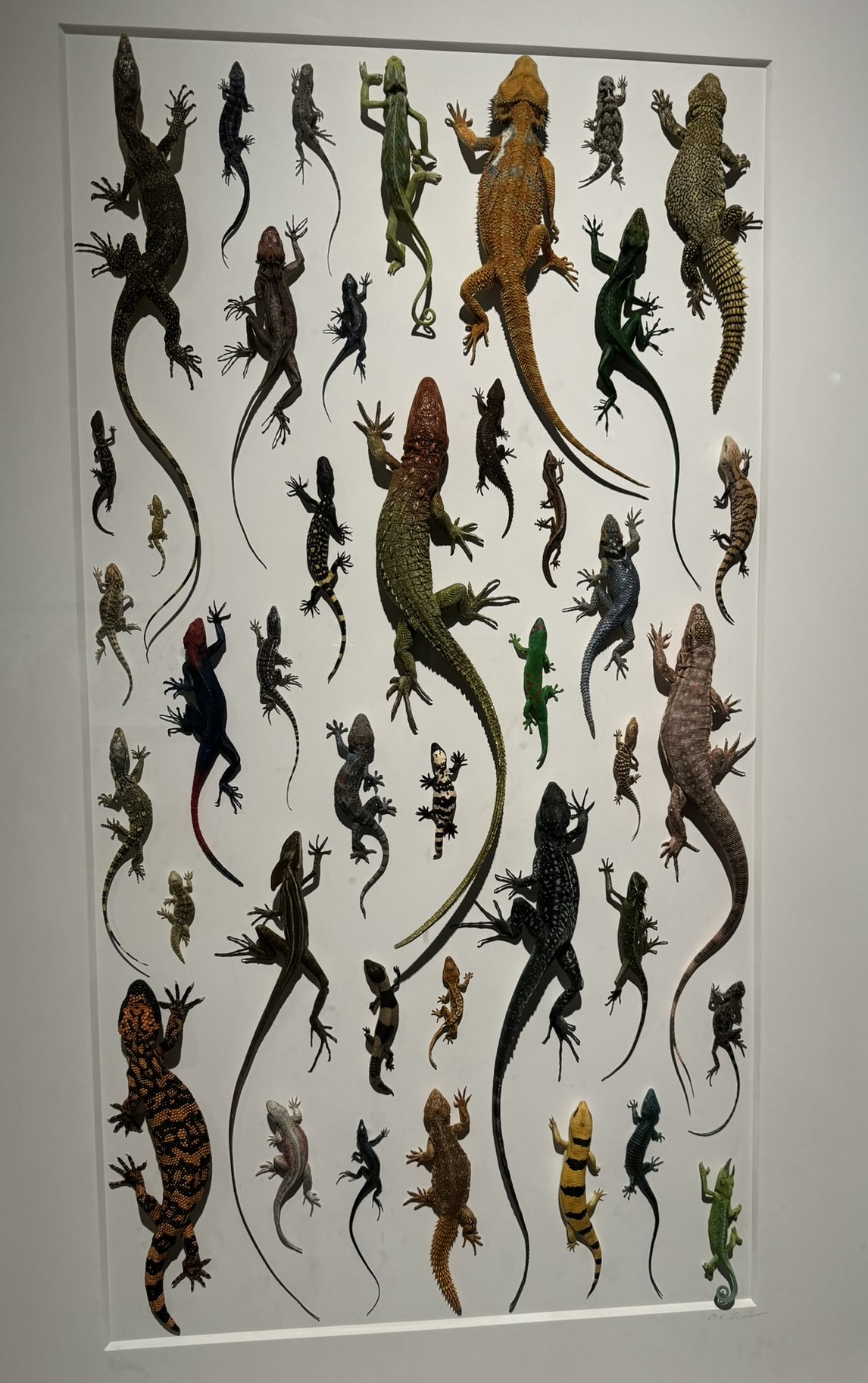
Speaking of animals, somehow many other species look different to me in death than humans, that is, if they haven’t started to decompose. This is especially true of insects, birds, reptiles, and amphibians. They often retain their colors and external patterns for a while, which is much better than rapidly fading to gray or some other shade that is the antithesis of living flesh. Let’s face it, many of these critters have colors and patterns more striking than the most expensive tattooists can paint on human epidermis. Artist and naturalist Christopher Marley has a sincere appreciation for the shapes, forms, and colors of the natural world and has created artistic designs using the preserved bodies of dead creatures, along with some minerals, in a breathtaking exhibit called “Exquisite Creatures.”

Exquisite Creatures Exhibit at Crystal Bridges Museum

My wife and I were fortunate enough to catch Marley’s show at Crystal Bridges Museum of American Art in Bentonville, Arkansas in July 2024. Most of the specimens are matted and framed under glass, hanging on the walls of the exhibit hall, with back lighting to enhance the incredible colors and designs of his arrangements. Kaleidoscopes of beetles, butterflies, moths, shells, and feathers are on display along with carefully choreographed groupings of snakes, lizards, skinks, fish, crustaceans, and birds. Some of the bug collections look almost exactly like beads of water resting on an impervious surface. The iridescence of the shells and exoskeletons is stunning, especially as they are arranged under the perceptive and sensitive eye of this artist.

Exquisite Creatures Exhibit at Crystal Bridges Museum

Marley collects the subjects of his work from a network of people around the world. His first book published in 2008 titled Pheromone focused on his artwork with insects. In the words of his publisher, “Marley has used his skills as a designer, conservator, taxidermist, and environmentally responsible collector to make images and mosaics that produce strong, positive emotional responses in viewers.” I completely concur with that evaluation. We were blown away with how he has taken many creatures that are often repulsed by people in general and molded their forms into magnificent displays that are indeed exquisite.

[Note: The photographs included here are not great quality, primarily because the gallery was so crowded and getting close and lined up to take a photograph was extremely difficult. Also, no photograph can replicate the experience of seeing these displays in person.]

Exquisite Creatures Exhibit at Crystal Bridges Museum

The Ozarks in DC: 2023 Smithsonian Folklife Festival

I had the privilege of being directly involved in the planning and implementation of the 2023 Smithsonian Folklife Festival, an annual event that takes place on the National Mall in Washington, DC. With a history going back over fifty years, the festival is usually scheduled over a ten-day period roughly encompassing the last week in June and the first week of July. It is produced by the Smithsonian’s Center for Folklife and Cultural Heritage and honors living cultural traditions while celebrating those who practice and sustain them. One of the programs selected for the 2023 festival was focused on the Ozarks, a region of the U.S. that is centered in southern Missouri and northwest Arkansas but also includes small portions of northeast Oklahoma, southeast Kansas, and extreme southwest Illinois. 

Smithsonian Folklife Festival 2023

I began working in 2019 for Missouri State University Libraries on a part time basis, assisting with projects sponsored by the Ozarks Studies Institute, an initiative of the Libraries. A fortunate turn of events led to the Smithsonian partnering with the Libraries for the Ozarks program of the 2023 festival, with the Dean of Libraries serving as a curator. The Dean offered me a full-time position eighteen months prior to the event to serve as an associate director for the university’s participation in the festival. 

The Dean and I teamed up with another part-time employee of the Libraries who has written two books about the Ozarks and has extensive cultural knowledge of the region. Our trio served as the core planning committee for the university to collaborate with the festival organizers from the Smithsonian. One of the first jobs we tackled was coming up with a name for the program. After considerable deliberation, we decided on “The Ozarks: Faces and Facets of a Region.” Our trio made numerous trips to visit with people and organizations throughout the region, in all five states, to spread the word and generate excitement about the festival. A small group of Ozarkers, including our planning trio, visited the National Mall in the summer of 2022 to get a clearer picture of how the event looks and works. We took two musical acts with us to perform as a preview of the 2023 Ozarks program.

Smithsonian Folklife Festival 2023

Over the course of a year, we worked with the Smithsonian staff to identify key stakeholders from the Ozarks who could assist with fundraising, program content, identifying other curators and participants, and overall planning of the festival. We had Zoom meetings almost every week for over a year to hammer out all the details, and several festival organizers from the Smithsonian visited the Ozarks multiple times to get a better sense of the region and to meet with our team. 

Using artists from the Ozarks and from the DC area, the larger planning team came up with design features for the festival that would reflect the natural beauty of the region. We had to decide on color schemes, fonts for signage, layout of the festival grounds, daily schedules of events, and a whole host of other elements. In early 2023 we began meeting with the festival logistics staff to work on structural and mechanical requirements for the site. We also met with interns and volunteers who are brought on each year to help the Smithsonian with festival participants’ needs regarding transportation, lodging, meals, and a wide variety of other accommodations. By the time June arrived, there were over 150 people involved in either planning or implementation. It is a massive effort.

Smithsonian Folklife Festival 2023

The festival was open each day, June 29 through July 9 (with the exception of July 5), from 11:00 a.m. to 5:00 p.m., followed by evening concerts most nights running from around 6:30 to 8:00 p.m. The Ozarks program site was situated under the trees on the south side of the Mall, just east of 14th Street SW. On the opposite north side of the Mall was the other program for the 2023 festival, which was called “Creative Encounters: Living Religions in the U.S.” Each year the festival is open on Independence Day, where people gather by the hundreds of thousands along the corridors, paths, and grassy fields extending from the Potomac River all the way to the Capitol to await the spectacular fireworks display at dusk between the Lincoln and Washington Memorials. I don’t typically go out of my way to see firework displays, but the colorful explosions that serve as a backdrop for the imposing Washington Monument are mighty impressive.

Smithsonian Folklife Festival 2023

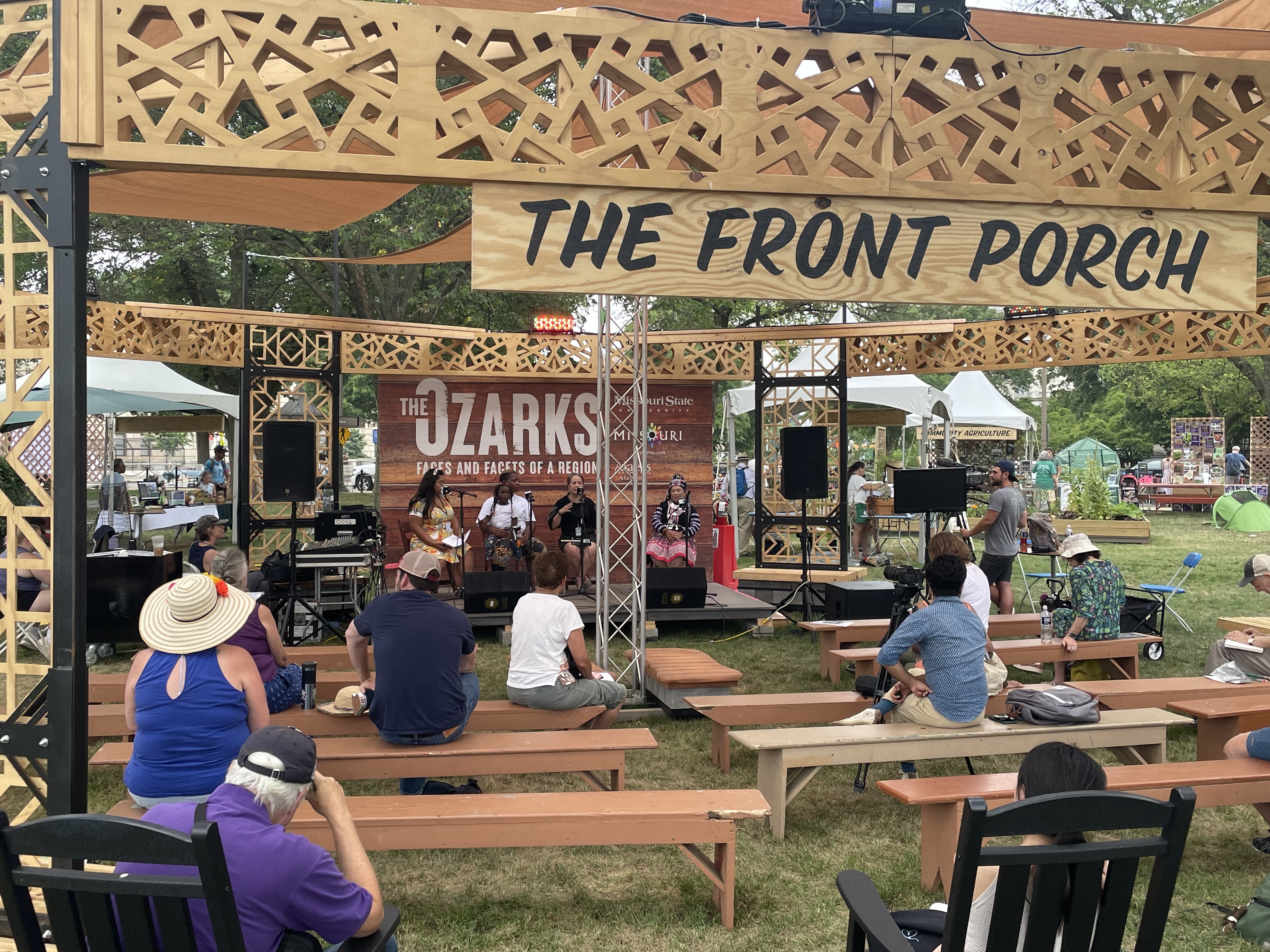
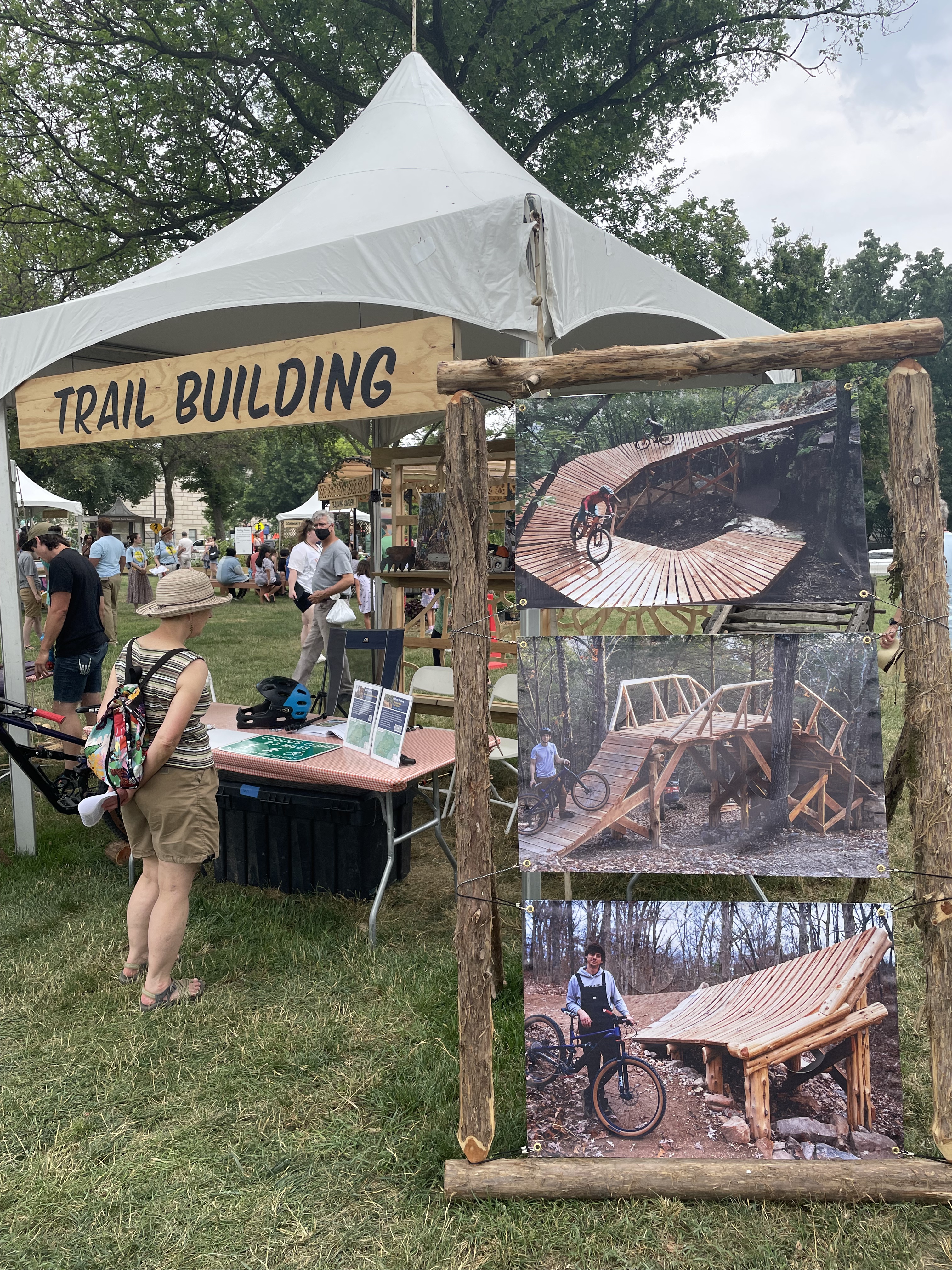
The Ozarks program was divided into four major themes: celebrations and gatherings; stories, sounds, and show business; migrations, movements, and pathways; and connections to land and place. The site featured large-scale murals and a mountain-bike trail build, music jam sessions and performances, dance and plant-knowledge workshops, food and craft demonstrations, and curated discussions. The Ozarks program included multiple theaters. There was a theater for discussions and demonstrations of plant knowledge, one for cooking demonstrations, one called the “Pickin’ Porch” mostly for music during the day, and one called “The Front Porch” for panel discussions. Both festival programs shared a large main stage out in the middle of the Mall that was reserved for musical workshops and performances during the day and for the larger evening concerts.

Smithsonian Folklife Festival 2023

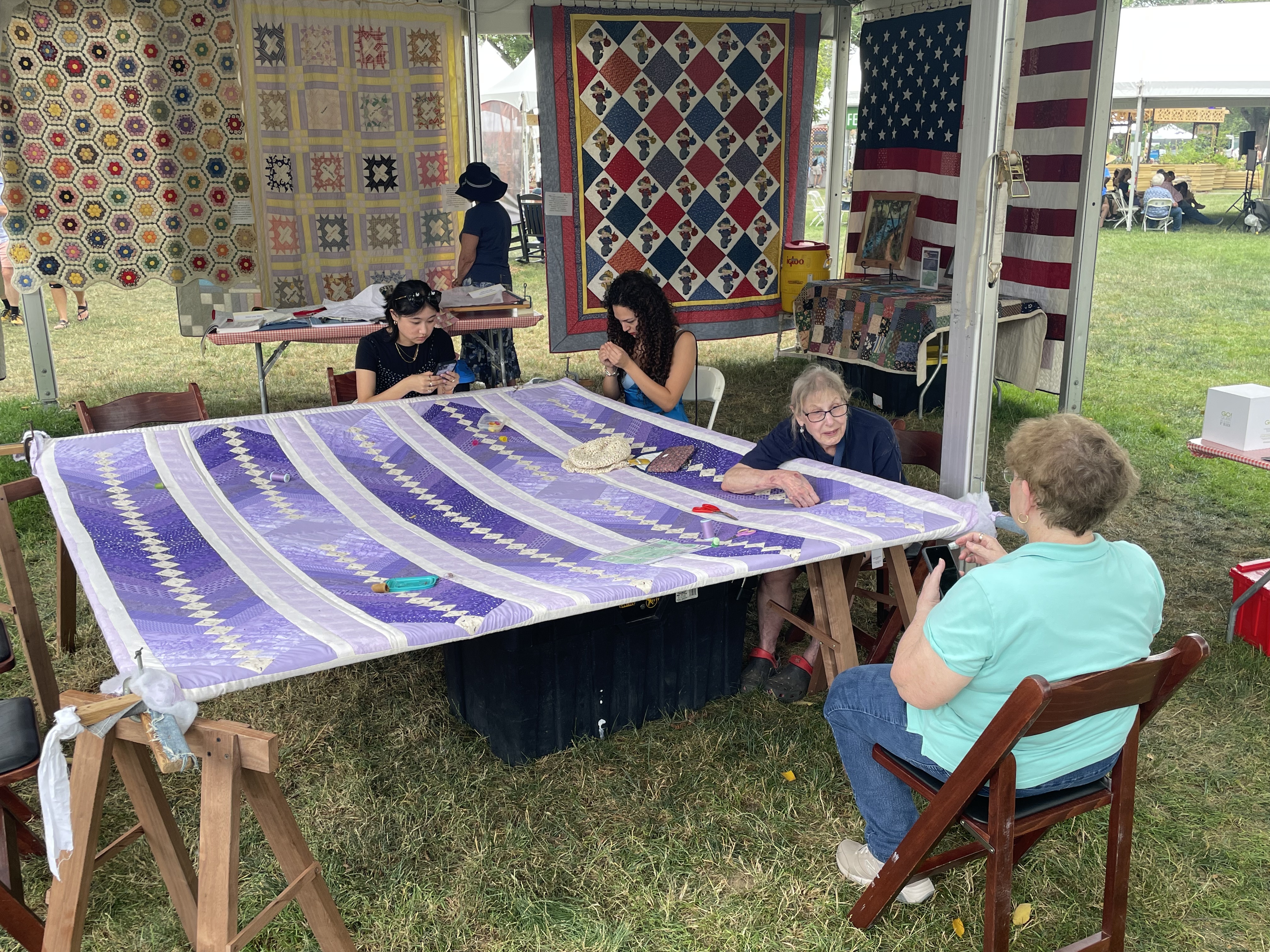
The Ozarks program brought close to 60 musicians to the festival, which is a clear indication of how important musical traditions are to the culture of the region. There were at least eleven different ensembles of varying sizes, along with many individual musicians, specializing in several different genres including Native American music, traditional old time music, bluegrass, folk, country, gospel, and contemporary. Foodways, plant knowledge, arts, crafts, and storytelling were demonstrated by white Ozarkers but also by many other ethnic groups that call the Ozarks home, including Native Americans, African Americans, people of Hispanic and Latino heritage, Marshallese, Hmong, Khmer, and Syrian. Contrary to much of its history over the last 200 years, some of the “faces and facets” of the Ozarks show remarkable diversity in race, ethnicity, and culture.

Smithsonian Folklife Festival 2023

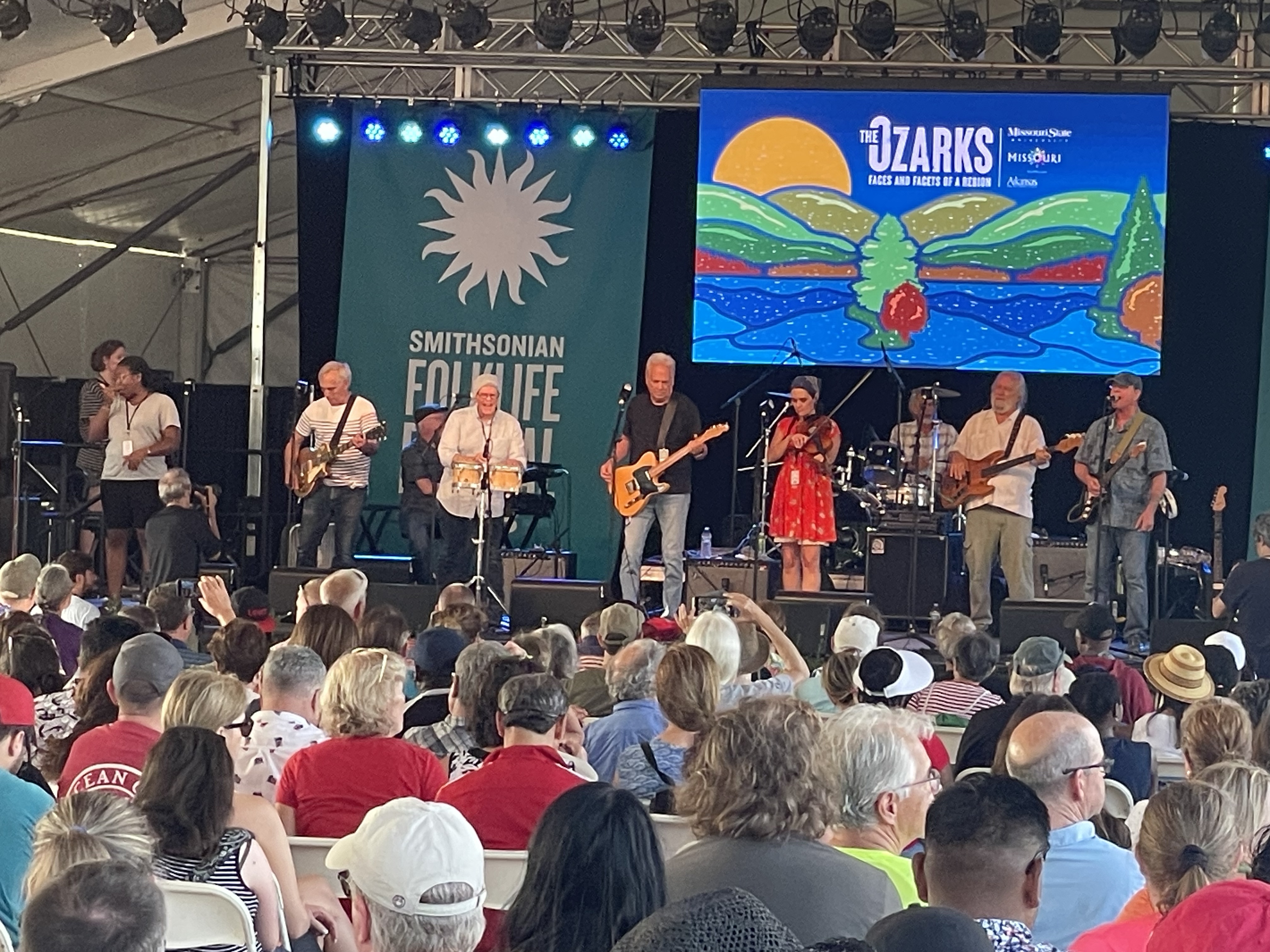
The largest and most recognizable musical group that the Ozarks program sponsored played on the main stage for the July 4 evening concert. The Ozark Mountain Daredevils is a band that originated out of Springfield, Missouri, in 1972. The group had several hits in their early years including “Jackie Blue” and “If You Want to Get to Heaven.” The band has evolved over the decades, losing and replacing band members and even going into a type of semi-retirement in the early 21st century. In recent years the Daredevils have enjoyed a bit of a resurgence, appearing on the Grand Ole Opry in Nashville on two occasions in 2023. They put on a hell of a show for the DC festival and for hundreds of people within earshot of the main stage that evening.

Ozark Mountain Daredevils

My primary job during the days of the festival was to occupy the Missouri State University Libraries table set up near the main entrance of the Ozarks program. With the help of one of our student workers, I was selling several books about the Ozarks and answering questions about the festival program and the region in general. I was surprised by how many festival visitors told us they were either from the Ozarks, had lived in the Ozarks, or had fond memories of visiting the region. Many of these folks have lived and worked in the DC area for years, and they were so happy to see the Ozarks featured on the National Mall. We could definitely detect a sense of pride in their voices when they talked about their connection to the region.

Smithsonian Folklife Festival 2023

Perhaps the most enjoyable connection I made during the time of the festival was with the two guys representing mountain biking, one of the fastest-growing forms of recreation in the Ozarks, especially in northwest Arkansas and Missouri. Seth Gebel is a young entrepreneur who owns Backyard Trail Builds. He goes out into the forest armed with only hand tools and cuts down cedar trees, trimming them out to create bridges, ramps, and runs for biking trails. He designed and built a short, curved and banked track at the entrance to the Ozarks site at the festival. Dave Schulz works within a nonprofit organization to help community leaders in revitalizing their towns by developing bicycle-focused public parks and sustainable trail systems, preserving natural environments while drawing tourism from around the world. Both of these guys gave daily riding demonstrations on the track that Seth built for the festival.

Smithsonian Folklife Festival 2023

The most magical moment for me came on the final evening of the festival in the dining room of the host hotel. A group of Ukranian vocalists from the Creative Encounters program stood up and began singing a traditional folk song in their native tongue. They were followed by several other individuals and groups from both programs, standing to sing and inviting others in the room to participate through responsive chanting, vocalizations, and clapping. As I witnessed what happened, I recognized that this festival offers us a snapshot of the best of humanity, the wonders we are capable of producing when we embrace our differences and come together to learn from each other.

Smithsonian Folklife Festival 2023

Taliesin West: Frank Lloyd Wright’s Desert Oasis

In 1909, famed American architect Frank Lloyd Wright began constructing a house on the brow of a hill near Spring Green, Wisconsin. He had grown up in the hills of the state and was inspired by the landscape. His mother was of Welsh descent, and he named the 800-acre estate Taliesin, which is a personal name rooted in Welsh mythology that translates to radiant or shining brow. This was not Wright’s first home, nor would it be his last. He had completed a small two-story residence in Oak Park, a suburb of Chicago, in 1889. Fire almost completely destroyed Taliesin in 1914 and again in 1925, but Wright rebuilt both times.

In the early 1930s, Wright and his third wife, Olgivanna, established an architectural apprentice program at his Wisconsin home called the Taliesin Fellowship, which provided students with an immersive experience that integrated design and construction with growing and preparing food and the study of the arts. The term the Wrights used was “organic architecture.” Wright would continue to make changes and additions to Taliesin over the years after the fires, including converting a chicken coop into a dormitory for his architectural apprentices!

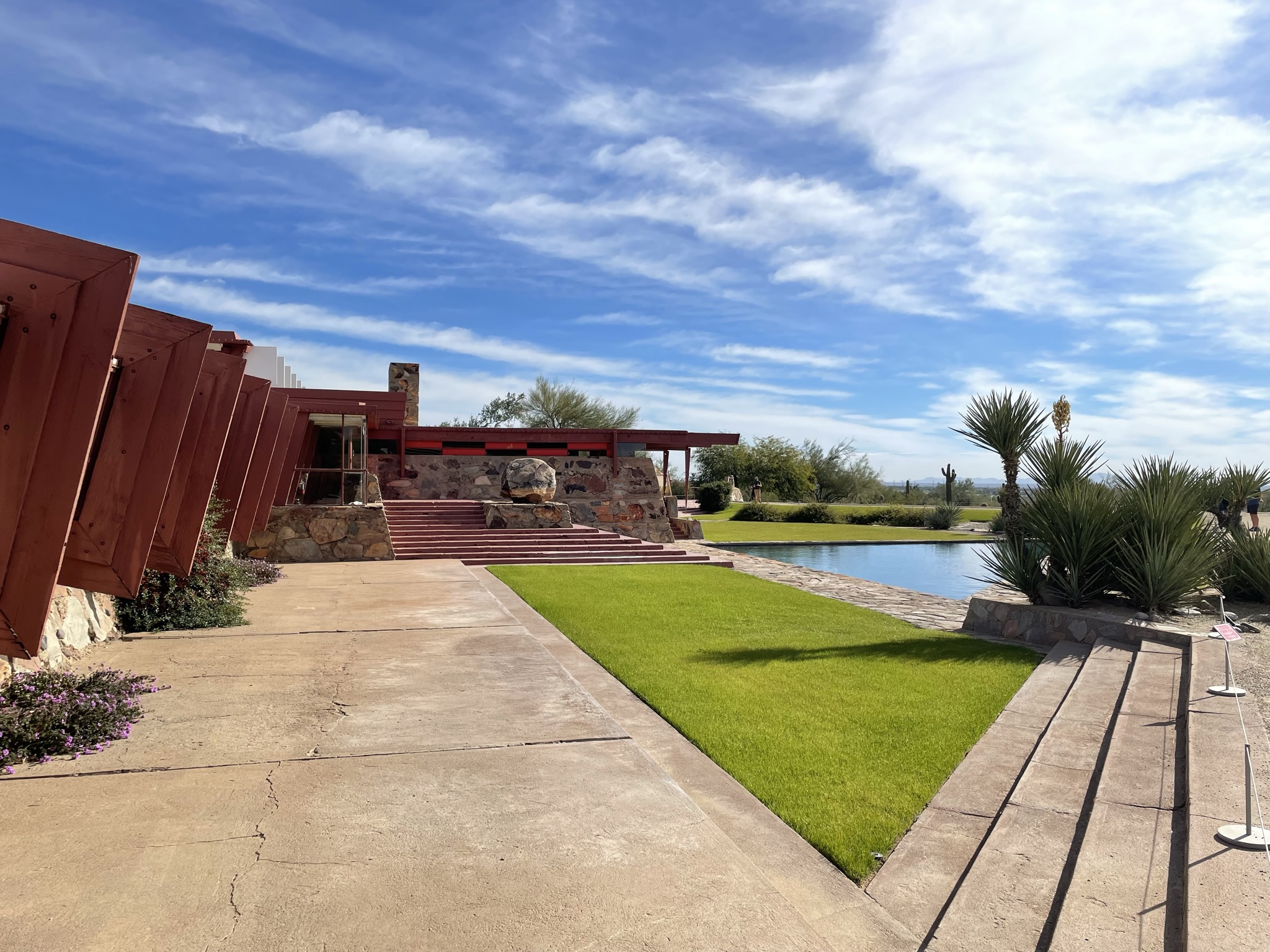
Wright and his students needed seasonal respite from the harsh winters of Wisconsin and found one in 1934 when he rented space for the Fellowship in sunny Arizona. The change in climate was so welcoming that Wright decided to create a winter location for his school. He purchased property in the rugged Sonoran Desert at the base of the McDowell Mountains in Scottsdale, northeast of Phoenix, where he and his apprentices would construct Taliesin West. This winter camp would become a study in how to blend architecture into a stark landscape incorporating water, shade, foliage, and indigenous materials to create a desert oasis. Wright’s architectural school used both Taliesin locations depending upon the season, even after the master’s death in 1959 in Phoenix at the age of 91. Although the Wisconsin program at Taliesin East finally closed in 2020, the tradition continues to this day with the Frank Lloyd Wright School of Architecture in two locations in Arizona. Both Taliesin East and West are now historical sites open to the public, with guided or self-guided tours available.

Taliesin West in Scottsdale, Arizona

During the week following Christmas in 2022, my wife and I returned to the Phoenix area for a vacation. It is one of our favorite destinations in the country and where we hope to spend considerable time during retirement. On this trip we visited Taliesin West, which was my first time seeing the site. We took a self-guided tour, using a mobile phone app with earplugs to listen to a virtual guide describe the structures and surrounding grounds as we walked through a series of numbered stations over the course of about an hour. The whole setup was quite slick – impressive and informative. Along with other visitors taking the same tour, we were able to stroll through the various rooms and outdoor spaces. It is understandable why Andrew Pielage decided to call his photographic exhibition of Wright’s work “Sacred Spaces,” showcasing how the architect skillfully designed structures that seem almost sanctified.

Taliesin West in Scottsdale, Arizona

Several design elements of Taliesin West stand out in my mind. A common theme throughout is the use of sharp angles for roof lines, steps, walkways, and water features. This collection of points is reminiscent of the McDowell Mountain peaks visible to the east of the property. The stone and plaster walls, interior and exterior, imitate the rocky outcroppings around Scottsdale and throughout the Phoenix valley. Red, orange, brown, and blue are dominant colors for painted surfaces and fabric, reflecting the palette of the Sonoran Desert floor and the skies above that remain clear most of the time. Although rare in the desert, water is present in the form of rivers, such as the Salt, Gila, and the Agua Fria in Phoenix. Also, the Sonoran Desert gets more rainfall than any other desert in North America. Wright and his apprentices included several modest water features at Taliesin West. Some people have speculated that Wright may have become paranoid after suffering through multiple devastating fires and wanted water nearby as a safeguard. In any case, the presence of water created a literal oasis at Taliesin West.

Taliesin West in Scottsdale, Arizona

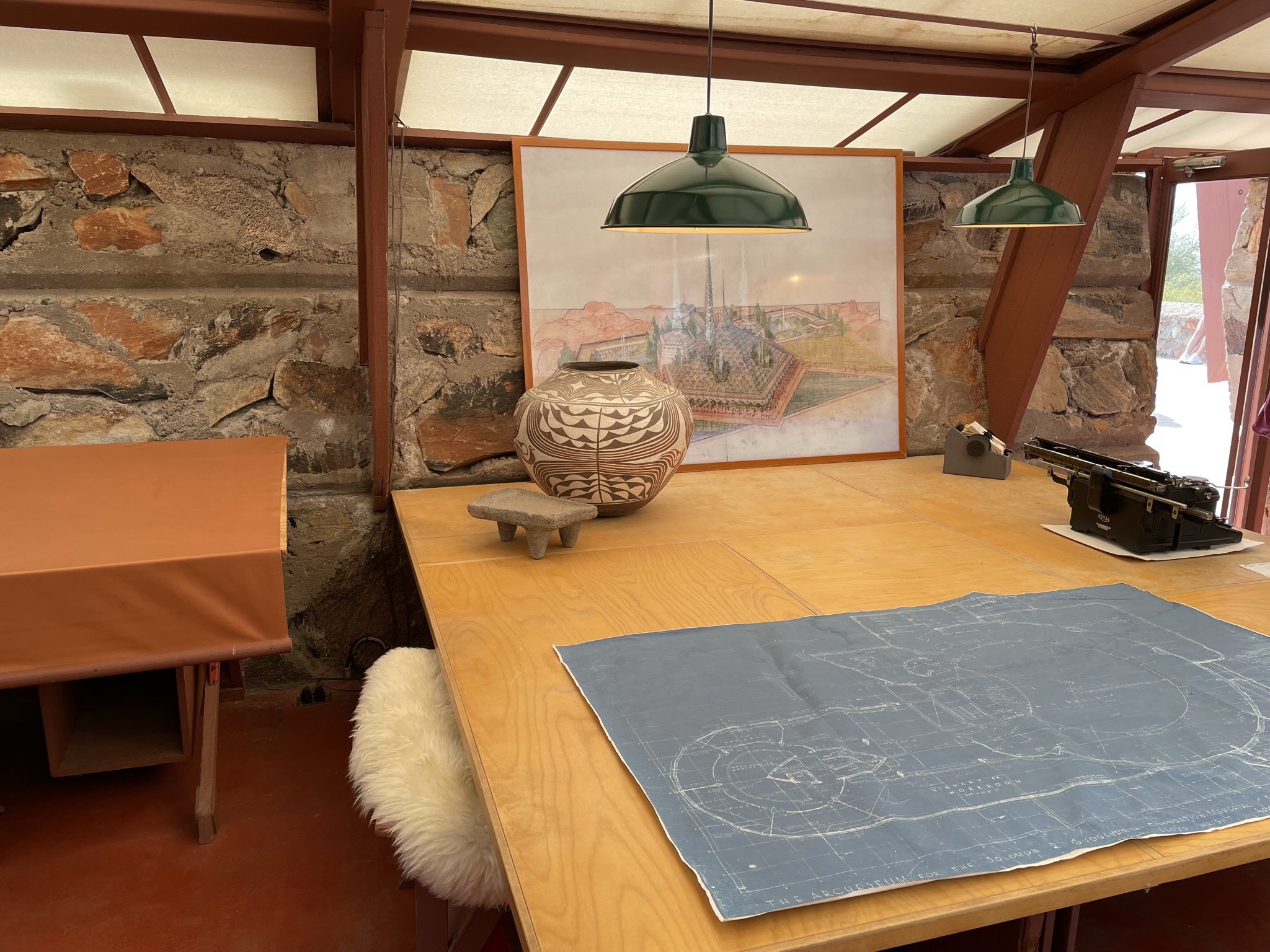
The Frank Lloyd Wright Foundation that owns and operates Taliesin West does a fine job of managing the site as a historically-preserved house museum. The rooms are presented in a fashion that makes them look as if Wright and his students have left for the summer but will return next winter. Spaces are appointed with original (or at least period) art pieces, artifacts, furniture, and furnishings. The story the curators are telling is as much about Wright’s apprentices and their accomplishments as it is about the master architect himself. There are various places where people could gather together, including a small theatre. There are at least three pianos in the buildings, implying how important music was to the general atmosphere the Wrights were producing. Toward the end of his life, Frank Lloyd Wright was hosting cocktail parties with Olgivanna at Taliesin West for select groups of people in the greater Phoenix area. What fascinating conversations must have occurred at such gatherings, no doubt dominated by the celebrity architect who had grown so fond of his sacred space in Arizona.

Taliesin West in Scottsdale, Arizona

Art for Everyone

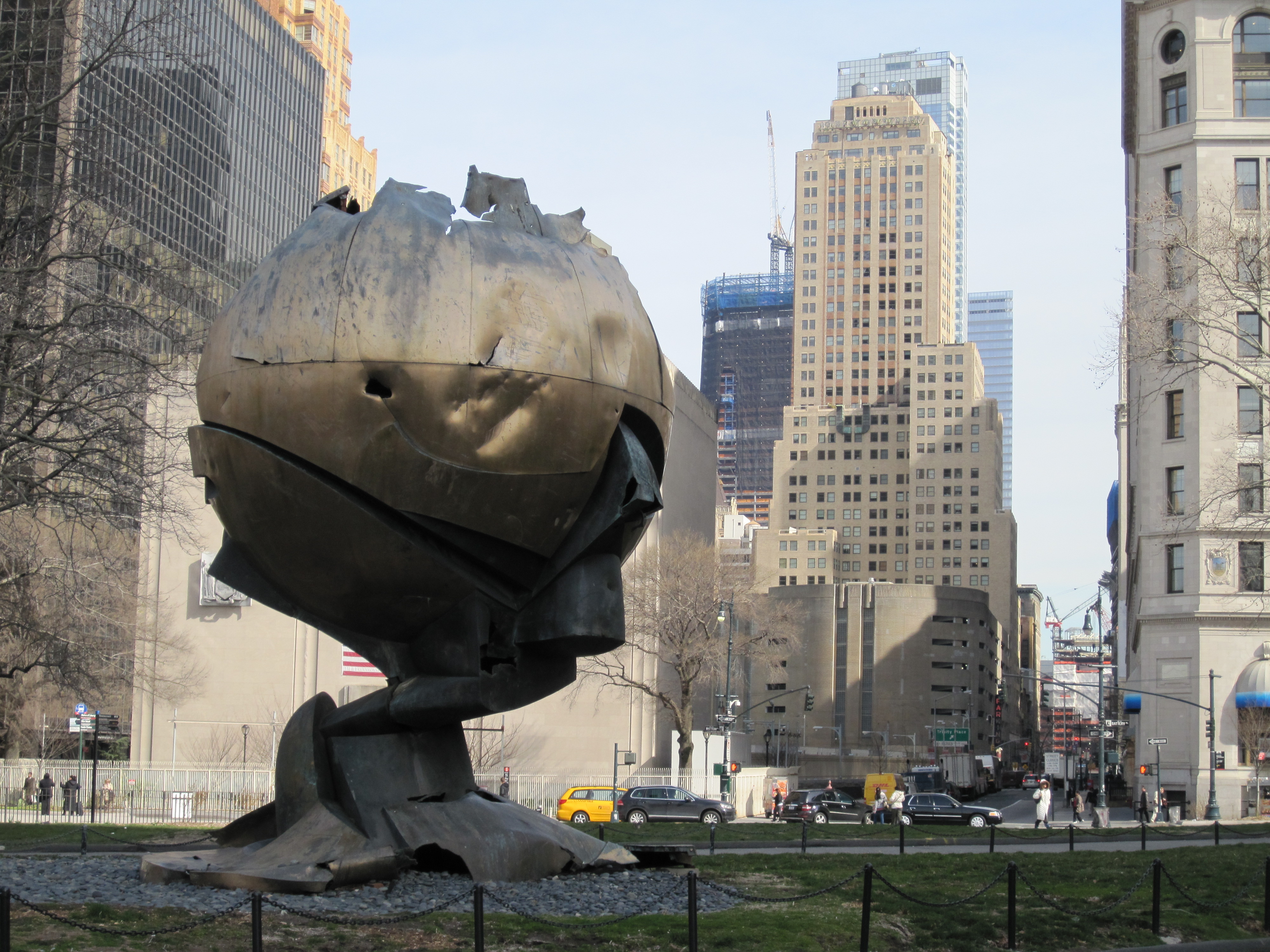
In 1967, a German sculptor named Fitz Koenig received a commission by the Port Authority of New York and New Jersey to install a work of art to be featured on the Austin J. Tobin Plaza situated between Word Trade Center’s twin towers, which were being built at the time. Koenig created a 20-ton cast bronze sphere 17 feet in diameter mounted on a disk pedestal positioned in the middle of a water fountain. Anyone visiting the plaza could pause to witness the largest bronze sculpture in the world at that time. After the twin towers fell in the terrorist attacks of September 11, 2001, Koenig’s Sphere, though seriously damaged, was the only work of public art at the World Trade Center that survived the destruction.

The Sphere in New York, NY

The sculpture was removed from the wreckage and brought back to Manhattan six months later and reinstalled in Battery Park, several blocks from its original location. It was later moved to Liberty Park. Ironically, Koenig’s Sphere was dedicated in 1971 to “world peace through trade.” The Sphere represents a remarkable example of how a work of art can take on a whole new meaning for the public based on outside forces that transform the piece, literally and figuratively. Upon its rededication, Koenig’s Sphere was recognized as “an icon of hope and the indestructible spirit of this country.”

I have written in a previous blog post about the value of public gardens, which I define as those that are open and free for everyone to enjoy at no cost. In a similar fashion, public art offers an opportunity for people to experience creative expression in almost endless media, shapes, sizes, colors, and settings. Large cities all over the world are adorned with magnificent art in public places, but even the smallest towns and villages show pride in their communities with various art installations, modest as they may be. They may take the form of a sculpture honoring a benefactor of a local garden, which is a wonderful way of celebrating two different treasures available to the public.

Springfield Botanical Garden in Springfield, MO

Municipalities often use statues or murals to draw attention to important figures in the history of their communities or significant events from the past. Then again, statues can be whimsical or can portray a particular type of character, including those from works of fiction or fairy tales. Wildlife is a frequent subject of public art too, which all ages tend to appreciate. Some businesses install works of art in front of their locations for the public to enjoy, which also attract customers and can even assist with brand recognition. Sometimes a statue or other work of art can have a dual purpose: as a stand-alone piece that also serves as a planter, an entrance, a directional sign, or any number of other functions.

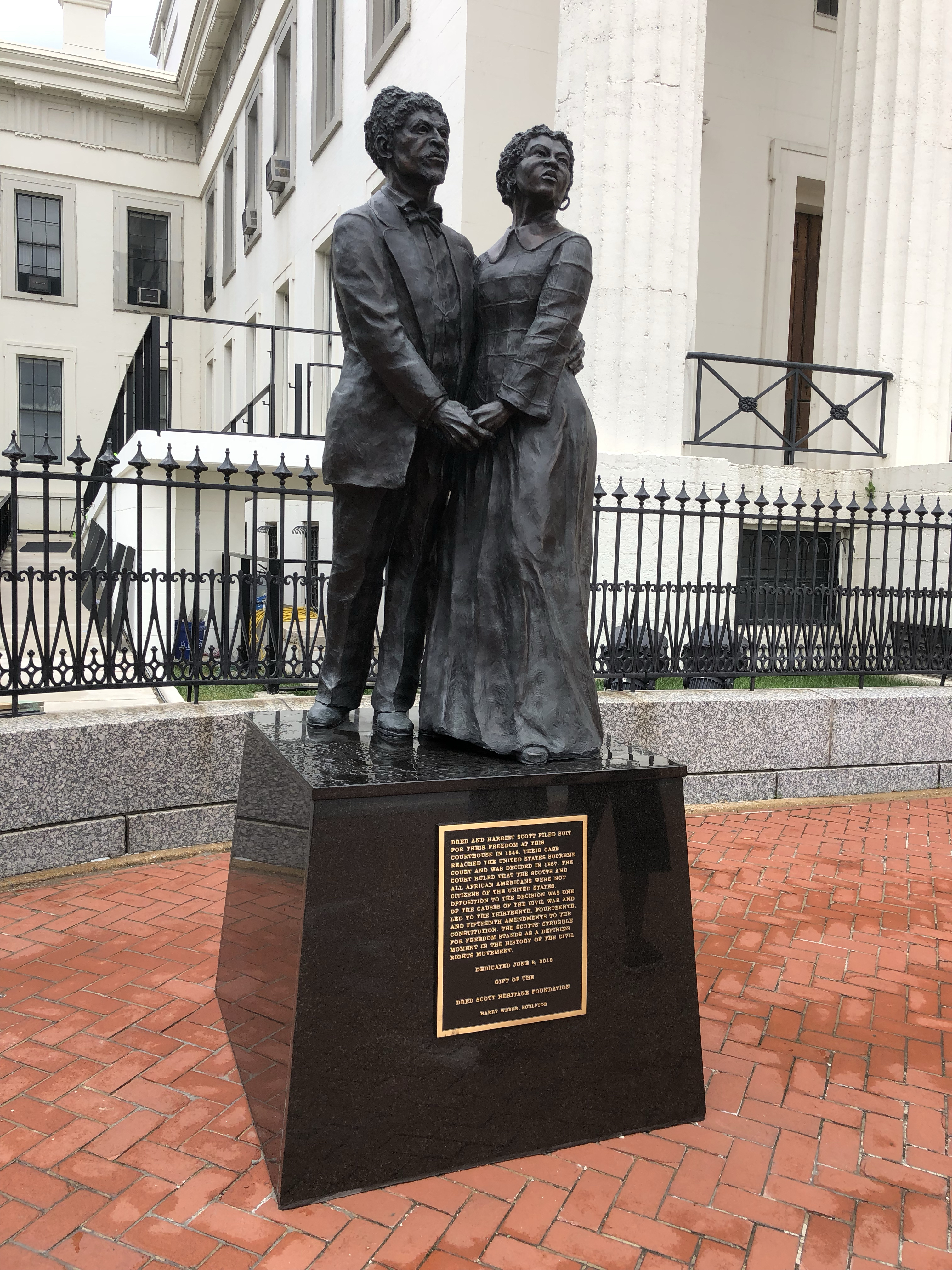
Dred and Harriet Scott in St. Louis, MO
Duke Kahanamoku in Huntington Beach, CA
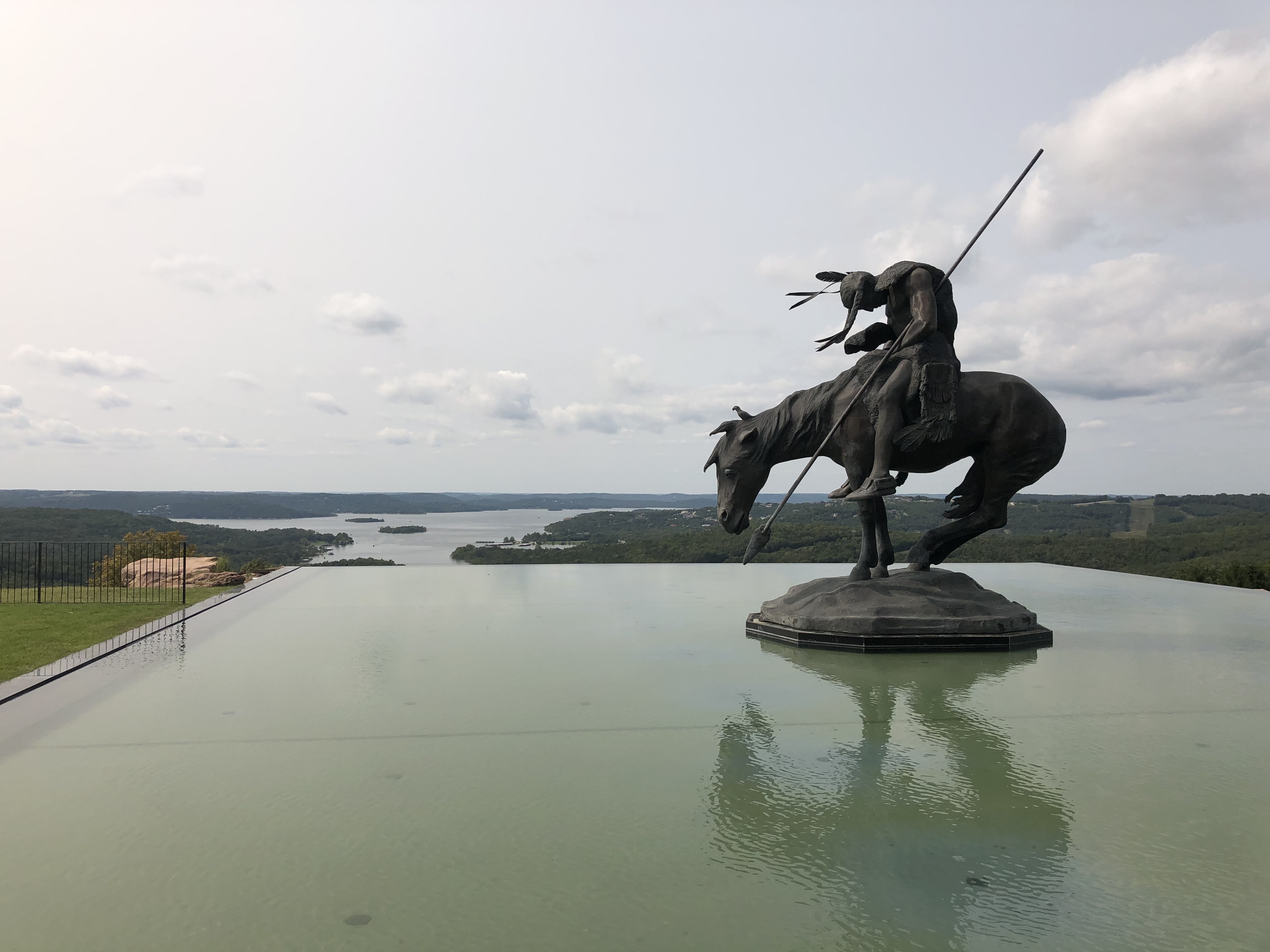
Top of the Rock near Branson, MO
Memphis, TN
Memphis, TN
Country Club Plaza in Kansas City, MO
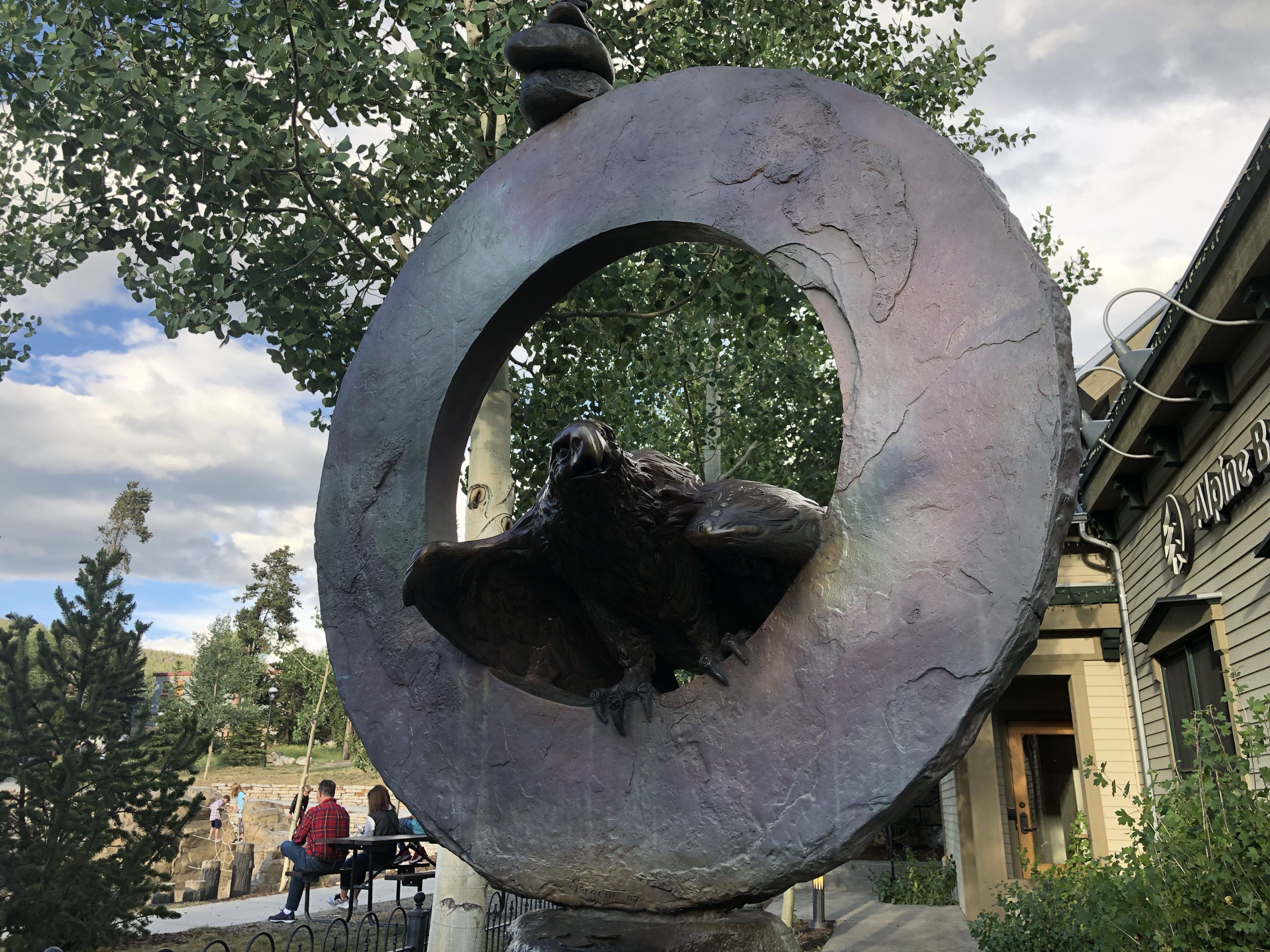
Breckenridge, CO
Breckenridge, CO

Museums and galleries that charge admission fees will often have several pieces of art located outside their buildings for people passing by to see. Better yet, some of them include free walking trails on their grounds featuring artwork that is usually quite spectacular and impressive in size and concept. Most valued and valuable works of art in the world are kept in secure, climate-controlled buildings and guarded closely. Access to these treasures is primarily limited to those who can afford admission fees; however, many of the world’s most famous art museums open their doors to the general public for free, at least several times annually. How fortunate are the folks who can take advantage of opportunities to see first-hand the works of the masters from centuries past. But we should never take for granted the art that surrounds us wherever we go. It’s there, and some of it is absolutely amazing.

Santa Fe, NM
Santa Fe, NM
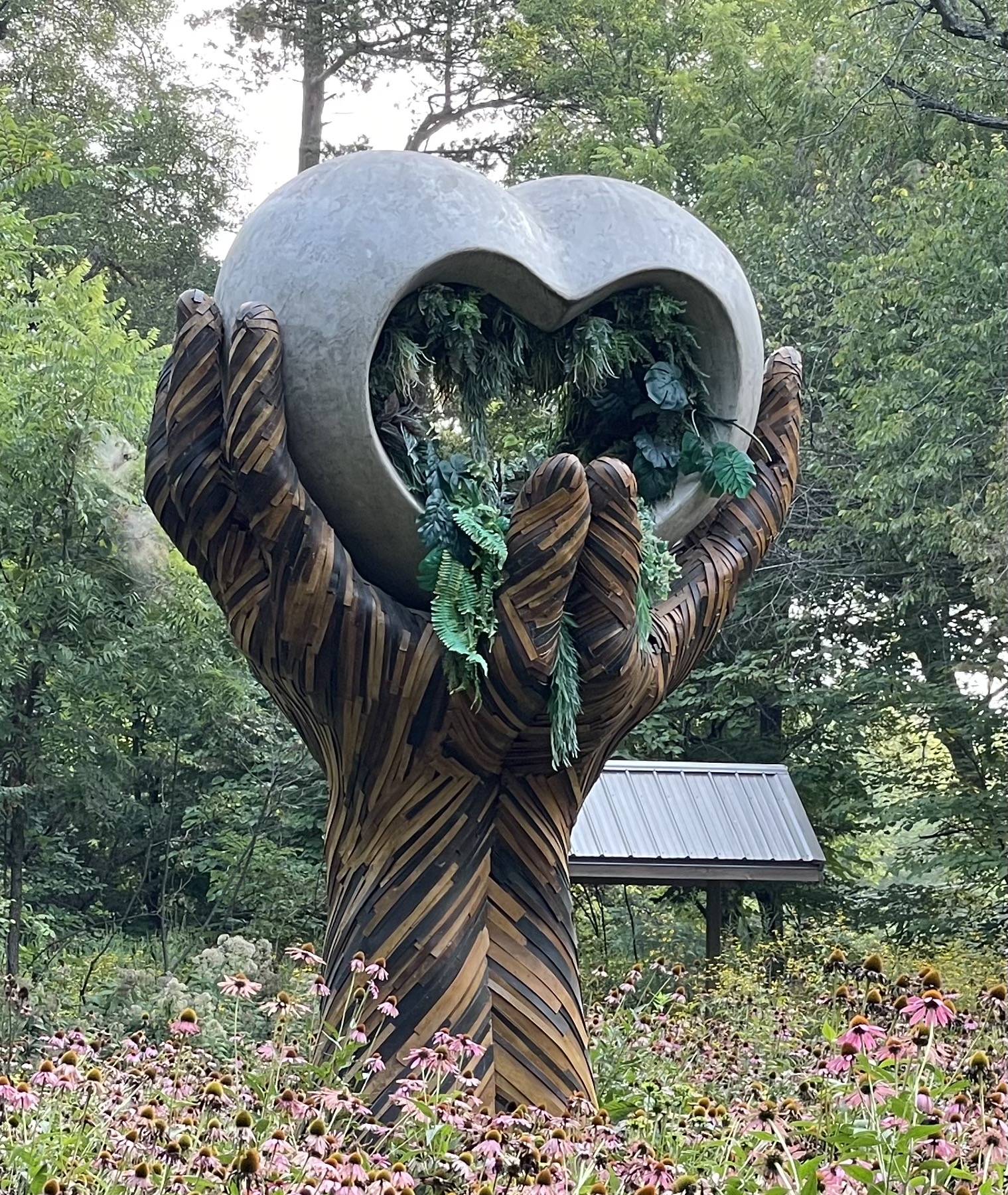
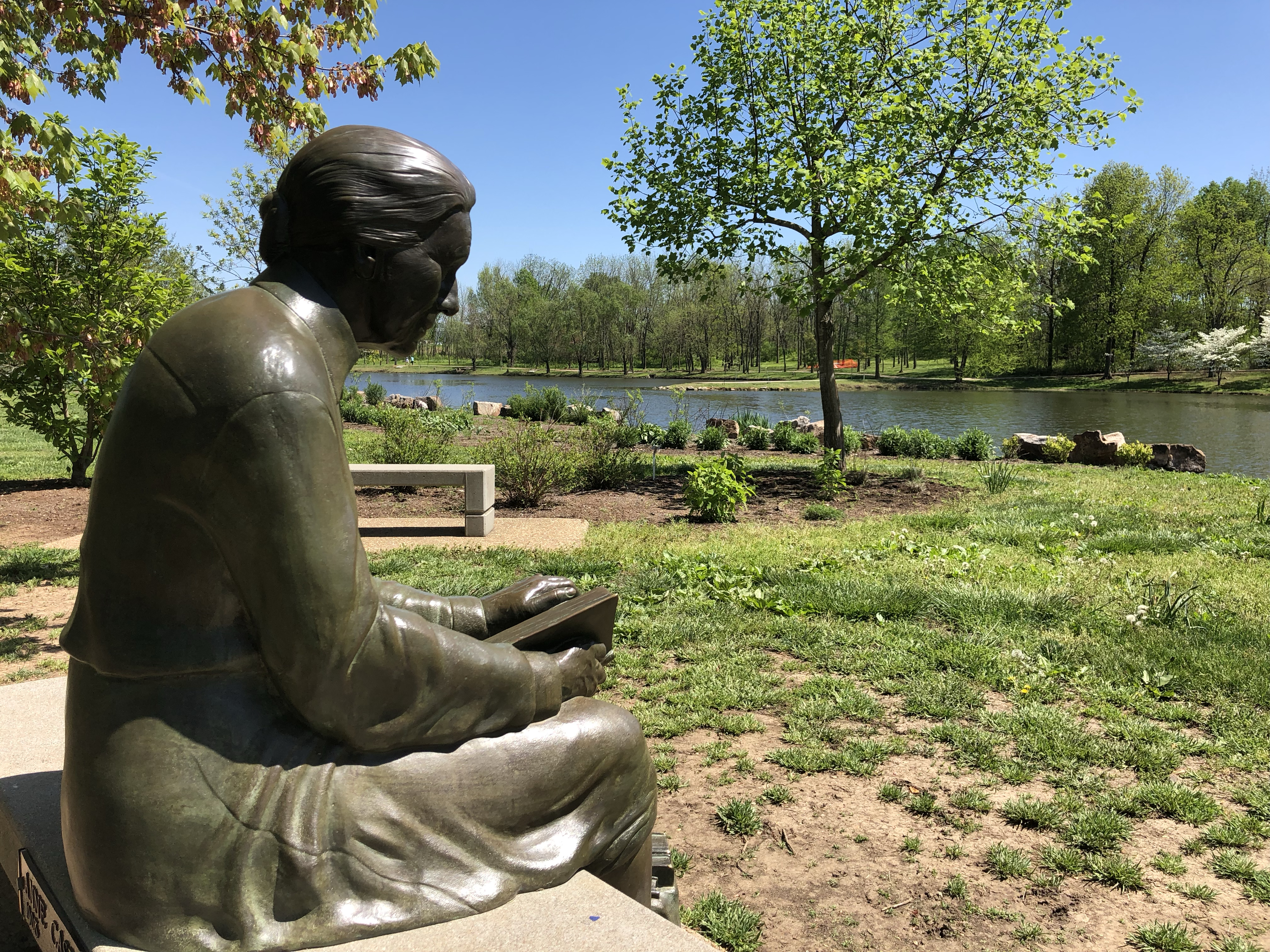
"Stone Heart in Wooden Hands" at Crystal Bridges in Bentonville, AR
“Stone Heart in Wooden Hands” at Crystal Bridges in Bentonville, AR

Santa Fe: Art Gallery of the Southwest

My wife and I took a trip to Santa Fe, New Mexico, during the summer of 2014.  She had been to the town several times, but I had not. We both love art, culture, and the southwest, and Santa Fe is one of those places where all three intersect.  We stayed in a lovely, rambling casita just off Canyon Road, which placed us in walking distance from the historic downtown attractions and more art galleries than anyone could possibly explore in a year’s time — alas, we were there for less than a week.

Native-American settlement in this area of the state goes back at least to the mid-11th century, with Pueblo Indian villages occupying the site for about a hundred years. Spanish explorers created a small village here thirteen years before the Mayflower Pilgrims established the Plymouth Colony. Santa Fe is the oldest capital city in the U.S. and still holds the record for the oldest public building in America, the Palace of the Governors. The city was captured and claimed by the U.S. in 1846 during the Mexican-American War. After New Mexico gained statehood in 1912, Santa Fe began to attract even more visitors from across the country who were drawn to the city’s dry climate and rich history.

Art and architecture have been among Santa Fe’s most valuable commodities from its early beginnings as a settlement for indigenous people. During the 20th century, the leadership and citizens of Santa Fe took measures to preserve the city’s ancient landmarks and maintain its multicultural traditions. Zoning codes are in place to protect the city’s distinctive Spanish-Pueblo architectural style of adobe and wood construction. Of course, other styles are fully represented in Santa Fe, including Greek Revival, Victorian, and Spanish Mission Revival.

Dragon sculpture over Ellsworth Gallery in Santa Fe

The historic district of Santa Fe is packed with galleries and museums, but the variety and abundance of public art on display transforms this southwestern village into a huge open-air exhibit. Galleries and other businesses often have interesting artwork on the exterior of their buildings that range from traditional to whimsical, like the pounded-copper dragon sculpture by artist Ilan Ashkenazi atop the Ellsworth Gallery, reflecting the gallery’s Japanese antiques and Samurai armor collections. The “Rock Paper Scissors” stainless steel and bronze sculpture by artist Kevin Box at a nearby gallery is another example.

"Rock, paper, scissors" sculpture in Santa Fe
“Rock, paper, scissors” sculpture in Santa Fe

Public art abounds in Santa Fe, and it comes in all shapes, sizes, and media. If you’re looking for garden art, there are plenty of public green spaces decorated with a variety of individual and collective installations. However, there are also outdoor garden galleries selling a whole host of fascinating pieces, including the mesmerizing whirligigs and the startling face sculptures. Public buildings also get in on the act. The “Santa Fe Current” is an installation by artist Colette Hosmer of sculpted fish “swimming” through pebbles in the garden area just outside Santa Fe’s Community Convention Center.

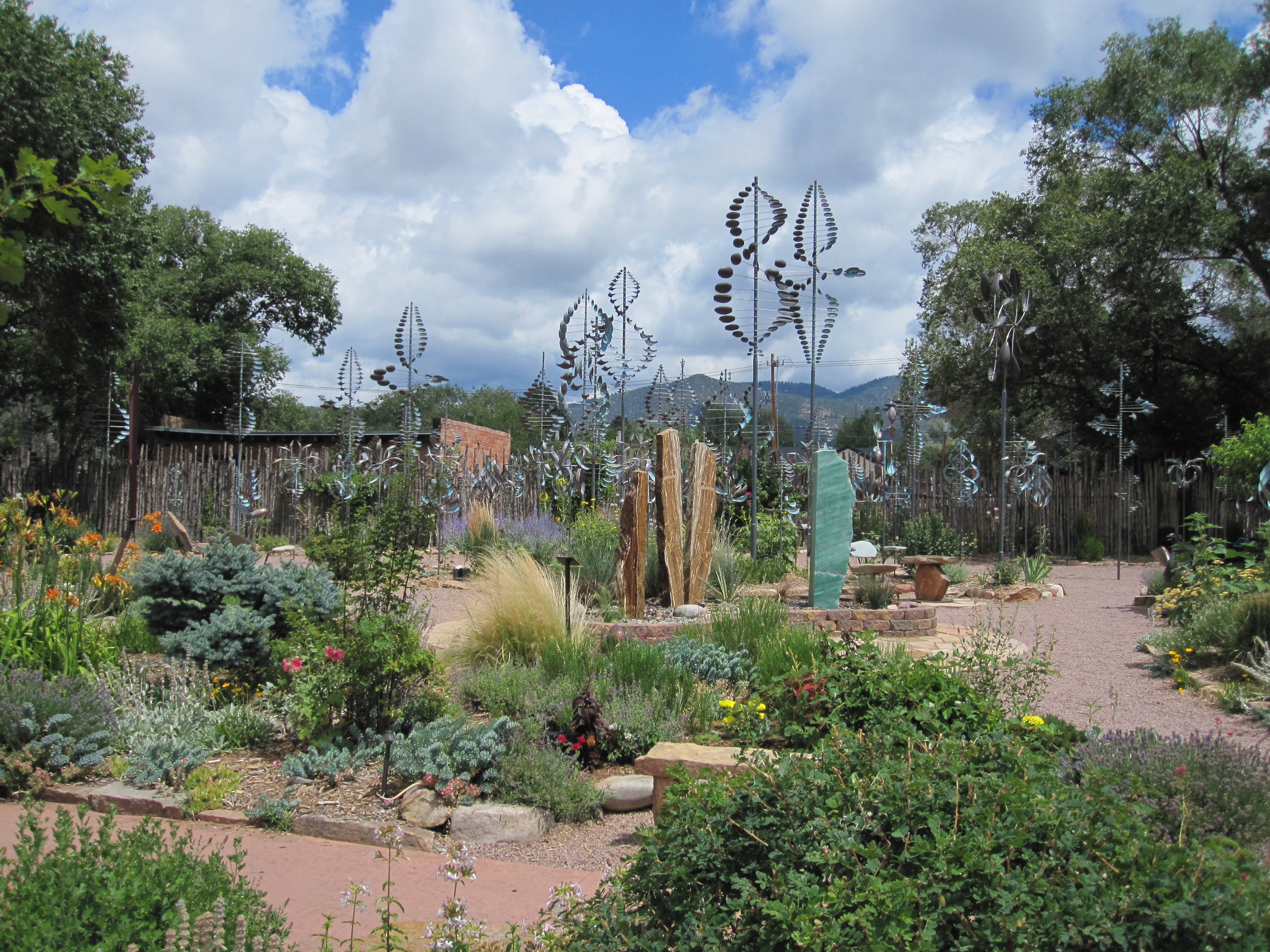
Whirligig garden in Santa Fe
Sculpted garden faces in Santa Fe
"Santa Fe Current" sculpture by Colette Hosmer
“Santa Fe Current” sculpture by Colette Hosmer

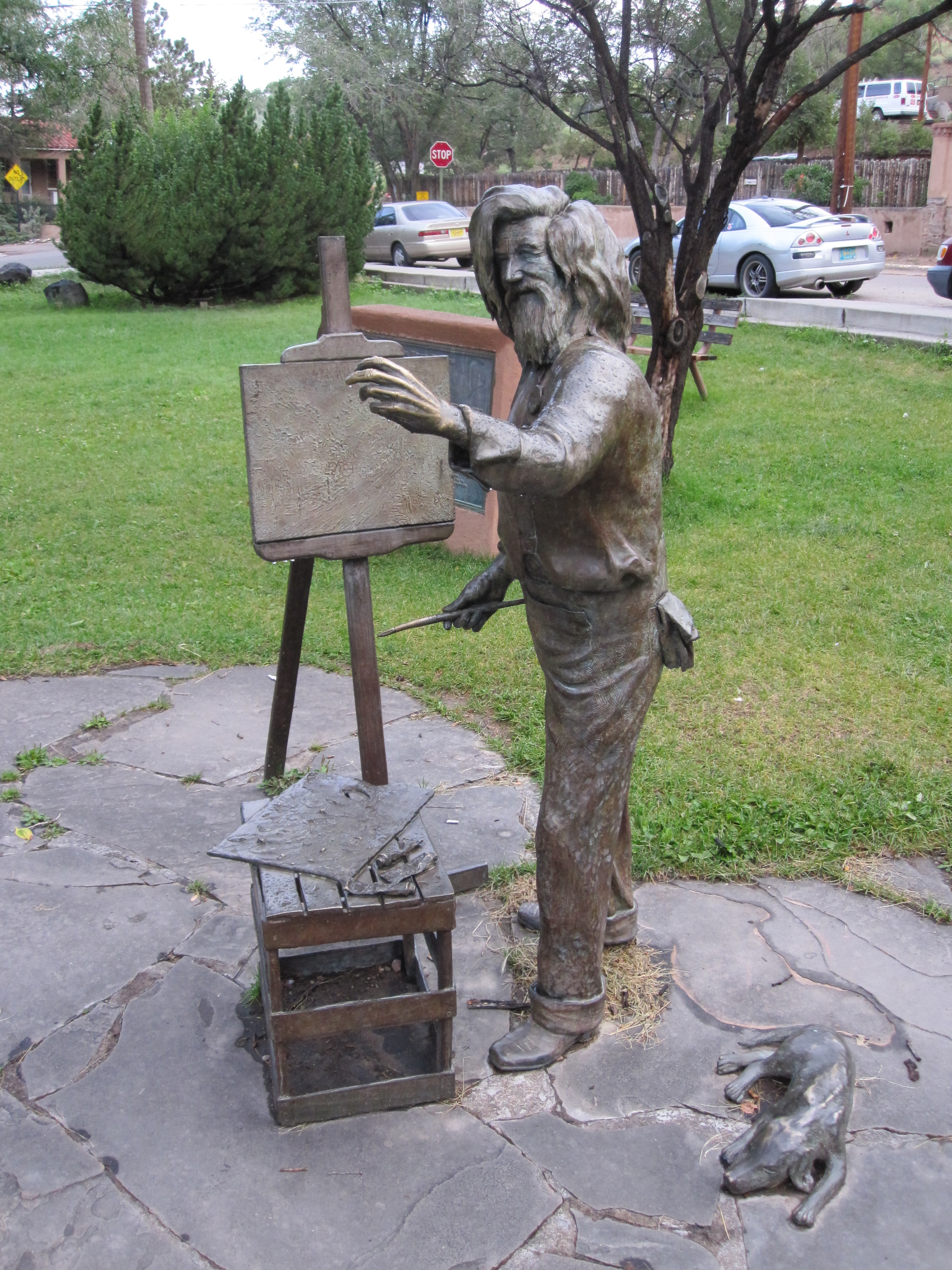
Bronze statues are almost ubiquitous in Santa Fe, scattered throughout the town on public and private property. I was especially enamored with the statues of children playing, but there are many other subjects by artists like Native-American sculptor Roxanne Swentzell. Statues of cowboys and animals are plentiful too. One of the most beloved statues resides in Thomas Macaione Park, named after a Santa Fe artist the locals affectionately called “El Diferente.” The statue depicts Macaione holding a paint brush and standing at his easel with a wooden crate at his feet holding his palette. There is also a statue of a dog resting a couple of feet away on the flagstones where Macaione stands. The piece was created by Mac Vaughan.

Thomas Macaione “el Diferente” bronze sculpture in Santa Fe
Sculpture of children playing in Santa Fe
Sculpture of a child reading in Santa Fe

One of the highlights of this trip was the opportunity I had to get up each morning just after sunrise and head down Canyon Road, which includes a half-mile section with over a hundred galleries, boutiques, and restaurants. From there I wandered around the old historic section of Santa Fe taking photos of art, architecture, gardens, wildlife, and the landscape. Some of the best shots I took of the surrounding countryside were from the hilltop ruins of Fort Marcy, which dates to the Mexican-American War. While I was roaming around the streets and alleys of Santa Fe in the cool of the early morning, there were very few people out and about at all. I could walk several blocks without seeing a soul. It felt like I had been given an exclusive pass to a museum that was closed for the day, and I was the only visitor. How unusual. How wonderful.

Sculpture of two Native-Americans in Santa Fe
Sculpture of nude couple kissing in Santa Fe
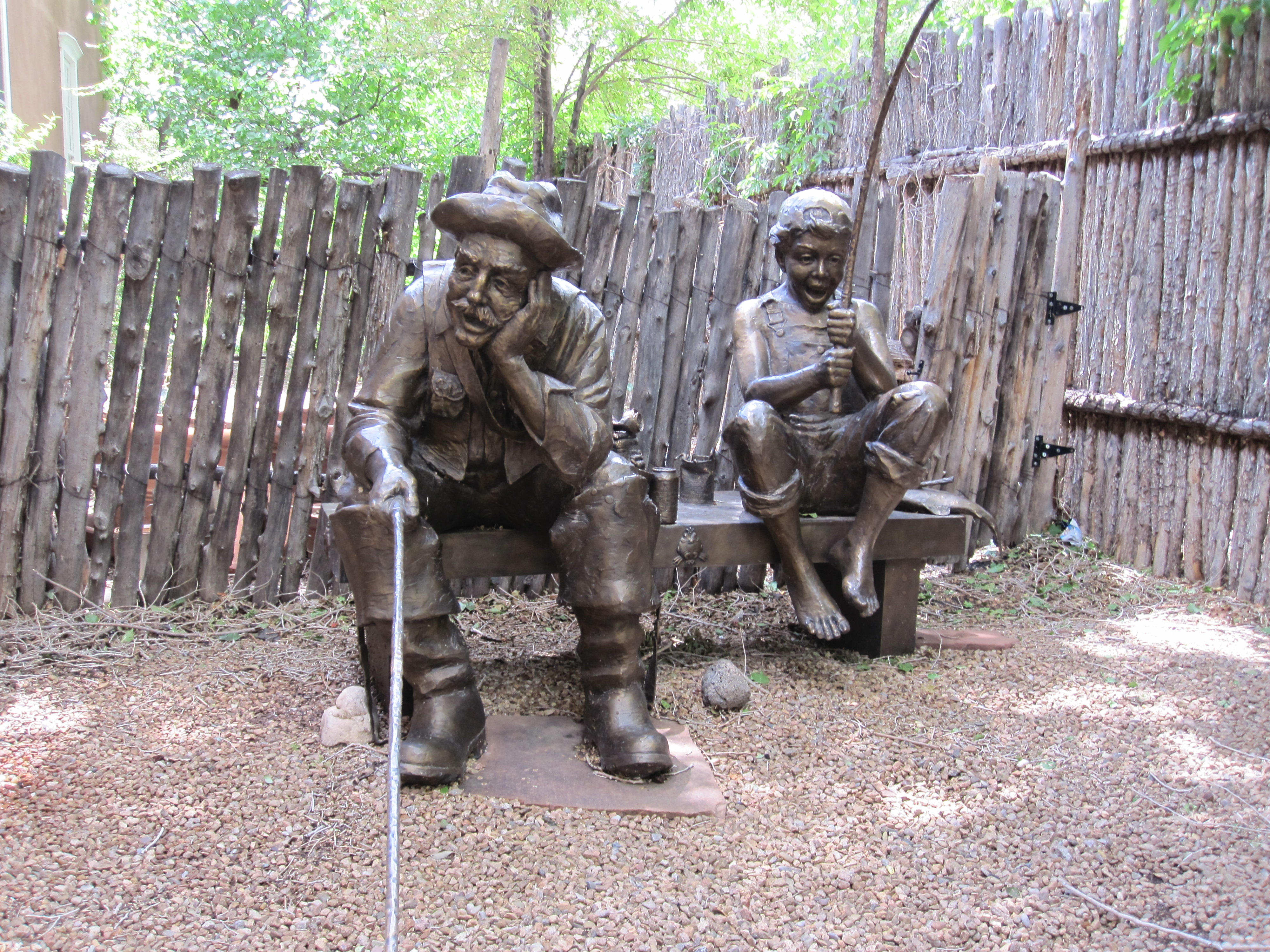
Sculpture of man and boy fishing in Santa Fe

Getting There Is Half the Fun: An Adventure Deep in the Ozarks

One of the more interesting responsibilities of my current job is participating in an oral history project exploring the history and culture of the Ozarks, a physiographic region of the country located in portions of southern Missouri, northern Arkansas, and small portions of eastern Kansas and Oklahoma. I have solicited interviews from several people so far including a retired NASA astronaut; a farmer who moonlights as a musician; a folklorist and musician; and most recently, a woman who is a visual artist, a writer, and a horticulturist growing ginseng in the hills of northwest Arkansas. Since this is a personal blog, I won’t reveal her identity but will call her Ms. Ozart for the sake of convenience.

Ms. Ozart had a career in environmental science, but she also pursued artistic endeavors from an early age. Now that she is no longer working away from home, she can focus most of her time and energy on what she loves most: growing native plants, gardening, painting, and writing. She was not raised in Arkansas but lives here now with her husband, a couple of horses, and a dog who at one time kept her chickens safe from predators. The dog is old, deaf, and retired. Ms. Ozart no longer has chickens.

It was her fascination with one specific plant that attracted Ms. Ozart to this part of the country. Ginseng is a perennial herb native to deciduous forests, especially in places like Appalachia and some parts of the Ozarks. It thrived in these locations and throughout many other areas of the country until it was grossly overharvested in the 1970s, mainly because of the purported medicinal benefits of the root. It is now considered an endangered species. The demand for the plant’s root has been high in China for centuries, and plants from the U.S. are still routinely shipped there. Ms. Ozart isn’t interested in harvesting the roots or selling them. It takes anywhere from 10 to 15 years for the root to develop to a marketable size. She is much more interested in propagating the plant and selling the seeds so other people can do the same.

At her invitation, I had the distinct pleasure of interviewing Ms. Ozart at her beautiful property. Because ginseng is rather valuable, and poaching is a constant threat, she prefers to keep her exact location as private as possible. Respectfully, I have included no photographs of the area with this post. In our preliminary correspondence, Ms. Ozart asked me if I would prefer to meet her in the nearby town and have her drive me to her home. She told me if I had a nice car, I probably wouldn’t want to go far beyond the town. Images of being blindfolded in the trunk of a large sedan came to mind. She warned me that my phone’s GPS app may have trouble finding the address, especially if I happened to exit the program in route from the nearby town. Cell service doesn’t exist this deep in the Ozarks – no bars . . . nada. I am fortunate to have a Ford F-150 pickup, so I decided to take my chances and trust my phone to get me there.

I have spent most of my life in rural areas. The last town where we lived in the northeast Georgia mountains was in a county with several small towns and a total population of just over 40,000. It was a booming metropolis compared to where Ms. Ozart resides. The “little town” several miles north of her location where she offered to meet me consisted of a tiny square that was like an appendage off the side of the two-lane state road. There were about six buildings housing such enterprises as a bank, a café, a feed store, and an art gallery where some of Ms. Ozart’s work is on exhibit and for sale. I continued farther out into the countryside until my riding companion, Siri, instructed me to turn left onto a dirt and stone road – not gravel, large stones. Sometimes, the rocks were semi-submerged boulders. The shocks on my truck will no doubt need to be replaced soon.

Ms. Ozart had warned me that it would take about 15 minutes or more to travel from the paved road to the base of her driveway where she would meet me. When I looked at the map and discovered the distance was only a few miles, I thought she was exaggerating. She wasn’t. Had I attempted to ramp up my speed to over 20 mph, my truck and I would have been launched airborne into either a tree or flowing water, both of which were in abundance on either side of the wide path that was given the designation of the county name followed by a four-digit number. The transportation department didn’t even bother with naming it for a prominent family that had carved out a living here generations ago, which is a common practice for farm roads in Georgia. I crossed over the same river twice and a few tributaries on surprisingly sturdy concrete bridges that were more like large culverts. I was expecting rickety wooden structures, which of course would never be able to support farm equipment and heavy trucks that undoubtedly traverse this byway every day.

I was traveling through a rather mountainous terrain compared to much of the Ozarks, with high ridges rising from rolling valleys fully furnished with fence lines, crumbling rock walls from long-abandoned structures, small creeks and branches, clusters of trees and shrubs, rock outcroppings, and grazing cows — lots of cows. I am convinced the livestock in northwest Arkansas have social security numbers. Even in December with the predominant hardwood trees undressed for the approaching winter, it was like an opening scene from the Daniel Boone television program from the late 1960s. Aside from the occasional power lines, the countryside probably looks much as it did in frontier days.

Notwithstanding the absence of cell service, most of the folks living along this county road are not really off the grid. They have electricity, running water, propane gas, satellite television, perhaps even slow and spotty satellite Internet service, and other amenities that people enjoy in the most remote parts of the country. Although Ms. Ozart has dreams of someday being a true homesteader, she freely admits that most of her provisions these days come from Walmart and the occasional delivery truck whose drivers risk life and limb to reach her door.

When I arrived at the base of her driveway — the cross section of a creek, a road intersection, and a pasture gate — Ms. Ozart was waiting for me in her small, well-seasoned red pickup truck. “You might want to ride the rest of the way with me,” she said. “Your truck probably doesn’t have four-wheel drive, does it?” And here I was, thinking the wagon trail that had gotten me this far was hazardous. I transferred my recording equipment to her truck, and we headed up the ridge on a rutted, winding trail just wide enough for one vehicle.

We stopped after about 100 yards to look at one of the locations where ginseng is growing on a raised plateau just across the creek from the “driveway.” The plants are dormant this time of year, and the leaves are gone, but she wanted to show me the spot just the same. She gingerly scampered across several rocks to reach the other side, warning me to secure my footing on the slippery surfaces as I followed. I could just imagine conducting the interview in blue jeans soaked in icy creek water. Luck was on my side. I remained high and dry.

We safely made it back to her truck and continued our trek toward her house located about a half mile up the hill. We were no longer crossing creeks and branches. We were going through them. She was describing the habitat for ginseng and its companion plants while showing me the more interesting features of her property, including lovely cascading waterfalls and massive rock outcroppings in tall ravines. At one point she stopped the truck to point out another hillside where she had discovered ginseng growing wild. I admit it was difficult for me to concentrate as I was keenly aware that she had parked the truck directly in the middle of a flowing creek. I kept waiting for the sensation of sinking and drifting as we sat there, but after she finished her story, she simply engaged the four-wheel drive and slowly maneuvered forward out of the water. I was thankful for her truck. I was more thankful I wasn’t driving.

We arrived at Ms. Ozart’s house and set up at her kitchen table for the interview. The room was comfortably warm with the help of a gas space heater. She had chili bubbling in a slow cooker that filled the house with a mouthwatering aroma. She put on a pot of coffee, graciously served me a cup, and sat across the table from me and my video camera for a 45-minute conversation that was fascinating and entertaining. She pulled out of her refrigerator seedlings of ginseng and other native herbs she overwinters packed in moss in plastic storage bags. She demonstrated how she makes pigments for paint by grinding rocks from the local creeks into powders of various hues and textures and mixing them with oil, honey, and other suspending agents.  She talked about how the Ozarks region is an inspiration for her writing and her visual art. She and her husband have built a rich life in this isolated slice of wilderness, which I find quite remarkable and admirable.

After we finished and I packed my equipment in her pickup, she drove me back to my truck. “Do you really get supplies delivered to you out here?” I asked as we bumped our way down the hill. “Oh sure,” she said. “Lowes delivered my washer and dryer too.” Admittedly, I was a bit surprised by this news, given how narrow and rugged her driveway is. When we reached a sharp curve where the creek widens next to the road, she pointed toward the stream and said, “I came down early one morning and found a FedEx truck tilted sideways and halfway in the creek right there. The driver had made a delivery to my house the night before, and lost control going back down on this turn. He showed up later that morning with a wrecker. It took the better part of the day for them to get his truck out of the creek, but they did it.”

When we reached my truck, I thanked her for her hospitality and told her how grateful I was that she drove the last leg up to her house. She chuckled a bit and said, “I thought that would work best.” I watched her from my rearview mirror retrieve the mail from her mailbox at the driveway entrance and then climb back in her truck to head home again. Somehow the rocky road leading back to the state highway didn’t seem quite as treacherous this time. The cows appeared just as disinterested as they had earlier. I recognized a few landmarks that I had remembered to look for on the way back to make sure that I wasn’t lost. I allowed myself to look around and soak up the pastoral vistas along the way, but I slowed down considerably and took great care crossing the bridges.

My Introduction to Los Angeles

A professional conference this year gave me an occasion to visit Los Angeles for the first time. Although I have been to California twice, I never traveled farther south than Big Sur. I arrived in L.A. two days before my conference began to take in a bit of sightseeing. Like Las Vegas and New York, Los Angeles is an iconic city that is closely tied to the uninhibited side of America, where everything is out of the cage and off the pavement. It attracts huge money, which is shamelessly exhibited in fast cars, flashy clothes, ostentatious jewelry, and mansions that could easily command their own zip codes. Usually we associate the “La-La Land” factor of the city with some of the more affluent sections and suburbs: Beverly Hills, Malibu, Santa Monica, Burbank, Hidden Hills, and Bel Air. However, there is more to Los Angeles than glitter and gold.
The afternoon I arrived, I rented a car and made the short drive down to Huntington Beach, the place where Duke Kahanamoku popularized surfing in the 1920s and graced the town with the title “Surf City.” The wind was especially strong while I was there, so walking out to the end of the long pier to circle Ruby’s Surf City Diner was rather brutal. The reward was witnessing first-hand the largest waves I have ever seen — much higher than those on the Florida coast to which I am accustomed. My visit was capped off perfectly with a few cocktails at the Barefoot Bar of Duke’s Huntington Beach Restaurant while I watched the Pacific sun set, a spectacle that never gets old.

Sunset at Huntington Beach


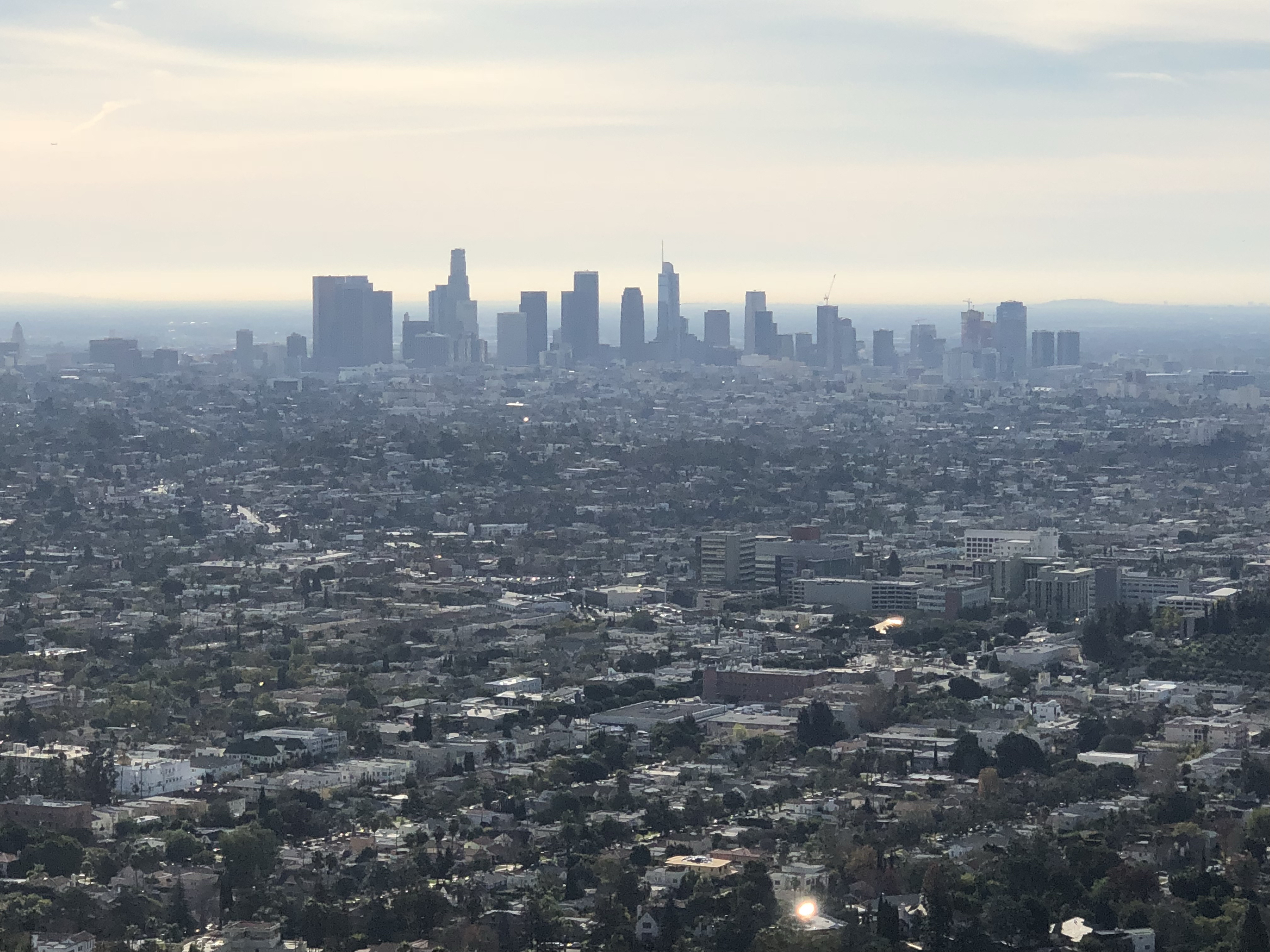
View of L.A. from Griffith Observatory

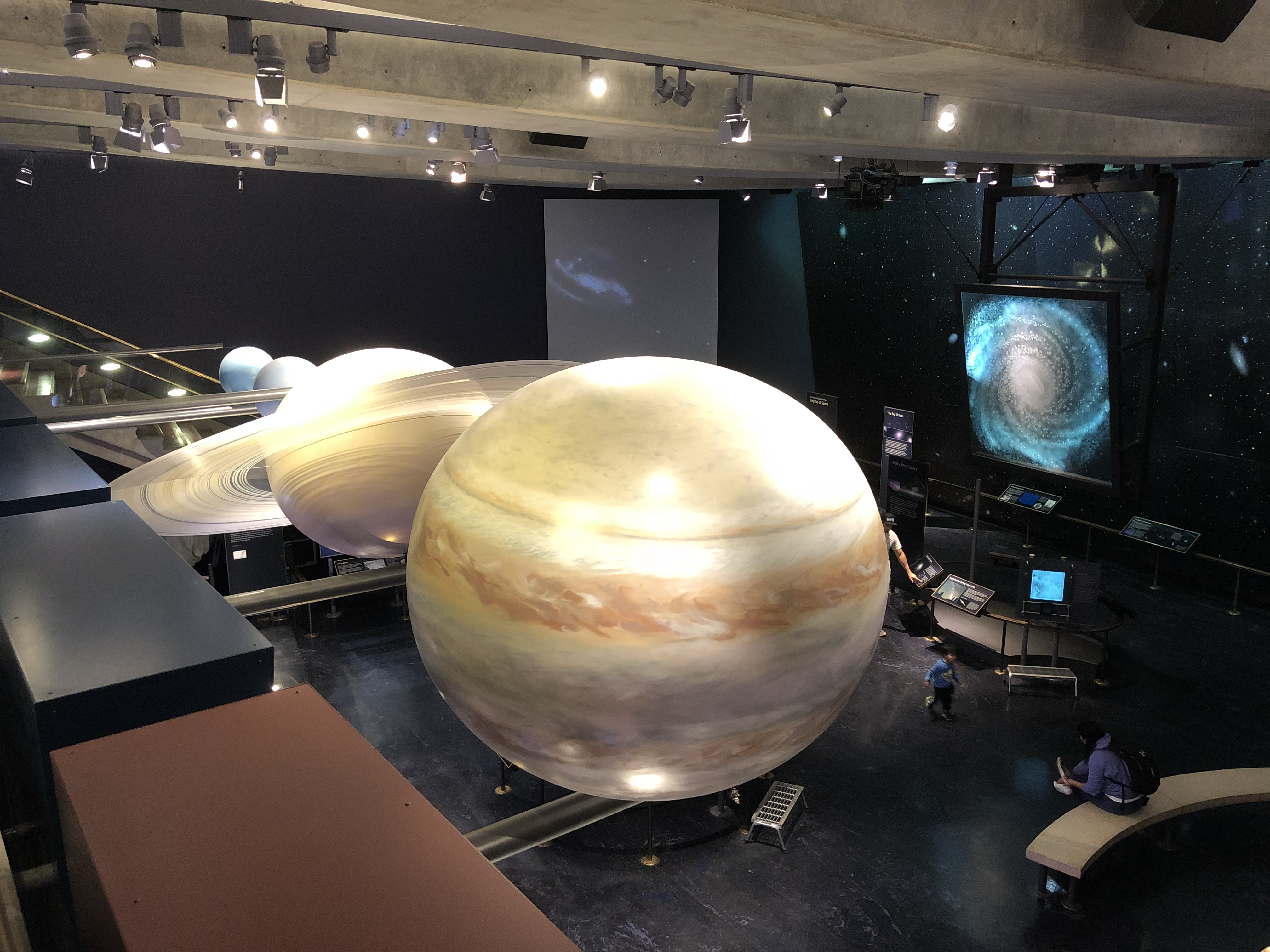
Early the next morning, I drove to the hills just north of Los Angeles to check out the Griffith Observatory. Whenever I travel, I am always in search of vantage points that will offer jaw-dropping vistas, which led me to this location. I was not disappointed. In addition to a close-up view of the famous “HOLLYWOOD” sign, the hill-top site provides near-360-degree scenery featuring the nearby green hillsides, the surrounding neighborhoods, and the skyline of the city in the distance. What I didn’t expect was how much I would enjoy the Observatory itself, which serves as a museum of astronomy. From the Fresco painted ceiling above the Foucault Pendulum at the entrance to the wonderful exhibits featuring the sun, other stars, the moon, and planets, the Griffith Observatory is a must-do for anyone who appreciates the mysteries of space. I was particularly impressed to see that a theater in the Observatory is named after the late Leonard Nimoy, the talented actor who portrayed Mr. Spock from the Star Trek television series and movies. He and his wife, actress Susan Bay-Nimoy, made a generous gift for the expansion and renovation of the Observatory. I always liked Nimoy as an actor and an artist, but learning about his philanthropy made me admire him even more.
Solar system exhibit in the Griffith Observatory

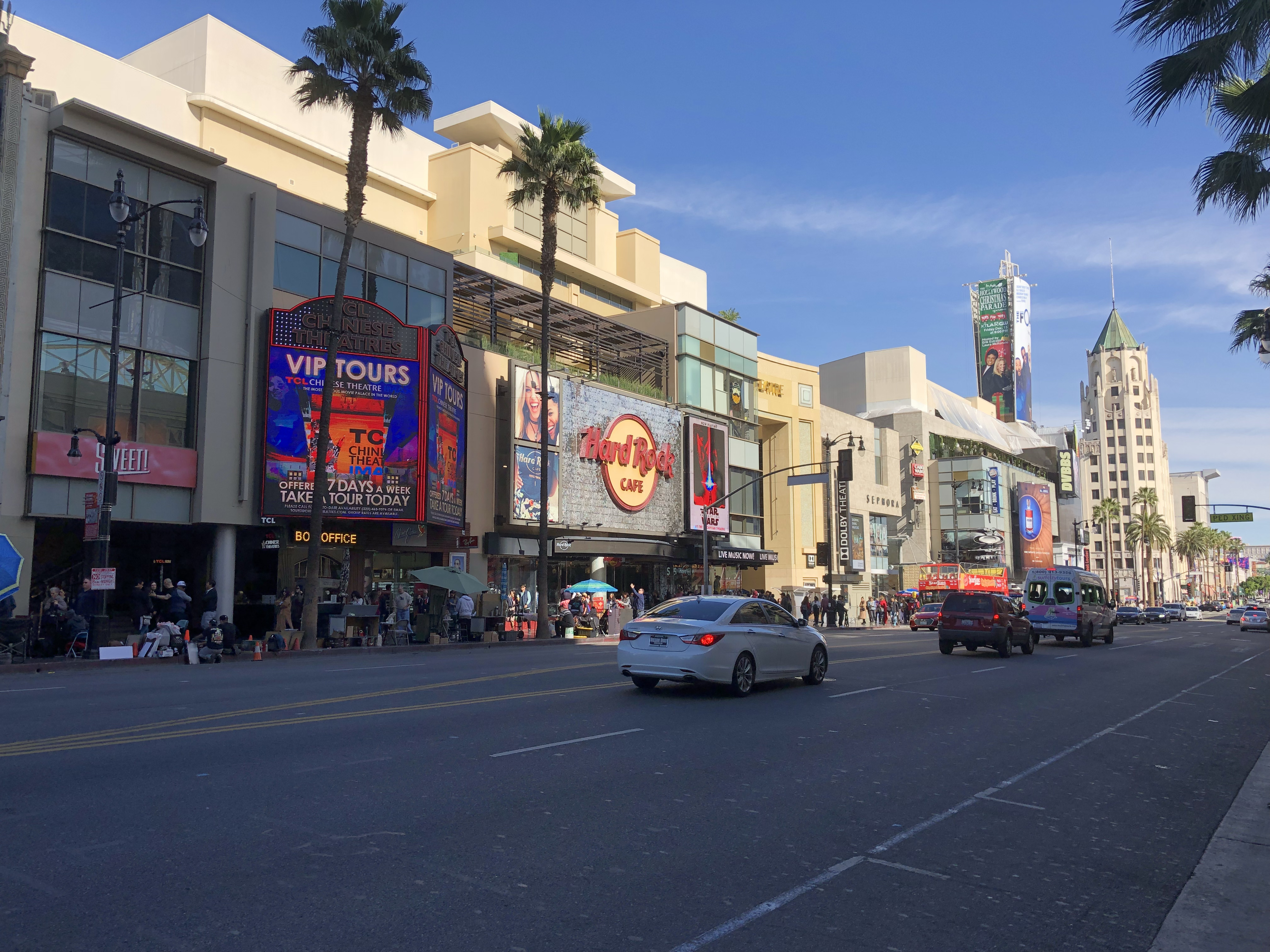
My next stop was the place that most vividly puts the tinsel in this town. Still recognized by many as the shrine of the entertainment industry, Hollywood covers three and a half square miles of prime commercial real estate in central L.A. Strolling down Hollywood Boulevard is an experience that can be recreated nowhere else in the country. The star-studded Walk of Fame stretches for fifteen blocks and is likely the most dangerous sidewalk in California because most people are looking at the ground the whole time they’re strolling along. Tourists also have near collisions with each other in front of the famous Chinese Theatre, where legends of film and television have literally left their mark with hand and footprints in the large cement blocks in the forecourt. Hollywood & Highland Center is a busy multi-story shopping complex that includes the Dolby Theatre, home of the Academy Awards. Of course, there are plenty of retailers, restaurants, specialty shops, and tourism stands up and down the street. Most impressive to me were the historic facades of the classic old theaters along both sides of the Boulevard — El Capitan, Egyptian, Pantages, and Pacific — they recall the golden age of film from the early to mid-20th century. It is easy to imagine what a glamorous time it must have been. Yes, Hollywood Boulevard would have to be classified as a tourist trap, but how can you visit L.A. for the first time and skip this legendary feature of the city?

Hollywood Boulevard
Hollywood Boulevard

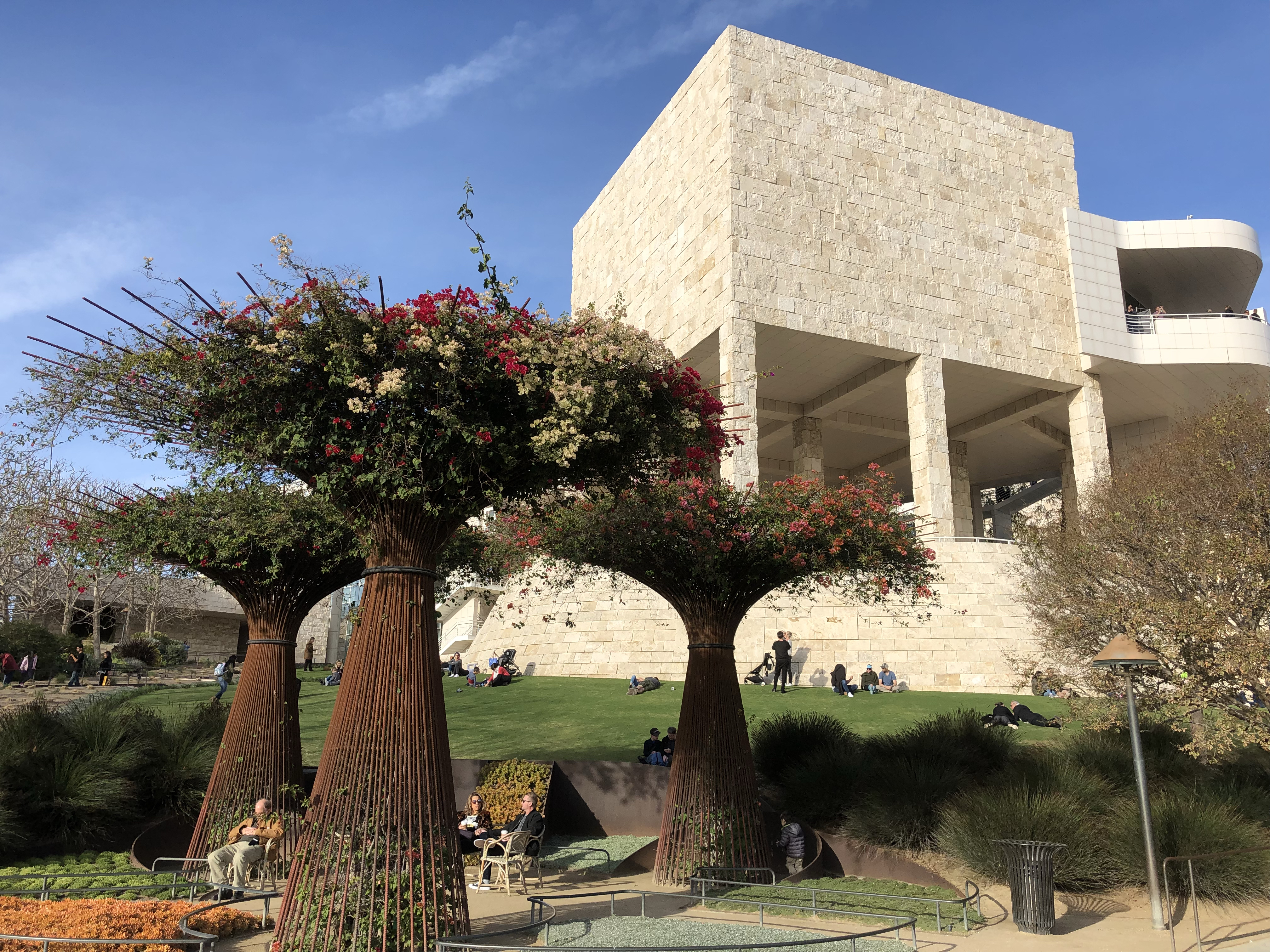
Bougainvillea arbors at the Getty Center

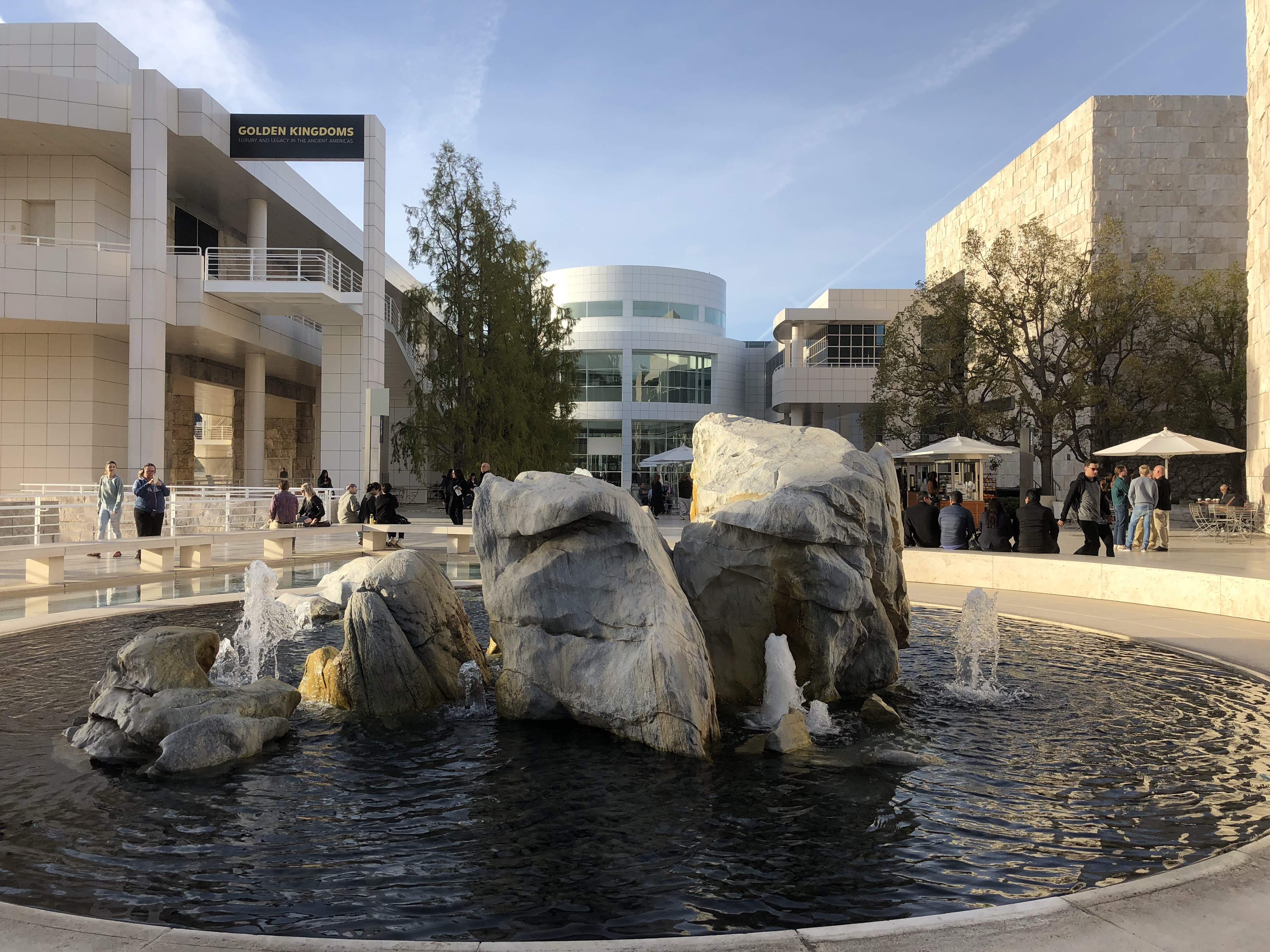
My last stop of the day was the Getty Center of the J. Paul Getty Museum. Situated on a 24-acre hill-top campus, the Getty Center is a remarkable combination of art, architecture, and nature overlooking greater metropolitan Los Angeles and Santa Monica Bay. The views of the city and the ocean from the various porticoes, terraces, and gardens are unbelievable. The collection, changing exhibitions, and outdoor art on view at the Getty Center reach across European and American history—from medieval times to the present. I was particularly delighted by the central garden, which boasts more than 500 species. The 134,000-square-foot design features a natural ravine and tree-lined walkway. A stream that winds through a variety of plants gradually descends to a plaza where bougainvillea arbors explode into bloom. I rushed through several of the galleries in the complex of buildings but was only able to get a taste of this astonishing cultural wonder. I hope to return to the Getty again someday to enjoy much more of what it has to offer, and when I do, I am sure there will be plenty of other treasures to explore in “The town of Our Lady of the Angels of Porciúncula” — The City of Angels.

Museum Courtyard at the Getty Center

The Garden at Musée Rodin

Visitors to Paris will often want to include in their itinerary a side trip to the Palace of Versailles, which is about a thirty-minute train ride from the city.  The round trip isn’t so time-consuming, but actually seeing the palace and grounds takes a minimum of half a day, even more if one truly explores the garden, which is 800 hectares (over 1,900 acres) in size. Unfortunately, some travelers are on a tight schedule and hardly have enough time to see the major attractions in Paris, much less places outside the city.  There is no substitute for seeing the Palace of Versailles, which is quite magnificent and offers a visual representation of the wealth and power of the monarchy in the 17th and 18th centuries. The garden is certainly spectacular and difficult to match; however, if there is a substitute in Paris that can serve as a rival, albeit on a smaller scale, the garden at the Musée Rodin must be near the top of the list.

Rodin gardens from mansion balconey
Rodin gardens from mansion balcony

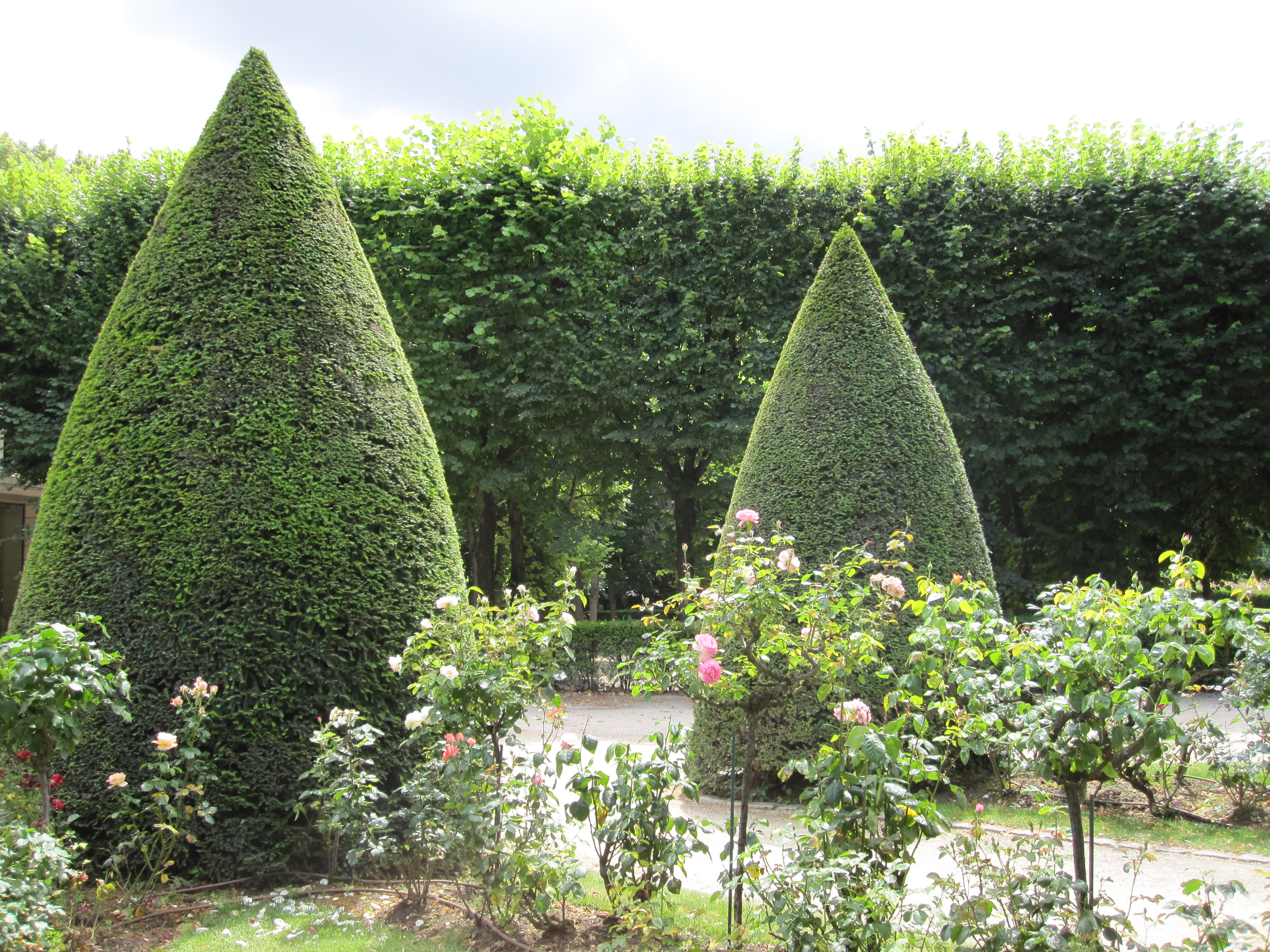
The Musée Rodin is housed in a mansion, formerly called the Hôtel Peyrenc de Moras, now known as the Hôtel Biron. Auguste Rodin was a 19th-century French sculptor who is known for creating several iconic works, including “The Age of Bronze,” “The Thinker,” “The Kiss,” and “The Burghers of Calais.” The collection in the restored mansion is interesting for the novice and probably a treasure for artists and art historians, but almost everyone can appreciate the beauty of the garden.  Its size is minuscule compared to Versailles, but it is still impressive. The grounds are divided into a rose garden, north of the mansion, and a large ornamental garden, to the south, while a terrace and hornbeam hedge backing onto a trellis conceal a relaxation area, at the bottom of the garden. Two thematic walks are also part of the garden: the “Garden of Orpheus,” on the east side, and the “Garden of Springs”on the west side.

Rodin garden roses and shrubs

In addition to the abundance of plants, the garden is also decorated with some of Rodin’s sculpture.  Rodin started to place selected works in the garden in 1908, together with some of the antiques from his personal collection. Male and female torsos, copies made in the Roman or modern period, after Greek works, were presented in these natural surroundings. Other pieces were added after his death. The first bronzes were erected in the gardens before World War I. Since 1993, they have been regularly cleaned and treated so as to preserve their original patinas.

Rodin mansion 3

Anyone who has visited Paris knows the frustration of wanting to see more, to do more, than limited time will allow. Tourists have to be selective, discriminating, and reasonable about what they will be able to cover during the time they are in the city. Any attraction that offers more than one type of experience is probably worth including. The Musée Rodin fits that description with historic architecture and provocative sculpture but also a landscape that is in itself a work of art, offering the visitor an opportunity to rest and reflect.

Art and Social Change

Do artists have a social responsibility?  That was the question posed for discussion to participants in lunch breakout sessions at the recent Symposium on Arts and Social Change sponsored by the Lillian E. Smith Center of  Piedmont College, a small private liberal arts college in Demorest, Georgia.  The Symposium, titled “Between Dream and Reality,” focused on public art as an inspiration for social change and was held at the college’s second campus in Athens, a town dominated by the presence of the University of Georgia.  Each breakout session had no more than a dozen people, so the conversations were manageable but lively.

Jen Delos Reyes
Jen Delos Reyes

The Symposium featured keynote speaker Jen Delos Reyes, Associate Director of the School of Art and Art History at the University of Illinois Chicago. Reyes is a creative laborer, educator, writer, and radical community arts organizer. Her practice is as much about working with institutions as it is about creating and supporting sustainable artist-led culture. She is the director and founder of Open Engagement, an international annual conference on socially-engaged art that has been active since 2007 and hosted conferences in two countries at locations including the Queens Museum in New York.  In her early-morning presentation, she highlighted three artists who are also community activists, people who have used creative approaches to address serious challenges in their neighborhoods with projects such as restoring row houses to safe, habitable homes that had become drug-infested death traps.

Other featured speakers at the Symposium included Ellen Elmes, a retired college art instructor who has painted twenty-five plus murals in several different states that celebrate community. Another presenter was Hope Hilton, an Athens-based artist, educator, designer, and writer who works with communities and students of all ages to inspire and facilitate a sense of place, history, and agency.  Broderick Flanigan is a freelance artist in Athens who is a community activist and the founder of Flanigan’s Portrait Studios.  The event was moderated by Barbara Brown Taylor, the Butman Professor of Religion at Piedmont College and author of thirteen books, including the New York Times bestsellers Learning to Walk in the Dark and An Altar in the World.  All of the presenters at this Symposium are devoting significant time and energy in their capacity as artists to promote, encourage, and facilitate positive social change.

Symposium logo
Symposium logo

Throughout her career as a writer and humanitarian, Lillian Smith examined how the arts engage people around issues of social injustice, segregation, and isolation.  Art was her passion, and she held a deep conviction that the artist has a responsibility to engage her audience in the conflicts and struggles of her generation, an opinion not necessarily shared by the students of The New Criticism movement, the literary theory that dominated the mid-20th century.  Smith emerged in the 1940s at the forefront of the Southern debate on segregation, where she was at least a decade ahead of other white liberals and stood virtually alone in calling for an immediate end to segregation laws and practices.

During the tumultuous years of the mid-20th century, when lynching, convict labor, and Jim Crow laws were still casting dark shadows across the South and African-Americans all over the country were pleading for justice and equality, there were plenty of elected officials and prominent leaders who were endorsing a patient, moderate approach in addressing the crisis.  Lillian Smith was not one of them. In a speech prepared for the Institute on Non-Violence and Social Change on the first anniversary of the Montgomery bus boycott in 1956, Lillian Smith wrote these words:  “You have done many good things, down here in Montgomery.  But one of the best, one of the most valuable, has been the fact that you have dramatized, for all America to see, that in times of ordeal, in times of crisis, only the extremist can meet the challenge.  The question in crisis or ordeal is not: Are you going to be an extremist?  The question is: What kind of extremist are you going to be?”

In a powerful essay titled “The Creative Process” written in 1962, James Baldwin made the following observation:

There are, forever, swamps to be drained, cities to be created, mines to be exploited, children to be fed. None of these things can be done alone. But the conquest of the physical world is not man’s only duty. He is also enjoined to conquer the great wilderness of himself. The precise role of the artist, then, is to illuminate that darkness, blaze roads through that vast forest, so that we will not, in all our doing, lose sight of its purpose, which is, after all, to make the world a more human dwelling place.

There can be little doubt that, through her novels and nonfiction works, Lillian Smith was indeed trying “to make the world a more human dwelling place.”  Does art exist in a vacuum?  Should the artist seek to be completely separated from society, unattached and oblivious to the pressing social issues of the day?  The answers to those questions can be debated over and over again with no real resolution.  What is clear, however, is that art has the mysterious power to transform minds and emotions, to spark imagination, to inspire collaboration, and to motivate people to act.  Once the work is done and that power is unleashed, the artist has very little control over the ultimate impact of what she has created.  Perhaps recognizing that indisputable truth is where the responsibility of the artist begins.

“To find the point where hypothesis and fact meet; the delicate equilibrium between dream and reality; the place where fantasy and earthly things are metamorphosed into a work of art . . . this is what man’s journey is about, I think.” –Lillian Smith, The Journey