

My Best Books of 2024

Book shelves
Book shelves

Admittedly, I let this month slip up on me and am rushing to get a post in today before December and 2024 are gone for good. So, here is a list of my favorite books from the past year. Who knows, this year-end review may become a tradition, not as a substitute for a monthly post but perhaps as an addition.

The Nickel Boys by Colson Whitehead

Based on an actual reform “school” for juvenile boys in Florida during the Jim Crow era, Whitehead’s prize-winning novel is a heartbreaking, maddening story told by one of the most talented young American writers. It is not just a story about racial discrimination and inequality, but both loom large in the plot. The backstory of the protagonist, Elwood Curtis, is touching and sets the stage for the tragic turn of events that leads to his incarceration. With emotional integrity that never even gets close to being sentimental, the author takes the reader on a horrifying tour of the school’s campus: dormitories, cafeteria, utility facilities, and the one building where unbearable acts of cruelty occur. I get the sense that Whitehead may have conflicting feelings about the passivity of early civil rights leaders, most especially Martin Luther King, Jr., who is heroic and inspirational to Elwood, especially as a young boy. I like this book much better than Whitehead’s other blockbuster hit, The Underground Railroad, which was a fine book but allegorical and thus not as engaging for me as this powerful story.

Dear Regina: Flannery O’Connor’s Letters from Iowa edited by Monica Carol Miller

I worked for almost two years as a consultant, hired by the literary estate of Flannery O’Connor, to create an inventory of the archive of her manuscripts, letters, photos, journals, and other personal effects. During the course of that project, I read each of the letters included in this collection, and it was a real treat to go back and read them again. The relationship between Flannery and her mother is complex, unusual, and in so many ways fascinating, especially considering the number of stories the author wrote where the main characters are a mother and a child.

Among the most interesting developments we find in these letters is how, in a matter of only two years, Flannery becomes much more independent and driven. In the beginning, the young graduate student seems to be nervous about being so far away from home and family for the first time in her life. As time goes by and Flannery is introduced to established writers and publishers who admire her work as a student at Iowa, she becomes more confident in her abilities, which results in a more bold attitude toward Regina. She is willing to rebuke her mother if she senses that Regina is overstepping her bounds or commenting inappropriately about matters she doesn’t understand.

On the darker side, readers can’t help seeing O’Connor’s deeply ingrained racism, her sense of moral superiority, her callous reaction to the suffering of others, and sometimes a general misanthropic nature. Some would argue that she simply resisted the social conventions of her time, especially expectations of young “ladies.” I think it’s more than that. I think she felt terribly awkward in most social situations and preferred to limit human interaction with only a few people. This personality trait may have helped her in the end as a writer and even on a more personal level when her lupus diagnosis forced her to live the last third of her life with her mother in the rural Deep South of middle Georgia.

Miller provides some commentary in her introduction to the book and at the beginning of the phases of Flannery’s tenure at Iowa. I think the book could have been stronger with a deeper analysis of the correspondence, but perhaps the literary estate placed restrictions on the editor. Given the executor’s reputation for such tight control on what has been published in the past, this is a valid speculation. Nevertheless, the estate did permit the letters to be published, which means they are now widely available to readers and scholars of O’Connor’s work. That’s a good thing.

Eve: How the Female Body Drove 200 Million Years of Evolution by Cat Bohannon

What a valuable book that almost serves as an updated edition of Natalie Angier’s classic study titled Woman: An Intimate Geography. Bohannon comes out swinging from the first page, observing how medical science has committed egregious errors and arrived at faulty conclusions because it has considered the needs of males and females to be the same when it comes to developing pharmaceuticals and treatments. The differences between the sexes go far beyond their genitals and mammary glands. The author explains why the most common use of male subjects only (human or other animals) for medical research is terribly shortsighted, sometimes resulting in catastrophic and even deadly consequences. And that’s just the first chapter!

Building on the complexities of the female body (while also giving plenty of attention to the difference between sex and gender along the way), Bohannon traces millions of years of evolution to draw some startling and perhaps controversial conclusions about human origins, female anatomy, reproduction, childbirth and child rearing, language, sociological patterns, human achievement, and so much more. The chapter on breastfeeding alone is worth the price of the book — good heavens, I learned so much! 

She makes solid arguments for why some of the great discoveries and advances in early human development may be attributed to women as opposed to men, who have historically taken the credit. Her practice of demonstrating the similarities and intersections of female characteristics across species in the animal kingdom – from orcas to mice, from ducks to our primate cousins — helps to reinforce the evolutionary evidence she produces to explain why women are specifically equipped for all the roles they fill as an equal half of homo sapiens.

I highly recommend it to just about everyone. Women will benefit from knowing more about what makes them tick and how they became the marvelous wonders they are. Men NEED to read it to better appreciate all the women in their lives, beginning with the ones that brought them to life and gave them a fighting chance to survive.

Shakespeare and Company by Sylvia Beach

What a delicious book! I have known about the importance of Sylvia Beach’s little American bookstore in Paris for a while but was not aware that she wrote such a wonderful memoir about her experiences as the owner and storekeeper of Shakespeare and Company. Her membership-supported enterprise was so much more than just a bookshop. It served as a refuge and haven for some of the most gifted expatriates and writers of the early 20th century, including Ernest Hemingway, F. Scott and Zelda Fitzgerald, Ezra Pound, T. S. Eliot, and most especially James Joyce. I had no idea that she was the first publisher of Joyce’s monumental novel, Ulysses. She really was a remarkable human being, one who made great sacrifices to support an amazing and historical intellectual community. She even risked her own life during the Nazi occupation of Paris by refusing to compromise her standards or cater to the monstrous regime that swept across Europe before and during World War II.

Grandma Gatewood’s Walk: The Inspiring Story of the Woman Who Saved the Appalachian Trail by Ben Montgomery

For anyone who needs a story of inspiration, endurance, and good old fashion intestinal fortitude, look no further than Ben Montgomery’s well written account of Emma Gatewood’s adventures on the Appalachian Trail and her other treks across the country on foot. It is estimated that this grandmother and great-grandmother ended up walking more than 14,000 miles, the distance of half the globe, all after she turned 67 years old. Included in these pedestrian journeys were two thru-hikes on the Appalachian Trail and a third time in sections, back in the late 1950s when the trail was not so popular or populated by hikers. Oh, and she also walked the Oregon Trail, literally, from Independence, Missouri to Portland, Oregon. She was in her seventies when she completed that one. Anybody want to complain about being tired now? Ever again?

Grandma Gatewood overcame terrible conditions on the Appalachian Trail, from rattlesnake encounters to raging storms, from extreme temperatures to blown out shoes (she wore only sneakers!), from fallen trees to flooded creeks, and injuries to her feet, ankles, and knees that would have spelled defeat for most men half her age attempting what she succeeded in doing several times. Her amazing stamina was born out of tragic circumstances: years of mental, emotional, and physical abuse from a monster of a husband.

Walking in the forest in solitude gave Emma Gatewood great joy and satisfaction, although she struggled to remain alone in her quest many times as her story spread during the months she was on the trails. She became a celebrity, and her time walking was interrupted more and more by journalists, photographers, and curious onlookers. For the most part she remained humble and patient, although she did lose her temper a few times with the rudest of the bunch. And then she felt remorse and asked them to forgive her! What an example she set for just about everyone on how to pursue dreams, overcome adversity, and live your best life.

If Beale Street Could Talk by James Baldwin

This is a powerful novel for several reasons, not the least of which is how it captures the sense of despair among African Americans over injustice from the legal system specifically and from the society at large. The narrative is impressive to me considering it is written by someone who lived his later life as a gay man but elected to employ a first-person voice of a young woman. The family dynamics and conflicts that drive the story are made more intense by Baldwin’s skill with descriptive language and dialogue. It’s all so believable. Along the way, he inserts little nuggets of gold that transform this book from a good to a great novel. Here is one fine example.

“Only a man can see in the face of a woman the girl she was. It is a secret which can be revealed only to a particular man, and, then, only at his insistence. But men have no secrets, except from women, and never grow up in the way that women do. It is very much harder, and it takes much longer, for a man to grow up, and he could never do it at all without women.”

The remainder of that paragraph is just as profound as this passage. There is a lot going on in this novel, including the tension that exists among the sexes and how love is exhibited and expressed in such diverse ways. If Beale Street could indeed talk, it would testify to the struggles of black America, as would the streets of Harlem, Birmingham, Montgomery, Atlanta, Detroit, and Tulsa, just to name a few. Baldwin was so familiar with such places, and he courageously explored every square foot of them.

Grace Saves All: The Necessity of Christian Universalism by David Artman

I have read other books on Christian Universalism, but this is the best so far. Artman is a minister who has struggled with the concept of hell and eternal damnation for most of his life, but in recent years he has found a spiritual path that changed his perspective on the Christian faith. He was able to do so with plenty of evidence from Biblical scripture and the guidance of some of the pioneers in the theological study of universal salvation or the idea that, in the end, God saves all humanity. No one is punished forever and ever in the lake of fire, gnashing their teeth, so forth and so on.

Artman explains early on in his book that Christian Universalism is nothing new and that many early Christians embraced this theological position and promoted it. Once he began to look at universalism closely, it just made sense in the context of a loving creator God. For Artman, “it is the only approach to Christian theology which can successfully defend the goodness of God; and therein lies its necessity.” In some ways, Artman and his readers come to universalism through the back door, as if it is the only option left. As he explains it: “Once someone fully grasps the concept that God knows the end from the beginning and is not controlled or regulated by any outside forces, the following realization strikes home – the outcome of all things will inevitably be what God intended from the beginning.”

Artman still believes in the free will of humanity. He just posits that ultimately God will win over even the strongest deniers, the faithless, the atheists, criminals, etc. Now, it may take a very long time to bring them back into the fold, but Artman’s God is more patient than Job, and will not stop pursuing the lost until they are found. The one issue I have with this concept is the admission by universalists that punishment is still very much a part of God’s plan, and God will use it if necessary to bring the wayward back to God, where they belong. The punishment is not forever and it isn’t revenge. It is just a tool God uses to achieve the goal. Artman believes “there is coming a time envisioned in which everyone will happily acknowledge the salvation of God which has come through Christ.” I’m not sure that punishment through torture is ever effective in producing true repentance, and certainly not a happy acknowledgement.

Artman remains close to his Christian faith with his belief that Jesus Christ is still the proper pathway to salvation. He doesn’t directly address how unfair it may be for people who live outside the boundaries of Christian tradition to find and board the Jesus bus headed to heaven. This is a book of Christian Universalism, and therefore, very Jesus centered, which may prove frustrating to those outside that faith tradition. To his credit, Artman recognizes there is scriptural evidence that contradicts some of his findings and conclusions. “Since all theologies end up facing passages of Scripture which are hard to deal with, the question is not if these passages will be dealt with, but how. All theological approaches must face this dilemma. No theology gets a free pass.” He reconciles scriptural contradictions wearing “Jesus-colored glasses,” taking comfort in the fact that Jesus ate with criminals and refused to throw stones at adulterers, so he cannot imagine that God doesn’t possess the same compassion and forgiveness.

In the end, Artman looks at the spirit of the Bible and the life of Jesus to reach a rational theory of how God operates, and universal salvation is the only outcome that makes sense. For those who would question his rationale, he replies: “Making an overall interpretation of the Bible is a difficult thing to do. There is no single biblical approach that doesn’t run into scriptural problems. And so, we must finally ask which biblical approach aligns most closely with the goodness of God, the character of Jesus, and the overall narrative arc of the Bible. On the whole I believe the Inclusive approach offers the best solution.” Good answer, Dr. Artman. Good answer.

Flannery at the Grammys by Irwin H. Streight

Professor Streight has written a very fine and thoroughly researched study of Flannery O’Connor’s impact and influence on songwriters in the pop music genre. I have long been interested in this topic, and I frequently made mention of those connections to visitors at Andalusia, O’Connor’s farm home in Milledgeville, Georgia, during my 13-year tenure as the director there. I still remember vividly sitting in a rocking chair on the front porch at Andalusia the day singer/songwriters Jim White and Mary Gauthier made their field recording of “Fruit of the Vine,” which Streight mentions in this book. They both exhibited such a sense of reverence during their visit.

O’Connor’s body of work is a Comstock Lode for songwriters, composers, playwrights, screenplay writers, and visual artists, which I consider a testament to her genius and durability as a writer. Streight focuses most of his attention on the more familiar and acclaimed rock and folk artists/groups who have paid homage to O’Connor in their work, such as Bruce Springsteen, R.E.M., U2, Lucinda Williams, Mary Gauthier, and Kate Campbell. But he digs even deeper to discuss songwriters in the alternative genres of metal, punk, and a few other less definable types.

Streight pushes toward the exhaustive in his study as he devotes a chapter to how often O’Connor’s themes and language show up in song lyrics, even though there may be no direct correlation between the author and the lyricist. He admits to the stretch in these cases, but the observations are interesting, and the connections are certainly worth acknowledging. The “Bonus Track” chapter on stage names from O’Connor’s novel, Wise Blood, and her characters is fascinating although probably not a strong connection to the author in most cases. All in all, Streight’s book should be of great interest to anyone interested in how pop culture reflects and reacts to serious fiction. This is a valuable contribution to O’Connor scholarship.

Chuck Berry, for Better or Worse

Chuck Berry statue in the Delmar Loop in St. Louis, MO

In the spirit of giving credit where credit is due, no one deserves the title “The Father of Rock-n-Roll” more than Chuck Berry. So many of the legends of the genre revered him and covered his hits, including The Beatles and The Rolling Stones. Keith Richards said if rock-n-roll had a name, it would have to be Chuck Berry. Even that white boy from Tupelo, referred so often to as the “King” of rock-n-roll, covered Berry’s tunes.

Chuck Berry’s life is not really a rags-to-riches story as he was born into a middle-class family in St. Louis where he lived his whole life. Growing up just beyond the eastern boundary of the Ozarks region, Berry was heavily influenced by rock-a-billy and country music, elements of which would end up in many of his greatest hits. Of course, Berry also grew up during the era of Jim Crow in a part of the country that had a dark past with race relations. Sadly, according to R. J. Smith in his brutally honest biography (Chuck Berry: An American Life, Hachette Books, 2022), Berry apparently carried his response of anger, resentment, and frustration to extremes at times, taking opportunities to insult and humiliate people, even those who adored him, and telling them, “Now you know how it feels to be black.”

Smith does a good job of balancing the artistry, intelligence, talent, and even the charm of Berry with the ugly side of his personality. Some of the stories about Berry make me think that he may have had some kind of serious psychological illness, like bipolar disorder. To say he was a womanizer would be to let him off the hook. He demonstrated signs of being what many folks in the post-MeToo era would define as a sexual predator and even a pedophile. At the very least, it is fair to say he had strong sexual appetites that wandered into the realm of the taboo and even aberrant.

His sexual deviance, along with his violent tendencies and his resistance to authority, including the IRS and government in general, got him into legal trouble on several occasions. He was sentenced to jail time more than once. One could argue that he shared this path with many of the outlaw country stars like Johnny Cash, Merle Haggard, Willie Nelson, and many others. Some rap and hip-hop performers who were no doubt influenced by Berry on some level would also be plagued with legal problems and prison terms.

No matter how bad the news was for Berry, he was still highly respected by the biggest names in the music business, including Bruce Springsteen. He was an early cross-over musician, infiltrating white homes with his unique style of playing and singing long before black performers were even allowed to eat in many restaurants or stay in hotels when they were on tour. He was beloved by millions of fans all over the world, even when he continued to attempt to perform in his 80s as dementia began to claim his mind and memory. His impact on 20th century music and beyond cannot be overemphasized, complete with his flaws and his brilliance.

Mal de Débarquement Syndrome – Update

In November, 2019, I posted about a malady that I have dealt with for twenty years called Mal de Debarquement Syndrome or MDDS. When I first recognized the symptoms, there wasn’t much information widely available about MDDS. There was plenty of published research about travel sickness, post-travel imbalance, jet lag, dizziness, vertigo, and migraines, but it failed to address the specific facets of this strange phenomenon. It wasn’t until 2015 that I even discovered there was a name for it.

In 2021, I experienced my first spontaneous episode of MDDS, meaning that it was not precipitated by air or sea travel. Instead of lasting a couple of weeks like all my other previous bouts, this time it went on for four months. My primary care physician suggested a diuretic, but I wasn’t convinced that an excess of salt and water in my body was the real problem. I scheduled a videonystagmography (VNG) test but wasn’t able to get in until after my symptoms began to subside. The test was negative. Another spontaneous episode occurred in mid-April of 2023 and lasted off and on through mid-July. My next step is to get a referral to a neurologist, and now I have a book to prepare me for my appointment with such a physician.

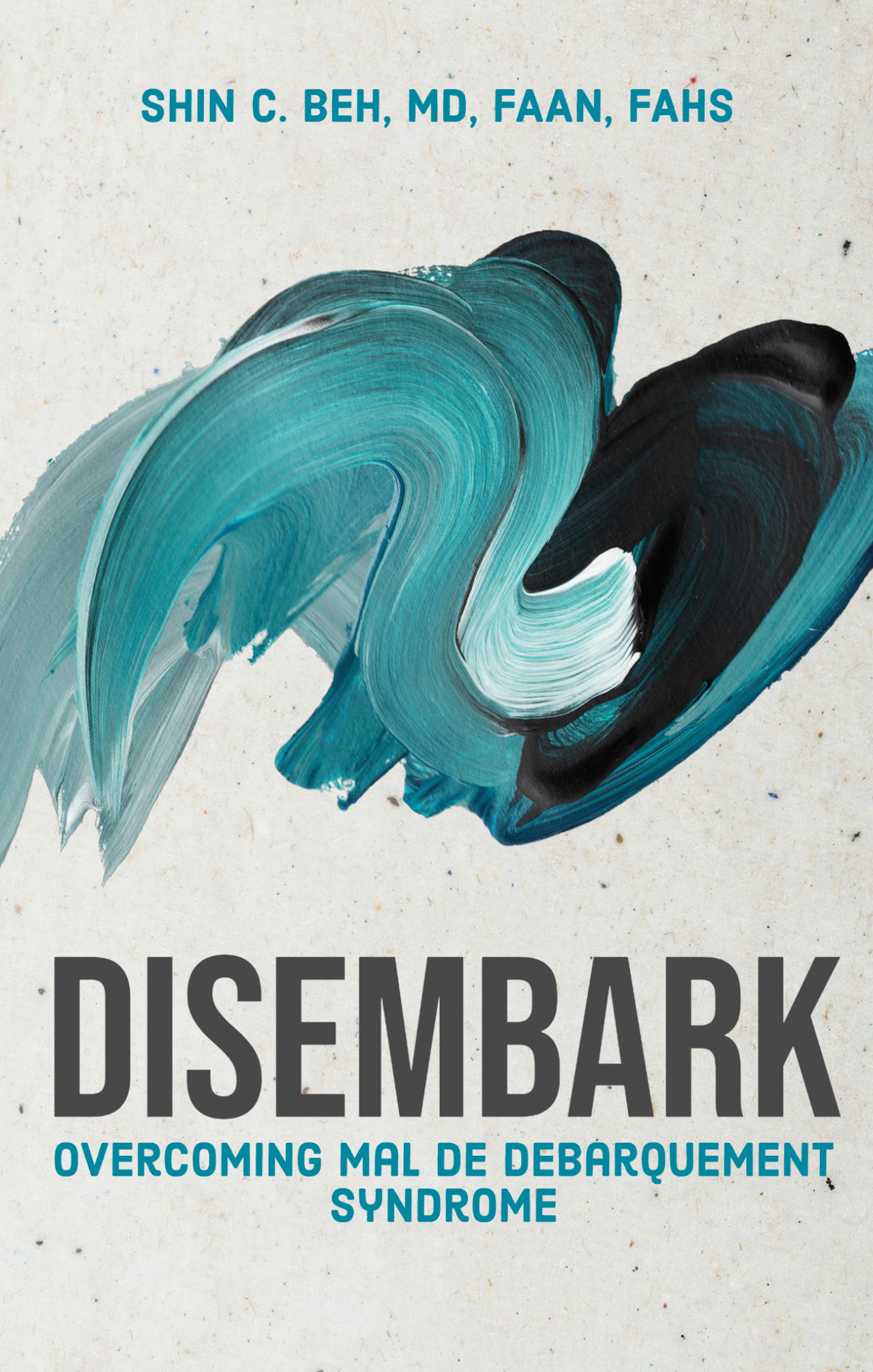
One of the leading specialists in studying and treating MDDS is Shin C. Beh, M.D., who practices out of his own facility, the Beh Center, in Frisco, Texas. Dr. Beh wrote a book that came out in early 2023 titled Disembark: Overcoming Mal de Debarquement Syndrome. I was lucky enough to discover it because someone posted an announcement of it on a social media MDDS support group page. This is a self published book, probably even a print-on-demand title, but future editions should be picked up by a major press because it really is well written and so informative.

Disembark by Shin C. Beh

Dr. Beh covers just about every aspect of MDDS that I can imagine, given how the research into this syndrome is young and evolving rapidly. He covers the symptoms and diagnosis of MDDS, along with several hypotheses of the underlying causes. I’m sure in the coming years the author will revise this information, and other authors likely will cover new ground as the research expands. The bulk of this book covers the various approaches to treatment that he and other practitioners have developed to help sufferers of MDDS deal with their symptoms. He makes it clear there is no cure, but he offers treatments ranging from natural remedies to an array of chemicals, most of which are formulated to treat other vestibular disorders, depression, anxiety, seizures, and migraines.

Vestibular migraines are actually Dr. Beh’s speciality, so he arrives at the study of MDDS through that gateway. His first book was about vestibular migraines. There are some obvious similarities between the two maladies, so the treatments overlap too. In addition to medications, he also suggests lifestyle pathways to diminish symptoms, including what to avoid and how to actively fight the symptoms through diet, exercise, sleep patterns, prayer/meditation, work habits, and environment control.

I made copious notes in the margins of my copy and intend to keep it as the first, I hope, in a collection of reference guides to MDDS. I also sent an email in gratitude for the book and the supporting research to the Beh Center. I received an answer thanking me for my message within a few hours, which was impressive. Again, there is no cure for MDDS, but this book goes a long way toward helping sufferers deal with this debilitating syndrome and giving hope to those who must live with it.

Introducing the Ozarks: An Annotated Bibliography

In late 2018, my wife and I moved from Georgia to Springfield, a town of about 170,000 people in southwest Missouri. It’s a great location for us because we have family and close friends in Georgia, Kansas, Texas, and Arizona. We really enjoy traveling, especially to the desert southwest, but we like the Florida beaches and places like New York City, Chicago, and Nashville. Living in Springfield strategically positions us near the center of the country and makes it easier to get to family, friends, and fun destinations. The icing on the cake is the small national airport that is a mere twenty minutes from our house, which is serviced by three major airlines and a few budget carriers.

Southern Missouri and northern Arkansas make up the bulk of the region known as the Ozarks. It as an area of the country defined by a variety of factors, from geology and topography to culture and customs. It is also quite beautiful. It is rich in natural resources, especially water, minerals, and forests. It is a complicated region in almost every category imaginable. Although it boasts no major cities, it does have some bustling urban centers. There are some wealthy people in the Ozarks, but there are far more families living in serious poverty. On the political spectrum, it is largely conservative with pockets of progressivism mostly in and around the cities.

Admittedly, I knew very little about the Ozarks. I had never set foot in Missouri and only visited once just a few months before we moved here. To get “learned up” about our new home, I did what I always do when encountering something new and unfamiliar. I started reading. The following is an annotated list of books I have read about the Ozarks over the last three years or so. My bibliography is in no way intended to be comprehensive or even representative; however, these books have given me greater insight into the history, culture, and people of the Ozarks. All of these titles are nonfiction, but I have also read fiction by Ozarks writers or stories set in the region. Perhaps sometime I will write a post reviewing those books as well.

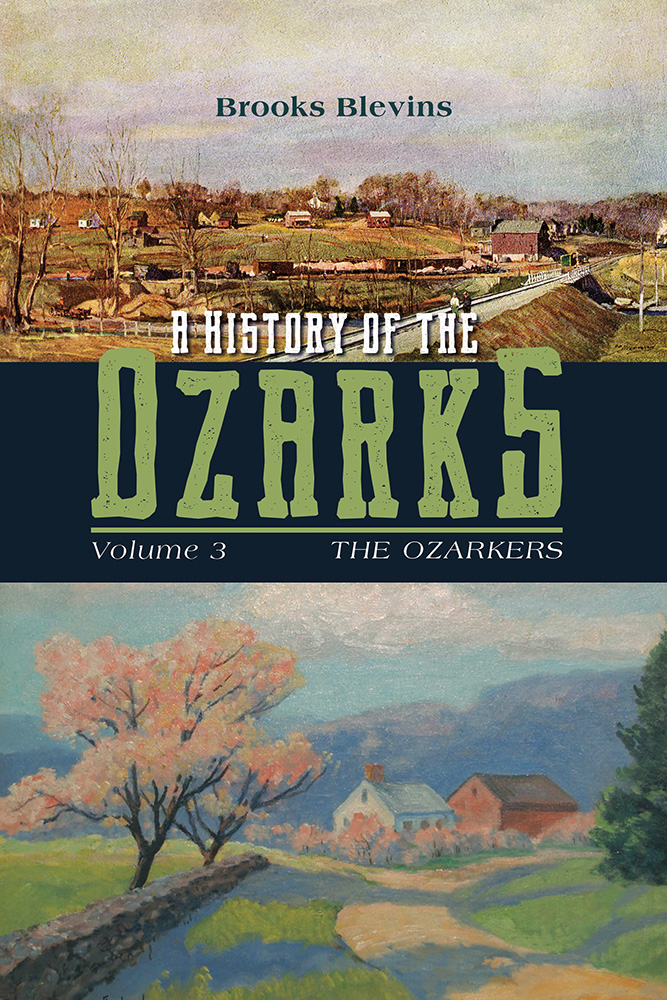
A History of the Ozarks, Volume 3 by Brooks Blevins

A History of the Ozarks, Volume 3: The Ozarkers by Brooks Blevins
Brooks Blevins is the uncontested authority on the history of the Ozarks. He is a professor at Missouri State University in Springfield, where I am also employed. But his full-time residence is in northern Arkansas, so he has his feet planted in the two main states of the Ozarks. He is a fine writer, a serious scholar, a respected teacher, and an all-round nice fellow. I have only read this 3rd volume of his trilogy, but I intend to at least go back and read the 1st volume covering the early history of the region.

Blevins is at his best when he is dispelling many of the misconceptions and over-generalizations of the Ozarks as a place full of backwoods hillbillies with no connection to the modern world. He also does a great job of pointing out the most attractive features of the region without romanticizing or falling into the trap of exceptionalism, which is always tempting to do if you are so identified with a place, which I believe he is.

The chapters on “Ozarks Society” and “Putting on a Show,” along with his “Conclusion,” were the most interesting to me because they highlight how much the Ozarks have changed over the last 150 years and are continuing to evolve. I’m not sure I agree with Blevins that the specific location of the Ozarks, a topic of serious debate for generations, is best defined by where the Ozarkers live; however, there seems to be a strong sense of place appreciated by so many people who live here, quite similar to sentiments held by many people in the Deep South about their region. This is a solid historical overview of a complex and fascinating part of the country in the modern period.

Living Waters: The Springs of Missouri by Loring Bullard
This book is well documented and researched. The photographs of the springs and streams they feed are stunningly beautiful. The layout of the book makes it easy and enjoyable to read. However, aside from the technical aspects of the book, Bullard clearly has a passion for his subject that is both personal and professional, which is demonstrated in the text of every page.

The organization of the book is especially fine, with chapters focusing on features and functions of springs rather than on individual locations. Bullard incorporates a considerable amount of history to offer context and appreciation of how past generations have understood and valued springs in the state and have taken advantage of them as valuable natural resources. Of course, the environmental message throughout is of paramount importance — we must take good care of our state’s springs because of the vital role they play in providing clean water for the ecosystems they feed.

White Man’s Heaven: The Lynching and Expulsion of Blacks in the Southern Ozarks, 1894-1909 by Kimberly Harper
Harper presents a thoroughly researched and well documented scholarly study that helps explain why the southwestern Ozarks is such a white region of the country. Lynching occurred in many places across the South, and obviously, into the Midwest. Many white people who had lived during the time of slavery, whether they actually owned slaves or not, resented the new autonomy of black people in their communities during Restoration. Over the decades, resentment evolved into a fear. “While blacks may not have been true economic, social, or even political competitors in the region, whites viewed blacks as a threat to their wives, daughters, and police officers.” Obviously, much of the fear centered on the perceived sexual predation of black men. “It was believed that women were not safe in the country or the city, so long as African American men roamed free.”

However, Harper goes beyond the acts of horrible white mob violence to explore why African Americans were driven out of communities, often at the same time lynching took place. Similar action was taken in other parts of the country — Forsyth County in north central Georgia comes to mind. Other areas of north Georgia, especially in the Appalachian foothills, still have small black populations to this day.

In the Ozarks and in the north Georgia mountains, the economy in the early 20th century was primarily subsistence farming, which did not require much labor outside the extended family of the farmer. As Harper observes, “This was in contrast to the black-majority regions of the South, where inexpensive and readily available black labor composed a significant segment of the local economy, making African Americans indispensable to local white employers.” One could easily make the same argument in recent decades for why white farmers have not been so anxious to deport undocumented Latinos from regions of the South where industrial agriculture is dominant and depends on vast numbers of inexpensive laborers.

This is a fine addition to American history and African American studies. Harper’s book joins more recent work on lynching by prominent African American scholars. Highly recommended.

Hipbillies: Deep Revolution in the Arkansas Ozarks by Jared M. Phillips
I had the opportunity to hear the author speak on a panel with two people who were involved in the Back To Land movement in the Arkansas Ozarks at a conference in West Plains, Missouri, in September, 2019. The people who decided beginning back in the 1970s to trade in urban dwelling for a rural, subsistence lifestyle among the hills and “hollers” of the Ozarks are often referred to as Hipbillies — a hybrid of hippies and hillbillies.

Phillips does a good job of placing this movement in the context of 20th century back-to-the-land and counter-culture philosophy characterized by the works of people like Wendell Berry and Gary Snyder. He gives proper credit to the successes of the Hipbillies while also recognizing their failures and some of their less-than-pure intentions. He credits them for fighting for environmental health, sustainable agricultural practices, and social justice issues. One of their greatest accomplishments was succeeding in modest changes to how the US Forest Service approached the management of timber.

Phillips admires how the Hipbillies, especially the pioneers from the early 1970s, faced overwhelming odds and even life-threatening circumstances yet still persevered to make it as homesteaders in a part of the country where the land is not so forgiving. He dispels some of the myths about how native Ozarkers rejected the Hipbillies. Instead, they often embraced them and even saved their lives during harsh winters and unpredictable farming seasons. There were clashes in places like Eureka Springs, but that was more a conflict between counter-culturists and town leadership.

The Hipbillies had big dreams when they landed in the Ozarks. “What was sought, then, was a rehabilitation of American culture — one that began in the dirt and grew over time like the forest that slowly reclaims and heals a ruined field,” Phillips writes. He contends that the Hipbillies took themselves seriously as revolutionaries. They “came to the Ozarks seeking refuge and a place in which they might build a new world for themselves, and hopefully, all of humanity . . . . While they did not always succeed, the story is not over — they are still alive and are still powerful cultural, political, and economic forces in the Arkansas highlands.”

Hillbilly Hellraisers: Federal Power and Populist Defiance in the Ozarks by J. Blake Perkins
The myths and stereotypes about the Ozarks are deeply ingrained in our consciousness, but they never have painted a true picture of the people and their culture, desires, needs, problems, etc. Perkins’s book reinforces one essential truth about Ozarks people: they tend be proud and fiercely independent, even in the face of long-term adversity.

There is a strong tradition of tension between individual rural families and individuals and/or institutions in authority. Poverty has always been a dark shadow hanging over the Ozarks, even when other parts of the country were climbing out of it. Although many people here petitioned for government assistance in the past, there is a history in this region of distrust of government programs, which ended up being administered and exploited by local and state officials. Law enforcement was fine as long as it didn’t try to stop individuals from scraping out a living, even through illegal means. More than anything, native Ozarkers have always just wanted to be left alone. When their autonomy was threatened, especially by outside forces, they sometime became violent.

Ozarks Hillbilly by Tom Koob and Curtis Copeland
Koob and Copeland do a good job here of presenting the stereotypes of the Hillbilly as the term has been used in literature and other art forms to describe many of the rural folk in the Ozarks. The authors argue that, contrary to the traditional image of a lazy, shiftless, ignorant, depraved character, the Ozarks Hillbilly is quite industrious, shrewd, and highly skilled. Hillbillies are survivalists and generations of them have struggled to provide for themselves and their families in a harsh and unforgiving environment.

I found it odd in a book about the Ozarks how much time the authors spent on discussing Appalachian Hillbillies. They seem to have keen interest in the way Hillbillies were presented in Deliverance, the novel by James Dickey and the popular film adaptation starring Burt Reynolds and Ned Beatty. There are definitely similarities between the two regions of the country, which have been explored by numerous scholars. The stereotypes of the rural residents of both areas also share commonalities. Perhaps a comparison/contrast book would have been even more helpful and intriguing. 

Where Misfits Fit: Counterculture and Influence in the Ozarks by Thomas Michael Kersen
For Kersen, the town of Eureka Springs, Arkansas, serves as an archetype for his thesis of how counterculture distinguishes the Ozarks and is among its more charming and sustaining features. As he states it, “The magic of Eureka Springs is that the town is a mass of contradictions and microconflicts that breed [sic] creativity.” No wonder that the book’s title is also the semi-official motto of the town: Where Misfits Fit.

Kersen does a good job of weaving the eccentricities of the people who occupy the Ozarks into the history of the region. He first offers his identification of the region, defining it by geography and culture. He then proceeds to outline its countercultural characteristics through popular myths, artistic expression, supernatural fixations, cult activity, musical influence and inspiration, and the back-to-the-land movements primarily of the 1970s (the author’s parents brought him to the Ozarks from Texas as part of this larger movement).

A thread running throughout the book is Kersen’s use of the adjective “liminal” to describe the Ozarks – a place that is difficult to box in and that continually crosses lines. He writes that “the Ozarks defies boundaries of all sorts — it is a work in progress.” Here again, the contradictions of the area come into play. For instance UFO enthusiasts that have been drawn here for decades rely on scientific knowledge about astronomy and space exploration but scorn scientists who fail to validate their paranormal claims. Kersen recognizes that “eccentric places attract eccentric people — people willing to live and think in the margins.” He also believes the Ozarks “offers something unique for its inhabitants and even American culture at large.”

I found some of the most valuable information in the Conclusions chapter, especially about the impact of in-migration into the Ozarks from countries around the world. The author wonders how Ozark identity will change as the racial and ethnic profile of the region continues to change. The book has extensive end notes, an impressive bibliography for further reading and study, and a decent index. Just a few points of criticism: the book could have benefited from skillful editing. There are too many typo kind of errors for an academic press book. Also, I suspect this book is a collection of separately-written essays because there is considerable repetition of information in the chapters. Otherwise, it is a fine book that is both accessible and informative.

Lake of the Ozarks: My Surreal Summers in a Vanishing America by Bill Geist
I was drawn to this book primarily because I visited the Lake of the Ozarks just a few months after settling here. I didn’t know anything about Bill Geist as I never watch Sunday Morning on CBS. I may have read his columns before but am not aware if I have. I can relate to many of the references Geist makes to growing up in the 1960s and 70s, although he is a bit older than I am. Some readers will no doubt be put off by the political incorrectness of the author’s perspectives, language, and the circumstances from his adolescence, but I suspect he is being perfectly honest and straightforward with his recollections and descriptions of his life and times working for his uncle and aunt at their lakeside lodge. There are some really laugh-out-loud passages in this book, which made it an enjoyable read.

Footprints in the Ozarks: A Memoir by Ellen Gray Massey
This is a pleasant read. It isn’t challenging; the text is straightforward; it doesn’t reveal anything new about the Ozarks region; it gets a bit sentimental in places; and it is so bucolic that the reader can almost smell the cow manure on the farm where Massey lived and raised her family. She also worked as a high school English teacher, and apparently quite a good one. She supervised her students over a ten-year period as they produced a quarterly journal titled Bittersweet. The value of this book lies in Massey’s descriptions of the social mores of her community, the relationships of family and friends, the tragedies her family faced (including the death of her husband), and how life in the rural Ozarks was fulfilling and rewarding to her, as it has been for so many others for many generations.

Coming Clean About Robert E. Lee, the Civil War, and the Deep South

Ty Seidule has written a book that immediately and unequivocally transforms him into a turncoat in the eyes of many southerners. Robert E. Lee and Me: A Southerner’s Reckoning with the Myth of the Lost Cause (St. Martin’s Press, 2021) is not the first book to challenge Confederacy sympathizers, but it offers a unique perspective from an author who has made the journey from apologist to critic and is completely forthright about a subject that is still extremely sensitive for so many Americans.

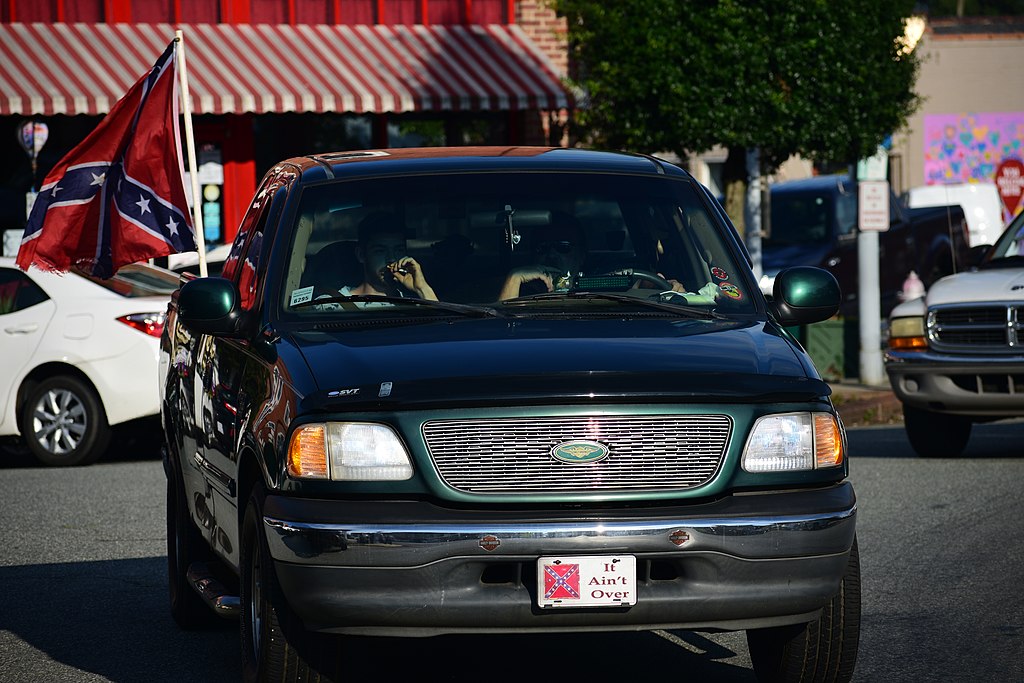
I am about the same age as the author, and I was raised in Georgia, the state where he spent many of his formative years. I know the landscape. I understand the vocabulary. I am keenly aware of how a horrible war that the rebellious Confederacy lost over 150 years ago left wounds that in many circles have yet to heal. I have seen the battle flag of that failed insurrection flying in the bed of pickup trucks, hung in windows of trailers and houses, proudly displayed on government property, and waved through the halls of the U.S. Capitol by modern-day insurrectionists. I have seen the long, dark shadow cast by the iconic and mythical leader of those Confederate forces – a man who is still revered and memorialized all over the South with language usually reserved for Biblical characters described in Sunday School lessons and from pulpits.

Confederate Response to Juneteenth in Graham
Confederate Response to Juneteenth in Graham Anthony Crider, CC BY 2.0 , via Wikimedia Commons

It takes amazing courage for a southerner who is also a decorated officer of the U.S. Army and a retired history professor at West Point to openly and very publicly admit that Robert E. Lee committed treason and should be viewed as a traitor to his country. And that’s exactly what Ty Seidule has done. I applaud his bravery and the extensive research he has completed to make that claim. This is a damn fine book, not because it covers new ground or reveals any real hidden truths, but because someone in a position of authority and respect is making a form of confession that deserves serious consideration.

Seidule has heard every excuse in the book for why the Civil War wasn’t about slavery, for why the Confederacy didn’t really lose the war, and for why Robert E. Lee was such an honorable man. For the first twenty years of his life, he believed the excuses too. He probably doesn’t give quite enough credit to his wife for finally helping him escape the vortex of Confederate mythology. She forced him to question what it means to be a “Christian Southern Gentleman,” something he had aspired to from childhood through his graduation from Washington and Lee University, an institution that has been responsible more than any other place for perpetuating the cult of Robert E. Lee. His thoughts about what it means to be a Christian and a gentleman have drastically changed through the years, and his perception of the South is much clearer than it was when he was a young man.

Robert E Lee Memorial, Richmond, VA
Robert E Lee Memorial, Richmond, VA Hal Jespersen at en.wikipedia, Public domain, via Wikimedia Commons

This book should be required reading in just about every college and university in the South, and even in many other parts of the country where the Civil War is still romanticized beyond recognition for what it truly was: a rebellious uprising against the United States of America. Seidule spends a lot of time talking about the impact of the novel and movie “Gone with the Wind,” which is appropriate; however, I wish he had given some attention to the earlier movie, “Birth of a Nation,” especially in his discussions of the Ku Klux Klan. One of the most striking arguments he makes concerns the inaccurate terminology that has been used for generations to describe the Civil War, including the ridiculous names for the conflict itself, from “the recent unpleasantness” to “the war of northern aggression.”

Seidule also makes a convincing point about how using the term “Union” is an inappropriate way to describe the U.S. Armed Forces while they fought against the Confederacy, as if the Union were some entity separate from the United States. That distinction brings us back to the problem with Robert E. Lee, who abandoned his commission as an officer of the U.S. Army and chose to side with a rebellious confederacy of states – a domestic enemy against whom Lee had sworn to protect his country. In the end, Lee was more loyal to the State of Virginia and the other southern states than he was to the United States, and that makes him a traitor. And it’s about time southerners and the rest of the nation came to terms with that stinging but absolutely honest indictment.

Robert E. Lee and Me by Ty Seidule (book cover)

Recommended Reading List: African American History and Race Relations

From the silent protests of athletes like Colin Kaepernick to the massive ground swelling of the Black Lives Matter movement, examples of discontent and outrage are growing in reaction to systemic racial injustice in the United States. Understanding and facing these challenges requires historical context – how we got to this dark place – and analysis from scholars and journalists who follow the issues closely and are gifted with the ability to explain the problems and offer possible solutions. The following annotated bibliography is in no way intended to be exhaustive. It doesn’t even scratch the surface of the books that have been published in recent years on African American history and race relations. It is simply a list of books I can honestly recommend because I have read them and think they are representative of the topic.

Caste: The Origins of Our Discontents by Isabel Wilkerson

Although she is not the first person to write about America’s caste system, Wilkerson probably has better examples and research to support her conclusions than did previous writers on the subject, especially after the presidency of Donald Trump. She makes a compelling argument for why we need to dig much deeper than race and class to understand the complexities of white privilege, discrimination, injustice, prejudice, poverty, and a whole host of other societal ills in America.

She draws comparisons to the ancient caste system in India to explain how arbitrary lines are drawn between groups of people that are irrational, indefensible, and immoral. She illustrates the paradox of a country that was founded on liberty and justice for all that at the same time enslaved people for 250 years of its history and continued to enforce a segregated society, often with horrible acts of violence, long after slavery was abolished. The chapter describing how the Nazis in Germany used the rhetoric and Jim Crow policies of the United States to construct their own pogroms is chilling and painful.

One of the major strengths of this book is Wilkerson’s use of metaphors to describe how the caste system in America originated and continues to be perpetuated by the dominant caste: the power base mostly of European descent. She uses a neglected house as a symbol of how the caste system has slowly but effectively compromised the structure of American society, eating away at its foundation and crumbling its walls. The inevitable result will eventually be a pile of rubble if we continue to avoid the problem.

Stony the Road: Reconstruction, White Supremacy, and the Rise of Jim Crow by Henry Louis Gates, Jr.

What a fine book. Not only does Gates bring a mountain of research to the table, but he also offers insight and thoughtful commentary based on decades of reading, thinking, teaching, and writing about Reconstruction and the Redemption period in American history that encompasses almost 100 years following the formal end of slavery. This topic has been covered to some degree by several scholars in recent years, with Doug Blackmon being the first to come to mind. I think what sets this book apart is the examination and analysis of the concept of the New Negro as it was proposed and argued by the major figures of African American society in the late 19th century and moving through the period now referred to as the Harlem Renaissance: W. E. B. DuBois, Frederick Douglas, and Booker T. Washington.

Gates recently published a book titled The Black Church: This Is Our Story, This Is Our Song, which is a wonderful history of African American religious communities and a study of how churches served much more than just places of worship. I am currently reading the book and cannot review it properly yet, but I do highly recommend it.

White Man’s Heaven: The Lynching and Expulsion of Blacks in the Southern Ozarks, 1894-1909 by Kimberly Harper

Harper presents a thoroughly researched and well documented scholarly study that helps explain why the southwestern Ozarks is such a white region of the country. Lynching occurred in many places across the South, and obviously, into the Midwest. Many white people who had lived during the time of slavery, whether they actually owned slaves or not, resented the new autonomy of black people in their communities during Restoration. Over the decades, resentment evolved into a fear. Obviously, much of the paranoia centered on the perceived sexual predation of black men. “It was believed that women were not safe in the country or the city, so long as African American men roamed free.”

However, Harper goes beyond the acts of horrible white mob violence to explore why African Americans were driven out of communities, often at the same time lynching took place. Similar action was taken in other parts of the country — Forsyth County in north central Georgia comes to mind. Other areas of north Georgia, especially in the Appalachian foothills, still have small black populations to this day. This book is a fine addition to American history and African American studies.

White Too Long: The Legacy of White Supremacy in American Christianity by Robert P. Jones

Well, this was painful . . . and so relevant. Jones is armed with a searing spotlight that reveals how Christianity in America was nurtured and sustained by white supremacy throughout its history and is still embracing it today. With compelling data, careful research, and thoughtful commentary, Jones forces readers to confront how racial discrimination and social injustice are far more prevalent in all denominations of Christianity than most people are willing to admit, including clergy and elected officials.

One of the lightbulb moments for me in this book was the realization that people who do horrible things while also identifying as Christians, are indeed Christians by the way our society defines it. He uses the horrific case of Dylann Roof, the white supremacist who shot and killed nine African Americans during a Bible study session at the Emanuel AME Church in Charleston in 2015. This young man was an active member of his Lutheran church and frequently posted Bible verses and Christian doctrinal messages through social media and his personal documents. He justified his actions with his Christian beliefs. As Jones astutely observes, if Roof had killed white Christians and had been attending a mosque and posting verses from the Koran, how many white Americans would have denied that he was a Muslim? Roof is a Christian terrorist, and the justification for his violence is directly linked to white supremacy. And, he is not alone in that twisted mindset.

The Dead Are Arising: The Life of Malcolm X by Les Payne and Tamara Payne

I had a pre-conceived image of someone who was much more violent than Malcolm X actually was based on this book. I was intrigued with how the man born Malcolm Little evolved from being a petty criminal, often robbing even members of his own family, to become an intellectual force to be reckoned with by the U.S. government and even foreign powers. It may not be fair to say that a few years in prison turned his life around. It would even be a weak cliché; however, there is no doubt that some of the relationships he developed with older mentors he met while in prison had a tremendous impact on his self-awareness, his belief system, his intelligence, his understanding of racial inequality, and his vision for the future of African Americans.

It was also interesting to watch how he eventually abandoned his complete devotion to Elijah Muhammad as the head of the political organization, Nation of Islam, to pursue his own leadership role within the framework of Islam as a world religion. Leaving the NOI and speaking out against it precipitated his violent death. Before he died, Malcolm moved to the forefront in the fight for civil rights and was unapologetic about the means employed to overcome racial injustice. Malcolm X had no patience for pacifists who advocated a moderate approach. He wasn’t asking for justice — he demanded it.

Malcolm’s parents were heavily influenced by the separatist and sovereign ideas for people of color espoused by Marcus Garvey, which probably led Malcolm to make distinctions between segregation and separation. The former was imposed, but the latter was voluntary and desirable — a fascinating perspective. He wanted to see black people become completely independent of white influence, dominance, and charity. His disdain for white people (white devils, as he called them) waned toward the end of his life, but he never felt compelled to be conciliatory or to make excuses for racial discrimination and the privileged white society that perpetuated it. Nobody could ever mistake Malcolm X for a “team player,” and his vision for black people presented a stark contrast to that of Martin Luther King, Jr.

The New Jim Crow: Mass Incarceration in the Age of Colorblindness (Revised Edition) by Michelle Alexander

Alexander presents us with a comprehensive and disturbing study of how mass incarceration resulting from the “war on drugs” in America has disproportionately imprisoned people of color in comparison to whites. As a well-trained attorney, she presents a mountain of evidence to argue her case, using quotes and testimonies from a wide array of historical and contemporary figures along with hard data and heartbreaking stories. No segment of American society escapes her stinging indictment: blacks and whites; conservatives and liberals; rich, poor, and middle class; champions of the Civil Rights Movement; and modern political figures, all the way up to Barack Obama (the book was published in 2010). This is an important book that deserves serious consideration by decision makers at almost every level of government, and especially those who are in any way connected to the criminal justice system.

Locking Up Our Own: Crime and Punishment in Black America by James Forman, Jr.

To some degree, Forman’s book takes up where The New Jim Crow leaves off. Understanding mass incarceration of black people at the hands of a legal system that is dominated by white people is not too difficult, but the situation gets cloudy when it happens in cities across the country that are largely governed by black people. In Forman’s experience as a public defender, Washington D.C. is a model city for the disturbing phenomenon. Using personal accounts from his own case files and extensive research into the historical developments that bred the “war on drugs” and “war on crime,” Forman carefully examines why the arc of the moral universe is longer than Martin Luther King, Jr. may have imagined, and it doesn’t seem to be bending very much toward justice for people of color.

Critics will argue that, first and foremost, breaking the law is not justified simply because we don’t like the laws and that black people cannot expect a pass just because they find themselves in difficult circumstances that often leave them with few options other than criminal activity. They will likely argue that Forman is proving the point that race is not a factor at all, especially since black people are arrested and convicted by black officers and judges. However, Forman digs deeper than the surface appearances to uncover complicated and nuanced systemic issues that lead to discrimination and inequality on our streets, in our courts, and in our prisons.

I had the opportunity to sit next to Professor Forman at a luncheon when he was honored with a Lillian E. Smith Book Award in 2018 for his work. His own life story is fascinating; his methods of teaching law are innovative and inspiring; and his passion for justice is akin to a minister’s drive to lead his congregation. He even sounds slightly like a preacher when he talks about the topic of this book. Readers will have to judge if he presents a convincing argument, but I don’t believe anyone can doubt his conviction.

Just Mercy: A Story of Justice and Redemption by Bryan Stevenson

This is such a compelling story from the man who leads up the organization that most recently brought us the Legacy Museum and the National Memorial for Peace and Justice (the lynching memorial, as many are calling it) in Montgomery, Alabama. I was particularly drawn to Stevenson’s reflections near the end of the book in the chapter titled “Broken.” He observes how our society has legalized vengeful and cruel punishments, how we surrender to the harsh instinct to crush those among us who are most visibly injured by circumstances that are in many cases beyond their control. Stevenson explains that we are all broken, but we are not defined solely by the mistakes we have made.

“I am more than broken. In fact, there is a strength, a power even, in understanding brokenness, because embracing our brokenness creates a need and desire for mercy, and perhaps a corresponding need to show mercy. When you experience mercy, you learn things that are hard to learn otherwise. You see things you can’t otherwise see; you hear things you can’t otherwise hear. You begin to recognize the humanity that resides in each of us.”

Robert E. Lee and Me: A Southerner’s Reckoning with the Myth of the Lost Cause by Ty Seidule

Ty Seidule has written a book that immediately and unequivocally transformed him into a heretic in the eyes of many Americans, especially those in the South. It takes amazing courage for a southerner who is also a decorated officer of the U.S. Army and a retired history professor at West Point to openly and very publicly admit that Robert E. Lee committed treason and should be viewed as a traitor to his country. And that’s exactly what Ty Seidule has done. I applaud his bravery and the extensive research he has completed to make that claim. This is a damn fine book, not because it covers new ground or reveals any real hidden truths, but because it says what has needed to be heard and understood for a very long time by someone in a position of authority who deserves respect and serious consideration.

Seidule has heard every excuse in the book for why the Civil War wasn’t about slavery, for why the Confederacy didn’t really lose the war, and for why Robert E. Lee was such an honorable man. For the first 20+ years of his life, he believed the excuses too. He probably doesn’t give quite enough credit to his wife for finally helping him escape the vortex of Confederate mythology. She forced him to question what it means to be a “Christian Southern Gentleman,” something he had aspired to from childhood through his graduation from Washington and Lee University, an institution that has been responsible more than any other place for perpetuating the cult of Robert E. Lee. His definitions of Christianity and gentleman have drastically changed through the years, and his perception of the South is much clearer than it was when he was a young man.

This book should be required reading in just about every college and university in the South, and even in many other parts of the country where the Civil War is still romanticized beyond recognition for what it truly was: a rebellious uprising against the United States of America. Seidule spends a lot of time talking about the impact of the novel and movie “Gone With the Wind,” which is appropriate; however, I wish he had given some attention to the earlier movie, “Birth of a Nation,” especially in his discussions of the Ku Klux Klan. One of the most striking arguments he makes concerns the inaccurate terminology that has been used for generations to describe the Civil War, including the ridiculous names for the conflict itself, from “the recent unpleasantness” to “the war of northern aggression.”

He also makes a convincing point about how using the term “Union” is an inappropriate way to describe the U.S. Armed Forces while they fought against the Confederacy, as if the Union were some entity separate from the United States. That distinction brings us back to the problem with Robert E. Lee, who abandoned his commission as an officer of the U.S. Army and chose to side with a rebellious confederacy of states – a domestic enemy against whom Lee had sworn to protect his country. In the end, Lee was more loyal to the State of Virginia and the other southern states than he was to the United States, and that makes him a traitor. And it’s about time southerners and the rest of the nation came to terms with that stinging but absolutely honest indictment.

Toward a Better Understanding of Our Species: A Reading List

Over the last few years, I have been on a binge reading books about the human species — everything from how we got here to where we might be going. These studies have explored topics such as evolutionary biology, immunology, sociology, psychology, futurology, and perhaps a few other ologies I can’t identify. Mostly, these books have been enlightening, informative, and even entertaining at times. I decided to share some of my favorites here.

Undeniable: Evolution and the Science of Creation by Bill Nye (audio version)

It takes a special talent to translate complicated scientific principles to lay readers like me. One of my favorite scientists who excelled at it was Carl Sagan, so it was no surprise to learn that Bill Nye was a student of Sagan. I have read and listened to many books through the years exploring the topic of evolution, and this is certainly one of the most accessible. The inspiration for this book comes from a debate the author had back in 2014 with Ken Ham, founder of the Young Earth creationists. He spends some time in the first part of the book presenting the major points he and Ham made in the debate, and he refers to the event on several occasions in subsequent chapters. In reality, the debate is just a launching point. Nye’s discussions mostly focus on science, leaving creationism in the dust.

Bringing to the table his skills as an entertainer, a television personality, and a fine writer, Bill Nye presents a fine overview of evolution — not just human evolution, but evolution of life on this planet and even speculation on how life may have evolved and may still be evolving elsewhere in the universe. Hearing him read his own book makes the narrative even more compelling, and his quirky sense of humor keeps it from getting dry or boring. Bill Nye is still making science fun! Highly recommended for readers who like popular science and aren’t looking for too much detail or depth.

The Story of the Human Body: Evolution, Health, and Disease by Daniel H. Lieberman

Lieberman takes a different approach to evolution and human origins than what I have seen thus far in most books. Using human evolutionary principles to explain the development of environmentally and socially induced medical problems turns out to be astounding, and for the most part, convincing. The author uses the latest fossil evidence to provide a chronicle of the development of modern humans, tracing our origins back to the earliest hominids and even more archaic common ancestors. Perhaps this discussion gets a bit too deep in the weeds for the ultimate purpose of the book, but I have always been interested in the topic and didn’t mind the extensive review. Readers who are short on time can probably skip the first section on human origins and still benefit from the rest of the book.

Lieberman uses terms like “mismatch” and “de-evolution” to explain how human culture, especially in affluent parts of the world, has facilitated ailments or diseases that are partially if not completely avoidable. As humans moved away from being hunters/gatherers to farmers and eventually industrialists, we developed some rather bad habits of excess and self-indulgence that our bodies have not evolved to handle very well. Instead of addressing the root causes of the problems, we have used our well-developed brains to create methods of treating the symptoms with varying degrees of success.

It seems to me that Lieberman’s observations are indisputable when he writes about unhealthy diets and sedentary lifestyles resulting in illnesses such as type 2 diabetes, high blood pressure, and heart disease. Toward the end of the book he employs more speculation about issues such as overcrowded wisdom teeth, foot problems, and myopia, but even so these chapters are thought-provoking and carefully explored. Lastly, Lieberman is another good writer and joins the league of scientists who can make complex subjects accessible for lay people. Well done.

Behave: The Biology of Humans at Our Best and Worst by Robert M. Sapolsky

If there were one word to best describe Sapolsky’s book in my mind, it would have to be “thorough.” Okay, “long” would work too, but that would make me sound like a simpleton. Truthfully, there were times during this book that I felt like one. Sapolsky spends a good portion of his book explaining how the various systems of the human body work in concert to shape our behavior: the brain, hormones, sensory organs, nerves, etc. For the lay reader, the detailed descriptions of the brain’s components alone, with their complicated functions and not-so-familiar names, are challenging enough. Then again, we are warned by the subtitle that this is a book of biology. Sapolsky provides more neuroscience than most of us probably need in order to accept his conclusions about how the body, right down to the molecular level, functions with our environment, circumstances, and experiences to make us behave or misbehave. Honestly, at times it gets a bit laborious.

The author’s amount of documentation is staggering. He addresses a host of other scientists and social scientists whose research in human behavior parallels his own, and I think his treatment of them is respectful and fair, even though he may disagree with their findings. He is also never short on evidence and examples to substantiate his own findings, sometimes to a fault. He has a tendency to repeat historical events to support his claims, such as the World War I Christmas truce of 1914 between British and German soldiers or the My Lai Massacre on March 16, 1968 during the Vietnam War.

Getting to the heart of this book is difficult without resorting to cliché and oversimplification. By the time I finished, I had decided that human behavior is complicated and that there are far too many internal and external factors involved to come up with a unified theory on why we do what we do. Evolution, genes, DNA, secretions, and synapses all play their part, but they are no more essential in our actions than upbringing, peer pressure, education, traditions, and a whole host of outside influences. Our behavior is shaped as much by what happened to our hominid ancestors thousands of years ago as it is by what happened to us an hour before we committed some act of compassion or cruelty. On a grand scale, our behavior as a species is somewhat predictable. On an individual level, not so much.

This is a book worth reading, even though it will occupy many hours of your time. Aside from the science and psychology, it’s entertaining. Sapolsky is quite funny, blending in pop culture references, occasional profanity, and good old clever wit. He has a talent for breaking down intricate scientific principles with common, everyday illustrations to which almost anyone can relate. For those who have a serious interest in this area of study, Behave is worth the time. I predict it will be an important addition to the scholarship for years to come.

Human Errors: A Panorama of Our Glitches, from Pointless Bones to Broken Genes by Nathan H. Lents

It is clear from early on in his book that Lents has a side motive in this study, which is to dispel the myth of intelligent design in biology, specifically human biology. The paraphrased common refrain throughout the book is “if you were an engineer tasked with designing the human body, this is not the most efficient means by which to achieve the goal.” One of the most interesting parts of the book to me is the assortment of problems humans have as a result of not yet fully evolving to upright, bi-pedal locomotion. Many of our joints and bones are subject to easier injury. Our sinuses try to defy gravity by draining upward instead of downward. And then there is the deadliest problem of all — women trying to give birth to infants with big heads through a narrow pelvis.

Although the author focuses on human “errors,” he also mentions when other species do or do not share our evolutionary challenges. Readers are given detailed explanations of issues associated with vision, swallowing and breathing through the same tube, diet, vitamin production, reproduction, immunity, and even cognition and social interaction. He will perhaps lose a few readers toward the end of the book when he explores the prospect of immortality, which delves a bit deeply into the speculative.

As other scientists have observed (like Lieberman above), Lents argues that modern technology and especially modern medical advances have made, and will continue to make, evolutionary adaptations unnecessary, thus altering the “survival of the fittest” model of passing on genes from one generation to the next. I suspect the jury is still out on whether or not that modification will be beneficial to our species in the long run.

Superhuman: Life at the Extremes of Our Capacity by Rowan Hooper

I have read other books about people with extraordinary abilities (memory, strength, musical talent, etc.), but Hooper covers a range of amazing traits and characteristics, some of which are not so mysterious but nevertheless admirable. He includes individuals who have faced incredible injury, disability, and other challenges with remarkable grace and joy. He even explores what it means to be happy. I found the chapter on sleep and dreams the most fascinating of all. It’s an uplifting exploration of humanity and the potential of our species.

Why We Sleep: Unlocking the Power of Sleep and Dreams by Matthew Walker

Speaking of sleep, here’s a book that received considerable attention in the media. Perhaps a more accurate title would be Why We Must Sleep. Adding “dreams” in the subtitle is almost a ruse to attract more readers, but we can give Walker a break here – he does include a discussion on dreams, but it is not even close to being the main attraction. Nor should it be. This book explores the necessity of sleep while explaining in detail its different phases and their importance. The author freely admits in the opening pages that he loves sleep, and he has obviously devoted his career to the study of it, not just in humans, but many species.

The overwhelming conclusion is that sleep is not an option nor a luxury. It is absolutely essential to survival. Perhaps most of us could have guessed that, but Walker presents us with an ocean of data to prove it and drive the point home convincingly. There are some fascinating stories in this book about sleep research that most of us have never dreamed of (sorry), and again, not just on humans.

The major takeaway from the book is simple. In order to remain healthy and happy, people need to be consistently getting 7-8 hours of sleep a night (9 hours wouldn’t hurt, but don’t go far beyond that threshold). Walker argues, not always convincingly but most of the time, that sleep deprivation can harm us in almost every way we can fathom — physically, mentally, and emotionally. I expected him at any moment to write, “You know that ingrown toenail that’s been bothering you for the last few weeks?”

Anybody who cares anything at all about general health and how to improve it should read this book. Of course, anyone interested in sleep has to read it. I can’t imagine a more thorough study of the subject for a popular audience. Fair warning: Walker is a scientist and a purist. He is laying out the facts to the best of his knowledge, which is extensive. There is no sensible approach or moderation, no wiggle room. If you want the very best sleep, and by extension the best health, you have to give up everything that hinders sleep, including alcohol, caffeine, jobs that interfere with sleep schedules, late-night activities, etc. And don’t even think about sleeping pills! Therapy is the ONLY answer to sleeping disorders. This level of slumber austerity is going to be rejected by most people, but at least we can be better aware of how important sleep is to our well-being and do our best to get a little, or a lot, more shut eye.

Sapiens: A Brief History of Humankind by Yuval Noah Harari 

I know this book gets dinged by reviewers for some outrageous claims, unsubstantiated conclusions, and superficial treatment of 100,000 years worth of history. Much of the criticism is warranted. For instance, one of Harari’s recurring suppositions is that humans from the past, although they lived in more hostile environments, were no less “happy” than people in modern civilization. This revelation shouldn’t come as a surprise if we consider that humans can only truly appreciate the living conditions of the present, not the future. Most of us are content with our world as it is because it is all we know.

Still, Harari is a good writer with some thought-provoking theories. He charts the process of how our modern species won the evolutionary competition to become the dominant primate and eventually reshape the global environment. At times he pushes the iconoclastic approach a bit too far in order to ramp up the buzz factor, and thus more readers. Based on the sales, his strategy worked. Academic historians are not going to be pleased, and critical readers of history will probably be disappointed. Popular audiences have enjoyed it immensely, and that’s fine. Most readers will take away a few fascinating nuggets from this ambitious survey of human history.

Homo Deus: A Brief History of Tomorrow by Yuval Noah Harari 

Harari waits until the very end of his book to tell readers that the previous 450 pages of forecasting are not really a prophesy, only an exploration of possibilities. Some of the ideas will sound ridiculous, but many of them are certainly plausible. The discussion of a hybrid creature combining human and machine that could possibly surpass homo sapiens to become the dominant species is not so far fetched. Interestingly, Harari spends an unusual amount of time near the beginning of the book writing about religion and its impact on human evolution and modern society, which may explain the title. It’s almost as if this could be two different books. The only place that the book became tiresome for me was the final chapter on data. If I had to classify it, I would describe Homo Deus as speculative nonfiction. I think his previous book, Sapiens, is more important. If we don’t take it too seriously, Homo Deus is a fun and intriguing read.

Books for Critical-Thinking Christians

Does the title of this post sound a tad arrogant? Intellectually elitist even? Arrogance is not my intent, and I don’t have an elite intellect. I do have a keen and personal interest in religion generally and Christianity specifically. I was raised on conservative Christian values — the Southern Baptist variety, which is quite fierce. Over the years, my beliefs, practices, and worldview have changed considerably due to education, travel, social interaction, and perhaps above all, reading. The following is an annotated bibliography of authors and books that have influenced my thinking about religion. I offer this suggested reading list for those who want to approach faith from a critical and thoughtful perspective that does not always confirm but instead challenges traditional assumptions about religion.

I have read all or parts of numerous books on world religions, and there are plenty of good introductions by major publishers, especially academic presses like Oxford, Yale, and Cambridge. A book I read not too long ago that addresses religious faith in general is Why Religion Matters: The Fate of the Human Spirit in an Age of Disbelief by Huston Smith. No one would question how influential Huston Smith was (he died in December, 2016) in the study of world religions. His book on the subject has sold over 2 million copies since it was first published in 1958. In 2000 he wrote this apologia for religion in the face of the growing post-modern position that faith is no longer necessary in the age of enlightenment. He is a skilled writer, and his prose is certainly accessible, even entertaining. In Why Religion Matters, Smith lays out his case for why religion exists, why it has survived for tens of thousands of years, and why it will continue in spite of opposition from the agnostic and atheistic sector of the scientific community.

I think Smith makes some good arguments, and I tend to agree with him that there is evolutionary evidence for the necessity of religious faith for humans. Where I question Smith is on the broad assumptions and emphatic stands he takes along the way. I also take issue when Smith seems to resort to tired religious clichés and platitudes. As an example, Smith writes: “Scientists would give their eye-teeth to know what the non-material component of photons is. For religionists, it is Spirit.” With this type of dismissive assumption, Smith is falling into the “god of the gaps” trap that atheists so often describe.  At any rate, this book is a good source for lay people (like me) who want to hear justification of faith by someone who spent a lifetime studying the subject.

CHRISTIAN HISTORY

It is probably my interest in history that has attracted me to books on early Christianity, so I add here several titles from well-respected scholars. The Historical Figure of Jesus by E. P. Sanders studies the relationship between Judaism and Christianity, distinguishing the certain from the improbable, and assessing the historical and religious context of Christ’s time. In Jesus of Nazareth, King of the Jews: A Jewish Life and the Emergence of Christianity, Paula Fredriksen explores the religious worlds, Jewish and pagan, of Mediterranean antiquity, through the labyrinth of Galilean and Judean politics, and on into the ancient narratives of Paul’s letters, the gospels, the Dead Sea Scrolls, and Josephus’ histories. Both of these books are dated now but are fine contributions to our understanding of the social and religious contexts within which Jesus of Nazareth moved, and to our appreciation of the mission and message that ended in the proclamation of Jesus as Messiah. For a less traditional perspective on the historical Jesus, I recommend The Misunderstood Jew: The Church and the Scandal of the Jewish Jesus by Amy-Jill Levine, who has dedicated her career to helping Christians and Jews understand the Jewishness of Jesus, thereby deepening the understanding of him, and facilitating greater interfaith dialogue.

One of my favorite scholars who enjoyed studying the life and legacy of Jesus is Marcus Borg. He apparently also enjoyed stirring up controversy, along with his frequent co-author, John Dominic Crossan. It isn’t really necessary to provide details of these books here because the subtitles are fairly descriptive. I freely admit a significant bias toward Borg and his approach toward examining the Gospels in a historical context, and I know that many readers will criticize him for recycling material in his books. The man was a master book salesman, and his prose is accessible and thought-provoking.

  • The First Christmas: What the Gospels Really Teach About Jesus’s Birth
  • The Last Week: What the Gospels Really Teach About Jesus’s Final Days in Jerusalem
  • Meeting Jesus Again for the First Time: The Historical Jesus and the Heart of Contemporary Faith
  • Jesus: A New Vision: Spirit, Culture, and the Life of Discipleship
  • The First Paul: Reclaiming the Radical Visionary Behind the Church’s Conservative Icon

A recent title by another scholar whom I respect is The Triumph of Christianity: How a Small Band of Outcasts Conquered an Empire. Bart D. Erhman doesn’t break any new ground here, but as in previous works, he manages to make early Church history more palatable for a large audience. He writes well and can manage to find opportunities to be witty with a subject that is not inherently humorous. Most of what we read here is generally covered in any survey of world civilizations, except in far more detail, which is why the book is worth reading for those of us who are not scholars but are nevertheless interested in history, religion, and the evolution of Christianity. Ehrman takes a direct and well-documented approach to explain why Christianity did indeed triumph over all the long-held religious traditions of the classical world.

THEOLOGY

Again, the titles in this category are not necessarily complex nor heavy. My intent is to introduce books that the rest of us can grasp and appreciate. Some of these would be considered more like apologies than theology, but subject headings are not my focus either. Here are a few books that have had the greatest impact on my thinking.

  • Mere Christianity by C. S. Lewis
  • The Seven Storey Mountain by Thomas Merton
  • Mystery and Manners by Flannery O’Connor
  • Waiting for God by Simone Weil
  • Heart of Christianity: Rediscovering a Life of Faith by Marcus Borg (I told you I was a fan)

I will add a couple of books here that are much more recent than the previous selections. These two titles by Philip Gulley and James Mulholland changed the way I thought about some fundamental tenants of Christian theology. If Grace Is True: Why God Will Save Every Person presents a radical departure from traditional teaching for most Christians. The element of this book I found most interesting was the authors’ belief in the bodily resurrection of Jesus, which begs the question: do they believe in the supernatural traditions of other major religions, like the stories surrounding Muhammad or Siddhartha Gautama? I decided to email Philip Gulley and put the question directly to him, and he wrote back! He responded, “Yes, bodily resurrection is an issue with which we both continue to struggle.” I truly admire his honesty. The other book by Gulley and Mulholland I recommend is If God Is Love: Rediscovering Grace in an Ungracious World. As idealistic as the premise of this book is (and perhaps a bit naïve in places), these guys make a compelling argument for how challenging it is to truly embrace the teachings of Jesus and the basic tenants of the major world religions.

RELIGION AND SCIENCE 

In so many ways, the last 250 years of religious thought and practice have been defined by the conflict between religion and science.  My intellectual interests as an adult have been concentrated in these two areas resulting from my heritage and a childhood curiosity about the natural world. Much of my reading that touches on both topics has been in the area of anthropology and evolution. Here are two titles that take a more general and conciliatory approach, one from a scientist and one from a minister. Stephen Jay Gould’s Rocks of Ages: Science and Religion in the Fullness of Life allows science and religion to coexist peacefully in a position of respectful noninterference. Science defines the natural world; religion our moral world in recognition of their separate spheres of influence. More recent scholars have scoffed at Gould’s compromise, especially scientists and humanists, but I still believe the concept is worth considering.

Luminous Web: Essays on Science and Religion is the fourth book thus far that I have read by Barbara Brown Taylor. It is actually a collection of essays from 2000 that predates the bestsellers by this Episcopal priest who left the ministry to finish her career teaching in the small liberal arts college where I am working now. Taylor was named by TIME magazine as one of the most influential people in the world in 2014. The principle thesis and the sharp observations in this book are still perfectly relevant. Taylor is a priest with a sincere interest in science, which places her in good company with some of the greatest minds in history going back to the Middle Ages with Thomas Aquinas and up to the 20th century with people like Pierre Teilhard de Chardin, who was both a priest and a scientist. I think Taylor believes in and is always searching for what Teilhard de Chardin named the “Omega Point,” that evolutionary conclusion where God and the physical universe are united, or as some have phrased it, a “divine unification.” To Taylor, God is not superseded by science nor is God made irrelevant by the scientific method. She clings to the idea that science and religion are equally in pursuit of the truth — the former in its exploration and explanation of the physical universe and the latter in its attempts to find meaning and purpose.

AGNOSTICISM AND ATHEISM

A critical study of Christianity is incomplete without the most challenging opinions of all. My fascination with science has led me to scholars and writers who completely dismiss religion as supernatural nonsense at best and dangerous, manipulative propaganda at worst. On any given day, I may find myself in sympathy with their judgments, but I still embrace mystery in the universe that I am not yet convinced science can explain nor dismiss. Good Without God: What a Billion Nonreligious People Do Believe by Greg M. Epstein is a nice overview of how people who do not believe in God live an ethical life, how they are charitable, loving, compassionate, fulfilled, and inspired without religion as their primary motivation. Epstein is obviously trying to soften the message of the irreligious that has been expressed with sarcasm, indignation, and even rudeness by leading atheists. It does seem to me, especially toward the end of the book, that Epstein is attempting to find ways in which humanists can enjoy the worldly fruits of religion through culture and ritual, as if living a humanist life without the type of community that faith offers is empty or disconnected. No doubt, his Jewish heritage is coming into play here, which he fully discloses. Perhaps this perspective also comes out of his role as a humanist chaplain (still an odd title for a humanist in my opinion) at Harvard.

In his cleverly-spelled title, god is Not Great: How Religion Poisons Everything, Christopher Hitchens is just a bit too unreasonable about the evils of religion in general. Of course, he is correct about so many of the atrocities committed in the name of religion, and I certainly wouldn’t dispute his calculated and logical arguments dispelling the myths that are at the center of religion. However, I maintain that religion seems to be a necessary component for so many humans, as history and other social sciences have firmly demonstrated. He thinks because he has successfully faced facts, reality, mortality, and the cosmos apart from the supernatural, that everyone else should be able to do so as well. Obviously, he is mistaken. And frankly, no amount of evidence or persuasion on his part or that of any other atheist will likely win over the multitudes around the globe who prefer supernatural beliefs about the universe instead of rational, scientific explanations. I suppose he is, nevertheless, compelled to keep trying. Hitchens is as brilliant as any of his contemporaries who have presented the case of atheism.

Speaking of brilliant, it is probably good form to give the last word on critical thinking to one of the leading evolutionary biologists in the world, who also happens to be the most outspoken and popular atheists of the 21st century. In The God Delusion, Richard Dawkins asserts the irrationality of belief in God and the grievous harm religion has inflicted on society, from the Crusades to 9/11. As much as I respect Dawkins as a scientist, scholar, and writer, I think he overstates the danger of religious practice. I prefer the more mellow and considerate position of humanists like Greg M. Epstein. However, anyone who truly wants to cover the range of opinions about religion, from pure devotion to intransigent denial, should consider reading this and other books by Richard Dawkins. Oh, and you can’t insult him by calling him the Devil’s advocate — he doesn’t believe in Him either.

(Note: some of the book descriptions in this post were lifted from the Goodreads website.)

Book Reviews: Two by Ta-Nehisi Coates

Between the World and Me

Ta-Nehisi Coates won the National Book Award for Between the World and Me. Some readers will criticize him for his lack of attention to a few basic grammatical rules. Okay, he needs to brush up on the mechanics, as many journalists do. Others may not like his style — the book takes the form of a long message to his son about what it means to be a black man in America. I think it is the perfect approach for his subject, making the book personal, emotional, and thoughtful. It reminds me of the innovation with narrative that the white civil-rights advocate Lillian Smith used in books like Killers of the Dream and Our Faces, Our Words. Coates could do a whole lot worse than follow Smith’s example. In our deeply divided society, this book will be rejected by many readers who have lost patience with what they perceive as a hypersensitive generation coddled by American universities where almost everyone is a victim of mistreatment and therefore has an excuse for irresponsibility. I don’t think Coates has fallen into that trap, either real or imagined. I highly recommend this title to anyone who wants some insights into the struggles of what an African-American colleague described once as “waking up everyday, looking in the mirror, and knowing you are wearing black skin.”

We Were Eight Years In Power

Coates is one of the most powerful voices in the country on identity politics and its ill effects on social justice, most especially for African-Americans. In interviews, Coates has made it clear that he sees little hope for conditions in America to improve with regard to the plight of African-Americans. We Were Eight Years In Power: An American Tragedy is a collection of essays, many appearing previously in The Atlantic, that reaffirms that opinion. His vision is definitely pessimistic and perhaps depressing. It would be easy to dismiss Coates as a man made bitter by his own struggles to be heard and to overcome the legacy of bondage that characterizes the black experience in America. But, his analysis is careful and calculating, and to some degree even objective. He is relentless in shining the scorching light on white supremacy and how it has systematically crushed the spirit of African-Americans, even during the Obama administration. Coates now sees white supremacy back on full exhibit, in the open, and he dubs Donald Trump as the “first white president.” The election of Barack Obama clearly set a standard and was perceived by his supporters to alter the course of American history. However, many white Americans distorted that monumental watermark into perversion: “If a black man can be president, then any white man — no matter how fallen — can be president.”

The Omega Point: Where Science and Religion Converge

I just finished reading The Luminous Web by Barbara Brown Taylor. This is the fourth book I have read by Taylor, and although it is not her best-known work, I think this short essay collection is very fine. Admittedly, my praise of the book comes out of my deep interest in the intersection (or polarization) of science and religion. Most scientists will not find it as compelling as those who are sympathetic to religious belief or even spirituality. Published in 2000, the book is perhaps somewhat dated now, but the principle thesis and the keen observations are still perfectly relevant. Taylor is a priest and a professor of religion with a sincere interest in science, which places her in good company with some of the greatest minds in history, going back to the Middle Ages with Thomas Aquinas and up to the 20th century with people like Pierre Teilhard de Chardin, who was both a priest and a scientist. I think Rev. Dr. Taylor believes in and is always searching for what Teilhard de Chardin named the “Omega Point,” that evolutionary conclusion where God and the physical universe are united, or as some have phrased it, a “divine unification.” To Taylor, God is not superseded by science nor is God made irrelevant by the scientific method.  She clings to the idea that science and religion are equally in pursuit of the truth — the former in its exploration and explanation of the physical universe and the latter in its attempts to find meaning and purpose.

The Luminous Web by Barbara Brown Taylor

I have been reading popular books on science and religion for about thirty years. I am drawn to authors who tend to challenge or even shatter long-held assumptions about religion, mainly Christianity since that is the faith of my heritage. In addition to Barbara Brown Taylor, a few that come to mind are Marcus Borg, John Dominic Crossan, Bart D. Ehrman, Philip Gulley, and James Mulholland. In recent years I have also been reading books by the modern atheists and humanists, like Carl Sagan, Stephen J. Gould, Richard Dawkins, Christopher Hitchens, Greg M. Epstein, Edward O. Wilson, Eugenie C. Scott, and Jerry A. Coyne. All of these writers have addressed the friction created where science and religion meet.

I certainly have issues with organized religion, although I am a member of the Episcopal Church. I am repelled by evangelical Christianity, fundamentalist factions across the globe, radical sects of all faiths, and any religious practice that results in division, discrimination, sexism, racism, and superiority. At the same time, I cannot agree with some of the modern atheists who have decided that all religion is superstitious nonsense with no purpose, no value to humanity. Some of these scholars claim that religion is not just a benign fantasy but a dangerous threat to the survival of humanity.  To judge religion based on the manner in which it is too often adulterated by immoral clergy, zealots, dictators, and politicians, to my way of thinking, is similar to faulting science when technology is used by power-hungry leaders to make weapons of mass destruction.

Some scientists posit that, since the beginning of the Enlightenment, science has been rapidly replacing religion as a unified explanation for all existence. In other words, we don’t need religion anymore. As much as Dawkins and others have tried to make the case of science’s ability to answer all our questions, I believe there will always be significant gaps. My argument for the existence and validity of religion is primarily built on its longevity, that it has been a hallmark of hominids at least as far back as the Neanderthals. Evolutionary theory teaches us that nature selects what will and will not survive based on characteristics such as fitness, adaptability, necessity, and the ability to pass on vital information from one generation to the next.  It works for genes, language, technology, and yes, religion. Humans have passed down faith and myth for thousands of years, not because they are entertained by them, but because they need them.

As contemplative animals who are consciously aware of their existence, their past, and their possible future, humans have evolved a thirst for answers to questions about our place in the universe, how it all began, and the meaning of life. But, we also need a practice to help us appreciate and absorb emotion, beauty, and a whole host of other experiences. Sometimes science falls short, not because of what is yet undiscovered, but because so many people need the most treasured part of life to remain a mystery. Is religion nothing more than a panacea? Is it “the opium of the people” as Karl Marx observed? Is it a vestige that we will eventually slough off like dead skin? I suppose it’s possible, but I don’t think that we will see that next stage in our evolutionary development nearly as soon as some of our atheist friends are predicting.