

I have known for years about the importance of Sylvia Beach’s little American bookstore in Paris called Shakespeare and Company. Her membership-supported enterprise was so much more than just a book shop. It served as a refuge and haven for some of the most gifted expatriates and writers of the early 20th century, including Ernest Hemingway, F. Scott and Zelda Fitzgerald, Ezra Pound, T. S. Eliot, and most especially James Joyce. Until I read her memoir (with the same title as her store) early in 2024, I had no idea that she was the first publisher of Joyce’s monumental novel, Ulysses. She really was a remarkable human being, one who made great sacrifices to support an amazing and historical intellectual community. She even risked her own life during the Nazi occupation of Paris by refusing to compromise her standards or cater to the monstrous regime that swept across Europe before and during World War II.
In addition to presenting valuable historical information about her store and its many patrons in her 1959 book, Beach shares some side-splitting anecdotes about her customers, friends, and acquaintances. Some of her own experiences at and away from the store are just hilarious. I laughed myself silly at her account of the performance of the Ballet Mecanique at the Theatre des Champs Elysees (1925), which included the use of plane propellers generating such a strong wind current that it “blew the wig off the head of a man . . . and whisked it all the way to the back of the house.”
James Joyce was clearly Beach’s most favored member, client, and dear friend. She turned out to be his most valued benefactor. As such, readers of her memoir learn more about the Irish novelist, poet, and literary critic than any other person she encountered. She offers insights into his personality, quirkiness, brilliance, innovation, and talent, as well as his tragic flaws and his greatest fears. He was deathly afraid of dogs, and Beach includes a story about an occasion when Joyce was the object of a rather large dog’s affection at a luncheon. Observing Joyce’s fearful reaction, the woman who owned the dog had it removed and told the guests that the canine had once chased a plumber out the window and that she had to buy the man a new pair of trousers. Joyce shuddered and whispered to Sylvia Beach, “She’s going to have to do the same thing for me.” Again, I laughed myself to tears.
The address of her bookstore was 12 Rue de l’Odeon in the 6th arrondissement on the Left Bank. She was forced to close the store in 1941 because of the Nazi occupation of France during WWII, but she continued to live in her upstairs apartment, surrounded by her treasured book collection. Sylvia Beach died in 1962. Over the decades since her death, the first-floor location of the bookstore has been the home of various retail establishments. There is currently a Shakespeare and Company bookstore in Paris inspired by Beach’s store, but it is not at the original address. Even when my wife and I were in Paris in 2016, I decided it would not be worth our time to locate the original address since it was no longer a bookstore.
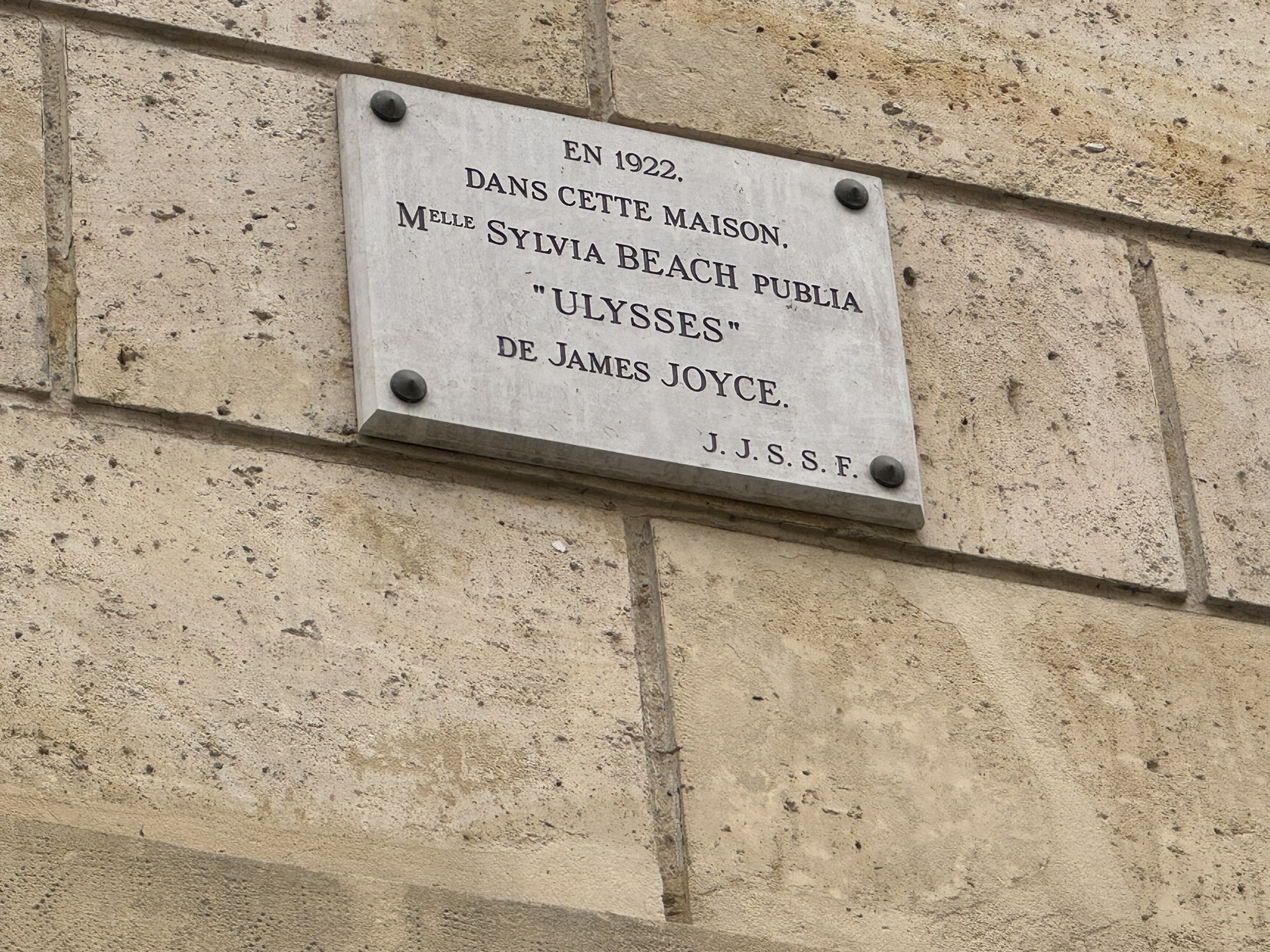
Fast forward to September 2024 when we were back in Paris again. Something almost miraculous happened to us on our last full day in the city. We visited the Luxembourg Garden and then strolled over to a nearby restaurant for lunch called the Le Hibou. We weren’t even paying attention to where we were walking after lunch, but we passed by a small clothing shop, Moicani, with some beautiful scarfs and decided to go in for a look. Jean Helfer, the affable proprietor, asked where we were from, and I said, “The States, in Missouri.” He replied in an almost reverential tone, “Do you know where you are standing right now?”

He pointed to a photograph of Sylvia Beach with Ernest Hemingway, in the very place I was standing! Totally by accident, we had stumbled on to the location of the original Shakespeare and Company bookstore. He handed me a brochure he has created giving a brief history of the bookstore, along with other addresses on the street of famous historical figures such as Gustave Flaubert and Thomas Paine. He was so gracious and kind. I was almost speechless the whole time we were in his shop.
What an incredible way to end our wonderful vacation in France. And yes, my wife bought a beautiful scarf!

 If You Want My Opinion