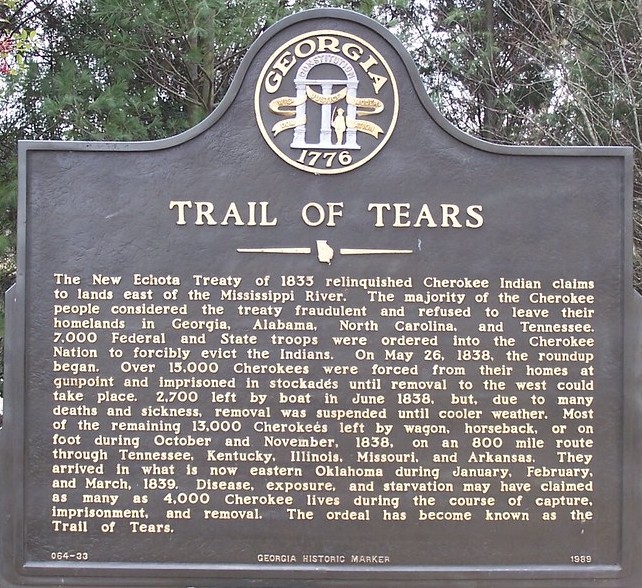
This is not the type of song I typically write, which is based on actual historical events. It is my tribute to the Cherokee Indians who endured the infamous Trail of Tears, the removal of indigenous people from the hills of North Georgia and Tennessee to the newly established Indian Territory (later to become the State of Oklahoma) between 1838 and 1839. Historians estimate that approximately 4,000 Cherokee people died on this trail, which represented about one-fourth of the total number who traveled west during the forced migration by the United States government.
I wanted this song to honor the Cherokee Nation, so I specifically incorporated phrases from first-hand accounts of survivors, including Wahnenauhi (English name – Lucy Lowery Hoyt Keys), Jane Bushyhead, and Rebecca Neugin. I also found inspiration from the poem, “The Trail of Tears,” by Cherokee poet Ruth Margaret Muskrat Bronson (1897-1982).
Full disclosure: I claim no Cherokee or any North American indigenous heritage. To my knowledge, I do not have Native American or American Indian blood running through my veins. This original song is not an attempt to “put myself in the shoes” of those who suffered. I am not the narrator in this song. The imagined speaker is an amalgamation of many different male voices who experienced the horror and loss inflicted by the Trail of Tears.
My mother loved Indians. More accurately, she loved the traditional characterization of the Indians in American arts and crafts. It was a romantic view of the people who were inhabiting North America when Europeans began to migrate west and “settle” on the continent. My mother was not interested in bows and arrows, spears, or war paint. She collected inexpensive artwork (prints, plates, figurines, etc.) featuring lovely brown-skinned people in traditional Indian attire as they were portrayed by Hollywood, for the most part. I would be the last to criticize her taste because some of the pieces she decorated our house with were indeed beautiful. She probably didn’t know much about the history of the numerous nations and tribes that were scattered all across North America, and she didn’t need to in order to appreciate her image of the Indian.
When I was young, one of our family’s favorite vacation spots was Gatlinburg, Tennessee, a tourist mecca in the Great Smoky Mountains with attractions, miniature golf, sky-lifts, and shops selling everything from taffy to stuffed black bears. To get to Gatlingburg, we had to go through the smaller town of Cherokee, North Carolina, which is also the home of the Eastern Band of the Cherokee Nation. We always stopped in Cherokee because, in the 1960s, it was a place of wonder where local residents used about the only thing they had, their history and heritage, as a way to scrape out a living. The town had live bears wasting away in cages, shops filled with Chinese-manufactured Indian souvenirs, and the occasional celebrity walking around the town to be photographed with visitors. I had my picture taken with Jon Provost, whose name probably means nothing to most folks today, but to a young lad in the late 1960s, he was an almost grown-up version of a television hero: Timmy Martin, the boy who had a dog named Lassie.
I also remember that, along the roadside passing through Cherokee, there would always be local men, young and old, dressed up like Hollywood Indians. They wore leather loincloths and moccasins, were often shirtless, had their faces decorated with paint, and usually had full feather headdresses (for the record, the Cherokee traditionally did not wear full feather headdresses at all). Vacationers were expected to pay them for a photograph, and looking back, I can only hope that this type of enterprise was not their only source of income, although it certainly may have been. The town of Cherokee today still has a vestige of the tourist trap atmosphere of the mid-20th century, but much of the most deplorable exploitation I remember from my childhood is gone. Some would argue what has taken its place is just as bad. The tribe owns a fairly large casino resort in Cherokee operated by Caesars Entertainment under the brand Harrah’s. The Eastern Cherokee do not live on a reservation, which is defined as land given by the federal government to a tribe. They own 57,000 acres of land which they bought in the 1800s and which is now owned by them but held in trust by the federal government.
There is an attraction in Cherokee that has moved away from the trappings of my childhood memories and beyond my mother’s fantasies of the “noble savage.” It is a temporary refuge from the slot machines, the gift shops, and the traffic. The Museum of the Cherokee Indian offers a cultural and historical overview of the people of the southern Appalachian Mountains going back 13,000 years. Contrary to popular opinion about appropriate nomenclature, it is actually more acceptable and accurate to use the term “American Indians” than “Native Americans” when referring to the tribes that occupied the western hemisphere before European exploration began. Combining interactive video with intriguing displays, the museum invites visitors to take a self-guided tour complete with computer-generated imagery, special effects, and an extensive artifact collection.
Museum of the Cherokee Indian
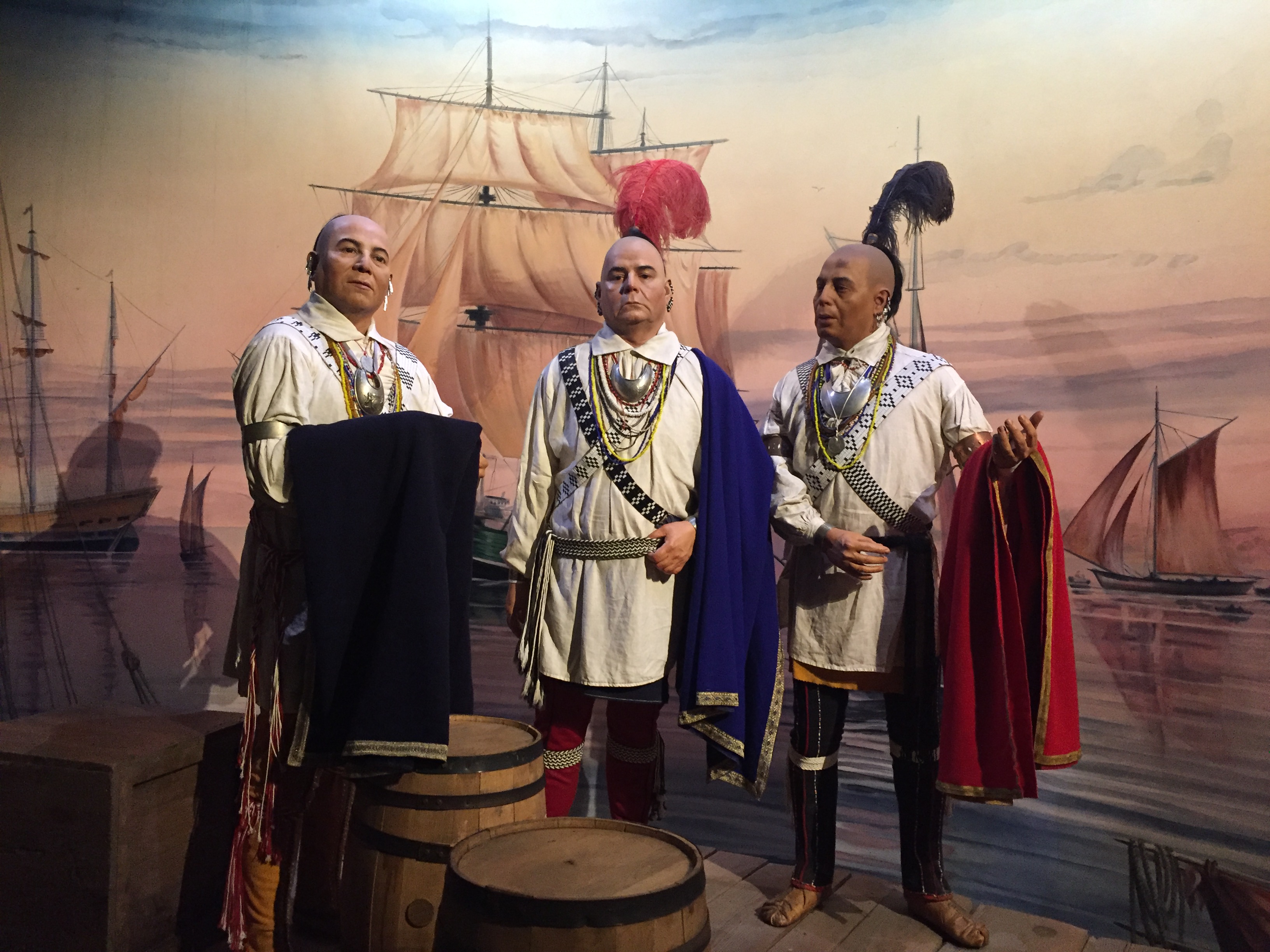
The museum’s interpretation is divided into two permanent exhibits: “Story of the Cherokee” and “Emissaries of Peace.” The first exhibit follows the history of the Cherokee from the early origins when mastodons roamed the region, through the Woodland and Mississippian periods, contact with Old World explorers and conquerors, the tragic Trail of Tears removal, and up to the present day. The second exhibit tells the story of Henry Timberlake’s visit to the Cherokees in 1762, and how he took Cherokee leaders to London to meet with King George III. These narratives are told through animation, audio-visual presentations, life-sized figures, artwork, and priceless artifacts.
Museum of the Cherokee Indian
The Museum of the Cherokee Indian is not a tourist trap designed only for entertainment or to perpetuate stereotypes about Indians portrayed in early motion pictures. It is managed by knowledgeable professionals who care about the Cherokee people’s heritage and dignity as an independent tribe. The executive director, James “Bo” Taylor, earned a degree in anthropology with a minor in Cherokee Studies from Western Carolina University. He has learned the Cherokee dances, which he performs regularly, and can read and write the Cherokee language. Taylor also teaches the Cherokee language in intensive ten-day immersion classes. The museum’s education director, Dr. Barbara R. Duncan, earned her Ph.D. in Folklore and Folklife from the University of Pennsylvania in 1982 and has lived in the southern Appalachian Mountains since 1983. She has written and edited award-winning books about Cherokee history and culture, including Living Stories of the Cherokee and Cherokee Heritage Trails Guidebook (with co-author Brett Riggs).
Museum of the Cherokee Indian
In addition to exhibits, the museum offers workshops, performances, guided tours of the region, publications, and classes. The museum archives is a repository of thousands of books, photographs, manuscripts, personal papers, and digital collections, all of which are accessible to museum members and qualified scholars. Visitors to the museum can spend an hour or two strolling through the halls, or a day or two becoming completely immersed in the displays and collections. This facility is a real treasure and not to be missed by those who are truly interested in the story of the Cherokee Indians, or as they originally called themselves, Aniyunwiya, “the principal people.” Enjoy the casino, but take a break from the tables and check out the Museum of the Cherokee Indian, and make sure to use part of your winnings to purchase a souvenir from the museum’s gift shop.