

I Still Love the Classic Christmas Specials

They started appearing on our television during the first hour of prime time, usually beginning in early December and lasting until a few days before Christmas. They were advertised heavily because they were only aired once a year. They were typically thirty minutes long, but a few stretched out for an hour. Some were fully animated in the Disneyesque style, but the oldest one was actually a puppet based production using a technic called stop motion animation. These timeless Christmas specials, broadcast every year during my formative years in the 1960s, were as important in heralding in the holiday season as the Macy’s Thanksgiving Day Parade and the Norelco commercial featuring Santa completely airborne before sliding into a village on an electric shaver. Some of my earliest Christmas memories involve making sure my homework and chores were all finished by 8:00 p.m. so I could plop on the floor in front of a television the size of a modern compact car to watch these simple but wonderful programs, in living color, no less.

“Rudolph the Red-Nosed Reindeer” was probably my favorite television Christmas special and happens to be the longest running of its kind in history, dating back to 1964. It was a groundbreaking production, introducing the stop motion animation mentioned earlier and the use of a recently invented LED light bulb capable of emitting visible red light, Rudolph’s incredible nose, of course. Sponsored by General Electric, the show was the brainchild of filmmaker Arthur Rankin, Jr., who went on to produce several other classic Christmas specials. With a cast of characters including Rudolph, Hermey, Yukon Cornelius, Bumble (the Abominable Snowman), and Santa Claus, the show came to life at the hands of Tadahito Mochinaga, a Japanese filmmaker inspired by Disney’s Mickey Mouse who invented the special type of animation used in the program. I can still remember feeling so sorry for the misfits of this story, from Rudolph and the dysfunctional unwanted toys to the poor elf whose dream was to become a dentist. Critics have argued that the story and the song written by Robert May and Johnny Marks on which the show is based are plagued by troubling ethical issues, but that was not my interpretation at all. I thought “Rudolph the Red-Nosed Reindeer” was a delightful morality tale about diversity, inclusion, and empathy. God knows we could use a little more of all of that these days.

"Rudolph the Red-Nosed Reindeer"
“Rudolph the Red-Nosed Reindeer”

A close second Christmas special for me was the 1966 fully animated “How the Grinch Stole Christmas,” based on the children’s book with the same title by Dr. Seuss. Featuring the unmistakable voice of Boris Karloff as the Grinch, this is another one of those classics that is still running each season on network television. Like most of these television specials, this book and show were designed to teach children of all ages an important lesson: the joy of Christmas doesn’t come from material things but from community and love for one another. I certainly received that message as a child, but what I remember most about the show was the incredibly creative and hilarious song, “You’re a Mean One, Mr. Grinch,” with lyrics by Dr. Seuss, musical composition by Albert Hague, and performance by Thurl Ravenscroft, best known for the voice of Kellogg’s Frosted Flakes hero, Tony the Tiger – “They’re GREAT!” Every year in early December on Facebook, I post a few lines from this memorable song to help usher in the Christmas season for my Friends.
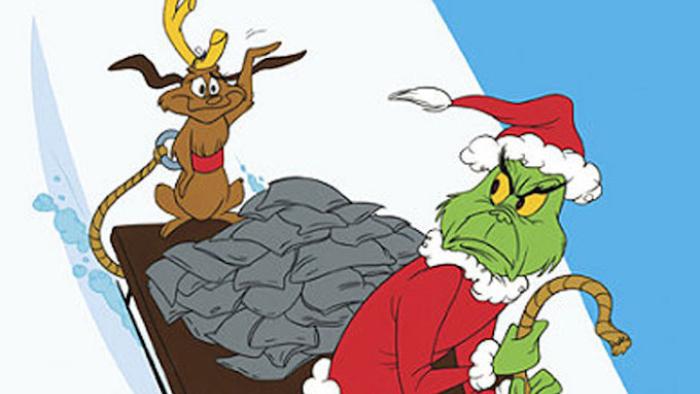
"How the Grinch Stole Christmas" (photo credit: Common Media)
“How the Grinch Stole Christmas” (photo credit: Common Media)

Third in line is another fully animated production by Arthur Rankin, Jr. “Frosty the Snowman” first aired in 1969 and has been a Christmas standard every year since. It features the recognizable narrative voice of Jimmy Durante and was his final film role. It also includes the unique voices of Billy De Wolfe as the selfish Professor Hinkle and comic actor Jackie Vernon as Frosty. One point of trivia about the animation is the fact that the narrator’s and Hinkle’s characters were drawn to look like their real-life counterpart actors. Once again, here is another Christmas special adapted from a song, which was written by Jack Rollins and Steve Nelson and first recorded by Gene Autry and the Cass County Boys in 1950 and later recorded by Jimmy Durante that same year. By the end of the show, we all know that greediness doesn’t pay and that there is a certain magic associated with Christmastime.

"Frosty the Snowman" (Photo credit: TV Guide)
“Frosty the Snowman” (Photo credit: TV Guide)

My final favorite is likely at the top of many viewers’ lists and is perhaps quoted more than all the others combined. The fully animated 1965 production of “A Charlie Brown Christmas” features all the most familiar characters from the imagination of Charles Schulz and his long-running Peanuts comic strip. In addition to its memorable lines and scenes, the special also includes a very fine soundtrack by American jazz pianist Vince Guaraldi. The show received both Emmy and Peabody awards and is firmly implanted in holiday memories of millions of Americans. After all, who hasn’t looked at a pathetic Christmas tree and dubbed it a “Charlie Brown tree?” Like the lesson the Grinch learned, the Peanuts kids teach us that the true meaning of Christmas is about love, respect, and friendship.

"A Charlie Brown Christmas" (Photo credit: Wikipedia)
“A Charlie Brown Christmas” (Photo credit: Wikipedia)


Decorating for Christmas

Aside from gorging on turkey and football, one of the strongest impulses generated by Thanksgiving Day among so many Americans is the urge to head to the attic, basement, or garage and pull out the holiday decorations. At this time of year, any sense of good taste is tossed out like moldy green-bean casserole that was pushed to the back of the refrigerator and forgotten for two weeks. Thanks to the development of inexpensive plastic, PVC, fiberglass, large-scale inflatable statuary, and sophisticated electrical components, some American homes and properties are transformed into dazzling spectacles that almost put to shame the illuminated facades of Las Vegas casino resorts.

The amount of time, energy, and financial resources that families dedicate to decorating varies considerably, but I suspect those who celebrate Christmas tend to be a bit more profuse than their Jewish counterparts. Muslims and Hindus use much less extravagant decorations for their special celebrations at other times of the year. Even among the folks who celebrate Christmas, the amount and type of decorations are quite diverse, with everything from simple nativity scenes to the construction of a North Pole Reindeer Flight School in the front yard that backs up neighborhood traffic for several blocks. The true zealots start their decorating activities the week before Thanksgiving, perhaps even earlier, and it can take them up to two weeks to get the job completely finished. I know a family that puts up a Christmas tree in every single room of the house, including miniature versions in all three bathrooms.

Such enthusiasts have a difficult time giving any decoration a well-deserved sabbatical or even retirement. They have an attachment to or fondness of every piece they ever purchased, so decorating through the years has a cumulative effect. At some point, all surfaces of the house are adorned with festive accessories in an attempt to display every single item they have accumulated. It can be a tad overwhelming. Some manage to pull it off better than others. Lest I be perceived as a decorating snob, I hastily confess that I have in years past clearly fallen into the camp of the unrestrained and over-exuberant. My wife has done an admirable job of intervening and helping me understand that less is better when it comes to Christmas ornamentation.

Christmas Tree and decorations

For most of its history, Christianity has been a remarkably adaptable religion, which partly explains its rapid expansion after the 4th century and its durability throughout a good portion of the western world and across many different cultures. A fine example of this adaptability can be found in Christmas decorations. Ancient Romans brought evergreen trees into their homes to celebrate the winter solstice. They also hung bright metal ornaments on trees around their homes. Pagan societies believed that the holly bush had magical qualities to repel evil spirits. Even beyond decorations, Christians managed to incorporate customs from other faith traditions into the celebration of Christmas.

Americans are a population heavily influenced by capitalism and commercialism. We market everything, including Christmas. We are also a flexible bunch, and we don’t mind bending the truth a little to sell the product. Again, we can see this characteristic exhibited in a fairly common holiday decoration: the nativity scene. We like to portray this pivotal point in human history as a nice package that can easily fit on a small side table or night stand. So we take all the elements of the story — the baby Jesus in the manger, Mary, Joseph, angels, the shepherds, the ox, the donkey, the star, and the wise men with their camels — and we fold them altogether into one, compact decoration. It is irrelevant that the wise men were not there on the night of the Christ child’s birth but at least a month or so later (perhaps much later) after he was presented at the Temple by his parents. We cannot be expected to have a separate set of figurines in the house to represent this part of the story. After all, we need to make room somewhere for a sleigh and eight or nine reindeer too!

The older I get, the more I appreciate celebrating the spirit of Christmas with simplicity and humility. Over the decades I have purchased, displayed, and discarded any number of decorations. I have suffered through finding just the right tree at a farm in the country, cutting it down, paying way too much for it, and hauling it home only to find that once we wrestled it into the stand, it was as crooked as a Washington politician. We have gone through several different artificial trees and are thrilled with the two we have now, one inside and one on our back porch, that came with lights already installed. Over the last few years we have started buying what my wife calls “timeless” decorations — pieces that are reminiscent of generations past. Some people would refer to them as classic decorations. A close friend of ours paints marvelous Santa faces on gourds, and we include our collection of them on the living room mantel every year.

There are two decorations that my wife and I cherish perhaps more than any others, and we put them out every year then carefully store them away until the next Christmas. One is a small, resin angel that her parents gave her when she was a child. It is beautiful and precious. The other is a little plastic illuminated church that houses a manually-wound chime player that plays “Silent Night.” It belonged to my mother, a woman to whom the Christmas story was fundamental and factual. The miraculous birth of Jesus was a mystery she embraced without question, with little or no struggle. She has been gone now for over a dozen Christmases, but that little church keeps the memory of her fresh and close for me. I am grateful to have this modest decoration that is somehow a perfect expression of her faith and this holiday.

Church and angel
Church and angel