Rock & Roll Hall of Fame

My wife and I took a brief trip to Cleveland, Ohio in August, 2024. We had hoped to do so in 2020 while my wife was working temporarily in Fort Wayne, Indiana, when I could fly in, and we could then drive over to Cleveland. But the world shut down when COVID struck. We both love rock music, and as an amateur rock and pop musician, I was interested in visiting one of the top destinations the city has to offer: the Rock & Roll Hall of Fame. However, we both agreed that we would need more than a single objective to justify flying from our home in Springfield, Missouri, through O’Hare airport in Chicago, and then on to Cleveland. We found one. We discovered that one of our favorite bands, Hootie and the Blowfish, was touring in 2024 and that Cleveland was one of their stops. They were going to be playing at the magnificent Blossom Music Center in Cuyahoga Falls, Ohio, about 20 minutes south of Cleveland. We had a twofer and were good to go!

Neither one of us knew much about Cleveland and didn’t have high expectations beyond what we planned to do while in the city. We were pleasantly surprised. Situated on the southwestern shore of Lake Erie, Cleveland is taking advantage of tourism with great parks and beaches right on the water. The views are breathtaking. With a scenic skyline, good hotels and restaurants, stadiums, arenas, and several major attractions, Cleveland really is a place to explore. The city claims to be the birthplace of Rock & Roll music, primarily because radio station WJW disc jockey Alan Freed coined the phrase “Rock & Roll” to describe the upbeat black rhythm and blues music he was playing in 1951. Of course, the Rock & Roll Hall of Fame was ground zero for us, and it also exceeded our expectations.

Rock & Roll Hall of Fame, Cleveland, OH

The building is a modern structure with a huge glass atrium at the entrance. It has six levels beginning on the entrance floor, but the tour starts one level below with the Ahmet Ertegun Main Exhibit Hall, which carries visitors from rock’s earliest stars to those newly emerging contemporary musicians. There are thousands of items on display, along with feature films, videos, interactive kiosks, reading material, and plenty of music. This exhibit has the museums largest displays devoted to single artists, bands, subgenres, and movements of Rock & Roll history and the industry: Revolutionary Women in History, Hip Hop, Roots of Rock, Pioneers of Rock, Sun Records, Cities & Sounds, the music of Cleveland and the Midwest, and so much more.

Rock & Roll Hall of Fame, Cleveland, OH

Level 1 has a ticket booth, a café, large museum store, and the Klipsch Stage where performances are scheduled throughout the year. Level 2 is called “The Garage” where visitors can sign up to play various instruments with or without a house band in a setting that looks very much like a real garage. I played an electric guitar (something I never do) and sang “Midnight Rider” by the Allman Brothers Band with the help of a house drummer and a bass player, who also sang harmony with me. Although it wasn’t my best performance of that song, it was still fun to play in such an iconic venue. This level also has a large collection of different types of instruments and sound booths for visitors to jam on their own. The Les Paul exhibit is on this floor too, paying homage to the American jazz, country, and blues guitarist, songwriter, luthier, and inventor. He was one of the pioneers of the solid-body electric guitar, and his prototype served as inspiration for the Gibson Les Paul guitar.

Level 3 is focused almost completely on the Hall of Fame inductees, with the Inductee Signature Gallery, New Inductee exhibit, and the Connor Theater featuring the Power of Rock Experience. Visitors can look through alphabetic lists of inductees and a large chronological display of the all the inductees going back to the Hall of Fame’s inception in 1986. This floor also has the New Inductee and the In Memoriam exhibits. The Connor Theater is on this floor, where visitors can watch a 15-minutes video highlighting the Hall of Fame induction nights from the past.

Level 4 features the Pink Floyd tour replica of The Wall, designed to mirror the Berlin performance in July 21, 1990. This level is also the location of the Foster Theater, which is used for onsite education programs or private rentals. The theater has hosted hundreds of rock star talks and legendary rock films over the years. Level 5, along with some of the ramps in the museum, has individual display cases devoted to the legends of Rock & Roll, from the Bee Gees and the Doobie Brothers to Public Enemy to Tom Petty.

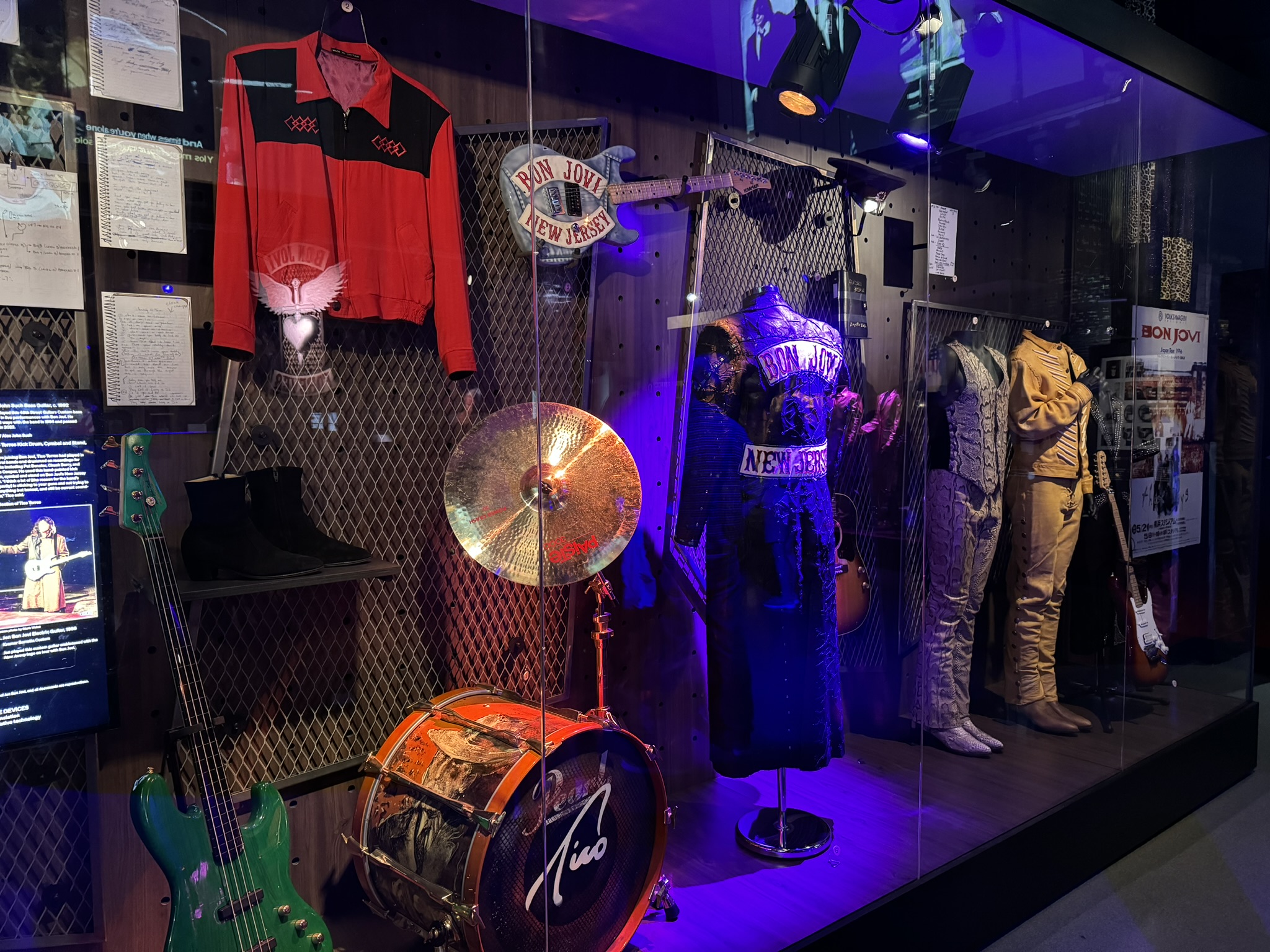
Level 6 is devoted to an exclusive exhibit that Bon Jovi unveiled with the museum in 2018. This full-floor showcase spans four decades of the band’s career along with never-before-seen artifacts from each of the band members. Visitors are immersed in the band’s story and music from inception to the present. Huge video presentations are joined by text panels and display cases filled with musical instruments, clothing, and loads of memorabilia from the band.

Rock & Roll Hall of Fame, Cleveland, OH

Organizations like the Rock & Roll Hall of Fame that establish themselves as authorities of a particular subject area all have one thing in common. They always stir up controversy, mostly about who or what is included, but more contentiously, excluded from their lists. This museum obviously recognizes this dilemma and even seeks to address it by allowing visitors to submit names of performers or bands they think should be inducted into the Hall of Fame. Many writers over the years have discussed this topic, and some of them have challenged the Hall of Fame on its choices of inductees through the decades. One of the most ironic exclusions is Huey Lewis and the News, the band that had a major hit with “The Heart of Rock & Roll,” which actually mentions Cleveland at the very end of the song!

Rock & Roll Hall of Fame, Cleveland, OH

I certainly had my share of questions come to mind as we strolled through each level of the museum. I was disappointed to see how much more space and almost reverential attention was given to Elvis Presley on one wall, while on the opposite wall a smaller display featured Chuck Berry, often considered the Father of Rock & Roll. I think those two positions should have been swapped. One of my favorite wall displays was for Jimi Hendrix, probably the greatest guitarist in rock history. I was baffled to learn that bands with place names such as Chicago were inducted fairly late in the game and that the bands Kansas and Boston still haven’t made it. At the same time, I was delighted to see so much attention given to Wanda Jackson, an Oklahoma native who got her start on ABC Television’s “Ozark Jubilee” broadcast out of Springfield, Missouri from 1955 to 1960. She later became known as the Queen of Rockabilly, a title she still holds to this day. As of this post date, she is still with us.

Rock & Roll Hall of Fame, Cleveland, OH

We were able to pack a lot in just two full days while still having some down time walking along the shore of Lake Erie, enjoying some great meals and drinks, and exploring the public spaces on the water around the Hall of Fame. On top of all that, we were lucky enough to catch Hootie and the Blowfish back together again for a national tour. Oh, and their opening acts were Edwin McClain and Collective Soul. For people who love rock music, it just doesn’t get much better than our quick trip to Cleveland.

Hootie and the Blowfish at Blossom Music Center (Ohio)

Exquisite Creatures: Christopher Marley’s Eye for Beauty in Death

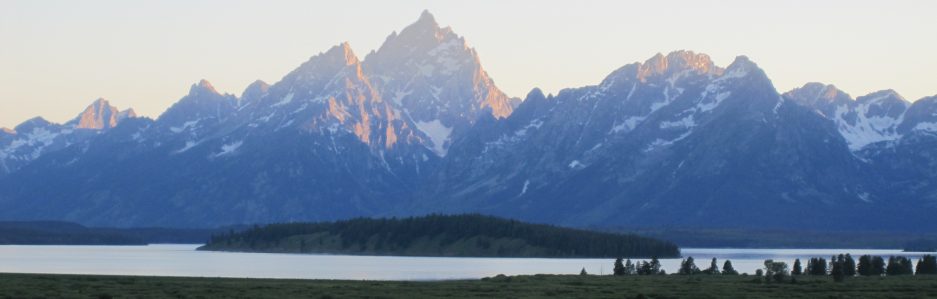
In my experience, people tend to be a bit too generous in their descriptions of deceased friends and loved ones laid out in caskets. “She looks so peaceful.” “He looks like he’s sleeping, doesn’t he?” Or my personal favorite, “They made her look so beautiful, didn’t they?” Oh please. No disrespect intended, but I have never liked the idea of the obligatory viewing of the body at funeral homes and have avoided it as much as possible, even with relatives. Dead people always look like they are missing something essential, and they are. They are missing the look of life, which can even be perceived in those who are in a deep sleep. I have no intention of being on display upon my own death, which is one of the reasons I will be cremated and sent on my merry way to the Grand Tetons National Park. Ashes to ashes, dust to dust, and I will be nourishing plants and animals until I am completely and efficiently recycled back into the biosphere.

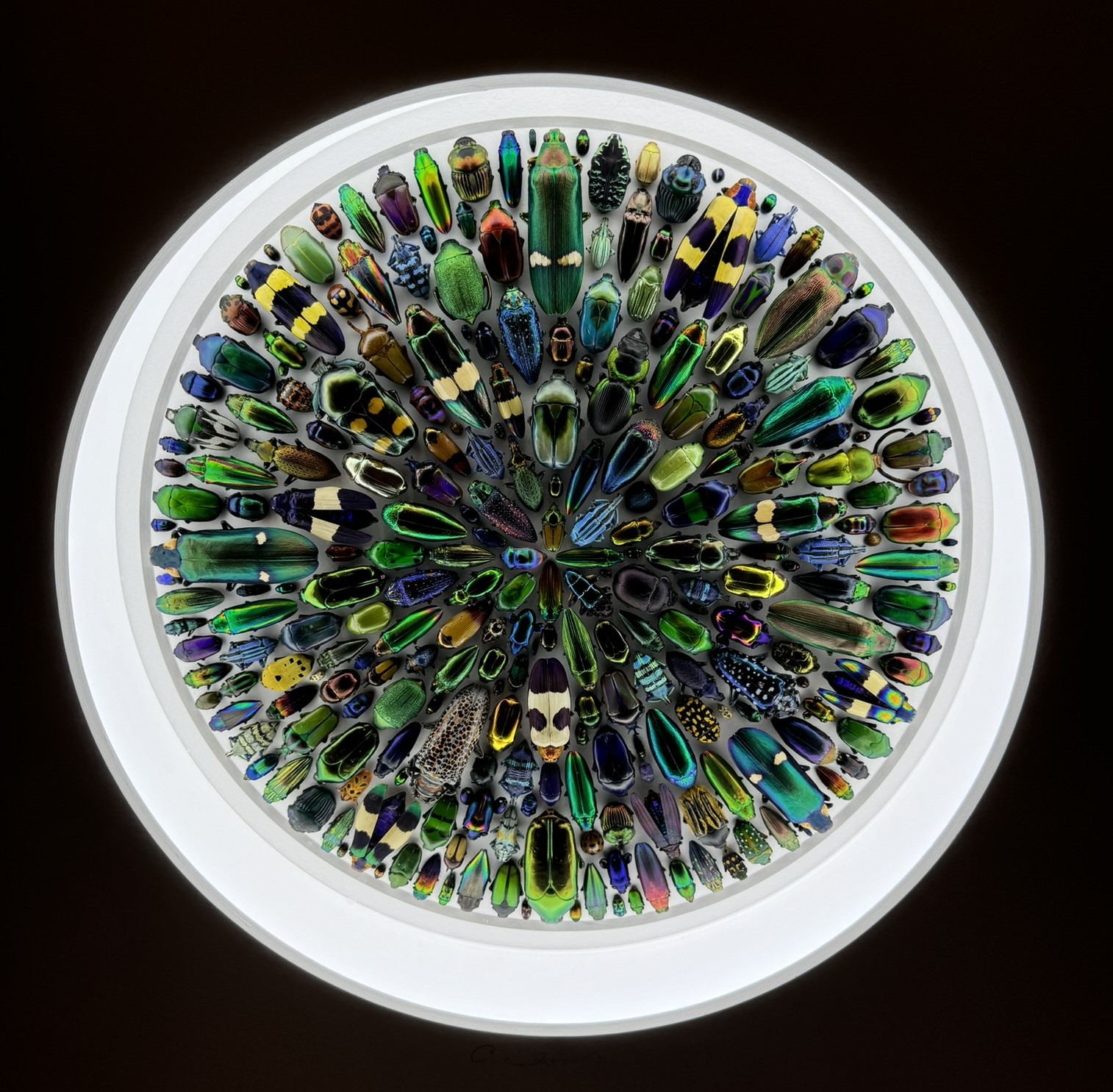
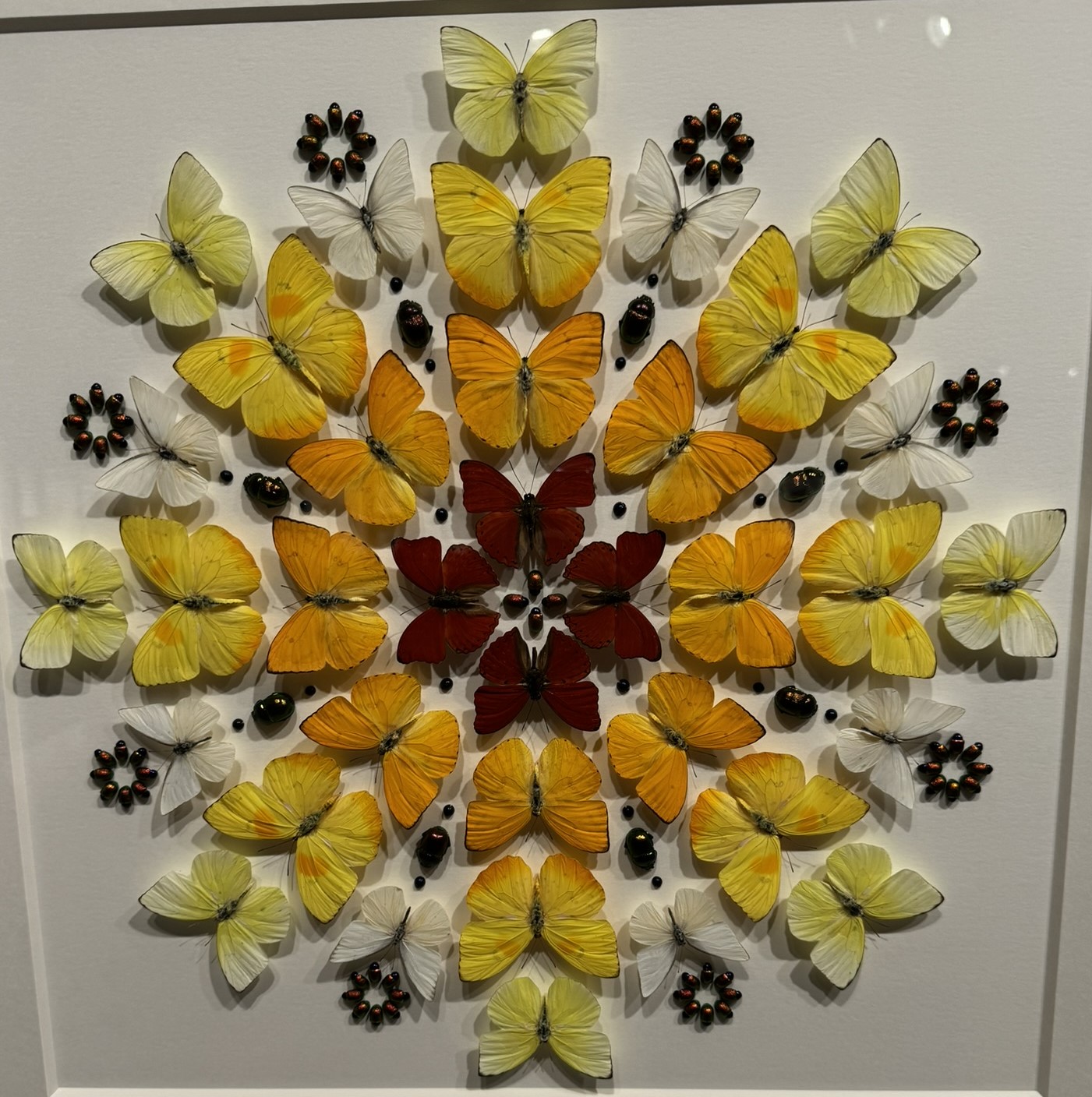
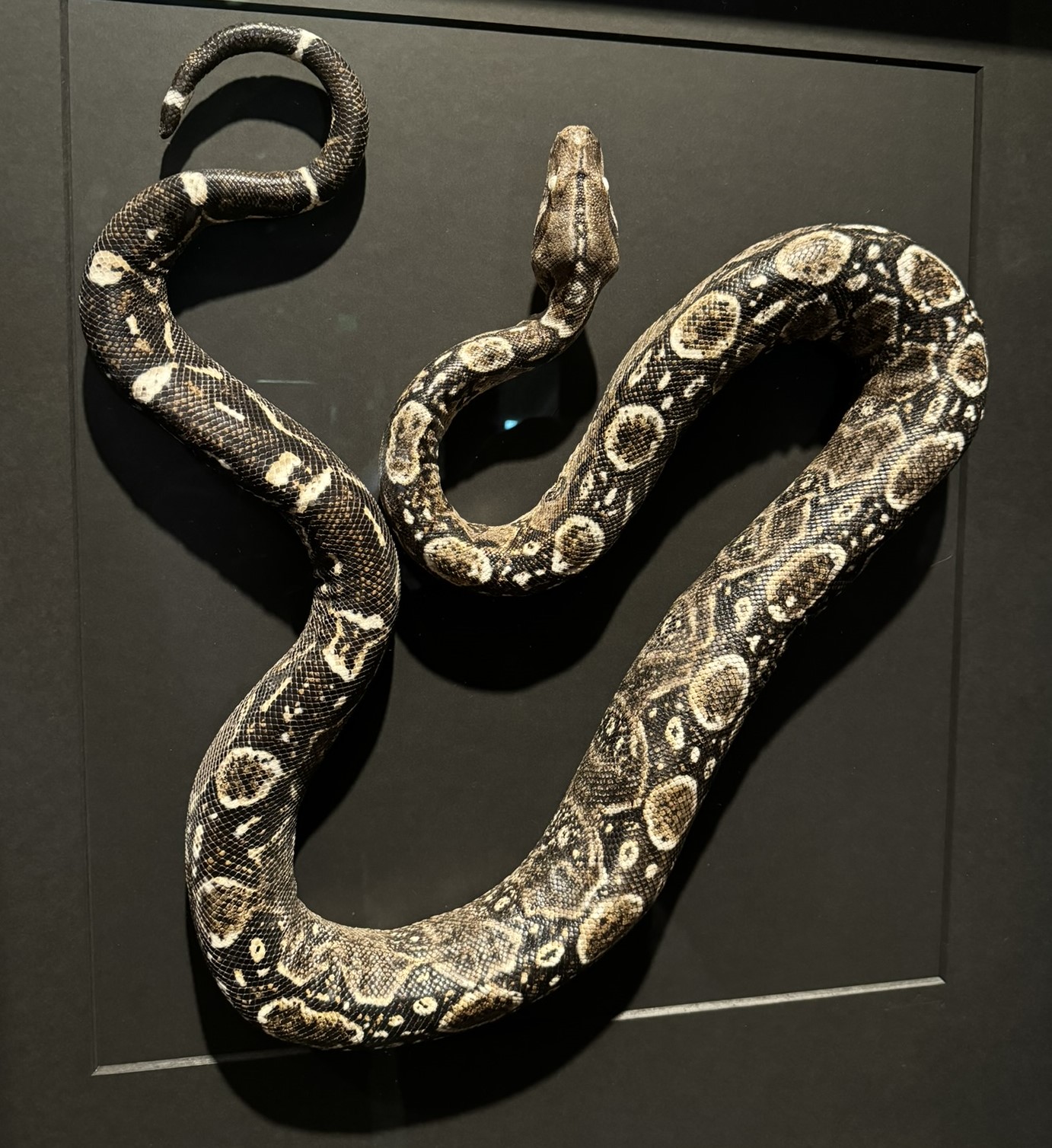
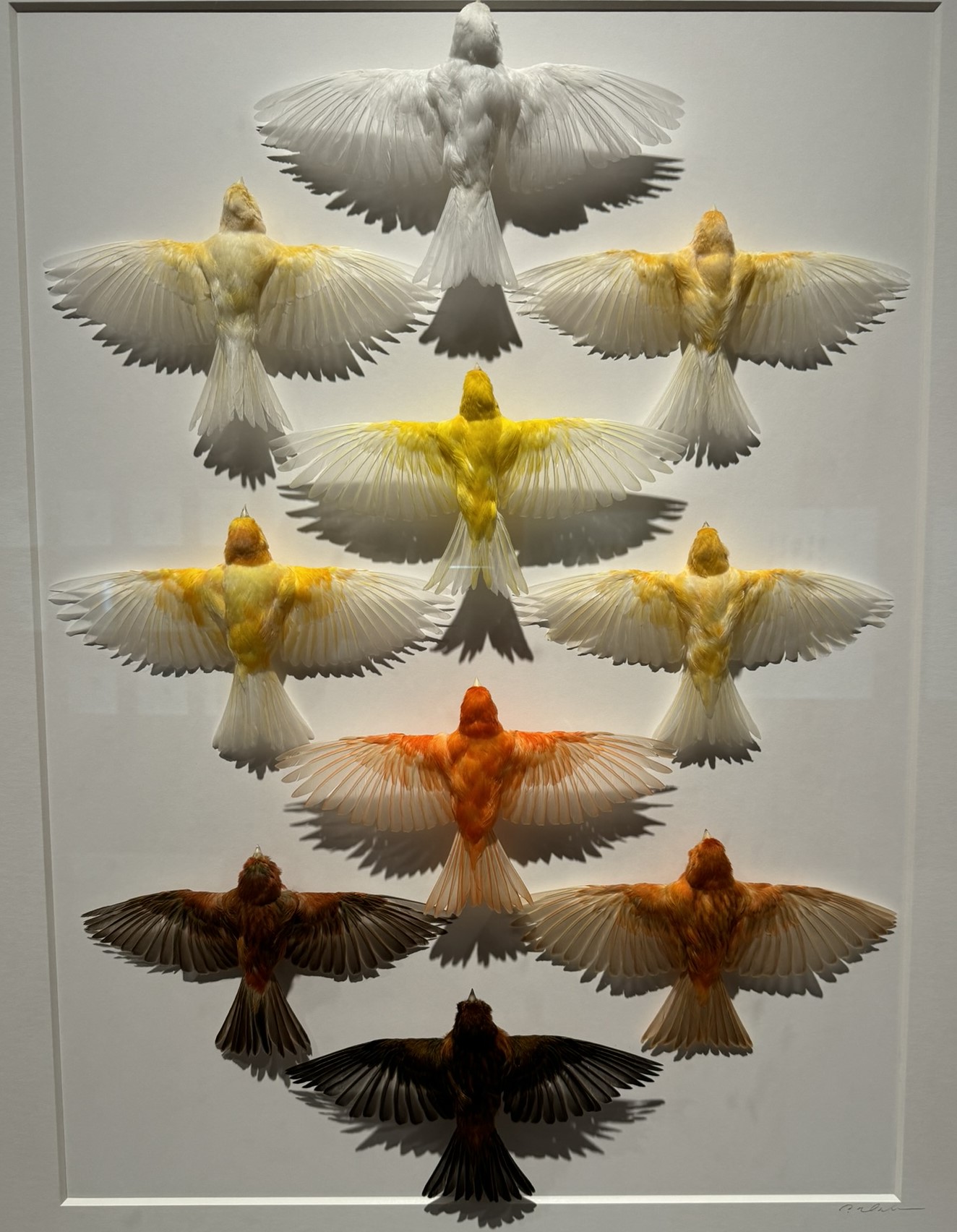
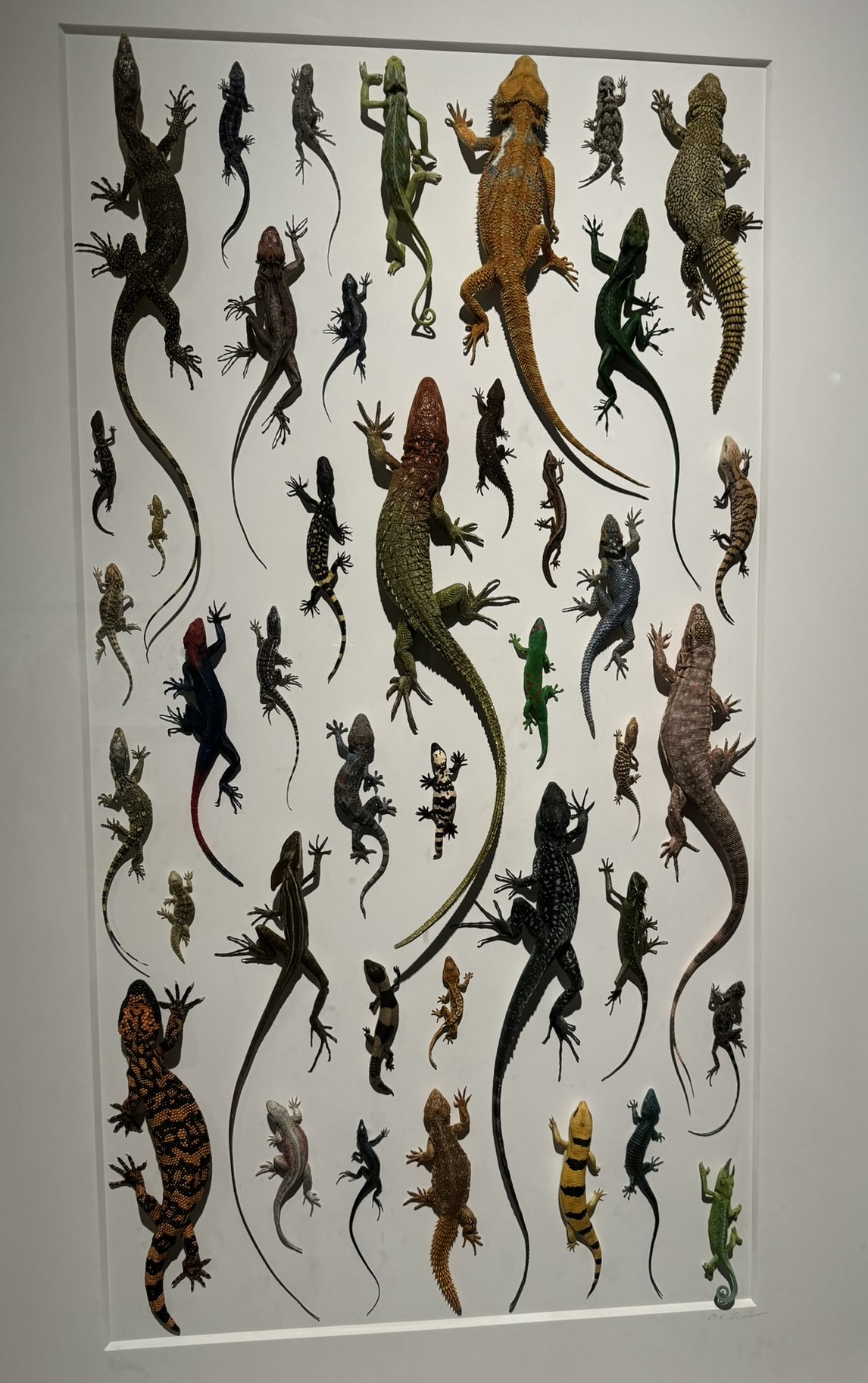
Speaking of animals, somehow many other species look different to me in death than humans, that is, if they haven’t started to decompose. This is especially true of insects, birds, reptiles, and amphibians. They often retain their colors and external patterns for a while, which is much better than rapidly fading to gray or some other shade that is the antithesis of living flesh. Let’s face it, many of these critters have colors and patterns more striking than the most expensive tattooists can paint on human epidermis. Artist and naturalist Christopher Marley has a sincere appreciation for the shapes, forms, and colors of the natural world and has created artistic designs using the preserved bodies of dead creatures, along with some minerals, in a breathtaking exhibit called “Exquisite Creatures.”

Exquisite Creatures Exhibit at Crystal Bridges Museum

My wife and I were fortunate enough to catch Marley’s show at Crystal Bridges Museum of American Art in Bentonville, Arkansas in July 2024. Most of the specimens are matted and framed under glass, hanging on the walls of the exhibit hall, with back lighting to enhance the incredible colors and designs of his arrangements. Kaleidoscopes of beetles, butterflies, moths, shells, and feathers are on display along with carefully choreographed groupings of snakes, lizards, skinks, fish, crustaceans, and birds. Some of the bug collections look almost exactly like beads of water resting on an impervious surface. The iridescence of the shells and exoskeletons is stunning, especially as they are arranged under the perceptive and sensitive eye of this artist.

Exquisite Creatures Exhibit at Crystal Bridges Museum

Marley collects the subjects of his work from a network of people around the world. His first book published in 2008 titled Pheromone focused on his artwork with insects. In the words of his publisher, “Marley has used his skills as a designer, conservator, taxidermist, and environmentally responsible collector to make images and mosaics that produce strong, positive emotional responses in viewers.” I completely concur with that evaluation. We were blown away with how he has taken many creatures that are often repulsed by people in general and molded their forms into magnificent displays that are indeed exquisite.

[Note: The photographs included here are not great quality, primarily because the gallery was so crowded and getting close and lined up to take a photograph was extremely difficult. Also, no photograph can replicate the experience of seeing these displays in person.]

Exquisite Creatures Exhibit at Crystal Bridges Museum

Springfield, Illinois: The Land of Lincoln

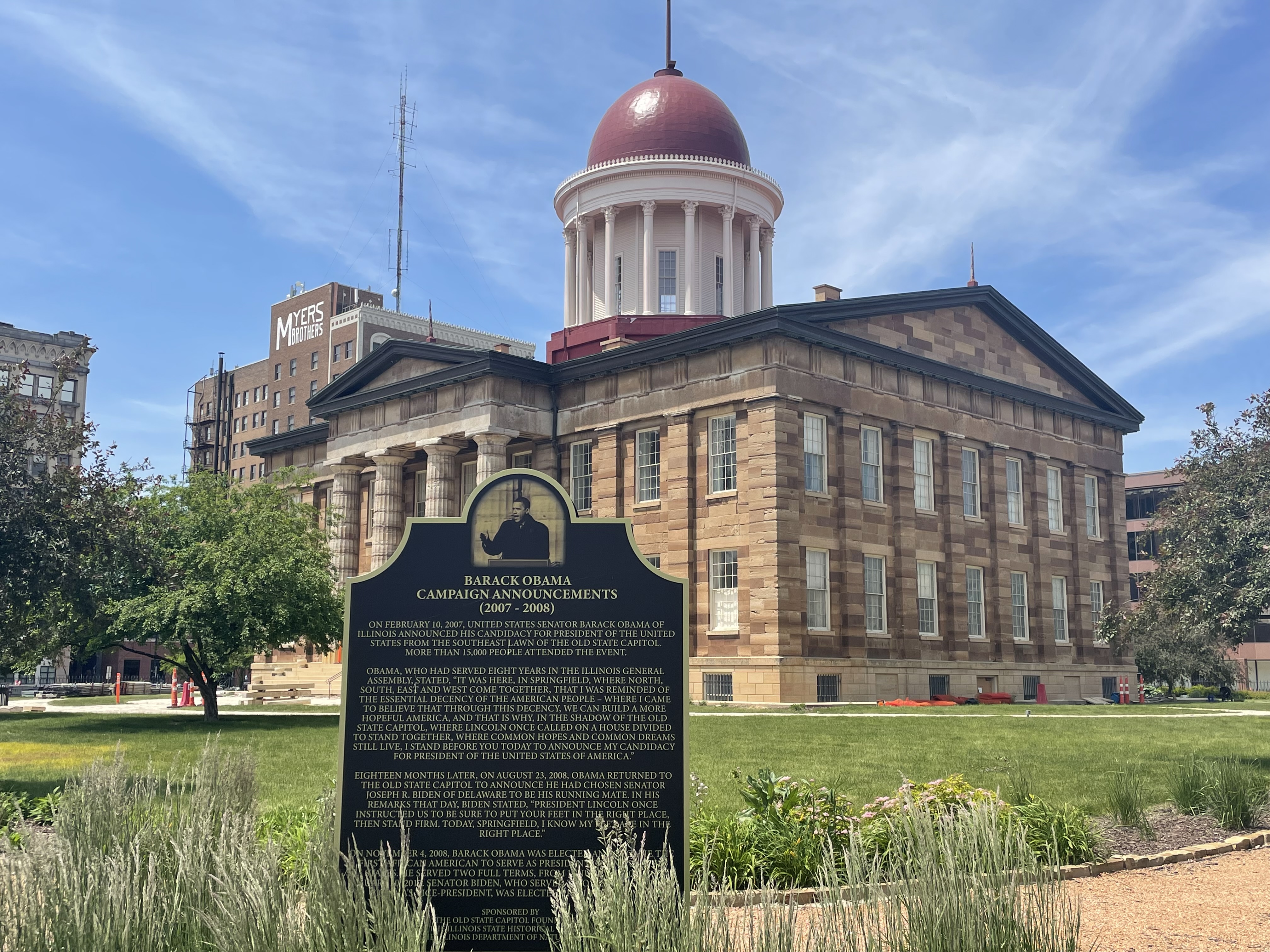
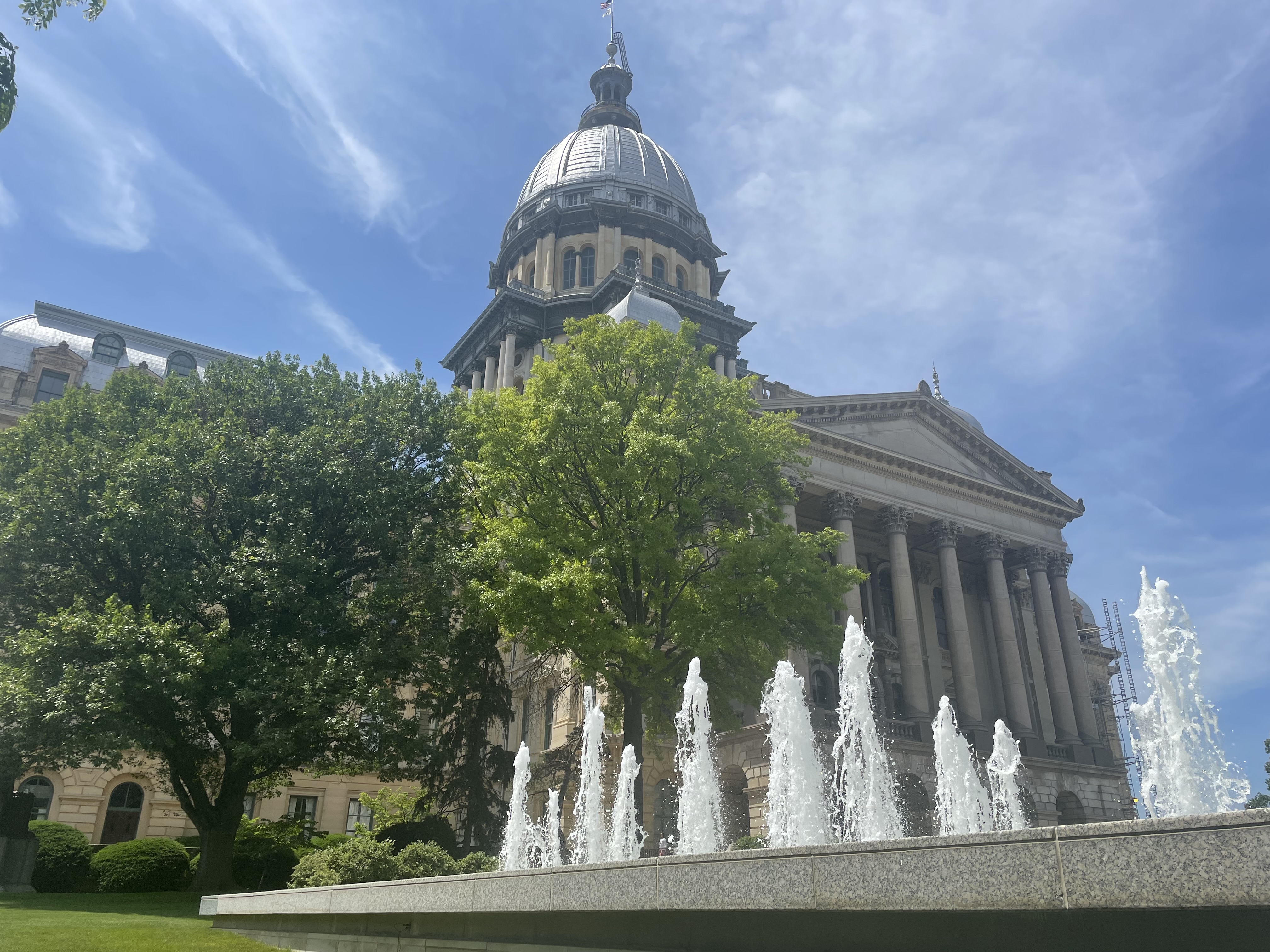
My wife and I spent a weekend in Springfield, Illinois, over the 2023 Memorial Day weekend. This town of just over 113,000 people may be the smallest state capital I have ever visited. I wouldn’t describe it as spectacular, but it does have a certain charm. There are several good restaurants and pubs downtown, and the hotel where we stayed was comfortable, clean, and convenient. The architecture of the state government buildings is impressive, especially the restored Old State Capitol that served as the state house from 1840 to 1876. On February 10, 2007, Barack Obama announced his candidacy for President of the United States on the southeast lawn of the building. The new State Capitol was completed in 1888, although the legislature began meeting in the building a decade earlier while it was under construction. Designed in the shape of a Greek cross, the capitol features a magnificent dome that carries the structure to a greater height than the U.S. Capitol in Washington, D.C.

Old State Capitol, Springfield, Illinois
New State Capitol, Springfield, Illinois

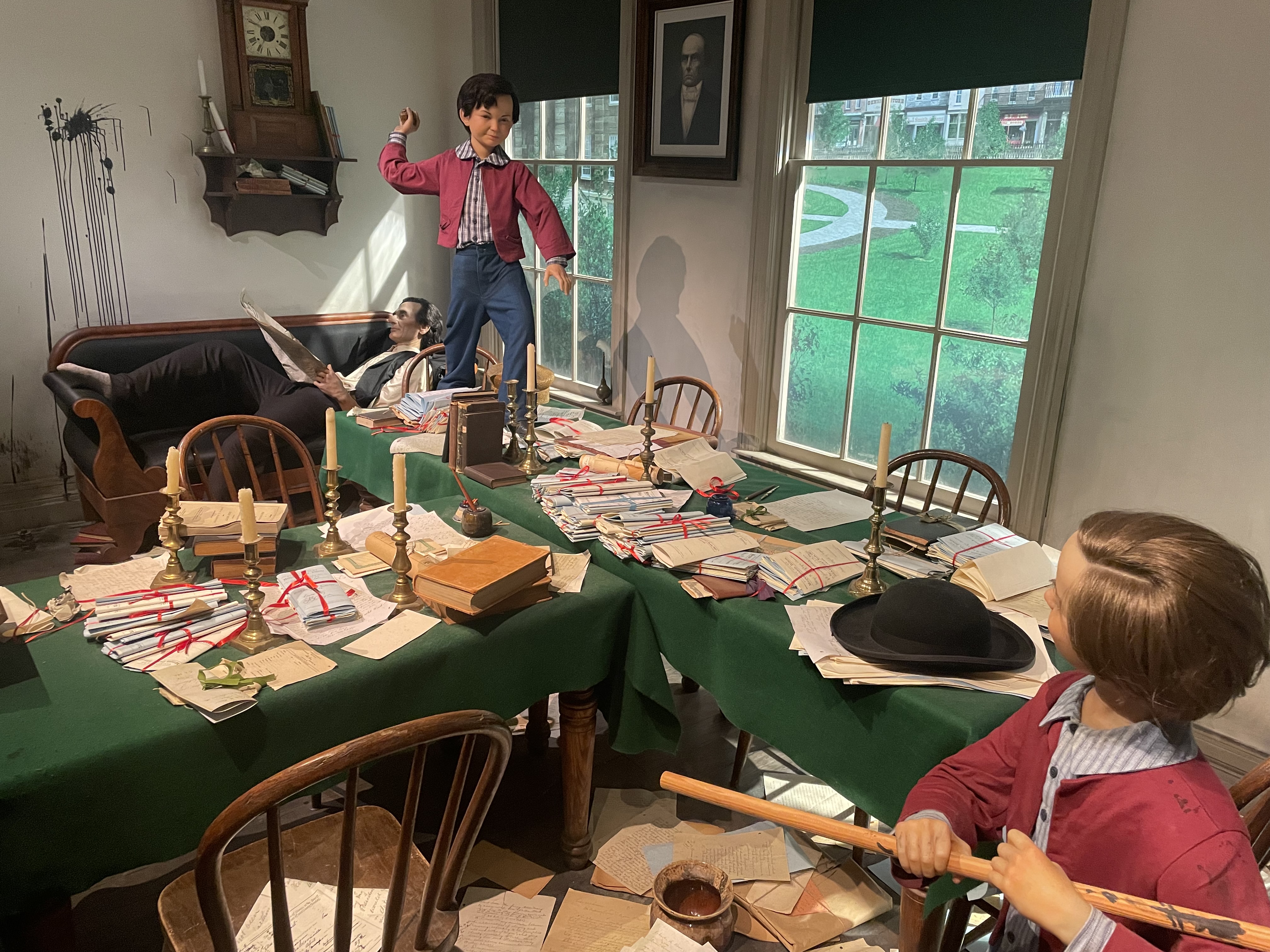
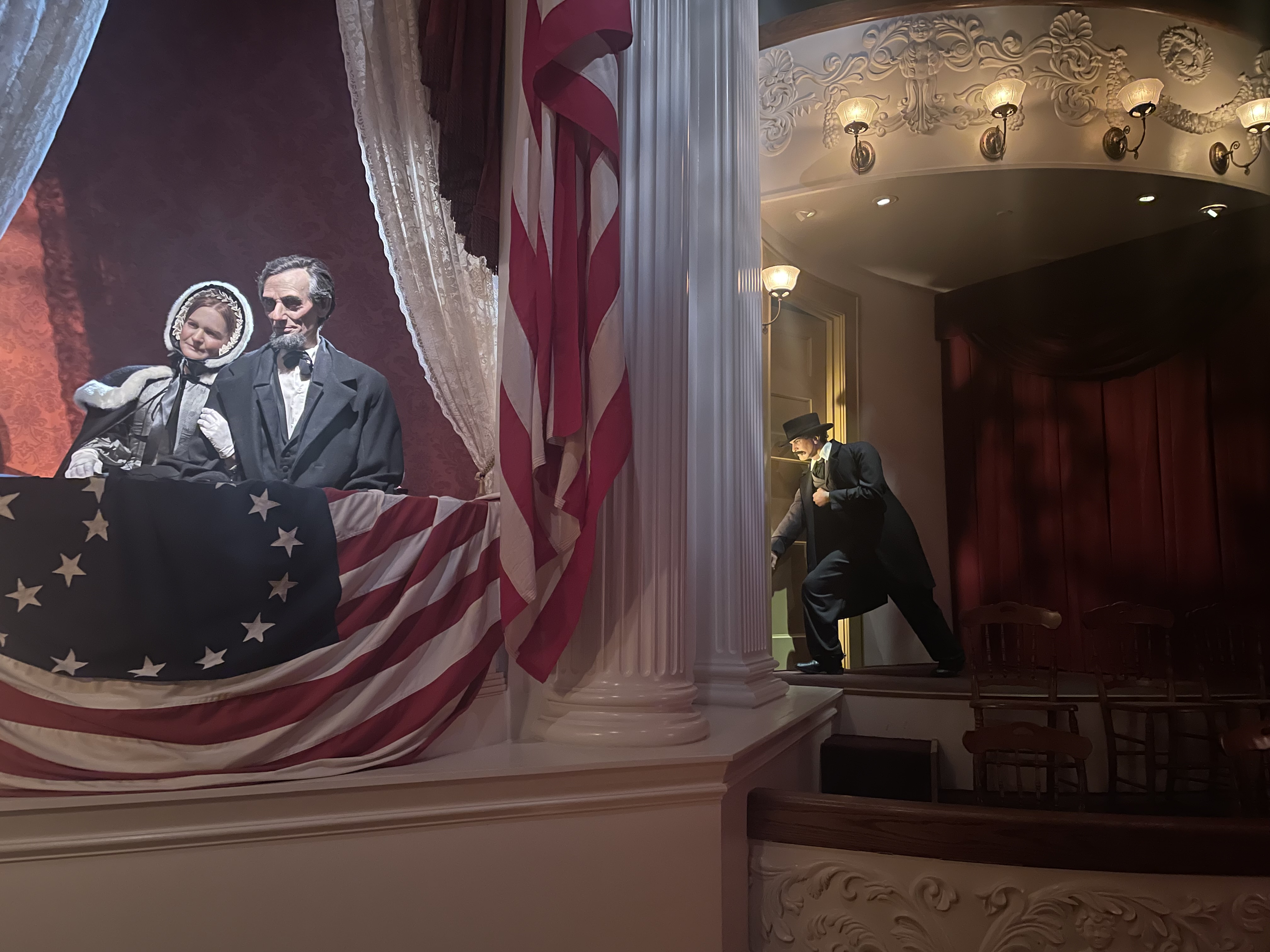
The major tourist draw for Springfield is a collection of attractions associated with the town’s most famous citizen, President Abraham Lincoln, who practiced law and started a family here. The Lincolns resided in the city from 1837 to 1847, the year Lincoln was elected to the U.S. House of Representatives. Though his most memorable years were spent in the nation’s capital, he built his legal and political career in Springfield and was buried there after his assassination in 1865. The Abraham Lincoln Presidential Library and Museum in Springfield is a first-class destination for people of all ages interested in history, presidents, or politics. The museum’s interactive exhibits and video presentations are joined by lifelike replicas of Lincoln, his family, and his associates to tell the story of the president’s early childhood in Kentucky and follow his path to the White House and on to his tragic death.

Abraham Lincoln Presidential Library and Museum, Springfield, Illinois

We also took a stroll around the Lincoln Home National Historic Site in Springfield, which is made up of a restored and/or replicated section of the town dating back to the 1840s and includes the actual house where Abraham and Mary Todd Lincoln raised their family. There are exhibits about the Lincolns and their neighbors in several of the other homes and buildings at the site, and visitors can book tours of the Lincoln home too. There is an interpretive center filled with information about the 16th President and what life was life in Springfield in the mid-19th century.

Lincoln Home National Historic Site, Springfield, Illinois

The Lincoln Tomb and War Memorials State Historic Site is also located in Springfield in Oak Ridge Cemetery. It is a massive granite structure crowned with a towering obelisk. Tours of the tomb are self-guided, and we were lucky enough to be the only people inside during our visit. The hallway leading back to the actual tombs of Lincoln and his family is filled with bronze statues of the President, including a miniature replica of the Lincoln Memorial Monument at the National Mall in Washington, D.C. It is a solemn place worthy of such a celebrated and significant leader of the nation. It is a humbling experience to see it in person.

Lincoln's Tomb, Springfield, Illinois
Lincoln’s Tomb, Springfield, Illinois
Lincoln's Tomb, Springfield, Illinois
Lincoln’s Tomb, Springfield, Illinois

San Diego’s Balboa Park

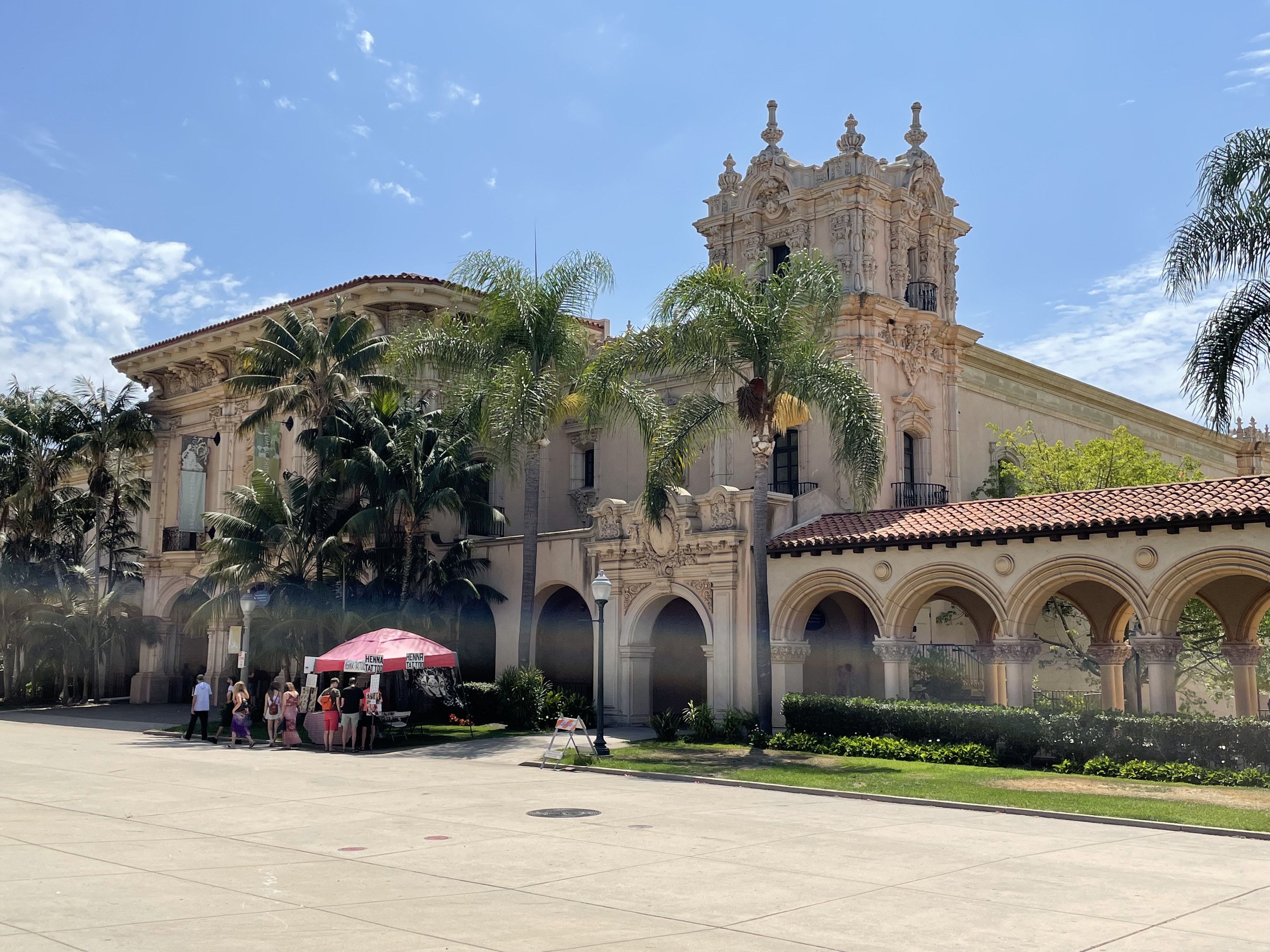
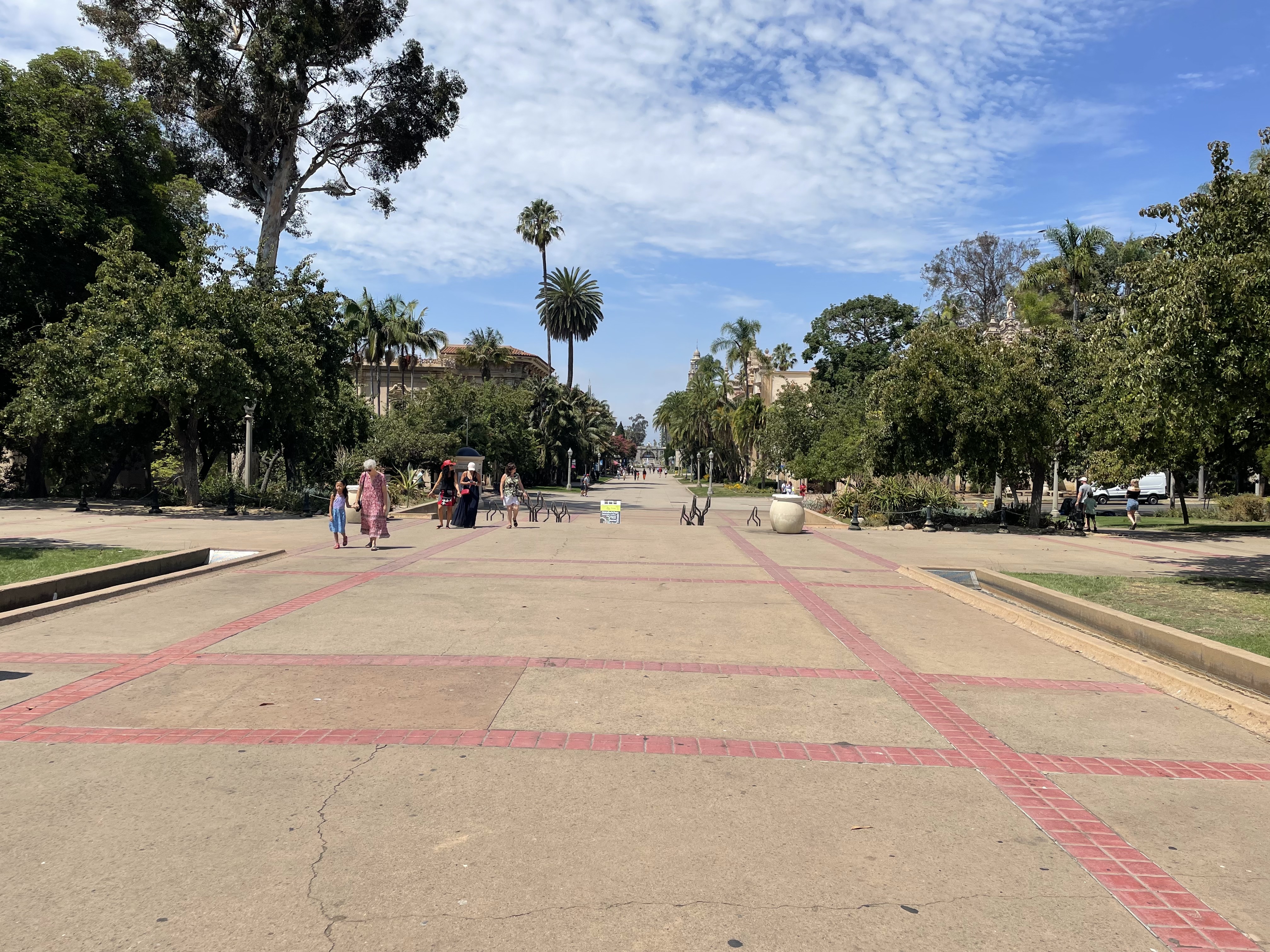
During our vacation in 2022 to San Diego, my wife and I spent a morning strolling around Balboa Park. Named for the Spanish-born explorer and perhaps the first European to witness the Pacific Ocean, this 1,200-acre site has a long, rich history going back to 1868 when San Diego’s leaders set aside the scrappy undeveloped area for public use. It didn’t really begin to take shape as a recognizable park until 1892 when a schoolteacher turned botanist and entrepreneur named Kate Sessions leased 32 acres of the property for her growing nursery’s propagation. She also agreed to plant trees annually in the park and in other public spaces around the city. The species included cypress, pine, oak, and eucalyptus. Some of the oldest specimens in the park today were part of the original plantings. She also introduced exotic plant species such as bird of paradise, Queen palm, and poinsettia. Her efforts eventually earned Sessions the honorary title “The Mother of Balboa Park.”

Balboa Park, San Diego, California

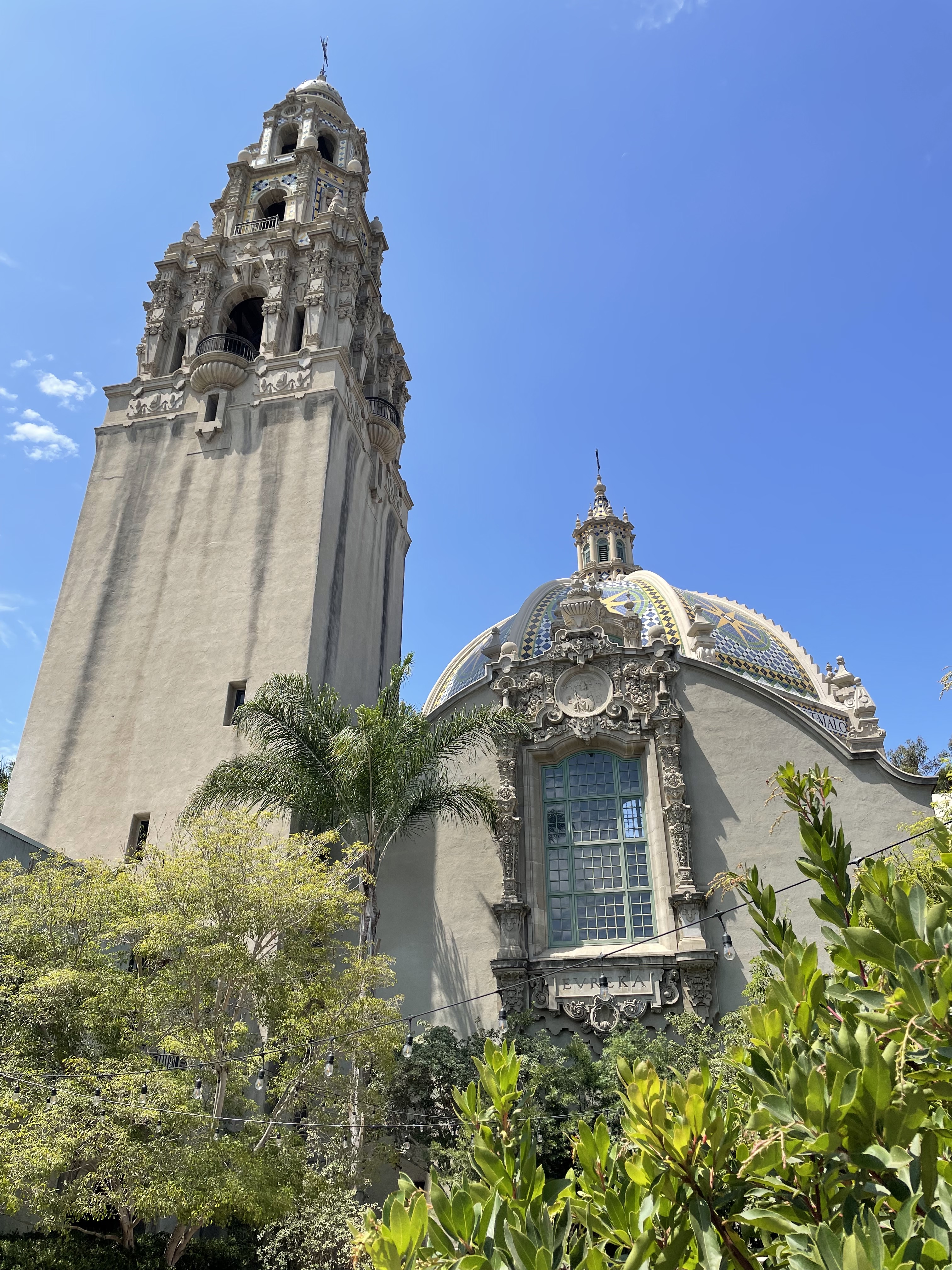
By the early 20th century, the City of San Diego had installed water systems, roads, and other infrastructural elements to Balboa Park. The origin of the elaborate Spanish Colonial architecture dates to 1915 when the park was selected as the site for the Panama-California Exposition. The Cabrillo Bridge and the buildings along El Prado date to this event, along with the Spreckels Organ Pavilion. More buildings were added for the California Pacific International Exposition of 1935-36, especially in the Southern Palisades area. These structures have a much more Southwestern look in the tradition of Pueblo Indian architecture and even Mayan designs.

Balboa Park, San Diego, California

After World War II, several of the main buildings were converted to museums and other cultural institutions. Today, visitors to the park can enjoy the San Diego History Center, San Diego Museum of Art, San Diego Natural History Museum, Fleet Science Center, Institute of Contemporary Art, Museum of Photographic Arts, Women’s Museum of California, Veterans Museum, WorldBeat Center, Museum of Us, San Diego Air and Space Museum, San Diego Mineral and Gem Society, San Diego Automotive Museum, San Diego Model Railroad Museum, Mingei International Museum, the Marston House (early 20th-century Arts & Crafts design), Comic-Con Museum, and Timken Museum of Art.

Balboa Park, San Diego, California

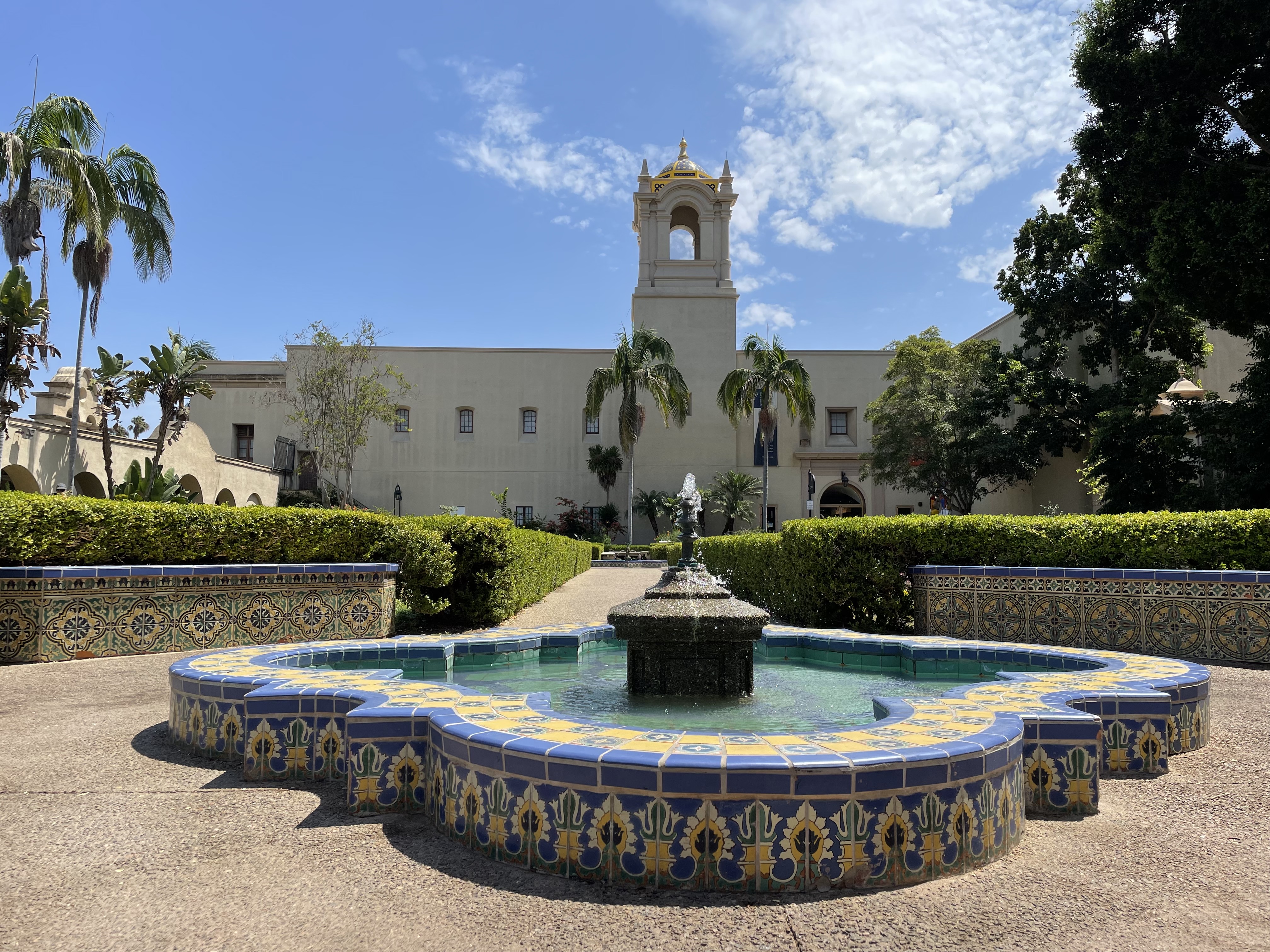
There are fountains and gardens throughout the park, along with the Japanese Friendship Garden (subject of an earlier post). There are restaurants and coffee shops. There are statues (especially in Sefton Plaza), the impressive California Tower, the Spanish Village Art Center, a beautiful carousel, and a miniature train. The park’s visitors center is the best place to start exploring the site. If we return to San Diego, I plan to devote more time to wandering through some of these museums. The Botanical Building and Lily Pond were undergoing major renovation work when we were there, so I definitely want to see those if we go back to Balboa Park, and I hope we do.

Balboa Park, San Diego, California

Taliesin West: Frank Lloyd Wright’s Desert Oasis

In 1909, famed American architect Frank Lloyd Wright began constructing a house on the brow of a hill near Spring Green, Wisconsin. He had grown up in the hills of the state and was inspired by the landscape. His mother was of Welsh descent, and he named the 800-acre estate Taliesin, which is a personal name rooted in Welsh mythology that translates to radiant or shining brow. This was not Wright’s first home, nor would it be his last. He had completed a small two-story residence in Oak Park, a suburb of Chicago, in 1889. Fire almost completely destroyed Taliesin in 1914 and again in 1925, but Wright rebuilt both times.

In the early 1930s, Wright and his third wife, Olgivanna, established an architectural apprentice program at his Wisconsin home called the Taliesin Fellowship, which provided students with an immersive experience that integrated design and construction with growing and preparing food and the study of the arts. The term the Wrights used was “organic architecture.” Wright would continue to make changes and additions to Taliesin over the years after the fires, including converting a chicken coop into a dormitory for his architectural apprentices!

Wright and his students needed seasonal respite from the harsh winters of Wisconsin and found one in 1934 when he rented space for the Fellowship in sunny Arizona. The change in climate was so welcoming that Wright decided to create a winter location for his school. He purchased property in the rugged Sonoran Desert at the base of the McDowell Mountains in Scottsdale, northeast of Phoenix, where he and his apprentices would construct Taliesin West. This winter camp would become a study in how to blend architecture into a stark landscape incorporating water, shade, foliage, and indigenous materials to create a desert oasis. Wright’s architectural school used both Taliesin locations depending upon the season, even after the master’s death in 1959 in Phoenix at the age of 91. Although the Wisconsin program at Taliesin East finally closed in 2020, the tradition continues to this day with the Frank Lloyd Wright School of Architecture in two locations in Arizona. Both Taliesin East and West are now historical sites open to the public, with guided or self-guided tours available.

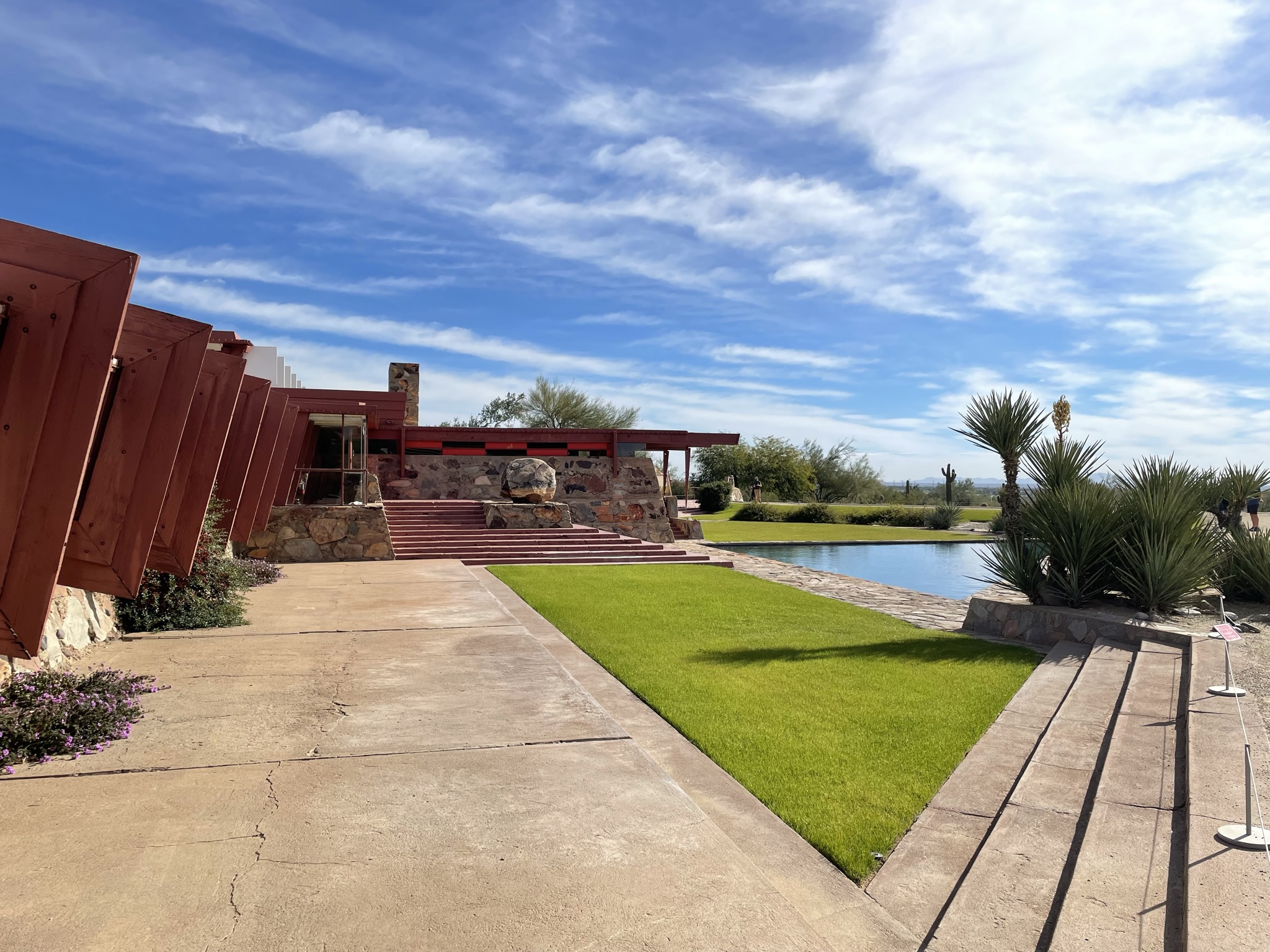
Taliesin West in Scottsdale, Arizona

During the week following Christmas in 2022, my wife and I returned to the Phoenix area for a vacation. It is one of our favorite destinations in the country and where we hope to spend considerable time during retirement. On this trip we visited Taliesin West, which was my first time seeing the site. We took a self-guided tour, using a mobile phone app with earplugs to listen to a virtual guide describe the structures and surrounding grounds as we walked through a series of numbered stations over the course of about an hour. The whole setup was quite slick – impressive and informative. Along with other visitors taking the same tour, we were able to stroll through the various rooms and outdoor spaces. It is understandable why Andrew Pielage decided to call his photographic exhibition of Wright’s work “Sacred Spaces,” showcasing how the architect skillfully designed structures that seem almost sanctified.

Taliesin West in Scottsdale, Arizona

Several design elements of Taliesin West stand out in my mind. A common theme throughout is the use of sharp angles for roof lines, steps, walkways, and water features. This collection of points is reminiscent of the McDowell Mountain peaks visible to the east of the property. The stone and plaster walls, interior and exterior, imitate the rocky outcroppings around Scottsdale and throughout the Phoenix valley. Red, orange, brown, and blue are dominant colors for painted surfaces and fabric, reflecting the palette of the Sonoran Desert floor and the skies above that remain clear most of the time. Although rare in the desert, water is present in the form of rivers, such as the Salt, Gila, and the Agua Fria in Phoenix. Also, the Sonoran Desert gets more rainfall than any other desert in North America. Wright and his apprentices included several modest water features at Taliesin West. Some people have speculated that Wright may have become paranoid after suffering through multiple devastating fires and wanted water nearby as a safeguard. In any case, the presence of water created a literal oasis at Taliesin West.

Taliesin West in Scottsdale, Arizona

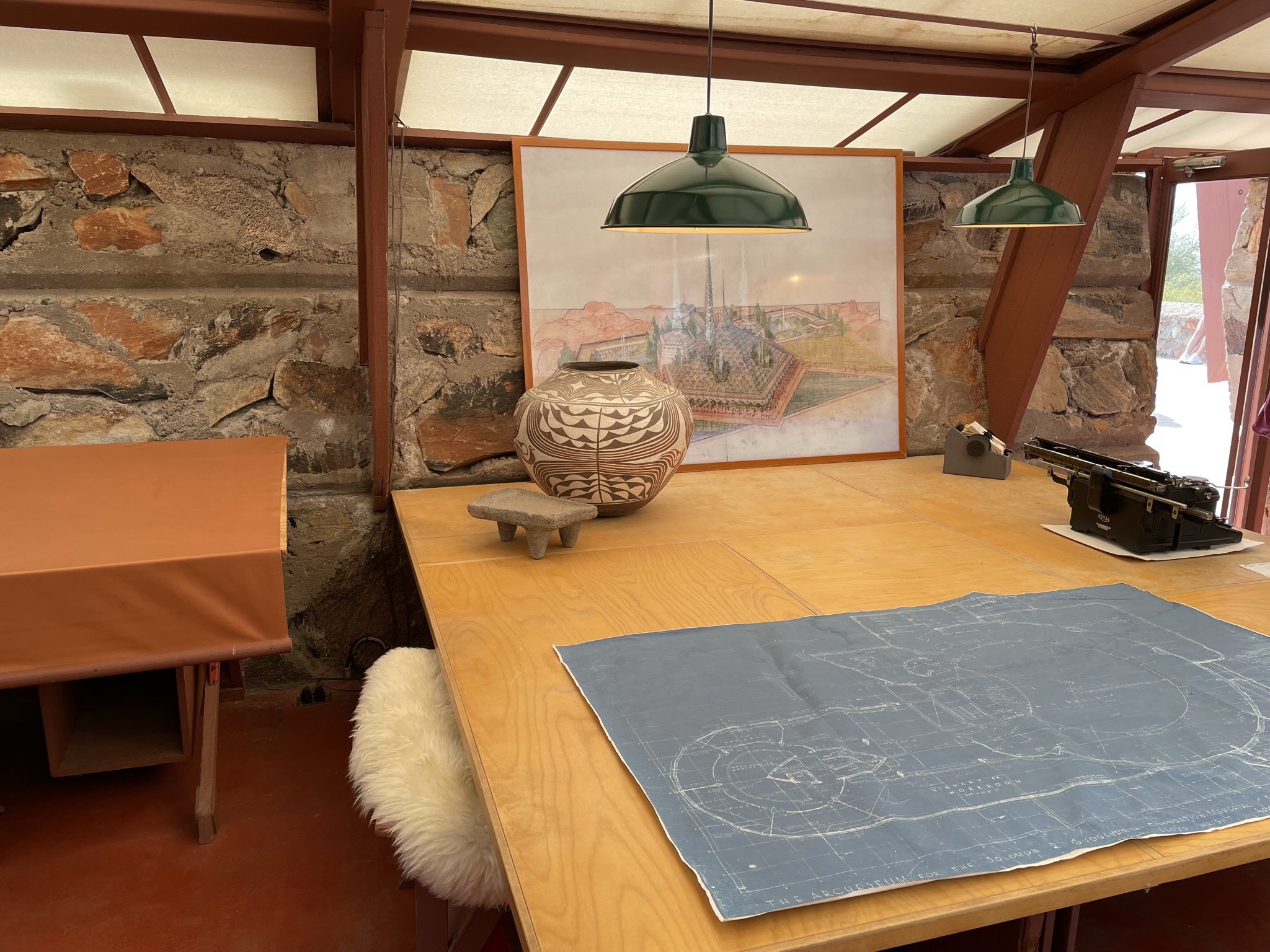
The Frank Lloyd Wright Foundation that owns and operates Taliesin West does a fine job of managing the site as a historically-preserved house museum. The rooms are presented in a fashion that makes them look as if Wright and his students have left for the summer but will return next winter. Spaces are appointed with original (or at least period) art pieces, artifacts, furniture, and furnishings. The story the curators are telling is as much about Wright’s apprentices and their accomplishments as it is about the master architect himself. There are various places where people could gather together, including a small theatre. There are at least three pianos in the buildings, implying how important music was to the general atmosphere the Wrights were producing. Toward the end of his life, Frank Lloyd Wright was hosting cocktail parties with Olgivanna at Taliesin West for select groups of people in the greater Phoenix area. What fascinating conversations must have occurred at such gatherings, no doubt dominated by the celebrity architect who had grown so fond of his sacred space in Arizona.

Taliesin West in Scottsdale, Arizona

Art for Everyone

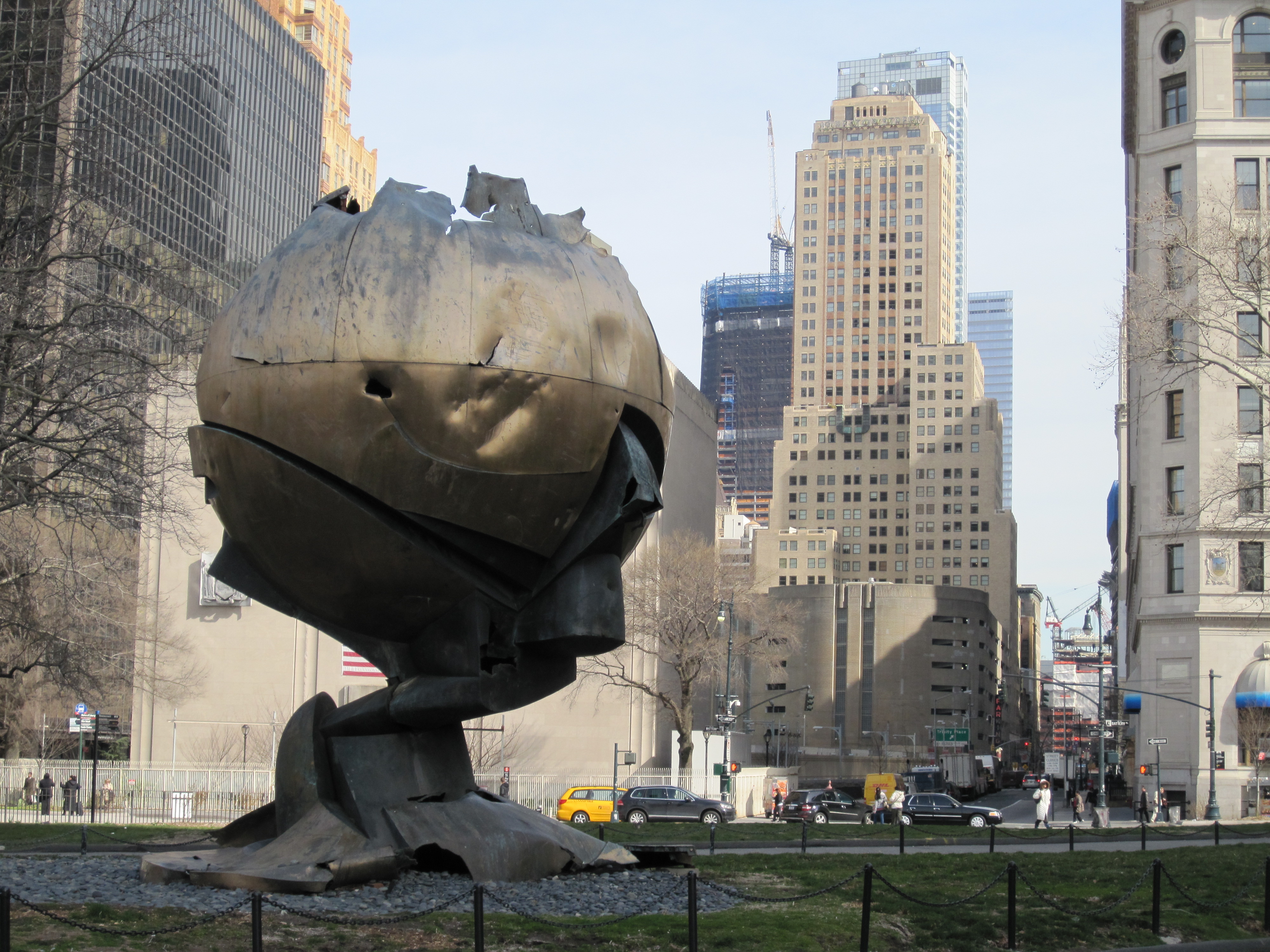
In 1967, a German sculptor named Fitz Koenig received a commission by the Port Authority of New York and New Jersey to install a work of art to be featured on the Austin J. Tobin Plaza situated between Word Trade Center’s twin towers, which were being built at the time. Koenig created a 20-ton cast bronze sphere 17 feet in diameter mounted on a disk pedestal positioned in the middle of a water fountain. Anyone visiting the plaza could pause to witness the largest bronze sculpture in the world at that time. After the twin towers fell in the terrorist attacks of September 11, 2001, Koenig’s Sphere, though seriously damaged, was the only work of public art at the World Trade Center that survived the destruction.

The Sphere in New York, NY

The sculpture was removed from the wreckage and brought back to Manhattan six months later and reinstalled in Battery Park, several blocks from its original location. It was later moved to Liberty Park. Ironically, Koenig’s Sphere was dedicated in 1971 to “world peace through trade.” The Sphere represents a remarkable example of how a work of art can take on a whole new meaning for the public based on outside forces that transform the piece, literally and figuratively. Upon its rededication, Koenig’s Sphere was recognized as “an icon of hope and the indestructible spirit of this country.”

I have written in a previous blog post about the value of public gardens, which I define as those that are open and free for everyone to enjoy at no cost. In a similar fashion, public art offers an opportunity for people to experience creative expression in almost endless media, shapes, sizes, colors, and settings. Large cities all over the world are adorned with magnificent art in public places, but even the smallest towns and villages show pride in their communities with various art installations, modest as they may be. They may take the form of a sculpture honoring a benefactor of a local garden, which is a wonderful way of celebrating two different treasures available to the public.

Springfield Botanical Garden in Springfield, MO

Municipalities often use statues or murals to draw attention to important figures in the history of their communities or significant events from the past. Then again, statues can be whimsical or can portray a particular type of character, including those from works of fiction or fairy tales. Wildlife is a frequent subject of public art too, which all ages tend to appreciate. Some businesses install works of art in front of their locations for the public to enjoy, which also attract customers and can even assist with brand recognition. Sometimes a statue or other work of art can have a dual purpose: as a stand-alone piece that also serves as a planter, an entrance, a directional sign, or any number of other functions.

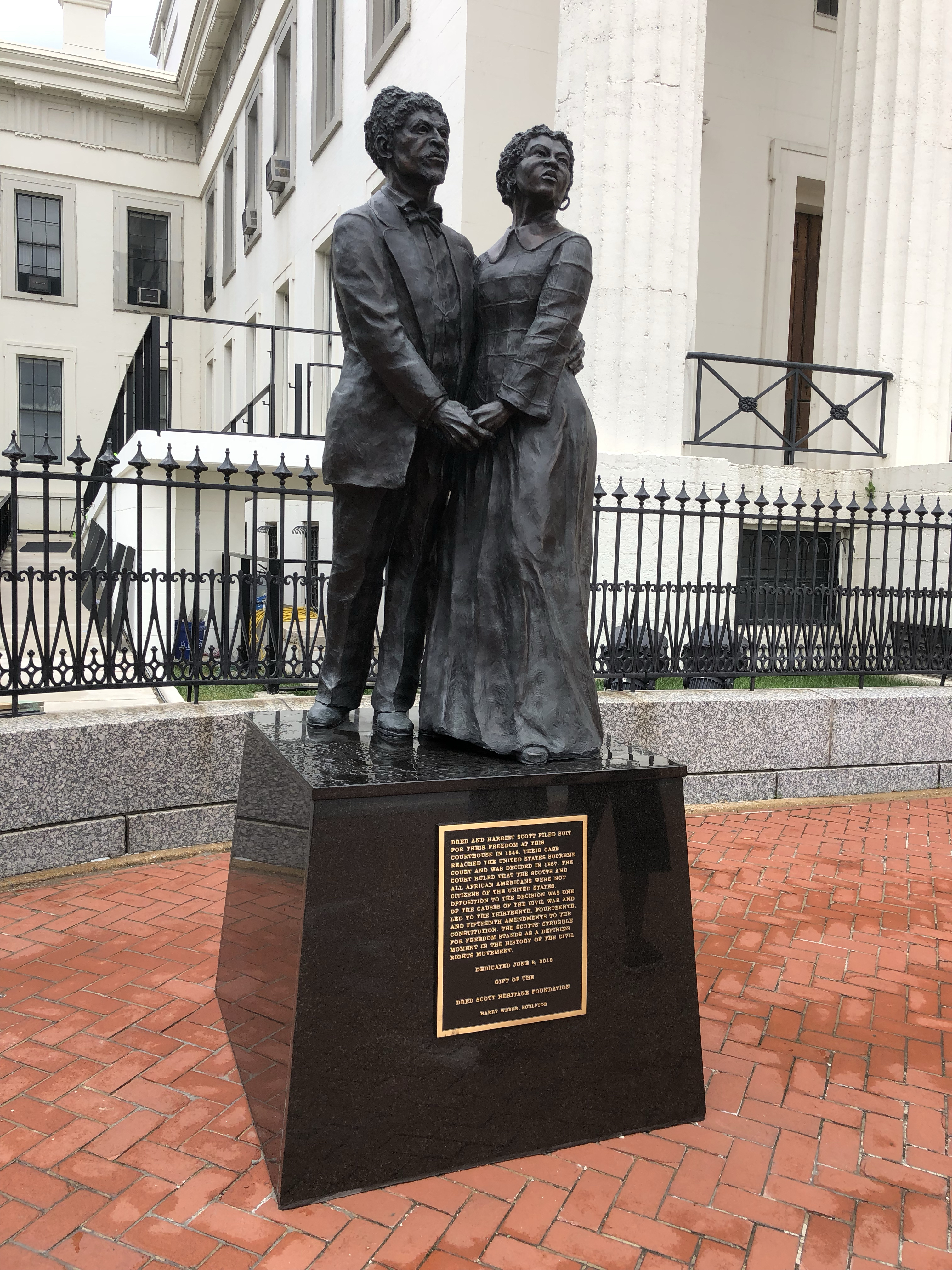
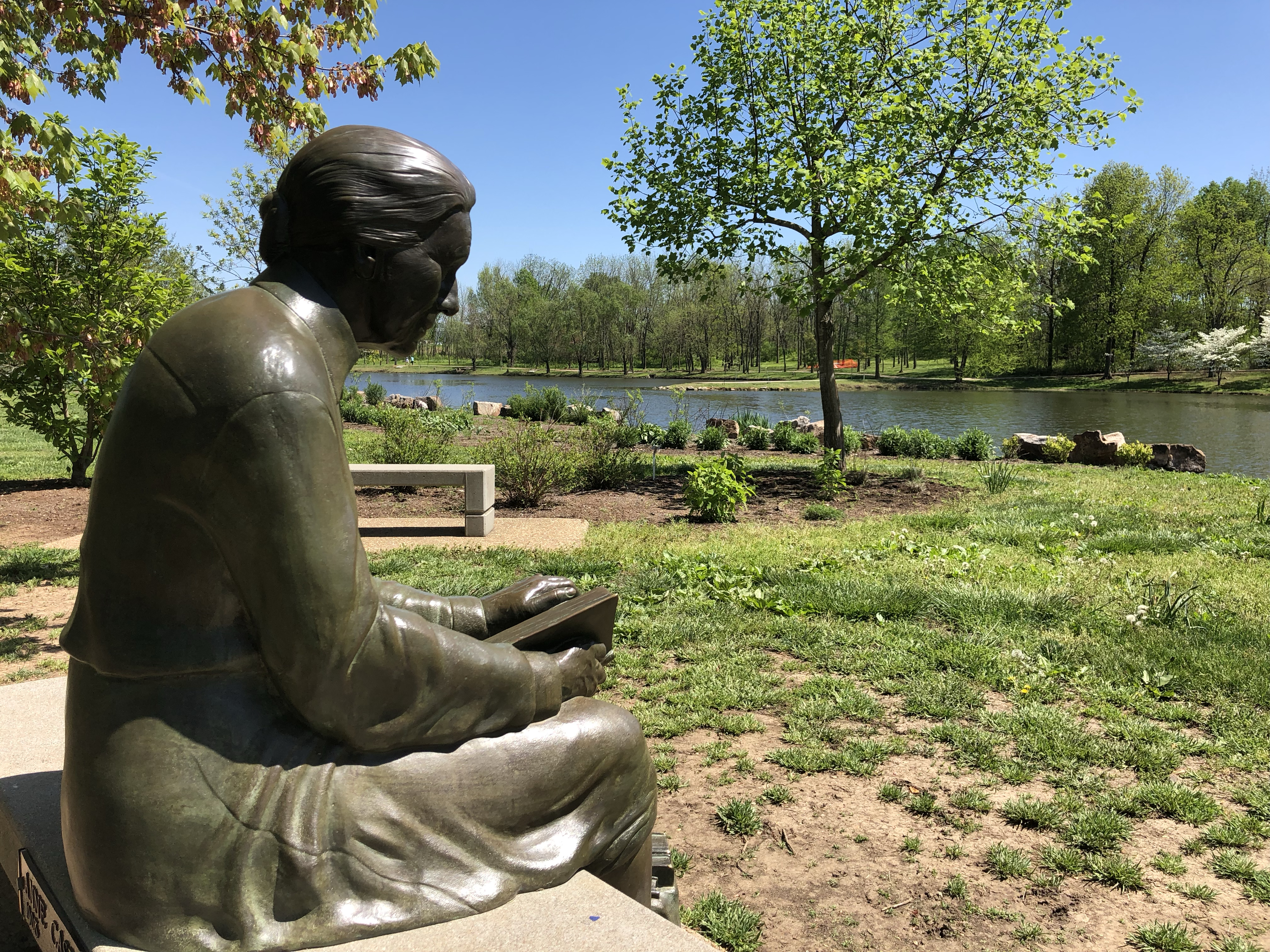
Dred and Harriet Scott in St. Louis, MO
Duke Kahanamoku in Huntington Beach, CA
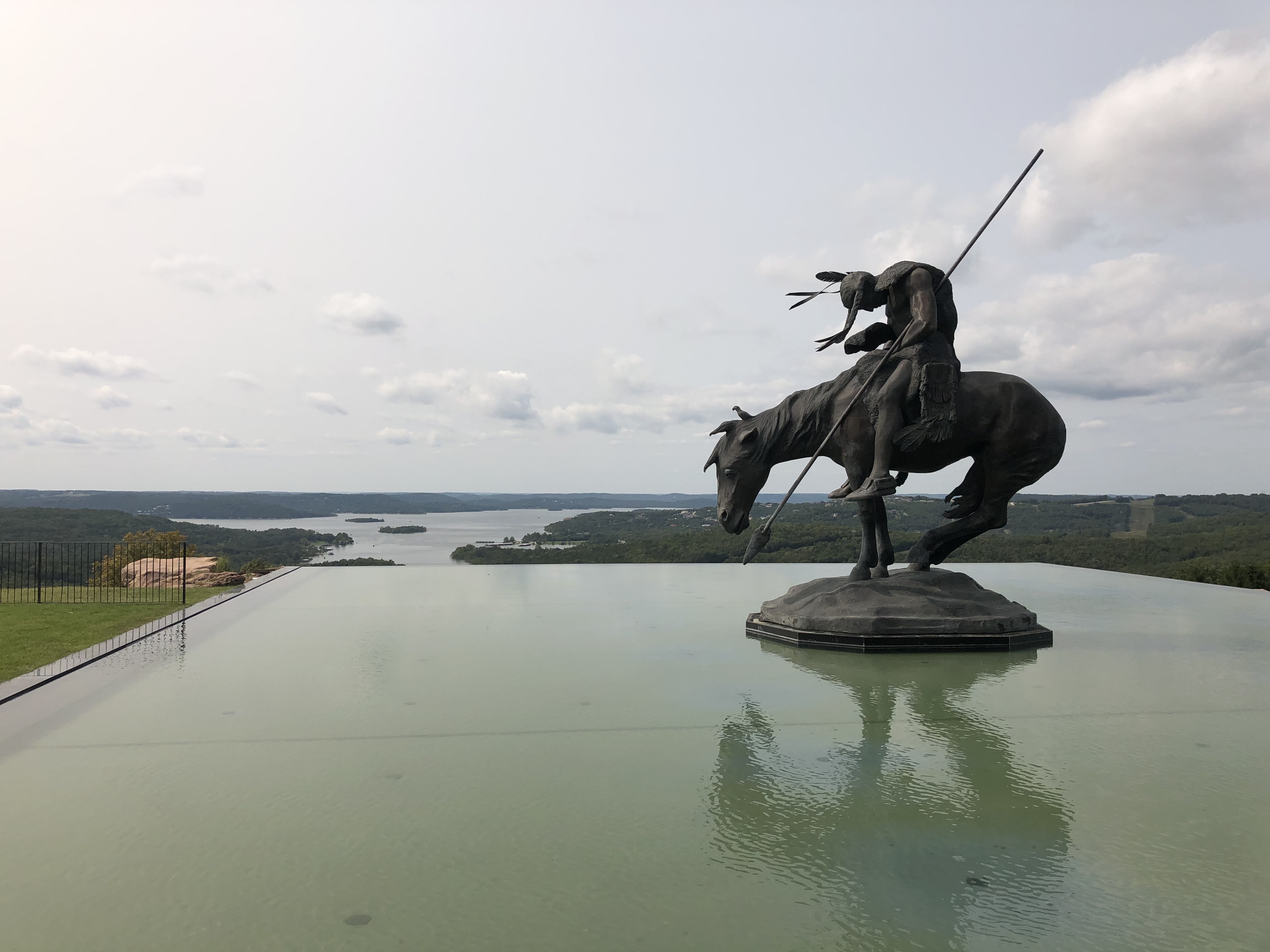
Top of the Rock near Branson, MO
Memphis, TN
Memphis, TN
Country Club Plaza in Kansas City, MO
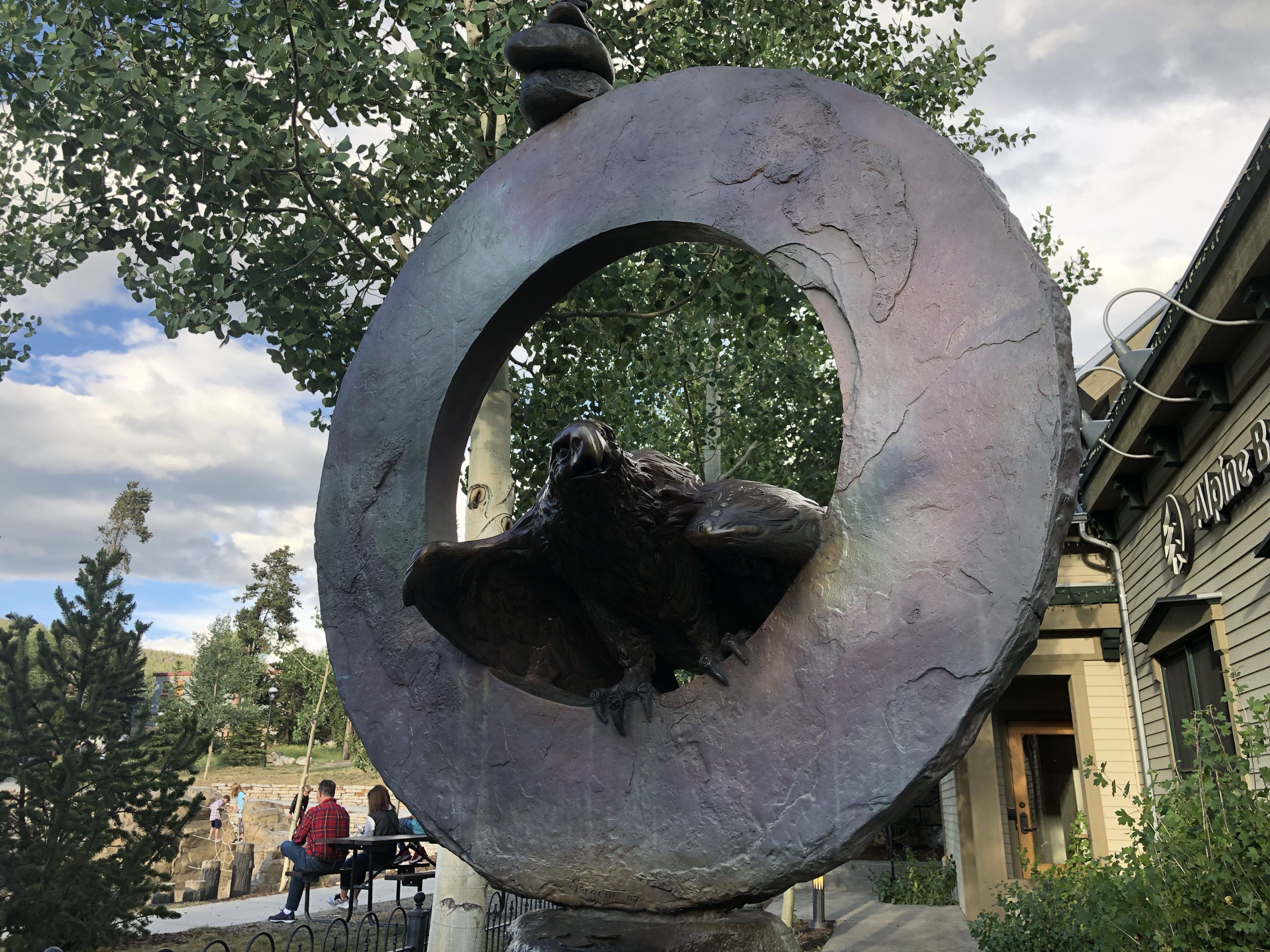
Breckenridge, CO
Breckenridge, CO

Museums and galleries that charge admission fees will often have several pieces of art located outside their buildings for people passing by to see. Better yet, some of them include free walking trails on their grounds featuring artwork that is usually quite spectacular and impressive in size and concept. Most valued and valuable works of art in the world are kept in secure, climate-controlled buildings and guarded closely. Access to these treasures is primarily limited to those who can afford admission fees; however, many of the world’s most famous art museums open their doors to the general public for free, at least several times annually. How fortunate are the folks who can take advantage of opportunities to see first-hand the works of the masters from centuries past. But we should never take for granted the art that surrounds us wherever we go. It’s there, and some of it is absolutely amazing.

Santa Fe, NM
Santa Fe, NM
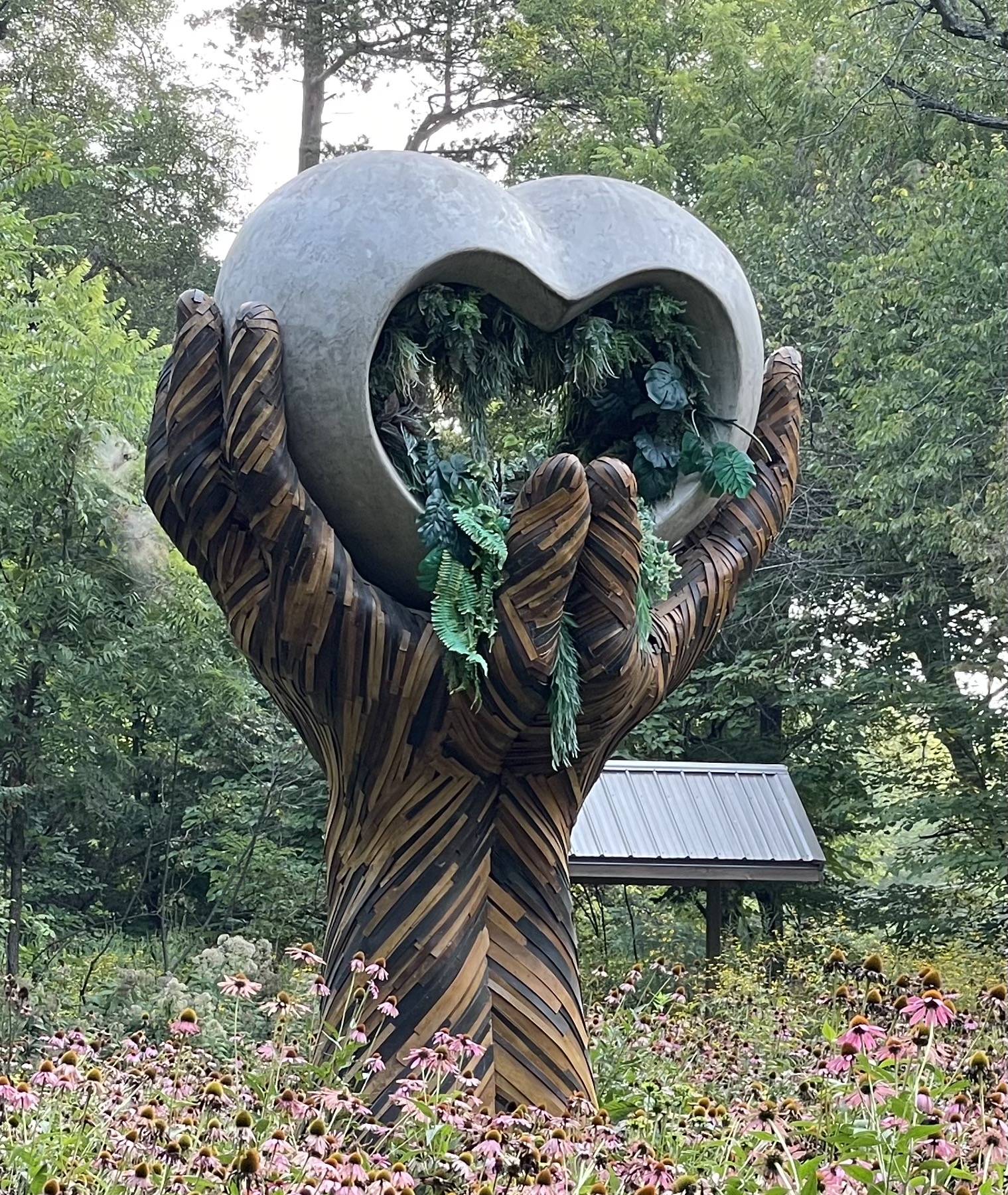
"Stone Heart in Wooden Hands" at Crystal Bridges in Bentonville, AR
“Stone Heart in Wooden Hands” at Crystal Bridges in Bentonville, AR

Santa Fe: Art Gallery of the Southwest

My wife and I took a trip to Santa Fe, New Mexico, during the summer of 2014.  She had been to the town several times, but I had not. We both love art, culture, and the southwest, and Santa Fe is one of those places where all three intersect.  We stayed in a lovely, rambling casita just off Canyon Road, which placed us in walking distance from the historic downtown attractions and more art galleries than anyone could possibly explore in a year’s time — alas, we were there for less than a week.

Native-American settlement in this area of the state goes back at least to the mid-11th century, with Pueblo Indian villages occupying the site for about a hundred years. Spanish explorers created a small village here thirteen years before the Mayflower Pilgrims established the Plymouth Colony. Santa Fe is the oldest capital city in the U.S. and still holds the record for the oldest public building in America, the Palace of the Governors. The city was captured and claimed by the U.S. in 1846 during the Mexican-American War. After New Mexico gained statehood in 1912, Santa Fe began to attract even more visitors from across the country who were drawn to the city’s dry climate and rich history.

Art and architecture have been among Santa Fe’s most valuable commodities from its early beginnings as a settlement for indigenous people. During the 20th century, the leadership and citizens of Santa Fe took measures to preserve the city’s ancient landmarks and maintain its multicultural traditions. Zoning codes are in place to protect the city’s distinctive Spanish-Pueblo architectural style of adobe and wood construction. Of course, other styles are fully represented in Santa Fe, including Greek Revival, Victorian, and Spanish Mission Revival.

Dragon sculpture over Ellsworth Gallery in Santa Fe

The historic district of Santa Fe is packed with galleries and museums, but the variety and abundance of public art on display transforms this southwestern village into a huge open-air exhibit. Galleries and other businesses often have interesting artwork on the exterior of their buildings that range from traditional to whimsical, like the pounded-copper dragon sculpture by artist Ilan Ashkenazi atop the Ellsworth Gallery, reflecting the gallery’s Japanese antiques and Samurai armor collections. The “Rock Paper Scissors” stainless steel and bronze sculpture by artist Kevin Box at a nearby gallery is another example.

"Rock, paper, scissors" sculpture in Santa Fe
“Rock, paper, scissors” sculpture in Santa Fe

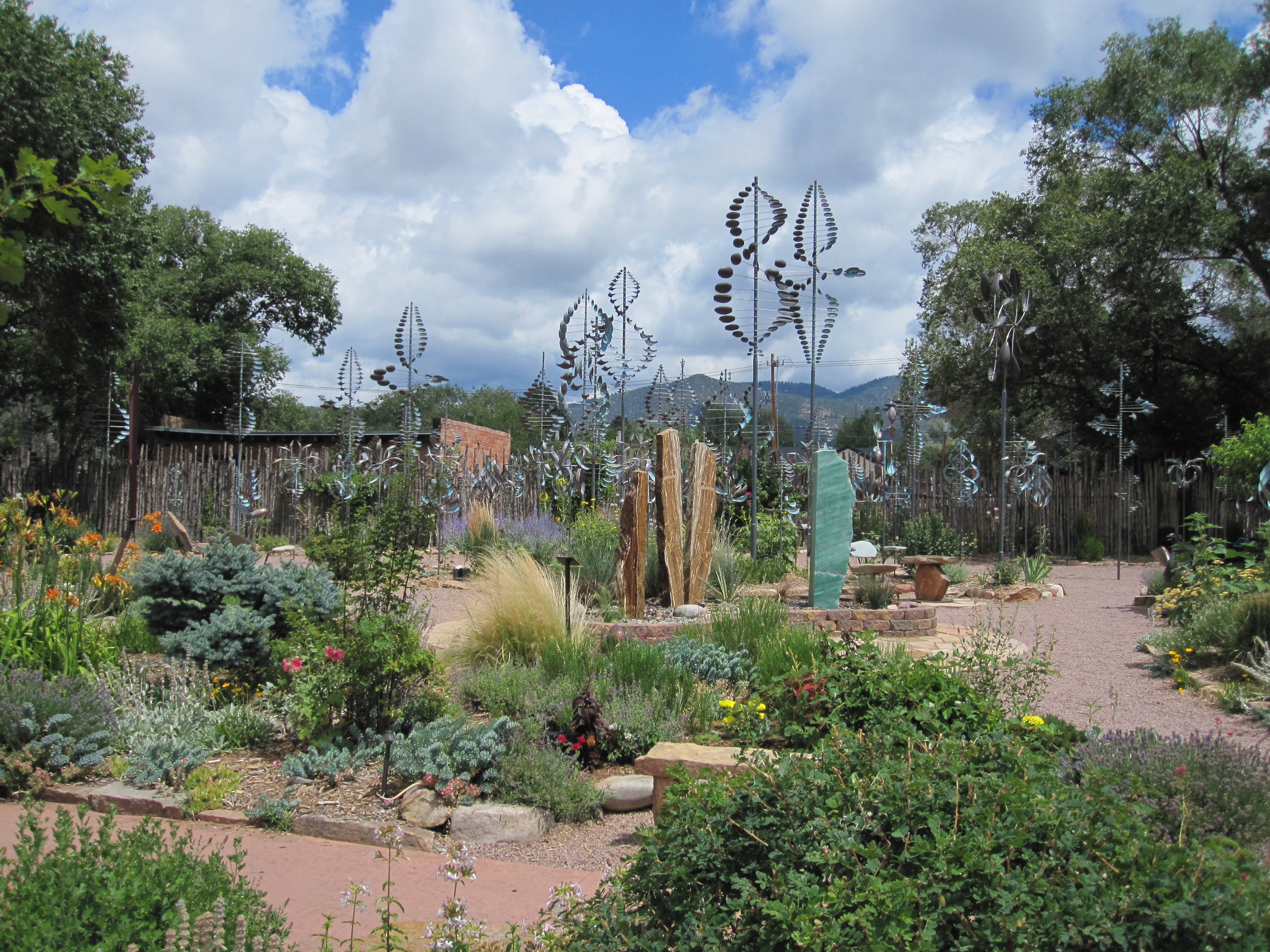
Public art abounds in Santa Fe, and it comes in all shapes, sizes, and media. If you’re looking for garden art, there are plenty of public green spaces decorated with a variety of individual and collective installations. However, there are also outdoor garden galleries selling a whole host of fascinating pieces, including the mesmerizing whirligigs and the startling face sculptures. Public buildings also get in on the act. The “Santa Fe Current” is an installation by artist Colette Hosmer of sculpted fish “swimming” through pebbles in the garden area just outside Santa Fe’s Community Convention Center.

Whirligig garden in Santa Fe
Sculpted garden faces in Santa Fe
"Santa Fe Current" sculpture by Colette Hosmer
“Santa Fe Current” sculpture by Colette Hosmer

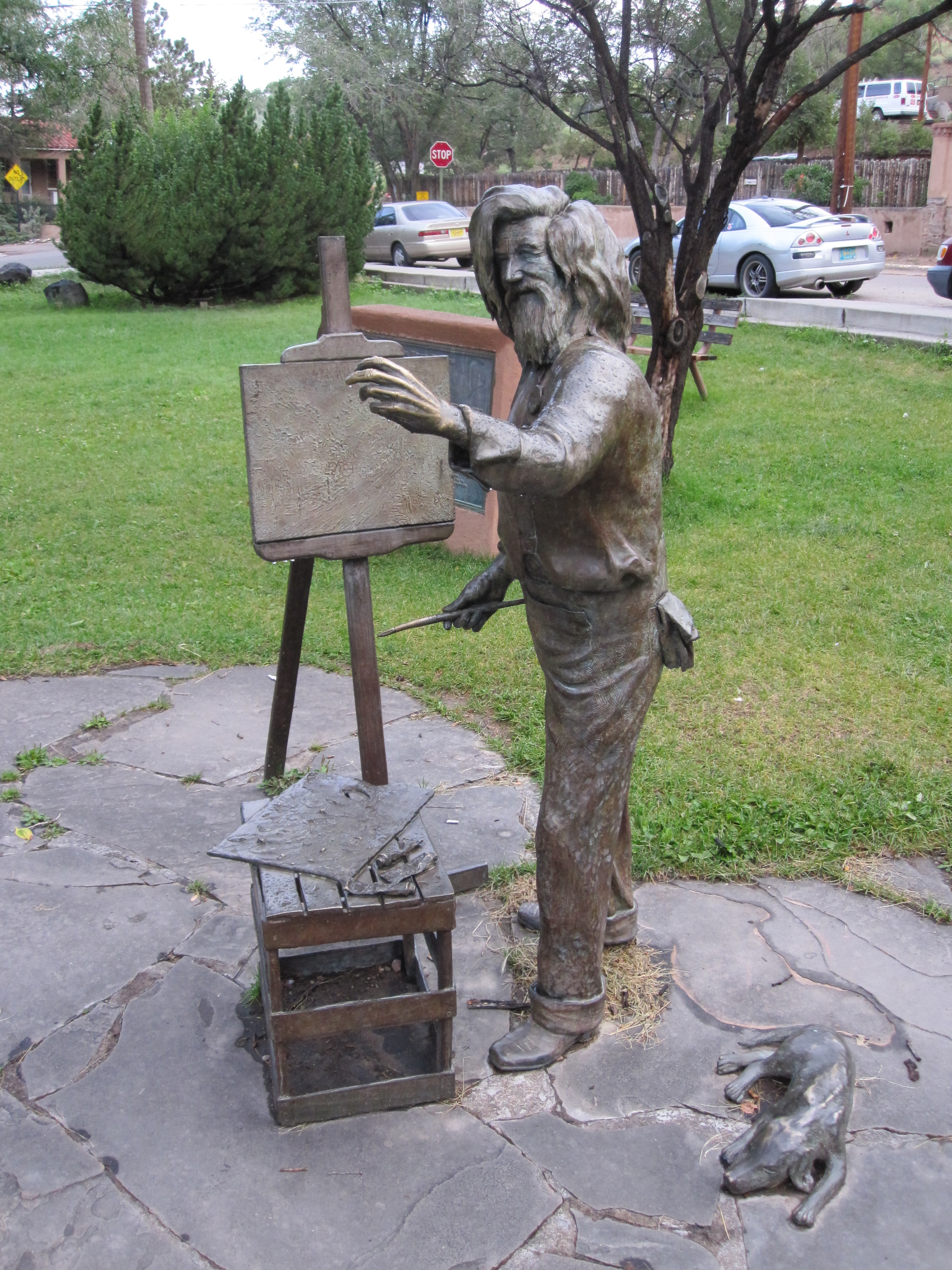
Bronze statues are almost ubiquitous in Santa Fe, scattered throughout the town on public and private property. I was especially enamored with the statues of children playing, but there are many other subjects by artists like Native-American sculptor Roxanne Swentzell. Statues of cowboys and animals are plentiful too. One of the most beloved statues resides in Thomas Macaione Park, named after a Santa Fe artist the locals affectionately called “El Diferente.” The statue depicts Macaione holding a paint brush and standing at his easel with a wooden crate at his feet holding his palette. There is also a statue of a dog resting a couple of feet away on the flagstones where Macaione stands. The piece was created by Mac Vaughan.

Thomas Macaione “el Diferente” bronze sculpture in Santa Fe
Sculpture of children playing in Santa Fe
Sculpture of a child reading in Santa Fe

One of the highlights of this trip was the opportunity I had to get up each morning just after sunrise and head down Canyon Road, which includes a half-mile section with over a hundred galleries, boutiques, and restaurants. From there I wandered around the old historic section of Santa Fe taking photos of art, architecture, gardens, wildlife, and the landscape. Some of the best shots I took of the surrounding countryside were from the hilltop ruins of Fort Marcy, which dates to the Mexican-American War. While I was roaming around the streets and alleys of Santa Fe in the cool of the early morning, there were very few people out and about at all. I could walk several blocks without seeing a soul. It felt like I had been given an exclusive pass to a museum that was closed for the day, and I was the only visitor. How unusual. How wonderful.

Sculpture of two Native-Americans in Santa Fe
Sculpture of nude couple kissing in Santa Fe
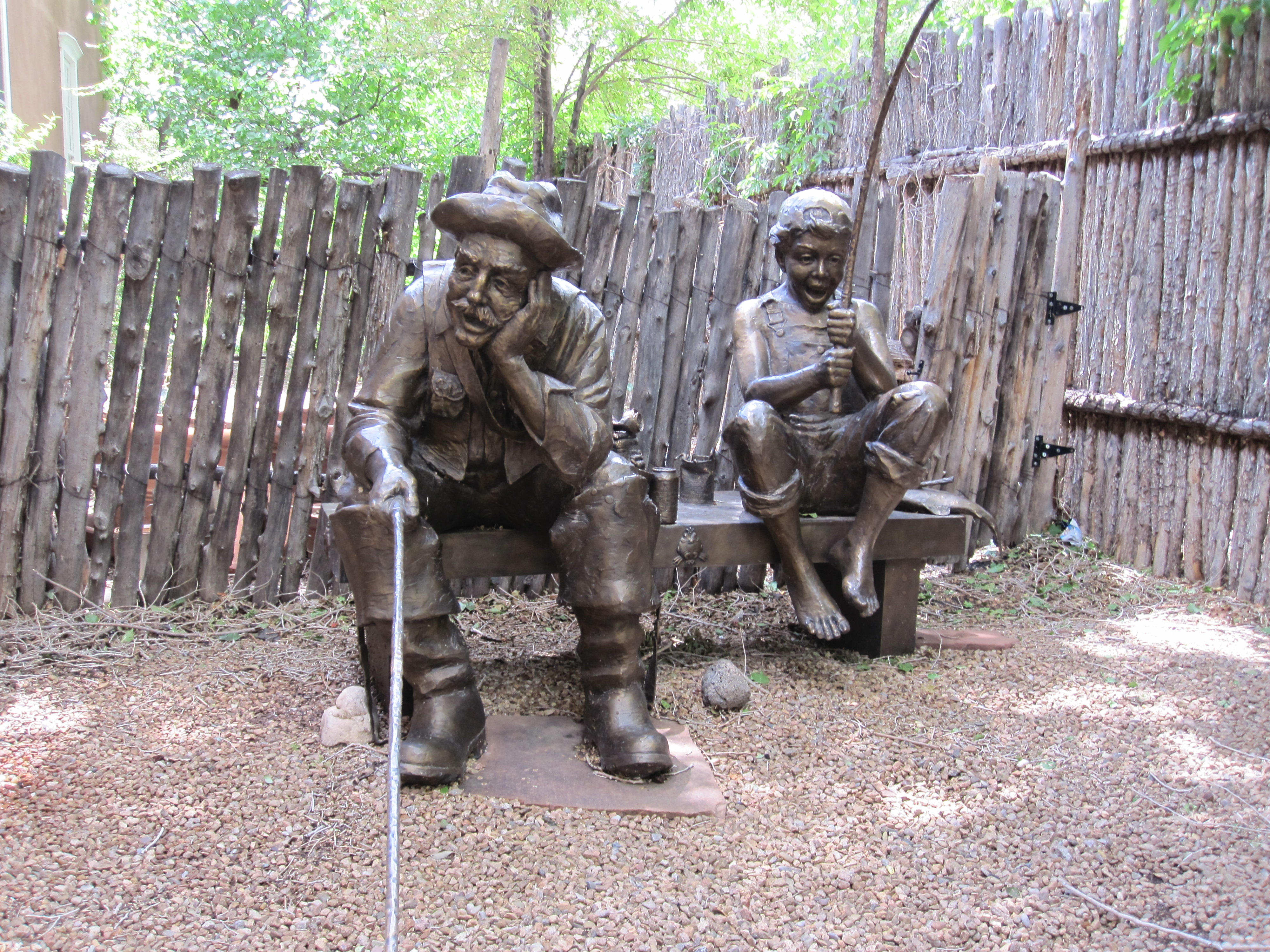
Sculpture of man and boy fishing in Santa Fe

A Surprising Concurrence of Events

Perci Diaconis and Frederick Mosteller are two mathematicians who published a study in 1989 exploring the science behind coincidence, which they defined as “a surprising concurrence of events, perceived as meaningfully related, with no apparent causal connection.” They observed how coincidences “can alter the course of our lives; where we work and at what, whom we live with, and other basic features of daily existence . . . .” Lately, I have been contemplating the surprising concurrence of events that has led me to where I am now in 2020, at the age of 60, and approaching what I hope will be the final third of my life.

I have happily admitted on many occasions that I am the luckiest man I have ever met. Usually, I am referring to the good fortune of being married to my amazing wife, whom I adore and cherish. I also know that a series of key events and decisions over the last 55 years has determined the path I have taken in my career, and I couldn’t have predicted at an early age how rewarding this journey would be. Of course, there are plenty of people who have had similar experiences and have advanced so much further in their professions than I ever will. I also know that the success I have enjoyed is not completely due to my knowledge, talent, and skills – not by a long shot. Again, I am a lucky guy.

I can almost see my vocational journey as a hiking trail, with switchbacks and long winding stretches, ups and downs, a few chance encounters, forks in the path, even a few rocky sections, all of which have led me to this place. How much is serendipity and how much is deliberate, I can’t say with any certainty. Perhaps the trailhead took the form of a set of The World Book encyclopedia our family purchased in the early 1960s, when I was a young child. I can’t remember how old I was when I started thumbing through the pages to look at the photographs and illustrations, but it was definitely before I started school. The World Book gave me an early appreciation for books and reading, for independent learning, and even for order – the set was arranged alphabetically, as were the articles within each bound volume.

The first marker on the trail was likely my assignment as a library assistant in elementary school. I have no recollection why either my teacher or our school librarian selected me for this responsibility, but I vividly remember removing cards from the pockets of books checked out by my classmates, using a stamp to imprint the due date on the card and the slip in the book, and filing the card in an oblong wooden box (likely with the librarian’s help). At an early age, I was granted opportunities to fall in love with books and reading, which I did. Like many adolescent boys of my generation, I became an enthusiastic fan of science fiction books by writers who defined the genre for the 20th century, such as Isaac Asimov, Robert A. Heinlein, and Clifford D. Simak.

My love of libraries mirrored my love for reading at an early age, and I visited them as often as I could. I must have had a natural appreciation for language, and the classes in high school where I performed best were in English. I was fortunate to have three outstanding English teachers from 7th through 12th grade. I attended a small high school, and I had each of these teachers for two years. They made grammar interesting for me, and they helped me appreciate the power of the written word. Under their instruction, I discovered the difference between writing that only entertains and that which enlightens, enriches, and provokes the reader.

I also had a true fascination for the natural sciences, probably nurtured by hours of emersion in The World Book. When I started at the local community college, I had big dreams of someday working in the field of medical technology. I knew hardly anything about it. I thought working in a hospital would equate to lots of money and prestige, but I knew I wasn’t ambitious enough to slug through medical school to become a doctor. Turns out I wasn’t even ambitious enough to pass college chemistry – it looked too much like algebra, which to this day baffles me.

With encouragement from advisors and after a careful look at the curriculum requirements, I decided an Associate’s Degree in Journalism would be my best hope of staying in school. This switchback in the trail also prompted me to start writing for the college newspaper, and one of my assignments was to report on a lecture being presented by a woman who had recently edited a collection of letters by a Georgia author. I was painfully immature and had virtually no appreciation for academic scholarship. My first draft of the article reflected my stupidity and shallowness, which my journalism professor was quick to point out to me. I had no idea what an important contribution the visiting scholar, Sally Fitzgerald, had made to the world of American literature nor how her work would impact my own world in the years ahead.

After graduating from the community college, my trail took me on an uphill stretch to a state college located about 45 minutes from my hometown. By then I had decided that a degree in English was a logical choice, although I was clueless about how I was going to find a career after graduating. I can’t imagine how concerned my parents must have been. However, I was becoming more serious about academics and was confident that I was a good writer – foolish boy. A few seasoned students in the English department had warned me about one professor, a woman with a reputation for pounding the ignorance right out of you. I signed up for one of her classes my second term there, having at least enough self-awareness that I needed discipline and a challenge. The first paper she returned to me looked as if she had slit an artery and bled out on the page. Clearly, I wasn’t such a gifted writer after all.

Meeting this professor was one of those life-changing chance encounters. I was not aware when I first arrived at this institution that its most famous graduate was Flannery O’Connor. I also did not know that the library was the steward of her most valuable personal and professional archive. My fellow English majors had informed me that the demanding professor was also the O’Connor scholar on campus and that she taught a course concentrating on the author’s work. She was the editor of the Flannery O’Connor Bulletin, a journal published by the college and the longest running scholarly publication devoted to a female writer in the country. Perhaps as an act of academic penance and atonement, I signed up for the O’Connor course for the summer session, which meant covering the author’s two novels, two collections of short stories, a volume of essays, and the letters edited by Sally Fitzgerald (the scholar I encountered just two years earlier), all in four weeks.

I had no memory of reading O’Connor in high school and didn’t know what to expect. In this class, I quickly realized her fiction was dark, perhaps even demented to my naïve way of thinking. The Catholicism was lost on this Southern Baptist lad, at least in the beginning, but I immediately recognized the backwoods Protestants that populated her stories. They could have been my relatives. The stories were violent and filled with strange and twisted characters – no happy endings, no riding off into the sunset. People sometimes came to gruesome ends. And yet, it was laugh-out-loud funny to me. The best part of all? It was literature. I was unequivocally hooked. This course truly stretched me, and I was proud to get a B when it was over. I requested to change advisors, wanting to be under this professor’s guidance for the remainder of my undergraduate tenure. I could not have known at that time the central role she and her O’Connor course were to play in my professional journey.

I took history courses as electives in the humanities for my major, enough to earn a minor in the field. Knowing I really didn’t want to teach high school English, I decided to stay on at the college and work toward an M.A. in history. I was a much more serious student now, and my grade point average reflected it. On-campus jobs opened up for me too, like working at a small education museum and archive. This college gave M.A. students an option to earn their degrees by either writing a thesis or by taking additional course work. Maybe I wanted to prove to myself, my professors, and my parents who had sacrificed so much to send me to school that I could write something worthy of a graduate degree, even from a small state college. So, I climbed that steep slope by writing about the desegregation of the county school system where my college was located, using a collection of oral history interviews I conducted with local educators, both white and black.

My graduate school adviser and the supervisor of my thesis was a member of the local public library board. Upon my graduation, he was kind enough to get my foot in the door with the library’s director, who was planning to hire a cataloger. After working a year at the public library, the director encouraged me and another employee to apply for library school at Emory University. It was a two-hour drive from where we lived, but our boss was generous and supportive enough to allow us to work four days a week and commute to Atlanta two days a week over the next two years to earn what the university called a Master of Librarianship. I will always be grateful to her for this opportunity, which launched my professional career. I eventually became the assistant director of the library, and after 12 years I was appointed the director when my boss left the position. I have written another post about some of the more memorable and bizarre experiences during my time working at the public library.

I stayed connected with the O’Connor scholar on campus and worked with her on several projects, the most ambitious being the Flannery O’Connor symposium in 1994. This four-day conference featured celebrated scholars, writers, visual artists, and performers, including Joyce Carol Oates, Lee Smith, Jill McCorkle, Louise Erdrich, Barry Moser, Polly Holliday, Leo Kottke, and once again, Sally Fitzgerald. People from the community who knew me at all were aware that Flannery O’Connor was my favorite writer, including the lawyer for the literary estate of the author, whose wife also happened to work with me as our children’s librarian. In a blog post from 2015, I wrote about another life-altering event – the day this lawyer walked into my office with a proposal for me to work for the executors of the estate to establish the Flannery O’Connor-Andalusia Foundation. I accepted the offer. This fork in the path allowed me to use my English and history degrees, my library training, and my administrative experience to help preserve and promote the legacy of a great American writer — what a privilege.

My mentor at the state college eventually retired, but she joined the board of directors of the O’Connor foundation, along with the man who followed her in the position. Both people have influenced and enhanced my life in ways I could never express, and I am forever in their debt. One of the grant-funded projects I initiated as the director of the foundation was a book publication, co-edited by the new O’Connor scholar. At Home with Flannery O’Connor is a collection of oral histories of people who knew the author during the time she lived at her family’s farm home, the headquarters for the foundation that we also operated as a historic house museum. Fortunately, I was familiar with oral history as a research tool from my master’s thesis work.

Flannery O’Connor lived at Andalusia for 13 years, which is exactly how long I remained there as the foundation’s director. In 2017, the property was transferred to O’Connor’s alma mater; however, by that time I had moved on to another job because my wife took a vice-president position at a small private college in northeast Georgia. Earlier that year, the president of this college had accepted a gift of property just north of the campus owned by a foundation of relatives and close friends of another Georgia writer named Lillian Smith. The organization was operating the Lillian E. Smith Center as an artist retreat and a literary landmark while also sponsoring programs for students and community members. The college president wanted to continue these activities and expand the center as an educational facility for his students, faculty, and staff. He had no one to manage the center, and I was as close to a perfect fit for the job as he was going to find.

We stayed at our respective jobs with this college for five years. I am still amazed at how much of what I had learned during the previous 30 years prepared me for this position: from property management to programming, from cataloging to curating, from historic research to historic restoration and preservation. I was even able to resurrect some of my early work experience serving as the college archivist for the president and working with the dean of libraries. I have written posts about Lillian Smith and her encounter with Flannery O’Connor – so many surprising connections and convergences that have touched my life.

In 2018, other opportunities took us away from my home state to Missouri. Through a friend of a friend, I met the dean of libraries at a state college in southwest Missouri where we live now. I find myself once again in a place where I can tap into several decades of professional experience to work on meaningful and rewarding projects, and it all just fell in my lap. I am a special projects coordinator working for the dean. I arrange author visits, public readings, and lectures. I also help install exhibits in the library. I conduct interviews for the library’s growing oral history collection. I am moderating a virtual book club for the alumni of the institution. Contrary to popular opinion, librarians do not just sit around a read all day. I always dreamed of a job where I could get paid to read. How lucky am I that part of my responsibilities are to read for a book club? Even better, I am learning new skills involved with editing videos that the library publishes through its YouTube channel, including the oral history interviews.

My father had several common refrains that contribute to the good memories I have about him. For the most part, he was a man of unquestioning faith, instilled and confirmed by a long life of Southern Baptist doctrine. When he recognized a surprising concurrence of events, he rarely wrote it off as coincidence, especially if the events had serious implications. Instead, he would declare, “As far as I’m concerned, the Lord arranges these things.” With pseudo sophistication and agnostic arrogance, many times I just shook my head and said, “I guess so, Dad,” not really agreeing with his assessment of how the universe works. In retrospect, given how my career path has carried me through the years to such wonderful destinations, maybe I need to hold out the possibility that Dad was right.

A New Steward for Andalusia

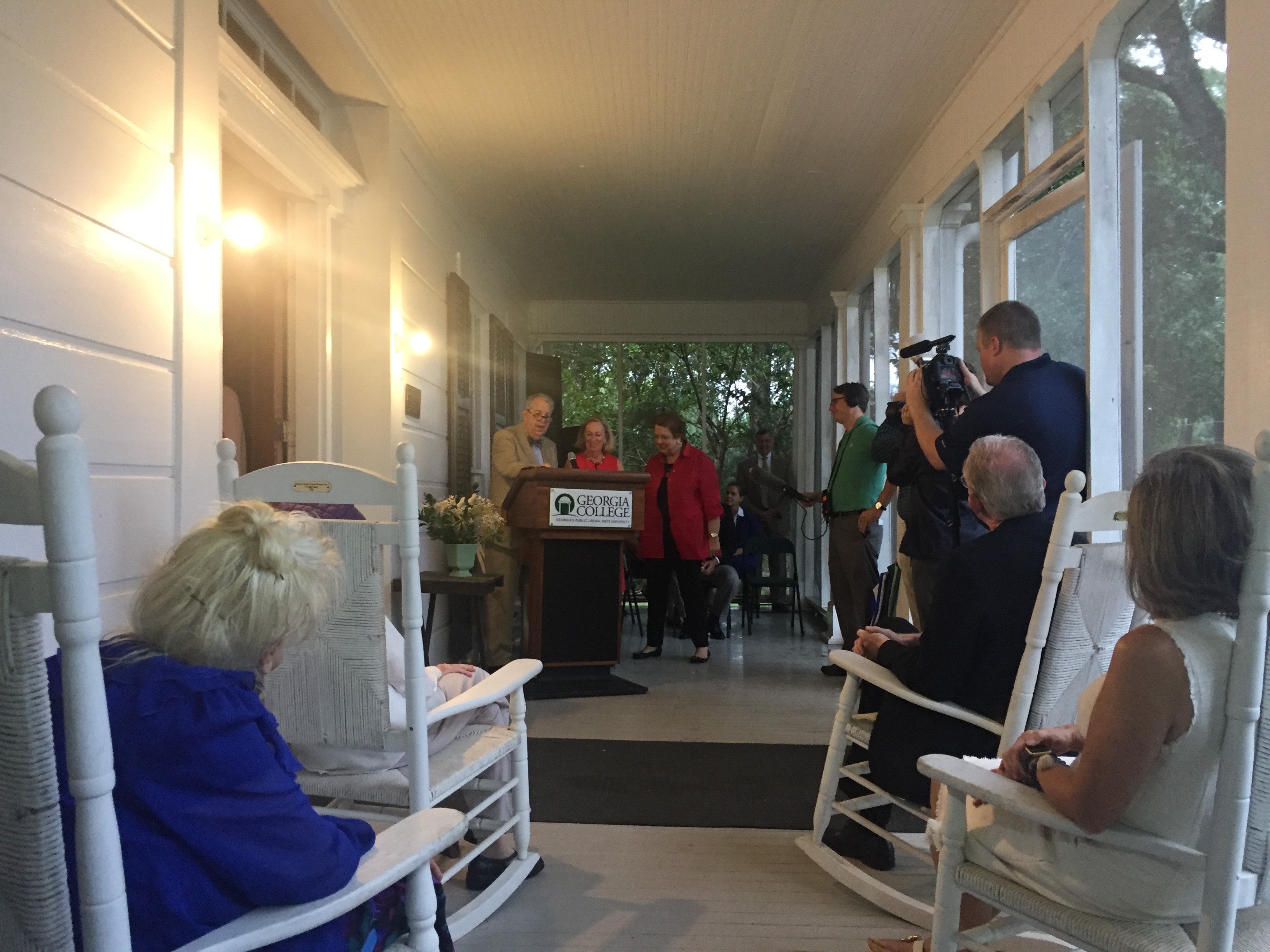
My wife and I were invited to a ceremony on August 9, 2017 making official the transfer of ownership and stewardship of Andalusia, the home of Flannery O’Connor, to her alma mater, Georgia College, in Milledgeville. The great American novelist and short story writer lived on this farm with her mother, Regina, for the last thirteen years of her life. In her first-floor bedroom, O’Connor worked faithfully every morning for several hours, struggling on her manual typewriter to construct sentences and paragraphs that would not only entertain her readers but help them envision the action of grace on characters who were often violently resistant to it.
Andalusia transfer ceremony 8-9-17

We were invited to this special occasion because I served for thirteen years as the founding director of the Flannery O’Connor-Andalusia Foundation, the nonprofit organization that gifted the 544-acre site to the College. The current chair of the Foundation, Donna Barwick, explained to the people gathered that rainy August morning how she and her fellow board members arrived at this decision. “We would never, as a small organization, be able to raise the amount of money that it will take to maintain this place in the way it should be for Flannery’s legacy,” she said. “So we’re confident that this place will be treated properly.” Sadly, she is absolutely correct. Private entities that are responsible for the care and preservation of historic homes have an extremely difficult time raising the capital to do the job — in many cases, it is an insurmountable task. Andalusia is no exception. With a sizable two-story Plantation Plain house and a dozen outbuildings, this literary landmark will require millions of dollars to completely restore it and then a respectable annual budget to maintain it and keep it open to the public.
When I first began as the director of the Foundation, I had unrealistic expectations of how much money we could raise to restore the farm. I was sure that wealthy benefactors would be eager to drop thousands, if not millions, of dollars into our lap in honor of such a great writer. After all, she has friends in high places, at least financially. Celebrities like Bruce Springsteen, Tommy Lee Jones, Bono, Jerry Bruckheimer, and the Coen Brothers have all publicly paid verbal tribute to the author. We made overtures to all of these people, but they either never responded or indicated that they were focusing their charitable giving on other causes, like world hunger.  It’s hard to trump world hunger.

Toward the end of my tenure at Andalusia, I had a meeting with the incoming President of Georgia College, Dr. Steve Dorman, and we spent considerable time then and later discussing the ways in which our Foundation and the College could collaborate. We even toyed with the idea of the College taking over the operation of the site, although we never truly talked about any specific plans or what such an arrangement might look like. Now that the mantle has officially been passed, I am giving some thoughtful consideration to this next chapter for Andalusia. I feel a certain allegiance to Georgia College because it is the place where I earned my BA in English and my MA in History. Naturally, I will always have an emotional attachment to Andalusia, the home of the author whose work I so admire and the place that I devoted so many years to preserving.

I believe that Georgia College is the most logical beneficiary for this remarkable treasure. The College has the staff, resources, and state-wide support needed to protect and preserve Andalusia. I would imagine that Flannery O’Connor and her mother considered other colleges for the future writer to attend, but they decided on Georgia State College for Women, which is now Georgia College. As the state’s designated liberal arts college for the University System of Georgia, this institution is also home to the world’s preeminent Flannery O’Connor studies program, which was cultivated for many years by Dr. Sarah Gordon and is now directed by Dr. Marshal Bruce Gentry. The College publishes the Flannery O’Connor Review, edited by Dr. Gentry, which is the longest running journal devoted to a female author in the world. I am convinced that the administration understands the value of this donation, which was expressed by President Dorman at the signing ceremony: “We are grateful to the Andalusia Foundation for entrusting us with its future and look forward to continuing to share this piece of American history with the world.”

I had the pleasure of spending an afternoon with a good friend of Flannery O’Connor, Marion Montgomery, who taught English at the University of Georgia for thirty years. He shared with me a conversation he had with Regina O’Connor not long after after her talented daughter had died. She may not have completely comprehended what Flannery was doing in her fiction, but Mrs. O’Connor understood the importance of the work and that Flannery’s professional papers needed to be preserved for scholars who were already exploring her genius and many more that would follow. Mrs. O’Connor confided to Professor Montgomery that she was struggling with the decision about where the papers should be reposited. Colleges and universities in various locations around the country were expressing deep interest in acquiring the archive, including Georgia College. Professor Montgomery asked her where she thought the material belonged. “At the College here in Milledgeville,” Mrs. O’Connor replied. Mr. Montgomery said, “I agree.” Since that time, hundreds and hundreds of scholars have spent countless hours poring over the O’Connor Collection at Georgia College, the place where a young woman’s talents as a cartoonist began to evolve into drawing startling figures with words instead of pictures. And now, some fifty years later, the care of the landscape that sparked a brilliant artist’s imagination is exactly with whom it belongs.

Museum of the Cherokee Indian

My mother loved Indians. More accurately, she loved the traditional characterization of the Indians in American arts and crafts. It was a romantic view of the people who were inhabiting North America when Europeans began to migrate west and “settle” on the continent. My mother was not interested in bows and arrows, spears, or war paint. She collected inexpensive artwork (prints, plates, figurines, etc.) featuring lovely brown-skinned people in traditional Indian attire as they were portrayed by Hollywood, for the most part. I would be the last to criticize her taste because some of the pieces she decorated our house with were indeed beautiful. She probably didn’t know much about the history of the numerous nations and tribes that were scattered all across North America, and she didn’t need to in order to appreciate her image of the Indian.

When I was young, one of our family’s favorite vacation spots was Gatlinburg, Tennessee, a tourist mecca in the Great Smoky Mountains with attractions, miniature golf, sky-lifts, and shops selling everything from taffy to stuffed black bears. To get to Gatlingburg, we had to go through the smaller town of Cherokee, North Carolina, which is also the home of the Eastern Band of the Cherokee Nation. We always stopped in Cherokee because, in the 1960s, it was a place of wonder where local residents used about the only thing they had, their history and heritage, as a way to scrape out a living. The town had live bears wasting away in cages, shops filled with Chinese-manufactured Indian souvenirs, and the occasional celebrity walking around the town to be photographed with visitors. I had my picture taken with Jon Provost, whose name probably means nothing to most folks today, but to a young lad in the late 1960s, he was an almost grown-up version of a television hero: Timmy Martin, the boy who had a dog named Lassie.

I also remember that, along the roadside passing through Cherokee, there would always be local men, young and old, dressed up like Hollywood Indians. They wore leather loincloths and moccasins, were often shirtless, had their faces decorated with paint, and usually had full feather headdresses (for the record, the Cherokee traditionally did not wear full feather headdresses at all). Vacationers were expected to pay them for a photograph, and looking back, I can only hope that this type of enterprise was not their only source of income, although it certainly may have been. The town of Cherokee today still has a vestige of the tourist trap atmosphere of the mid-20th century, but much of the most deplorable exploitation I remember from my childhood is gone. Some would argue what has taken its place is just as bad. The tribe owns a fairly large casino resort in Cherokee operated by Caesars Entertainment under the brand Harrah’s. The Eastern Cherokee do not live on a reservation, which is defined as land given by the federal government to a tribe. They own 57,000 acres of land which they bought in the 1800s and which is now owned by them but held in trust by the federal government.

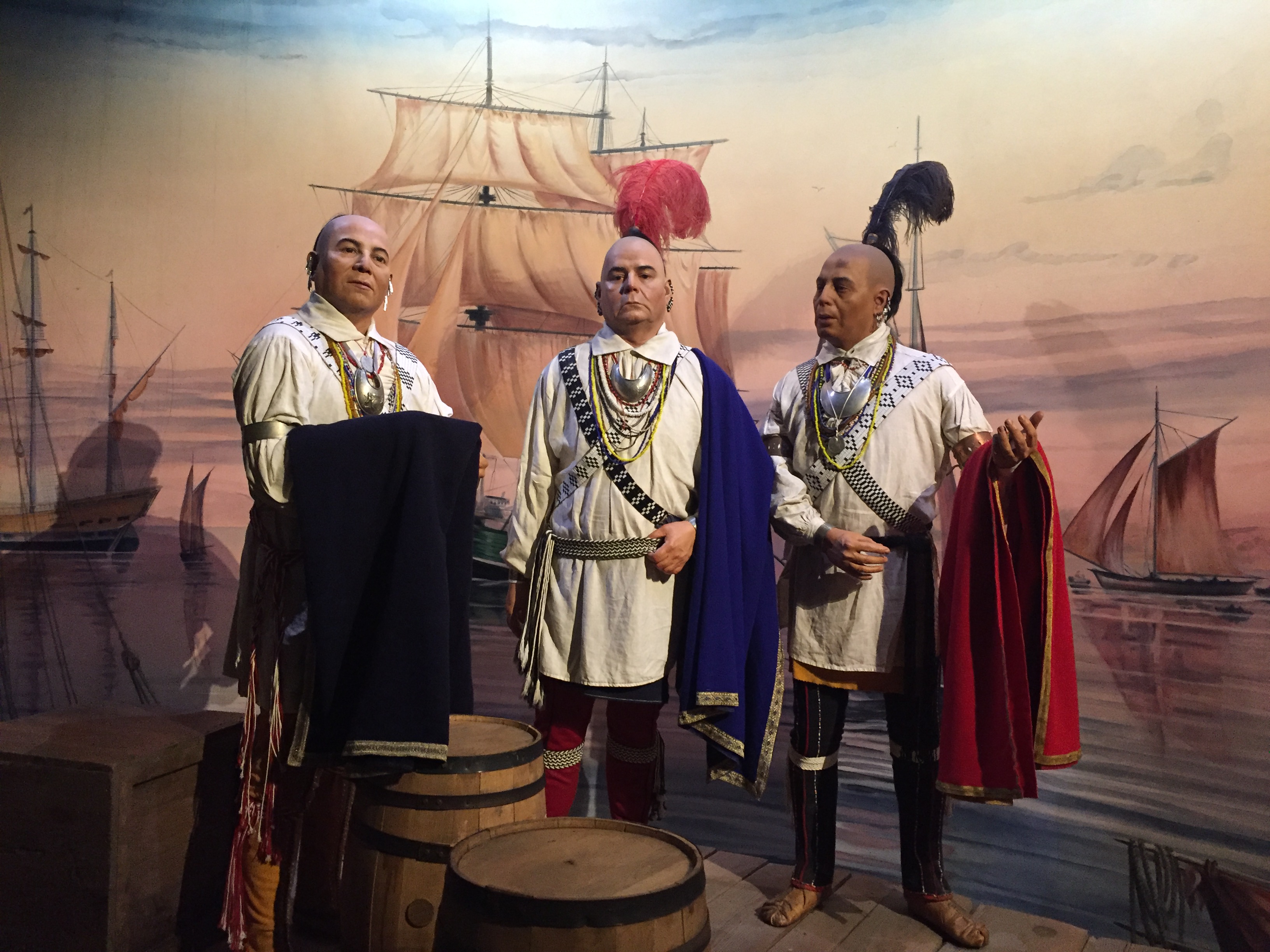
There is an attraction in Cherokee that has moved away from the trappings of my childhood memories and beyond my mother’s fantasies of the “noble savage.” It is a temporary refuge from the slot machines, the gift shops, and the traffic. The Museum of the Cherokee Indian offers a cultural and historical overview of the people of the southern Appalachian Mountains going back 13,000 years. Contrary to popular opinion about appropriate nomenclature, it is actually more acceptable and accurate to use the term “American Indians” than “Native Americans” when referring to the tribes that occupied the western hemisphere before European exploration began. Combining interactive video with intriguing displays, the museum invites visitors to take a self-guided tour complete with computer-generated imagery, special effects, and an extensive artifact collection.

Museum of the Cherokee Indian

The museum’s interpretation is divided into two permanent exhibits: “Story of the Cherokee” and “Emissaries of Peace.” The first exhibit follows the history of the Cherokee from the early origins when mastodons roamed the region, through the Woodland and Mississippian periods, contact with Old World explorers and conquerors, the tragic Trail of Tears removal, and up to the present day.  The second exhibit tells the story of Henry Timberlake’s visit to the Cherokees in 1762, and how he took Cherokee leaders to London to meet with King George III. These narratives are told through animation, audio-visual presentations, life-sized figures, artwork, and priceless artifacts.

Museum of the Cherokee Indian

The Museum of the Cherokee Indian is not a tourist trap designed only for entertainment or to perpetuate stereotypes about Indians portrayed in early motion pictures. It is managed by knowledgeable professionals who care about the Cherokee people’s heritage and dignity as an independent tribe. The executive director, James “Bo” Taylor, earned a degree in anthropology with a minor in Cherokee Studies from Western Carolina University. He has learned the Cherokee dances, which he performs regularly, and can read and write the Cherokee language. Taylor also teaches the Cherokee language in intensive ten-day immersion classes. The museum’s education director, Dr. Barbara R. Duncan, earned her Ph.D. in Folklore and Folklife from the University of Pennsylvania in 1982 and has lived in the southern Appalachian Mountains since 1983. She has written and edited award-winning books about Cherokee history and culture, including Living Stories of the Cherokee and Cherokee Heritage Trails Guidebook (with co-author Brett Riggs).

Museum of the Cherokee Indian

In addition to exhibits, the museum offers workshops, performances, guided tours of the region, publications, and classes. The museum archives is a repository of thousands of books, photographs, manuscripts, personal papers, and digital collections, all of which are accessible to museum members and qualified scholars. Visitors to the museum can spend an hour or two strolling through the halls, or a day or two becoming completely immersed in the displays and collections. This facility is a real treasure and not to be missed by those who are truly interested in the story of the Cherokee Indians, or as they originally called themselves, Aniyunwiya, “the principal people.” Enjoy the casino, but take a break from the tables and check out the Museum of the Cherokee Indian, and make sure to use part of your winnings to purchase a souvenir from the museum’s gift shop.