Pilgrims to Andalusia, the Home of Flannery O’Connor

During the thirteen years that I served as the director of Andalusia, the home of Flannery O’Connor in Milledgeville, Georgia, I had the privilege of meeting thousands of fans of this gifted writer. They came from every state in the country and from almost every continent around the globe. O’Connor is one of those rare authors whose work attracts an amazingly diverse audience. On any given day at Andalusia farm, we might have welcomed a busload of World War II generation grandparents in the morning followed in the afternoon by college students dressed all in black with spiked hair, black fingernail polish and lipstick, tattoos on all visible surfaces, and metal piercings decorating their faces who would walk in the door and say, “Flannery O’Connor is so kick-ass!” Her fan base covers almost every segment of society: straight, LGBTQ, Catholic, Protestant, Muslim, Hindu, Buddhist, agnostic, atheist (one of our largest donors was an atheist biology professor), Democrat, Republican, alt left and right, blue and white collar, and readers representing all income levels. Her books have been translated into at least twenty different foreign languages, indicating the cultural diversity of her following too.

What draws readers to O’Connor’s work, and why do they travel great distances to visit Andalusia, the place where she finished all of her published books? From my standpoint, there are only a few definitive answers but plenty of speculation. When we welcomed visitors to the farm, the first question we asked them was, “How did you find out about Andalusia?” Their answer would usually give us some clues of how to structure their tour to give them the best experience possible. If their response was, “We just saw the sign on the road and wondered what was back here,” then we would give them plenty of biographical information to introduce them to O’Connor’s life and the significance of her contributions to American literature. If on the other hand they told us that they had been teaching O’Connor’s work for 25 years and had always wanted to see the place that inspired her fiction, we would go in a different direction, encouraging them to ask questions that would satisfy their curiosity about O’Connor’s environs.

Andalusia, Home of Flannery O'Connor
Andalusia, Home of Flannery O’Connor

Anyone who has read O’Connor’s fiction even once immediately recognizes that her characters are particularly odd and not altogether admirable, which is probably the most polarizing point for her readers. Consequently, there are few lukewarm reactions to O’Connor’s stories; people either hate them or absolutely adore them. The haters walk away puzzled at why the lovers become nearly obsessed. Many of the die-hard fans who visited Andalusia had a mission to locate every place on the property that supposedly appears in the stories: the hayloft where Hulga lost her wooden leg; the milking parlor where Asbury drank the unpasteurized milk; the equipment shed with its tractor that ran over Mr. Guizac; and the white water tower in “A Circle in the Fire.” Other admirers weren’t as fascinated with such direct physical connections but were nevertheless impressed with how the farm clearly served as an inspiration for the fiction. O’Connor is revered by so many writers, some of whom made the pilgrimage to Andalusia while I was there: Allan Gurganus, Padgett Powell, and Salman Rushdie were among them.

Who else visited Andalusia and why? Here is where the story becomes more intriguing and just a tad O’Connoresque. A few examples may shed some light on how wide the spectrum was and render a snapshot of the author’s devotees. The true pilgrims were the visitors who regarded O’Connor and her home with a certain sense of reverence, like the woman who stepped up to the front porch and asked me if she should remove her shoes before entering the house, as if she were about to tread on holy ground. I assured her that I always kept my shoes on in and outside the house. Those who were specifically drawn to O’Connor’s use of grace bestowed, if not slammed, on her characters truly considered Andalusia to be a place of religious significance.  This was especially the perspective of practicing Catholics and most notably clergy, like the two priests who requested to hold a prayer vigil in the guest bedroom on the second floor where they would be less likely disturbed by, or be disturbing to, other visitors. They were up there for an hour. I was impressed with their stamina — the room was hotter than three hells in the summer, which was the time they elected to visit, in full black vestments.

A common observation shared by so many Andalusia visitors was a sense of the author’s spirit being present in the main house and on the property. For some this was merely a recognition that the authenticity of the place — buildings, furniture, and furnishings original to O’Connor’s time at the farm — helped them somehow feel closer to its famous occupant. Of course, we also had our fair share of ghost hunters and paranormal investigators who, for reasons that defy understanding, believe that the departed with celebrity status are more easily detected than your run-of-the-mill homeowner. I have never understood why ghost hunters don’t spend more time at hospitals, the very place where so many people pass on to the “next plane of existence.” I could usually tell if a visitor had high hopes for a Poltergeist encounter by the familiar question, “So, did she die in the house?” She did not. She died in the hospital.

Some of our guests went the extra mile to make their visit to Andalusia a truly memorable experience. A couple of folk singers recorded an original song on the front porch. Artists painted landscapes and farm buildings. Writers drafted stories while sitting in the iris gardens. Photographers snapped shots everywhere their eyes pulled them. One young woman was so taken by the beauty of the place while she was attending the college in town, O’Connor’s undergraduate alma mater, that she decided to have her wedding on the front lawn under the enormous oak trees, complete with peacock feathers in her hair. (O’Connor raised many different breeds of domestic birds, but peacocks are the species so identified with her life at Andalusia.)

O’Connor fans have found inventive ways to demonstrate their devotion to the author, from naming their daughters “Flannery” to having elaborate tattoos of peacock feathers permanently decorating their bodies. It was a pleasure to meet them all and to hear them share their admiration for this comic genius. Some made great sacrifices to pay homage to O’Connor at Andalusia, like the four scholars from Japan who spent most of a Saturday at the farm. When I asked what brought them to the states, the only one who could speak any English at all looked at me with a surprised expression and then smiled warmly and said, “Flannery O’Connor.  This place.” I was moved.
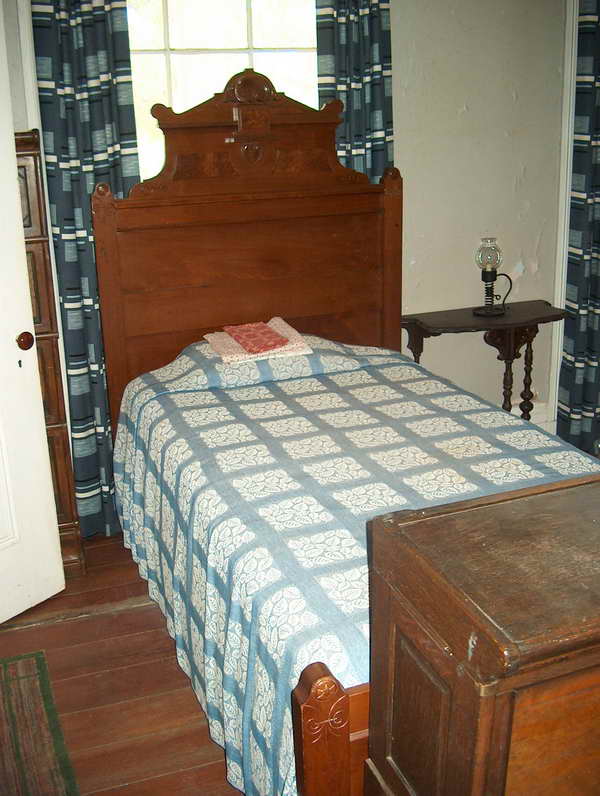
Flannery O'Connor's bed
Flannery O’Connor’s bed

The impact that O’Connor’s work had on some visitors’ lives was immediately apparent when they walked in the front door of the main house. Their countenance, their excitement, and their strong emotions spoke volumes. Several claimed that O’Connor had drawn them to the Catholic Church. Others credited O’Connor for launching their vocations as writers, artists, teachers, or ministers. It is rather ironic that a writer who has brought great joy to so many readers also endured great suffering for the last third of her 39 years as lupus slowly took away her life. This is an inescapable part of her story that no sensitive visitor to Andalusia would ever miss. I watched big, burly men apologize to me as they wept standing at the doorway of O’Connor’s first-floor bedroom where she slept and worked. No need to be sorry — I cried too, more than once.

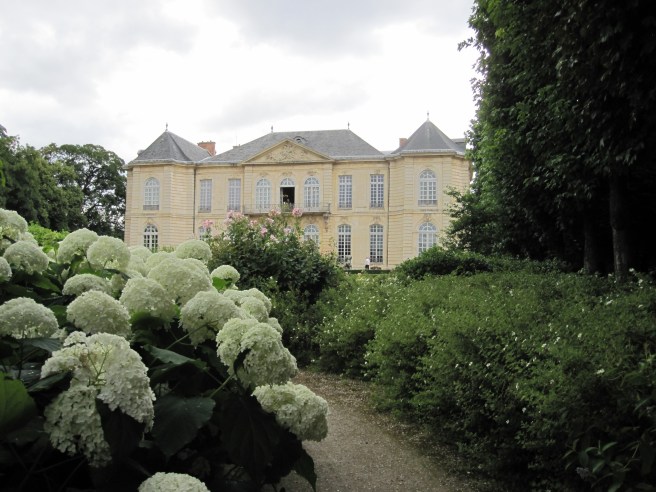
The Garden at Musée Rodin

Visitors to Paris will often want to include in their itinerary a side trip to the Palace of Versailles, which is about a thirty-minute train ride from the city.  The round trip isn’t so time-consuming, but actually seeing the palace and grounds takes a minimum of half a day, even more if one truly explores the garden, which is 800 hectares (over 1,900 acres) in size. Unfortunately, some travelers are on a tight schedule and hardly have enough time to see the major attractions in Paris, much less places outside the city.  There is no substitute for seeing the Palace of Versailles, which is quite magnificent and offers a visual representation of the wealth and power of the monarchy in the 17th and 18th centuries. The garden is certainly spectacular and difficult to match; however, if there is a substitute in Paris that can serve as a rival, albeit on a smaller scale, the garden at the Musée Rodin must be near the top of the list.

Rodin gardens from mansion balconey
Rodin gardens from mansion balcony

The Musée Rodin is housed in a mansion, formerly called the Hôtel Peyrenc de Moras, now known as the Hôtel Biron. Auguste Rodin was a 19th-century French sculptor who is known for creating several iconic works, including “The Age of Bronze,” “The Thinker,” “The Kiss,” and “The Burghers of Calais.” The collection in the restored mansion is interesting for the novice and probably a treasure for artists and art historians, but almost everyone can appreciate the beauty of the garden.  Its size is minuscule compared to Versailles, but it is still impressive. The grounds are divided into a rose garden, north of the mansion, and a large ornamental garden, to the south, while a terrace and hornbeam hedge backing onto a trellis conceal a relaxation area, at the bottom of the garden. Two thematic walks are also part of the garden: the “Garden of Orpheus,” on the east side, and the “Garden of Springs”on the west side.

Rodin garden roses and shrubs

In addition to the abundance of plants, the garden is also decorated with some of Rodin’s sculpture.  Rodin started to place selected works in the garden in 1908, together with some of the antiques from his personal collection. Male and female torsos, copies made in the Roman or modern period, after Greek works, were presented in these natural surroundings. Other pieces were added after his death. The first bronzes were erected in the gardens before World War I. Since 1993, they have been regularly cleaned and treated so as to preserve their original patinas.

Rodin mansion 3

Anyone who has visited Paris knows the frustration of wanting to see more, to do more, than limited time will allow. Tourists have to be selective, discriminating, and reasonable about what they will be able to cover during the time they are in the city. Any attraction that offers more than one type of experience is probably worth including. The Musée Rodin fits that description with historic architecture and provocative sculpture but also a landscape that is in itself a work of art, offering the visitor an opportunity to rest and reflect.

A Valuable and Valued Experience

In recent years, the literature about travel has been focusing on the importance of creating or taking advantage of experiences rather than seeking the traditional rewards such as entertainment or relaxation.  Of course, how we define a memorable experience is all over the board.  Foodies may be looking for something much different than hikers, and history buffs may not appreciate the same experience that is meaningful to a photographer or painter.  Then again, there may be significant overlap.  In any case, if we want to learn as much as we can about a destination while we are there, we have to be willing to invest.  We have to spend time doing some research before we ever leave home, but even so, that preparation may not be enough in some cases to get a true appreciation for what we are seeing, hearing, smelling, and touching.

If we want to make sure we are doing the best we possibly can with our financial investments, we seek the advice of an expert.  If we want to take full advantage of the time we have to exercise and stay fit, we may pay a trainer or an instructor.  We may also pay teachers to help us learn particular skills or develop our hobbies.  And, there are times when it makes sense to pay someone to ensure that our travel experience is as rich as it can possibly be.  Yes, travel agents come to mind, but web-based services have almost made this profession obsolete, although they do still offer a valuable service for many individuals and groups.  I’m thinking of a service that is a bit more, well, personal.  On several occasions, we have paid to have a guide at special places of interest.  Some places are just impossible to completely enjoy even with such assistance because of poor crowd control, cheap audio equipment, or an inexperienced guide.  The Vatican Museum comes to mind — they pack way too many people in at a time, and it becomes a real challenge just to stay with your guided group.

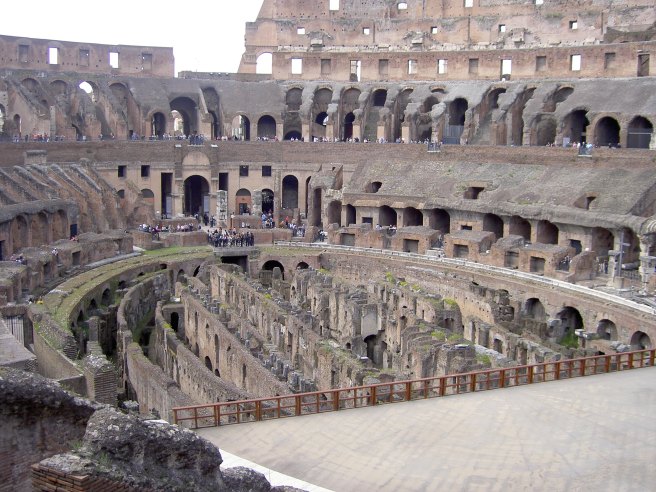
For the most part, we have been very pleased with the guides we have had and felt that this investment provided us with a deeper appreciation for what we were seeing.  The two best examples that come to mind of where guides were invaluable to us are the Colosseum and Forum in Rome and Versailles Palace outside Paris.  In Rome it would be almost impossible in a short time to see the most historically-significant parts of the Colosseum and the Forum without an experienced guide.  I don’t remember her name, but our guide’s knowledge of these two attractions was certainly impressive.  We hired her for an individual tour, which was not cheap but worth every Euro.  She was able to answer in detail each question we asked.  She spoke fluent English.  She had a sense of humor without being silly.  She took us on a walking tour, and she managed to cover essential ground, literally and figuratively, while also adding interesting anecdotes, myths, and fascinating details.  It was such a rich experience.

Colosseum in Rome
Colosseum in Rome


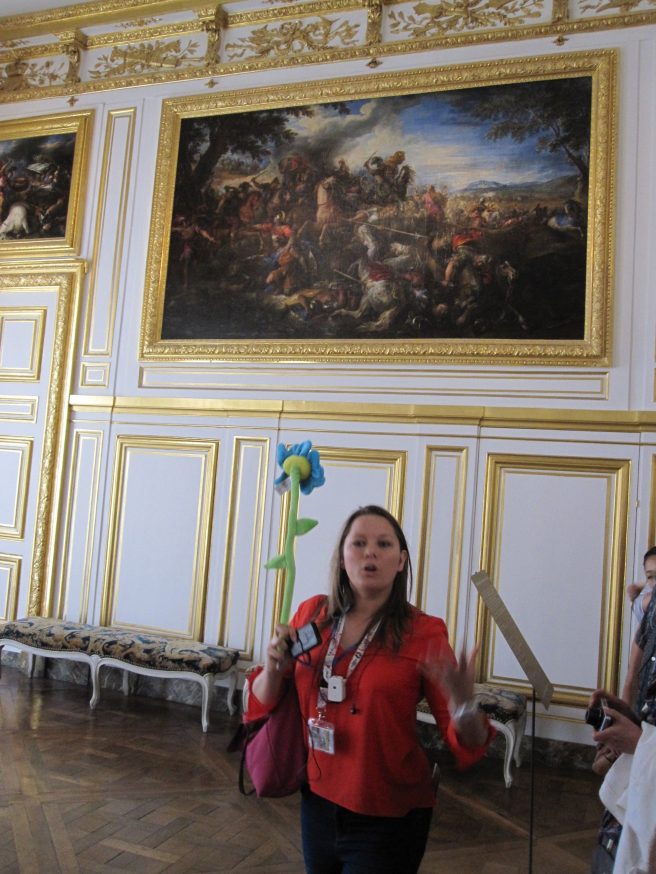
The Palace at Versailles is a short 30 minute train ride to the west of Paris and well worth the time and effort to get there.  Because the Palace is so huge and we only had about four hours to spend there, we decided to pay for a guided tour.  This time, we were part of a group.  We still had bad memories of being shuffled through the Vatican Museum, shoulder to shoulder, like cows being herded to the slaughter.  We were prepared for the worst at Versailles.  Pauline was our host, and we could not have been more pleased.  She met our group at a building where tickets are sold about three blocks from the entrance to the Palace grounds.  She held in her hand a brightly-colored cloth blue flower on a tall green stalk, which she held up high enough for everyone to see to make following her a bit easier.  As is usually the case with guided tours, Pauline was able to bypass the longer general admission line and get us in the Palace promptly, which is almost worth the price of the tour alone.

Pauline distributed our audio headsets shortly after we entered the Palace and tested them all.  The technology was much better this time than when we were at the Vatican Museum, and our ear phones allowed us to hear every word she said.  Taking us through each of the rooms of the Palace that are open to visitors, Pauline not only explained the significance of the rooms, but she was always careful and creative about weaving the information back into her chronological theme of the royal families that resided at the Palace.  Her approach was similar to that of a school teacher, asking questions from the group and using responses to deliver her narrative.  She managed to do so without dumbing down the story so that people of all ages and education levels could appreciate the tour.  She was really talented.  Another skill Pauline exhibited was aggressiveness.  There are always rude people in museums who will insist on edging their way in front of others to get a better view or to take a photograph, or even worse, the obligatory selfie.  Incidentally, selfie sticks are prohibited in the Versailles Palace and in many museums and galleries in Paris, thank goodness.  When our group encountered anyone attempting to push in front of us at the railings while Pauline was talking to us, she would quickly and firmly say, “Excuse me, this is a group tour, would you please step aside?  Thank you!”  It worked every time.

Pauline at Versailles
Pauline, our guide at Versailles

Traveling is a luxury that many people cannot afford, which is unfortunate.  However, there are ways to make tourism more affordable.  There is a considerable range of prices for transportation, lodging, meals, attractions, and incidentals.  It usually makes sense to pay for many services in advance, including admission.  The Paris Pass is highly recommended for visitors to the city who plan to be there a few days and want to see multiple museums and galleries.  Other major cities have similar deals, and they are definitely worth considering.  Most of the time, we don’t feel a need to have a personal guide or to even join a group tour, both of which can be expensive.  We tend to like the freedom of seeing what interests us most and skipping the rest, which is practically impossible with a guided tour.  But there are times when having a knowledgeable narrator can provide that memorable and meaningful experience that so many travelers seek.