
A Swift Rise to Stardom and Influence

American popular music has produced some unforgettable female icons during my lifetime: Janis Joplin, Dolly Parton, Cher, Madonna, Janet Jackson, Beyonce, Adele, just to name a few. They have all been influential on their fan base, and to some degree, to the public in general. Joplin gave young women permission to experiment with sex and drugs, often to dangerous excess. She died of a heroin overdose. Dolly Parton has always encouraged women with her words and by example to be strong and independent without sacrificing their femininity or sexual charm. Madonna in some ways paralleled the rise to fame of Michael Jackson. She was definitely the queen of pop for a while, more so than Michael’s own sister, Janet. She still holds the record as the biggest selling female artist to date. All of these women enjoyed success here and around the world.

Perhaps these women prepared the way for the female entertainer who has taken the world by storm in the 21st century and will likely surpass them all at some point. Taylor Swift is so much more than a singer, songwriter, musician, producer, and entertainer. She is a force. With the release of her single “Our Song” in 2006, she became the youngest singer-songwriter to perform an original song and reach the number one spot on the Hot Country Songs chart at the ripe age of seventeen. Two years later she became the youngest person to win the Country Music Association Awards’ top spot. She has won more American Music Awards than anyone else in history. She is the first woman to have four albums in the Billboard 200 chart’s top 10 simultaneously. She also broke Billboard’s record for most number one albums by a female artist. Swift made history again at the 2024 Grammy Awards when she took home the Album of the Year, becoming the first and only person to have won the award four times.

These accolades are phenomenal; however, some of her other accomplishments have served to establish her as one of the most influential women in the country, if not the world. According to some sources, the opening night of Swift’s Eras Tour set a record for the most attended concert ever by a female musical entertainer in the U.S. The tour continued to break attendance records across the country and became the first to surpass $1 billion in revenue. According to Forbes magazine, Swift became a billionaire in 2023 and thus the highest-earning female performer in the music industry. Between vinyl, streaming, and other media, Taylor Swift continues to break sales records in various categories every year.

I couldn’t find an estimate of how many people have seen Swift in concert over the course of her career. Based on stats that are available, close to 10 million people worldwide have attended her Eras tour, which ends in December 2024. She has been a dominant figure in the lives of at least two generations: her adoring fans and the many parents who continue to take their young children to her concerts. It is amazing how many of those parents and children (mostly female but certainly not all) sing along to every word of every song Taylor Swift performs. What a rush that must be for her.

Taylor Swift
Taylor Swift

Swift is an outspoken advocate for progressive causes, especially related to women and the LGBTQ population. She is not afraid to let her fans know through public statements and social media where she stands on controversial issues. She is not overtly political, and she attracts fans from across the political divide. Yes, there are Swifties for Trump – they may not agree with her ideologically, but they still love and identify with her music. She doesn’t shy away from publicly revealing her candidate of choice, even on the national level. She backed Joe Biden in 2020 and Kamala Harris in 2024. She wisely stops short of suggesting who her fans should support, but she strongly encourages them to do their research and vote their conscience. Shortly after the presidential debate between Trump and Harris in September 2024, Taylor Swift sent messages on her social media platforms making her choice known and including a link to a voter registration site. According to multiple sources, over 400,000 people clicked on the link in the 24 hours after Swift posted it. That’s power, and I would guess that very few people in this country have that level of influence.

For those who still think that Taylor Swift’s work is just a bunch of shallow revenge music obsessing over her broken heart, I suspect they haven’t followed her career closely enough. Her latest album, The Tortured Poets Department, has considerable depth thematically in places. Her lyrics really started to show her maturity as a songwriter with the 2020 release of Folklore. Okay, perhaps her musical compositions are not complex or interesting enough for some people, but I maintain she is writing good stuff. The song “This Is Me Trying” from the Folklore album packs a powerful punch that almost channels Bruce Springsteen in my mind. Oh, one more thing. My wife and I live in Missouri and are Kansas City Chiefs fans. We absolutely love seeing Taylor Swift at the football games and think the budding romance between the rock star and Chiefs tight end, Travis Kelce, is a refreshing American celebrity love story. They are adorable. Go ahead, call me a Swiftie. I’m “fearless.”

Source consulted:
https://theweek.com/culture/entertainment/1025810/taylor-swift-records-2023
Images:
https://en.wikipedia.org/wiki/Taylor_Swift

Sir Elton John

There is no entertainer whose work I have admired more than that of Elton John. His 1974 Greatest Hits may have been the first album I ever personally owned, only because I have a sister who is about six years my senior, and I listened to her albums and singles until I discovered Elton John on the radio as I approached my formative teen years. I played that vinyl until it warped. Three years earlier I had started learning to the play the guitar, at first with a few lessons from a fellow who loved old folk tunes, but I quickly began picking out chords on my own and learning to play by ear. I had been singing both melody and harmony parts since I was a young child, mostly in church, school, or with family and relatives.

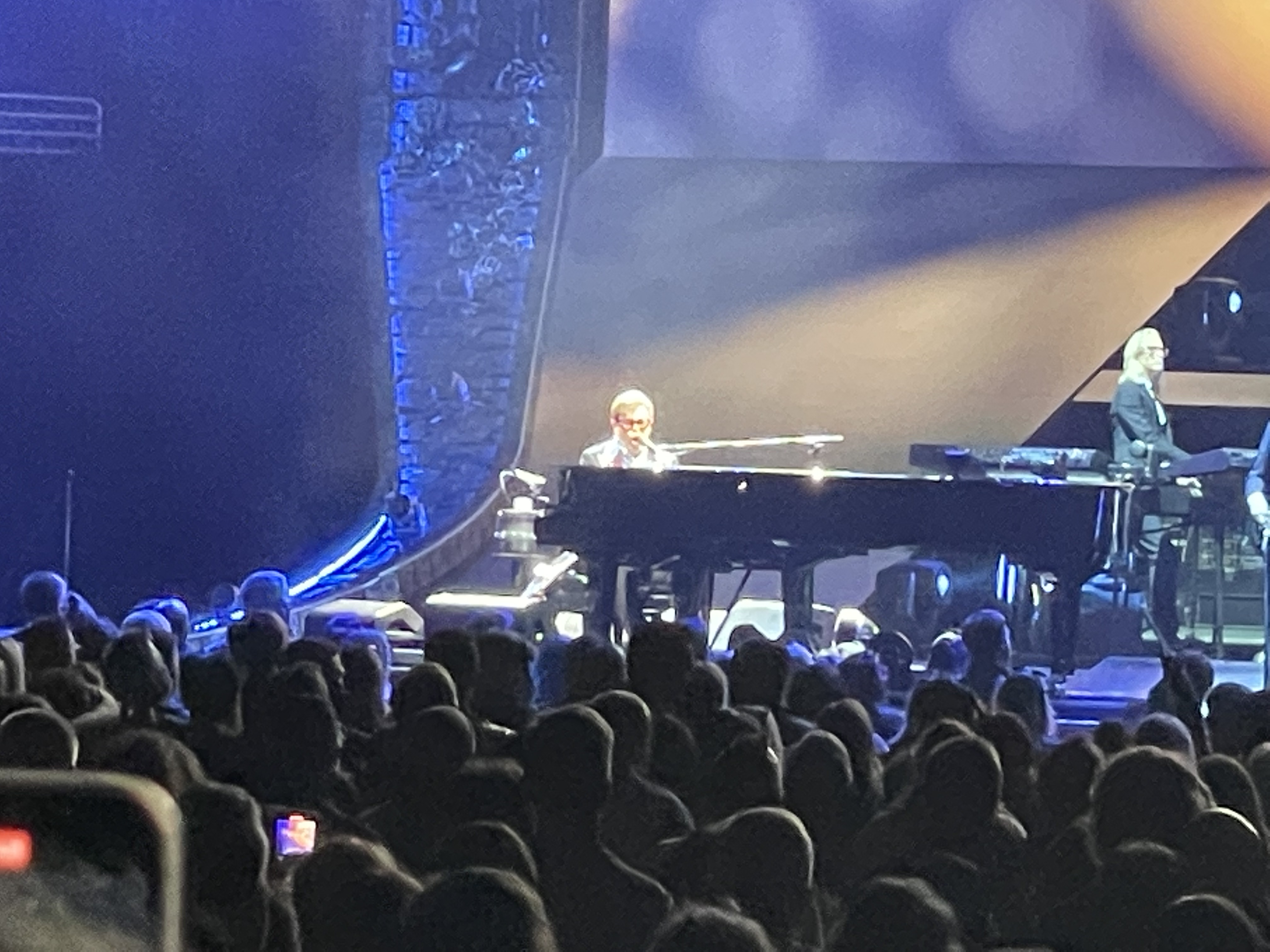
Elton John concert, February 1, 2022 (Kansas City)

The songs that Elton John and his lyrical collaborator, Bernie Taupin, produced interpreted the human condition for me and countless others around the globe. By his own testimony, one absolute constant in Elton John’s roller-coaster life has been his love and admiration for his songwriting partner. It was their songs that largely inspired me to start playing music, and I have been playing and performing them ever since. I still cover several of their tunes to this day (on guitar and keys), including the brilliantly composed “Your Song,” which I am still astounded to know that Taupin wrote at the ripe old age of 19.

If I had to choose one word to characterize Elton John’s life, it would have to be “outrageous,” an adjective that he has used from time to time in public appearances and in writing. By his own admission, Elton John has an addictive personality and spent many decades fighting horrible battles with drugs before finally going sober. He has a nasty temper nurtured by his wealth and fame, a personality trait that in my view is his least attractive. “I’m perfectly aware of how ridiculous my life is, and perfectly aware of what an arsehole I look like when I lose my temper over nothing,” he writes in his 2019 memoir simply titled Me. Of course, he is known for being self-indulgent, something he shares with many other pop stars of his generation. He is fairly critical of himself and open about what he perceives as his failures.

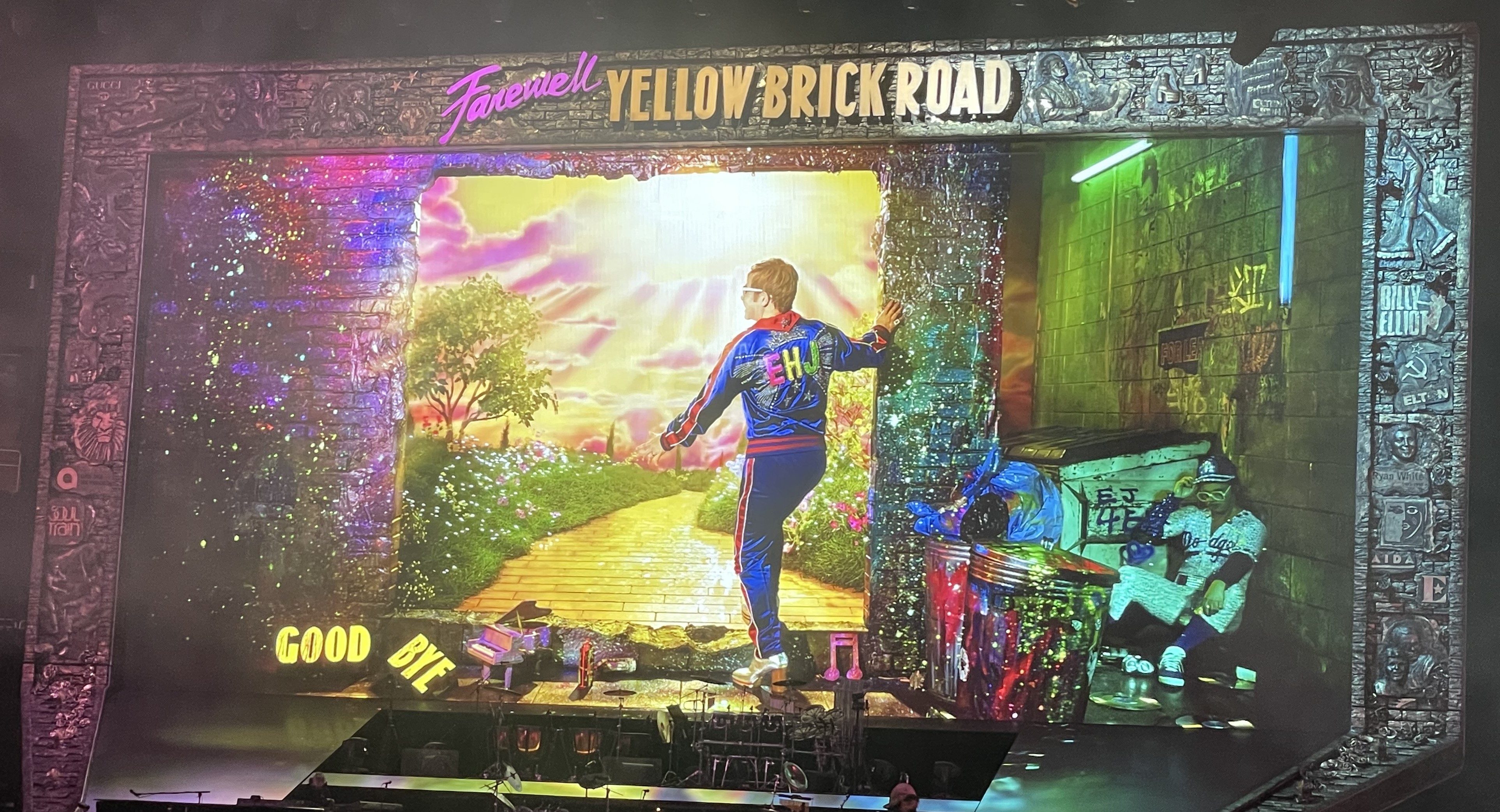
Elton John concert, February 1, 2022 (Kansas City)

Elton John has endured his share of sadness: a troubled relationship with his parents, the many friends he has lost to AIDS, his own broken personal relationships, and the many years he was imprisoned by cocaine and alcohol. Those low points are perhaps balanced out with times of great joy, especially his hundreds and hundreds of live performances through the decades, the part of his career that he perhaps loved the most. He found what seems to be enduring love with his husband, David Furnish, and the couple have two sons, Zachary and Elijah. In the end, for multiple reasons connected to his upbringing and his rise to fame, I get the sense that Elton John had a very difficult time growing up, even long after he reached adulthood. Even so, I don’t see him as a tragic figure. I see him as an incredibly talented musician, songwriter, and entertainer who from a young age wanted to be loved and needed to be the best at what he was doing. By my account, he succeeded.

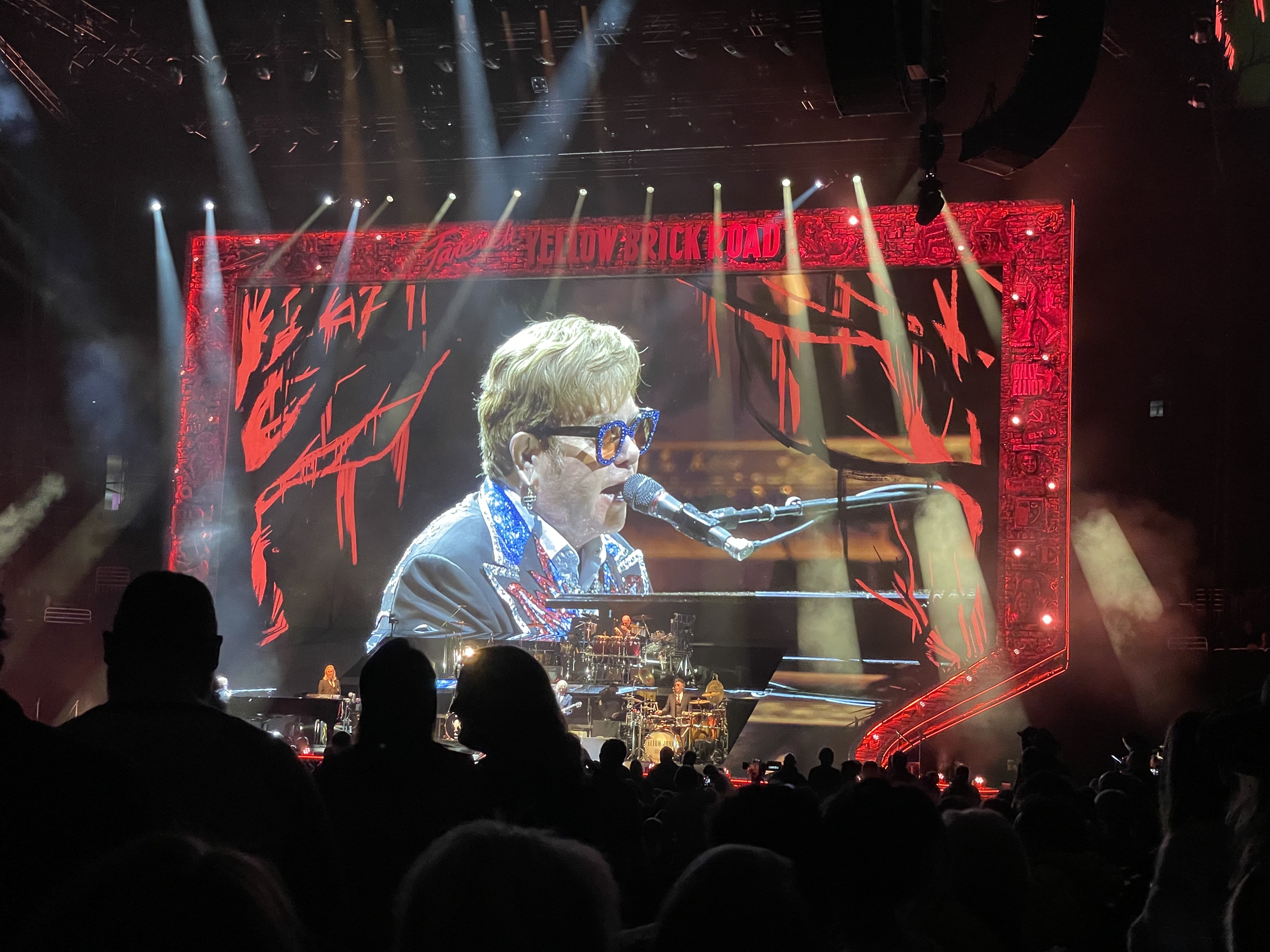
In a post from a few years back, I mentioned that I missed an opportunity to see Elton John perform when I was studying abroad in England in 1984. Fortunately, my wife and I were able to catch him in Kansas City in February, 2022, for his Farewell Yellow Brick Road tour. He was showing obvious signs of his 75 years on the planet by then, but his voice was still incredibly strong. Yes, I know that backtracks and other enhancements make it possible for concerts to sound almost flawless, but Elton John has been extremely critical of performers who lip sync at their shows. I’m assuming he doesn’t. He has probably tuned his songs down a half or whole step from the original, and he has younger vocalists to help with the stratospheric notes, but he also rearranges songs to make them more manageable for his septuagenarian voice. Some of the tunes don’t sound the way most of us remember them, but they are still wonderful songs, and he remains a fabulous and generous entertainer.

Elton John concert, February 1, 2022 (Kansas City)

The Complex Character of Johnny Cash

Johnny Cash in 1977 (Wikipedia)

I have never been a big fan of Johnny Cash, which in some circles brands me as a heretic. I didn’t enjoy hearing him sing. No one ever credited him with being a skilled musician, and he likely would not have argued the point. I did not agree with so many musicians, critics, and fans who thought his song lyrics were profound. There were a few that rose to the occasion, but most of them were rather simple. Many of his fans and even a few biographers have painted him as a scholar — I have my doubts. I also thought the whole “man in black” persona was rather cheesy and contrived.

I do, however, recognize the impact he had on so many other musicians and entertainers. It is amazing how many people in the industry collaborated with him, especially later in his life. He helped launch the career of Kris Kristofferson, one of the best songwriters of popular music in the 20th century. I know Cash is a bit of a legend in the entertainment world, a reputation he spent a good deal of time cultivating. He was certainly a man of conviction, and on multiple levels.

Johnny Cash was also very close to evangelist Billy Graham, and the minister apparently admired the entertainer for his public testimony about his faith. Cash devoted much of his creative output to gospel music, often times at the risk of falling out of favor with record labels, producers, television executives, and some of his fans. He loved deeply, believed passionately, and endured incredible heartache and pain at times, including the physical kind. I don’t think he was as much of an outlaw as he portrayed himself to be or as the media depicted him. But he was definitely an outlier.

Most people who know anything about him understand that Johnny Cash had his share of flaws: addictions, infidelities, mental instability. He was also plagued with constant inner struggles. He was a troubled soul who clung to the faith of his Christian upbringing, even though it seemed impossible for him to follow a righteous path. The vices always seemed to get the best of him, even by his own admission. I suspect guilt played a huge role in his religious convictions, especially the death of his brother at a young age and the fact that his father blamed him for the unfortunate accident that took his brother’s life.

In the context of 20th century music, Johnny Cash is a name that is as immediately recognized as Elvis Presley, Bob Dylan, Bruce Springsteen, or Willie Nelson. He is indeed a legend, a celebrity who crossed multiple genres in the world of entertainment. I have recently started performing a Johnny Cash song in my solo shows. The one I selected is “Ring of Fire,” which has one of the most complicated and imbalanced rhythms of any song ever written in American popular music. I certainly don’t play it in the odd time signature that was produced in the studio. I doubt very seriously if I could even come close. Hmmm. Maybe old Johnny’s music wasn’t as simple as I once thought.

Chuck Berry, for Better or Worse

Chuck Berry statue in the Delmar Loop in St. Louis, MO

In the spirit of giving credit where credit is due, no one deserves the title “The Father of Rock-n-Roll” more than Chuck Berry. So many of the legends of the genre revered him and covered his hits, including The Beatles and The Rolling Stones. Keith Richards said if rock-n-roll had a name, it would have to be Chuck Berry. Even that white boy from Tupelo, referred so often to as the “King” of rock-n-roll, covered Berry’s tunes.

Chuck Berry’s life is not really a rags-to-riches story as he was born into a middle-class family in St. Louis where he lived his whole life. Growing up just beyond the eastern boundary of the Ozarks region, Berry was heavily influenced by rock-a-billy and country music, elements of which would end up in many of his greatest hits. Of course, Berry also grew up during the era of Jim Crow in a part of the country that had a dark past with race relations. Sadly, according to R. J. Smith in his brutally honest biography (Chuck Berry: An American Life, Hachette Books, 2022), Berry apparently carried his response of anger, resentment, and frustration to extremes at times, taking opportunities to insult and humiliate people, even those who adored him, and telling them, “Now you know how it feels to be black.”

Smith does a good job of balancing the artistry, intelligence, talent, and even the charm of Berry with the ugly side of his personality. Some of the stories about Berry make me think that he may have had some kind of serious psychological illness, like bipolar disorder. To say he was a womanizer would be to let him off the hook. He demonstrated signs of being what many folks in the post-MeToo era would define as a sexual predator and even a pedophile. At the very least, it is fair to say he had strong sexual appetites that wandered into the realm of the taboo and even aberrant.

His sexual deviance, along with his violent tendencies and his resistance to authority, including the IRS and government in general, got him into legal trouble on several occasions. He was sentenced to jail time more than once. One could argue that he shared this path with many of the outlaw country stars like Johnny Cash, Merle Haggard, Willie Nelson, and many others. Some rap and hip-hop performers who were no doubt influenced by Berry on some level would also be plagued with legal problems and prison terms.

No matter how bad the news was for Berry, he was still highly respected by the biggest names in the music business, including Bruce Springsteen. He was an early cross-over musician, infiltrating white homes with his unique style of playing and singing long before black performers were even allowed to eat in many restaurants or stay in hotels when they were on tour. He was beloved by millions of fans all over the world, even when he continued to attempt to perform in his 80s as dementia began to claim his mind and memory. His impact on 20th century music and beyond cannot be overemphasized, complete with his flaws and his brilliance.

Confessions of a Lazy Musician

Music has been a central part of my life for as long as I can remember. My mother’s extended family members were faithful Southern Baptists, for whom music was the primary expression of worship and praise. I was raised in this environment and at an early age was encouraged to sing frequently, not only in church, but for elderly relatives on their sick beds, at occasional family gatherings, and during Christmas holidays. As a pre-adolescent, I became increasingly impressed with older teens who performed in church, especially those who played musical instruments. My older sister had taken several years of piano lessons, and we had an old upright in our dining room that she used for rehearsing. I was frequently scolded for “banging” on the piano.

In the early 1970s at around the age of eleven, I expressed interest in learning how to play the guitar, so my parents bought a starter instrument for me and located a teacher. My instructor was an old guy who loved folk music and wanted me to start with the basics by playing simple songs note by note. I was impatient, which in retrospect was unfortunate because this was my one chance to learn how to read music. Instead, I jumped ahead in my music books and began learning how to play open chords — the easiest ones such as C, D, G, Em, and Am. In a short time, I began picking out songs that were popular during that time from pop and folk singers, especially John Denver. I started out as an amateur musician at just the right time. Many of the songs that I loved during those years could be played well enough with 3-5 chords. I took guitar lessons for less than a year.

My primary incentive in learning to play the guitar was to accompany myself to sing the songs that my friends and I were listening to on the radio. The more I played, the better my hearing became adapted for learning songs; therefore, I never went back to trying to read a musical score. I expanded my open chord portfolio, but I was not willing to push through the pain of playing bar chords, which continues to limit me as a guitarist to this day. Soon I was given opportunities to play and sing in church. By the time I reached the 10th grade, I was playing well enough to accompany choral groups at school and sing in talent contests.  My sister and I, along with one of our female cousins, formed a trio and played at nearby churches and for community groups. I was nervous playing in front of crowds, but I became better at listening to songs and reproducing them well enough for the average, uncritical audience. It was great fun, and it was a way for a short kid with not much athletic ability to find acceptance, approval, and even admiration from peers and adults.

Like most amateur musicians and singers from my generation, I also tried my hand at writing songs. My earliest influences were church music and pop/folk performers, so I began writing songs that I could sing and play for worship services and just for my own fulfillment. Some of them were good enough that I continued to sing them into adulthood. Others were absolutely horrible, and they are now thankfully forgotten. I have had the opportunity to perform original songs many times over the last thirty years, and my audiences have been quite gracious and accepting of my efforts. I continue even now to write songs, one of which I copyrighted and featured in this blog.

Sometime during my early college years, I began discovering chords on the piano. At the small community college I attended in the late 1970s, there were no restrictions on the use of the pianos in the practice rooms in the Department of Music. I would often head over in the late afternoons, when most faculty and almost all students were gone, and spend an hour or more discovering the triad configuration of the major chords and a few of the minors. By the time I had finished my undergraduate degree, I had memorized all the major and minor chords, along with sharps and flats. I had learned how to make numerous augmented and diminished chords, the major and minor 7ths, and suspended chords.

Also, my ear was better allowing me to determine the, and I stress this adjective, necessary chords to reproduce melodies on the guitar, but even more proficiently on the piano. I was playing chords on the keyboard that I was never able to master on the guitar. Solely from a mechanical standpoint, the piano is easier for me to play, and I have always taken the path of least resistance as a musician. Soon, I was singing and accompanying myself almost exclusively on the piano for church services, and then several times a year at weddings. If I listened to a song and worked at it for a while, I could learn to play it well enough to accompany myself or someone else to sing it. In other words, I was faking it sufficiently for most audiences and the people who were either inviting me or paying me to perform.

In my early forties, a friend of mine invited me to come to band rehearsal with him. He played bass for a 5-member local band covering classic rock, Southern rock, and some easy-listening music. As it turned out, they were considering bringing in a sixth member to serve as a front man. He knew I had a fairly good singing voice because he had heard me perform at a wedding. I started practicing with them regularly, and within a few months, I was singing for them. Up to this time, their drummer was the lead singer, and he continued to sing about half of our set lists for the next ten years I was with the band. It was a good arrangement. The musicians in this group were all far more accomplished than I was, but occasionally I did play acoustic and even keyboards on a few of the songs I sang for the band. Playing in that band was such a rush and fulfilled a deep desire to perform the music that I loved so much. I will always be thankful for the opportunity.

Howard baby grand piano

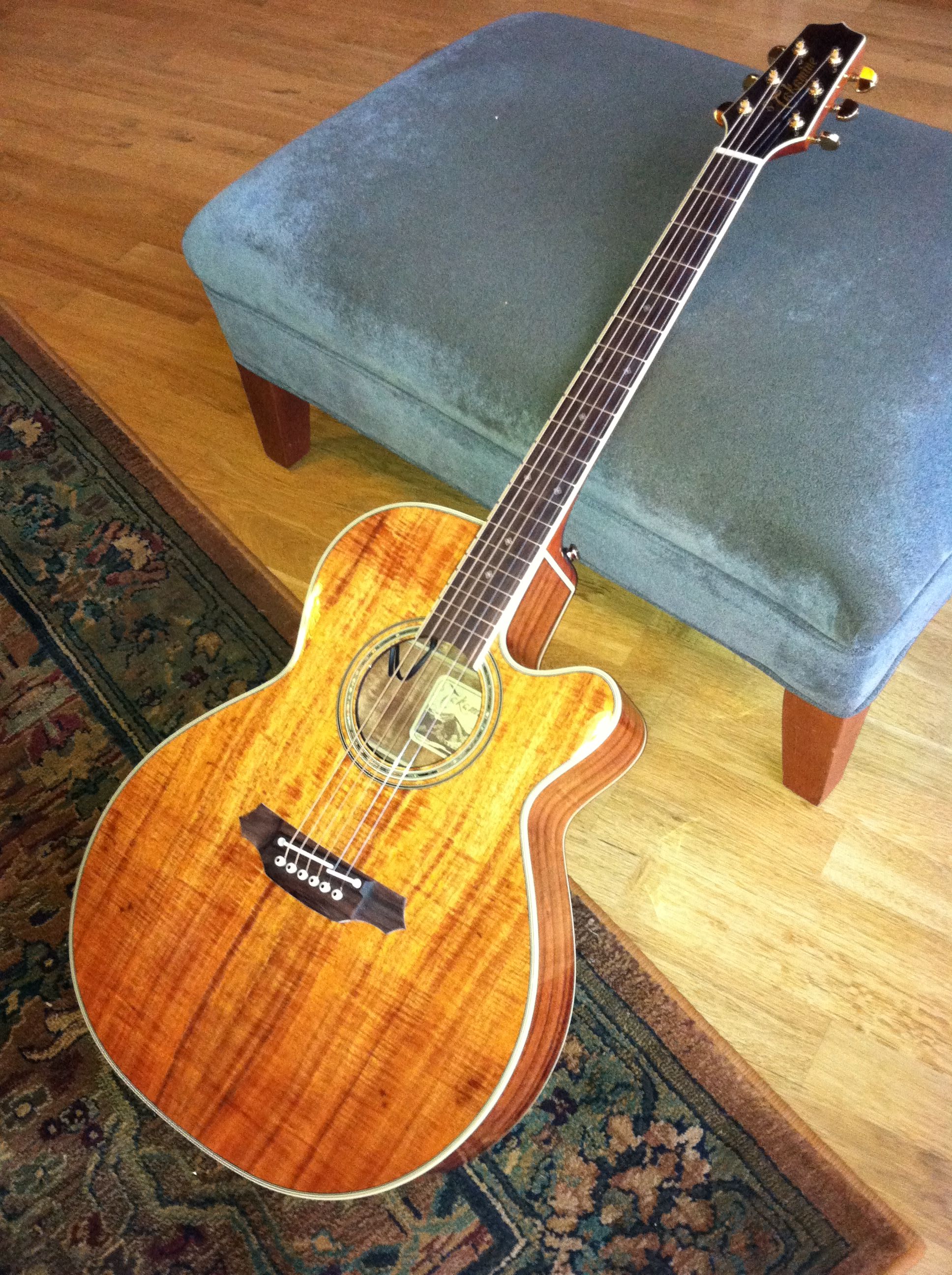
I am also extremely grateful to my wife, who always encourages me and goes out of her way to convince me and others that I am not a lazy musician. Of course, I know better, but I love her to the moon and back for the confidence she gives me and the praise she pours on me every time I play music. She has also facilitated my musical endeavors in direct and significant ways through amazing gifts: a baby grand piano she bought for me ten years ago and a Takamine guitar as an anniversary present in 2012. The Howard baby grand is a beautiful instrument intended for someone with talent and skill that far exceed my own, but I am astounded at how my playing has improved on this piano. I hear sounds and find melodic movements that I never sensed on other keyboards. It may not be magic, but I also can’t explain it, so it’s magic to me.

Takamine guitar
Takamine guitar


My guitars
My guitars

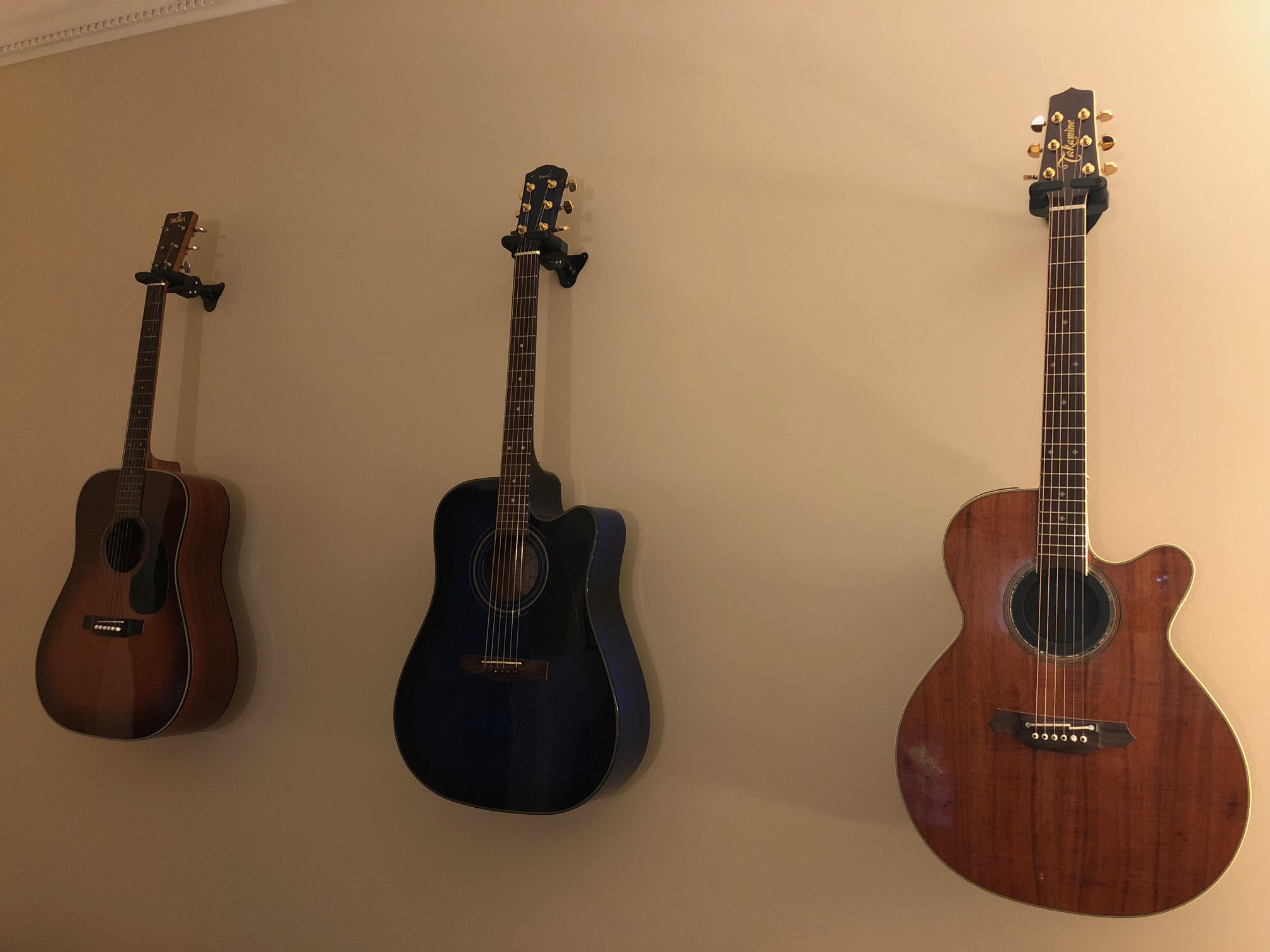
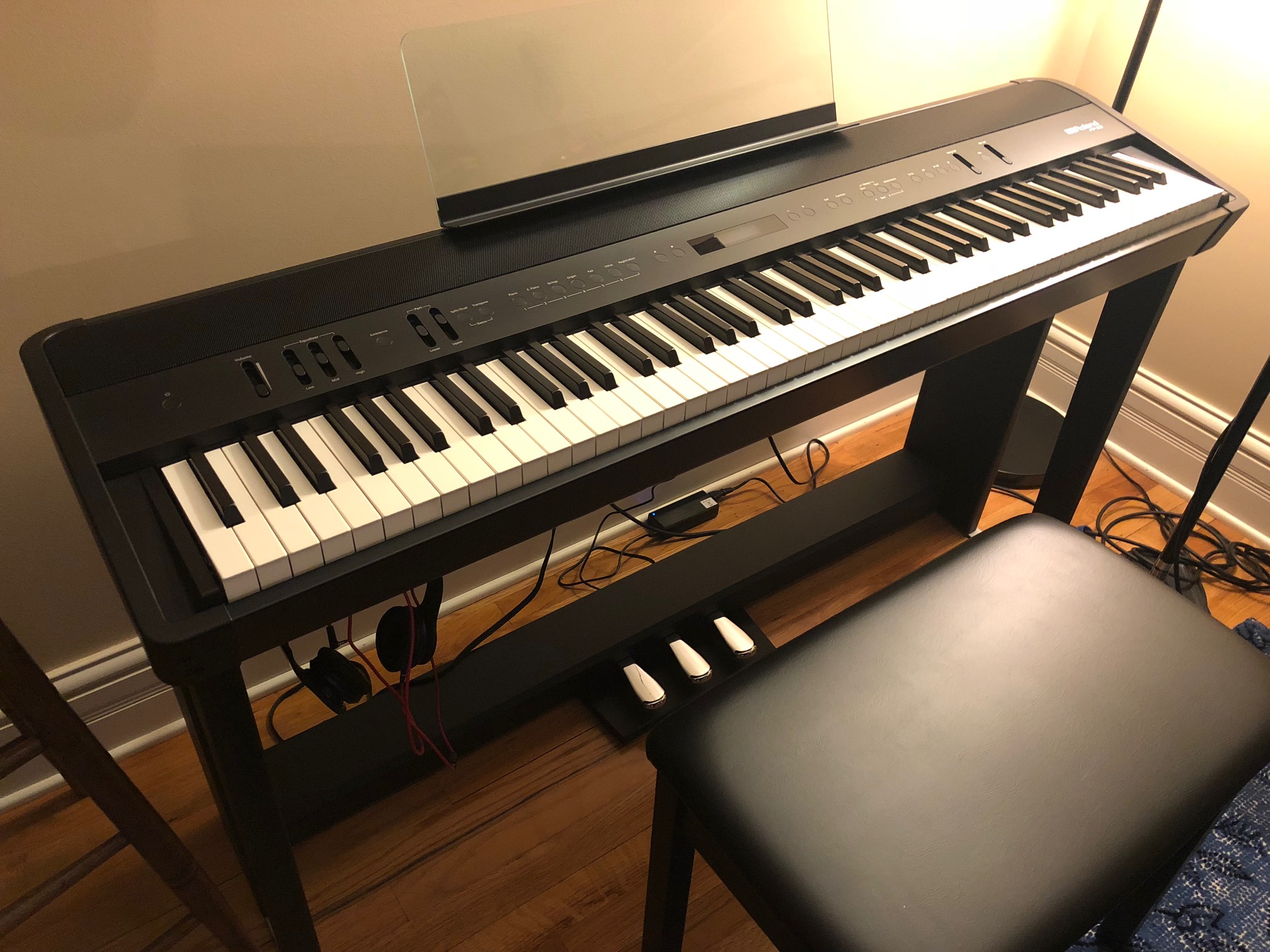
The Takamine is hands-down the finest guitar I have ever played. It is an acoustic with a pickup and electronic tuner. I had the pleasure of playing it during the last year I was with the band, and I still enjoy playing it on my own now. It is the fifth acoustic I have owned, including my first learner model and a Stella 12-string I had in high school. Currently, I have a wood-grain Yamaha that I have had since college, a Fender with a deep blue finish that I bought from one of my band mates, and the Takamine. I need to play much more than I do, but what can I say? I’m a lazy musician. The most recent addition to my collection of instruments is a Roland FP-90 keyboard that features real wooden hammer-action keys, multiple banks of sounds (pianos, strings, organs, synth sounds, etc.), four on-board speakers, and inputs for a mic and an amp. I had a smaller Yamaha keyboard that I bought while I was with the band, but this Roland is like a Rolls Royce by comparison.

My Roland FP-90 keyboard

I have spent much of my life attempting to entertain others at home, at church, at school, at work, and in restaurants and bars. I have sung and played for weddings, funerals, parties, dinners, meetings, and other occasions. Even when I was providing music at church, deep down it was my need to perform that inspired me as much or more than any religious conviction. I addressed this issue as honestly as possible in another blog post. Music has always been my most creative expression, and I am so thankful that I had some raw talent and the right people — family, friends, teachers — to encourage me at a young age. I only wish that I had taken the time and put forth the effort to learn to read music, which would have given me so many more opportunities to give people enjoyment. And, in the end, that is the reward for me of being an amateur performer.