I have posted about the rich music tradition that exists in the area around Springfield, Missouri, which is in a region of the country called the Ozarks (a moniker that can be both singular or plural – trust me on this one). Primarily located in southern Missouri and northern Arkansas, the Ozarks is characterized by rolling hills, deep hollows, caves, springs, plentiful rivers and streams, steep rocky bluffs, lush vegetation, and rich cultural traditions that can be traced back to Appalachia and further back to Scotland, Ireland, and even Germany. A major hallmark of Ozarks culture is a type of folk music handed down over many generations, a genre that is often referred to in the region as “Old Time” music. Dominant instruments include fiddle, banjo, mandolin, upright bass, and acoustic guitar. There are definite similarities to Bluegrass music, although purists will argue about distinct differences that exist between the genres and even marked variations in style within “Old Time” music according to location within the Ozarks, especially with fiddle playing.
Stringed instruments
The traditional Ozarks music may be old, but it is far from dead. There are plenty of bands and ensembles performing tunes that date back to the 19th century, and there are locations throughout the Ozarks that host regular jam sessions where musicians gather to play. One of the oldest is at a former general store in McClurg, a small crossroads in Taney County, Missouri. This weekly jam and potluck supper is hosted by the current owner of the venue, Tom Peters, who is the former Dean of Libraries at Missouri State University in Springfield and was my direct supervisor before we both retired at the end of 2024. One of the most encouraging aspects of Ozarks jam sessions and performances is how often young players in their teens and early 20s are participating. A new generation of “Old Time” musicians is carrying the tradition into the future.
McClurg Jam- photo by Kevin Cole
The Ozarks is a large geographic region that even stretches west to encompass small segments of Oklahoma and Kansas and east to include a sliver of Illinois (this is a contentious topic among Ozarkers, who tend to be quite opinionated about the boundaries of the area). Most of the Ozarks is rural, with small towns and villages scattered among the hills and plateaus. There are centers of larger population, such as Fayetteville, Arkansas, home of the state’s flagship university. In Missouri there are larger towns like West Plains, Rolla, Joplin, and Branson. The largest metropolitan area in the Ozarks is Springfield, Missouri. Naturally, there is considerable diversity in musical interest throughout the region, with an emphasis on “Old Time,” gospel, Bluegrass, and country in the rural areas. These genres are also popular in the population centers, along with folk, Americana, rock, pop, jazz, and little bit of everything else. Chappell Roan, one of the country’s latest sensational pop stars, is from Willard, Missouri, a suburb of Springfield.
Ozarks map by Curtis J. Copeland
Promoting and preserving the music of the Ozarks are admirable endeavors, and I am proud to have been involved in such efforts while I was working at the university. I conducted interviews of musicians and vocalists and edited videos of interviews and performances, all of which were featured on the university library’s YouTube channel. Our team explored a variety of music-related topics that are available to watch or listen to on this channel: past and present live music venues along historic Route 66 that crosses the Missouri Ozarks; African-American musical influences in the region; “Ozark Jubilee,” the nationally-televised country music variety show that was broadcast in Springfield from 1955 to 1960; the Gordon McCann folk music collection; and the Max Hunter collection.
Missouri State University Library in Springfield, MO
One of the playlists on the library’s YouTube channel is titled “Songs of the Ozarks,” which was part of the university’s scholarly content associated with its participation in the 2023 Smithsonian Institution’s Folklife Festival. The festival featured the history and culture of the Ozarks region, presented in part by the university, on the National Mall in Washington, D.C. The playlist includes 43 videos of musicians, vocalists, songwriters, bands, and ensembles who are active in the Ozarks region. The interviews and performances were conducted and recorded by Emalee Flatness-Combs, a musician, singer, and songwriter based in the Ozarks who is also an alumna of Missouri State University. The genres covered in this collection include “Old Time,” folk, Bluegrass, country, cowboy, gospel, Americana, rock, and pop.
The following is a sampling of the musical acts included in the “Songs of the Ozarks” playlist.
Randall Chowning – a founder, one of the lead vocalists, and the lead guitarist of the Ozark Mountain Daredevils, a rock band formed in 1972 in Springfield.
John Fullerton – “Cowboy John,” a member of the legendary Sons of the Pioneers who has appeared with a wide range of celebrities including Roy Rogers Jr. and the High Riders, Three Trails West, Miss Devon & the Outlaw, and Riders in the Sky.
David Scrivner – a lifelong “Old Time” fiddle player and student of the great Missouri fiddler, Bob Holt; Scrivner won the Arkansas State Fiddle Contest in 2019 and plays fiddle regularly at the McClurg jam.
Sylamore Special – an award-winning Bluegrass band based out of northwest Arkansas that came together in 2021 and have played numerous times at Silver Dollar City amusement park in Branson, Missouri, and also at the Arkansas Country Music Awards.
David Warren – an accomplished Bluegrass musician and jig dancer who played several years with ensembles including the Bluegrass Buck Jumpers and the Bressler Brothers.
Pam Setser – a musician, singer, and songwriter whose career spans decades and has brought her in touch with music legends from Merle Haggard to Doc Watson and Maybelle Carter; she has performed on “Hee Haw” and has been on stage with Grandpa and Ramona Jones, The Whites, and Joni Bishop.
Sylamore Special performing at the 2023 Smithsonian Folklife Festival
There is a rich tradition of music in the Ozarks going back more than 150 years, and so much of that legacy lives on today throughout the region. There is also a lasting influence of indigenous music from tribes that inhabited the Ozarks for many generations before European settlers migrated into the area. And beginning in the late 20th century, new musical and dance styles were introduced as refugee and immigrant populations from around the world began taking up permanent residence in the Ozarks. The musical landscape is constantly changing in the Ozarks, but fortunately so far, the newcomers are not displacing the old standards. Cultural diversity is a treasure to be valued, and the Ozarks is blessed with an abundance of it.
I had the privilege of being directly involved in the planning and implementation of the 2023 Smithsonian Folklife Festival, an annual event that takes place on the National Mall in Washington, DC. With a history going back over fifty years, the festival is usually scheduled over a ten-day period roughly encompassing the last week in June and the first week of July. It is produced by the Smithsonian’s Center for Folklife and Cultural Heritage and honors living cultural traditions while celebrating those who practice and sustain them. One of the programs selected for the 2023 festival was focused on the Ozarks, a region of the U.S. that is centered in southern Missouri and northwest Arkansas but also includes small portions of northeast Oklahoma, southeast Kansas, and extreme southwest Illinois.
Smithsonian Folklife Festival 2023
I began working in 2019 for Missouri State University Libraries on a part time basis, assisting with projects sponsored by the Ozarks Studies Institute, an initiative of the Libraries. A fortunate turn of events led to the Smithsonian partnering with the Libraries for the Ozarks program of the 2023 festival, with the Dean of Libraries serving as a curator. The Dean offered me a full-time position eighteen months prior to the event to serve as an associate director for the university’s participation in the festival.
The Dean and I teamed up with another part-time employee of the Libraries who has written two books about the Ozarks and has extensive cultural knowledge of the region. Our trio served as the core planning committee for the university to collaborate with the festival organizers from the Smithsonian. One of the first jobs we tackled was coming up with a name for the program. After considerable deliberation, we decided on “The Ozarks: Faces and Facets of a Region.” Our trio made numerous trips to visit with people and organizations throughout the region, in all five states, to spread the word and generate excitement about the festival. A small group of Ozarkers, including our planning trio, visited the National Mall in the summer of 2022 to get a clearer picture of how the event looks and works. We took two musical acts with us to perform as a preview of the 2023 Ozarks program.
Smithsonian Folklife Festival 2023
Over the course of a year, we worked with the Smithsonian staff to identify key stakeholders from the Ozarks who could assist with fundraising, program content, identifying other curators and participants, and overall planning of the festival. We had Zoom meetings almost every week for over a year to hammer out all the details, and several festival organizers from the Smithsonian visited the Ozarks multiple times to get a better sense of the region and to meet with our team.
Using artists from the Ozarks and from the DC area, the larger planning team came up with design features for the festival that would reflect the natural beauty of the region. We had to decide on color schemes, fonts for signage, layout of the festival grounds, daily schedules of events, and a whole host of other elements. In early 2023 we began meeting with the festival logistics staff to work on structural and mechanical requirements for the site. We also met with interns and volunteers who are brought on each year to help the Smithsonian with festival participants’ needs regarding transportation, lodging, meals, and a wide variety of other accommodations. By the time June arrived, there were over 150 people involved in either planning or implementation. It is a massive effort.
Smithsonian Folklife Festival 2023
The festival was open each day, June 29 through July 9 (with the exception of July 5), from 11:00 a.m. to 5:00 p.m., followed by evening concerts most nights running from around 6:30 to 8:00 p.m. The Ozarks program site was situated under the trees on the south side of the Mall, just east of 14th Street SW. On the opposite north side of the Mall was the other program for the 2023 festival, which was called “Creative Encounters: Living Religions in the U.S.” Each year the festival is open on Independence Day, where people gather by the hundreds of thousands along the corridors, paths, and grassy fields extending from the Potomac River all the way to the Capitol to await the spectacular fireworks display at dusk between the Lincoln and Washington Memorials. I don’t typically go out of my way to see firework displays, but the colorful explosions that serve as a backdrop for the imposing Washington Monument are mighty impressive.
Smithsonian Folklife Festival 2023
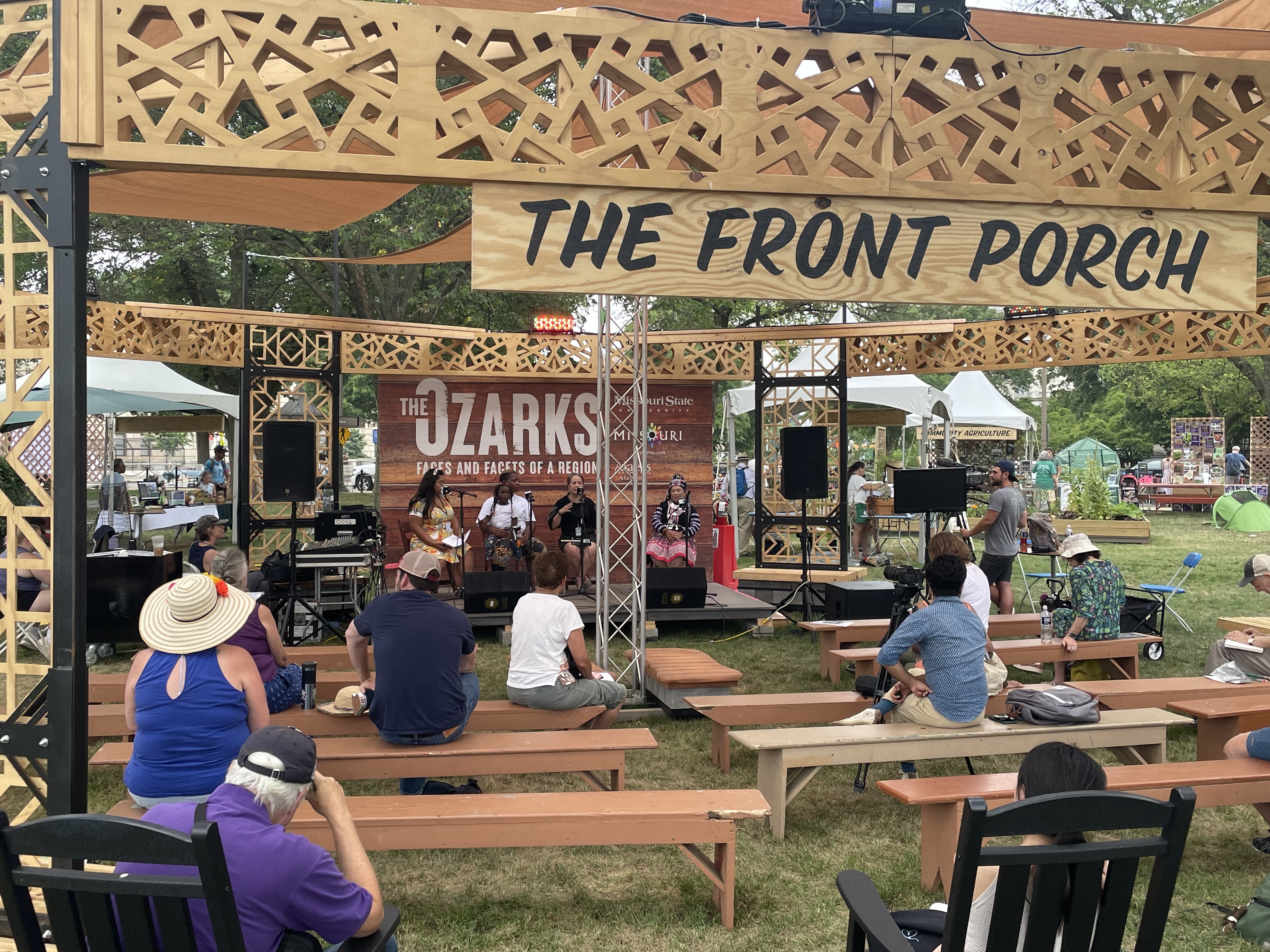
The Ozarks program was divided into four major themes: celebrations and gatherings; stories, sounds, and show business; migrations, movements, and pathways; and connections to land and place. The site featured large-scale murals and a mountain-bike trail build, music jam sessions and performances, dance and plant-knowledge workshops, food and craft demonstrations, and curated discussions. The Ozarks program included multiple theaters. There was a theater for discussions and demonstrations of plant knowledge, one for cooking demonstrations, one called the “Pickin’ Porch” mostly for music during the day, and one called “The Front Porch” for panel discussions. Both festival programs shared a large main stage out in the middle of the Mall that was reserved for musical workshops and performances during the day and for the larger evening concerts.
Smithsonian Folklife Festival 2023Smithsonian Folklife Festival 2023
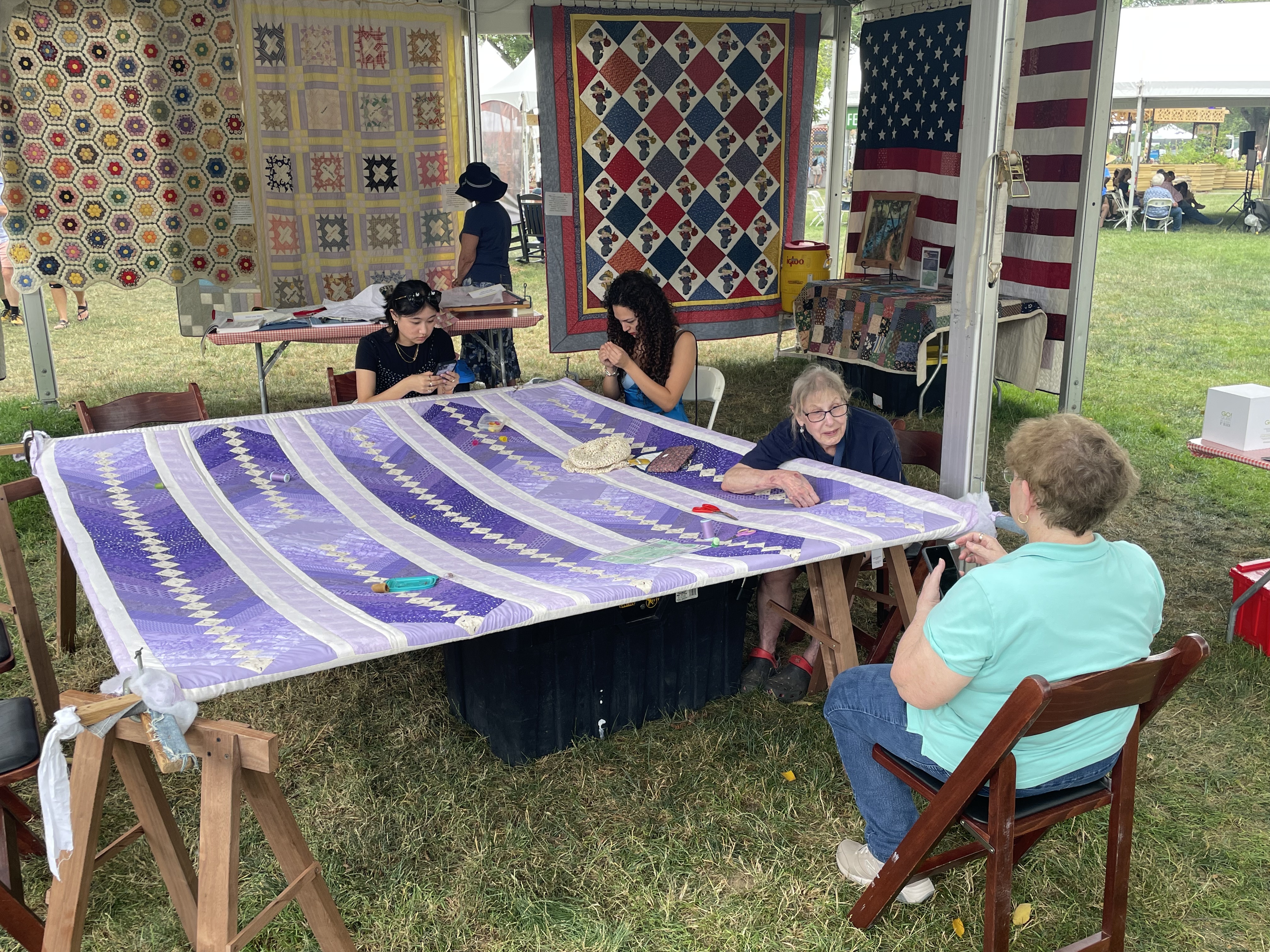
The Ozarks program brought close to 60 musicians to the festival, which is a clear indication of how important musical traditions are to the culture of the region. There were at least eleven different ensembles of varying sizes, along with many individual musicians, specializing in several different genres including Native American music, traditional old time music, bluegrass, folk, country, gospel, and contemporary. Foodways, plant knowledge, arts, crafts, and storytelling were demonstrated by white Ozarkers but also by many other ethnic groups that call the Ozarks home, including Native Americans, African Americans, people of Hispanic and Latino heritage, Marshallese, Hmong, Khmer, and Syrian. Contrary to much of its history over the last 200 years, some of the “faces and facets” of the Ozarks show remarkable diversity in race, ethnicity, and culture.
Smithsonian Folklife Festival 2023Smithsonian Folklife Festival 2023
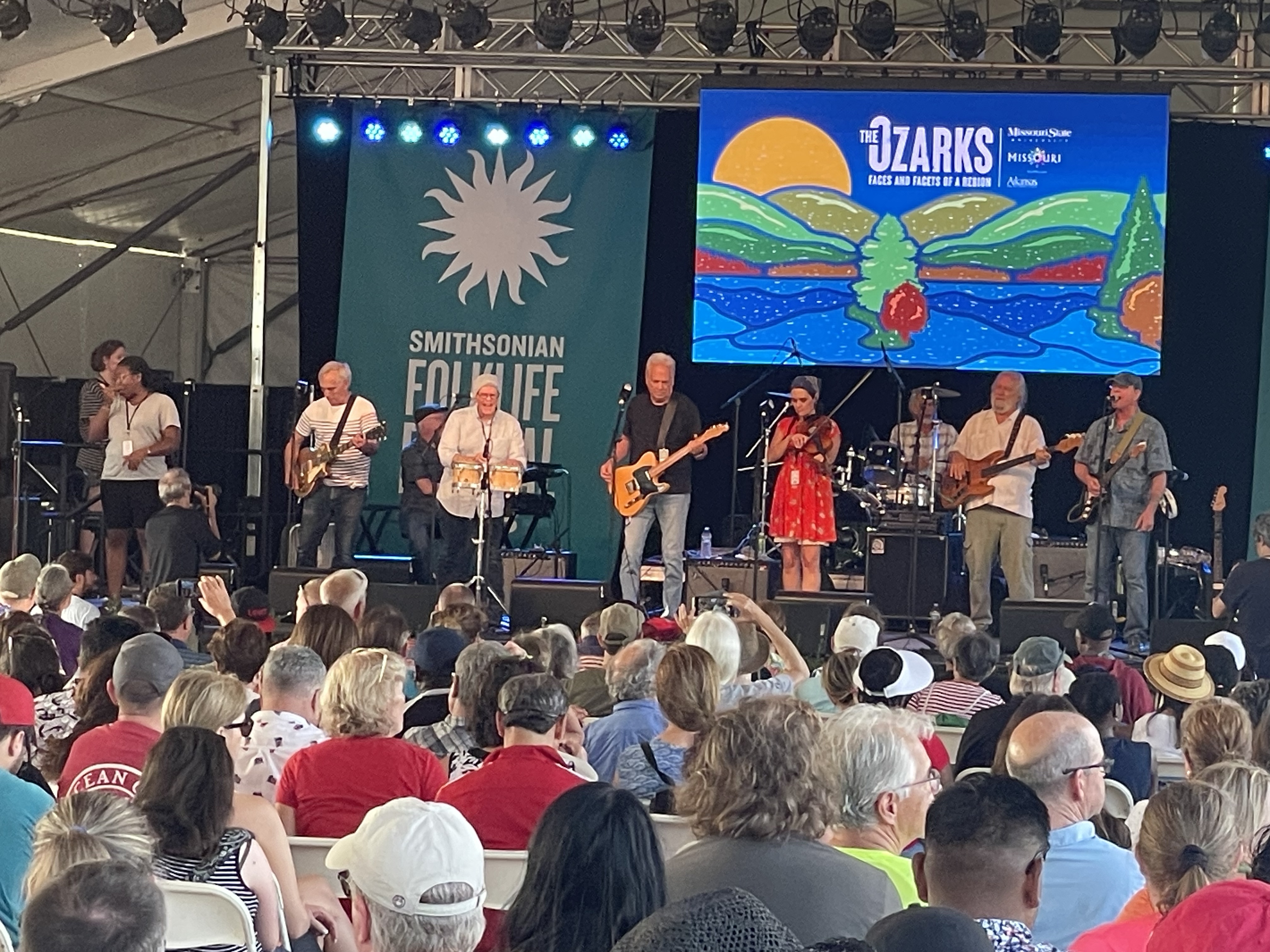
The largest and most recognizable musical group that the Ozarks program sponsored played on the main stage for the July 4 evening concert. The Ozark Mountain Daredevils is a band that originated out of Springfield, Missouri, in 1972. The group had several hits in their early years including “Jackie Blue” and “If You Want to Get to Heaven.” The band has evolved over the decades, losing and replacing band members and even going into a type of semi-retirement in the early 21st century. In recent years the Daredevils have enjoyed a bit of a resurgence, appearing on the Grand Ole Opry in Nashville on two occasions in 2023. They put on a hell of a show for the DC festival and for hundreds of people within earshot of the main stage that evening.
Ozark Mountain Daredevils
My primary job during the days of the festival was to occupy the Missouri State University Libraries table set up near the main entrance of the Ozarks program. With the help of one of our student workers, I was selling several books about the Ozarks and answering questions about the festival program and the region in general. I was surprised by how many festival visitors told us they were either from the Ozarks, had lived in the Ozarks, or had fond memories of visiting the region. Many of these folks have lived and worked in the DC area for years, and they were so happy to see the Ozarks featured on the National Mall. We could definitely detect a sense of pride in their voices when they talked about their connection to the region.
Smithsonian Folklife Festival 2023
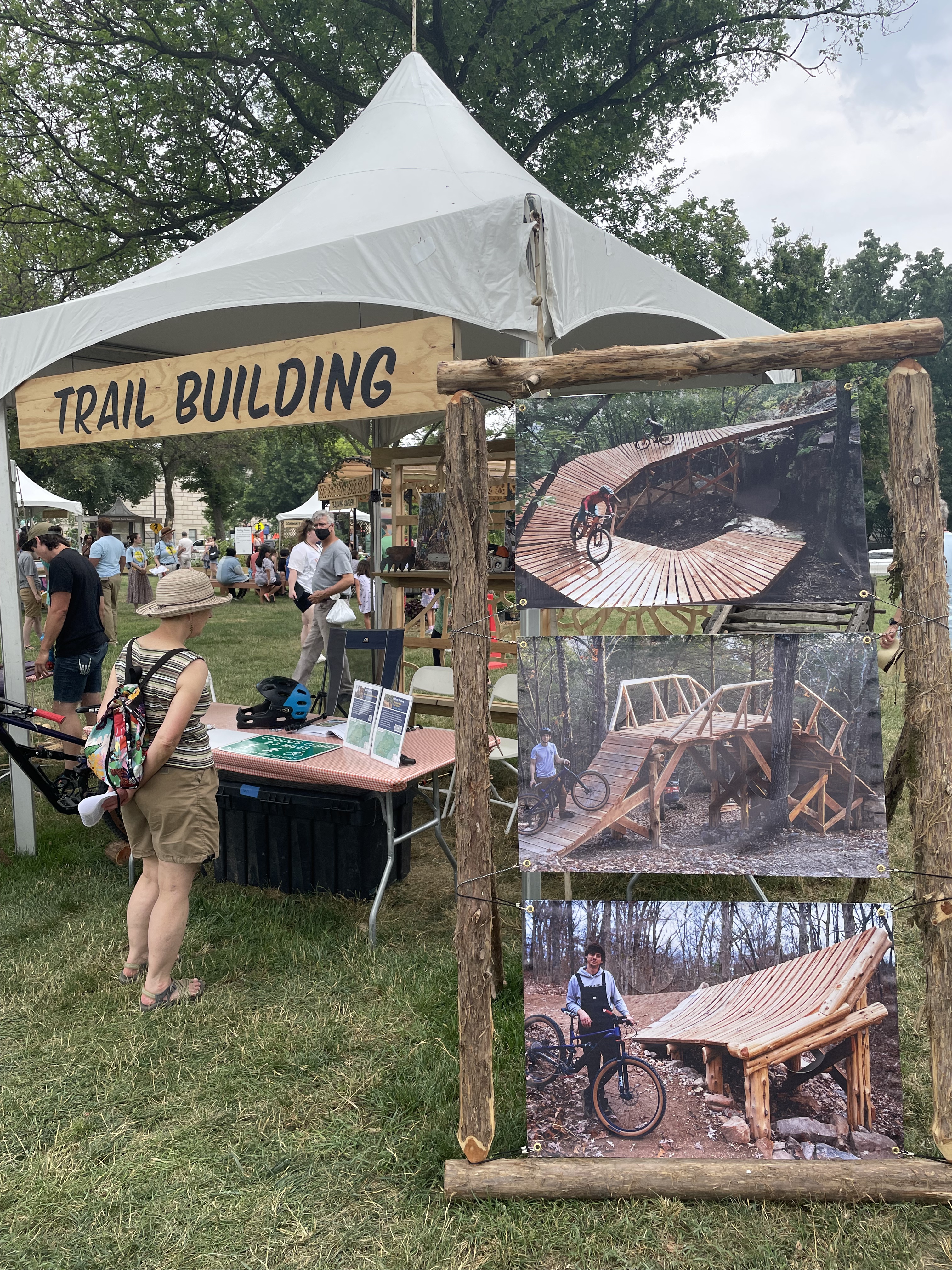
Perhaps the most enjoyable connection I made during the time of the festival was with the two guys representing mountain biking, one of the fastest-growing forms of recreation in the Ozarks, especially in northwest Arkansas and Missouri. Seth Gebel is a young entrepreneur who owns Backyard Trail Builds. He goes out into the forest armed with only hand tools and cuts down cedar trees, trimming them out to create bridges, ramps, and runs for biking trails. He designed and built a short, curved and banked track at the entrance to the Ozarks site at the festival. Dave Schulz works within a nonprofit organization to help community leaders in revitalizing their towns by developing bicycle-focused public parks and sustainable trail systems, preserving natural environments while drawing tourism from around the world. Both of these guys gave daily riding demonstrations on the track that Seth built for the festival.
Smithsonian Folklife Festival 2023
The most magical moment for me came on the final evening of the festival in the dining room of the host hotel. A group of Ukranian vocalists from the Creative Encounters program stood up and began singing a traditional folk song in their native tongue. They were followed by several other individuals and groups from both programs, standing to sing and inviting others in the room to participate through responsive chanting, vocalizations, and clapping. As I witnessed what happened, I recognized that this festival offers us a snapshot of the best of humanity, the wonders we are capable of producing when we embrace our differences and come together to learn from each other.
The Ozarks is one of those regions of the country that is diverse and interesting enough to be a tourism gold mine. From the bright lights and music of Branson, Missouri, to the gentle flowing current of the Buffalo River in Arkansas, there is something for just about everyone. Although there are no large cities in the Ozarks, there are towns with a few city amenities, like the restaurants, shopping, museums, and entertainment spots available in Springfield, Missouri and Fayetteville and Bentonville, Arkansas. On the other hand, Ozarks visitors can head off grid and commune with nature at any number of conservation areas, state parks, national parks and forests, national rivers, and wilderness regions.
Mount Magazine State Park, Arkansas
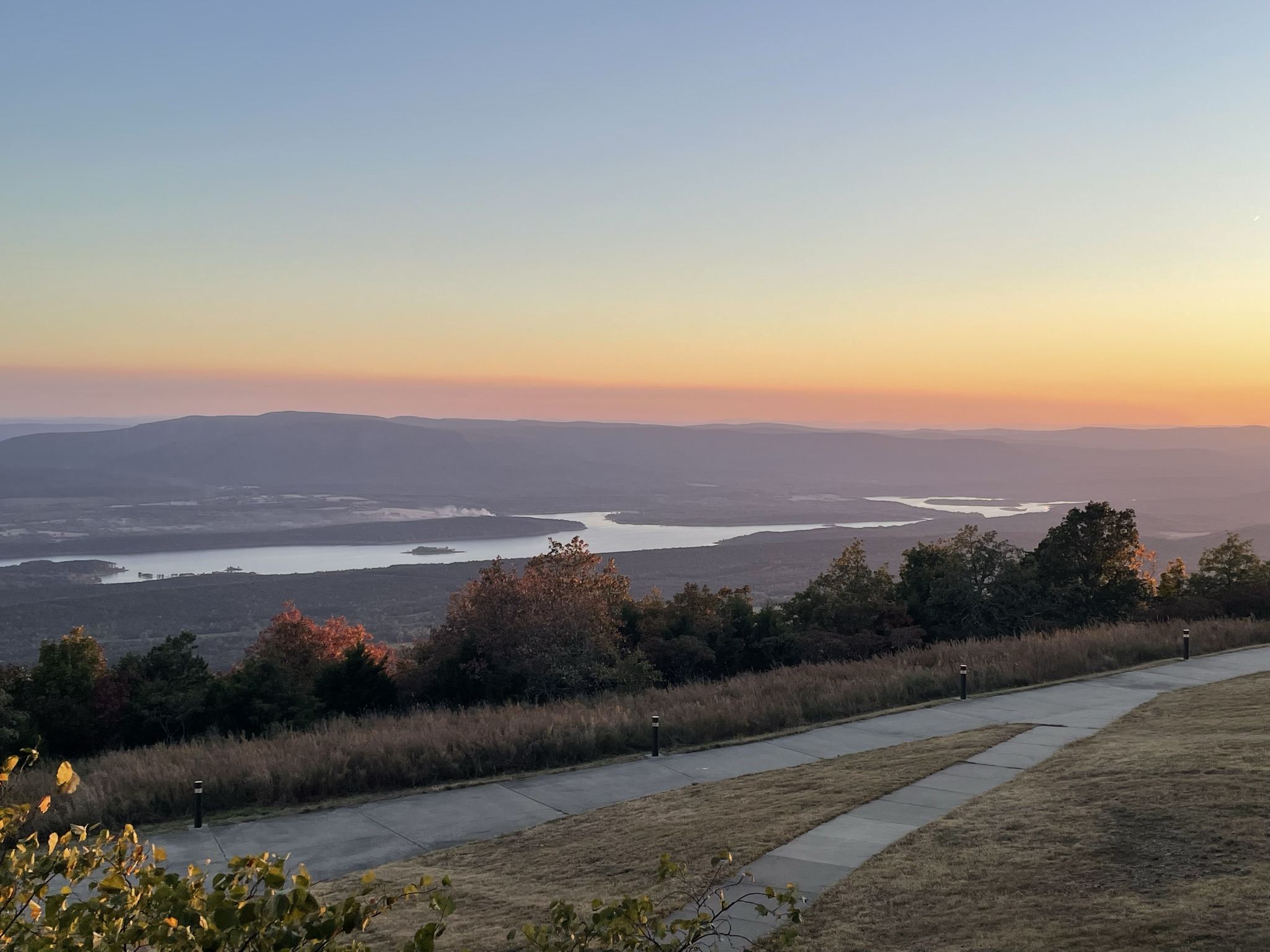
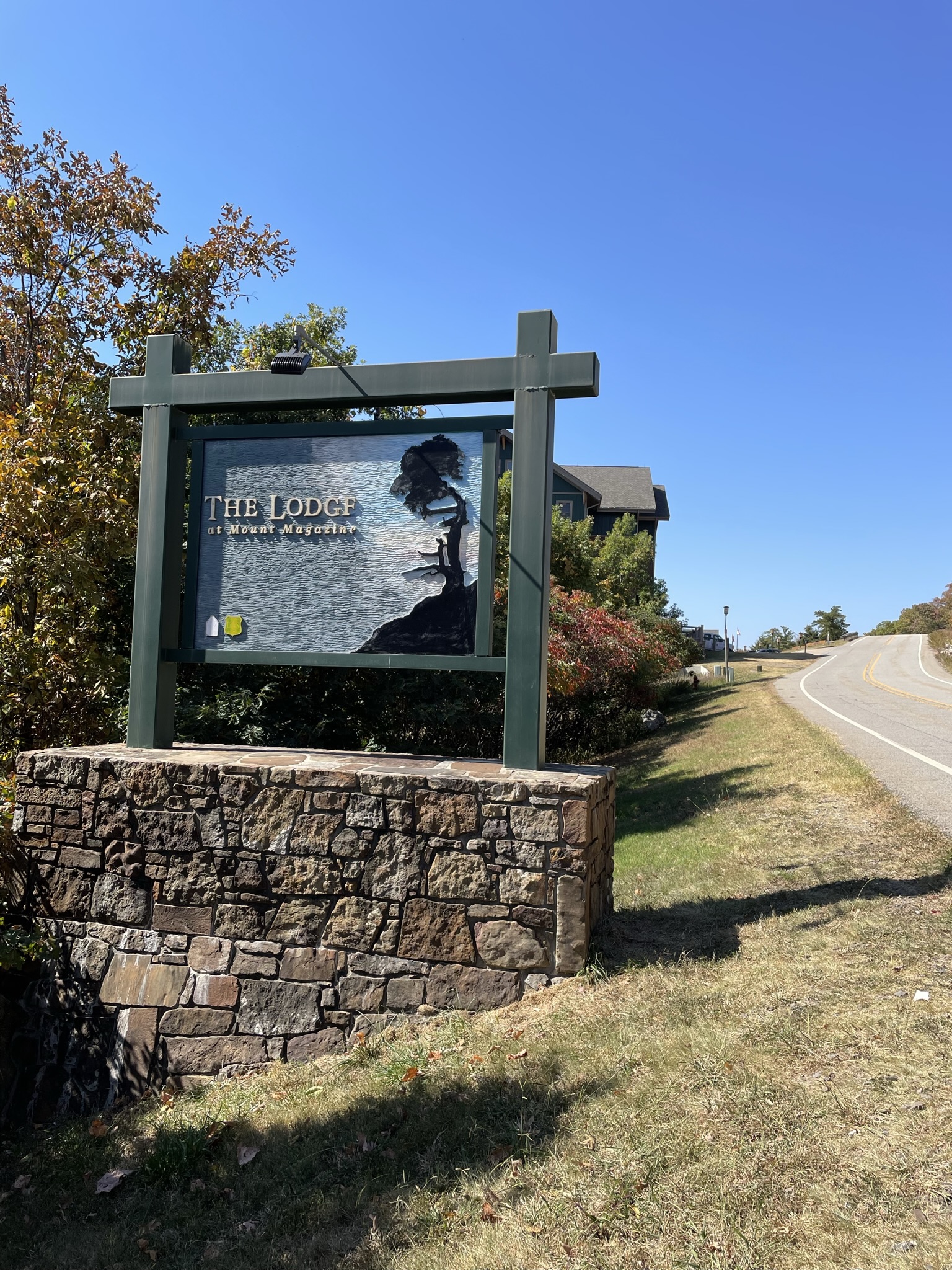
Between those opposite ends of the destination scale, there are a few spots that offer a nice blend of the outdoors with the comforts of the built environment. One of those is the Lodge at Mount Magazine State Park near Paris, Arkansas. Located just below the crest of the highest peak in the state (2,753 feet), the lodge is situated on Mount Magazine’s south bluff overlooking the expansive Petit Jean River Valley and Blue Mountain Lake. Because this ridge is so high above the valley floor, the park includes a launch area for hang gliders within walking distance of the lodge. Other activities to enjoy include mountain biking, horseback riding, backpacking, and ATV riding. The park visitor’s center is within walking distance of the lodge on one of several nearby easily accessible nature trails.
The Lodge at Mount Magazine State Park, ArkansasThe Lodge at Mount Magazine State Park, Arkansas
The term “lodge” may be a bit misleading to potential vacationers to the site. Other than the rural setting, the exposed pine log beams, the nature-themed art, and the natural rock accents, the lodge has many of the comforts of a resort. The rooms are well appointed, many of which have a whirlpool spa. The indoor pool is spacious, and there is a fitness center and a game room too. There are multiple seating areas with large glass panels looking out over the valley. The dining room and bar are a real cut above what most guests would associate with a state park. Accommodations range from individual rooms and suites in the main lodge to cabins of various sizes flanking the building on either side, all overlooking the valley. Each cabin has a fully equipped kitchen, fireplace, and covered deck with an outdoor hot tub. The lodge also houses a conference center.
The Lodge at Mount Magazine State Park, Arkansas
What attracted me most about the lodge and prompted me to book a room for my wife and me in the fall of 2022 was the view. It is magnificent. We spent many hours on the balcony of our lodge room looking out at that incredible vista. The pleasant surprise was how nice the whole facility was. The service was great. The food was quite delicious and plentiful considering the price and the somewhat rustic setting, with buffets offered for most meals, although ordering from a small menu was an option. The park is in a remote part of the Ozark-St. Francis National Forests, but there are small towns only thirty minutes away. It’s a great place for the family that enjoys nature but doesn’t want to sleep in a tent or camper, although the park has plenty of campsites. The lodge and cabins are also perfect for a romantic getaway, and we are always ready for that kind of excursion.
In late 2018, my wife and I moved from Georgia to Springfield, a town of about 170,000 people in southwest Missouri. It’s a great location for us because we have family and close friends in Georgia, Kansas, Texas, and Arizona. We really enjoy traveling, especially to the desert southwest, but we like the Florida beaches and places like New York City, Chicago, and Nashville. Living in Springfield strategically positions us near the center of the country and makes it easier to get to family, friends, and fun destinations. The icing on the cake is the small national airport that is a mere twenty minutes from our house, which is serviced by three major airlines and a few budget carriers.
Southern Missouri and northern Arkansas make up the bulk of the region known as the Ozarks. It as an area of the country defined by a variety of factors, from geology and topography to culture and customs. It is also quite beautiful. It is rich in natural resources, especially water, minerals, and forests. It is a complicated region in almost every category imaginable. Although it boasts no major cities, it does have some bustling urban centers. There are some wealthy people in the Ozarks, but there are far more families living in serious poverty. On the political spectrum, it is largely conservative with pockets of progressivism mostly in and around the cities.
Admittedly, I knew very little about the Ozarks. I had never set foot in Missouri and only visited once just a few months before we moved here. To get “learned up” about our new home, I did what I always do when encountering something new and unfamiliar. I started reading. The following is an annotated list of books I have read about the Ozarks over the last three years or so. My bibliography is in no way intended to be comprehensive or even representative; however, these books have given me greater insight into the history, culture, and people of the Ozarks. All of these titles are nonfiction, but I have also read fiction by Ozarks writers or stories set in the region. Perhaps sometime I will write a post reviewing those books as well.
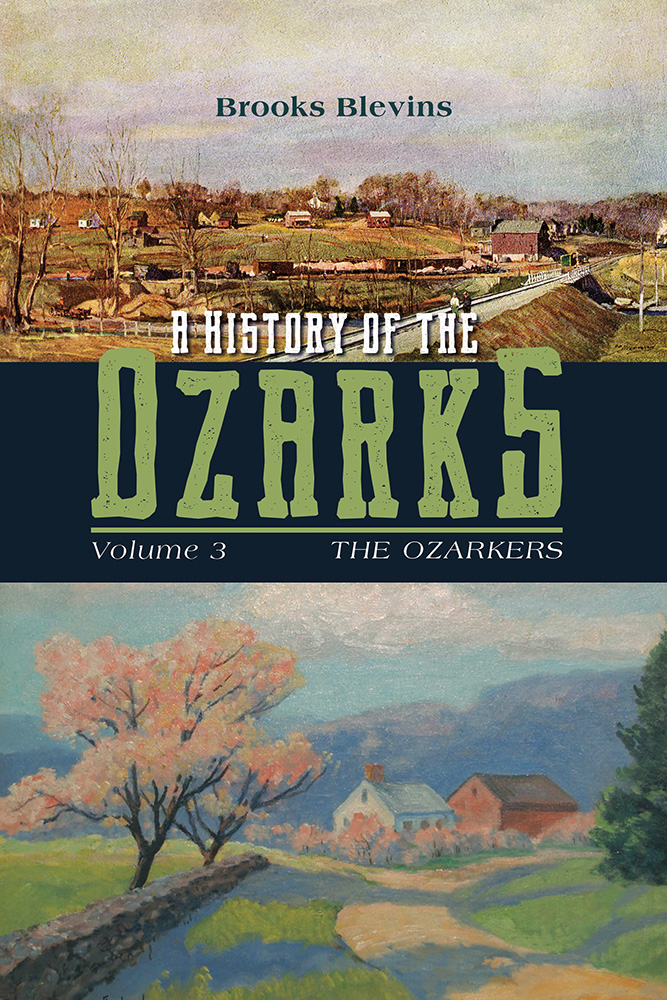
A History of the Ozarks, Volume 3 by Brooks Blevins
A History of the Ozarks, Volume 3: The Ozarkers by Brooks Blevins Brooks Blevins is the uncontested authority on the history of the Ozarks. He is a professor at Missouri State University in Springfield, where I am also employed. But his full-time residence is in northern Arkansas, so he has his feet planted in the two main states of the Ozarks. He is a fine writer, a serious scholar, a respected teacher, and an all-round nice fellow. I have only read this 3rd volume of his trilogy, but I intend to at least go back and read the 1st volume covering the early history of the region.
Blevins is at his best when he is dispelling many of the misconceptions and over-generalizations of the Ozarks as a place full of backwoods hillbillies with no connection to the modern world. He also does a great job of pointing out the most attractive features of the region without romanticizing or falling into the trap of exceptionalism, which is always tempting to do if you are so identified with a place, which I believe he is.
The chapters on “Ozarks Society” and “Putting on a Show,” along with his “Conclusion,” were the most interesting to me because they highlight how much the Ozarks have changed over the last 150 years and are continuing to evolve. I’m not sure I agree with Blevins that the specific location of the Ozarks, a topic of serious debate for generations, is best defined by where the Ozarkers live; however, there seems to be a strong sense of place appreciated by so many people who live here, quite similar to sentiments held by many people in the Deep South about their region. This is a solid historical overview of a complex and fascinating part of the country in the modern period.
Living Waters: The Springs of Missouri by Loring Bullard This book is well documented and researched. The photographs of the springs and streams they feed are stunningly beautiful. The layout of the book makes it easy and enjoyable to read. However, aside from the technical aspects of the book, Bullard clearly has a passion for his subject that is both personal and professional, which is demonstrated in the text of every page.
The organization of the book is especially fine, with chapters focusing on features and functions of springs rather than on individual locations. Bullard incorporates a considerable amount of history to offer context and appreciation of how past generations have understood and valued springs in the state and have taken advantage of them as valuable natural resources. Of course, the environmental message throughout is of paramount importance — we must take good care of our state’s springs because of the vital role they play in providing clean water for the ecosystems they feed.
White Man’s Heaven: The Lynching and Expulsion of Blacks in the Southern Ozarks, 1894-1909 by Kimberly Harper Harper presents a thoroughly researched and well documented scholarly study that helps explain why the southwestern Ozarks is such a white region of the country. Lynching occurred in many places across the South, and obviously, into the Midwest. Many white people who had lived during the time of slavery, whether they actually owned slaves or not, resented the new autonomy of black people in their communities during Restoration. Over the decades, resentment evolved into a fear. “While blacks may not have been true economic, social, or even political competitors in the region, whites viewed blacks as a threat to their wives, daughters, and police officers.” Obviously, much of the fear centered on the perceived sexual predation of black men. “It was believed that women were not safe in the country or the city, so long as African American men roamed free.”
However, Harper goes beyond the acts of horrible white mob violence to explore why African Americans were driven out of communities, often at the same time lynching took place. Similar action was taken in other parts of the country — Forsyth County in north central Georgia comes to mind. Other areas of north Georgia, especially in the Appalachian foothills, still have small black populations to this day.
In the Ozarks and in the north Georgia mountains, the economy in the early 20th century was primarily subsistence farming, which did not require much labor outside the extended family of the farmer. As Harper observes, “This was in contrast to the black-majority regions of the South, where inexpensive and readily available black labor composed a significant segment of the local economy, making African Americans indispensable to local white employers.” One could easily make the same argument in recent decades for why white farmers have not been so anxious to deport undocumented Latinos from regions of the South where industrial agriculture is dominant and depends on vast numbers of inexpensive laborers.
This is a fine addition to American history and African American studies. Harper’s book joins more recent work on lynching by prominent African American scholars. Highly recommended.
Hipbillies: Deep Revolution in the Arkansas Ozarks by Jared M. Phillips I had the opportunity to hear the author speak on a panel with two people who were involved in the Back To Land movement in the Arkansas Ozarks at a conference in West Plains, Missouri, in September, 2019. The people who decided beginning back in the 1970s to trade in urban dwelling for a rural, subsistence lifestyle among the hills and “hollers” of the Ozarks are often referred to as Hipbillies — a hybrid of hippies and hillbillies.
Phillips does a good job of placing this movement in the context of 20th century back-to-the-land and counter-culture philosophy characterized by the works of people like Wendell Berry and Gary Snyder. He gives proper credit to the successes of the Hipbillies while also recognizing their failures and some of their less-than-pure intentions. He credits them for fighting for environmental health, sustainable agricultural practices, and social justice issues. One of their greatest accomplishments was succeeding in modest changes to how the US Forest Service approached the management of timber.
Phillips admires how the Hipbillies, especially the pioneers from the early 1970s, faced overwhelming odds and even life-threatening circumstances yet still persevered to make it as homesteaders in a part of the country where the land is not so forgiving. He dispels some of the myths about how native Ozarkers rejected the Hipbillies. Instead, they often embraced them and even saved their lives during harsh winters and unpredictable farming seasons. There were clashes in places like Eureka Springs, but that was more a conflict between counter-culturists and town leadership.
The Hipbillies had big dreams when they landed in the Ozarks. “What was sought, then, was a rehabilitation of American culture — one that began in the dirt and grew over time like the forest that slowly reclaims and heals a ruined field,” Phillips writes. He contends that the Hipbillies took themselves seriously as revolutionaries. They “came to the Ozarks seeking refuge and a place in which they might build a new world for themselves, and hopefully, all of humanity . . . . While they did not always succeed, the story is not over — they are still alive and are still powerful cultural, political, and economic forces in the Arkansas highlands.”
Hillbilly Hellraisers: Federal Power and Populist Defiance in the Ozarks by J. Blake Perkins The myths and stereotypes about the Ozarks are deeply ingrained in our consciousness, but they never have painted a true picture of the people and their culture, desires, needs, problems, etc. Perkins’s book reinforces one essential truth about Ozarks people: they tend be proud and fiercely independent, even in the face of long-term adversity.
There is a strong tradition of tension between individual rural families and individuals and/or institutions in authority. Poverty has always been a dark shadow hanging over the Ozarks, even when other parts of the country were climbing out of it. Although many people here petitioned for government assistance in the past, there is a history in this region of distrust of government programs, which ended up being administered and exploited by local and state officials. Law enforcement was fine as long as it didn’t try to stop individuals from scraping out a living, even through illegal means. More than anything, native Ozarkers have always just wanted to be left alone. When their autonomy was threatened, especially by outside forces, they sometime became violent.
Ozarks Hillbilly by Tom Koob and Curtis Copeland Koob and Copeland do a good job here of presenting the stereotypes of the Hillbilly as the term has been used in literature and other art forms to describe many of the rural folk in the Ozarks. The authors argue that, contrary to the traditional image of a lazy, shiftless, ignorant, depraved character, the Ozarks Hillbilly is quite industrious, shrewd, and highly skilled. Hillbillies are survivalists and generations of them have struggled to provide for themselves and their families in a harsh and unforgiving environment.
I found it odd in a book about the Ozarks how much time the authors spent on discussing Appalachian Hillbillies. They seem to have keen interest in the way Hillbillies were presented in Deliverance, the novel by James Dickey and the popular film adaptation starring Burt Reynolds and Ned Beatty. There are definitely similarities between the two regions of the country, which have been explored by numerous scholars. The stereotypes of the rural residents of both areas also share commonalities. Perhaps a comparison/contrast book would have been even more helpful and intriguing.
Where Misfits Fit: Counterculture and Influence in the Ozarks by Thomas Michael Kersen For Kersen, the town of Eureka Springs, Arkansas, serves as an archetype for his thesis of how counterculture distinguishes the Ozarks and is among its more charming and sustaining features. As he states it, “The magic of Eureka Springs is that the town is a mass of contradictions and microconflicts that breed [sic] creativity.” No wonder that the book’s title is also the semi-official motto of the town: Where Misfits Fit.
Kersen does a good job of weaving the eccentricities of the people who occupy the Ozarks into the history of the region. He first offers his identification of the region, defining it by geography and culture. He then proceeds to outline its countercultural characteristics through popular myths, artistic expression, supernatural fixations, cult activity, musical influence and inspiration, and the back-to-the-land movements primarily of the 1970s (the author’s parents brought him to the Ozarks from Texas as part of this larger movement).
A thread running throughout the book is Kersen’s use of the adjective “liminal” to describe the Ozarks – a place that is difficult to box in and that continually crosses lines. He writes that “the Ozarks defies boundaries of all sorts — it is a work in progress.” Here again, the contradictions of the area come into play. For instance UFO enthusiasts that have been drawn here for decades rely on scientific knowledge about astronomy and space exploration but scorn scientists who fail to validate their paranormal claims. Kersen recognizes that “eccentric places attract eccentric people — people willing to live and think in the margins.” He also believes the Ozarks “offers something unique for its inhabitants and even American culture at large.”
I found some of the most valuable information in the Conclusions chapter, especially about the impact of in-migration into the Ozarks from countries around the world. The author wonders how Ozark identity will change as the racial and ethnic profile of the region continues to change. The book has extensive end notes, an impressive bibliography for further reading and study, and a decent index. Just a few points of criticism: the book could have benefited from skillful editing. There are too many typo kind of errors for an academic press book. Also, I suspect this book is a collection of separately-written essays because there is considerable repetition of information in the chapters. Otherwise, it is a fine book that is both accessible and informative.
Lake of the Ozarks: My Surreal Summers in a Vanishing America by Bill Geist I was drawn to this book primarily because I visited the Lake of the Ozarks just a few months after settling here. I didn’t know anything about Bill Geist as I never watch Sunday Morning on CBS. I may have read his columns before but am not aware if I have. I can relate to many of the references Geist makes to growing up in the 1960s and 70s, although he is a bit older than I am. Some readers will no doubt be put off by the political incorrectness of the author’s perspectives, language, and the circumstances from his adolescence, but I suspect he is being perfectly honest and straightforward with his recollections and descriptions of his life and times working for his uncle and aunt at their lakeside lodge. There are some really laugh-out-loud passages in this book, which made it an enjoyable read.
Footprints in the Ozarks: A Memoir by Ellen Gray Massey This is a pleasant read. It isn’t challenging; the text is straightforward; it doesn’t reveal anything new about the Ozarks region; it gets a bit sentimental in places; and it is so bucolic that the reader can almost smell the cow manure on the farm where Massey lived and raised her family. She also worked as a high school English teacher, and apparently quite a good one. She supervised her students over a ten-year period as they produced a quarterly journal titled Bittersweet. The value of this book lies in Massey’s descriptions of the social mores of her community, the relationships of family and friends, the tragedies her family faced (including the death of her husband), and how life in the rural Ozarks was fulfilling and rewarding to her, as it has been for so many others for many generations.
Missouri is often referred to as the “Show Me” state, a reference to a late 19th century lawmaker’s observation that its citizens as a rule prefer visible proof over blind faith. Given the political climate in Missouri in 2021, I would argue that this moniker is no longer applicable. A much more accurate appellation would be the “Float Me” state. River and stream floating trips are a major source of relaxation in Missouri with a long history and a strong tradition. According to multiple sources, flat-bottom jon boats originated, or were at least made popular, in the late 19th century in the Ozarks because they were perfect for navigating the shallow waterways characteristic of the region of southern Missouri and northern Arkansas. With an abundance of large lakes, rivers, and streams, water recreation is a huge business in Missouri attracting millions of tourists each year; however, native inhabitants have been enjoying the simple pleasures of just floating downstream for many generations.
Not only is Missouri blessed with plenty of water resources, but the Ozarks comprises one of the nation’s richest concentrations of natural springs. There are well over a thousand of them in the state. The maximum daily discharge from some of these overflowing aquifers can exceed 500 million gallons. On average, more than a billion gallons of water flow from the ten largest springs in Missouri every single day. For many centuries, springs provided drinking water for settlements and towns throughout this region of the country and were later used for powering mills and producing salt. Some springs purportedly had healing qualities. In recent decades, these groundwater flows have predominately functioned as recreational resources centered around fishing, camping, hiking, and other outdoor activities.
One of the largest springs in Missouri is Bennett Spring, located in what is now Bennett Spring State Park in Dallas County. As one of the state’s oldest parks, this spring was the site for several grist and flour mills going back to 1846, the most successful of which was operated by a man named Peter Bennett, the namesake for the spring and park. In 1924-1925, the state purchased the spring and part of the surrounding area to create the park. In the 1930s, the Civilian Conservation Corps contributed much of the present-day character of the park, building cabins, a shelter house, roads, trails, the arched bridge across the spring branch, and the rustic dining lodge.
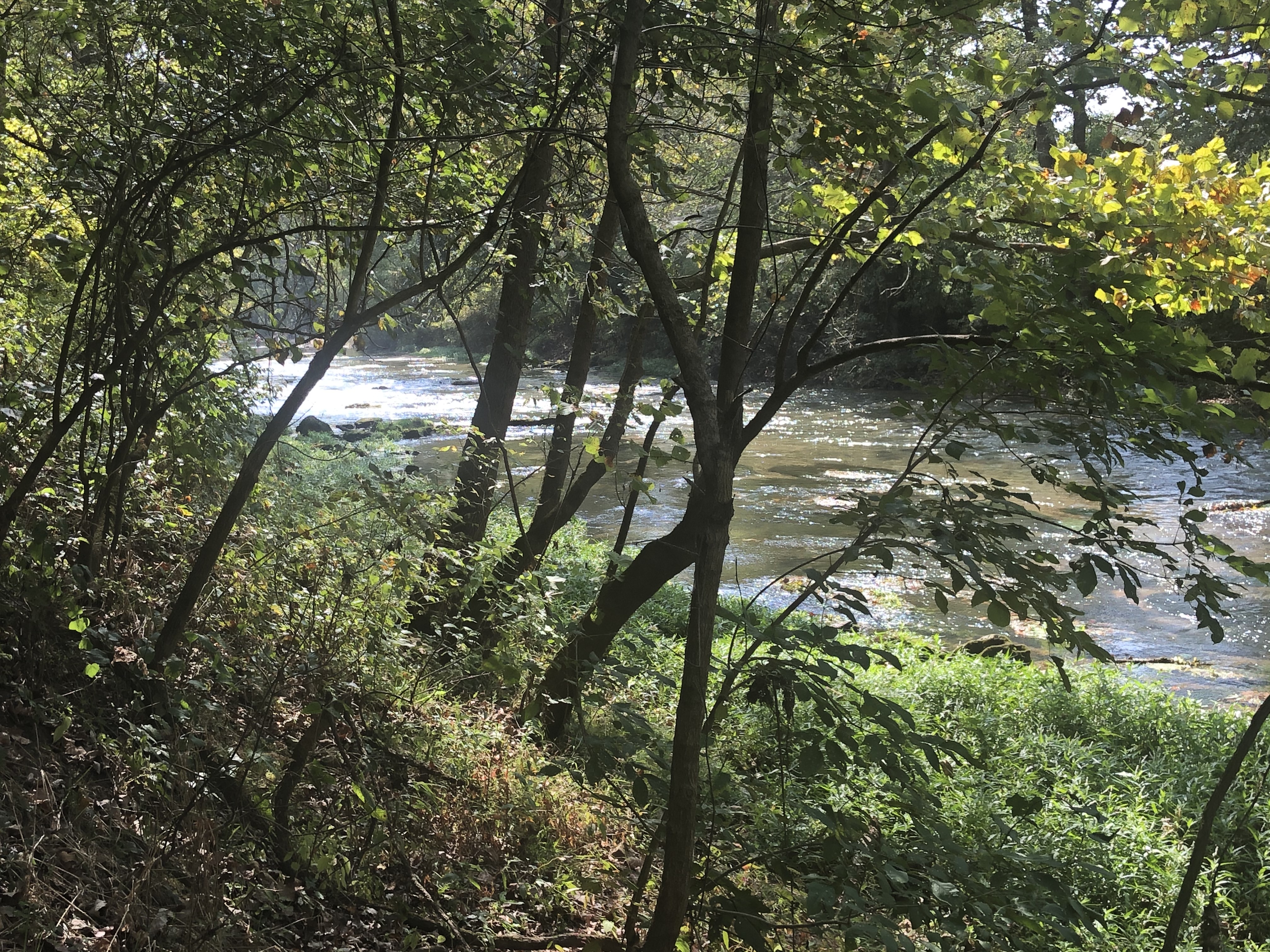
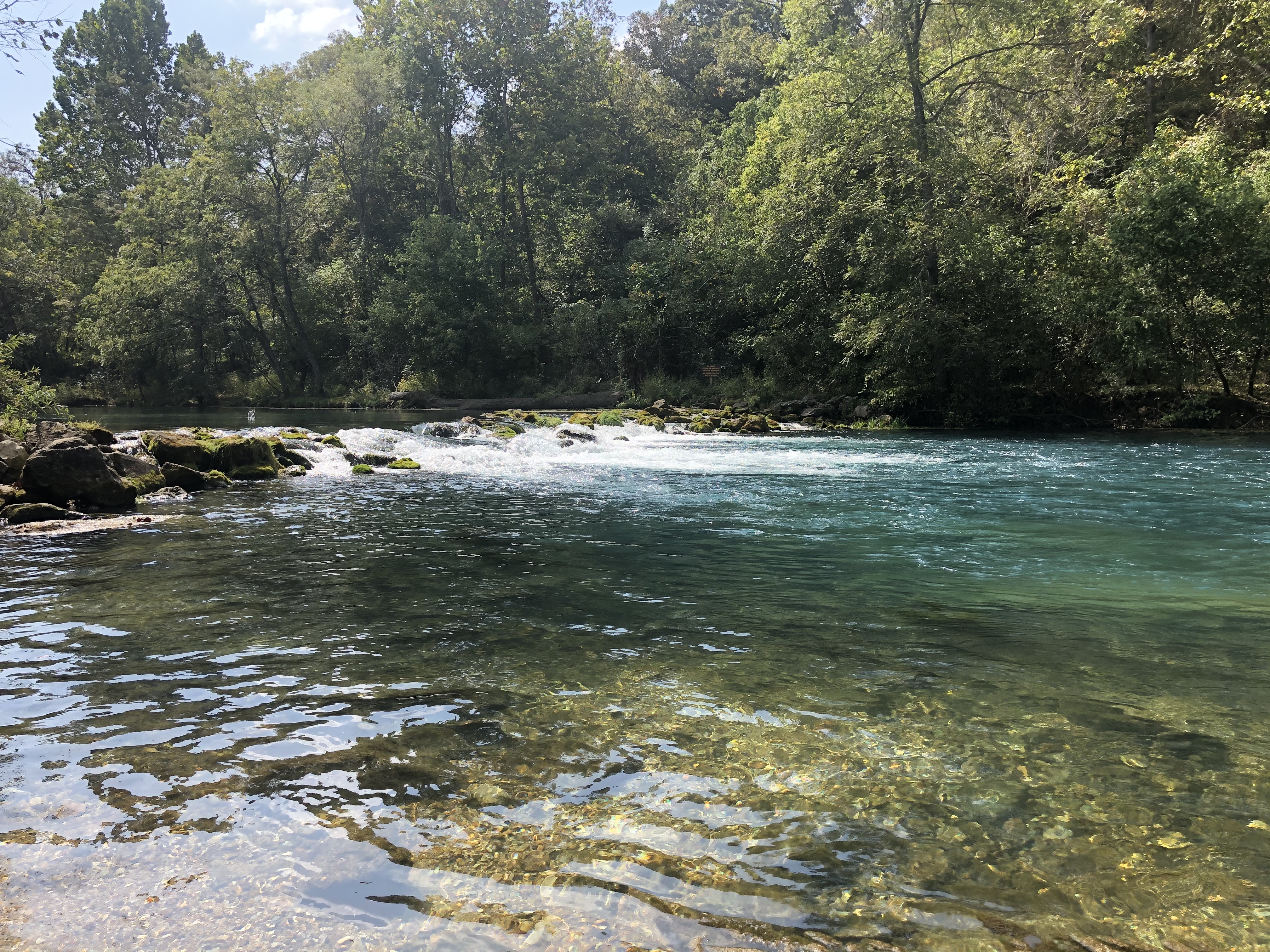
Bennett Spring branch
Bennett Spring State Park features many different ecosystems including rich bottomland and stream habitats associated with the spring valley and oak-hickory woodlands in the upland areas. Many animals native to the Ozarks make their homes here, including numerous pickerel frogs, northern water snakes, pileated woodpeckers, river otters, muskrats, and bobcats. The park’s diverse flora includes dense forests of trees, grasses, and herbaceous plants. Wildflowers such as bluebells and purple coneflowers flourish in the summer.
Bennett Spring branch headwaters
The park features a series of hiking trails, which is what sparked my interest in the late summer during the COVID pandemic and prompted a day trip to check out the site. Upon arriving at the park mid-morning, I made a quick visit to the Nature Center that serves to introduce visitors to the ecology of springs in general and to the natural resources specific to the park. I then made my way to Whistle Trail, which mostly travels along the east side of the spring’s branch, winding its way over the bluffs rising above the stream. It connects with other trails in the park that lead to the spot where the branch flows into the Niangua River, a tributary of the Osage River of south-central Missouri. According to the park’s website, Whistle Trail is likely prehistoric but was used more frequently by local inhabitants from the 1840s to the present.
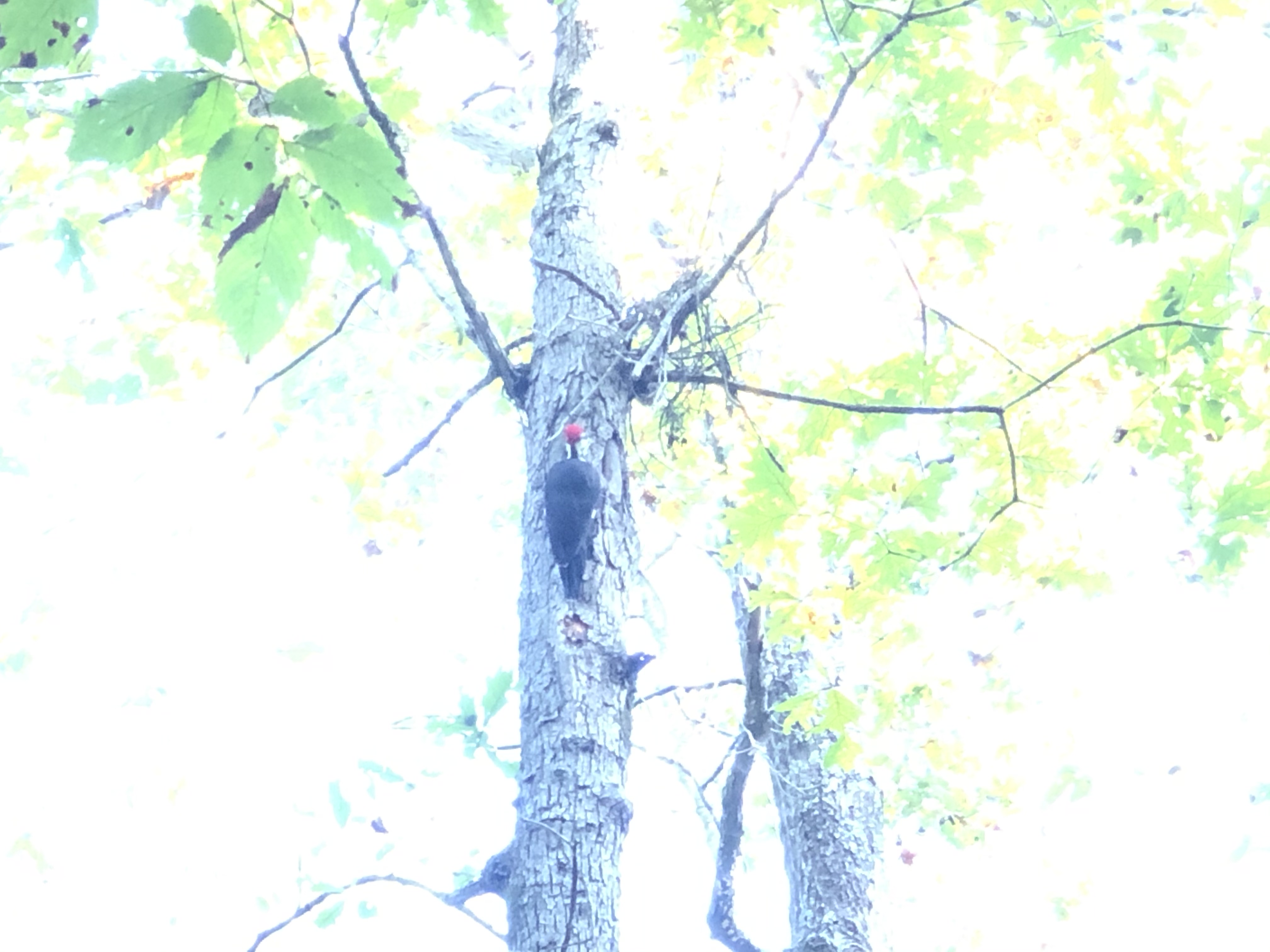
Pileated woodpecker at Bennett Spring State Park
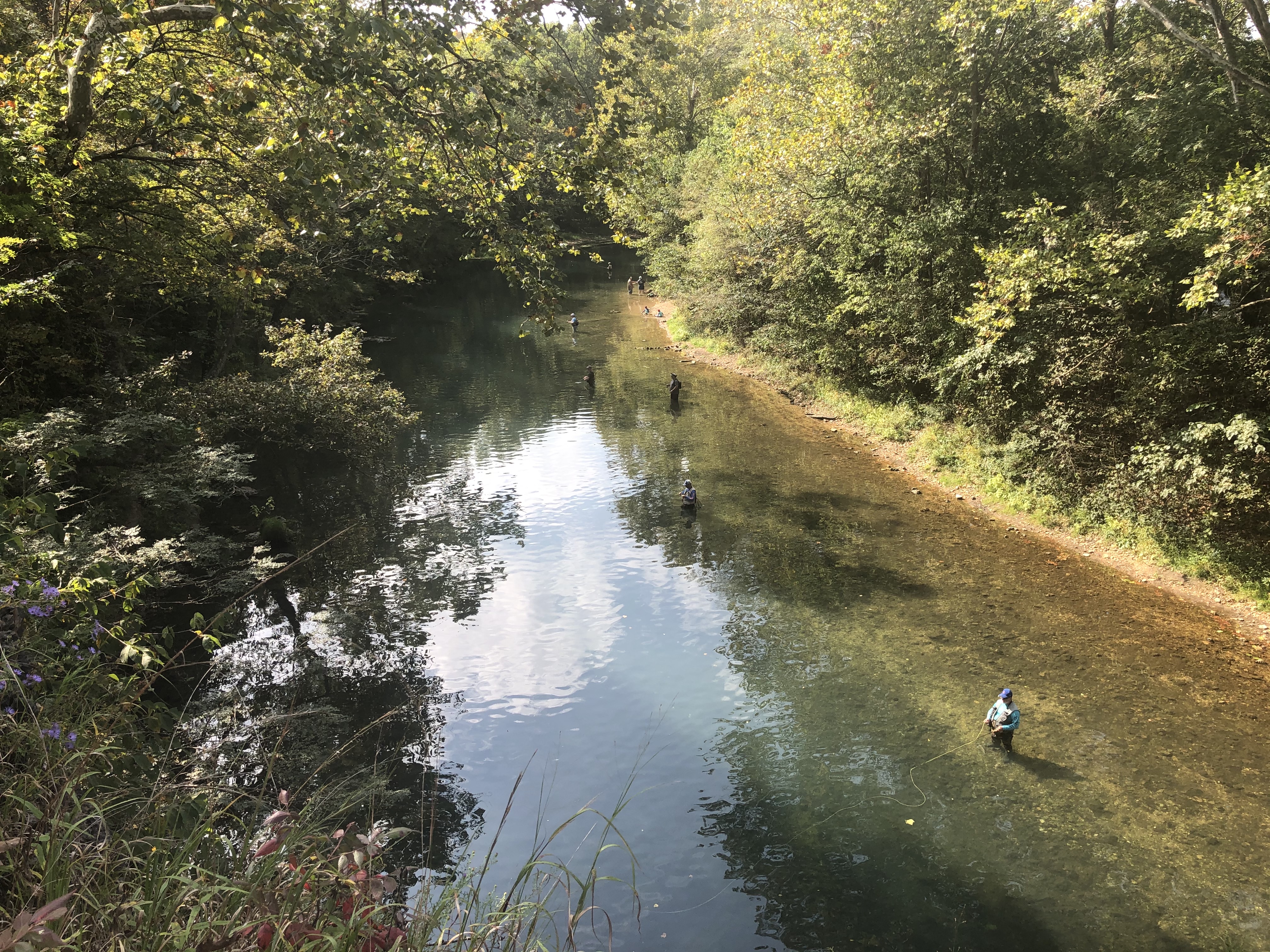
The views from Whistle Trail are quite wonderful at times, especially because of its proximity to the water and the path it cuts through the lush surrounding forest. I was lucky enough to encounter a pileated woodpecker, only my third sighting of this magnificent species to date. Typically, I prefer the solitude that hiking trails offer, but in this case, it was quite entertaining to watch people wading in the stream trying their luck at hooking a rainbow trout, which I could easily see swimming all around the anglers in the crystal-clear water. The Missouri Department of Conservation stocks the branch daily during the regular fishing season, from March through October, and there is a hatchery located near the spring. The park attracts over a million anglers a year. From what I have heard, there are so many people in the stream fishing when the season first opens that you can barely see the water!
Anglers in Bennett Spring branch
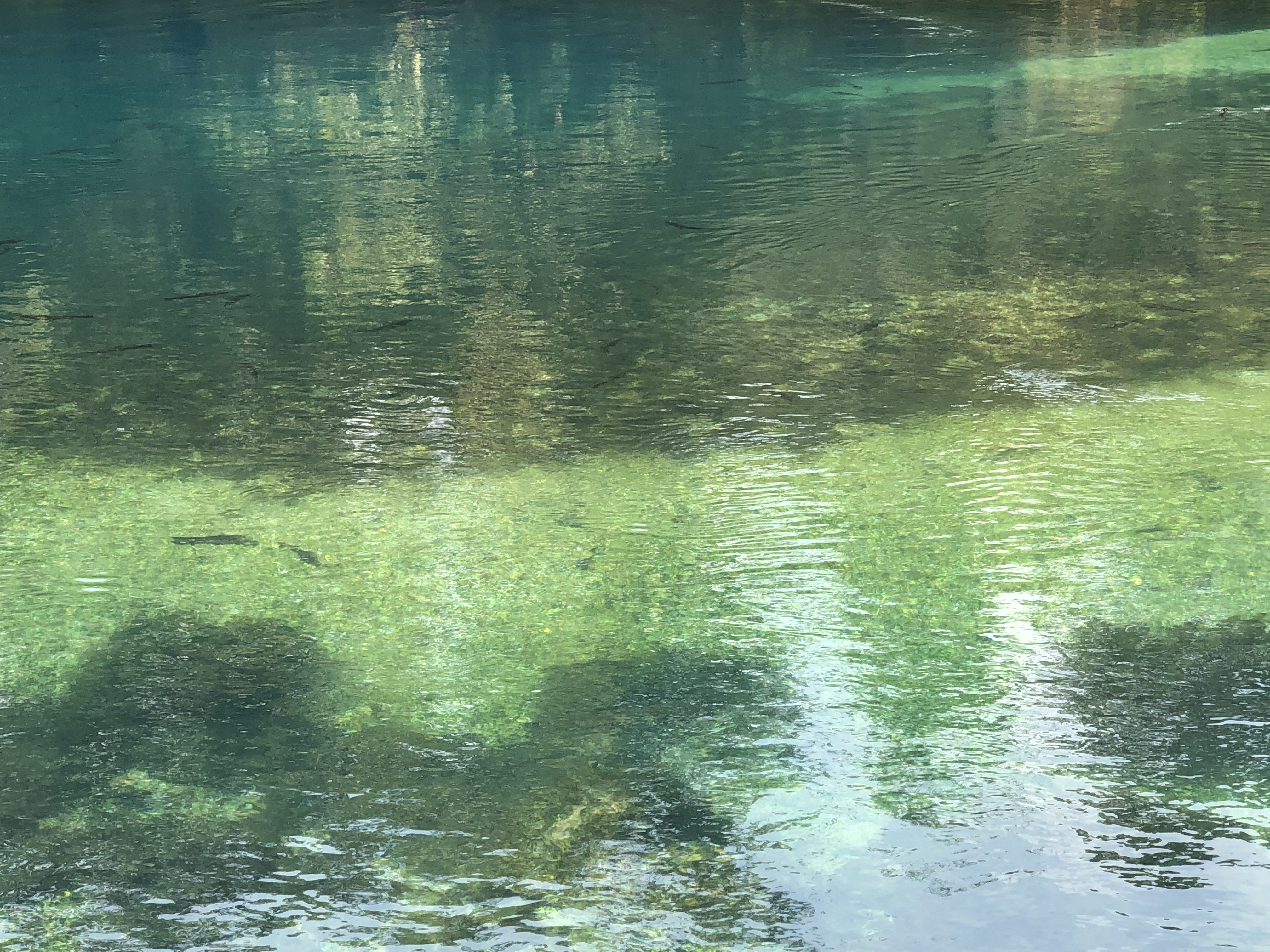
I spent the rest of my time wandering around the buildings, other structures, camping sites, and open grassy areas, just enjoying the beauty of the surroundings. I sat in a swing by the spring branch watching families fish and play in the water. For the last hour or so I explored the spring itself, which creates a gorgeous pool of blue-green water about 50 feet in diameter. Again, the trout are clearly visible swimming just below the surface. The water emerges from a 20-foot-wide seam at a temperature of approximately 57 degrees Fahrenheit. Discharging 100 million gallons per day, the spring creates the trout stream that meanders 1.3 miles through the park before flowing into the Niangua River. Bennett Spring is the principal groundwater outlet for the extensive karst geographical area in south-central Missouri.
Trout swimming in Bennett Spring pool
Missouri has over 90 state parks, and Bennett Spring is among the most popular. A variety of interpretive programs are offered at the park for all ages. The park’s concession hosts offer fly fishing classes too. Canoes, rafts, and kayaks are available to rent for floating on the Niangua. There are multiple options for lodging including a motel, cabins, and camping sites. With seven hiking trails ranging in distance from 1.3 to almost 12 miles and elevations from 849 to 1,102 feet above sea level, hikers can get their fill of exercise, wildlife gazing, and plenty of fresh air. I found the property to be just what I wanted for a day trip, but a weekend would be lovely too. Bennett Spring State Park represents the best of what the Ozarks has to offer for outdoor enthusiasts. I highly recommend a visit.
Kayakers entering Niangua River from Bennett Spring branchLosing stream behind Bennett Spring
One of the more interesting responsibilities of my current job is participating in an oral history project exploring the history and culture of the Ozarks, a physiographic region of the country located in portions of southern Missouri, northern Arkansas, and small portions of eastern Kansas and Oklahoma. I have solicited interviews from several people so far including a retired NASA astronaut; a farmer who moonlights as a musician; a folklorist and musician; and most recently, a woman who is a visual artist, a writer, and a horticulturist growing ginseng in the hills of northwest Arkansas. Since this is a personal blog, I won’t reveal her identity but will call her Ms. Ozart for the sake of convenience.
Ms. Ozart had a career in environmental science, but she also pursued artistic endeavors from an early age. Now that she is no longer working away from home, she can focus most of her time and energy on what she loves most: growing native plants, gardening, painting, and writing. She was not raised in Arkansas but lives here now with her husband, a couple of horses, and a dog who at one time kept her chickens safe from predators. The dog is old, deaf, and retired. Ms. Ozart no longer has chickens.
It was her fascination with one specific plant that attracted Ms. Ozart to this part of the country. Ginseng is a perennial herb native to deciduous forests, especially in places like Appalachia and some parts of the Ozarks. It thrived in these locations and throughout many other areas of the country until it was grossly overharvested in the 1970s, mainly because of the purported medicinal benefits of the root. It is now considered an endangered species. The demand for the plant’s root has been high in China for centuries, and plants from the U.S. are still routinely shipped there. Ms. Ozart isn’t interested in harvesting the roots or selling them. It takes anywhere from 10 to 15 years for the root to develop to a marketable size. She is much more interested in propagating the plant and selling the seeds so other people can do the same.
At her invitation, I had the distinct pleasure of interviewing Ms. Ozart at her beautiful property. Because ginseng is rather valuable, and poaching is a constant threat, she prefers to keep her exact location as private as possible. Respectfully, I have included no photographs of the area with this post. In our preliminary correspondence, Ms. Ozart asked me if I would prefer to meet her in the nearby town and have her drive me to her home. She told me if I had a nice car, I probably wouldn’t want to go far beyond the town. Images of being blindfolded in the trunk of a large sedan came to mind. She warned me that my phone’s GPS app may have trouble finding the address, especially if I happened to exit the program in route from the nearby town. Cell service doesn’t exist this deep in the Ozarks – no bars . . . nada. I am fortunate to have a Ford F-150 pickup, so I decided to take my chances and trust my phone to get me there.
I have spent most of my life in rural areas. The last town where we lived in the northeast Georgia mountains was in a county with several small towns and a total population of just over 40,000. It was a booming metropolis compared to where Ms. Ozart resides. The “little town” several miles north of her location where she offered to meet me consisted of a tiny square that was like an appendage off the side of the two-lane state road. There were about six buildings housing such enterprises as a bank, a café, a feed store, and an art gallery where some of Ms. Ozart’s work is on exhibit and for sale. I continued farther out into the countryside until my riding companion, Siri, instructed me to turn left onto a dirt and stone road – not gravel, large stones. Sometimes, the rocks were semi-submerged boulders. The shocks on my truck will no doubt need to be replaced soon.
Ms. Ozart had warned me that it would take about 15 minutes or more to travel from the paved road to the base of her driveway where she would meet me. When I looked at the map and discovered the distance was only a few miles, I thought she was exaggerating. She wasn’t. Had I attempted to ramp up my speed to over 20 mph, my truck and I would have been launched airborne into either a tree or flowing water, both of which were in abundance on either side of the wide path that was given the designation of the county name followed by a four-digit number. The transportation department didn’t even bother with naming it for a prominent family that had carved out a living here generations ago, which is a common practice for farm roads in Georgia. I crossed over the same river twice and a few tributaries on surprisingly sturdy concrete bridges that were more like large culverts. I was expecting rickety wooden structures, which of course would never be able to support farm equipment and heavy trucks that undoubtedly traverse this byway every day.
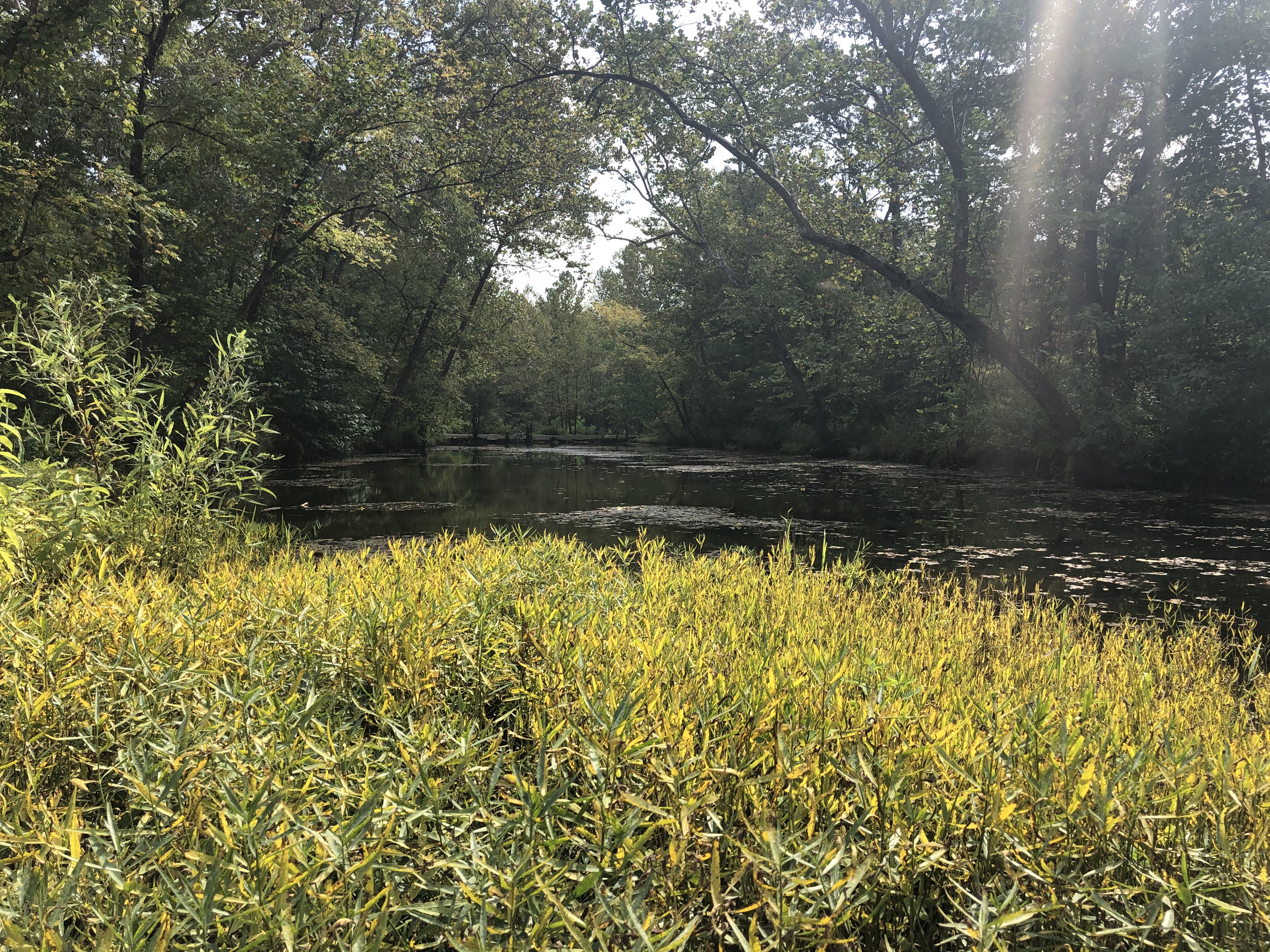
I was traveling through a rather mountainous terrain compared to much of the Ozarks, with high ridges rising from rolling valleys fully furnished with fence lines, crumbling rock walls from long-abandoned structures, small creeks and branches, clusters of trees and shrubs, rock outcroppings, and grazing cows — lots of cows. I am convinced the livestock in northwest Arkansas have social security numbers. Even in December with the predominant hardwood trees undressed for the approaching winter, it was like an opening scene from the Daniel Boone television program from the late 1960s. Aside from the occasional power lines, the countryside probably looks much as it did in frontier days.
Notwithstanding the absence of cell service, most of the folks living along this county road are not really off the grid. They have electricity, running water, propane gas, satellite television, perhaps even slow and spotty satellite Internet service, and other amenities that people enjoy in the most remote parts of the country. Although Ms. Ozart has dreams of someday being a true homesteader, she freely admits that most of her provisions these days come from Walmart and the occasional delivery truck whose drivers risk life and limb to reach her door.
When I arrived at the base of her driveway — the cross section of a creek, a road intersection, and a pasture gate — Ms. Ozart was waiting for me in her small, well-seasoned red pickup truck. “You might want to ride the rest of the way with me,” she said. “Your truck probably doesn’t have four-wheel drive, does it?” And here I was, thinking the wagon trail that had gotten me this far was hazardous. I transferred my recording equipment to her truck, and we headed up the ridge on a rutted, winding trail just wide enough for one vehicle.
We stopped after about 100 yards to look at one of the locations where ginseng is growing on a raised plateau just across the creek from the “driveway.” The plants are dormant this time of year, and the leaves are gone, but she wanted to show me the spot just the same. She gingerly scampered across several rocks to reach the other side, warning me to secure my footing on the slippery surfaces as I followed. I could just imagine conducting the interview in blue jeans soaked in icy creek water. Luck was on my side. I remained high and dry.
We safely made it back to her truck and continued our trek toward her house located about a half mile up the hill. We were no longer crossing creeks and branches. We were going through them. She was describing the habitat for ginseng and its companion plants while showing me the more interesting features of her property, including lovely cascading waterfalls and massive rock outcroppings in tall ravines. At one point she stopped the truck to point out another hillside where she had discovered ginseng growing wild. I admit it was difficult for me to concentrate as I was keenly aware that she had parked the truck directly in the middle of a flowing creek. I kept waiting for the sensation of sinking and drifting as we sat there, but after she finished her story, she simply engaged the four-wheel drive and slowly maneuvered forward out of the water. I was thankful for her truck. I was more thankful I wasn’t driving.
We arrived at Ms. Ozart’s house and set up at her kitchen table for the interview. The room was comfortably warm with the help of a gas space heater. She had chili bubbling in a slow cooker that filled the house with a mouthwatering aroma. She put on a pot of coffee, graciously served me a cup, and sat across the table from me and my video camera for a 45-minute conversation that was fascinating and entertaining. She pulled out of her refrigerator seedlings of ginseng and other native herbs she overwinters packed in moss in plastic storage bags. She demonstrated how she makes pigments for paint by grinding rocks from the local creeks into powders of various hues and textures and mixing them with oil, honey, and other suspending agents. She talked about how the Ozarks region is an inspiration for her writing and her visual art. She and her husband have built a rich life in this isolated slice of wilderness, which I find quite remarkable and admirable.
After we finished and I packed my equipment in her pickup, she drove me back to my truck. “Do you really get supplies delivered to you out here?” I asked as we bumped our way down the hill. “Oh sure,” she said. “Lowes delivered my washer and dryer too.” Admittedly, I was a bit surprised by this news, given how narrow and rugged her driveway is. When we reached a sharp curve where the creek widens next to the road, she pointed toward the stream and said, “I came down early one morning and found a FedEx truck tilted sideways and halfway in the creek right there. The driver had made a delivery to my house the night before, and lost control going back down on this turn. He showed up later that morning with a wrecker. It took the better part of the day for them to get his truck out of the creek, but they did it.”
When we reached my truck, I thanked her for her hospitality and told her how grateful I was that she drove the last leg up to her house. She chuckled a bit and said, “I thought that would work best.” I watched her from my rearview mirror retrieve the mail from her mailbox at the driveway entrance and then climb back in her truck to head home again. Somehow the rocky road leading back to the state highway didn’t seem quite as treacherous this time. The cows appeared just as disinterested as they had earlier. I recognized a few landmarks that I had remembered to look for on the way back to make sure that I wasn’t lost. I allowed myself to look around and soak up the pastoral vistas along the way, but I slowed down considerably and took great care crossing the bridges.










 If You Want My Opinion