Fascism By Any Other Name

“It’s not going to be as bad as you think.” A close friend said this to me shortly after Donald J. Trump was elected for a second term as President of the United States in November 2024. I wanted to believe him. I wanted to believe that the storming of the U.S. Capitol by a mob of the President’s devoted supporters on January 6, 2021, was in the final analysis a step too far even for someone as desperate for a second consecutive term as Trump apparently was. After all, he finally told them to stand down and go home, right?

I should have known better. Even though he had previously stated that he would look at presidential pardons on a case-by-case basis, on his first day back in office in 2025 he granted a full and unconditional pardon to 1500 individuals convicted of offenses related to events at or near the Capitol on that dark day. He also commuted the sentences of 14 criminals, including prominent members of radical groups like the Oath Keepers and Proud Boys, who were convicted of seditious conspiracy. In spite of my friend’s reassurance, it was going to be worse than I thought.

Before going further, I must admit that I am disappointed in the leadership of the Democratic Party, who are as much responsible as anyone for the return of Trump to the White House. Joe Biden’s cognitive decline during his term must have been obvious to plenty of people: his cabinet, his advisors, VP Harris, his good friends in Congress, and the party executives and strategists. He probably couldn’t admit it to himself, and his family would have had a difficult time convincing him to surrender the remainder of his term to Kamala Harris or even to announce early in his presidency that he would not seek a second term.

Everyone waited to change course until after Biden’s dismal and embarrassing performance in the debates with Trump. There was no choice but to seek another Democratic candidate for the White House. It was much too late in the game, and it was abundantly clear that the party rapidly pushed through the nomination of Kamala Harris to oppose Donald Trump in the 2024 election. And while she only lost by less than 2% of the popular vote, Trump swept the Electoral College, an outdated and unrepresentative system for electing the highest office in the country. States are political entities, not people. Our presidents don’t answer to our governors. States shouldn’t select our President – individual voters should. Alas, this is a topic for another post sometime, maybe.

From day one in office for his second term, Trump’s top priority was to surround himself with people who would be loyal first and foremost to him personally. A major test of that loyalty was an admission or declaration that the 2020 election was stolen and that he should have returned then for a second term. Furthermore, his appointees were all expected to support his decisions without question, even if those decisions and subsequent actions might violate existing laws, longstanding precedents, or even the U.S. Constitution. He has even extended his demands for allegiance to Republican members of Congress, threatening to replace them in future elections with candidates more in line with his administration.

From the rhetoric he spouts on social media and to the Press, Trump has repeatedly communicated his belief that any restriction on his authority as the President is illegitimate. He does not accept the concepts of Balance of Power or Checks and Balances that are firmly embedded in our representative style of government. Apparently, he is convinced that his authority is superior to both the legislative and judicial branches of the federal government. Sadly, some members of Congress and perhaps even some of our judges agree with him, along with plenty of American citizens.

Many of the people who voted for Trump believe our Republic form of government has failed them, and as a result, they are willing to grant Trump carte blanche, even at the risk of ushering in authoritarianism. They see the federal government as inefficient, ineffective, and oppressive. Trump has promised he can fix it, but only if the American people let him have complete control of the country. They truly believe that he will “Make America Great Again,” in whatever ways they define “great.”

Right-wing media have convinced a lot of people that undocumented immigrants from south of the border are a threat to national security. With his reptilian intelligence, Trump played on those fears and has placed purging the country of these “outsiders” at the top of his agenda. Illegal immigration has gone from being a problem to be addressed by the whole nation to a perceived crisis that only Trump is willing to face by defending our borders and saving our country from invasion. Trump and his sympathetic media outlets have essentially demonized millions of people living and working in the United States, turning them into enemies of the state. This is a move that comes right out of the fascist playbook, one that the Nazis used to great advantage against the Jews in their takeover of Germany.

I have grown so weary of the pseudo patriotism I see swelling across the country, with its flag waving nationalists (mostly white) whose entire proclamation of American idealism is encapsulated in a tired, worn-out country song by Lee Greenwood that includes the line, “Where at least I know I’m free,” as if the United States is the only free nation on the planet. Precious few of the proud folks who sing along have ever or will ever “stand up” and truly defend the country and the principles upon which it was founded. They either forgot them, never knew them, or have abandoned them altogether for ones they find more suitable for their vision of the future. Oh, they certainly understand the phrase “America First,” because they know what Trump really means is “America Only.” It reeks of selfishness, greed, arrogance, vanity, and narcissism – the very characteristics embodied by their chosen leader.

Call it a return to the “good old days.” Call it a revival of “Christian values.” Call it standing up for “the people.” Call it anything you want, but it looks and sounds a whole lot like fascism to me. Evil rarely manifests itself as ugly or frightening. It comes cloaked in righteousness. It wears the most attractive clothes. It says what you want to hear. It promises security and makes you feel comfortable. It delineates between Us and Them. It tricks you into believing you have been mistreated. It understands how you feel. It seeps in almost imperceptibly, as if it doesn’t really exist at all. Even now, it is slouching towards America to be born.

A Republic in Peril

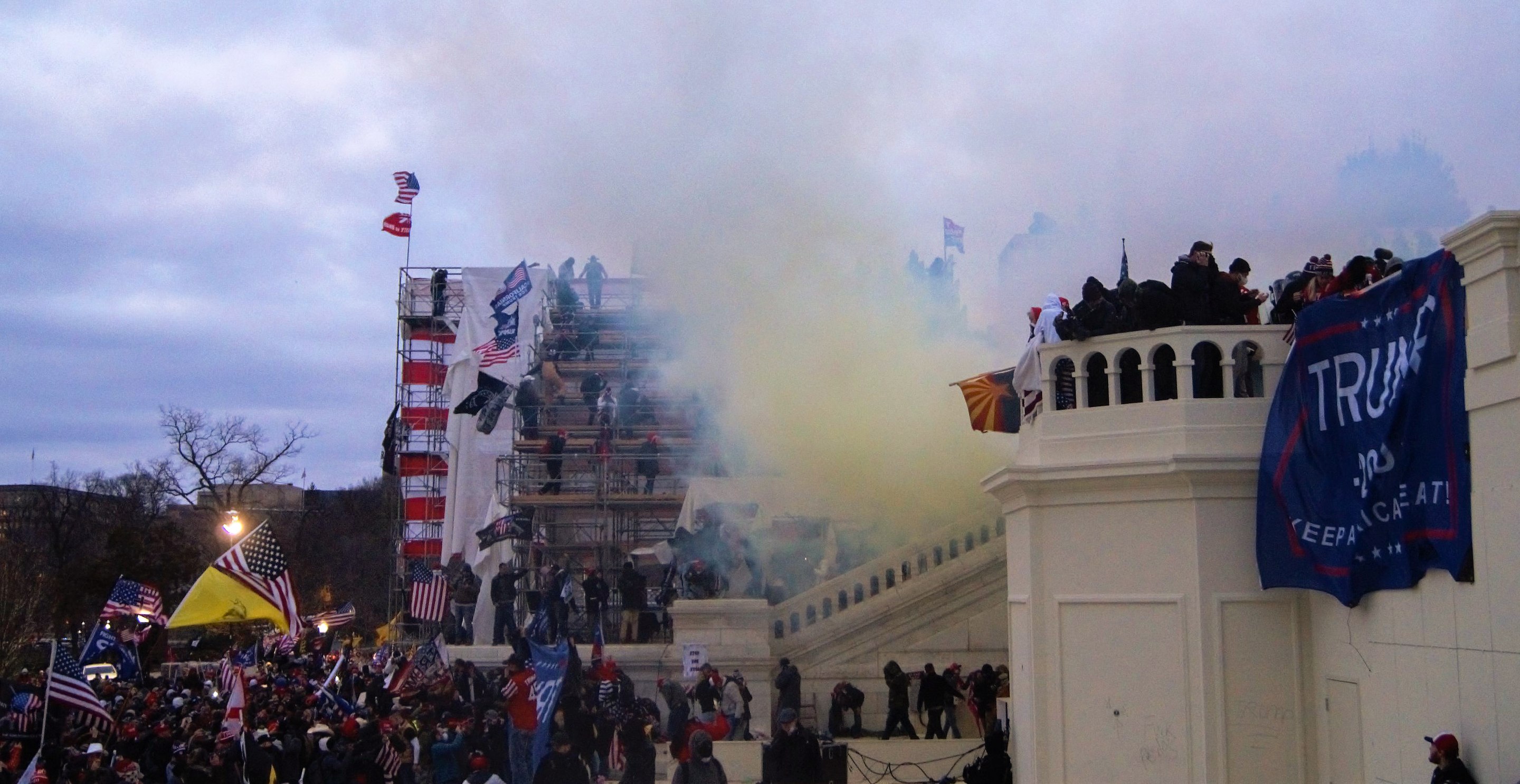
U.S. Capitol attack - January 6, 2021 (Wikipedia)
U.S. Capitol attack – January 6, 2021 (Wikipedia)

As I write this last blog post of 2023, a new year is only days away. Another Christmas has passed, along with the hopes and wishes every Christmas inspires. I am still hoping for something this year that I thought would never be on my wish list. I hope the American experiment doesn’t fail. I hope the Republic that was the vision of a group of enlightened thinkers almost 250 years ago doesn’t crumble. I hope the U.S. Constitution isn’t replaced with a less representative form of government. I hope the democratic principles that have guided this nation’s trajectory for so many generations aren’t cast aside, even if we have never honestly embraced or implemented them holistically. I hope we don’t give up on the dream of liberty and justice for all.

What concerns me most as we head into 2024, the year of our next presidential election, is the fact that a sizeable minority of our population no longer supports the concept of a limited, restrained government. Oh, they certainly say they do. In fact, they scream it. Some of them think the only function of government should be defense of the borders, so they have no respect for the legislative or judicial branches of government. They constantly espouse the virtue of state’s rights, but that’s only because they don’t believe the federal government has a role in governing the affairs of the population. When it comes down to it, many of them would be perfectly happy if they never heard from their state capitals again, especially in the form of a tax bill every year. Not only is all politics local for them, but just about everything else is too, and that’s the way they prefer it.

However, there is one branch of government that they have decided should be virtually untouchable: the executive branch. They want this branch to be untethered by legislators, judges, law enforcement, or even laws for that matter. They believe this branch should essentially be above the law. They think this branch should have the power and authority to do whatever it deems necessary for the nation to achieve greatness and superiority over all other nations. Most importantly, they want this type of omnipotence concentrated in the hands of one individual, the person they wish to see occupying the White House, and no one else. They are convinced that only one person is qualified for this totalitarian position. They earnestly believe this person has the skills, experience, knowledge, and determination to transform the country into what they want it to be. They just don’t quite understand that authoritarianism is not an example of small government. History has taught us that it is quite the opposite.

This minority of the population has been building, organizing, communicating, and planning for many years. The exact origin of the movement is debatable. It has mostly existed underground and on the fringes of society, and in modern times, it has taken advantage of the Internet, empowered especially through social media. Perhaps it has waxed and waned over most of U.S. history, sweeping across both sides of the political spectrum; however, in the 21st century it surfaced and became extremely vocal among the ultra-conservative right. The movement’s members were like a volatile collection of chemicals, just waiting for the right catalyst to come along and fully activate them.

By definition, a catalyst causes or magnifies a reaction without ever undergoing any permanent change itself. The catalyst in this case had been a larger-than-life personality in American society for decades. Born into wealth, he was groomed to be an entrepreneur, rising to celebrity status while building a commercial empire with the assistance of domestic and foreign credit and always grabbing the attention of mass media. He built relationships with some of the wealthiest and most powerful members of society in the U.S. and around the world. His business ethics and methods were often the target of scrutiny, if not serious accusation of wrongdoing, but his reptilian instinct served him well as he maneuvered through the legal system emerging mostly unscathed. His devoted fans have often admitted that he may not be eloquent, but he always speaks his mind and means what he says, which they really admire. Of course, when he said something that sounded dangerous or immoral, they were quick to backtrack and say that you can’t pay attention to what he says, just focus on what he does. Makes perfect sense.

The qualities and characteristics that made him most appealing to the movement were his apparent great wealth, his arrogance, his boastful nature, his dissatisfaction with the federal government, and his insistence that the nation was on the wrong path primarily because it could not protect its borders and because it repeatedly made bad deals with foreign powers that never put America first. Nevertheless, he promised that he, and he alone, could rescue the country. He would rid the nation’s capital of the corrupt bureaucrats and lobbyists, or “drain the swamp,” a phrase often used by Benito Mussolini as he rose to power in Italy in the 1920s. The catalyst would secure the southern border with Mexico by building a massive wall, promising to make the Mexican government pay for it. He would remove all government regulations and restrictions that hindered business pursuits and the accumulation of wealth. He wanted patriots to join him in the noble cause to Make America Great Again. The catalyst’s name was Donald J. Trump, who ran for President of the United States and was elected in 2016 with the help of this growing political and social movement.

History will judge how successful Trump’s administration was in fulfilling his promises to his base and to the population at large, but there is no real debate about what happened when he was defeated in his attempt to win a second term in office. He didn’t just claim that the election was stolen, which other candidates before him had done (including Hillary Clinton when she lost to Trump). He went much further. He used those claims to support his attempts to stay in office, even to the point of trying to overturn the election results. When Vice-President Mike Pence proceeded to certify the election on January 6, 2021, despite Trump’s demand that the process be halted, a subset of this movement’s members stormed the U.S. Capitol, a mob that had been encouraged by Trump. He publicly praised their efforts to interrupt the peaceful transfer of power from his administration to that of the newly elected President, Joe Biden.

Over 1,100 rioters who invaded and vandalized the Capitol (resulting in several deaths) from all fifty states were charged with a variety of crimes associated with the incident, and close to 400 people were sentenced to prison for their actions. Other indictments and lawsuits have been filed for alleged crimes involving attempts to overthrow the election, some committed by close associates of President Trump. His most loyal supporters still deny that Trump lost the election, including elected and appointed state officials, Republicans in Congress, lawyers, some of Trump’s former cabinet members, journalists, radio talk show personalities, and Fox News program hosts. Thus far, no evidence brought before any state or federal court that I’m aware of has offered conclusive proof of interference, tampering, or fraud sufficient to overthrow or reconsider the election results. And yet, millions of people across the country still believe that Trump actually won his bid for reelection.

Over the last twelve months as individuals began to solidify support for their candidacy for the Republican primary leading up to the next presidential election, it became abundantly clear that Donald Trump was going to be the frontrunner. Now at the end of the year, his numbers across a wide spectrum of polling organizations far exceed any other Republican hopeful. He has been noticeably absent at all Republican debates. He doesn’t need to be there. He is winning by a long shot. And just as he did leading up to the last election, he is pounding a clear message home to his base: if he doesn’t win this election in 2024, then the election will be fraudulent. To his loyal base, there will be only one conclusion if he doesn’t win. The election was stolen. They will accept no alternative outcome other than a victory for Donald Trump, a man who now faces numerous federal and state indictments for alleged crimes associated with the last election and attempts to overthrow it.

Here’s where it gets frightening. Trump’s base, the movement for which he served as a catalyst, has illustrated it is willing to resort to violence to achieve the agenda of overthrowing the government to give Donald Trump total control. They are also likely among the most heavily armed civilians in the country. Over the years, especially during his presidency, Trump demonstrated his admiration and respect for totalitarian leaders around the world, including Vladimir Putin in Russia, Kim Jong Un in North Korea, and Xi Jinping of China. He even committed the embarrassing diplomatic faux pas of saluting Kim Jong Un during an official meeting with the supreme leader. In a recent town hall session hosted by Sean Hannity of Fox News, Trump stated that he would be a dictator for one day once he was reelected. This type of authoritarian rhetoric has become more common for Trump, and his base seems perfectly happy with it. To my way of thinking, these folks are ravenous for a dictator, as long as his name is Donald J. Trump.

So, I am concerned about our Republic’s future. I dread the turbulent political landscape that lies ahead leading up to the 2024 election in November. I am troubled over the lack of conviction among Republican lawmakers who continue to feed into the conspiracies and lies about the last election. I am saddened that the handful of men and women in Congress who had the spine to stand up to Trump and the election deniers were publicly castigated by the former President and their own colleagues, then promptly voted out of office. Most of all, I am worried that no matter the outcome of the election, the system of law and order that distinguishes us as a nation may be threatened.

Packaging Jesus in America

The United States is a country that knows how to sell. The backbone of entrepreneurship here is not necessarily based on providing a product or service that is valuable. The secret to success in business is convincing Americans that they need or want what you’re selling, and we do it well. Where else could you take a smooth stone, nest it in a little clump of straw, place it in a cardboard box with a tiny book of “instructions,” and sell it for $3.95 as a Pet Rock? An ad executive named Gary Dahl did exactly that in the mid-1970s and became a millionaire in just a few months. Other examples include mood rings, Lucky Break plastic wishbones, and HeadOn headache relief wax. We can probably all think of a few “universities” and other nonprofits that are worthy mentions.

We will sell anything in America, and I mean ANY thing. When I was the director at Andalusia, the historic home of American author Flannery O’Connor, we scooped up red clay from the yard, placed it in small plastic pill bottles, and sold it for .75 a bottle in our little gift shop. We did the same with pond water from the property. Adoring fans and generous supporters of our house museum bought them by the dozens. No, I can’t say I’m proud of stooping to such obnoxious commercialistic measures, but it helped keep the lights on. At least we didn’t make any claims about the supernatural qualities of the clay, with all due respect to the folks at El Santuario de Chimayo who offer up mystical holy dirt on a Native American sacred hill in New Mexico.

Speaking of the sacred, I believe that Americans do a better job at marketing religious belief than just about anything else. We borrow myths and customs from various cultures and across the centuries, synthesizing them into a giant brand that we couple with Christianity, making it a lot more attractive. For example, we skillfully package up the entire Advent season in a display that can practically fit in the palm of your hand – a nativity scene that comes complete with Mary, Joseph, some livestock, and a few shepherds gathered snugly in a small stable admiring the baby Jesus. We even throw in three wise men and a guiding star over the structure, although we know these guys didn’t see the holy family until long after everyone had vacated the manger scene. We simply don’t have room for two dioramas on the coffee table. We have to save room for Santa, the reindeer, and the scioto ceramic Christmas village.

There are other practices to further illustrate the point: bunny rabbits and eggs at Easter combined with passion plays that reduce the death of Christ to a one-act skit. I am reminded of the time I was driving through the foothills of Appalachia in rural north Georgia on a Good Friday back in the late 1990s when I passed a small country church. Thankfully, I happened to turn my head in time to see three large crosses on the front lawn of the church, which would be completely expected. What prompted me to slam on brakes and swerve into the entrance of the adjacent parking lot, however, was the fact that there were three men in what appeared to be white bed sheets draped around their wastes “hanging” on the crosses. They were standing on small pedestals attached to the upright beams and holding on to large spikes driven into both ends of the crossbeams. There were several folks standing at a respectful distance in front of the display taking photographs. No banner or marque could have possibly commanded more attention. The man on the middle cross, playing the part of Jesus, I presumed, had a slightly protruding belly and was offering a modest smile for the photo op. As I moved in closer, I noticed he was also chewing gum. Who wouldn’t want to be in THAT church two days later to celebrate the resurrected Savior? What a shame Flannery O’Connor died before this happened.

Even people who love to celebrate the winter holidays with garish decorations have become disgusted with big-box stores that start filling their shelves with the stuff in early September. Now we can walk into our local Walmart before the summer ends, wander over near the garden section, and find all the accessories we could possibly need for Halloween, Thanksgiving, and Christmas with just one trip. All the aforementioned illustrations may cheapen a faith tradition that is almost 2000 years old, but I don’t find them too offensive really. They simply reflect the way Americans think and operate under the encompassing influence of capitalism, which is the true soul of the Republic, morally bankrupt as it may seem at times.

What I do find reprehensible is how people in high places have notoriously attempted to hijack religion and use it to further their personal or institutional agendas, and Christianity has perhaps fallen victim to this evil form of abuse as much or more than any other faith. It happened with the late Roman Empire, the rise of the papacy, the Crusades, the witchcraft trials, the perpetuation of slavery in America, and many other pivotal points in western history. And it’s happening today – right now. The most effective way to pitch a policy package or promote a public figure to a large block of this country’s population is to make sure Jesus is clearly visible on the label.

All your past and present failures, bad decisions, naughty behavior, crude language – all your transgressions can be immediately forgiven and forgotten as long as you claim that Jesus is your co-pilot. He doesn’t even have to be in charge of the flight! In spite of the separations set forth in the 1st Amendment to the Constitution, the United States throughout its history has wedded patriotism to the Christian faith. You can bet that when most Americans read the phrase “In God We Trust” on their money (why is it still there?), they aren’t conjuring images of Zeus, Shiva, or even Allah. They are envisioning the Christian Trinity.

No other demographic is more committed to maintaining the dominance of Christianity in this country, right up to the three branches of government, than strongly conservative evangelicals. They are a powerful lobby and voting bloc, spreading out over multiple denominations and encompassing all races and socio-economic sectors. Their influence has waned slightly in recent decades as the overall population is becoming more secular, but they have a loud and clear voice in public affairs, especially on the national level. Sadly, even the least qualified candidates can overcome a multitude of sins and ineptitude by claiming they are guided by Biblical principles and dedicated to protecting this brand of Christianity from resistance or competition. By focusing on a few essential staples that evangelical Christians hold sacred, these con artists can easily sell them the rest of the merchandise regardless of how cheap, useless, or even dangerous it may be. Jesus is central to the deal, and we Americans can’t pass up a good deal.

Schooled by the President

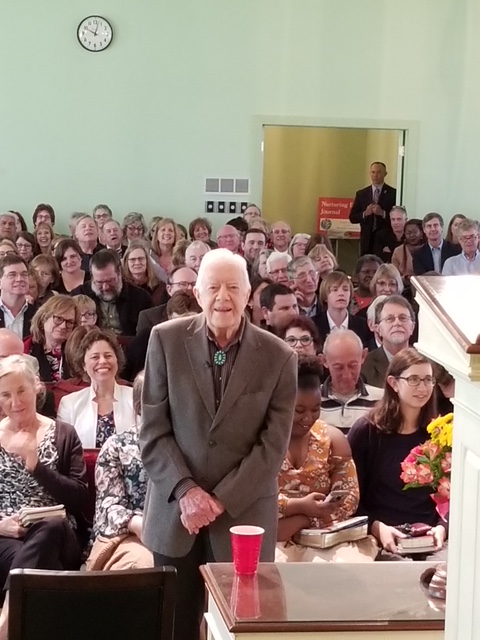
My wife and I joined a group of people from our community to mark off another travel experience bucket list item. In this case, the distance from home was short enough for a road trip. We traveled through pines and vast farmland to the little village of Plains, Georgia, where we gathered with a couple of hundred other people before sunrise in anticipation of the big event: Sunday School at Maranatha Baptist Church. Okay, I haven’t attended Sunday School in over twelve years, and we could have easily found a class to attend much closer to home, but the teacher wouldn’t have been the 39th President of the United States.

Jimmy Carter has been teaching Sunday School for most of his life, reportedly even during his presidency (1977-1981). However, in recent years his class at Maranatha Baptist Church has been drawing capacity crowds, especially after his diagnosis of brain cancer in 2015. This health scare may have interrupted his teaching, but it didn’t stop it. He teaches his class in the church’s sanctuary that seats about 350 people when filled to capacity, and there is an overflow adjacent room that seats 100 more people who watch  via video feed. The 93-year-old former Commander in Chief is still greeting anywhere from several dozen to a few hundred pilgrims multiple times throughout the year for a 45-minute session, although there are rumors that he will scale back if not completely stop teaching sometime this year (2018).

The charming little red-brick church is tucked in a pecan grove a couple of miles outside the center of Plains, a hamlet of less than 800 people where Jimmy Carter was born and raised and the place he and First Lady, Rosalynn, still call home. No part of the state defines “rural Georgia” better than its southwest section, and Plains is a bonafide representative. Maranatha Baptist Church looks like so many other little churches I have seen and visited during my life. The members are equally familiar: genuine, proud, polite, but above all in this case, fiercely respectful and protective of their world-famous congregant. Those who are charged with orchestrating this unusual ministry of the church do so with humility, humor, grace, and above all, efficiency.

The church’s website advises attendees to arrive no later than 6:00 a.m. in case the crowd is large. We arrive at ten after the hour. Entrance to the sanctuary is based on a simple numbering system. When we pull into the dirt driveway of the property, a friendly fellow welcomes us and hands us through the car window a slip of paper with a sequential number indicating what will later be our place in the lineup to file into the church. We are number 58 — obviously not quite as committed as 57 other sojourners, the earliest of which we later learn arrived at 4:00 a.m.

Like many activities that combine religious practice with celebrity status, the President’s Sunday School class attracts an eclectic assembly that writers like Chaucer would find fascinating, as do we. One notable example is the chap who arrives in a mint-condition Model-T, sporting the requisite hat/goggle combination and accompanied by an extraordinarily tall tabby cat that he walks among the pecan trees on a leash. We learn that he is just beginning a long journey across the country to visit various attractions, an adventure he will record in a travelogue — think Steinbeck’s Travels with Charley, the feline version.

On the Sundays the Carters are attending, the glaring distinction of this church is the early and abundant presence of law enforcement, which includes local sheriff deputies and at least six Secret Service agents, complete with bomb-sniffing dogs canvassing the exterior of the church building and weaving their way through the herd of vehicles parked under the trees behind the church. A member of our group observes what a misnomer “Secret Service” is to describe a team of people at a little country church dressed all in black with sunglasses and ear pieces, handguns clearly visible. Their service is no secret whatsoever. During the hour of worship that follows his class, President Carter sits in a pew next to one of the two center aisles (the Carters are indeed members at Maranatha). There are agents at the entrances to the building and one agent sitting directly behind him. Every time President Carter stands with the rest of the congregation, the agent stands and shifts his own position slightly out into the aisle just behind Carter’s left shoulder — an added measure of protection. Without a doubt, we are attending the safest worship service in the state that morning.

On the Sunday we attend, illness has descended upon a significant portion of the congregation, including Rosalynn Carter who is recovering from surgery in Atlanta. A few of the members are having to pull double duty. Jan is the fearless and funny woman, school teacher turned event coordinator, who lines everyone up outside and gets them ready to go through security and enter the church. She is joined by several other members inside who provide instructions for the Presidential encounter, all the dos and don’ts that are expected, including no applause for the President. We are reminded this is church, not a campaign rally. Jan also plays the piano later in the morning for the worship service. Shortly before the teacher enters the sanctuary, the recently-installed pastor, at the ripe age of 23, provides a Q&A about himself, his family, the church, and the Carters. Another woman who helps with the orientation before the President’s arrival identifies herself with the last name “Carter,” and someone in the audience asks if there is any relation. She replies, “Yes. Billy Carter was my father.” Later that morning, this jovial niece of the President returns to the podium to lead the singing — the music minister is out that day involved in a church-related activity out of town. They are a resourceful and flexible church family.

President Jimmy Carter


President Carter could not be more charming. We just barely make the cut to get in the sanctuary and are sitting in the choir loft behind him, but he graciously turns around to include us. He spends the first few minutes greeting everyone and asking, by sections of pews, “where are ya’ll from?” Place names are shouted out: Maine, Texas, Canada, Illinois, Kentucky, Colorado, and many others. We are amazed by the distance some of these folks have traveled to hear a great statesman with humble beginnings speak of a faith that has no doubt sustained him through trials that would crumble most of us.

Jimmy Carter is judged harshly these days by so many of our population who consider his presidency to be lackluster at best and a dismal failure at its worst. He faced insurmountable challenges and horrible crises while in office, and admittedly some of his decisions perhaps did not serve the country well. Many of his accomplishments in the White House are overlooked now, but he should always be remembered for brokering a peaceful resolution demonstrated by a handshake between a Jewish prime minister and a Muslim president that undoubtedly saved many, many lives in the Middle East and beyond. Also, no one denies his decades of post-Presidential humanitarian achievements with Habitat for Humanity, the Carter Center, monitoring elections around the world, and so much more. To my way of thinking, he is a remarkable testimony to the charity and love most often identified with Jesus, the one he calls Savior. In the end, his Sunday School lesson always comes back to that simple but profound profession of faith.

Book Reviews: Two by Ta-Nehisi Coates

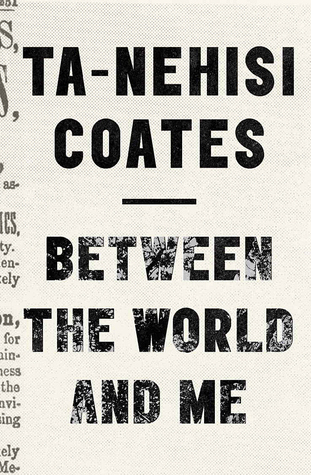
Between the World and Me

Ta-Nehisi Coates won the National Book Award for Between the World and Me. Some readers will criticize him for his lack of attention to a few basic grammatical rules. Okay, he needs to brush up on the mechanics, as many journalists do. Others may not like his style — the book takes the form of a long message to his son about what it means to be a black man in America. I think it is the perfect approach for his subject, making the book personal, emotional, and thoughtful. It reminds me of the innovation with narrative that the white civil-rights advocate Lillian Smith used in books like Killers of the Dream and Our Faces, Our Words. Coates could do a whole lot worse than follow Smith’s example. In our deeply divided society, this book will be rejected by many readers who have lost patience with what they perceive as a hypersensitive generation coddled by American universities where almost everyone is a victim of mistreatment and therefore has an excuse for irresponsibility. I don’t think Coates has fallen into that trap, either real or imagined. I highly recommend this title to anyone who wants some insights into the struggles of what an African-American colleague described once as “waking up everyday, looking in the mirror, and knowing you are wearing black skin.”

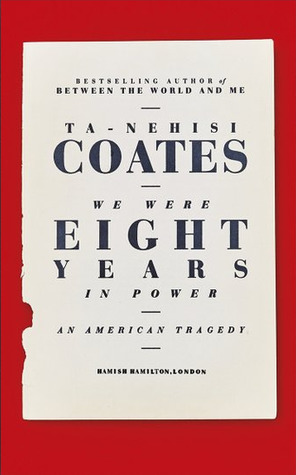
We Were Eight Years In Power

Coates is one of the most powerful voices in the country on identity politics and its ill effects on social justice, most especially for African-Americans. In interviews, Coates has made it clear that he sees little hope for conditions in America to improve with regard to the plight of African-Americans. We Were Eight Years In Power: An American Tragedy is a collection of essays, many appearing previously in The Atlantic, that reaffirms that opinion. His vision is definitely pessimistic and perhaps depressing. It would be easy to dismiss Coates as a man made bitter by his own struggles to be heard and to overcome the legacy of bondage that characterizes the black experience in America. But, his analysis is careful and calculating, and to some degree even objective. He is relentless in shining the scorching light on white supremacy and how it has systematically crushed the spirit of African-Americans, even during the Obama administration. Coates now sees white supremacy back on full exhibit, in the open, and he dubs Donald Trump as the “first white president.” The election of Barack Obama clearly set a standard and was perceived by his supporters to alter the course of American history. However, many white Americans distorted that monumental watermark into perversion: “If a black man can be president, then any white man — no matter how fallen — can be president.”

How About an Early Election?

Many voting precincts around the country allow people to vote early for elections, which is a dandy idea if you ask me.  I get to avoid a line even if there aren’t any real crowds (sadly), and I take care of my civic responsibility at a time that suits my schedule.  Early voting is a wonderful convenience.  Given the current political climate leading up to what is likely the most controversial and divisive presidential election of my lifetime, I would like to carry the concept one step further.  Let’s get this over with by having an early election.  If social media is any indication of the current volatility of emotion and anxiety surrounding the election, we need to blow the lid off this pressure cooker as soon as possible.  Is there really anybody left out there who hasn’t made a decision about the candidates?

If we’re honest with each other and ourselves, which hardly ever happens on social media, we know that what we all do is accentuate the negative news about the candidate we oppose and ignore the damning news about the one we support. After a while, most of the “breaking news” about the candidates just becomes sound and fury, signifying nothing. The latest scandal is just another bug on the windshield — hit the spray switch and the wipers and in a few seconds it’s gone. It doesn’t change the course, it certainly doesn’t change anybody’s mind, and it doesn’t get us any closer to being one nation indivisible.

Members of Congress will continue to thwart the efforts of the President no matter who wins the White House, and the President will continue to use executive orders and other powers to bypass Congress. With this model now firmly established in Washington, the federal government will get very little good work accomplished, which for some of the remnants of the Tea Party, will be just fine. The chances of the federal government shrinking any time soon are practically nonexistent, so the next best thing for the anti-government crowd is for the train to stall on the tracks. Of course, that means that horrible abuses of the system and wasteful spending of tax money will continue to escalate, and both of the controlling parties are equally out of control with spending.

I don’t know what it will take for Americans to overcome their deep differences. We may be too far gone. Even an attack on our own soil only produces a temporary and superficial sense of unity that is quickly forgotten when the partisan rhetoric machine cranks up again. I certainly don’t hold out any hope that Trump, Clinton, or Johnson will be able to bring the nation together. If the model of Darwinian evolution’s survival of the fittest can be applied to the U.S., perhaps we simply aren’t the fittest.

Stalled on the Tracks

For most of my life I have lived in the rural parts of Georgia.  Of course, some would argue that outside of Atlanta, there’s nothing left except rural parts.  During a good portion of their histories, many small-town businesses in Georgia were supplied by railroads.  Rail tracks often ran right through the middle of town, as they still do.  Most of the freight trains no longer stop in these small towns because those businesses are supplied by the trucking industry, but the trains still travel through the towns quite regularly.  Most small Georgia towns will only have one or two places where roads either go over or under tracks; otherwise, vehicular traffic has to stop for trains as they make their way through town.

I can remember as a child being stopped at a railroad crossing in the car with my parents.  It was exciting and fascinating to hear the whistle of the engine, to feel how it shook the ground as it passed by, and to watch the succession of rail cars as they sped through the crossing.  Counting the rail cars and reading the graffiti painted on their exterior walls was great entertainment.  Then I celebrated my sixteenth birthday and started driving.  The novelty of freight cars roaring through town wore off and was replaced by impatience waiting for the train to pass so that I could get where I was going.  Now as I have aged and live with a more hectic schedule, as most of us do, I find myself dreading the sight of the flashing red lights and the descending black and white striped crossbars that indicate the approach of yet another freight train and just one more delay in my already too-busy schedule.  But, even worse, and something that raises my blood pressure to dangerous levels, is when the passing train slows down until it finally comes to a complete stop, blocking the road.  This is a situation that railroad companies avoid if at all possible because some townships have actually filed suit against railroads for causing significant traffic problems with stopped or even stalled trains.

Freight Train
Freight Train

Thinking about how enraged I have been waiting 10-15 minutes for a train to finally move past a crossing, I can’t help but draw comparisons with the current political climate in the U.S.  Our government, especially on the federal and state levels, is like a train stalled on the tracks at a major crossing. People who are from multiple origins and who have many different objectives are on either side of the crossing. They can’t get to the other side. They can’t even see the other side. They are completely separated by this huge obstruction that refuses to move forward and clear the way for the good of everyone involved.  The real frustration comes from the realization that the train operators don’t seem to care at all that they have brought everyone, and everything, to a stand-still.  A train can carry an incredible amount of materials, or people, from one place to another most efficiently, as long as it keeps moving.  When it slows down, or worse yet, stops, the train is useless. If a train can’t deliver, it has totally lost its value.

The Centre Cannot Hold

According to a 2014 survey conducted by the Pew Research Center, “Republicans and Democrats are more divided along ideological lines – and partisan antipathy is deeper and more extensive – than at any point in the last two decades.”  The chasm is exhibited in more than just politics, although the divisions are greatest among those who are the most engaged and active in the political process.  In a report issued on June 12, 2014, the Center made the following observation.

Partisan animosity has increased substantially over the same period. In each party, the share with a highly negative view of the opposing party has more than doubled since 1994. Most of these intense partisans believe the opposing party’s policies “are so misguided that they threaten the nation’s well-being.”

America seems to be the land of extremes. The labels employed so frequently in public discourse are usually an indictment and a stamp of extreme disapproval: right wing, left wing, socialist, capitalist, communist, opponent, liar, criminal, idiot, moron, etc. We are either desperately searching for the next word or deed that will offend us or someone else, or we are so self-absorbed that we care nothing about those outside our circle of friends and supporters. The polarization is crippling. There is no room for compromise but only intense fear that any concession will result in a quick trip down the proverbial slippery slope. Common ground is gone; there are only camps. An opinion or policy is either right or wrong, not worthy of thoughtful consideration or discussion. There are no intentions of improving on an idea or a plan; either reject any suggestions or scrap it altogether. Considering a different path along the same trajectory is out of the question; only the opposite direction is acceptable.

As much as I dislike doom and gloom forecasts based on the current political climate, I am nevertheless disheartened by what appears to be the disappearance of an ideological center in America.  So many issues now divide us as a population: abortion, immigration, terrorism, gun violence, the economy, same-sex marriage, etc.  Interestingly enough, the research indicates that Democrats are becoming more liberal at a faster rate than Republicans are becoming more conservative (many of my friends would disagree with this finding).  A third political party that poses a platform blending hot-button items into some semblance of a synthesis has very little chance of succeeding.  The viability of a third party of any kind is almost inconceivable, including the Libertarian Party.

America has a colorful history of political antagonism, even to the point of violence.  The Civil War makes the current political waters seem relatively calm by comparison.  Yet looking back at the first half of the 20th century when America went through two world wars, it seems that members of those generations had the ability to put their differences aside to concentrate on greater problems. Even during the Reagan administration, when I started paying attention to politics, the divisions didn’t seem as deep as they are now.  Sadly, the spirit of cohesion and reconciliation that followed an event as horrific as the terrorist attacks of 9/11 was short lived.  Hostility almost seems to be equally directed internally and externally.

I know that round-the-clock news coverage from so many sources has certainly heightened awareness of the national debates, and social media sites are breeding grounds for vitriolic memes and declarations that serve to further divide people on a wide variety of issues, from 2nd Amendment rights to welfare reform.  The spectacular, if not outrageous,  Presidential campaign underway now obviously is bringing a tremendous amount of tension to the surface, forcing so many of us to dive deeper into our tribal nature and choose sides.  I am reminded of the familiar lines from the poem by William Butler Yeats, “The Second Coming.”

Things fall apart; the centre cannot hold;
Mere anarchy is loosed upon the world . . .

Perhaps our enemies don’t really need to attack us at all; they just need to be patient, and wait.

The Sky Is Falling

World leaders are meeting for the next week or so in Paris to discuss ways in which the major countries around the globe can reduce carbon emissions in hopes of warding off catastrophic effects from global warming.  How serious this problem is has become a topic of “heated” debate in this country, just like almost everything else, from Starbucks holiday coffee cups to Syrian refugees coming to America.  A handful of scientists (about 3% worldwide) are not convinced that the current climate changes we are experiencing are caused by human activity, which is all the evidence needed to call the whole idea a scam by a growing minority of people in this country who completely distrust any message coming from the federal government or the research of individuals, institutions, agencies, and organizations funded by federal tax dollars.  They are convinced that restrictions imposed by governments due to climate change will result in onerous taxes, economic ruin, burdensome regulations, dictatorial bureaucrats, and higher energy costs.

It would appear that the denial of climate change issues has moved into the realm of conspiracy theory.  Some of my friends argue that scientists are lying and falsifying data to appeal to liberal policy makers who pay them and who seek even further control over our lives and property.  They point to the changes in terminology — moving away from phrases like global warming and toward phrases like climate change — as an indication that the science is not solid and that climatologists are not to be trusted.   Here’s a flash.  What we are seeing around the planet IS global warming, but we have folks who can’t understand that global warming is NOT a term to describe weather.  There is a difference between climate and weather, so the vocabulary was modified in an attempt to increase understanding about the problem, which obviously failed.

Frankly, I don’t feel qualified to speak too much about climate change from a scientific standpoint, so I have to trust the consensus of opinion of the majority of climatologists around the world, just like I feel compelled to trust the vast majority of doctors who believe immunization is more helpful than harmful. I could list many other examples. I can remember a time when conservatives thought that recycling was a trick on dumb liberals, that is, until they discovered there is plenty of money to be made in the recycling business. Then it became desirable. I suspect we will eventually see this same pattern evolve with the reduction of carbon emissions, sustainable energy sources, and other similar initiatives.  I believe in being skeptical, but skepticism on the level of global scientific opinion of such a large majority seems unreasonable.