During our extended winter retreat to Phoenix for 2026, my wife and I hiked some familiar trails but also explored a few we had never tried. We also took a day trip up to Sedona, one of our favorite spots in the state. We walked around some of the shops, bought some clothes and shoes, and had a fabulous lunch at the regional airport’s cafe, of all places. They had some cocktail specials we couldn’t resist, and the food was excellent. Before all that, we drove north of town on Highway 89A towards Flagstaff for a morning walk on West Fork Trail in an area called Oak Creek Canyon.
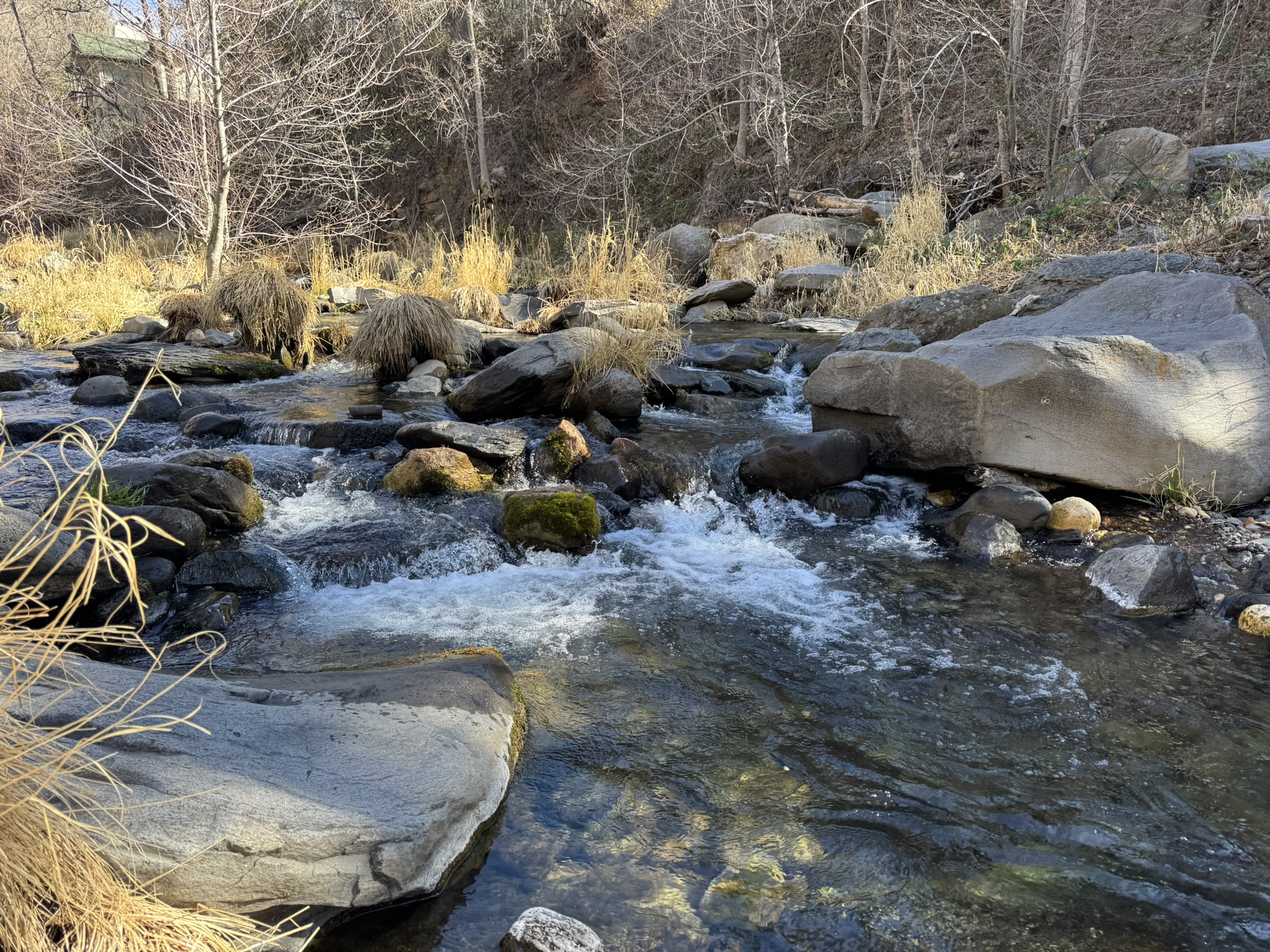
West Fork Trail of Oak Creek Canyon, Arizona
We had driven through Oak Creek Canyon many years ago but had never taken the time to explore the area, which boasts a landscape quite different from the desert environment of the Phoenix basin. The West Fork Trail is 14 miles long, but we only walked the first couple of miles. Literature and websites warn hikers to prepare to get their feet wet, which is fair considering the trail crisscrosses the creek numerous times. During our short walk we forded the creek three times over wet rocks and fallen logs. Even with our hiking poles, we decided a fourth crossing was pushing our luck, especially considering we didn’t bring a change of clothes along in case we slipped and took an unplanned dip.
West Fork Trail of Oak Creek Canyon, Arizona
The section of the trail that we walked is flat and sandy, following closely to the creek through forests of ponderosa pines, maples, and of course, oaks. Not far from the trailhead are the stone ruins of Mayhew Lodge, an old hunting cabin converted into a resort that attracted celebrities such as Jimmy Stewart, Walt Disney, Clark Gable, and President Herbert Hoover. It burned to the ground in 1980, leaving behind only the ruins that are adjacent to the first part of the trail, which is the most accessible portion of West Fork.
West Fork Trail of Oak Creek Canyon, Arizona
According to the Visit Arizona website, the trail becomes more challenging after the early creek crossings. “The canyon walls begin to close in, forcing the creek through a slot canyon. After wading through the creek to get back to the trail, hikers can expect bouldering, swimming and bushwhacking to complete the entire trek.” Visitors to Sedona who enjoy the outdoors will be well rewarded by taking the short drive north to witness the rock pinnacles, natural arches, and deep canyons on the West Fork Trail.
West Fork Trail of Oak Creek Canyon, ArizonaWest Fork Trail of Oak Creek Canyon, Arizona
In his remarkable book, Badass Retirement, author Robert Pagliarini includes a chapter titled “Upgrade Health.” His message is simple for people who want to escape average retirement: think and act like an athlete. He posits that professional athletes “invest their time and energy into improving their performance.” They work hard at it to avoid injury, recover quickly if they do get hurt, and achieve the highest possible energy and stamina for years, even decades. He stresses that retirees should have these exact same goals – and I agree one hundred percent.
My wife and I are now in our second year of retirement, and one of our top priorities since we left employment is to get in better physical shape and maintain a healthier lifestyle than we did during our working years. We are paying closer attention to what we eat and drink (well, better than we once did). We are also wearing the right kind of clothes and shoes for our new lifestyle. We are paying more attention to our bodies and making sure we get the medical care we need. We believe in the value of vaccinations and medication.
Perhaps the most significant change in retirement related to our health is our increased focus on physical fitness. Much of our time is now discretionary, and we are devoting more of it to a variety of exercise options including weight training, cardio activity, Pilates, walking, and hiking. We both have trainers we work out with at least once a week. We have pickleball paddles and hope to learn how to play this game that has swept across America and is attracting all ages, not just seniors.
Dan Kinney Family Center, Springfield, MO
We are fortunate to live in a community that offers ample opportunities for indoor and outdoor recreational activities. Our city and county have an excellent trail system for walking, hiking, and biking. Some of the trails connect to surrounding towns. We have a nature conservation area, a botanical garden, a historical landmark park, and several outdoor green spaces with hiking trails, paved walkways, creeks, and ponds.
Springfield (MO) Botanical Center
Because we are both over age 60, we get an extra benefit through our local park board in the form of a deep discount on membership at their fitness centers. We can reach the one closest to our house in about ten minutes. This family center has a multi-use court for pickleball, basketball, volleyball, children’s inflatable bounce houses, and group exercise programs like SilverSneakers. There is a walking track on the second floor that circles the court. There is an outdoor paved walking track too. The center is equipped with a wide variety of dumbbells, weight machines, treadmills, bikes, ellipticals, stair steppers, and much more. The center also has meeting space and separate rooms for small classes and individual training.
We are making a concerted effort to exercise several times a week, with two days of weights, at least one day of cardio, and 2-3 days of alternate activity like walking or Pilates. We live in a subdivision that is great for walking. If possible, we also try to include exercise as part of our daily routine when we travel, taking advantage of hotel and condo fitness rooms or just walking nearby trails or in neighborhoods. We look for public gardens, arboretums, and greenways for walking too. When we are away from home for extended periods of time, we purchase a temporary membership at a fitness center so we can maintain our weight and cardio routines.
Springfield (MO) Conservation Center
Hiking has always been a favorite activity for both of us, even before we met and got married. I have written about our hiking adventures a few times in this blog. When we travel, we look for fun and scenic places to hike. Phoenix, the Sonoran Desert, San Francisco, Lake Erie, Joshua Tree National Park, Yosemite, Mount Hood, and various locations in the Ozarks and Appalachia are just a few places we have hiked. We have walked or hiked in temperatures from 13 to 90 degrees Fahrenheit, in light rain and sunshine, and in all four seasons.
Sometimes it’s not easy to get motivated, but we know we need to keep moving, strengthen our core, develop and maintain muscle tone, protect our bones, keep our hearts healthy, and improve our balance. Robert Pagliarini makes a valid point to keep in mind in his badass book on retirement. “The most important asset you have is your health, but knowing what to do when it comes to nutrition, supplements, and fitness feels like a moving target for a good reason. If there is one area that changes more than any other, it’s health.” Medical professionals agree that exercise is essential to staying healthy, and we intend on staying as healthy as possible as we age. After all, we’ve got places to go, people to see, things to do!
The last day was November 13, 2024. The thought of it filled me with excitement, relief, happiness, and maybe just a hint of anxiety. I have contemplated this date for decades but only gave it serious thought during the last five years or so. I have been preparing for this moment over a good portion of my adult life. My ideas about how it would look and the impact it would have on me have changed over the years. I’m extremely grateful to be reaching such a pivotal point in my life, and I am even more thankful that I got to celebrate the occasion with my spouse/best friend. November 13, 2024, was the day my professional career ended, and retirement began.
time clock (source: Wikimedia Commons)
My wife retired earlier in 2024, and although I cut back to halftime hours for my final year, I still went to work several days a week, every week. The thought of never again having to drag out of bed at dawn, down a cup of coffee, grab a bite to eat, shower, shave, get dressed, and head out the door for work is just lovely, if not a bit scary. No work means no paycheck. Yes, like many Americans we will have sources of retirement income, including social security. No, it’s not the same as a regular earned paycheck, which is more a difference in the mind than the wallet. For many people, retirement is a huge shift in thinking and practice; in short, we transition from spending and saving what we are earning to spending what we saved, either on our own or through our employers and/or the government. It takes some getting used to for most of us, I suspect.
The joys of being retired are slowly revealing themselves with each passing week. The stress that comes from adhering to a daily schedule and meeting deadlines pretty much disappeared on day one. The luxury of rarely setting an alarm for waking in the morning is heaven, although I still tend to wake up between 5:30 and 6:30 a.m., although there have been a few mornings I have slept past 8:00, especially in a hotel with blackout curtains. Retirement offers so many scheduling options, such as traveling and vacationing on whatever days of the week that works best for our planned activities, assuming we have set plans. Sometimes we just get a whim and go off on an adventure, which is so liberating and fun. We can book flights now based on the optimum prices, availability, airline, time of year, and choice of destination, rather than how we can fit air travel into a work week.
Money can buy so many things, but the most precious commodity we cannot purchase for any amount of cash is more time. However, retirement puts more of the time we have back in our hands to do with as we please. I love to read, and during the years I was working, I typically would get up early enough to spend at least 30 minutes to an hour reading with my first cup of coffee. Reading at night has never been a good option for me because I tend to lose attention and retention after dinner. Now, I can read for hours on end at almost any time of the day that works for me, which is heavenly. I am also devoting more time to reading online subscriptions to newspapers like the New York Times and Wall Street Journal. One slight downside of not driving back and forth to work each day is less time spent listening to audiobooks, so I will need to carve out time each week for that relaxing and engaging activity too.
pocket watch (source: Wikimedia Commons)
I have been an amateur musician for over fifty years, and another huge benefit to retirement is the amount of time devoted to learning new music, improving my skills, and performing more often. I am even spending an hour each week working with a friend and gifted guitar player who is expanding my knowledge and abilities on that instrument. I also have more opportunities now to sit down for blocks of time to work on the keyboard, learning new songs and getting better at playing in general. I am hoping that retirement will free up more time for songwriting too. Being able to sleep in also means I can stay out later to participate in open mic and jam sessions around town or take in live music shows in the area. My wife and I love going out in the evenings to live music shows.
Another benefit that is more related to our ages than retirement specifically is our eligibility for Medicare, the federal government’s medical insurance program for people age 65 and over. We will save a bundle on premiums and on most medical services and procedures in the coming years, which will free up more money for travel and the many other interests we have. I am baffled by people who tell me that retirement did not meet up to their expectations. Some of them even went back to work. I suppose there are retirees out there who fill up their days watching hours and hours of television. Yes, we do watch television, but mostly we watch sports programming (Go CHIEFS!!!) and a few series now and again. We also love the idea that we can now catch matinee movies at the cinemas during the week and get better deals on admission and concessions. Speaking of discounts, we have become much more aware of lower prices for seniors at restaurants, grocery stores, and other retailers. Those savings really add up over time.
Admittedly, I have become quite obnoxious about the freedom retirement affords. When I’m shopping for seed at our local Wild Birds Unlimited store around mid-day, I often look around at some of the other shoppers and think, “Damn, I bet you’re here on your lunch break, aren’t you?” Or if I’m driving around town mid-morning and the traffic is heavy, I find myself saying out loud in my car, “Why aren’t all you people at work?” I know, I know. I’m a terribly smug person. Eventually I’ll settle in to this wonderful rhythm of retired life, and in so doing, perhaps I will become a bit more humble and gracious. But for now, let me rub it in just a tiny bit.
Missouri is often referred to as the “Show Me” state, a reference to a late 19th century lawmaker’s observation that its citizens as a rule prefer visible proof over blind faith. Given the political climate in Missouri in 2021, I would argue that this moniker is no longer applicable. A much more accurate appellation would be the “Float Me” state. River and stream floating trips are a major source of relaxation in Missouri with a long history and a strong tradition. According to multiple sources, flat-bottom jon boats originated, or were at least made popular, in the late 19th century in the Ozarks because they were perfect for navigating the shallow waterways characteristic of the region of southern Missouri and northern Arkansas. With an abundance of large lakes, rivers, and streams, water recreation is a huge business in Missouri attracting millions of tourists each year; however, native inhabitants have been enjoying the simple pleasures of just floating downstream for many generations.
Not only is Missouri blessed with plenty of water resources, but the Ozarks comprises one of the nation’s richest concentrations of natural springs. There are well over a thousand of them in the state. The maximum daily discharge from some of these overflowing aquifers can exceed 500 million gallons. On average, more than a billion gallons of water flow from the ten largest springs in Missouri every single day. For many centuries, springs provided drinking water for settlements and towns throughout this region of the country and were later used for powering mills and producing salt. Some springs purportedly had healing qualities. In recent decades, these groundwater flows have predominately functioned as recreational resources centered around fishing, camping, hiking, and other outdoor activities.
One of the largest springs in Missouri is Bennett Spring, located in what is now Bennett Spring State Park in Dallas County. As one of the state’s oldest parks, this spring was the site for several grist and flour mills going back to 1846, the most successful of which was operated by a man named Peter Bennett, the namesake for the spring and park. In 1924-1925, the state purchased the spring and part of the surrounding area to create the park. In the 1930s, the Civilian Conservation Corps contributed much of the present-day character of the park, building cabins, a shelter house, roads, trails, the arched bridge across the spring branch, and the rustic dining lodge.
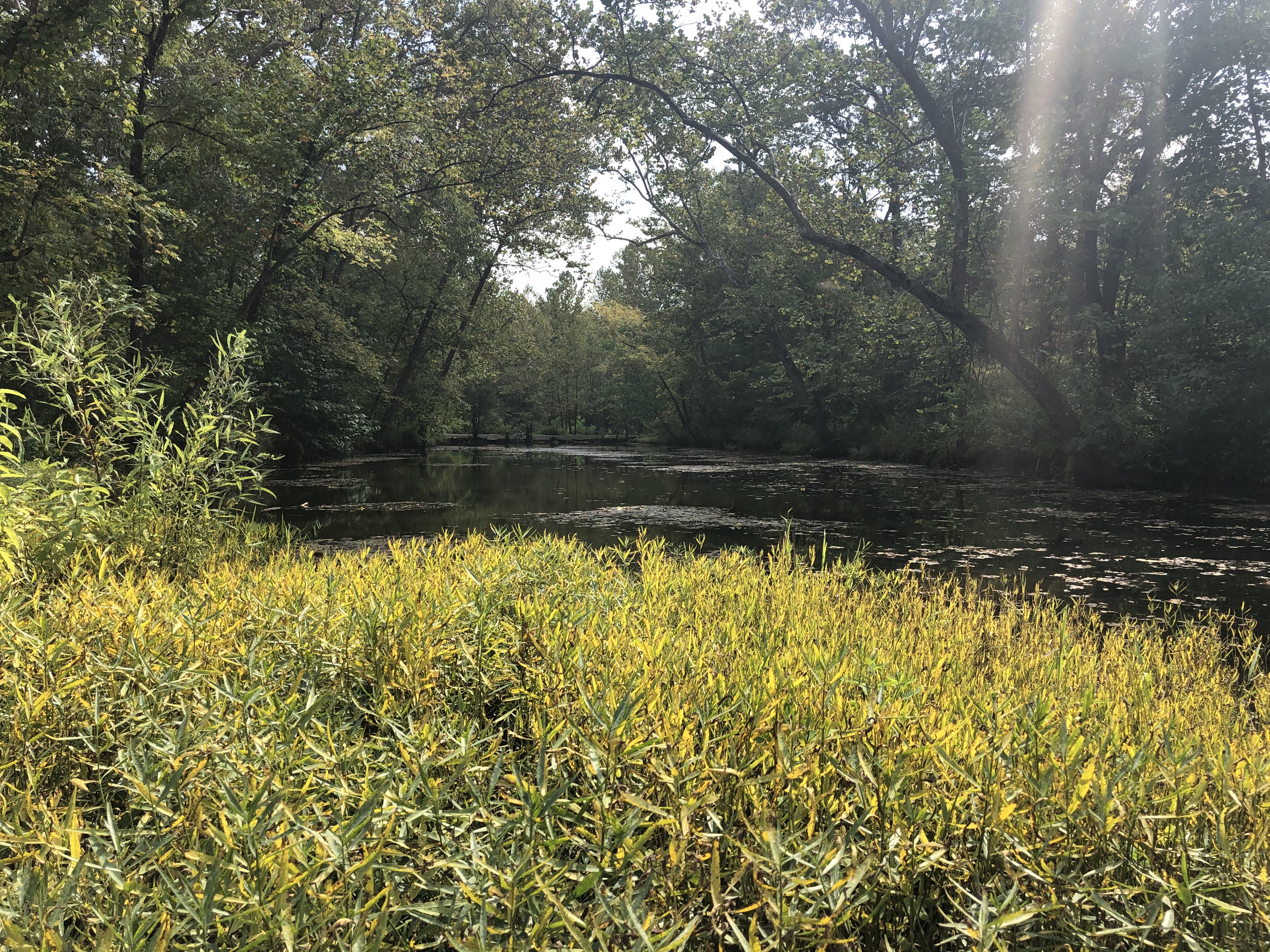
Bennett Spring branch
Bennett Spring State Park features many different ecosystems including rich bottomland and stream habitats associated with the spring valley and oak-hickory woodlands in the upland areas. Many animals native to the Ozarks make their homes here, including numerous pickerel frogs, northern water snakes, pileated woodpeckers, river otters, muskrats, and bobcats. The park’s diverse flora includes dense forests of trees, grasses, and herbaceous plants. Wildflowers such as bluebells and purple coneflowers flourish in the summer.
Bennett Spring branch headwaters
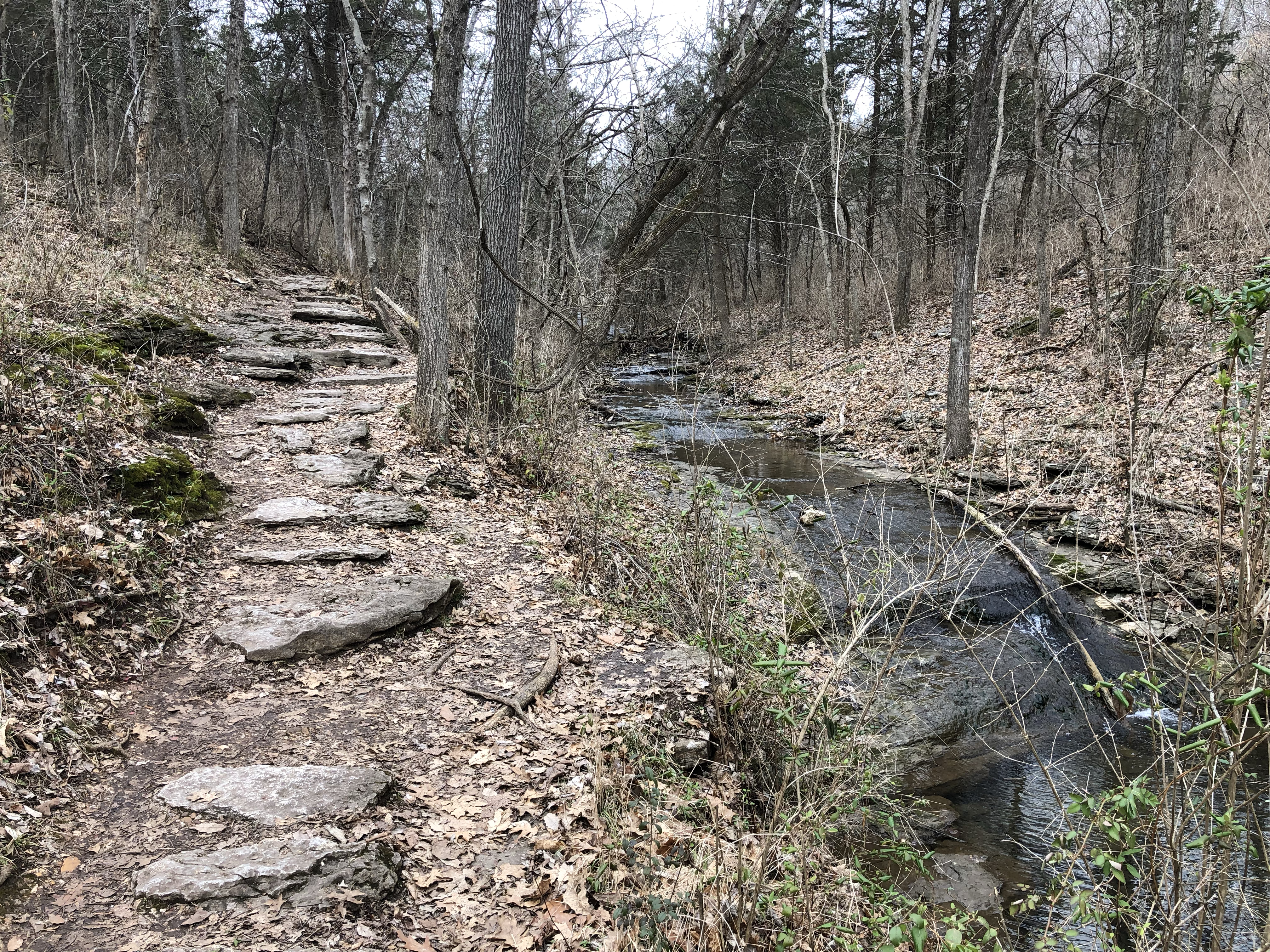
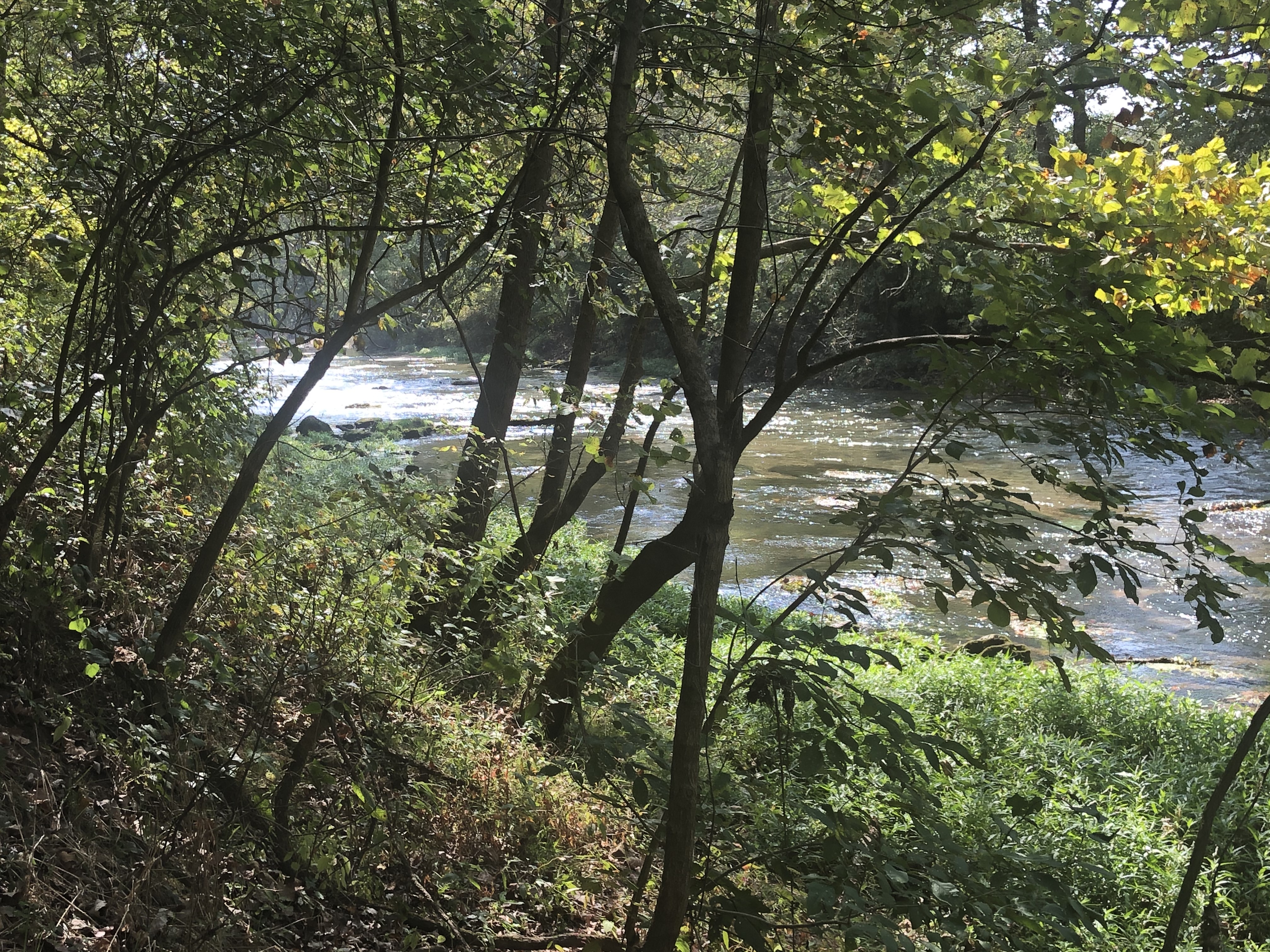
The park features a series of hiking trails, which is what sparked my interest in the late summer during the COVID pandemic and prompted a day trip to check out the site. Upon arriving at the park mid-morning, I made a quick visit to the Nature Center that serves to introduce visitors to the ecology of springs in general and to the natural resources specific to the park. I then made my way to Whistle Trail, which mostly travels along the east side of the spring’s branch, winding its way over the bluffs rising above the stream. It connects with other trails in the park that lead to the spot where the branch flows into the Niangua River, a tributary of the Osage River of south-central Missouri. According to the park’s website, Whistle Trail is likely prehistoric but was used more frequently by local inhabitants from the 1840s to the present.
Pileated woodpecker at Bennett Spring State Park
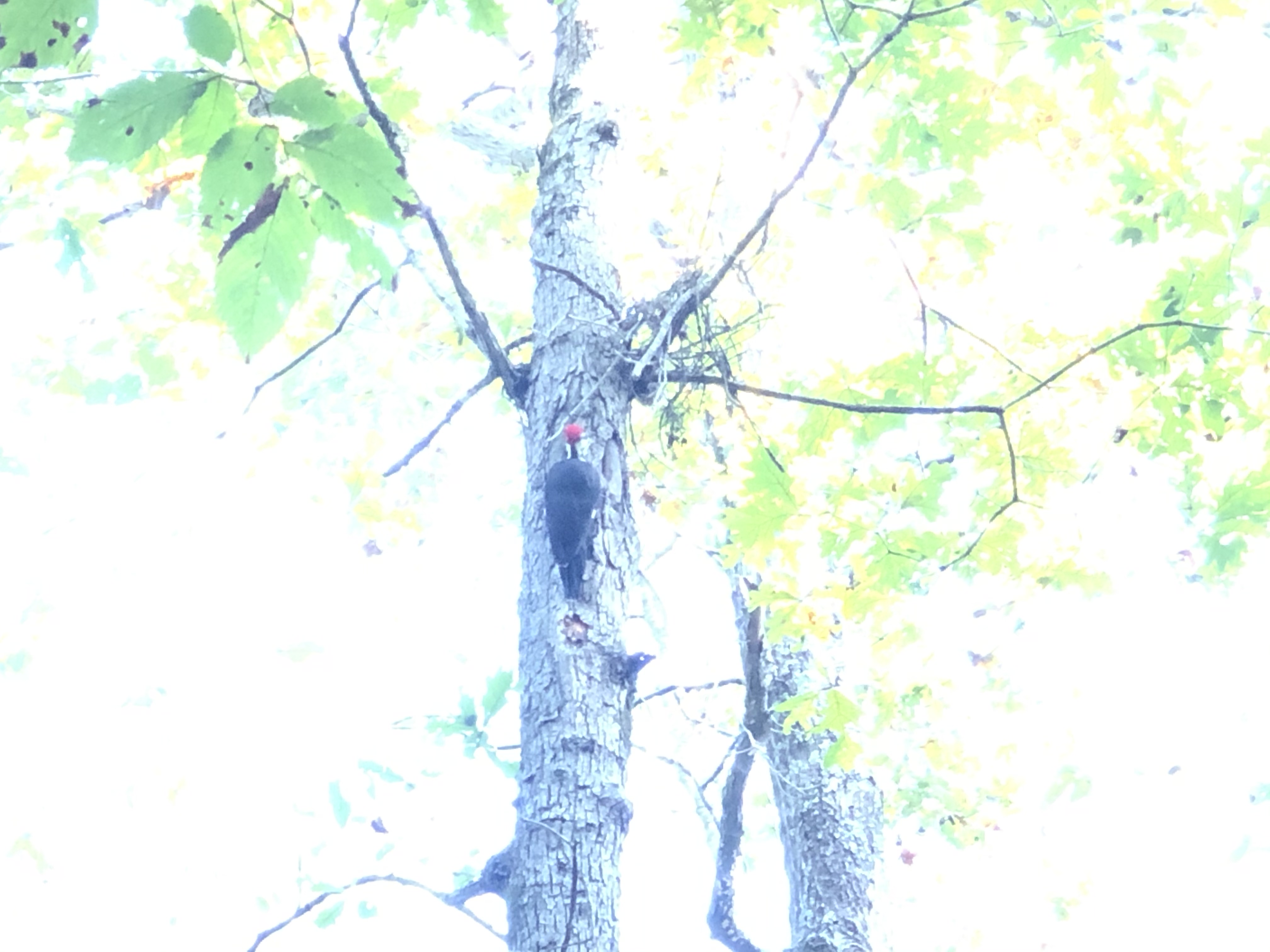
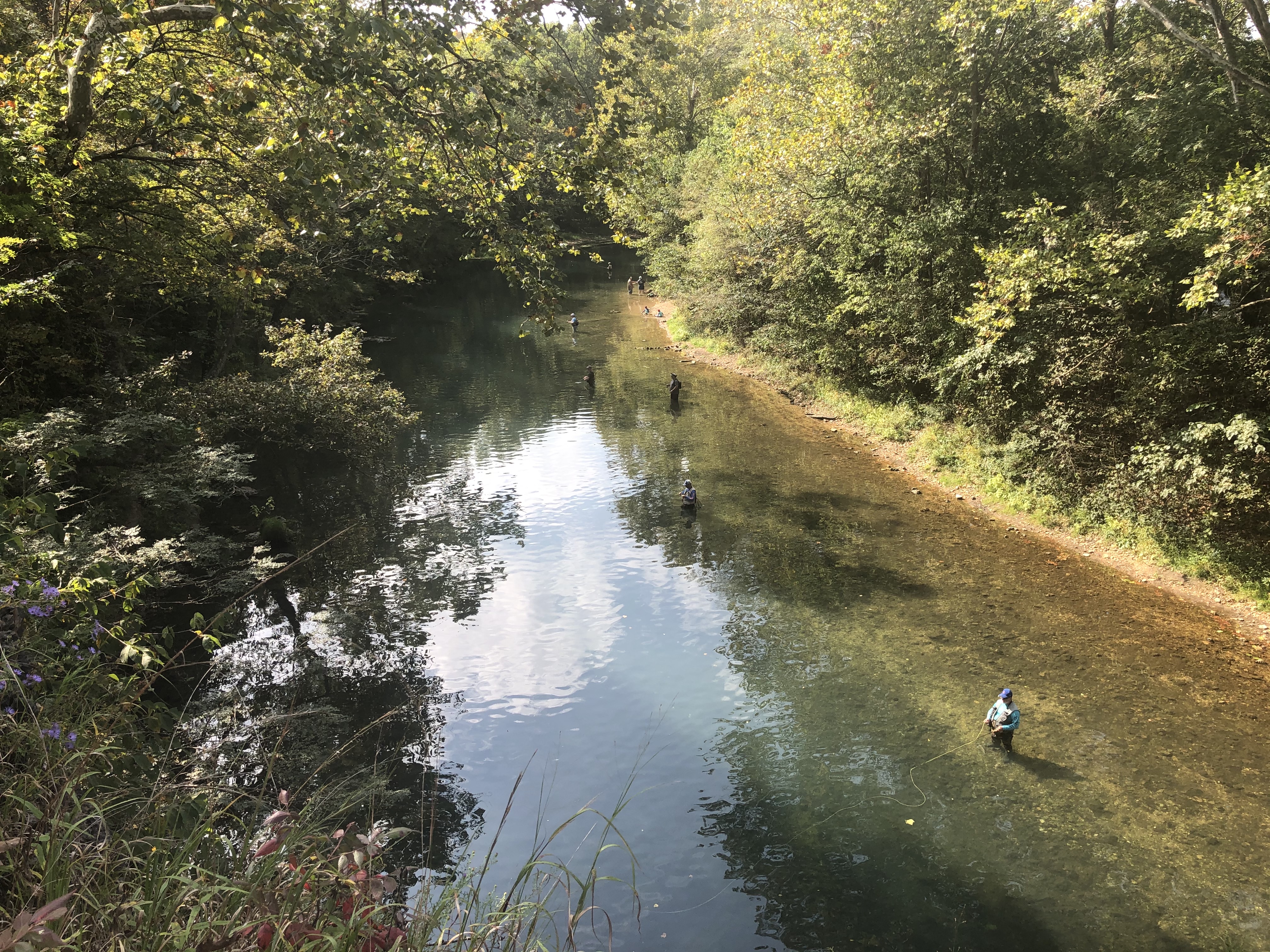
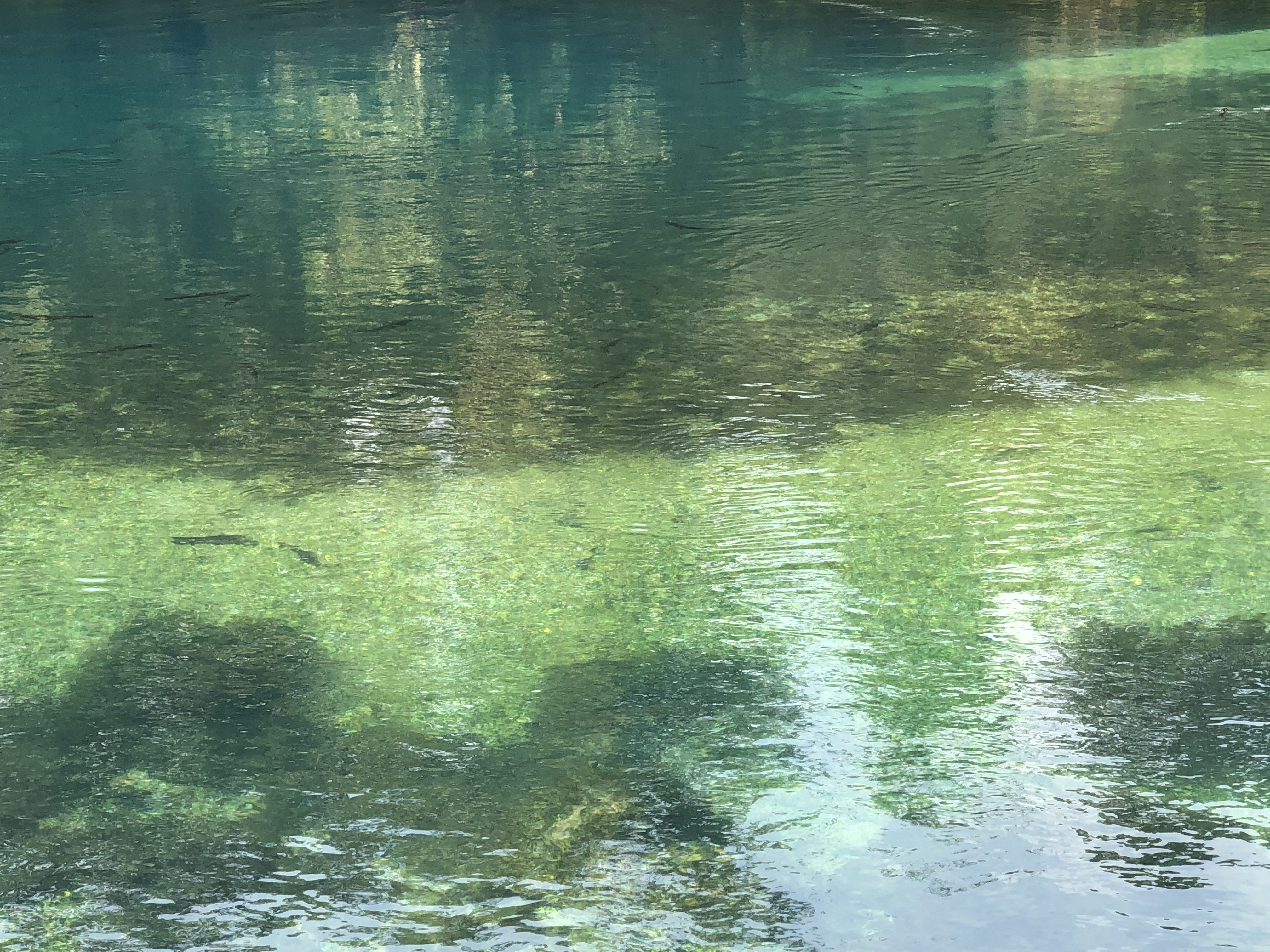
The views from Whistle Trail are quite wonderful at times, especially because of its proximity to the water and the path it cuts through the lush surrounding forest. I was lucky enough to encounter a pileated woodpecker, only my third sighting of this magnificent species to date. Typically, I prefer the solitude that hiking trails offer, but in this case, it was quite entertaining to watch people wading in the stream trying their luck at hooking a rainbow trout, which I could easily see swimming all around the anglers in the crystal-clear water. The Missouri Department of Conservation stocks the branch daily during the regular fishing season, from March through October, and there is a hatchery located near the spring. The park attracts over a million anglers a year. From what I have heard, there are so many people in the stream fishing when the season first opens that you can barely see the water!
Anglers in Bennett Spring branch
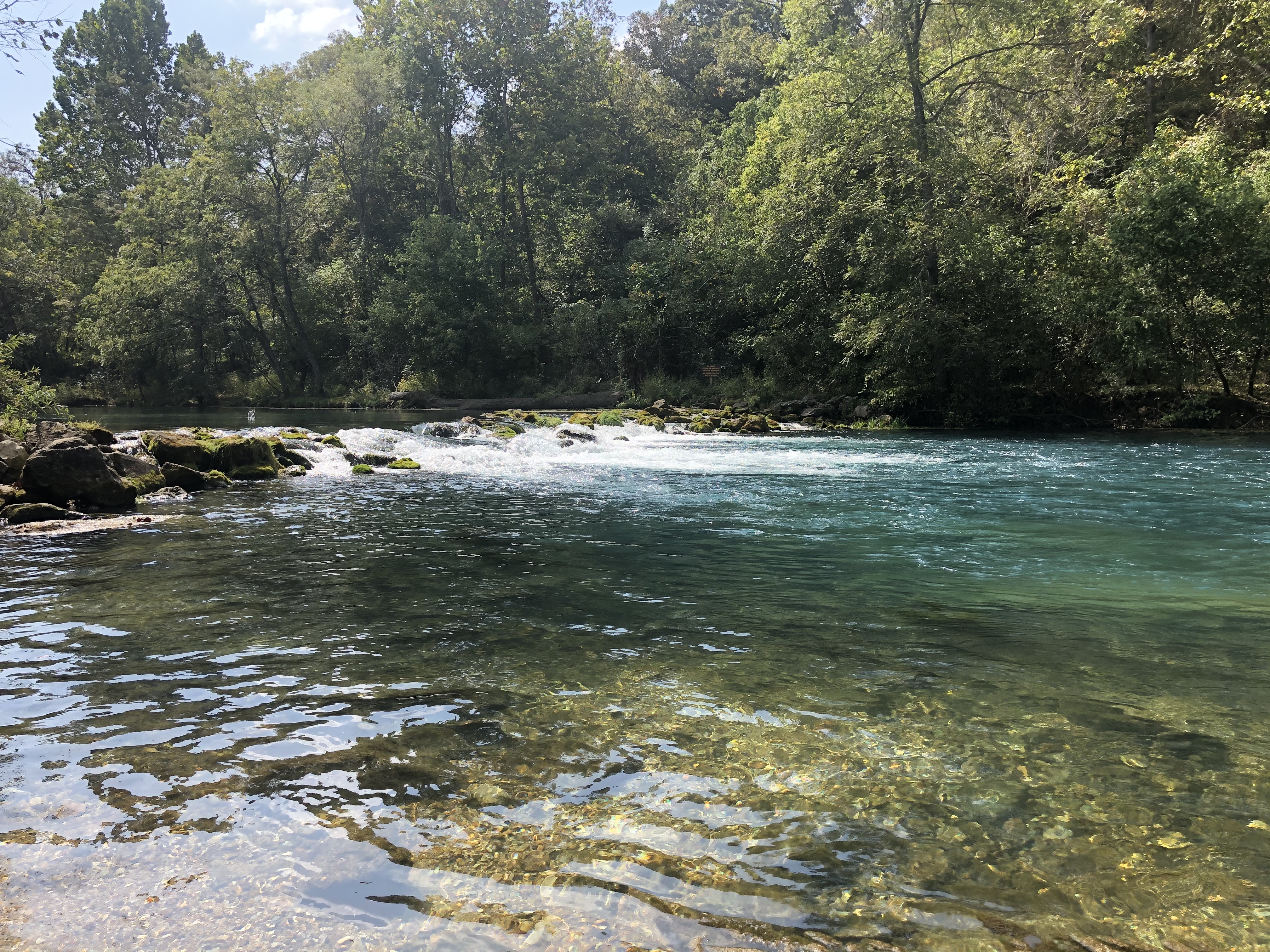
I spent the rest of my time wandering around the buildings, other structures, camping sites, and open grassy areas, just enjoying the beauty of the surroundings. I sat in a swing by the spring branch watching families fish and play in the water. For the last hour or so I explored the spring itself, which creates a gorgeous pool of blue-green water about 50 feet in diameter. Again, the trout are clearly visible swimming just below the surface. The water emerges from a 20-foot-wide seam at a temperature of approximately 57 degrees Fahrenheit. Discharging 100 million gallons per day, the spring creates the trout stream that meanders 1.3 miles through the park before flowing into the Niangua River. Bennett Spring is the principal groundwater outlet for the extensive karst geographical area in south-central Missouri.
Trout swimming in Bennett Spring pool
Missouri has over 90 state parks, and Bennett Spring is among the most popular. A variety of interpretive programs are offered at the park for all ages. The park’s concession hosts offer fly fishing classes too. Canoes, rafts, and kayaks are available to rent for floating on the Niangua. There are multiple options for lodging including a motel, cabins, and camping sites. With seven hiking trails ranging in distance from 1.3 to almost 12 miles and elevations from 849 to 1,102 feet above sea level, hikers can get their fill of exercise, wildlife gazing, and plenty of fresh air. I found the property to be just what I wanted for a day trip, but a weekend would be lovely too. Bennett Spring State Park represents the best of what the Ozarks has to offer for outdoor enthusiasts. I highly recommend a visit.
Kayakers entering Niangua River from Bennett Spring branchLosing stream behind Bennett Spring
I have expressed my appreciation for waterfalls in previous posts, and we are fortunate to live in an area of the country where creeks, lakes, and waterfalls are abundant. Even better, many of these features are freely accessible at state parks, national forests, and recreational areas. One of the most popular waterfalls close to our home is Panther Creek Falls, located a few miles south of Tallulah Gorge in northeast Georgia. This waterfall is located in the Panther Creek Recreation Area at the end of a 3.5-mile moderate walk along Panther Creek. The National Forest parking area is located on old U.S. Highway 441 north of Clarkesville.
Panther Creek Falls Trail is 5.5 miles long and follows Panther Creek through stands of hemlock and white pine along steep, rocky bluffs of the creek. The trails passes a series of cascades as well as Panther Creek Falls. It terminates where Davidson Creek joins Panther Creek. When my younger son and I explored the trail last February, we decided to take the 3.5-mile hike to the falls and return to the parking area for a 7-mile excursion. We had plenty of company on that mild winter day, with other hikers and campers all along the path. The trail is noted for its beautiful variety of wildflowers and ferns. The stream offers excellent opportunities for trout fishermen too. Some rock scrambling is required, and there are some steep sections, but much of the hike is relatively flat. Erosion has caused several trail sections to drop sharply and suddenly to the creek below, demanding extra caution. I was amazed at how many families with small children were there when we hiked the trail — some were even carrying strollers with them!
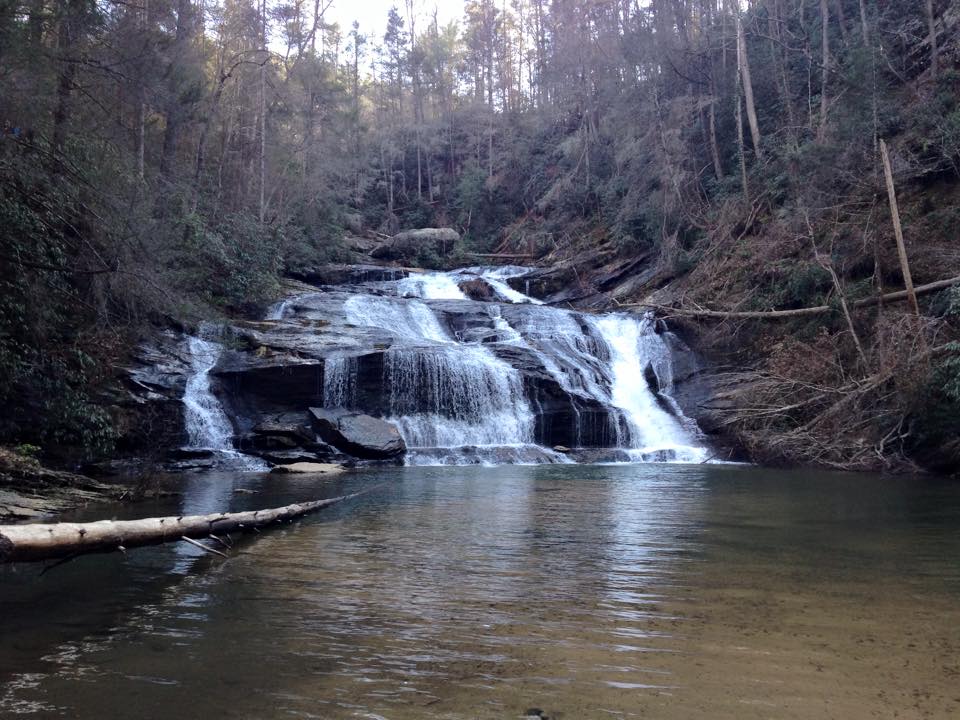
Panther Creek Falls
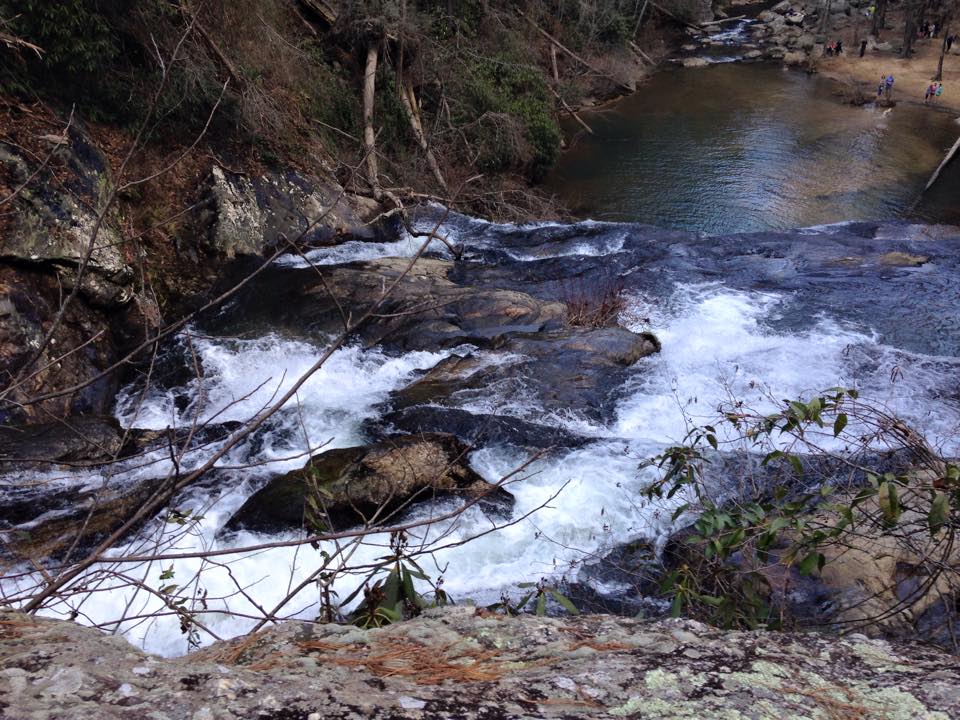
I was so enamored with the trail that I took my wife back at a later date, and while we only hiked in and out about a mile or so, she could appreciate the beauty of the forest and the creek without seeing the falls. A large, shallow pool forms at the base of the falls, which is a wonderful destination for families and hiking groups. The setting is beautiful, surrounded by hills covered in trees and laurel. For those who like seclusion and privacy when they commune with nature, this recreation area is probably not a good choice. In the warmer parts of the year, I’m sure it gets quite crowded.
View from the top of Panther Creek Falls
The naming of the creek is a source of curiosity for me. I have not read anything official that links the name to animals that may have inhabited the area in the past. According to some sources, a subspecies of the puma, the Florida panther, survives in a small, isolated and precarious population at the rapidly urbanizing southern tip of Florida. However, these animals were once widespread, even inhabiting portions of Georgia. Another subspecies, the eastern puma (also known as cougar or mountain lion) may have once occupied regions of north Georgia. Although in recent years there have been claims of sightings in north Georgia and South Carolina, the U.S. Fish and Wildlife Service has declared the eastern puma extinct and removed it from the list of protected wildlife and plants under the Endangered Species Act. Regardless of nomenclature of the falls, this trail offers a great opportunity to get outside and enjoy the natural resources that are so abundant in the hills and mountains of north Georgia. We will definitely return.







 If You Want My Opinion