

Rock & Roll Hall of Fame

My wife and I took a brief trip to Cleveland, Ohio in August, 2024. We had hoped to do so in 2020 while my wife was working temporarily in Fort Wayne, Indiana, when I could fly in, and we could then drive over to Cleveland. But the world shut down when COVID struck. We both love rock music, and as an amateur rock and pop musician, I was interested in visiting one of the top destinations the city has to offer: the Rock & Roll Hall of Fame. However, we both agreed that we would need more than a single objective to justify flying from our home in Springfield, Missouri, through O’Hare airport in Chicago, and then on to Cleveland. We found one. We discovered that one of our favorite bands, Hootie and the Blowfish, was touring in 2024 and that Cleveland was one of their stops. They were going to be playing at the magnificent Blossom Music Center in Cuyahoga Falls, Ohio, about 20 minutes south of Cleveland. We had a twofer and were good to go!

Neither one of us knew much about Cleveland and didn’t have high expectations beyond what we planned to do while in the city. We were pleasantly surprised. Situated on the southwestern shore of Lake Erie, Cleveland is taking advantage of tourism with great parks and beaches right on the water. The views are breathtaking. With a scenic skyline, good hotels and restaurants, stadiums, arenas, and several major attractions, Cleveland really is a place to explore. The city claims to be the birthplace of Rock & Roll music, primarily because radio station WJW disc jockey Alan Freed coined the phrase “Rock & Roll” to describe the upbeat black rhythm and blues music he was playing in 1951. Of course, the Rock & Roll Hall of Fame was ground zero for us, and it also exceeded our expectations.

Rock & Roll Hall of Fame, Cleveland, OH

The building is a modern structure with a huge glass atrium at the entrance. It has six levels beginning on the entrance floor, but the tour starts one level below with the Ahmet Ertegun Main Exhibit Hall, which carries visitors from rock’s earliest stars to those newly emerging contemporary musicians. There are thousands of items on display, along with feature films, videos, interactive kiosks, reading material, and plenty of music. This exhibit has the museums largest displays devoted to single artists, bands, subgenres, and movements of Rock & Roll history and the industry: Revolutionary Women in History, Hip Hop, Roots of Rock, Pioneers of Rock, Sun Records, Cities & Sounds, the music of Cleveland and the Midwest, and so much more.

Rock & Roll Hall of Fame, Cleveland, OH

Level 1 has a ticket booth, a café, large museum store, and the Klipsch Stage where performances are scheduled throughout the year. Level 2 is called “The Garage” where visitors can sign up to play various instruments with or without a house band in a setting that looks very much like a real garage. I played an electric guitar (something I never do) and sang “Midnight Rider” by the Allman Brothers Band with the help of a house drummer and a bass player, who also sang harmony with me. Although it wasn’t my best performance of that song, it was still fun to play in such an iconic venue. This level also has a large collection of different types of instruments and sound booths for visitors to jam on their own. The Les Paul exhibit is on this floor too, paying homage to the American jazz, country, and blues guitarist, songwriter, luthier, and inventor. He was one of the pioneers of the solid-body electric guitar, and his prototype served as inspiration for the Gibson Les Paul guitar.

Level 3 is focused almost completely on the Hall of Fame inductees, with the Inductee Signature Gallery, New Inductee exhibit, and the Connor Theater featuring the Power of Rock Experience. Visitors can look through alphabetic lists of inductees and a large chronological display of the all the inductees going back to the Hall of Fame’s inception in 1986. This floor also has the New Inductee and the In Memoriam exhibits. The Connor Theater is on this floor, where visitors can watch a 15-minutes video highlighting the Hall of Fame induction nights from the past.

Level 4 features the Pink Floyd tour replica of The Wall, designed to mirror the Berlin performance in July 21, 1990. This level is also the location of the Foster Theater, which is used for onsite education programs or private rentals. The theater has hosted hundreds of rock star talks and legendary rock films over the years. Level 5, along with some of the ramps in the museum, has individual display cases devoted to the legends of Rock & Roll, from the Bee Gees and the Doobie Brothers to Public Enemy to Tom Petty.

Level 6 is devoted to an exclusive exhibit that Bon Jovi unveiled with the museum in 2018. This full-floor showcase spans four decades of the band’s career along with never-before-seen artifacts from each of the band members. Visitors are immersed in the band’s story and music from inception to the present. Huge video presentations are joined by text panels and display cases filled with musical instruments, clothing, and loads of memorabilia from the band.
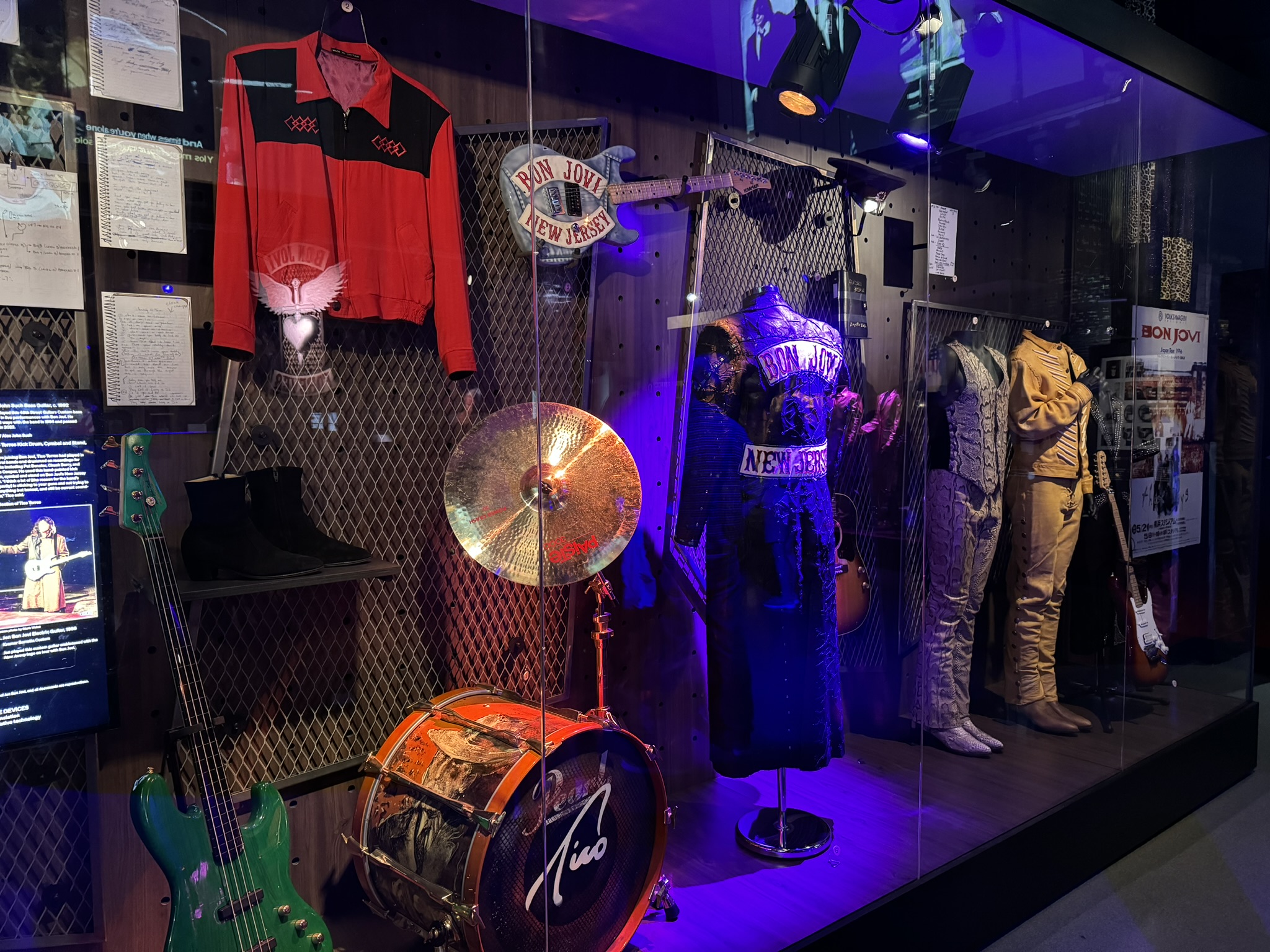
Rock & Roll Hall of Fame, Cleveland, OH

Organizations like the Rock & Roll Hall of Fame that establish themselves as authorities of a particular subject area all have one thing in common. They always stir up controversy, mostly about who or what is included, but more contentiously, excluded from their lists. This museum obviously recognizes this dilemma and even seeks to address it by allowing visitors to submit names of performers or bands they think should be inducted into the Hall of Fame. Many writers over the years have discussed this topic, and some of them have challenged the Hall of Fame on its choices of inductees through the decades. One of the most ironic exclusions is Huey Lewis and the News, the band that had a major hit with “The Heart of Rock & Roll,” which actually mentions Cleveland at the very end of the song!

Rock & Roll Hall of Fame, Cleveland, OH

I certainly had my share of questions come to mind as we strolled through each level of the museum. I was disappointed to see how much more space and almost reverential attention was given to Elvis Presley on one wall, while on the opposite wall a smaller display featured Chuck Berry, often considered the Father of Rock & Roll. I think those two positions should have been swapped. One of my favorite wall displays was for Jimi Hendrix, probably the greatest guitarist in rock history. I was baffled to learn that bands with place names such as Chicago were inducted fairly late in the game and that the bands Kansas and Boston still haven’t made it. At the same time, I was delighted to see so much attention given to Wanda Jackson, an Oklahoma native who got her start on ABC Television’s “Ozark Jubilee” broadcast out of Springfield, Missouri from 1955 to 1960. She later became known as the Queen of Rockabilly, a title she still holds to this day. As of this post date, she is still with us.

Rock & Roll Hall of Fame, Cleveland, OH

We were able to pack a lot in just two full days while still having some down time walking along the shore of Lake Erie, enjoying some great meals and drinks, and exploring the public spaces on the water around the Hall of Fame. On top of all that, we were lucky enough to catch Hootie and the Blowfish back together again for a national tour. Oh, and their opening acts were Edwin McClain and Collective Soul. For people who love rock music, it just doesn’t get much better than our quick trip to Cleveland.

Hootie and the Blowfish at Blossom Music Center (Ohio)

The Complex Character of Johnny Cash

Johnny Cash in 1977 (Wikipedia)

I have never been a big fan of Johnny Cash, which in some circles brands me as a heretic. I didn’t enjoy hearing him sing. No one ever credited him with being a skilled musician, and he likely would not have argued the point. I did not agree with so many musicians, critics, and fans who thought his song lyrics were profound. There were a few that rose to the occasion, but most of them were rather simple. Many of his fans and even a few biographers have painted him as a scholar — I have my doubts. I also thought the whole “man in black” persona was rather cheesy and contrived.

I do, however, recognize the impact he had on so many other musicians and entertainers. It is amazing how many people in the industry collaborated with him, especially later in his life. He helped launch the career of Kris Kristofferson, one of the best songwriters of popular music in the 20th century. I know Cash is a bit of a legend in the entertainment world, a reputation he spent a good deal of time cultivating. He was certainly a man of conviction, and on multiple levels.

Johnny Cash was also very close to evangelist Billy Graham, and the minister apparently admired the entertainer for his public testimony about his faith. Cash devoted much of his creative output to gospel music, often times at the risk of falling out of favor with record labels, producers, television executives, and some of his fans. He loved deeply, believed passionately, and endured incredible heartache and pain at times, including the physical kind. I don’t think he was as much of an outlaw as he portrayed himself to be or as the media depicted him. But he was definitely an outlier.

Most people who know anything about him understand that Johnny Cash had his share of flaws: addictions, infidelities, mental instability. He was also plagued with constant inner struggles. He was a troubled soul who clung to the faith of his Christian upbringing, even though it seemed impossible for him to follow a righteous path. The vices always seemed to get the best of him, even by his own admission. I suspect guilt played a huge role in his religious convictions, especially the death of his brother at a young age and the fact that his father blamed him for the unfortunate accident that took his brother’s life.

In the context of 20th century music, Johnny Cash is a name that is as immediately recognized as Elvis Presley, Bob Dylan, Bruce Springsteen, or Willie Nelson. He is indeed a legend, a celebrity who crossed multiple genres in the world of entertainment. I have recently started performing a Johnny Cash song in my solo shows. The one I selected is “Ring of Fire,” which has one of the most complicated and imbalanced rhythms of any song ever written in American popular music. I certainly don’t play it in the odd time signature that was produced in the studio. I doubt very seriously if I could even come close. Hmmm. Maybe old Johnny’s music wasn’t as simple as I once thought.

Chuck Berry, for Better or Worse

Chuck Berry statue in the Delmar Loop in St. Louis, MO

In the spirit of giving credit where credit is due, no one deserves the title “The Father of Rock-n-Roll” more than Chuck Berry. So many of the legends of the genre revered him and covered his hits, including The Beatles and The Rolling Stones. Keith Richards said if rock-n-roll had a name, it would have to be Chuck Berry. Even that white boy from Tupelo, referred so often to as the “King” of rock-n-roll, covered Berry’s tunes.

Chuck Berry’s life is not really a rags-to-riches story as he was born into a middle-class family in St. Louis where he lived his whole life. Growing up just beyond the eastern boundary of the Ozarks region, Berry was heavily influenced by rock-a-billy and country music, elements of which would end up in many of his greatest hits. Of course, Berry also grew up during the era of Jim Crow in a part of the country that had a dark past with race relations. Sadly, according to R. J. Smith in his brutally honest biography (Chuck Berry: An American Life, Hachette Books, 2022), Berry apparently carried his response of anger, resentment, and frustration to extremes at times, taking opportunities to insult and humiliate people, even those who adored him, and telling them, “Now you know how it feels to be black.”

Smith does a good job of balancing the artistry, intelligence, talent, and even the charm of Berry with the ugly side of his personality. Some of the stories about Berry make me think that he may have had some kind of serious psychological illness, like bipolar disorder. To say he was a womanizer would be to let him off the hook. He demonstrated signs of being what many folks in the post-MeToo era would define as a sexual predator and even a pedophile. At the very least, it is fair to say he had strong sexual appetites that wandered into the realm of the taboo and even aberrant.

His sexual deviance, along with his violent tendencies and his resistance to authority, including the IRS and government in general, got him into legal trouble on several occasions. He was sentenced to jail time more than once. One could argue that he shared this path with many of the outlaw country stars like Johnny Cash, Merle Haggard, Willie Nelson, and many others. Some rap and hip-hop performers who were no doubt influenced by Berry on some level would also be plagued with legal problems and prison terms.

No matter how bad the news was for Berry, he was still highly respected by the biggest names in the music business, including Bruce Springsteen. He was an early cross-over musician, infiltrating white homes with his unique style of playing and singing long before black performers were even allowed to eat in many restaurants or stay in hotels when they were on tour. He was beloved by millions of fans all over the world, even when he continued to attempt to perform in his 80s as dementia began to claim his mind and memory. His impact on 20th century music and beyond cannot be overemphasized, complete with his flaws and his brilliance.

The Legend of Bob Dylan

My older son and I recently saw Bob Dylan and his band in concert.  My son is quite the connoisseur of classic pop music going back to before he was born, and to some extent, before I was born.  Going to this show was what he requested for his birthday because he feels certain that there won’t be too many more chances to see Dylan live, and judging from how frail the aging rocker looked on stage, I would agree.  While 73 doesn’t seem so old when considering how many of his contemporaries are still touring extensively, Dylan doesn’t seem to “get around” with the same agility of guys like Mick Jagger or Paul McCartney.

Just before the show began, the house lights went out and the stage was dark.  A single member of his band came out in the dark, picked up a guitar, and started playing a gentle, folksy tune.  It was like being in church.  When the lights went up, the rest of the band was in place, wearing matching outfits.  I leaned over to my son and said, “How often do you see band members dressed alike?”  He replied, “I never have.”  They were definitely representing a different era, when rock-n-roll was reaching adolescence and getting more rebellious, but there was still a touch of class and style left over from the very early days of the bands that accompanied Buddy Holly and Elvis.


President Barack Obama presents Bob Dylan with a Medal of Freedom (May 29, 2012)

Most people don’t become legends during their lifetimes, nor do they become iconic.  Bob Dylan is an exception.  Some of his songs clearly define the rock-n-roll era, especially the elements in the genre that are most significant historically: protest, reflection, freedom, and change.  More than any other popular musician and songwriter from my generation that I can recall, Bob Dylan has proven over and over again that rock-n-roll was never just about the music, and certainly not about beautiful voices.  Hell, he never even tried to make pretty sounds with his voice, that is, on the occasions that he decided to sing instead of speak his songs.  But I would argue with anyone that his lyrics were some of the most powerful and moving of that generation.

At this particular show, Bob Dylan sang an incredible variety of music in a short time. He was probably on stage for less than two hours altogether, but during that time, we heard folk, blues, country, reggae, and rock.   He never picked up a guitar, but he played a miniature grand piano, and of course, the harmonica.  The instrumental variety from his band was impressive, including tunes using a violin and a huge string bass.  It was clear that he was playing what he wanted to play, not what the crowd expected or necessarily wanted.  He didn’t include “Like a Rolling Stone,” which no doubt irritated some of the audience.  But he did play “Tangled Up In Blues” and “Blowing In the Wind.”  Dylan performed that last song as his finale for the single encore he gave, and true to form, he used a variation so different from the original recorded version that I didn’t even recognize it until he was into the chorus.  I leaned over to my son and said, “I almost didn’t recognize this one, the way he’s playing it.”  Looking straight ahead to the stage, admiring the legend, my son replied, “He’s earned the right to do it anyway he wants.”  I couldn’t agree more.