
All Aboard the Glacier Express

The modern word “express” originates from the Latin “pressare,” which is where we also get the word “pressure.” It refers to the action of pressing or creating pressure. Of course, the prefix “ex” simply means “out.” So, roughly speaking, express means to press outward, or onward, at considerable speed and without pausing. When applied as an adjective to transportation, and more specifically rail transportation, express implies a locomotive that makes few intermediate stops and reaches its destination quickly. According to multiple sources, the Shanghai Maglev in China, also known as the Shanghai Transrapid, is the fastest train in the world with a maximum operating speed of 460km/h or 268 mph. And who claims the dubious ranking for the slowest express train in the world, averaging just 42 km/h or 26 mph? That would be the Glacier Express in Switzerland, and it is a record they are proud to hold.

Glacier Express
Glacier Express

As a highlight of a vacation my wife and I took to Paris and Switzerland in late summer 2024, we booked a ride on this magnificent train that travels through the Swiss Alps, skirting along just north of the Swiss-Italian border between the two cities of Zermatt and St. Moritz. Our major goal of discretionary spending and travel in retirement centers on creating memorable experiences, and if we think it is warranted, we will make financial sacrifices to take those once-in-a-lifetime trips. The eight-hour excursion on the Glacier Express definitely fell into this category.

We decided to take full advantage of the journey by upgrading to Excellence Class, a single car of the locomotive that accommodates only twenty people. Nestled in reclining seats positioned next to large windows, we were facing each other across a small table where, during the 180-mile ride, two wait staff served us a five-course Alpine meal prepared on board the train, complete with champagne and a selection of wine paired with each course. The food was quite good, served on china with silver cutlery and plated as elegantly as one would find in any fine restaurant. My wife wisely passed on the steak tartare, which is a French term for raw ground beef sprinkled with Worcestershire sauce. I ate one bite and immediately decided hamburger is best served at least at medium temperature for my taste. Otherwise, everything was really tasty.  
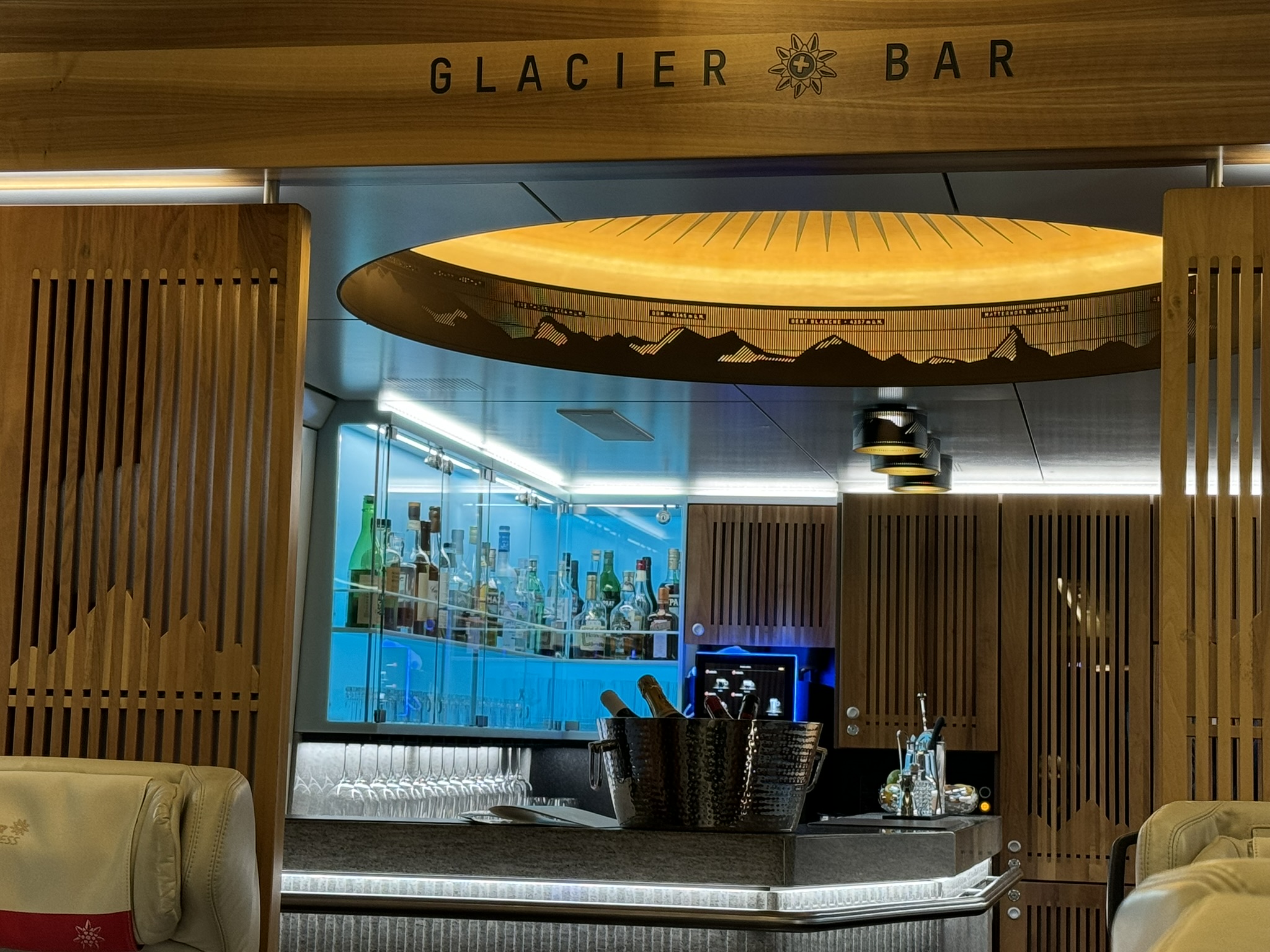
Glacier Express Bar
Glacier Express Bar

Excellence Class provides each passenger an electronic tablet and headphones loaded with information about the train, history of the Glacier Express, relevant maps, and points of interest along the route. Onboard wi-fi is also available on the device. Guests have access to dedicated concierge service, luggage handling and storage, and a private bar. The car is roomy with a large central aisle and small space behind each seat for small carryon luggage like the backpacks we had with us. Souvenirs are available for purchase and delivered to passengers at the end of the journey. We treated ourselves to a magnet and two cute tilted glasses embossed with the train’s logo.
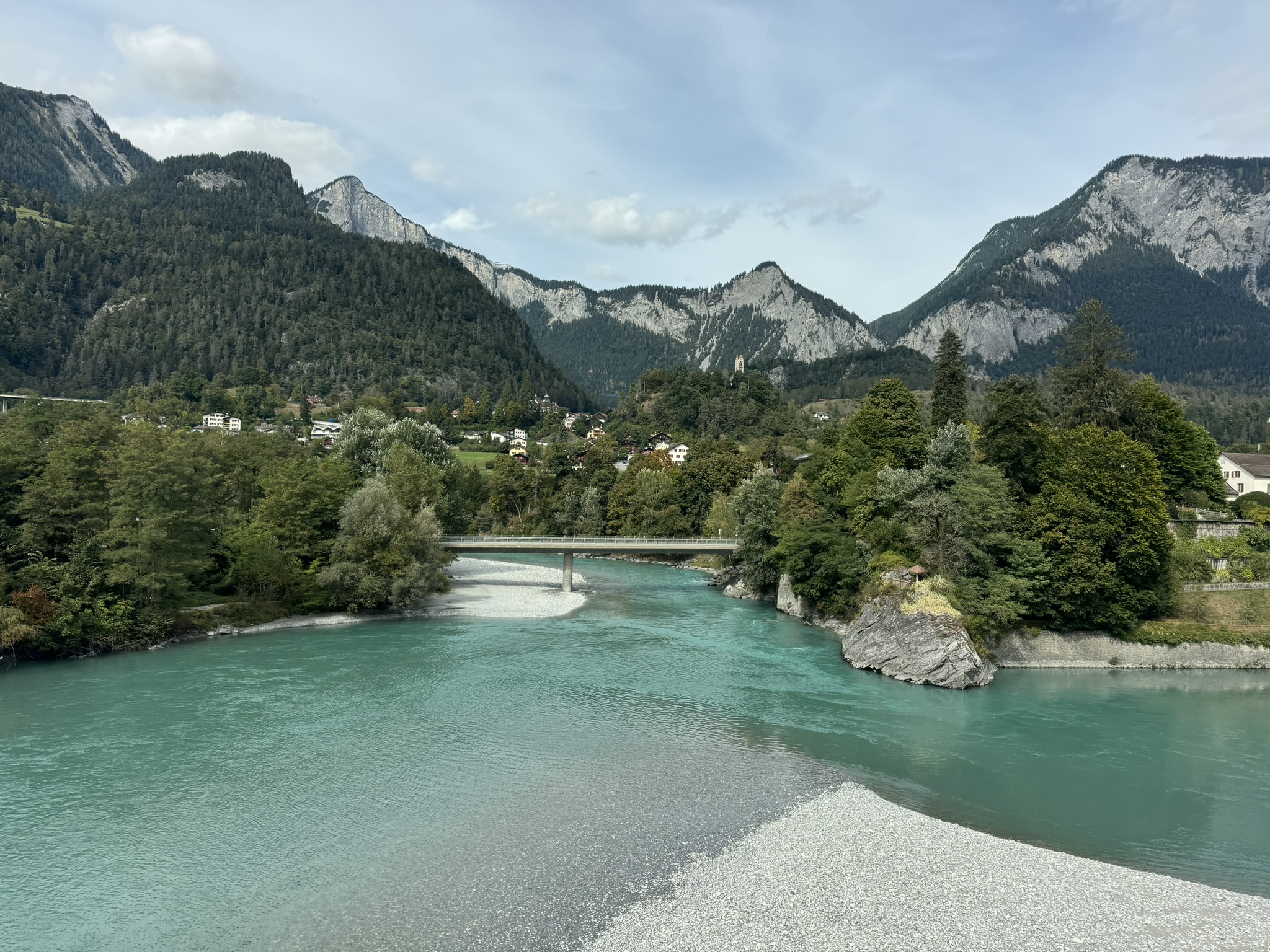
Rhine Gorge from the Glacier Express

When we originally began contemplating a ride on the Glacier Express, I envisioned tracks running through flat valleys, offering us panoramic views of the Swiss Alps from a distance. While that scenario was indeed part of the trip, this train ends up traveling from a low point of 1,919 feet and climbing to an elevation of 6,670 feet at the highest point at Oberalp Pass. In other words, we were gazing up through our windows at soaring peaks just above us, some of which were covered in snow. At other times our eyes were treated to enormous green hillsides and valleys dotted with quaint villages and farmland populated by sheep. There was an abundance of ponds and waterfalls, along with cascading streams, creeks, and rivers.

My wife is not a big fan of bridges, so of course, she was thrilled to learn that the Glacier Express crosses over a total of 291 bridges along the way, including the world famous Landwasser Viaduct. This single-track limestone railway passage is constructed of six tall arches rising 213 feet above the ravine with a span of over 1,500 feet. As we approached the viaduct, our train began to slow down considerably, which we expected. Several of us in Excellence Class (my wife not included) walked a few cars down where our concierge told us we could get a better view to take photos from the train’s open windows. As the train started over the bridge, the concierge clapped her hands and excitedly announced to my wife and those passengers remaining in our car, “Oh, this is the first time in my three years on the Glacier Express that the train is actually going to stop on the viaduct!” My traveling companion was not amused.
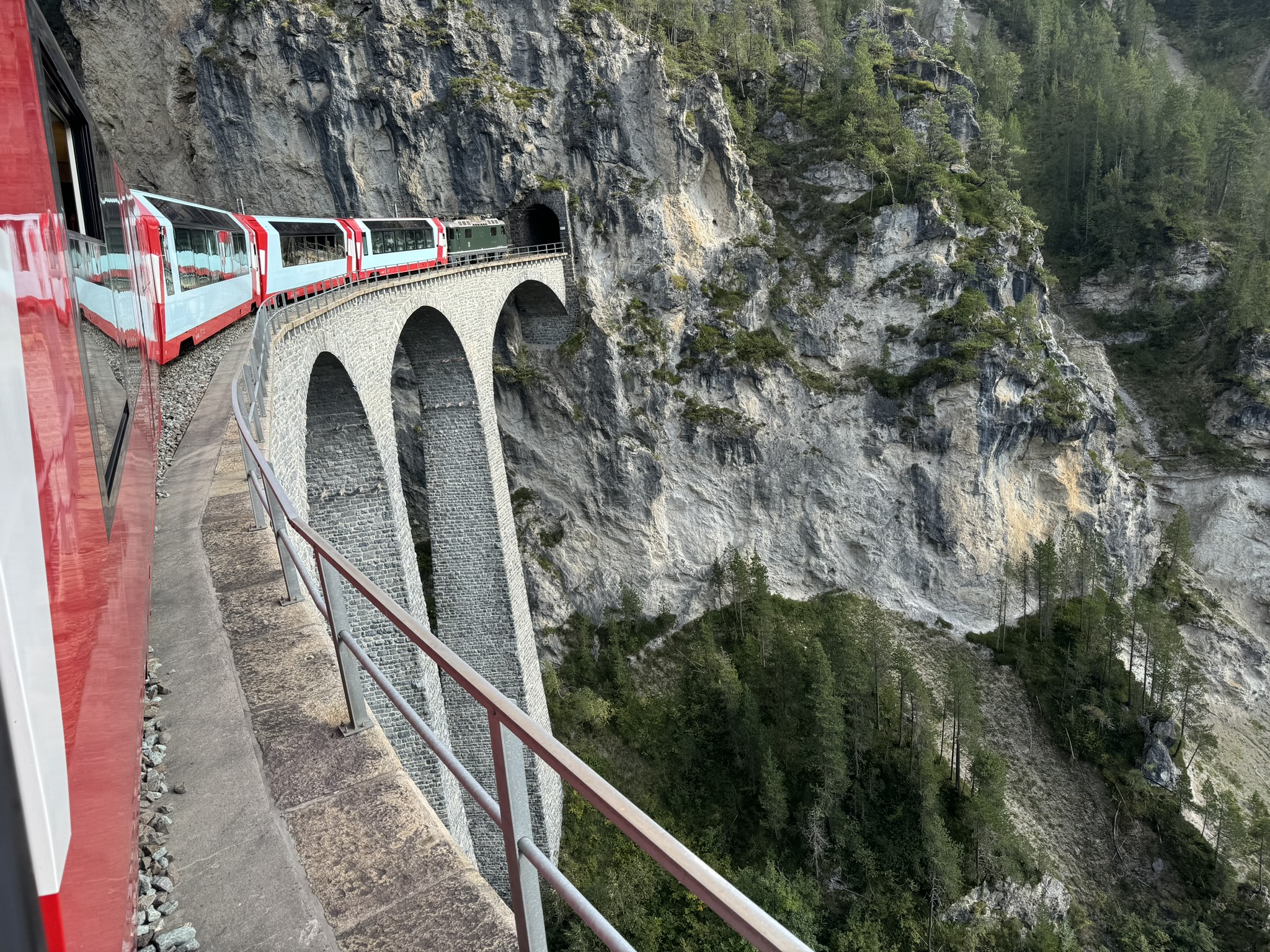
Landwasser Viaduct from the Glacier Express

The Albula Line first opened in 1903, and the Glacier Express made its debut journey on the track in 1930. With the opening of the Furka Base Tunnel in 1982, which protected against avalanches, the Express was able to run year-round. The company began offering Excellence Class in 2019 and are continuing to add amenities into the future. The train excursion is wonderful as a stand-alone opportunity, but considering how enchanting both Zermatt and St. Moritz are as bookends to the trip, riding the Glacier Express makes for an unforgettable travel experience.
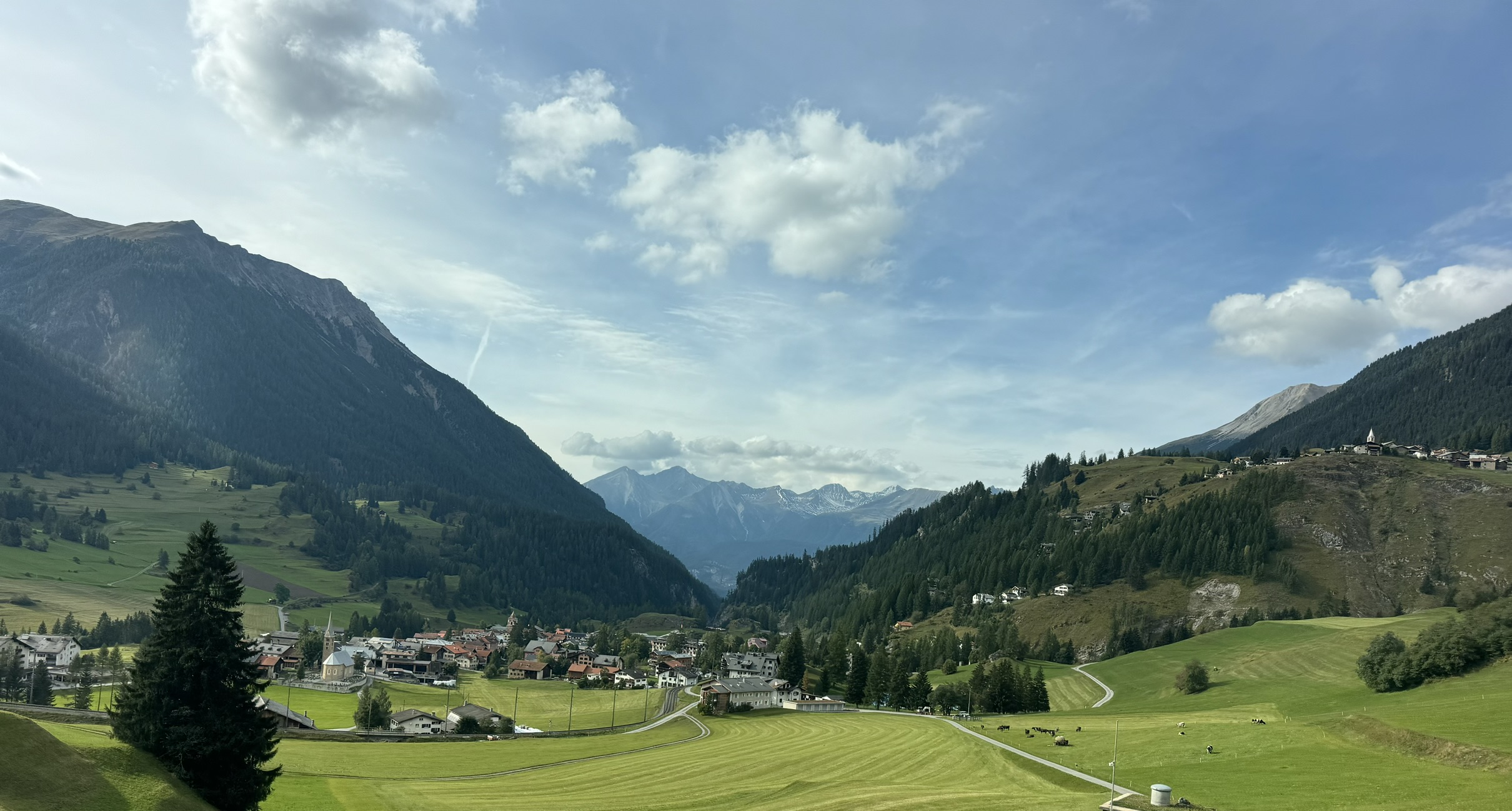
Swiss Alps from the Glacier Express

Riding the Rails Through the Rockies

I visited Colorado for the first time this summer in 2019. Although my wife has made numerous trips to Colorado, the state has been on my wish list for many years. I particularly wanted to see the Colorado Rocky Mountains, so we flew into Denver, rented a car, and drove southwest to the ski resort town of Breckenridge where we enjoyed several days of relaxing, shopping, eating great food, and taking a few sight-seeing side trips. Fortunately, my wife planned for us to take an out-and-back train excursion that runs from Leadville, Colorado, up the side of the nearby ridge.

Train station at Leadville, Colorado

The Leadville Colorado & Southern Railroad climbs roughly 700 feet as it winds its way through the trees of the San Isabel National Forest and over steep ravines pointing toward Freemont Pass until it reaches an old water tank that was used by the historic mining trains many years ago. Then the train heads back down the track and ends up back where it started at the depot 2.5 hours later. The views of the Arkansas River are incredible from the train’s vantage point 1,000 feet above the valley floor. The conductor on our trip was fantastic, providing us with entertaining stories, facts, and figures on the way up the ridge, then letting us enjoy the ride back without commentary – only the magnificent vistas.

French Gulch Water Tank – end of the line at elevation of 10,840 feet

At an elevation of 10,152 feet, Leadville is the highest incorporated city in the United States. It still has the feel of a frontier mining town, with saloons that attracted legendary wild west characters like Doc Holliday and “The Unsinkable Molly Brown.” Several of the highest peaks in Colorado, exceeding 14,000 feet, are visible from the small town and during the course of the train ride. There are many ways to experience the beauty of the Rockies: driving, biking, hiking, climbing, and more. I highly recommend the novel approach afforded by the Leadville Colorado & Southern Railroad.

Amazing views from the Leadville train excursion

Stalled on the Tracks

For most of my life I have lived in the rural parts of Georgia.  Of course, some would argue that outside of Atlanta, there’s nothing left except rural parts.  During a good portion of their histories, many small-town businesses in Georgia were supplied by railroads.  Rail tracks often ran right through the middle of town, as they still do.  Most of the freight trains no longer stop in these small towns because those businesses are supplied by the trucking industry, but the trains still travel through the towns quite regularly.  Most small Georgia towns will only have one or two places where roads either go over or under tracks; otherwise, vehicular traffic has to stop for trains as they make their way through town.

I can remember as a child being stopped at a railroad crossing in the car with my parents.  It was exciting and fascinating to hear the whistle of the engine, to feel how it shook the ground as it passed by, and to watch the succession of rail cars as they sped through the crossing.  Counting the rail cars and reading the graffiti painted on their exterior walls was great entertainment.  Then I celebrated my sixteenth birthday and started driving.  The novelty of freight cars roaring through town wore off and was replaced by impatience waiting for the train to pass so that I could get where I was going.  Now as I have aged and live with a more hectic schedule, as most of us do, I find myself dreading the sight of the flashing red lights and the descending black and white striped crossbars that indicate the approach of yet another freight train and just one more delay in my already too-busy schedule.  But, even worse, and something that raises my blood pressure to dangerous levels, is when the passing train slows down until it finally comes to a complete stop, blocking the road.  This is a situation that railroad companies avoid if at all possible because some townships have actually filed suit against railroads for causing significant traffic problems with stopped or even stalled trains.

Freight Train
Freight Train

Thinking about how enraged I have been waiting 10-15 minutes for a train to finally move past a crossing, I can’t help but draw comparisons with the current political climate in the U.S.  Our government, especially on the federal and state levels, is like a train stalled on the tracks at a major crossing. People who are from multiple origins and who have many different objectives are on either side of the crossing. They can’t get to the other side. They can’t even see the other side. They are completely separated by this huge obstruction that refuses to move forward and clear the way for the good of everyone involved.  The real frustration comes from the realization that the train operators don’t seem to care at all that they have brought everyone, and everything, to a stand-still.  A train can carry an incredible amount of materials, or people, from one place to another most efficiently, as long as it keeps moving.  When it slows down, or worse yet, stops, the train is useless. If a train can’t deliver, it has totally lost its value.