Ewing and Muriel Kauffman Memorial Garden

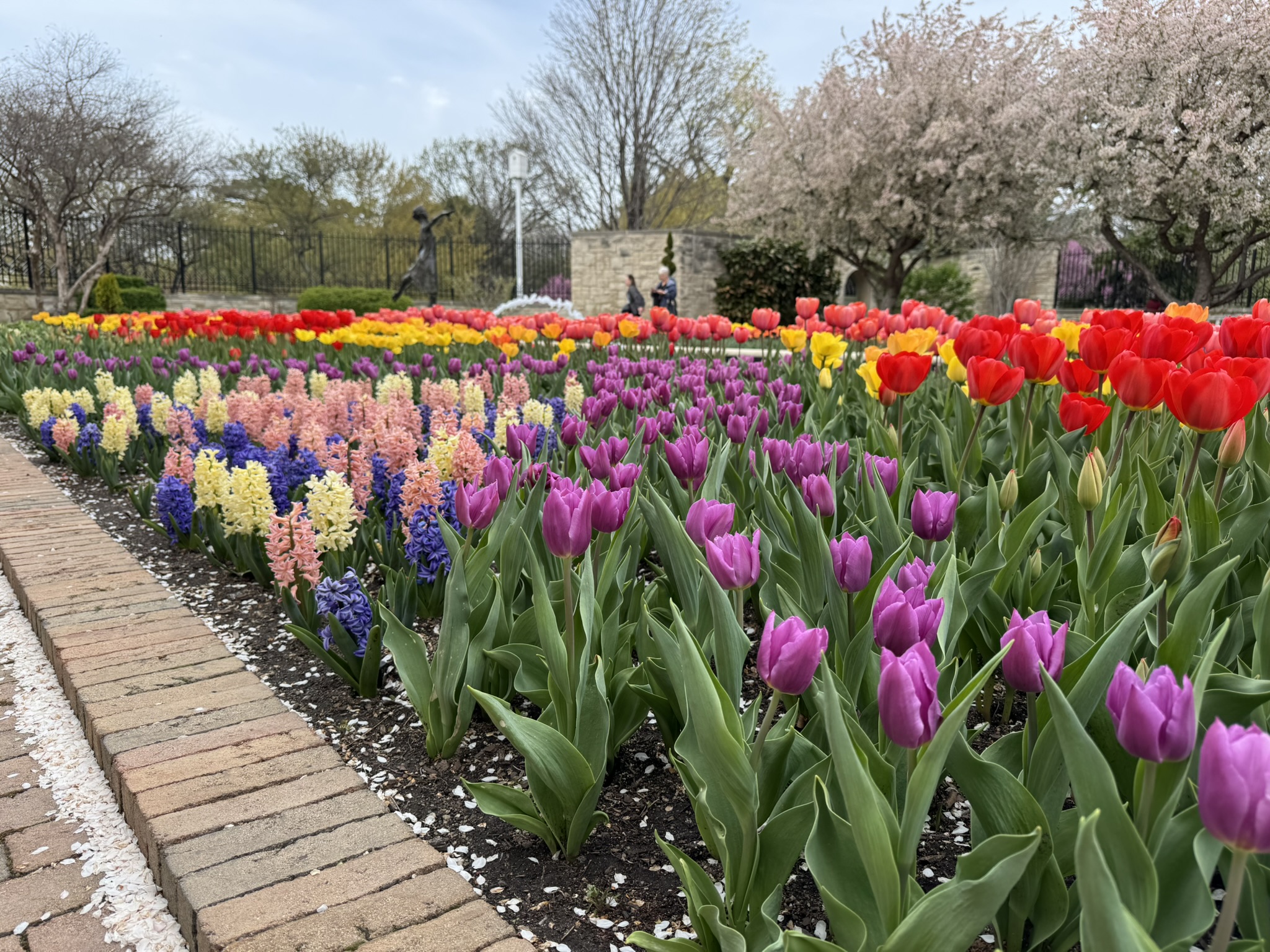
Public gardens have been a topic of this blog on several occasions over the years, primarily because I usually make a point of visiting such places when I am traveling. In April 2025 my wife and I were in Kansas City having lunch with a friend who told us to make sure we stopped by the Kauffman Memorial Garden before heading back home. She mentioned that the tulips and other spring bulbs were in full bloom and that we would be amazed by the displays of color and design. Among the many advantages of being retired is the flexibility of our schedule, which meant we felt no pressure to get back on the road. We took our friend’s advice. She wasn’t exaggerating. The wow factor was in overdrive.

Ewing and Muriel Kauffman Memorial Garden, Kansas City, MO

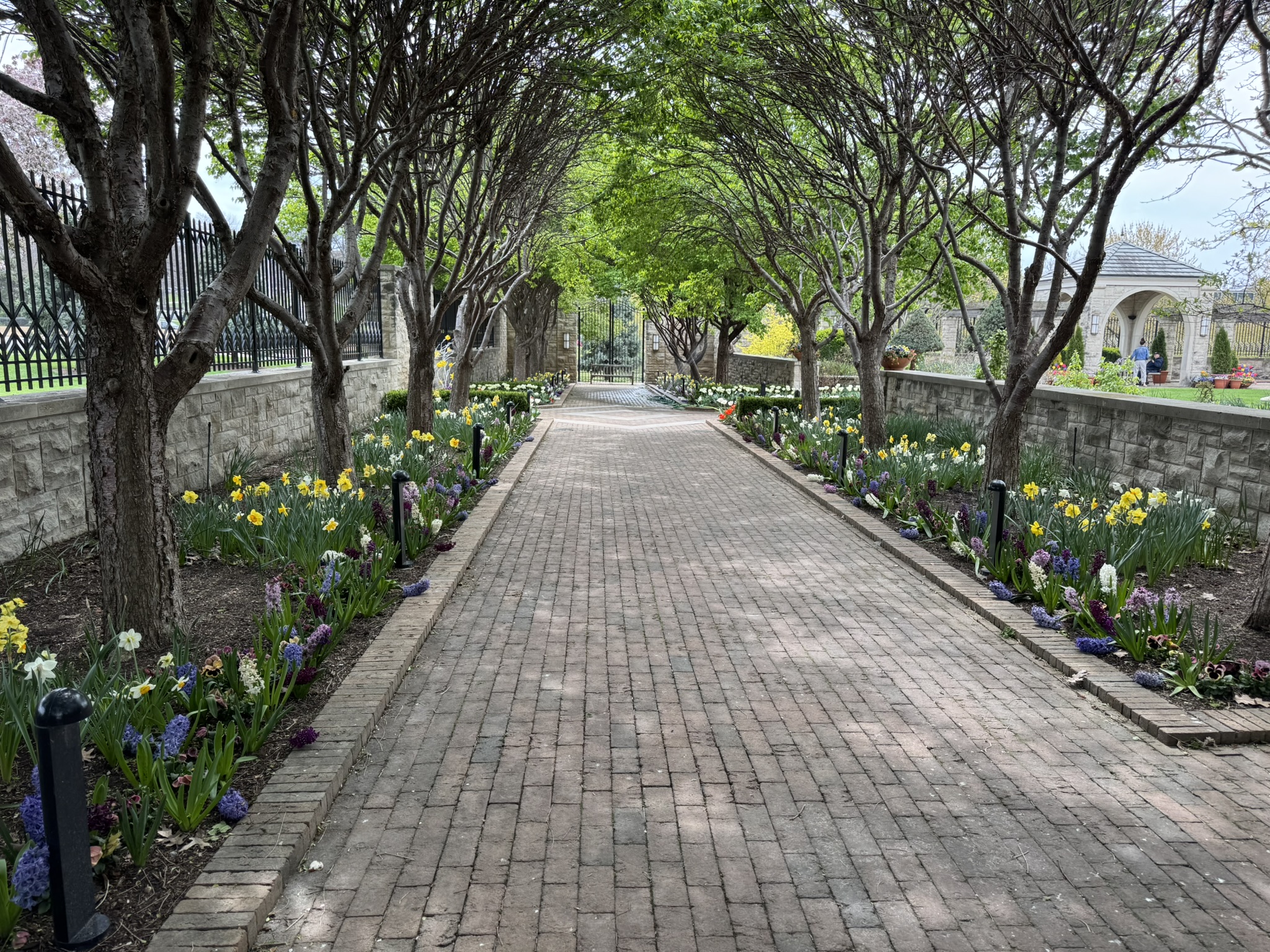
Approximately two acres in size, the Ewing and Muriel Kauffman Memorial Garden is the centerpiece of Legacy Park, an urban greenspace in the historic Rockhill neighborhood of Kansas City that is owned and operated by the Ewing Muriel Kauffman Foundation. There is no charge to enter the garden, and parking is free. The garden is not available for private functions, including weddings, receptions, or parties. Organized photo sessions, including portraits, are also prohibited. Children must be accompanied by adults. Dogs other than service animals are not allowed. Brick pathways make the garden accessible to almost anyone, regardless of limited mobility. This tranquil space is truly an oasis nestled in a metropolitan area of over 2 million people.  

Ewing and Muriel Kauffman Memorial Garden, Kansas City, MO

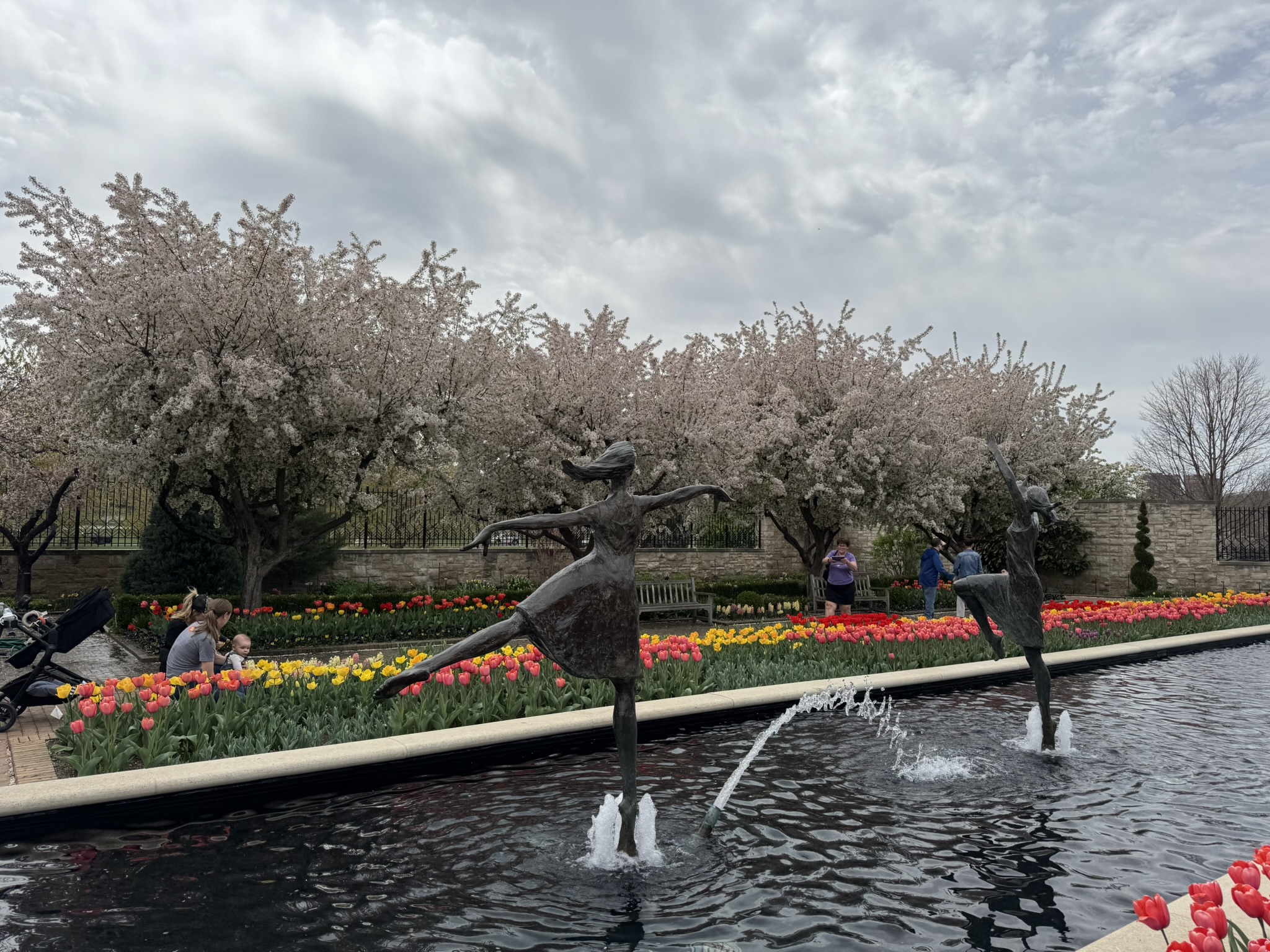
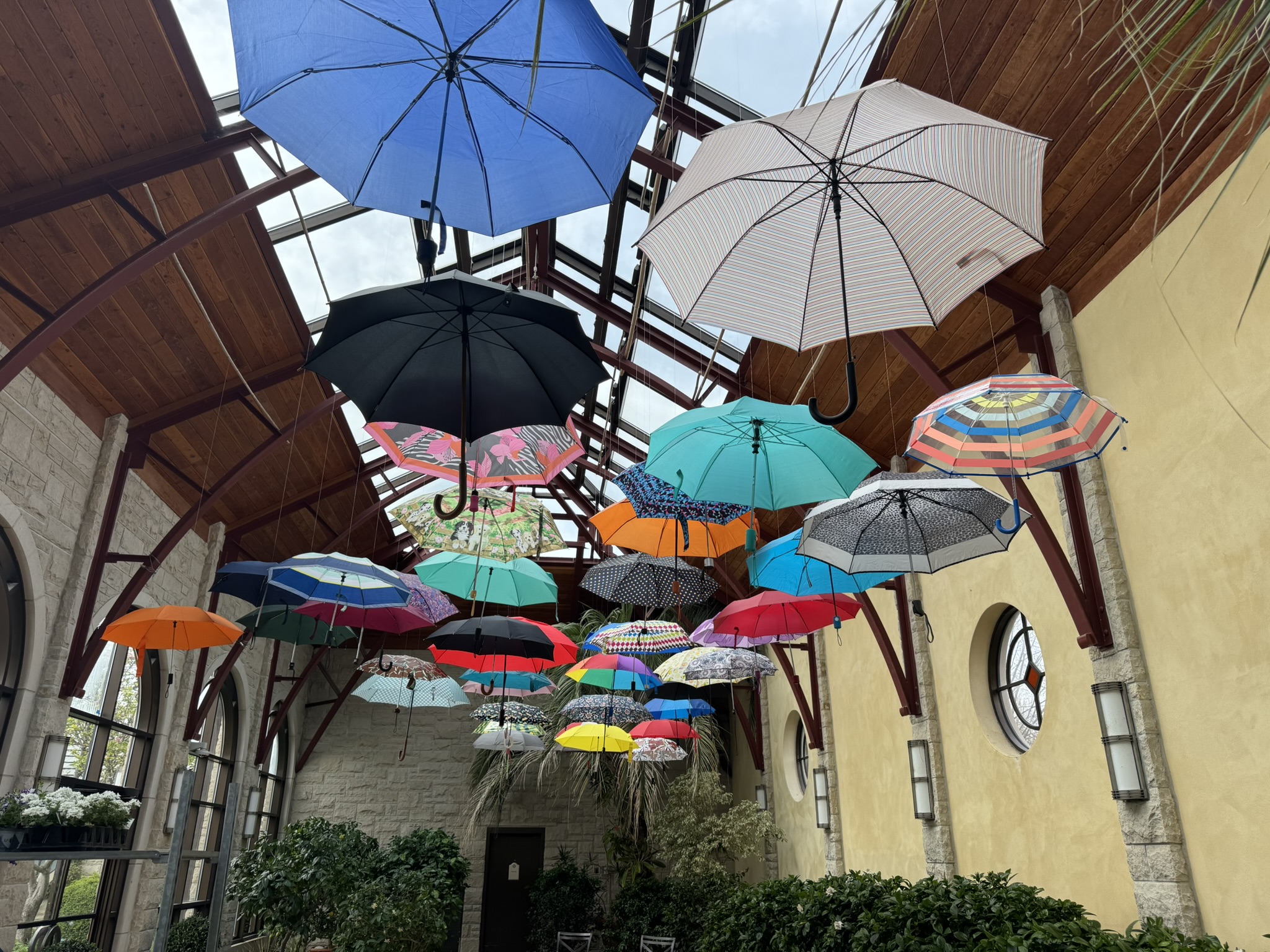
According to the website, the garden opened on Memorial Day weekend in 2000. Its design is inspired by the gardens of Europe, complete with fountains, pools, statuary and other artwork, planting containers, benches, and a greenhouse all enclosed within a stone and wrought-iron wall. It features more than 350 varieties of perennials, a collection of ornamental trees, and numerous annual beds that change seasonally. For our visit, we were greeted by a resplendent display of tulips, daffodils, hyacinths, pansies, crocus, and several other species I couldn’t identify. The colors were spectacular, and the palette design was careful and deliberate.

Ewing and Muriel Kauffman Memorial Garden, Kansas City, MO

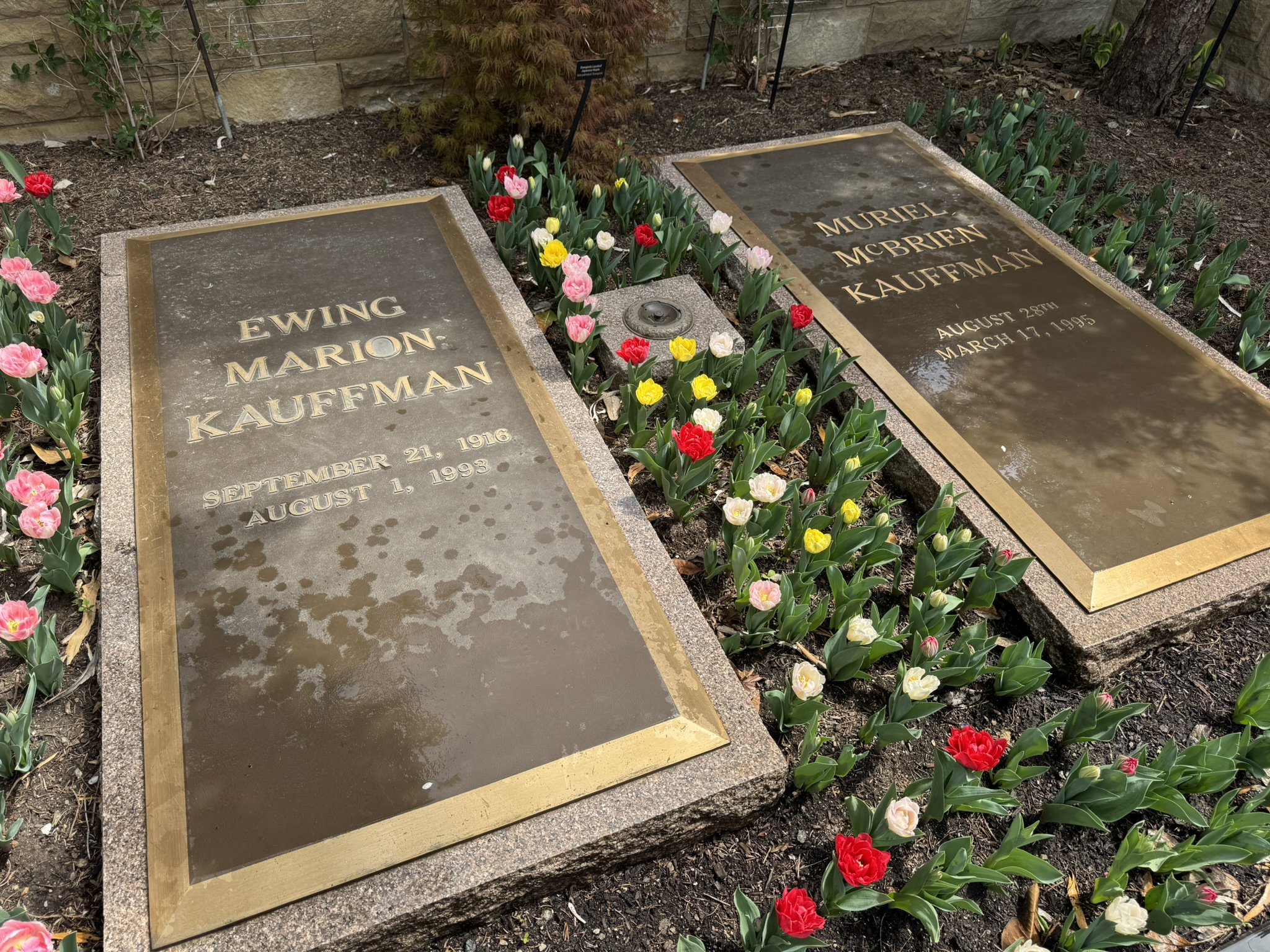
The namesakes of the foundation and the garden have a fascinating and close connection to Kansas City, and their legacy is a large one. Among his many accomplishments, Ewing Marion Kauffman established Marion Laboratories in 1950 and created the Kansas City Royals baseball team as an expansion club in 1968. His wife, Muriel, served as the treasurer and first legal counsel for Marion Laboratories. They started a foundation that would eventually become a powerhouse in funding the performing and visual arts, but the reach of their philanthropy extended to so many other areas. The garden serves quite literally as a memorial to the couple – they are buried on the grounds. They left a remarkable charitable footprint, and this garden is a showcase of their generosity and love for their home, Kansas City.

Ewing and Muriel Kauffman Memorial Garden, Kansas City, MO

Walking Through Luxembourg Garden in Paris

I have written about gardens several times in this blog. They are among my most favorite places in the world. I love them in all their many forms: small residential gardens, larger private ones, arboretums, botanical gardens, public gardens, and those you find at houses of worship, city parks, river walks, and even businesses. They brighten up any space with texture, structure, color, and incredible beauty. They are places of refuge and contemplation. There are so many features to enjoy, including ponds, streams, waterfalls, varying terrain, rocks, boulders, statuary, fountains, and other built structures. Whenever my wife and I travel, we almost always look for gardens to visit or revisit.

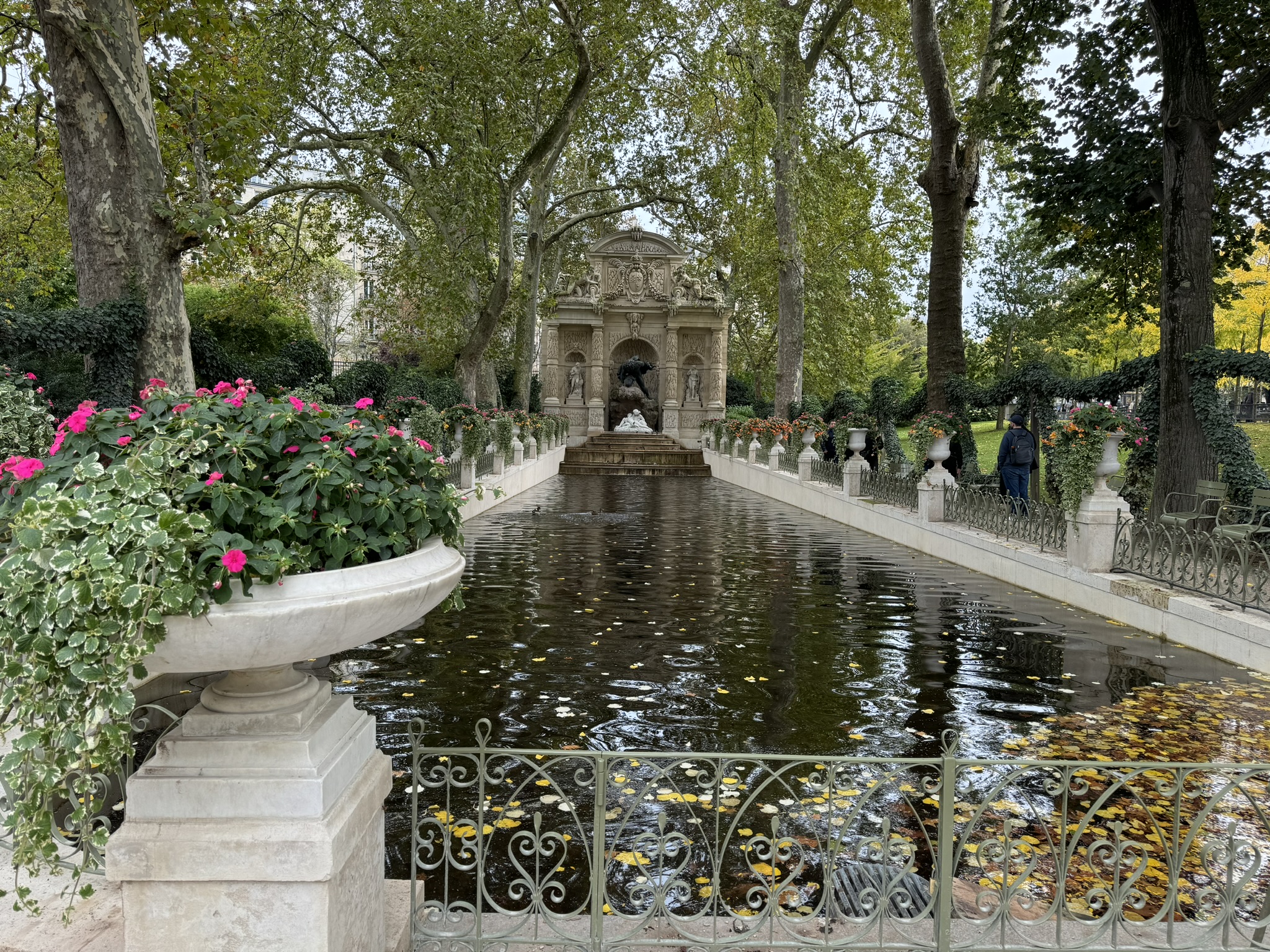
In September 2024, we took a two-week trip to Paris and various locations in Switzerland. On our last day in Paris, we spent the better part of the morning wandering around one of the most spectacular spots in the city, Luxembourg Garden. Located in the 6th arrondissement in an artsy part of the city, the Jardin du Luxembourg comprises 25 hectares (56.8 acres) adjacent to the grand building that houses the French Senate, thus its more familiar name for Parisians, Jardin du Sénat. The Luxembourg Garden comprises formal English gardens, 3,000 trees of various species, 5,000 square meters of flower beds, an orchard containing more than 500 old varieties of pear and apple trees, a collection of exceptional orchids, and 102 statues and monuments, including the famous Médicis fountain.

French Senate building at Luxembourg Garden

The garden’s origins date back to the 17th century when Marie de Médicis, the widow of Henry IV, built an Italian palace on property once owned by François, Duke of Piney-Luxembourg. The French Senate took over ownership of the garden in the early 1800s after the palace became the home of the governing body in 1799. It wasn’t until the last half of the 19th century with the restoration projects in Paris under Napolean III that the garden began to take its more modern shape. Luxembourg Garden has appeared in numerous works of literature by authors such as Victor Hugo, Henry James, and William Faulkner.

Médicis fountain at Luxembourg Garden

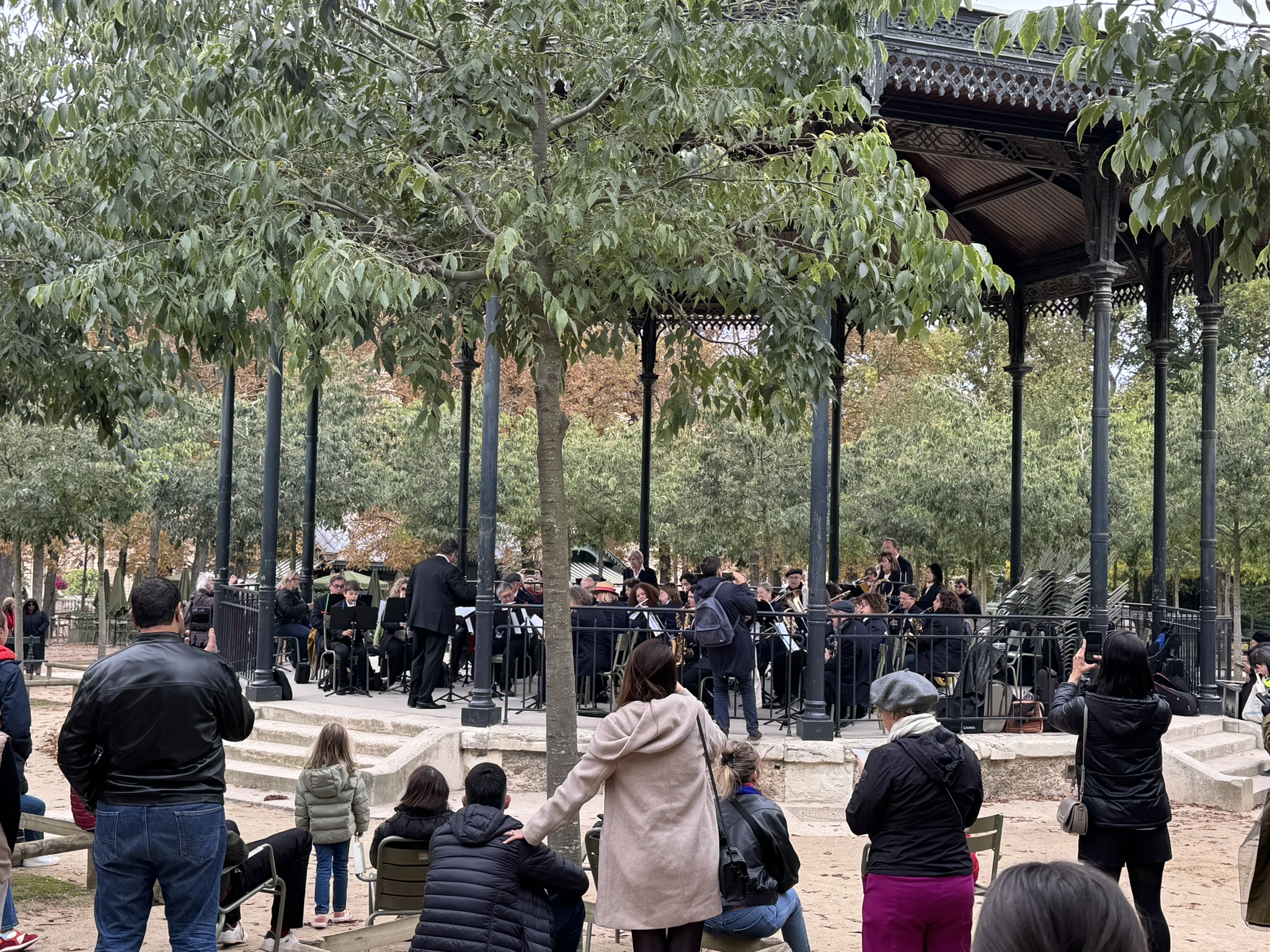
As we entered the garden that Sunday morning at the Porte Gay-Lussac, we were greeted by the sounds of music coming from what appeared to be a small community orchestra at the nearby Kiosque à musique. We made our way counterclockwise to the Médicis fountain and then past the Senate building, protected by a high metal fence and guards with firearms. We continued around the perimeter of the garden, making side trips into the interior from time to time. Before leaving, we spent a few moments near the Grand Bassin, a large octagonal basin of water surrounded by raised balustraded terraces adorned with a series of statues of former French queens, saints, and other historical figures.

Orchestra at Luxembourg Garden
Luxembourg Garden
Luxembourg Garden

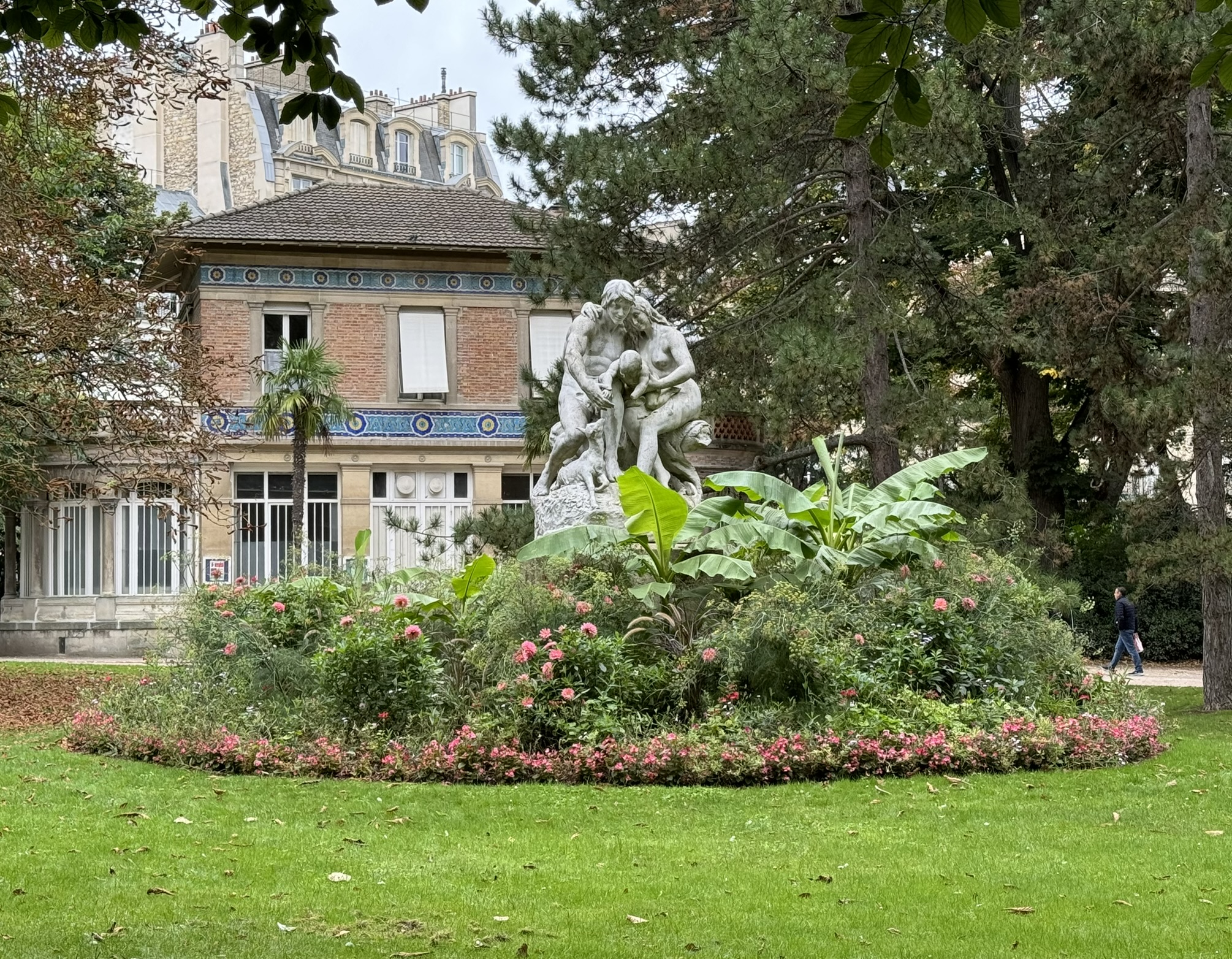
What impressed me most about this garden is how brilliantly the built environment blends with and enhances the horticultural surroundings. Walkways wind through trees, hedges, shrubs, lawns, and planted beds, encouraging us to meander and gaze. Statues, sculpture, and other features are spaced out and in the open or tucked neatly into nooks and crannies, inviting us to explore and pause to appreciate and learn. Luxembourg Garden is truly an oasis we can enjoy simply for its beauty and design. However, it’s also an outdoor classroom for aspiring students of all ages who wish to be schooled in botany, art, architecture, history, and so much more.

Bacchus (Dionysus) statue at Luxembourg Garden
Luxembourg Garden
Luxembourg Garden
Grand Bassin at Luxembourg Garden

The Ozarks in DC: 2023 Smithsonian Folklife Festival

I had the privilege of being directly involved in the planning and implementation of the 2023 Smithsonian Folklife Festival, an annual event that takes place on the National Mall in Washington, DC. With a history going back over fifty years, the festival is usually scheduled over a ten-day period roughly encompassing the last week in June and the first week of July. It is produced by the Smithsonian’s Center for Folklife and Cultural Heritage and honors living cultural traditions while celebrating those who practice and sustain them. One of the programs selected for the 2023 festival was focused on the Ozarks, a region of the U.S. that is centered in southern Missouri and northwest Arkansas but also includes small portions of northeast Oklahoma, southeast Kansas, and extreme southwest Illinois. 

Smithsonian Folklife Festival 2023

I began working in 2019 for Missouri State University Libraries on a part time basis, assisting with projects sponsored by the Ozarks Studies Institute, an initiative of the Libraries. A fortunate turn of events led to the Smithsonian partnering with the Libraries for the Ozarks program of the 2023 festival, with the Dean of Libraries serving as a curator. The Dean offered me a full-time position eighteen months prior to the event to serve as an associate director for the university’s participation in the festival. 

The Dean and I teamed up with another part-time employee of the Libraries who has written two books about the Ozarks and has extensive cultural knowledge of the region. Our trio served as the core planning committee for the university to collaborate with the festival organizers from the Smithsonian. One of the first jobs we tackled was coming up with a name for the program. After considerable deliberation, we decided on “The Ozarks: Faces and Facets of a Region.” Our trio made numerous trips to visit with people and organizations throughout the region, in all five states, to spread the word and generate excitement about the festival. A small group of Ozarkers, including our planning trio, visited the National Mall in the summer of 2022 to get a clearer picture of how the event looks and works. We took two musical acts with us to perform as a preview of the 2023 Ozarks program.

Smithsonian Folklife Festival 2023

Over the course of a year, we worked with the Smithsonian staff to identify key stakeholders from the Ozarks who could assist with fundraising, program content, identifying other curators and participants, and overall planning of the festival. We had Zoom meetings almost every week for over a year to hammer out all the details, and several festival organizers from the Smithsonian visited the Ozarks multiple times to get a better sense of the region and to meet with our team. 

Using artists from the Ozarks and from the DC area, the larger planning team came up with design features for the festival that would reflect the natural beauty of the region. We had to decide on color schemes, fonts for signage, layout of the festival grounds, daily schedules of events, and a whole host of other elements. In early 2023 we began meeting with the festival logistics staff to work on structural and mechanical requirements for the site. We also met with interns and volunteers who are brought on each year to help the Smithsonian with festival participants’ needs regarding transportation, lodging, meals, and a wide variety of other accommodations. By the time June arrived, there were over 150 people involved in either planning or implementation. It is a massive effort.

Smithsonian Folklife Festival 2023

The festival was open each day, June 29 through July 9 (with the exception of July 5), from 11:00 a.m. to 5:00 p.m., followed by evening concerts most nights running from around 6:30 to 8:00 p.m. The Ozarks program site was situated under the trees on the south side of the Mall, just east of 14th Street SW. On the opposite north side of the Mall was the other program for the 2023 festival, which was called “Creative Encounters: Living Religions in the U.S.” Each year the festival is open on Independence Day, where people gather by the hundreds of thousands along the corridors, paths, and grassy fields extending from the Potomac River all the way to the Capitol to await the spectacular fireworks display at dusk between the Lincoln and Washington Memorials. I don’t typically go out of my way to see firework displays, but the colorful explosions that serve as a backdrop for the imposing Washington Monument are mighty impressive.

Smithsonian Folklife Festival 2023

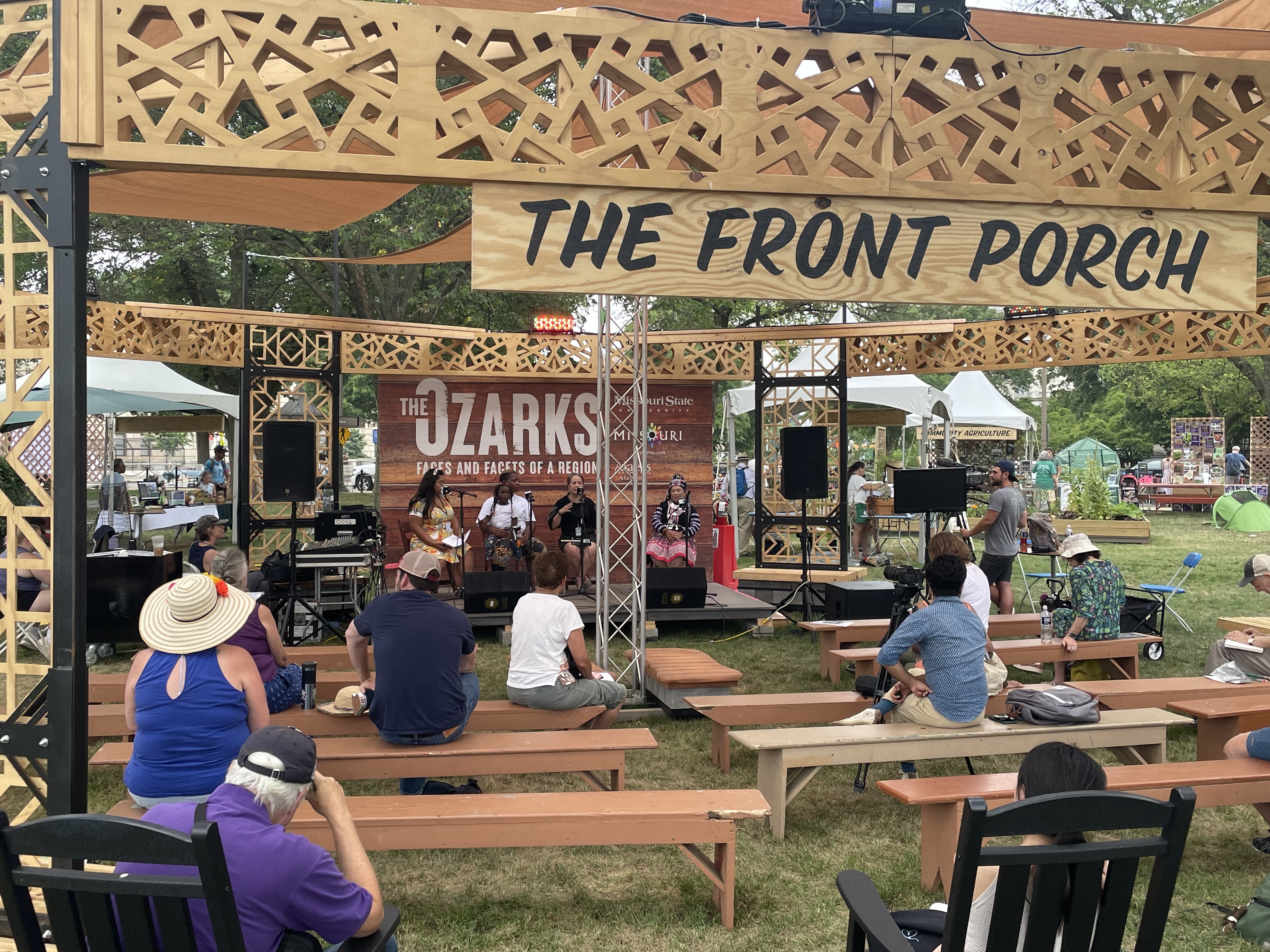
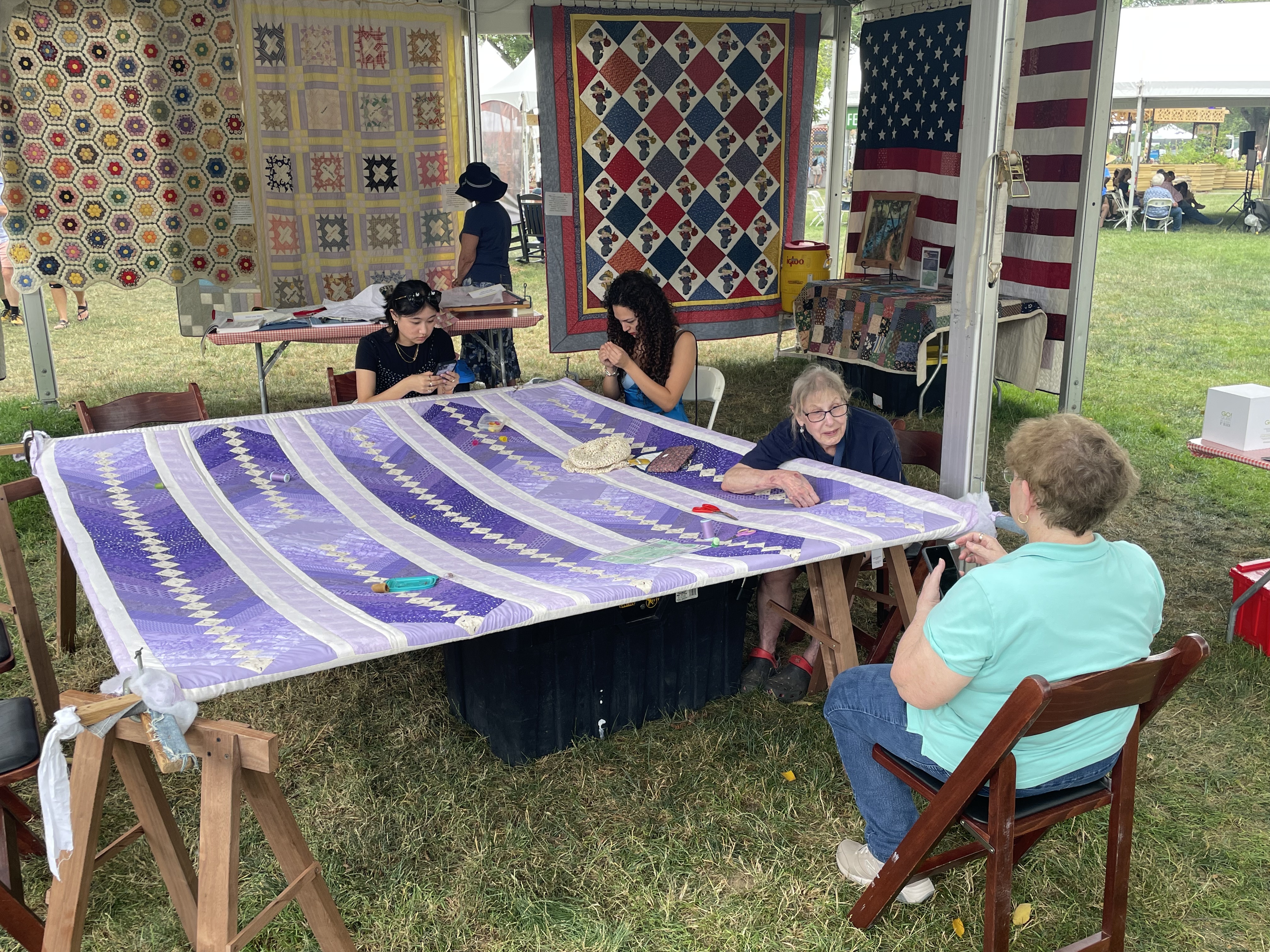
The Ozarks program was divided into four major themes: celebrations and gatherings; stories, sounds, and show business; migrations, movements, and pathways; and connections to land and place. The site featured large-scale murals and a mountain-bike trail build, music jam sessions and performances, dance and plant-knowledge workshops, food and craft demonstrations, and curated discussions. The Ozarks program included multiple theaters. There was a theater for discussions and demonstrations of plant knowledge, one for cooking demonstrations, one called the “Pickin’ Porch” mostly for music during the day, and one called “The Front Porch” for panel discussions. Both festival programs shared a large main stage out in the middle of the Mall that was reserved for musical workshops and performances during the day and for the larger evening concerts.

Smithsonian Folklife Festival 2023

The Ozarks program brought close to 60 musicians to the festival, which is a clear indication of how important musical traditions are to the culture of the region. There were at least eleven different ensembles of varying sizes, along with many individual musicians, specializing in several different genres including Native American music, traditional old time music, bluegrass, folk, country, gospel, and contemporary. Foodways, plant knowledge, arts, crafts, and storytelling were demonstrated by white Ozarkers but also by many other ethnic groups that call the Ozarks home, including Native Americans, African Americans, people of Hispanic and Latino heritage, Marshallese, Hmong, Khmer, and Syrian. Contrary to much of its history over the last 200 years, some of the “faces and facets” of the Ozarks show remarkable diversity in race, ethnicity, and culture.

Smithsonian Folklife Festival 2023

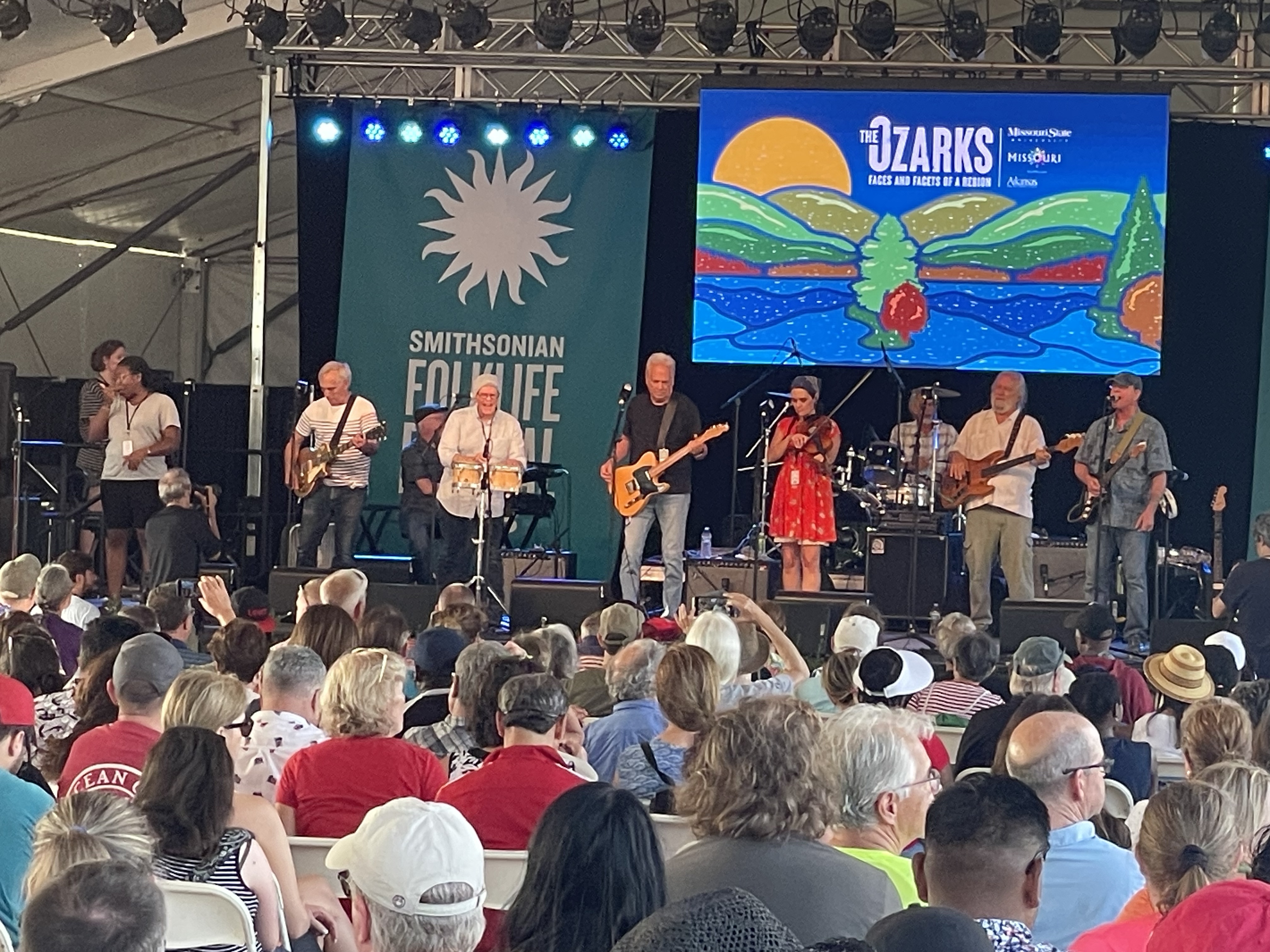
The largest and most recognizable musical group that the Ozarks program sponsored played on the main stage for the July 4 evening concert. The Ozark Mountain Daredevils is a band that originated out of Springfield, Missouri, in 1972. The group had several hits in their early years including “Jackie Blue” and “If You Want to Get to Heaven.” The band has evolved over the decades, losing and replacing band members and even going into a type of semi-retirement in the early 21st century. In recent years the Daredevils have enjoyed a bit of a resurgence, appearing on the Grand Ole Opry in Nashville on two occasions in 2023. They put on a hell of a show for the DC festival and for hundreds of people within earshot of the main stage that evening.

Ozark Mountain Daredevils

My primary job during the days of the festival was to occupy the Missouri State University Libraries table set up near the main entrance of the Ozarks program. With the help of one of our student workers, I was selling several books about the Ozarks and answering questions about the festival program and the region in general. I was surprised by how many festival visitors told us they were either from the Ozarks, had lived in the Ozarks, or had fond memories of visiting the region. Many of these folks have lived and worked in the DC area for years, and they were so happy to see the Ozarks featured on the National Mall. We could definitely detect a sense of pride in their voices when they talked about their connection to the region.

Smithsonian Folklife Festival 2023

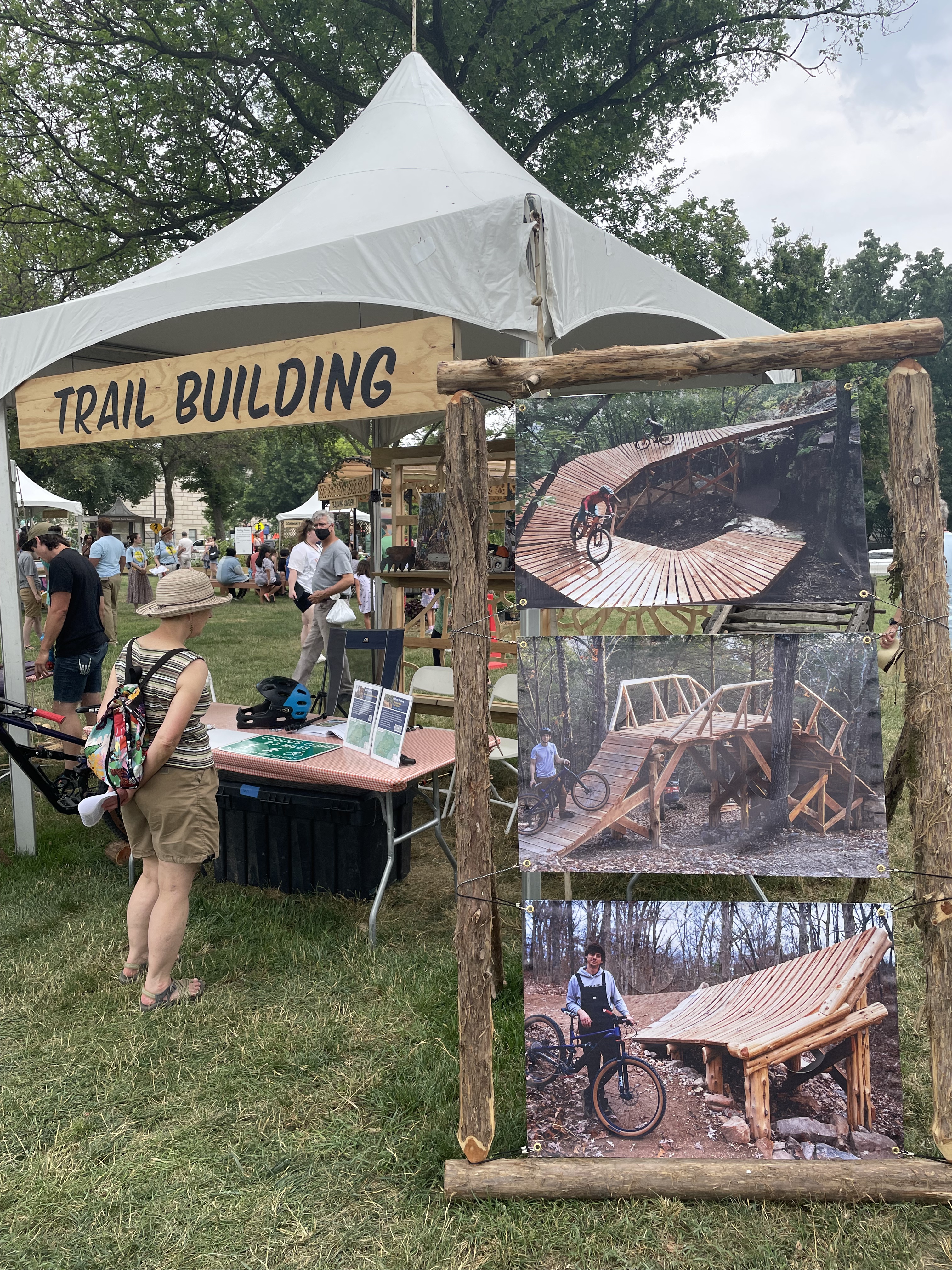
Perhaps the most enjoyable connection I made during the time of the festival was with the two guys representing mountain biking, one of the fastest-growing forms of recreation in the Ozarks, especially in northwest Arkansas and Missouri. Seth Gebel is a young entrepreneur who owns Backyard Trail Builds. He goes out into the forest armed with only hand tools and cuts down cedar trees, trimming them out to create bridges, ramps, and runs for biking trails. He designed and built a short, curved and banked track at the entrance to the Ozarks site at the festival. Dave Schulz works within a nonprofit organization to help community leaders in revitalizing their towns by developing bicycle-focused public parks and sustainable trail systems, preserving natural environments while drawing tourism from around the world. Both of these guys gave daily riding demonstrations on the track that Seth built for the festival.

Smithsonian Folklife Festival 2023

The most magical moment for me came on the final evening of the festival in the dining room of the host hotel. A group of Ukranian vocalists from the Creative Encounters program stood up and began singing a traditional folk song in their native tongue. They were followed by several other individuals and groups from both programs, standing to sing and inviting others in the room to participate through responsive chanting, vocalizations, and clapping. As I witnessed what happened, I recognized that this festival offers us a snapshot of the best of humanity, the wonders we are capable of producing when we embrace our differences and come together to learn from each other.

Smithsonian Folklife Festival 2023

San Diego’s Balboa Park

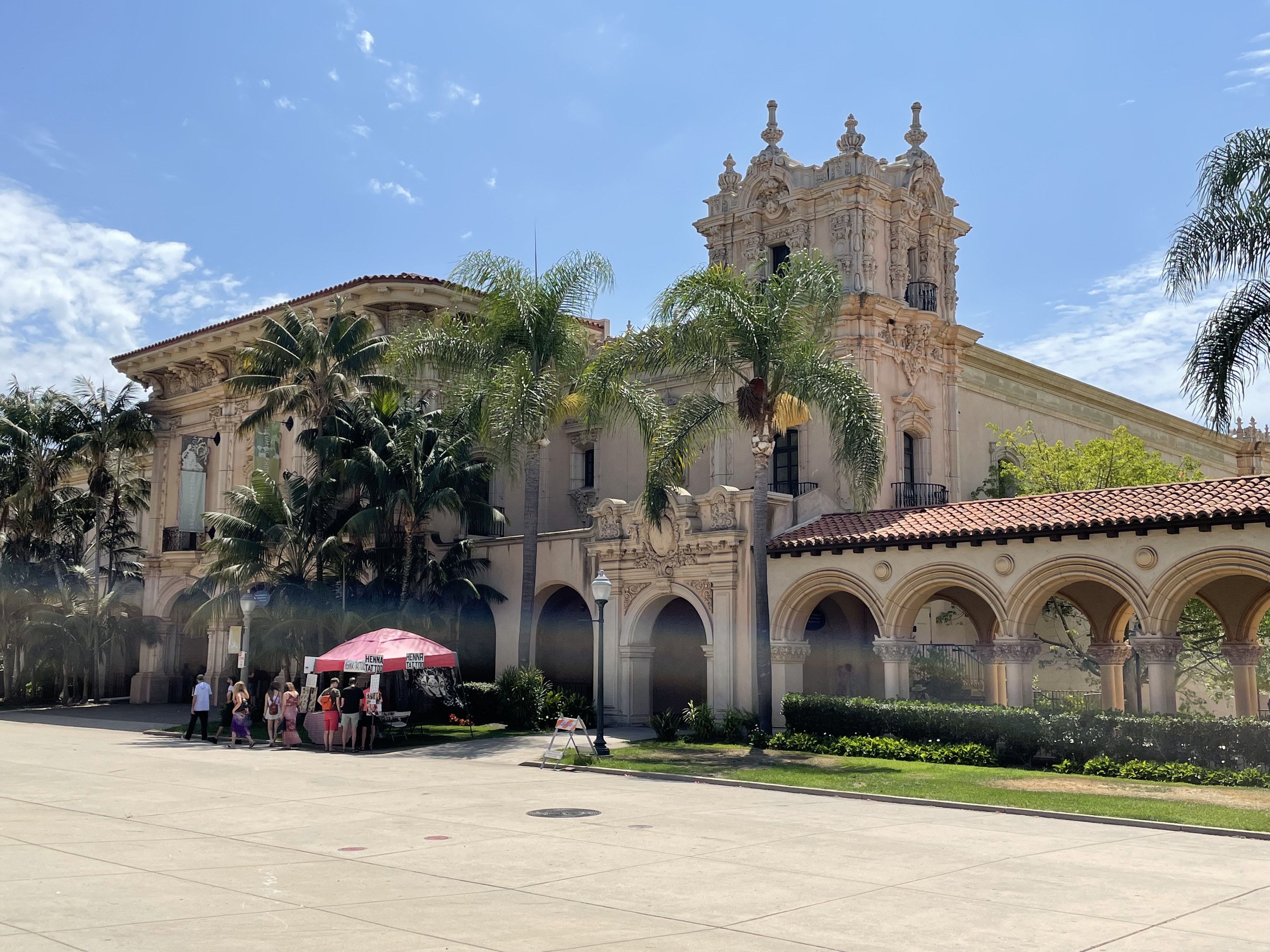
During our vacation in 2022 to San Diego, my wife and I spent a morning strolling around Balboa Park. Named for the Spanish-born explorer and perhaps the first European to witness the Pacific Ocean, this 1,200-acre site has a long, rich history going back to 1868 when San Diego’s leaders set aside the scrappy undeveloped area for public use. It didn’t really begin to take shape as a recognizable park until 1892 when a schoolteacher turned botanist and entrepreneur named Kate Sessions leased 32 acres of the property for her growing nursery’s propagation. She also agreed to plant trees annually in the park and in other public spaces around the city. The species included cypress, pine, oak, and eucalyptus. Some of the oldest specimens in the park today were part of the original plantings. She also introduced exotic plant species such as bird of paradise, Queen palm, and poinsettia. Her efforts eventually earned Sessions the honorary title “The Mother of Balboa Park.”

Balboa Park, San Diego, California

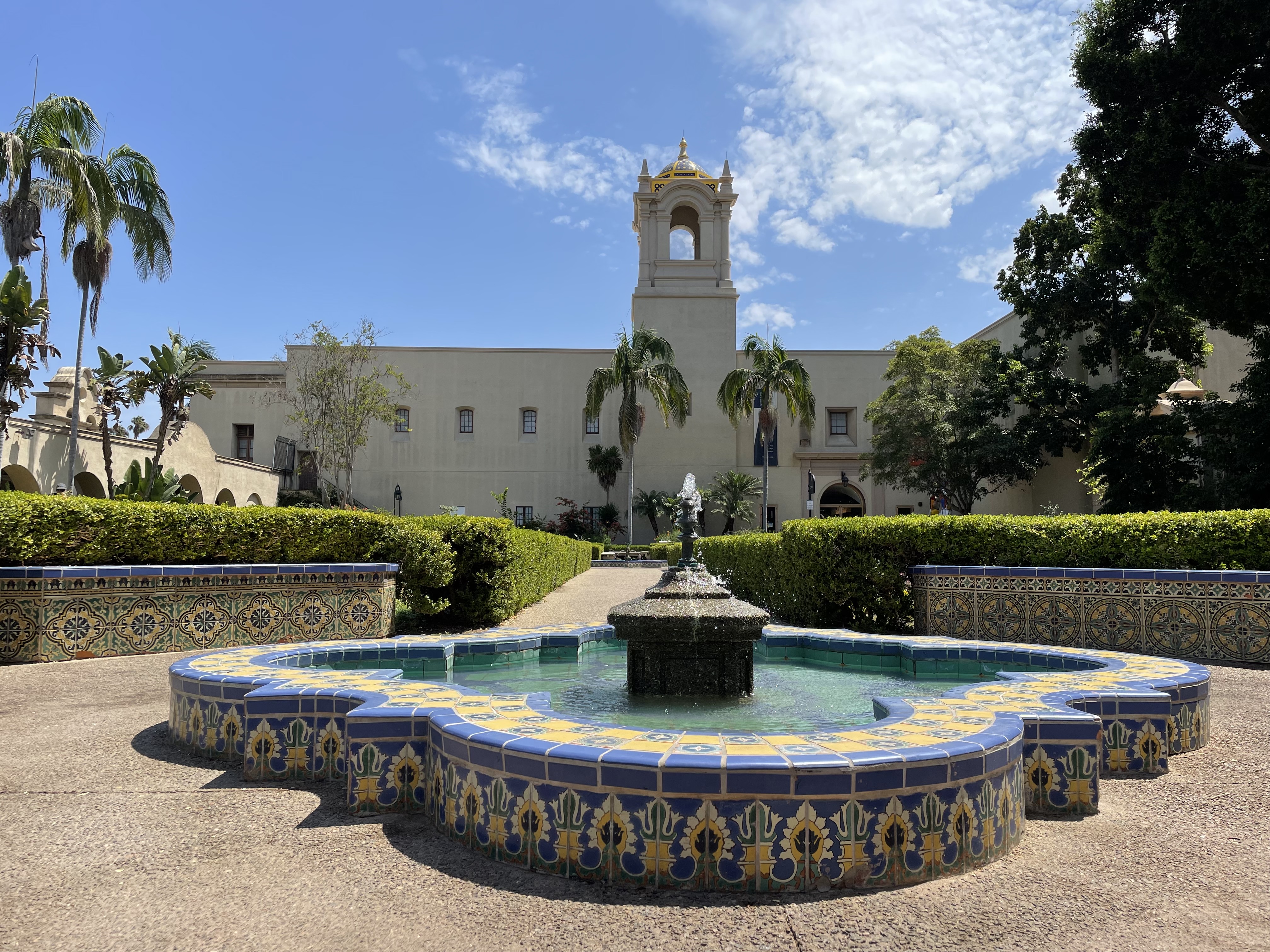
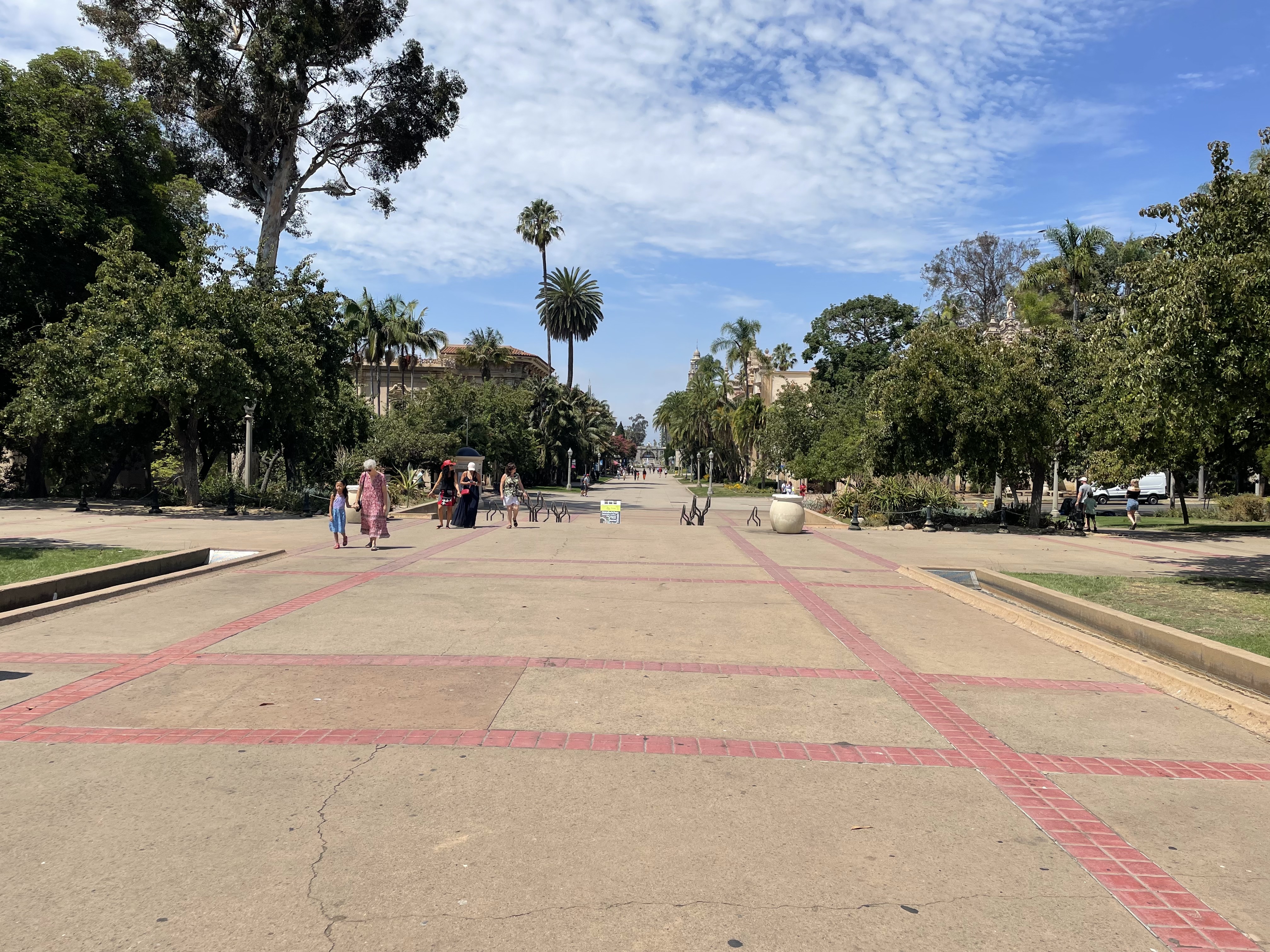
By the early 20th century, the City of San Diego had installed water systems, roads, and other infrastructural elements to Balboa Park. The origin of the elaborate Spanish Colonial architecture dates to 1915 when the park was selected as the site for the Panama-California Exposition. The Cabrillo Bridge and the buildings along El Prado date to this event, along with the Spreckels Organ Pavilion. More buildings were added for the California Pacific International Exposition of 1935-36, especially in the Southern Palisades area. These structures have a much more Southwestern look in the tradition of Pueblo Indian architecture and even Mayan designs.

Balboa Park, San Diego, California

After World War II, several of the main buildings were converted to museums and other cultural institutions. Today, visitors to the park can enjoy the San Diego History Center, San Diego Museum of Art, San Diego Natural History Museum, Fleet Science Center, Institute of Contemporary Art, Museum of Photographic Arts, Women’s Museum of California, Veterans Museum, WorldBeat Center, Museum of Us, San Diego Air and Space Museum, San Diego Mineral and Gem Society, San Diego Automotive Museum, San Diego Model Railroad Museum, Mingei International Museum, the Marston House (early 20th-century Arts & Crafts design), Comic-Con Museum, and Timken Museum of Art.

Balboa Park, San Diego, California

There are fountains and gardens throughout the park, along with the Japanese Friendship Garden (subject of an earlier post). There are restaurants and coffee shops. There are statues (especially in Sefton Plaza), the impressive California Tower, the Spanish Village Art Center, a beautiful carousel, and a miniature train. The park’s visitors center is the best place to start exploring the site. If we return to San Diego, I plan to devote more time to wandering through some of these museums. The Botanical Building and Lily Pond were undergoing major renovation work when we were there, so I definitely want to see those if we go back to Balboa Park, and I hope we do.

Balboa Park, San Diego, California

San Diego’s Japanese Friendship Garden

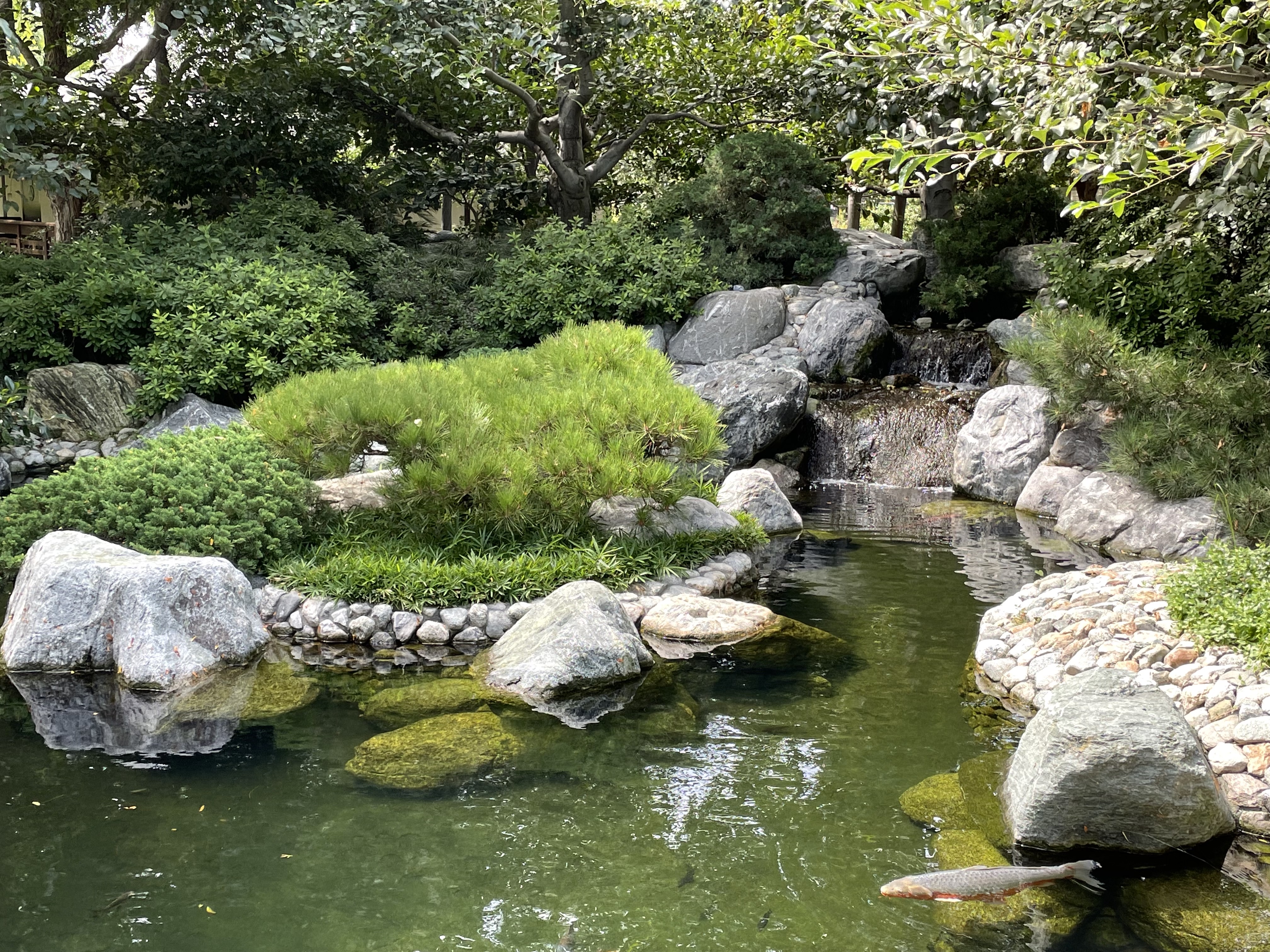
Japanese gardens are different from other gardens. They are characterized by simplicity and minimalism, designed to encourage reflection and meditation. They raise landscape architecture to a fine art form, creating harmony of several key elements in a natural setting: stone (from gigantic boulders to pea-size river rock), sculpture, plants, shrubs, trees, paths, and perhaps most important, water. Running water, cascading falls, and shaded pools with large koi fish are almost always included. On the botanical side, there are usually plenty of evergreens, but typically in a wide variety of shades and textures depending upon the garden’s geographic location. Although there are several different types of Japanese gardens based on terrain and purpose, most are composed of the above-mentioned features.

Japanese Friendship Garden, San Diego

My wife and I have visited many different public and private gardens over the years, from coast to coast in America and a few in Europe too. We happen to have a Japanese garden where we live in Springfield, Missouri. We enjoyed a stroll through the Japanese Friendship Garden in Phoenix, Arizona several years ago. In August 2022, we were on a vacation in San Diego, so of course, we specifically sought out the Japanese Friendship Garden there, which is one of the most famous in the country.

Japanese Friendship Garden, San Diego

Like other Japanese Friendship Garden cities, San Diego has a sister city, Yokohama, in Japan. The partnership was established in 1957 and was one of the first sister cities on the west coast. The Japanese Friendship Garden in San Diego opened in 1991 and has expanded over the years to a size of twelve acres. Among the garden’s many features are a cherry tree grove, a large section of azaleas and camelias, a water feature that mimics the San Diego watershed, and a beautiful koi pond. There is a bonsai exhibit and places for rotating exhibits of art. It really is one of the finest attractions we saw in San Diego.

Japanese Friendship Garden, San Diego

Walking In Memory of Autumn

A ten-year study conducted by Paul Williams and Paul Thompson published in 2013 concluded that brisk walking several times a week can significantly reduce the risk of cardiovascular disease, heart failure, and dementia. No weightlifting, jumping jacks, or push-ups required – just a fast-paced walk. Furthermore, individuals who do exercise regularly in other ways can still benefit just the same from walking. That magic 10,000-step-a-day threshold that our Fitbits remind us about daily was reinforced by another ten-year study completed in 2015 that demonstrated how meeting that daily goal can lower risk of death by 46%.

Honestly, we all know we need to move to stay healthy. A treadmill will do the job, but strolling five miles on a churning rubber belt is about as exciting as working in a meaningless profession from 9-5 every single day, which is why the treadmill analogy works so well for those circumstances. The good news is, no matter where we live, there are usually at least a few good options outdoors to pack in several miles of vigorous walking when the weather permits. Local nature trails, state and national parks, city and county recreation areas, national forests, greenways, river walks, and so many other options are available to us if we are serious about staying healthy.

What if we live in a big city? Well, there are typically public parks and gardens with paved trails for walking. We can even map out a “trail” in our boroughs, neighborhoods, or suburbs. However, there is another great space for walking that we should always remember – cemeteries. True enough, most of us don’t exactly consider walking among gravestones to be a source of happiness, but take into consideration the design, maintenance, and accessibility of cemeteries. They can be quite beautiful. Most major cities have several of them, and they may be even larger than parks and recreation areas.

Maple Park Cemetery, Springfield, MO

Obviously, people tend to have an emotional connection to cemeteries where friends and family are buried, which means that they usually support them through political influence, volunteer hours, and donations. In this sense, cemeteries are beneficiaries of charity in much the same way churches and hospitals are. Through their function as spaces of “eternal rest” for the departed and places for contemplation and memories for those left behind, cemeteries have evolved into sanctuaries characterized by creative architecture, landscaping, and gardening.

Maple Park Cemetery, Springfield, MO

Acre for acre, we are hard-pressed to find more diversity of trees, shrubs, and other plantings in urban areas than what cemeteries contain. Many of them have water features, bridges, statues, prayer gardens, chapels, gazebos, and special monuments and memorials. The older they are, the more character they have developed. They are rich repositories of history and genealogy. Cemeteries speak volumes about a community’s past and the promise of its future.

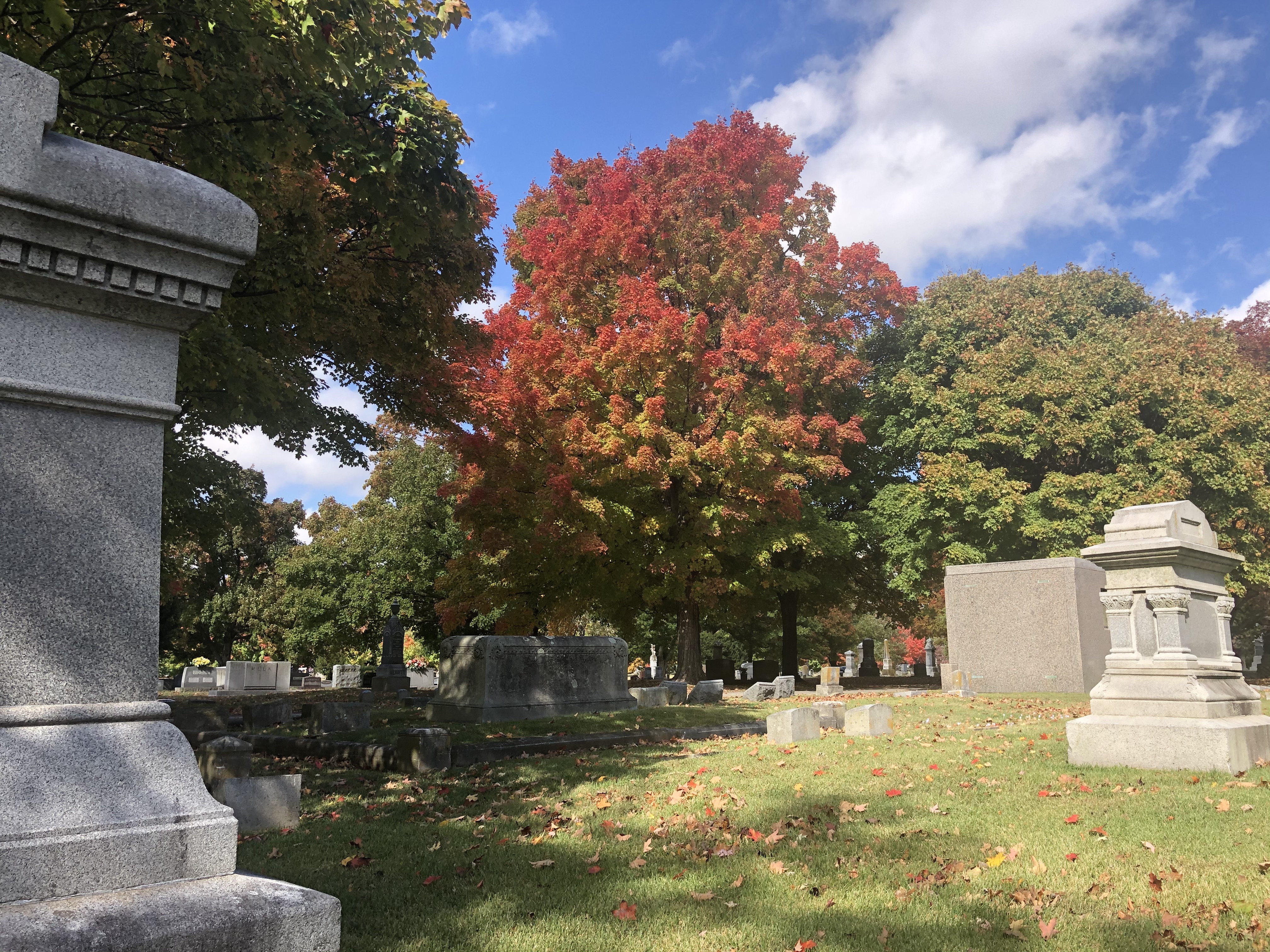
This autumn I decided to take a walk in one of the cemeteries where we currently live in Springfield, Missouri. Maple Park Cemetery dates to 1876 when a group of local businessmen established it on a 31-acre tract where an old fairground was once located. Some of the city’s most prominent citizens are interred there. One of the most famous people buried in Maple Park is known not by his own merit but by how he met his end. David Tutt was killed on the square in downtown Springfield by Wild Bill Hickok.

Maple Park Cemetery, Springfield, MO

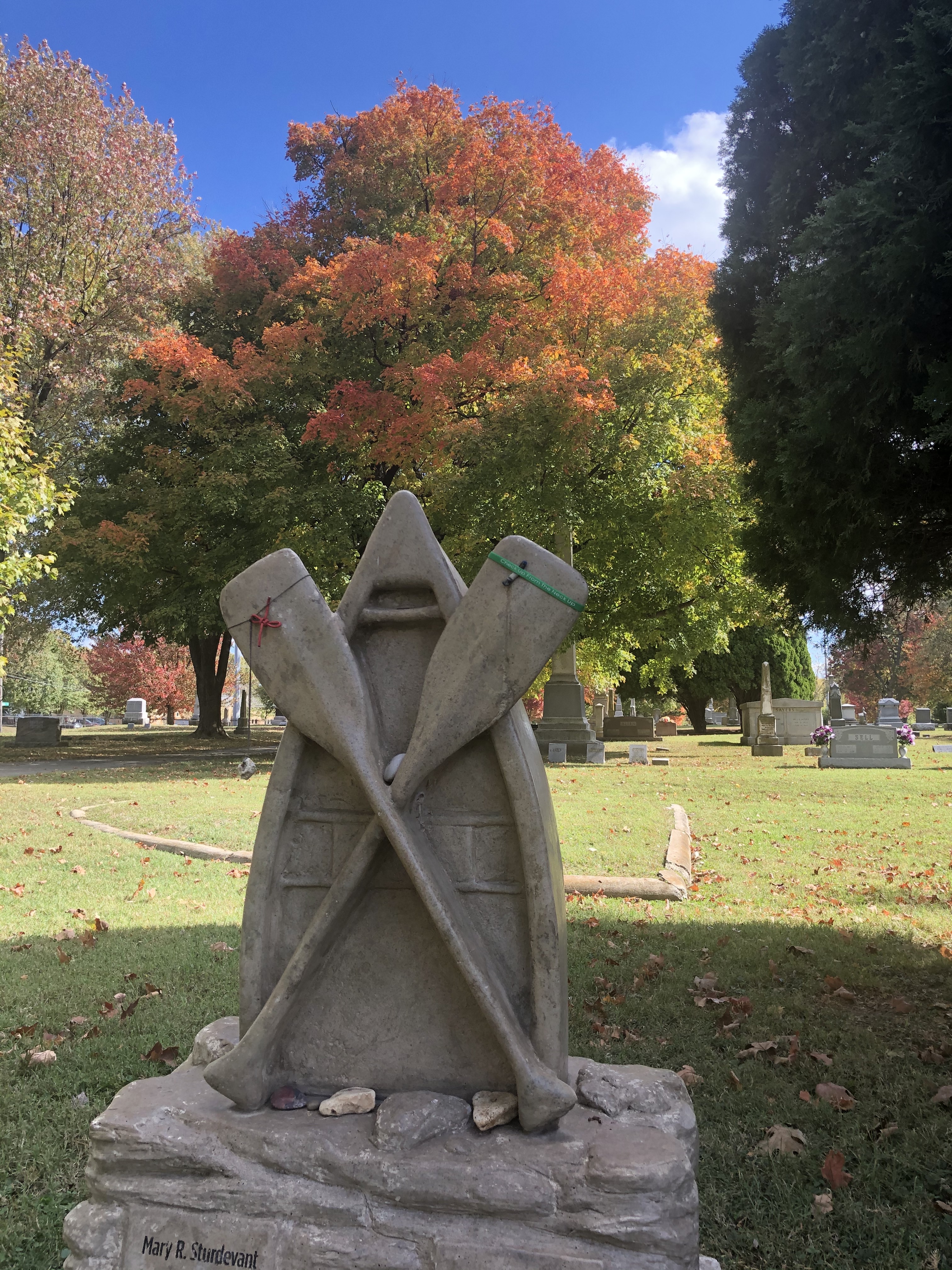
Maple Park gets its name because of an abundance of the species, which according to early newspaper accounts were growing on the property when the cemetery was first established. Because Maple Park is almost 150 years old, there is an interesting variety of grave markers and mausoleums. There is also a wonderful mixture of mature and young trees of many different species, which put on a spectacular show in autumn months.

Many of us drive for hours to visit mountains and valleys to see fall leaves on a grand scale, but Maple Park Cemetery offers a chance to see those brilliant yellow, orange, and red trees in a setting that is peaceful and even reverent. My walk among the memorial markers under the canopies of color helped me appreciate how wonderful it is to still be moving, how the turning of the seasons is a perfect metaphor for our lives, and how precious beauty is because it is so brief.

Maple Park Cemetery, Springfield, MO

The Beautiful Annabel Lee

Visitors to this blog are no doubt aware that one of my passions is landscape gardening. My love for flowering plants, shrubs, ornamentals, and trees has grown for over thirty years as I’ve experimented with many different species and multiple gardening designs. This avocation has given my wife and me countless hours of pleasure, along with way too many sore muscles and aching joints. In previous posts, I have highlighted some of the side benefits of gardening, such as attracting wildlife. I have also discussed pond construction projects at three different homes.

One of my posts featured the technique of stacked container plantings, which combine vertical interest with the opportunity to group many different plants together compactly. Over the years, I have really come to appreciate container gardening, which has several distinct advantages. Containers are a great option where there is no soil for planting, such as decks, patios, porches, baloneys, steps, paved walkways, or pool decking. They also work well integrated with flower or shrub beds, adding vertical and visual interest with a variety of shapes, sizes, textures, and materials. What can be used as a growing container is only limited by the gardener’s imagination.

In our gardens, we have had a plethora of containers of all shapes and sizes: red clay, glazed ceramic, plastic, coconut husk, peat, wood, metal, glass, and more. Some of these came in bright, cheerful colors. Our most substantial containers, not to mention the heaviest, are made of concrete. Their edges are at least an inch thick, and they can withstand temperatures that dip down in the single digits if they are mostly emptied in the winter and don’t hold much moisture. This feature is especially advantageous as they are much too heavy for us to move once they are in place.

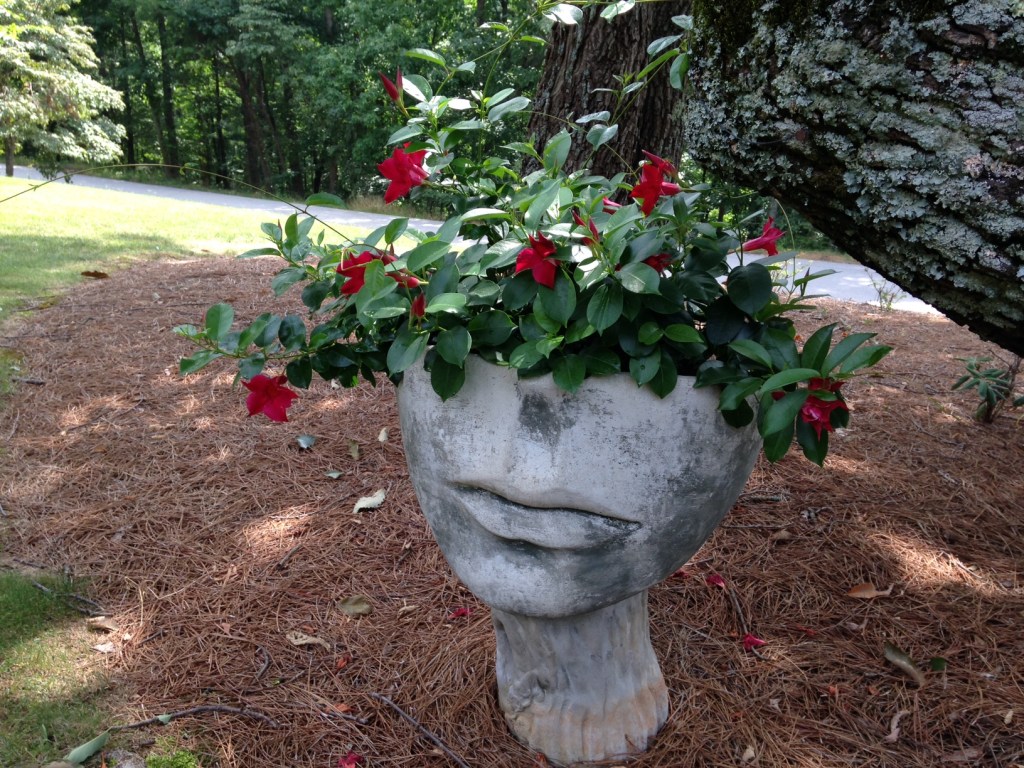
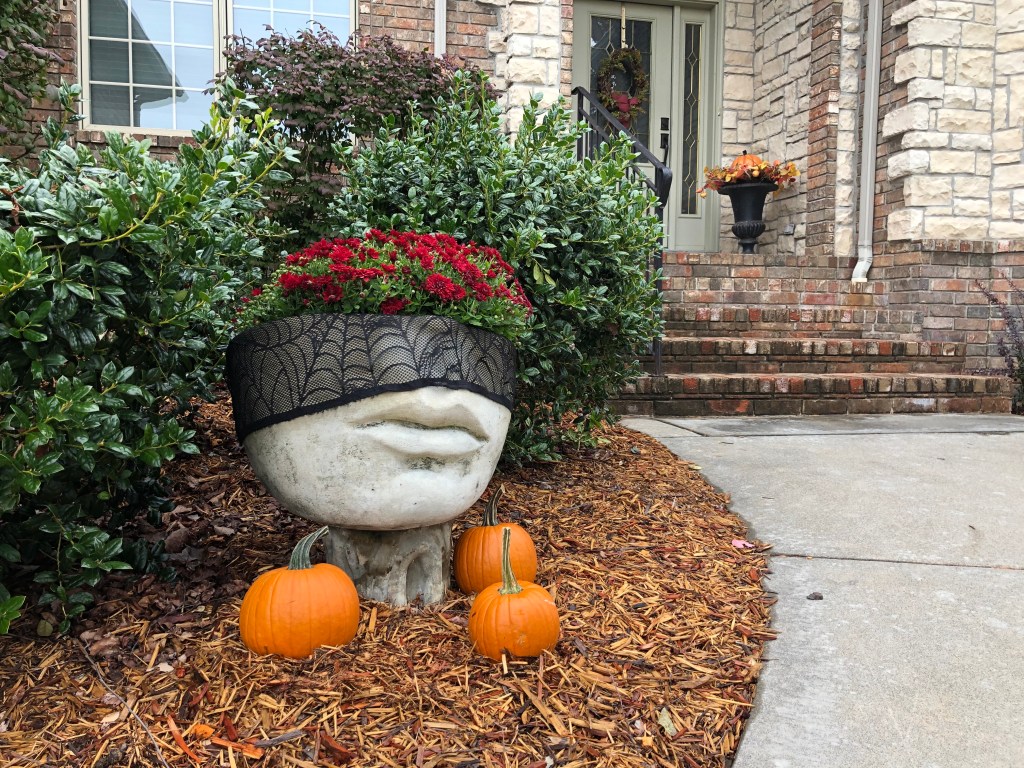
Our absolute favorite concrete planter is one made of the gray cement that is typical of most driveways and foundation walls. Sounds about as basic and boring as you can get, right? What makes this offset cup-shaped planter special is how the side is sculpted in the shape of the lower half of a human face, complete with a chin, lips, philtrum, and just a hint of the lower nose. It usually sits atop a short pedestal made of the same concrete that is sculpted into the shape of a stump, but it looks more like a neck for the face planter.

Annabel Lee 2009
Annabel Lee 2009


The first time we saw the planter in 2009 in a garden center in north Georgia, we were smitten. We backed our pickup truck to a retaining wall with the tailgate down, and the woman running the place helped us gently roll the planter from the berm into the bed of the truck. Once we got it home, we carefully rolled it off the tailgate down a 2×12-inch board, strapped the planter to a set of hand trucks, and wheeled it around the house to its place in our patio garden.

Annabel Lee 2011
Annabel Lee 2011


We both observed that the face looked female and had a rather pensive expression, even without eyes. During the next rain shower, as water streamed down her cheeks, we watched the mood turn to melancholy. In all conditions, her face presents a haunting countenance, perhaps because it is lifeless. It is literally and figuratively like stone, which helped us decide on a name for the planter. “Annabel Lee” is the name of Edgar Allan Poe’s final poem, which is about the death of a beautiful woman. Now, we have our very own Annabel Lee, not “in her sepulchre there by the sea,” but in our garden for all to see.

Annabel Lee 2014
Annabel Lee 2014


Over the years, we have changed up the plants that finish off the top part of Annabel Lee’s face and provide her with hair. Sometimes she has locks draping down the side of her face or the back of her head. Some seasons she has a more punk, spiked look. Once or twice she has channeled Medusa, that Gorgon of Greek mythology that turns everyone else to stone! She makes a wonderful lawn decoration for Halloween and is a year-round centerpiece to the hardscape of the garden. But, at night when her very own spotlight illuminates her cheek and casts shadows across her face, Annabel Lee almost comes to life. It’s a vision powerful enough to inspire Edgar Allan Poe to write just one more verse.

Annabel Lee 2016
Annabel Lee 2016
Annabel Lee 2017
Annabel Lee 2017
Annabel Lee 2019
Annabel Lee 2019
Annabel Lee 2019 Halloween
Annabel Lee 2020
Annabel Lee 2020

Bird Sanctuaries

For as long as I can remember, I have been fascinated with birds. This is not to say that I am a birdwatcher as that term is normally used. I don’t go out into the forests and glades armed with binoculars and a field guide. I might be able to identify a handful of bird calls, but only the most obvious ones that most people recognize. I know the names of a dozen or so species, perhaps more if I give it some serious thought. The point is, I am not by any stretch of the imagination an expert on feathered creatures. I simply enjoy watching them. More specifically, I like seeing them up close but from the comfort of my house, mostly from indoors. For over forty-five years I have been creating environments around the various places I have lived that would be safe and attractive for wildlife, a topic of one of my previous posts. More than any other creature, birds have remained the primary focus of my energy in this endeavor.

Cardinal and Chickadee on a frozen feeder

My father was an electrician by trade, but he was also quite a talented carpenter. I don’t recall if I asked him to build me a bird feeder or if he just decided I might like one, but he constructed a masterpiece just outside my bedroom window using two-inch metal pipe that formed a cross-like structure with braces at the top, to which he attached a corrugated metal roof about 2×3 feet in size. At the cross bar, about a foot or so below the roof, he attached two square wooden trays with small rims to hold bird seed. He completed the structure with a sheet-metal baffle cone attached to the pipe just below the wooden trays. It would be more accurate to say that my father had built a bird restaurant, which was typical of his approach to all backyard projects. He once erected a woodshed just behind our house that was better constructed than many of the houses in our town and could store enough firewood for a dozen Minnesota winters. We lived in middle Georgia.

Unfortunately, when Dad secured the feeder in the ground with concrete, the baffle wasn’t high enough to stop squirrels from taking a running leap up the pole, bouncing off the metal, and grabbing the edge of the wooden trays to then gorge themselves on seed. To thwart the rodents’ gluttonous invasions, my father once coated the pole with axle grease. Not to be deterred, the furry critters repeatedly and with astounding diligence would jump on the slick pole, slide to the ground, and repeat the routine until their white bellies were quite black and saturated with grease, thus cleaning the pole to the extent that they could once again raid the seed trays. We eventually gave up and just resigned ourselves to buy enough seed to satisfy the squirrels and feed the birds. Later, I started putting seed on the brick ledge below my window that only the birds could reach, allowing me to be only inches away from them as they pecked away at millet and sunflower seeds.

When I permanently moved away from home, I dug up the homemade feeder and carried it with me to at least two of my homes. Finally, the wooden trays began to rot due to my neglect, and I disposed of the feeder. It also took up too much space in my small yards. Moving forward, I elected to buy more traditional feeders at the big box stores and at boutique bird shops. I have mounted them on deck railings, attached them to tree trunks, and hung them from poles. I have watched them be ravaged by squirrels and raccoons. I have seen one completely destroyed by what must have been a black bear, sightings of which were frequent at our home in north Georgia. I was thrilled when stores began to stock their shelves with safflower seeds, which squirrels tend to dislike and leave alone. Our current backyard in southwest Missouri has only small trees, providing little protection for squirrels but plenty of shelter for the birds. The twin feeders we have are equipped with a well-designed baffle high enough off the ground to prevent the pesky varmints from reaching the bird’s dinner. Victory at last. Let them eat acorns like God intended.

Finches feasting
Finches feasting

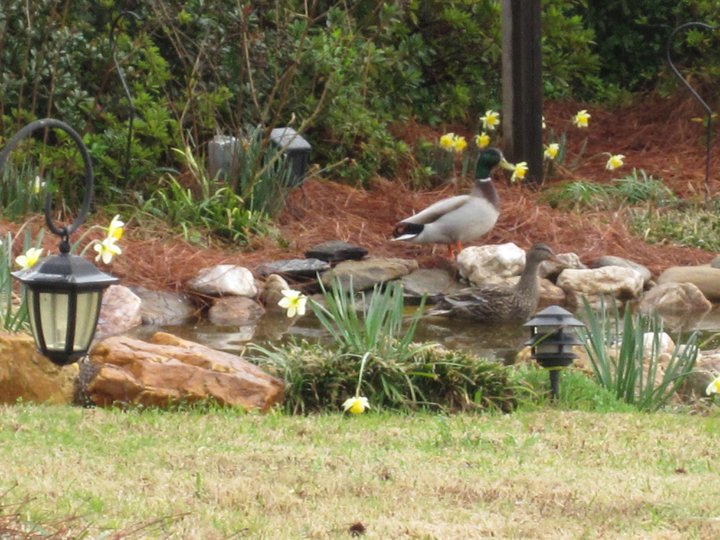
In addition to feeders, I have added water features to our gardens. Birds need fresh water for drinking and bathing. They are also attracted to running or moving water, probably because it facilitates bathing and usually indicates freshness. Currently, we only have a store-bought metal bird bath; however, at previous homes I built two garden ponds, each equipped with a cascading waterfall. Songbirds would often splash around in and drink from the small pools formed by the cascade. Even when we lived on a lake, we had one of these ponds in the yard, and ducks became regular visitors. They liked paddling around in the water.

Ducks at our pond
Ducks at our pond

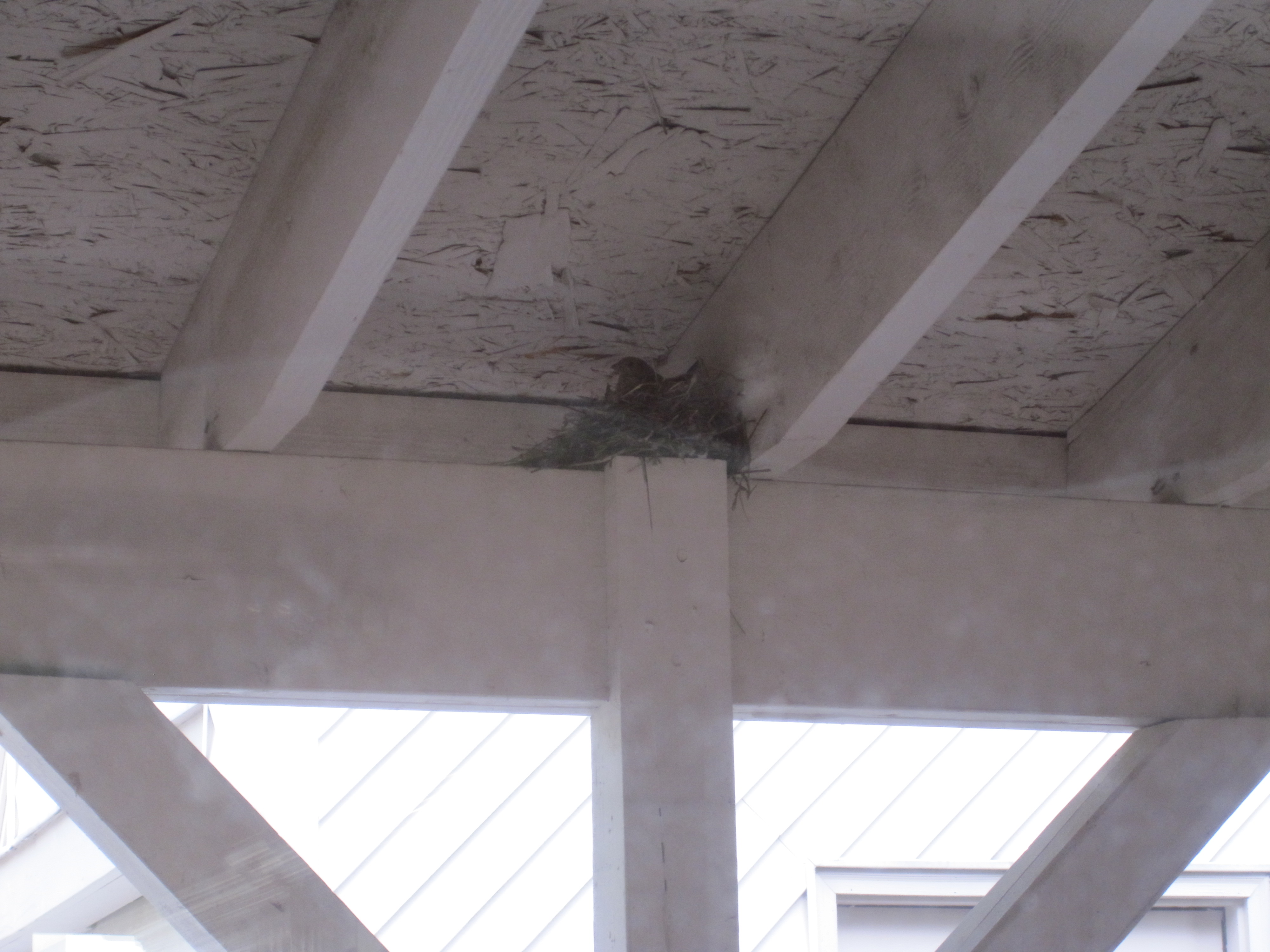
There are certain elements of nature that, for lack of a better expression, are good for my soul. Most of these are grand in scale, such as beaches, high mountains, waterfalls, noisy rivers, public gardens, or sprawling vistas of the desert southwest. I have witnessed all of these many times, and they never disappoint me. But, I also get hours of pleasure by simply sitting in a chair on the deck or peering through the window and watching Cardinals, Chickadees, Bluebirds, Yellow Finches, Grosbeaks, Woodpeckers, and many other birds (yes, even sparrows) as they chirp, flit around, perch, and fill their bellies with seed and suet. They are like flowers that fly. It gives me great joy to help care for them.

Sparrow nesting on the porch

Getting There Is Half the Fun: An Adventure Deep in the Ozarks

One of the more interesting responsibilities of my current job is participating in an oral history project exploring the history and culture of the Ozarks, a physiographic region of the country located in portions of southern Missouri, northern Arkansas, and small portions of eastern Kansas and Oklahoma. I have solicited interviews from several people so far including a retired NASA astronaut; a farmer who moonlights as a musician; a folklorist and musician; and most recently, a woman who is a visual artist, a writer, and a horticulturist growing ginseng in the hills of northwest Arkansas. Since this is a personal blog, I won’t reveal her identity but will call her Ms. Ozart for the sake of convenience.

Ms. Ozart had a career in environmental science, but she also pursued artistic endeavors from an early age. Now that she is no longer working away from home, she can focus most of her time and energy on what she loves most: growing native plants, gardening, painting, and writing. She was not raised in Arkansas but lives here now with her husband, a couple of horses, and a dog who at one time kept her chickens safe from predators. The dog is old, deaf, and retired. Ms. Ozart no longer has chickens.

It was her fascination with one specific plant that attracted Ms. Ozart to this part of the country. Ginseng is a perennial herb native to deciduous forests, especially in places like Appalachia and some parts of the Ozarks. It thrived in these locations and throughout many other areas of the country until it was grossly overharvested in the 1970s, mainly because of the purported medicinal benefits of the root. It is now considered an endangered species. The demand for the plant’s root has been high in China for centuries, and plants from the U.S. are still routinely shipped there. Ms. Ozart isn’t interested in harvesting the roots or selling them. It takes anywhere from 10 to 15 years for the root to develop to a marketable size. She is much more interested in propagating the plant and selling the seeds so other people can do the same.

At her invitation, I had the distinct pleasure of interviewing Ms. Ozart at her beautiful property. Because ginseng is rather valuable, and poaching is a constant threat, she prefers to keep her exact location as private as possible. Respectfully, I have included no photographs of the area with this post. In our preliminary correspondence, Ms. Ozart asked me if I would prefer to meet her in the nearby town and have her drive me to her home. She told me if I had a nice car, I probably wouldn’t want to go far beyond the town. Images of being blindfolded in the trunk of a large sedan came to mind. She warned me that my phone’s GPS app may have trouble finding the address, especially if I happened to exit the program in route from the nearby town. Cell service doesn’t exist this deep in the Ozarks – no bars . . . nada. I am fortunate to have a Ford F-150 pickup, so I decided to take my chances and trust my phone to get me there.

I have spent most of my life in rural areas. The last town where we lived in the northeast Georgia mountains was in a county with several small towns and a total population of just over 40,000. It was a booming metropolis compared to where Ms. Ozart resides. The “little town” several miles north of her location where she offered to meet me consisted of a tiny square that was like an appendage off the side of the two-lane state road. There were about six buildings housing such enterprises as a bank, a café, a feed store, and an art gallery where some of Ms. Ozart’s work is on exhibit and for sale. I continued farther out into the countryside until my riding companion, Siri, instructed me to turn left onto a dirt and stone road – not gravel, large stones. Sometimes, the rocks were semi-submerged boulders. The shocks on my truck will no doubt need to be replaced soon.

Ms. Ozart had warned me that it would take about 15 minutes or more to travel from the paved road to the base of her driveway where she would meet me. When I looked at the map and discovered the distance was only a few miles, I thought she was exaggerating. She wasn’t. Had I attempted to ramp up my speed to over 20 mph, my truck and I would have been launched airborne into either a tree or flowing water, both of which were in abundance on either side of the wide path that was given the designation of the county name followed by a four-digit number. The transportation department didn’t even bother with naming it for a prominent family that had carved out a living here generations ago, which is a common practice for farm roads in Georgia. I crossed over the same river twice and a few tributaries on surprisingly sturdy concrete bridges that were more like large culverts. I was expecting rickety wooden structures, which of course would never be able to support farm equipment and heavy trucks that undoubtedly traverse this byway every day.

I was traveling through a rather mountainous terrain compared to much of the Ozarks, with high ridges rising from rolling valleys fully furnished with fence lines, crumbling rock walls from long-abandoned structures, small creeks and branches, clusters of trees and shrubs, rock outcroppings, and grazing cows — lots of cows. I am convinced the livestock in northwest Arkansas have social security numbers. Even in December with the predominant hardwood trees undressed for the approaching winter, it was like an opening scene from the Daniel Boone television program from the late 1960s. Aside from the occasional power lines, the countryside probably looks much as it did in frontier days.

Notwithstanding the absence of cell service, most of the folks living along this county road are not really off the grid. They have electricity, running water, propane gas, satellite television, perhaps even slow and spotty satellite Internet service, and other amenities that people enjoy in the most remote parts of the country. Although Ms. Ozart has dreams of someday being a true homesteader, she freely admits that most of her provisions these days come from Walmart and the occasional delivery truck whose drivers risk life and limb to reach her door.

When I arrived at the base of her driveway — the cross section of a creek, a road intersection, and a pasture gate — Ms. Ozart was waiting for me in her small, well-seasoned red pickup truck. “You might want to ride the rest of the way with me,” she said. “Your truck probably doesn’t have four-wheel drive, does it?” And here I was, thinking the wagon trail that had gotten me this far was hazardous. I transferred my recording equipment to her truck, and we headed up the ridge on a rutted, winding trail just wide enough for one vehicle.

We stopped after about 100 yards to look at one of the locations where ginseng is growing on a raised plateau just across the creek from the “driveway.” The plants are dormant this time of year, and the leaves are gone, but she wanted to show me the spot just the same. She gingerly scampered across several rocks to reach the other side, warning me to secure my footing on the slippery surfaces as I followed. I could just imagine conducting the interview in blue jeans soaked in icy creek water. Luck was on my side. I remained high and dry.

We safely made it back to her truck and continued our trek toward her house located about a half mile up the hill. We were no longer crossing creeks and branches. We were going through them. She was describing the habitat for ginseng and its companion plants while showing me the more interesting features of her property, including lovely cascading waterfalls and massive rock outcroppings in tall ravines. At one point she stopped the truck to point out another hillside where she had discovered ginseng growing wild. I admit it was difficult for me to concentrate as I was keenly aware that she had parked the truck directly in the middle of a flowing creek. I kept waiting for the sensation of sinking and drifting as we sat there, but after she finished her story, she simply engaged the four-wheel drive and slowly maneuvered forward out of the water. I was thankful for her truck. I was more thankful I wasn’t driving.

We arrived at Ms. Ozart’s house and set up at her kitchen table for the interview. The room was comfortably warm with the help of a gas space heater. She had chili bubbling in a slow cooker that filled the house with a mouthwatering aroma. She put on a pot of coffee, graciously served me a cup, and sat across the table from me and my video camera for a 45-minute conversation that was fascinating and entertaining. She pulled out of her refrigerator seedlings of ginseng and other native herbs she overwinters packed in moss in plastic storage bags. She demonstrated how she makes pigments for paint by grinding rocks from the local creeks into powders of various hues and textures and mixing them with oil, honey, and other suspending agents.  She talked about how the Ozarks region is an inspiration for her writing and her visual art. She and her husband have built a rich life in this isolated slice of wilderness, which I find quite remarkable and admirable.

After we finished and I packed my equipment in her pickup, she drove me back to my truck. “Do you really get supplies delivered to you out here?” I asked as we bumped our way down the hill. “Oh sure,” she said. “Lowes delivered my washer and dryer too.” Admittedly, I was a bit surprised by this news, given how narrow and rugged her driveway is. When we reached a sharp curve where the creek widens next to the road, she pointed toward the stream and said, “I came down early one morning and found a FedEx truck tilted sideways and halfway in the creek right there. The driver had made a delivery to my house the night before, and lost control going back down on this turn. He showed up later that morning with a wrecker. It took the better part of the day for them to get his truck out of the creek, but they did it.”

When we reached my truck, I thanked her for her hospitality and told her how grateful I was that she drove the last leg up to her house. She chuckled a bit and said, “I thought that would work best.” I watched her from my rearview mirror retrieve the mail from her mailbox at the driveway entrance and then climb back in her truck to head home again. Somehow the rocky road leading back to the state highway didn’t seem quite as treacherous this time. The cows appeared just as disinterested as they had earlier. I recognized a few landmarks that I had remembered to look for on the way back to make sure that I wasn’t lost. I allowed myself to look around and soak up the pastoral vistas along the way, but I slowed down considerably and took great care crossing the bridges.

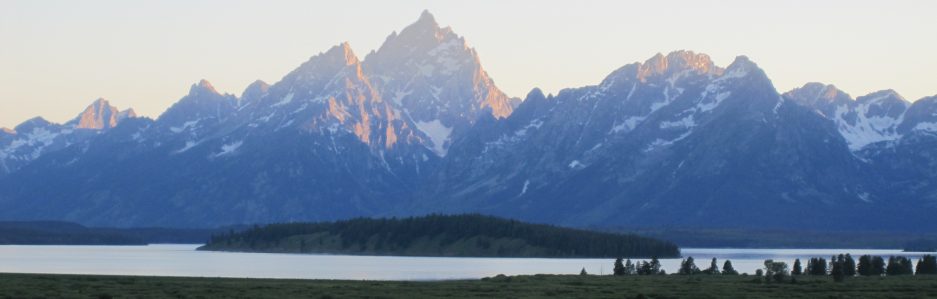
Missouri Botanical Garden

I am a big fan of public gardens and visit them as often as possible, especially when traveling to new places. With the move to Missouri in 2018, my wife and I have taken opportunities as often as possible to explore some of the wonderful resources the state has to offer. One of the most remarkable places I have seen so far is the Missouri Botanical Garden just outside St. Louis. Founded in 1859, the 79-acre facility is the nation’s oldest botanical garden in continuous operation and is now a National Historic Landmark.
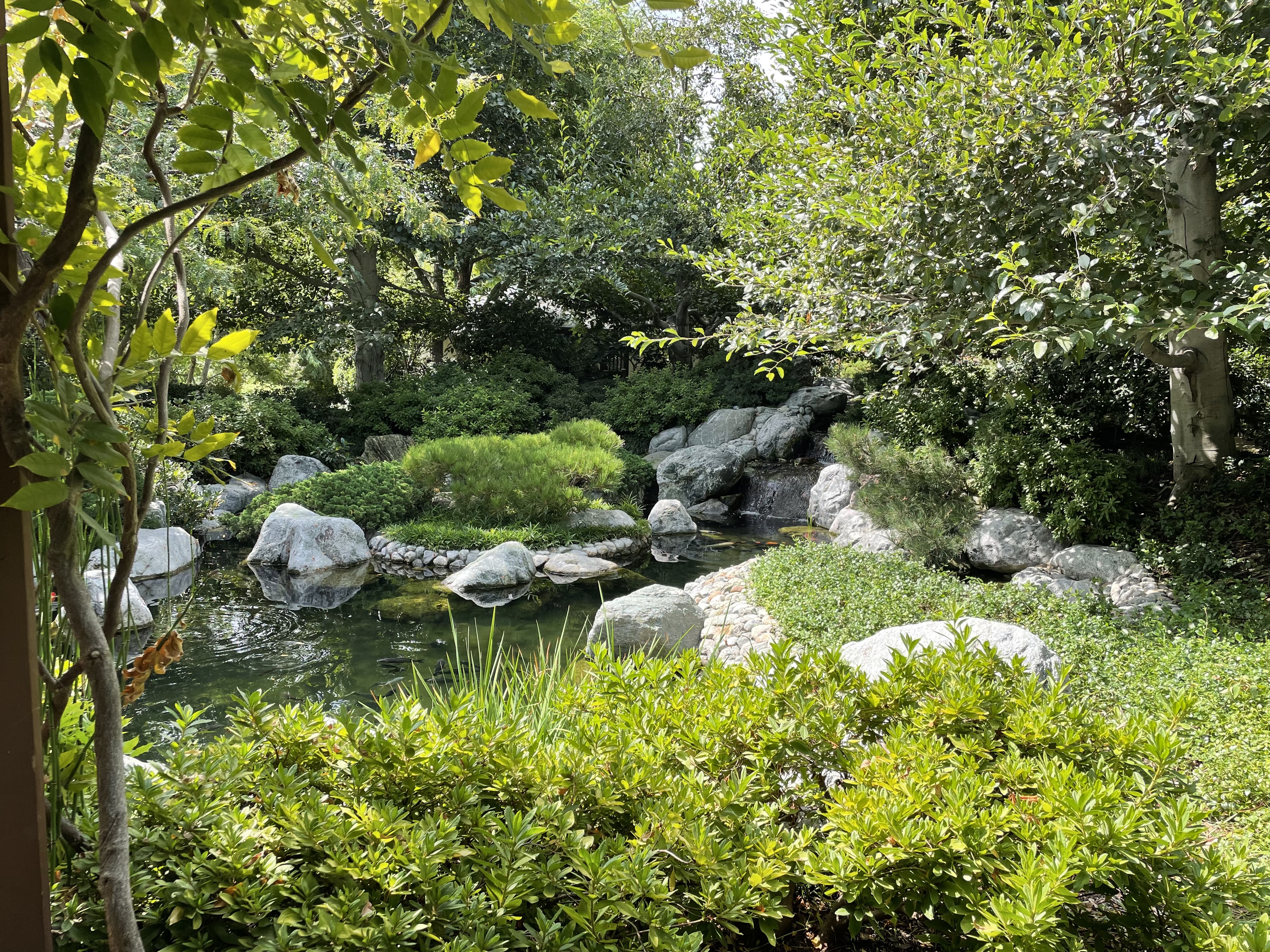
Missouri Botanical Garden

According to the Garden’s website, “more than 4,800 trees live on the grounds, including some unusual varieties and a few stately specimens dating back to the 19th century, when founder Henry Shaw planted them.” The Garden also features the nation’s most comprehensive resource center for gardening information, including 23 residential-scale demonstration gardens. There are various themed gardens throughout the site: Chinese, English, Woodland, Ottoman, and Victorian. There is a 14-acre Japanese strolling garden, one of the largest in the country.

Missouri Botanical Garden

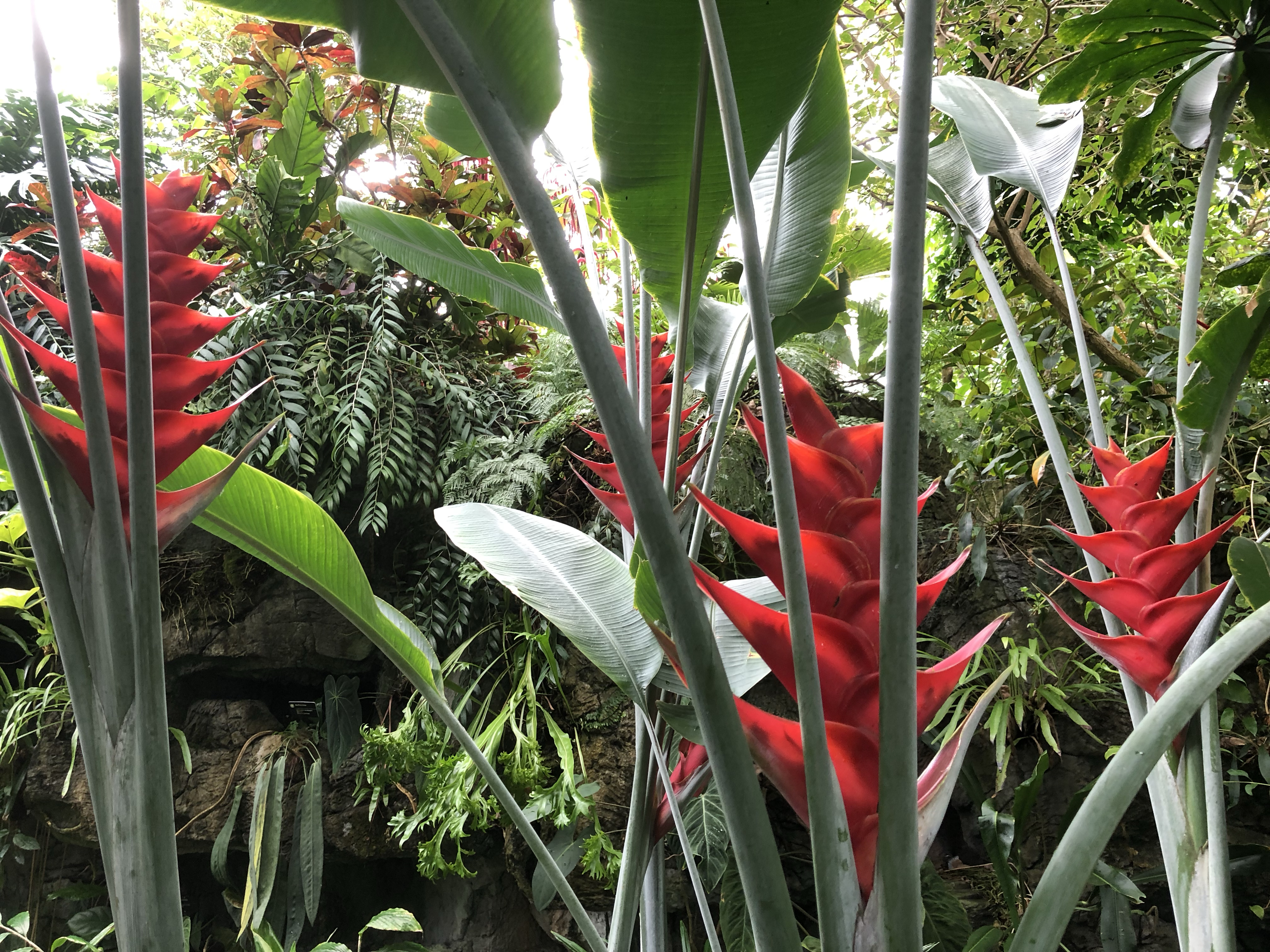
A notable feature of the Garden is the conservatory with a lush, vibrant tropical rainforest complete with waterfalls, tanks of fish, and a walkway winding through incredible exotic plants. I will most likely never visit South America or any other part of the world where I would see a tropical rainforest, so I am always grateful for the privilege of even seeing one in miniature. The one at the Missouri Botanical Garden is the best I have seen so far.

Missouri Botanical Garden

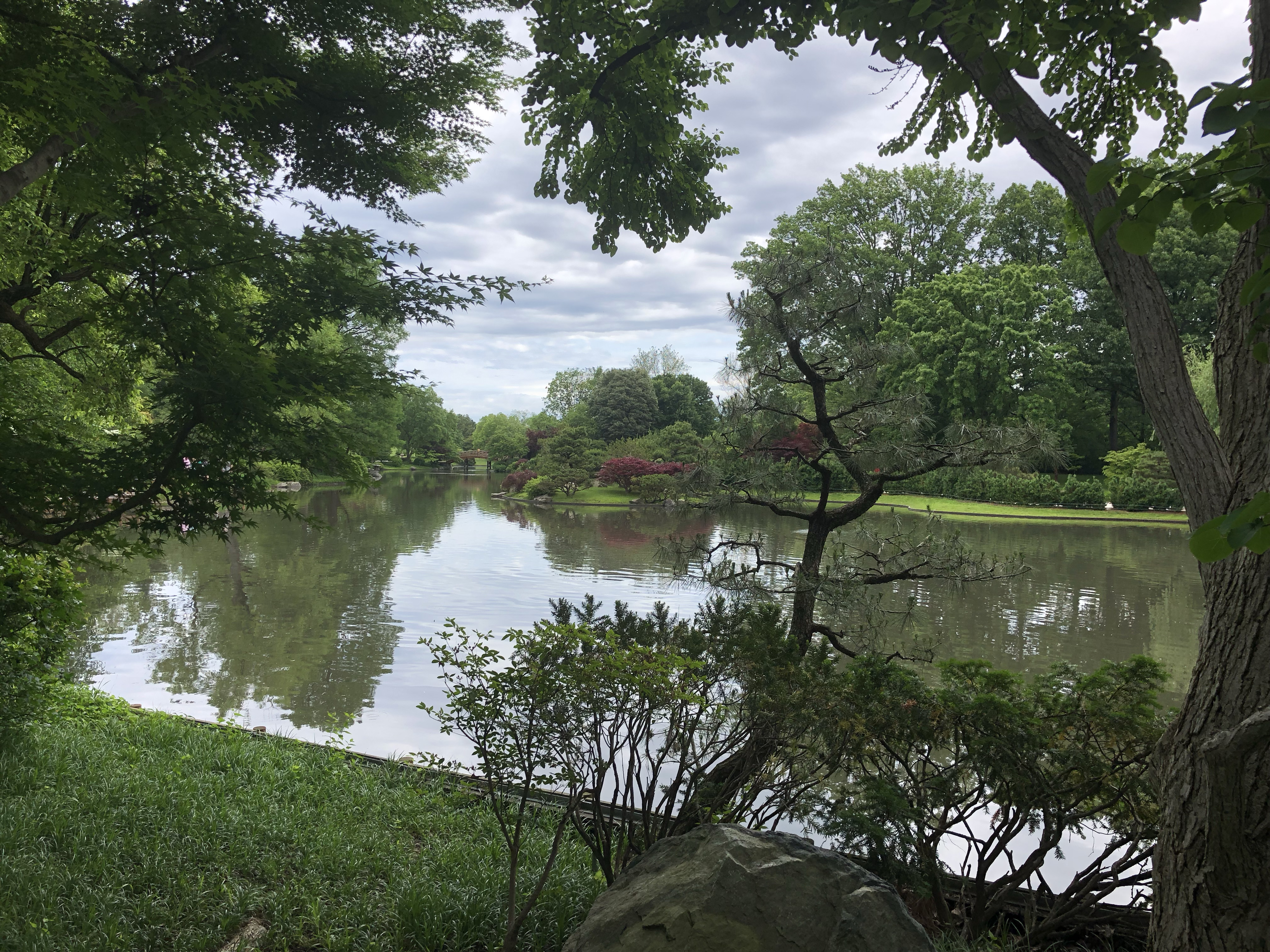
There are so many elements of the Garden that make it a destination. The trails are carefully constructed to take advantage of the landscape and lead visitors to one breathtaking vista after another. The plants are grouped and positioned throughout the property to appear as if they evolved there naturally. There are tree-covered byways with every shade of green imaginable; sunny sections with an explosion of color during the blooming season, including a rose garden; and terraces with mixes of perennials and annuals. There are natural lakes, running streams, and constructed water features.  I was also fascinated with how well the flora is enhanced by statuary, glasswork, and structures.

St. Louis has so many attractions: Gateway Arch, Busch Stadium, a first-class art museum, and a zoo for starters. The Missouri Botanical Garden is every bit as impressive as any of these places. It is undoubtedly a point of pride for the city and for the whole state. I look forward to returning every season of the year to see what surprises the Garden has in store.

Missouri Botanical Garden