
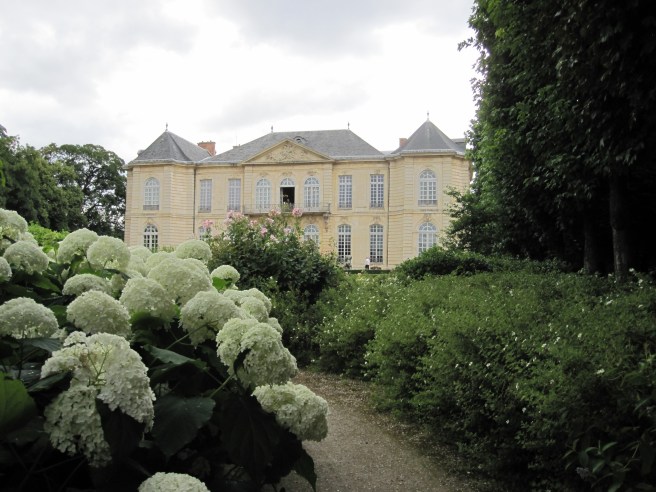
The Garden at Musée Rodin

Visitors to Paris will often want to include in their itinerary a side trip to the Palace of Versailles, which is about a thirty-minute train ride from the city.  The round trip isn’t so time-consuming, but actually seeing the palace and grounds takes a minimum of half a day, even more if one truly explores the garden, which is 800 hectares (over 1,900 acres) in size. Unfortunately, some travelers are on a tight schedule and hardly have enough time to see the major attractions in Paris, much less places outside the city.  There is no substitute for seeing the Palace of Versailles, which is quite magnificent and offers a visual representation of the wealth and power of the monarchy in the 17th and 18th centuries. The garden is certainly spectacular and difficult to match; however, if there is a substitute in Paris that can serve as a rival, albeit on a smaller scale, the garden at the Musée Rodin must be near the top of the list.

Rodin gardens from mansion balconey
Rodin gardens from mansion balcony

The Musée Rodin is housed in a mansion, formerly called the Hôtel Peyrenc de Moras, now known as the Hôtel Biron. Auguste Rodin was a 19th-century French sculptor who is known for creating several iconic works, including “The Age of Bronze,” “The Thinker,” “The Kiss,” and “The Burghers of Calais.” The collection in the restored mansion is interesting for the novice and probably a treasure for artists and art historians, but almost everyone can appreciate the beauty of the garden.  Its size is minuscule compared to Versailles, but it is still impressive. The grounds are divided into a rose garden, north of the mansion, and a large ornamental garden, to the south, while a terrace and hornbeam hedge backing onto a trellis conceal a relaxation area, at the bottom of the garden. Two thematic walks are also part of the garden: the “Garden of Orpheus,” on the east side, and the “Garden of Springs”on the west side.

Rodin garden roses and shrubs

In addition to the abundance of plants, the garden is also decorated with some of Rodin’s sculpture.  Rodin started to place selected works in the garden in 1908, together with some of the antiques from his personal collection. Male and female torsos, copies made in the Roman or modern period, after Greek works, were presented in these natural surroundings. Other pieces were added after his death. The first bronzes were erected in the gardens before World War I. Since 1993, they have been regularly cleaned and treated so as to preserve their original patinas.
Rodin mansion 3

Anyone who has visited Paris knows the frustration of wanting to see more, to do more, than limited time will allow. Tourists have to be selective, discriminating, and reasonable about what they will be able to cover during the time they are in the city. Any attraction that offers more than one type of experience is probably worth including. The Musée Rodin fits that description with historic architecture and provocative sculpture but also a landscape that is in itself a work of art, offering the visitor an opportunity to rest and reflect.

Edward Clark Potter

Enfield, Connecticut, is often associated with the manufacture of gunpowder and weapons, but it is also the place where Jonathan Edwards preached his famous sermon, “Sinners in the Hands of an Angry God.”  Edward Clark Potter, born in 1857, was raised in this small township just across the border from southern Massachusetts.  Educated in local schools and at the Williston Seminary in Easthampton, Massachusetts, young Edward defied his mother’s plans for him to enter the ministry and instead enrolled at Amherst College in Massachusetts for three semesters before heading to Boston in 1879 to study art.  A few years later he moved to Vermont to work at a marble quarry, overseeing stone cutting  there for Daniel Chester French, an established sculptor working in Boston.  In the late 1880s Potter studied in Paris with figure sculptor Antonin Mercié and animal specialist Emmanuel Frémiet.  He returned to the United States in 1890 and married May Dumont of Washington, D.C.  The couple started a family back in Potter’s hometown of Enfield.  His friend and mentor Daniel French encouraged Potter’s interest in modeling animals, and the young artist eventually earned a reputation as one of America’s leading animaliers by the turn of the twentieth century.

Potter and French collaborated on numerous commissioned projects, mostly statues of famous personalities on horseback with Potter being responsible for sculpting the horses.  Potter’s own five equestrian groups, including those representing Henry Warner Slocum and Philip Kearny, demonstrated his growing talent and ability to express the unity between the rider and his horse.  Potter won a gold medal at the Louisiana Purchase Universal Exposition in 1904 for the equestrian De Soto Sighting the “Father of the Waters.”  When his statue of a Civil War bugler on horseback was unveiled in 1915 in Brookline, Massachusetts, it was praised as innovative and unconventional.

Edward Clark Potter
Edward Clark Potter

Potter and his family preferred to stay in the rural countryside, where he could take care of the animals he raised and used as his subjects for sculpting.  However, Potter also enjoyed his proximity to New York where he was involved in the art community.  He was a charter member of the National Sculpture Society and took a leadership role in the National Academy of Design.  He also made significant original artistic contributions to New York City, including a marble statue of Zoroaster on the cornice of the New York Appellate Court House in Madison Square.  Surprisingly, his most famous sculpting contribution to New York, or any place for that matter, did not come in the form of a person or a horse.

Around 1910 Potter received a commission of $8,000 on the recommendation of Augustus Saint-Gaudens, one of America’s foremost sculptors of the day.  Potter teamed up with the Piccirilli Brothers, renowned marble carvers, to create two statues constructed of Tennessee pink marble.  The two pieces were originally named  Leo Astor and Leo Lenox, but sometime in the 1930s, Mayor Fiorello LaGuardia named them Patience and Fortitude, for the qualities he felt the citizens of New York would need to survive the economic depression.  Architecture critic Paul Goldberger praised the pieces as “New York’s most lovable public sculpture.”  These two majestic lions flank the Fifth Avenue and 42nd Street entrance to the New York Public Library.  Patience still guards the south side of the Library’s steps, and Fortitude maintains his position to the north.  As a tribute to the Lions’ popularity and all that they stand for, the Library adopted these figures as its mascots. They are trademarked by the Library, represented in its logo, and featured at major occasions.

To learn more, consult Top Cats: the Life and Times of The New York Public Library Lions by Susan G. Larkin. This publication surveys their history through photographs, cartoons, prints, original drawings, memorabilia, and lively tales.

Strolling Through Hyde Park

My wife and I were in London this past summer for a few days.  We had some scheduled work-related activities on the Sunday after we arrived, but our morning was free.  The day was overcast, as so many are in London.  We decided to spend the morning strolling through Hyde Park, one of eight Royal Parks in the city.  Seized by Henry VIII from the monks of Westminster Abbey in 1536 as a private hunting grounds for the monarch, this 350-acre property was not made available to the general public until 1637.  In the late 17th century, William and Mary purchased Nottingham House on the western edge of the park and renamed it Kensington Palace, which is where the royal family made its home.  During the 18th century, the park began to take on many of the features that distinguish it today, thanks to the efforts and creativity of Queen Caroline.  Two of the most striking landscape elements she introduced were Kensington Gardens and Serpentine Lake.

Hyde Park, London
Serpentine Lake in Hyde Park, London

Through the centuries Hyde Park has been a site for national celebrations and a sanctuary of free speech, illustrated by the famous Speakers’ Corner, where anyone is allowed to stand up and openly speak on any subject, including grievances against the state.  Karl Marx, Vladimir Lenin, and George Orwell are among the most famous orators who have expressed their views at Speakers’ Corner.  The park is also a haven for wildlife, and the Serpentine Lake offers a rich habitat for a wide variety of water fowl and other aquatic animals.  Of course, maneuvering through a patchwork of goose poop is an issue if you choose to get too close to the water!  As one might expect, the park is filled with statues, memorials, fountains, artwork, pavilions, walkways, and concessions.

Hyde Park, London
Water garden in Hyde Park, London

On the morning of our stroll, we entered the park through the Marble Arch on the northeast, next to Speakers’ Corner.  Immediately we were greeted with people taking advantage of the weekend with their exercise routines: running, walking, tai chi, yoga, martial arts, and more.  A major portion of this section of the park was currently occupied by the British Summer Time festival of music, but we made our way around it toward the large section of Serpentine Lake, intersecting with West Carriage Drive and crossing Serpentine Bridge.  We passed by the Princess Diana Memorial Fountain to reach the Lido Restaurant, where we bought some hot drinks to warm us up a bit — it was chilly morning for July.  We continued leisurely along one of the walkways within view of the lake and headed back toward the southeast part of the park to the Serpentine Waterfall and the enchanting water garden just beyond it.

Hyde Park, London
Water garden in Hyde Park, London

On the southeast corner of the park, we spent some time wandering through the Rose Garden, a spectacular oasis featuring roses mixed with herbaceous plants that were exploding with color while we were there.  We were joined by parents carrying babies in strollers and older children asking a thousand questions.  I have written on public gardens before, and this is absolutely one of the finest I have ever visited.  I cannot begin to imagine how much money the city, and perhaps the Crown, invests in this amazing display of natural beauty.  The vistas are breathtaking.

Hyde Park, London
Flower garden in Hyde Park, London

Like most of the major international cities, London is filled with attractions and history.  It would be foolish to suggest bypassing all of those places to take a stroll through the park. You have to see the Houses of Parliament, Big Ben, Westminster Abbey, St. Paul’s Cathedral, etc.  At the same time, don’t cheat yourself by missing the opportunity to immerse yourself in the local environment, and public parks are a great place to do so.  Sure, there are tourists wandering around in Hyde Park — we were among that category.  But, there were also plenty of locals enjoying the simple pleasures of this treasured and historic resource.  The conversations we overheard between couples and companions and  among parents and children gave us a superficial but satisfying sense of being British just for a couple of hours.  We never want to miss those kinds of opportunities when we travel.

God is a Gambler. Who Knew? (Part 2)

(continued from January 29, 2016)

If you tell students that the Book of Job illustrates how human beings are easily dispensable to God, who is quite willing to use them to prove a point, they don’t exactly embrace this vision too comfortably.  Nevertheless, it is difficult to read this story and not come away with a less-than-flattering description of God’s nature.  When God turns Job over to Satan, the evil one goes to work quickly.  In short order, all of Job’s livestock and servants are killed, along with ten of his children.  Poor Job tears his clothes and shaves his head in mourning, but he still blesses God in his prayers, which prompts Satan to return to God to increase the stakes.  To further prove how strong Job’s faith really is, God allows Satan to inflict physical torment on the poor guy.  Afflicted with horrible skin sores, Job is in so much misery that his wife encourages him to curse God, give up the struggle, and die.  Still Job stands fast and continues to honor God.

You can push a person so far though, and Job comes close to reaching his limit.  His close friends offer him philosophical rhetoric to bring him comfort and to explain his horrible predicament, and they even try to convince him that he must have done something to anger God — repent and all will be well.  One of his pals, Elihu, explains that physical suffering helps the victim to comprehend God’s love and forgiveness when he finally is well again, knowing that God has rescued him from misery.  Again, what a disturbing view of God’s relationship to humanity!  Job doesn’t buy it.  He is confident in his righteousness and refuses to admit to uncommitted sins.  Still, he grows weary and finally gets a bit demanding of God, and goes so far as to express his wish that he had never been born.  From an ancient Hebrew perspective, this just may be where he crosses the line and prompts God to blast him with what could be the best poetry in the Bible, even though much is certainly lost in the translation.

Out of a mighty whirlwind, God poses a series of blistering, rhetorical questions to Job, most of which begin with the phrase “Where were you . . . ,” which are designed to show Job how ignorant he is of the majesty of creation and how magnificent God truly is.  After he picks himself up out of a heap, good old Job admits to the limitations of his human knowledge, a response that apparently pleases God.  According to many Biblical scholars, the original story (which is one of the oldest in the Bible) ends at this point.  However, in the Biblical narrative, the plot continues, and God returns Job’s health and even more property than he had before.  God blesses Job with new children and gives him an extremely long life as an added bonus.  Of course, one could argue that property can easily be replaced, but ten children?  In the end, God won the bet and proved Satan wrong, which is the most important thing to remember, right?  As I stated before, a tad disconcerting.

The reason that the Book of Job is so important in Hebrew literature, or any literature for that matter, is because it creatively explores the age-old question of why an omnipotent God allows good people to suffer.  After all, Job isn’t selected as the pawn in this contest between God and Satan because he is bad, but because he is the best.  For modern Christians, especially those who espouse the prosperity gospel so popular in America, Job’s story presents quite a quandary.  If you follow God’s commands and live a life of righteousness, you just may come to ruin as a reward for your faithfulness!  Somehow I doubt Joel Osteen preaches from Job very often — I could be wrong.

Considering that the ancient Hebrews had no concept of personal eternity and were convinced that, as God’s chosen people, they were fulfilling God’s plan for creation and living up to their side of the covenant with God, this story becomes somewhat more palatable for the modern reader.  The Hebrews were commanded by God to be fruitful and multiply, to spread across the land, and to bear witness to God’s preeminence among all other deities.  There is no room in this arrangement for the wish of never having been born.  The survival and well-being of the individual was vastly overshadowed by the importance of the survival and fruition of the Hebrew nation.  The suggestion is that human beings should not dare question God’s divine justice because they cannot possibly appreciate its complexity.

What I find particularly fascinating is how the Book of Job serves as an excellent foreshadow for the coming of Christ and his sacrificial death to save humanity.  Jesus wasn’t chosen to face horrible agony because he was a rotten sinner.  Jesus was sent by God to suffer because he was the spotless lamb.  With all respect and deference to the modern descendants of the Hebrew nation and culture, the story of the New Testament messiah conveniently “resurrects” the suffering servant, who even has his own moments of doubt and questioning in the garden.  This is the same Jesus who charges those who profess to love him to take up their cross and follow him.  I guess you could say that’s just part of the deal.

God is a Gambler. Who Knew? (Part 1)

For ten years, I taught a freshman course covering the first half of world history as an adjunct instructor at a small public liberal arts college.  I knew that a good portion of my students had been raised in Protestant homes, and most were probably very active in their home churches.  Because so much of early world history ends up being a class in comparative religions, I thought it only fair to give my students the following disclaimer on the first day of class: “I am the college teacher your preacher warned you about.”  I knew that much of what I was going to cover about the origins of the world’s major religions, including Christianity, was going to be met with some resistance.  A few students probably thought I was an agent of Satan.  Having come out of a fundamentalist Christian background (Southern Baptist), I could certainly sympathize with that position.

What I thought would be particularly helpful was to spend quality time talking about a book from the Old Testament in the Bible, the work that is raised to the level of idolatry by so many pastors and their congregants.  By looking at the book as both a work of literature and as holy scripture, I attempted to help them see some basic tenants of their faith from a different angle than what they were exposed to in church.  I hoped to offer a bit more historical context too, helping my students understand the genesis of three of the world’s religions: Judaism, Christianity, and Islam.  The book I chose is my favorite of the wisdom literature from the Biblical Hebrew tradition and one that I think is most representative of that tradition.  This book does such a good job of exploring the complexity of the human condition, especially as it is impacted by faith.  The book I selected was Job.

The major reason that Job is such a good book to teach to students who are familiar with Bible stories from church is because it presents all kinds of challenges to the traditional image of God and the accepted nature of God’s relationship to humanity.  Here we have the story the takes off with a discussion between God and Satan about a man named Job.  God is obviously very proud of Job, who seems to be the model of human creation.  In a little chat with Satan, God says, “Have you considered my servant Job? There is no one on earth like him; he is blameless and upright, a man who fears God and shuns evil.”  Of course, this is taken as a direct challenge to God’s adversary, Satan, who claims that Job is such a swell guy only because God is taking very good care of him.  After all, Job is wealthy, has a large family, and performs purification rituals for his family even when he knows of nothing they have done wrong.  He is described as the greatest man among all the people of the region.

So Satan decides to make a little bet with God, just to prove God wrong.  Satan presents God with this challenge concerning Job’s welfare: “Stretch out your hand and strike everything he has, and he will surely curse you to your face.”  And how does the creator of all the universe, including Job but also Satan and his minions, respond to this challenge?  Does God dismiss it as petty?  Does God make clear to Satan that God doesn’t need to prove anything to anyone?  Well, no.  Essentially God’s response to Satan is, “Oh yea?  Is that what you think?  Fine then!  You’re on!!”  In verse twelve of the Book of Job, we read:  “The Lord said to Satan, ‘Very well, then, everything he has is in your power, but on the man himself do not lay a finger.’”  The deck may be stacked in God’s favor, but still, God apparently likes to play the game!  Who knew?  And, the events that unfold after this exchange between God and Satan present us with a view of the deity that is both unexpected and just a tad disconcerting.

Opportunity of a Lifetime

As I have indicated before, I began my career as a librarian in a medium-sized public library in a small county of around 42,000 people.  As is typical in small communities, there were plenty of personal interconnections.  When I graduated with an MA in History in 1985 from a state college in this same county, I started work shelving and cataloging books in the public library.  With the encouragement, patience, and generous assistance from the library director, I and another worker in the library commuted to Emory University twice a week for two years to complete our Masters degrees in Librarianship (MLn).  I served as a reference librarian for most of my fifteen years there, but when the director left during my twelfth year, I was offered the position.  I served as the library’s director for three years.

One morning, during the spring of my last year, the husband of our children’s librarian walked into my office to say he had a proposition for me.  His wife was serving in this position at the library before I began there.  Her husband was a local attorney.  I knew them both very well — we attended social events and my first wife and I had even house-sat for them and had taken care of their two children for a weekend.  As it happened, he was the lawyer for the estate of a major American writer, who also was (and still is) one of my favorite authors: Flannery O’Connor.  She had lived a good portion of her life in this town where her family had deep roots going back to the early 19th century.  She spent the last thirteen years of her life at the family’s farm, called Andalusia, located on the north end of town.

foc_eberhart_photo
Flannery O’Connor
His clients were two sisters who were also first cousins of O’Connor.  Flannery O’Connor died in 1964, but her mother, Regina, lived until 1995.  As executors of Regina O’Connor’s estate, these two women were also in charge of Flannery O’Connor’s literary estate, which was primarily administered through a trust that had been established by Regina O’Connor’s will.  As co-executors and co-trustees, one of their responsibilities was to establish a non-profit foundation to maintain Andalusia as a proper memorial to O’Connor and also to perpetuate her legacy as a writer.  They needed someone to help establish this organization.  They also needed someone to work with a sizable archive of personal papers, correspondence, writings, photographs, memorabilia, and artifacts belonging to Flannery O’Connor.  The archive needed to be organized, cataloged, and properly stored for preservation purposes.  The co-executors asked the lawyer to find someone who might be interested and capable of doing both of these tasks.  He came to my office in the library that spring day, explained the proposition from the estate, and asked me if I would consider taking the job as an independent consultant working for the co-executors.  I accepted, which changed almost everything for me.

I will no doubt dedicate several future posts recounting my experiences as a consultant and then later the director of the Flannery O’Connor-Andalusia Foundation that I assisted in establishing.  I was there for thirteen years — as long as Flannery O’Connor lived there.  That was long enough, or arguably, a bit too long.  While I can look back and think about plenty of mistakes I made and how I should have made different decisions, I don’t have any real regrets.  With a BA in English, an MA in History, and an MLn, I don’t think I could have been any better suited for the job with regard to my education and training.  I had the help of some talented and dedicated mentors, board members, volunteers, colleagues, and for a few years, a trusted co-worker and friend.  What I can state with absolute certainty is that this path that departed from my expected trajectory led me to some of the richest experiences I have ever had and offered me opportunities that other people with my education and training will, sadly, never enjoy.  I am humbly grateful, and hope that Flannery O’Connor would be pleased with the work we accomplished at Andalusia.

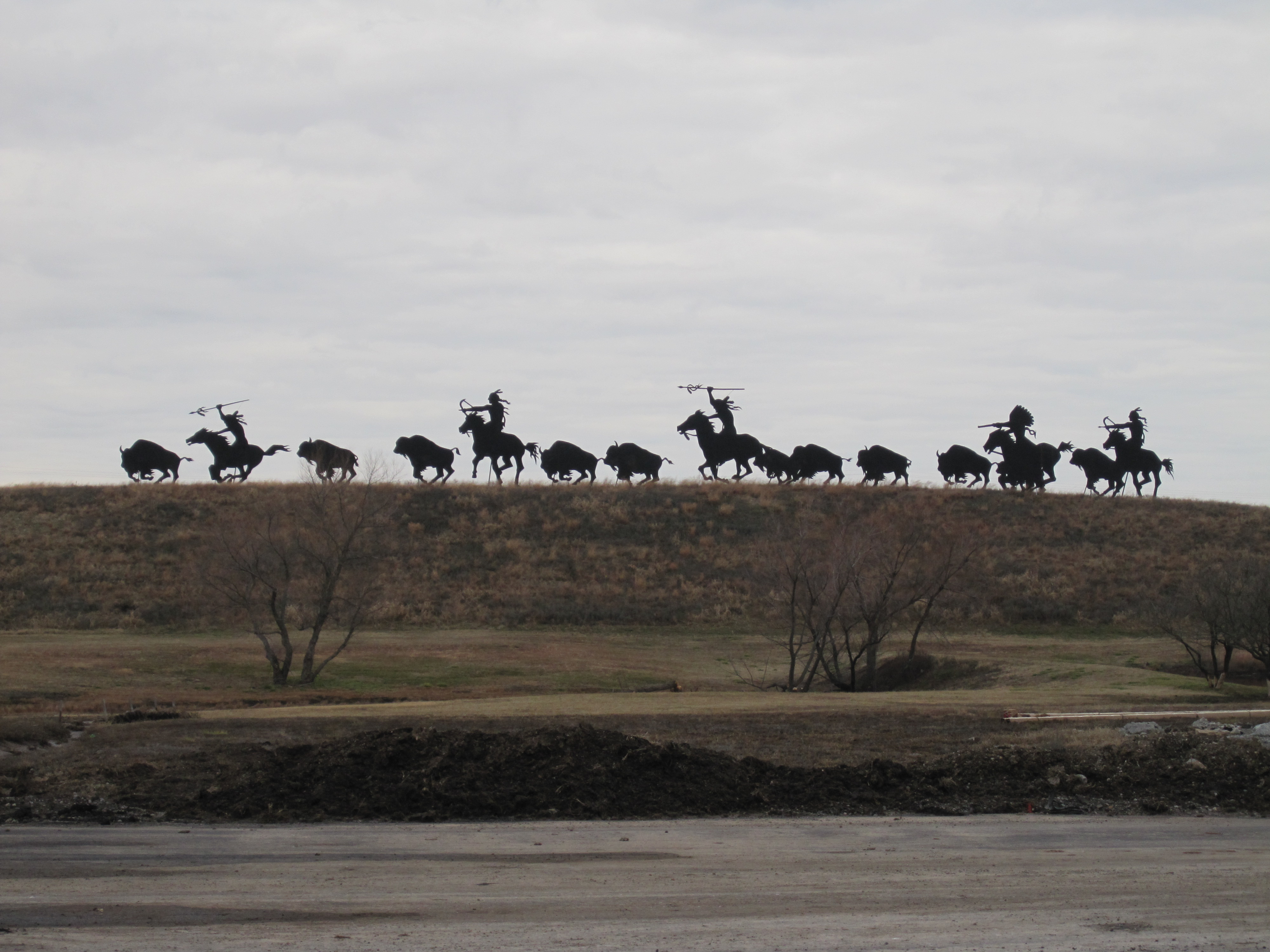
Otoe-Missouria Buffalo Hunt in Silhouette

Buffalo Hunt Silhouette

This metal sculpture is on a hillside behind one of the new casinos in northern Oklahoma, just south of Arkansas City, Kansas.   The Otoe-Missouria Tribe was encountered by Lewis & Clark on their epic expedition of 1804, when the inhabitants were still living in their Nebraska tribal home.  So the story goes, the tribe was on a buffalo hunt, making Lewis & Clark wait on them to return to their village.  There are statues in front of the casino commemorating that “First Council” meeting.  The metal outdoor artwork obviously recalls the hunt.

I find the sculpture particularly striking because it produces a silhouette effect regardless of the outdoor lighting.  On an overcast day, like the one when I took this photo, the effect is quite pronounced.  The individual pieces are large, and in a photograph, you can almost be convinced that they are real.  I gasped when I first saw it and wondered why it was visible only from the back parking lot of the casino.  I think it is magnificent.  I hope that this fine display of art is not offensive to Native Americans, especially those in this particular area near the northern border of Oklahoma.  I hope it is considered a tribute to a culture and way of life now buried deeply in our country’s past, with all its beauty and its scars.

Slavery by Another Name by Douglas Blackmon

In his Pulitzer-prize-winning book, Slavery by Another Name: The Re-Enslavement of Black Americans from the Civil War to World War II, historian Douglas Blackmon brings to light one of the most shameful chapters in American history—an “Age of Neoslavery” that thrived from the aftermath of the Civil War through the dawn of World War II.  Having been raised in the Southeast where these atrocities flourished in the decades leading up to the time I was born in 1960, reading this exposé was both painful and illuminating for me — it is one of the best works of nonfiction I have read in many years.

2319745

Under laws enacted specifically to intimidate blacks, tens of thousands of African- Americans were arbitrarily arrested, hit with outrageous fines, and charged for the costs of their own arrests. With no means to pay these ostensible “debts,” prisoners were sold as forced laborers to coal mines, lumber camps, brickyards, railroads, quarries, and farm plantations. Thousands of other African-Americans were simply seized by southern landowners and compelled into years of involuntary servitude. Government officials leased falsely imprisoned blacks to small-town entrepreneurs, provincial farmers, and dozens of corporations—including U.S. Steel—looking for cheap and abundant labor. Armies of “free” black men labored without compensation, were repeatedly bought and sold, and were forced through beatings and physical torture to do the bidding of white masters for decades after the official abolition of American slavery.

This book is a moving, sobering account of a little-known crime against African-Americans, and the insidious legacy of racism that reverberates today.  In light of events involving law enforcement and the legal system with regard to black people over the past year, this book is extremely relevant.  It should be required reading in most southern history college courses, and it should be considered strongly for most advanced American history courses. It is well researched, thoroughly documented, and extremely compelling.  Blackmon is such a good writer.