
Otoe-Missouria Buffalo Hunt in Silhouette

Buffalo Hunt Silhouette

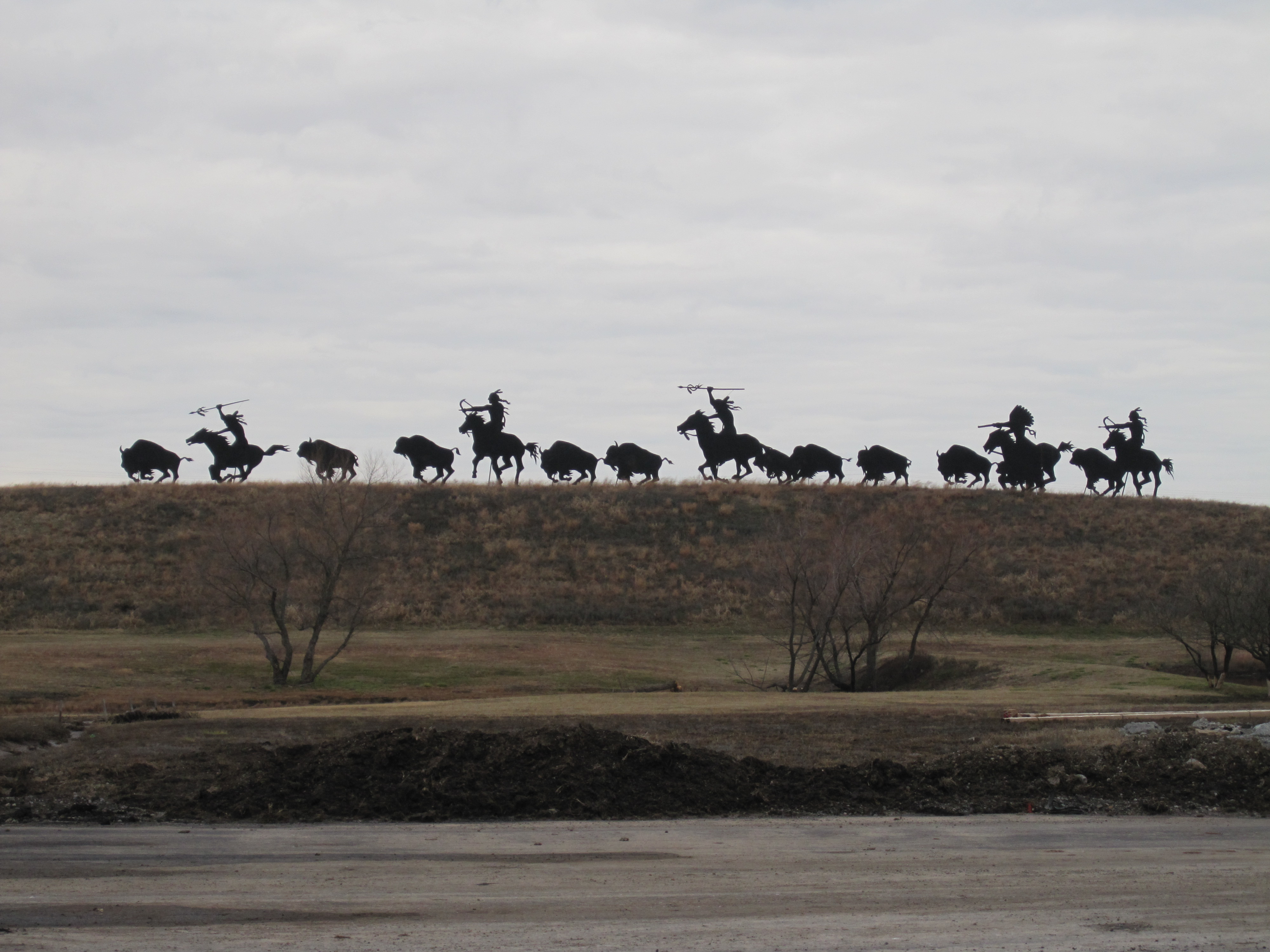
This metal sculpture is on a hillside behind one of the new casinos in northern Oklahoma, just south of Arkansas City, Kansas.   The Otoe-Missouria Tribe was encountered by Lewis & Clark on their epic expedition of 1804, when the inhabitants were still living in their Nebraska tribal home.  So the story goes, the tribe was on a buffalo hunt, making Lewis & Clark wait on them to return to their village.  There are statues in front of the casino commemorating that “First Council” meeting.  The metal outdoor artwork obviously recalls the hunt.

I find the sculpture particularly striking because it produces a silhouette effect regardless of the outdoor lighting.  On an overcast day, like the one when I took this photo, the effect is quite pronounced.  The individual pieces are large, and in a photograph, you can almost be convinced that they are real.  I gasped when I first saw it and wondered why it was visible only from the back parking lot of the casino.  I think it is magnificent.  I hope that this fine display of art is not offensive to Native Americans, especially those in this particular area near the northern border of Oklahoma.  I hope it is considered a tribute to a culture and way of life now buried deeply in our country’s past, with all its beauty and its scars.

Slavery by Another Name by Douglas Blackmon

In his Pulitzer-prize-winning book, Slavery by Another Name: The Re-Enslavement of Black Americans from the Civil War to World War II, historian Douglas Blackmon brings to light one of the most shameful chapters in American history—an “Age of Neoslavery” that thrived from the aftermath of the Civil War through the dawn of World War II.  Having been raised in the Southeast where these atrocities flourished in the decades leading up to the time I was born in 1960, reading this exposé was both painful and illuminating for me — it is one of the best works of nonfiction I have read in many years.

2319745

Under laws enacted specifically to intimidate blacks, tens of thousands of African- Americans were arbitrarily arrested, hit with outrageous fines, and charged for the costs of their own arrests. With no means to pay these ostensible “debts,” prisoners were sold as forced laborers to coal mines, lumber camps, brickyards, railroads, quarries, and farm plantations. Thousands of other African-Americans were simply seized by southern landowners and compelled into years of involuntary servitude. Government officials leased falsely imprisoned blacks to small-town entrepreneurs, provincial farmers, and dozens of corporations—including U.S. Steel—looking for cheap and abundant labor. Armies of “free” black men labored without compensation, were repeatedly bought and sold, and were forced through beatings and physical torture to do the bidding of white masters for decades after the official abolition of American slavery.

This book is a moving, sobering account of a little-known crime against African-Americans, and the insidious legacy of racism that reverberates today.  In light of events involving law enforcement and the legal system with regard to black people over the past year, this book is extremely relevant.  It should be required reading in most southern history college courses, and it should be considered strongly for most advanced American history courses. It is well researched, thoroughly documented, and extremely compelling.  Blackmon is such a good writer.