Strolling Through Hyde Park

My wife and I were in London this past summer for a few days.  We had some scheduled work-related activities on the Sunday after we arrived, but our morning was free.  The day was overcast, as so many are in London.  We decided to spend the morning strolling through Hyde Park, one of eight Royal Parks in the city.  Seized by Henry VIII from the monks of Westminster Abbey in 1536 as a private hunting grounds for the monarch, this 350-acre property was not made available to the general public until 1637.  In the late 17th century, William and Mary purchased Nottingham House on the western edge of the park and renamed it Kensington Palace, which is where the royal family made its home.  During the 18th century, the park began to take on many of the features that distinguish it today, thanks to the efforts and creativity of Queen Caroline.  Two of the most striking landscape elements she introduced were Kensington Gardens and Serpentine Lake.

Hyde Park, London
Serpentine Lake in Hyde Park, London

Through the centuries Hyde Park has been a site for national celebrations and a sanctuary of free speech, illustrated by the famous Speakers’ Corner, where anyone is allowed to stand up and openly speak on any subject, including grievances against the state.  Karl Marx, Vladimir Lenin, and George Orwell are among the most famous orators who have expressed their views at Speakers’ Corner.  The park is also a haven for wildlife, and the Serpentine Lake offers a rich habitat for a wide variety of water fowl and other aquatic animals.  Of course, maneuvering through a patchwork of goose poop is an issue if you choose to get too close to the water!  As one might expect, the park is filled with statues, memorials, fountains, artwork, pavilions, walkways, and concessions.
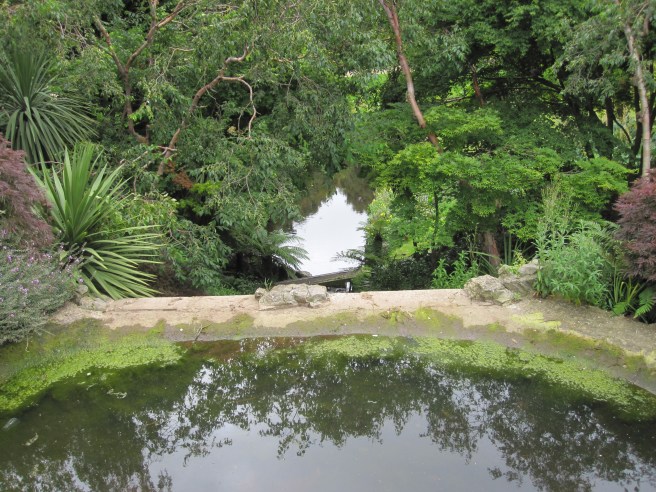
Hyde Park, London
Water garden in Hyde Park, London

On the morning of our stroll, we entered the park through the Marble Arch on the northeast, next to Speakers’ Corner.  Immediately we were greeted with people taking advantage of the weekend with their exercise routines: running, walking, tai chi, yoga, martial arts, and more.  A major portion of this section of the park was currently occupied by the British Summer Time festival of music, but we made our way around it toward the large section of Serpentine Lake, intersecting with West Carriage Drive and crossing Serpentine Bridge.  We passed by the Princess Diana Memorial Fountain to reach the Lido Restaurant, where we bought some hot drinks to warm us up a bit — it was chilly morning for July.  We continued leisurely along one of the walkways within view of the lake and headed back toward the southeast part of the park to the Serpentine Waterfall and the enchanting water garden just beyond it.
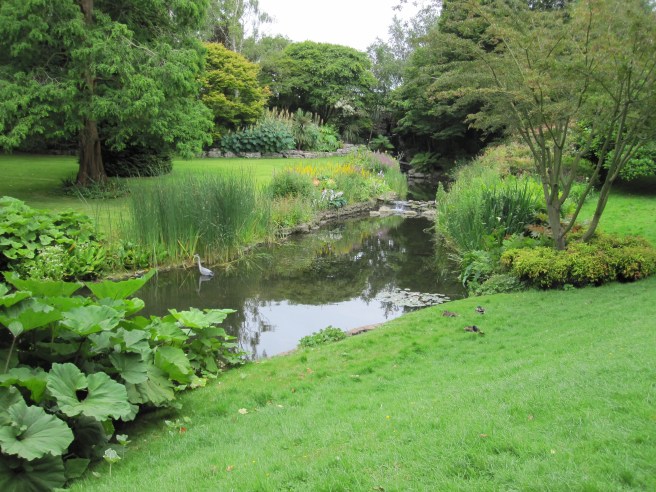
Hyde Park, London
Water garden in Hyde Park, London

On the southeast corner of the park, we spent some time wandering through the Rose Garden, a spectacular oasis featuring roses mixed with herbaceous plants that were exploding with color while we were there.  We were joined by parents carrying babies in strollers and older children asking a thousand questions.  I have written on public gardens before, and this is absolutely one of the finest I have ever visited.  I cannot begin to imagine how much money the city, and perhaps the Crown, invests in this amazing display of natural beauty.  The vistas are breathtaking.

Hyde Park, London
Flower garden in Hyde Park, London

Like most of the major international cities, London is filled with attractions and history.  It would be foolish to suggest bypassing all of those places to take a stroll through the park. You have to see the Houses of Parliament, Big Ben, Westminster Abbey, St. Paul’s Cathedral, etc.  At the same time, don’t cheat yourself by missing the opportunity to immerse yourself in the local environment, and public parks are a great place to do so.  Sure, there are tourists wandering around in Hyde Park — we were among that category.  But, there were also plenty of locals enjoying the simple pleasures of this treasured and historic resource.  The conversations we overheard between couples and companions and  among parents and children gave us a superficial but satisfying sense of being British just for a couple of hours.  We never want to miss those kinds of opportunities when we travel.

Kayaking on Lake Burton

My wife and I took our Hobie kayaks out on Lake Burton recently, putting in at a shady little cove at Moccasin Creek State Park near Clarkesville, Georgia.  Lake Burton is considered one of the highest demand lakes in the country for real estate, and on its shores are fabulous homes owned by celebrities, athletes, and wealthy entrepreneurs.  Some of the two-storey boat houses are grander than most middle class homes in America.  The 2800-acre lake is nestled in the mountains of northeast Georgia, about 100 miles northeast of Atlanta.  It is one of several Georgia Power Company lakes created by a series of dams on the Tallulah River.

Kayaking on Lake Burton

I have bragged on Georgia’s state park system several times, and Moccasin Creek is one of the reasons.  In addition to providing access to a beautiful mountain lake, the park is a perfect setting for camping, and the campground is one of the best I’ve seen in the state. It has a large pavilion, a big playground, a general store, a fishing dock, a boat ramp, and several boat slips.  Activities at the park include picnicking, fishing, canoeing, hiking, and geocaching.  There are good restaurants close by, and it’s a short drive from destinations like Helen, Georgia too.

We got out on the lake a little after 9:00 on a Saturday morning and stayed out for about 90 minutes.  One of the most enjoyable aspects of kayaking on a lake like Burton is the leisurely pace and close proximity to the shoreline afforded by these boats.  You get to see so much more detail than you would on a motor boat or jet ski.  Some of the houses we saw just in the small portion of the lake we traveled were incredible.  Of course, we also appreciate the exercise we get from peddling the Hobies.  We plan to explore more lakes in north Georgia on the kayaks, and there are quite a few from which to choose.

Gardens for Everyone

Thomas Jefferson purportedly wrote these words: “No occupation is so delightful to me as the culture of the earth, and no culture comparable to that of the garden.” Thinking of the word “garden” brings to mind so many different images and activities, probably because there are so many definitions and far too many types to list. A few examples will suffice: flower gardens, vegetable gardens, herb gardens, rock gardens, fairy gardens, cottage gardens, formal gardens, private gardens, and public gardens. It is this final variation that I turn my attention to so many times when I am traveling. Large cities almost always have botanical gardens that are usually enclosed and often charge admission to explore; however, cities also frequently have open access gardens that are situated among the towering buildings or incorporated into larger parks. London, Paris, and other European cities have magnificent public gardens that are as famous as any other attractions, drawing millions of tourists each year. The United States also boasts some splendid examples as well.

Public Garden, Boston, MA

Perhaps the oldest public garden in the country is appropriately called the Public Garden located in the heart of Boston on the southwest side of the famous Boston Commons. Designed by George F. Meacham in the mid-19th century, the Public Garden now has paved trails that wind around the pond, under the trees, and through the floral displays that change with the seasons. We were there in September when the summer blooms were still dazzling. This park is enjoyed by so many people, both Bostonians and visitors to the city. It is a wonderful oasis between the famous historic district and the bustling urban center.

Golden Gate Bridge Park
Golden Gate Bridge Park, San Francisco, CA

Monuments and landmarks present a fine opportunity for the placement of public gardens. The Golden Gate Bridge Park is another example of a space that brings together locals and tourists. The abundance of moisture from the San Francisco Bay and the humid, foggy air sweeping in from the Pacific provides a near-perfect environment for a green-space. We spent several minutes wandering around this garden before taking a trek out on the most recognizable bridge in America.

Opryland Hotel Gardens
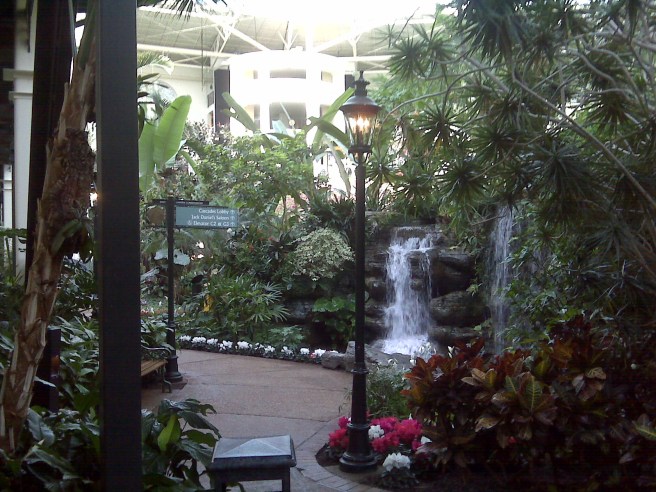
Opryland Hotel Gardens, Nashville, TN

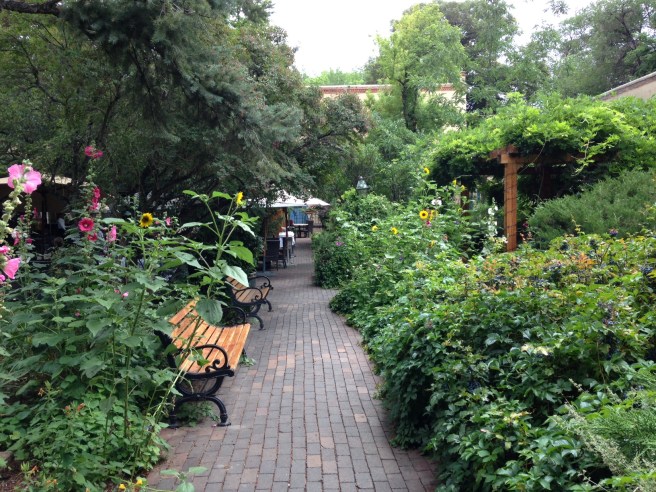
Sometimes gardens that are owned and maintained by private entities are still made available to the public at no charge. Hotels, office complexes, and shopping centers usually have, at bare minimum, some level of landscaping. Occasionally these establishments go far beyond the obligatory curb dressing to create extensive gardens and observatories, such as the Opryland Hotel in Nashville. In tourist towns, several retailers may collaborate to install and maintain plantings, beds, boxes, and pots to attract shoppers to their doors. These private gardens are not only accessible to the public but are specifically designed to attract people passing through the area. I have seen some beautiful examples of this type of garden in destinations such as Gatlinburg (Tennessee), Sedona (Arizona), St. Simons Island (Georgia), and Santa Fe (New Mexico).

Shopping courtyard garden
Garden at a shopping courtyard in Santa Fe, NM

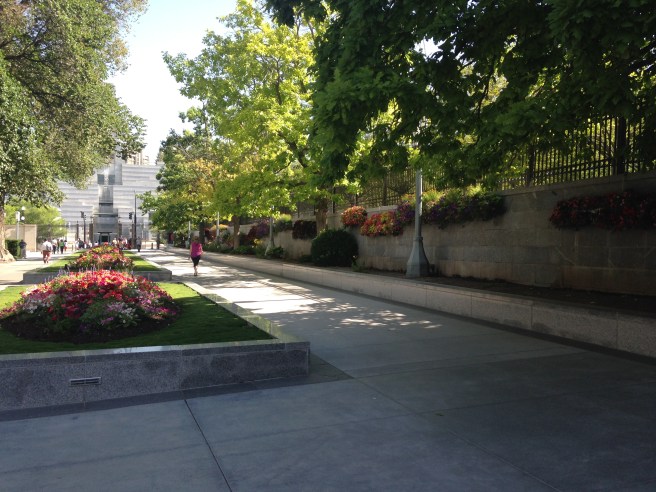
Places of worship are also a good source for gardens that can be enjoyed by everyone.  Usually maintained by a small band of devoted gardeners in the organization, these spaces welcome visitors and encourage them to take a few moments to be still, contemplate,  meditate, or pray. Some of these gardens are small and simple, but still lovely.  Others are huge and elaborate, attracting thousands of visitors each year. Some are not free and open to the general public, such as the Gardens of Vatican City, although guided tours are available. The Gardens at Temple Square of the LDS Church represent an over-the-top horticultural exhibit that is enjoyed by anyone who wants to pass through the church’s massive complex in Salt Lake City, Utah.

Temple Square Gardens
Gardens at Temple Square, LDS Church headquarters, Salt Lake City, UT

As an amateur gardener, I have a deep appreciation for the integration of beautiful plants into the built environment. Public gardens address a basic need that so many people have of staying connected to nature. They are also a haven for birds and other small wildlife that share real estate with humans. They filter the air, enrich it with oxygen, and lace it with their perfumes. They tantalize our eyes with various shades of green and a wide array of vibrant colors. Public gardens tempt us to pause, relax, and reflect. The familiar phrase of “stop and smell the roses” is a cliché for a reason.  It’s based on a fundamental human need to slow down and appreciate very simple pleasures.  Take the opportunity to do so the next time you pass a public garden.

Raccoons Are So Cute . . . and Deadly

What could be more adorable among wild animals than a raccoon?  With that signature black mask that looks like a small child dressed for Halloween and that distinctive striped, bushy tail, these waddling mammals are quite often photographed and recorded on video as they make their way through suburban neighborhoods, and even large cities, looking for an easy meal. Considering how adaptive they have become to residential areas and how broad their diet is, most meals are probably fairly easy indeed.  They are mostly nocturnal, spending the hours after dusk raiding trash cans or prowling around for frogs and crustaceans.  Watching them rub their faces or stand on their hinds legs with their front paws extended forward, observers are lured into thinking that raccoons are practically tame and even friendly.  Plenty of people have made pets of young raccoons, and as long as their diet and other environmental conditions are strictly controlled, they are probably harmless for the most part.  Nevertheless, the raccoon is not a domesticated species — it is wild.  Here lies the problem.

Raccoon at pond
Raccoon at pond

In captivity, raccoons can live up to 20 years; however, in the wild they rarely live more than 3-4 years.  That’s quite a significant spread.  They have very few natural predators, and humans are not as nearly interested in their pelts as was the case several generations ago (alas, Daniel Boone and Fess Parker have been dead for a while).  They are hunted for sport, but not widely.  What accounts for the difference?  Disease and infection are the greatest threat to longevity for raccoons, and because they share environments with humans, they are a greater risk than most people realize.  YouTube is full of videos of raccoons wandering around in backyards, playing in sandboxes, or even swimming in pools.  How cute!  How dangerous!!

The Centers for Disease Control and Prevention (CDC) has an entire section of its website devoted to risks associated with close encounters with raccoons.  In addition to rabies, giardia, and leptospirosis, raccoons also spread the Baylisascaris infection from a specific type of roundworm.  The roundworm eggs are sometimes found in the feces of raccoons, and if ingested, they can cause a deadly infection.  Raccoons need water for digestion, and they also feed on amphibians, so they are naturally drawn to water, even swimming pools.  Frogs often gather along the waterline of pools and in the skimmers, which offers a feeding opportunity for raccoons.  They are creatures of habit, so once they start visiting a pool and find food, they will likely return.  Another habit they have is pooping in water, and they will often do so in the shallow walk-out sections of swimming pools.  If the feces is infected, it can introduce roundworm eggs into the water.  And the real kicker is this: chlorine doesn’t kill the eggs or the parasite!

It is simply not a good idea to attract raccoons to where people live, especially by intentionally feeding them.  Young children have a tendency to place their hands and objects in their mouths, which puts them at significant risk if they are playing in areas where raccoons are roaming around freely.  As cute as they are, raccoons are something you want to see on a hike through the forest, not in your backyard.

Building Ponds and Waterfalls

Since starting this blog over a year ago, I have written several posts about waterfalls my family has visited in recent years.  I am attracted to water.  Some of my best memories from childhood through the present involve vacations at the beach, tubing down rivers, kayaking on ponds and lakes, and swimming in pools.  There are very few sounds that are more calming to me than waves crashing against the shore.  I love the music that water makes as it moves in nature — creeks, rivers, cascades, and falls.  I like how water divides land, how it reflects the sky and sparkles like diamonds with bright sunlight.  It is cliche to say that water is the source of life, and yet it is an indisputable fact that life on this planet would be impossible without water.

My appreciation for the gifts of water led me to begin contemplating about ten years ago how I could incorporate water into my garden.  I had seen ponds at homes and in public places, but I had never thought about creating one for myself.  Then I got divorced.  When such an emotional life-changing event occurs, some people turn to abusing alcohol, taking drugs, or other reckless behavior.  But, I have two sons who were both teenagers when my marriage ended.  They needed me to be sober, responsible, and engaged in their lives as much as possible within the limits imposed by the breakup.  Besides, addiction is not a problem for me, nor is it how I combat stress, anger, sadness, or any of the other strong feelings that accompany the dissolution of a marriage.  I needed a distraction, something that could occupy my mind and muscles while getting me out of the house.  So I started digging a hole in the backyard.

First pond 2006
First pond 2006

It took me several days just to dig the hole, and almost that long to get the sides level.  I read books.  I watched videos.  I drew pictures and diagrams.  I had a fairly steep embankment running down the side of my house (I ended up keeping our house) that extended into the fenced back yard and somewhat leveled out beside the posts of the back deck.  I envisioned a cascading waterfall built into the bank, where I had planted an assortment of shrubs several years earlier.  I consulted with a local landscape supply store about liners, flex hose, pumps, skimmers, and rocks.  The rocks I purchased were generally no larger than a honey dew melon, and I didn’t have a lot of money left after buying the mechanical supplies.  My property was bordered in the back by woods and a small creek.  Fortunately, my younger son was quite enthusiastic about the project as it developed, and was more than willing to help me drag rocks from the creek bed and up the hill to the pond site.  We moved a LOT of rocks, some of which were quite large.  My back will never be the same.  It took several weeks to finish, but the end product was really beautiful.  I even bought a few fish to complete the package.  Furthermore, the process of building the pond gave me the distraction I desperately needed and an opportunity to spend some quality time with my young teenager when he really needed my attention.

Second pond 2008
Second pond 2008

When my second wife and I got married, I moved in with her to a house located on a Georgia Power Company lake.  Even before we got married and I moved away from my house, I was already missing my pond.  Of course, there were several million gallons of water within a stone’s throw of our back door, and we had huge, clear windows looking out on the large cove where we lived.  I could fish in our back yard, climb onto a jet ski right off our dock, and go swimming without leaving home.  We were planning to get married on the patio looking out over the lake, and I was determined the sound of running water was going to be the music for our ceremony.  I went to work a couple of months before the wedding.  This time, I didn’t have a steep slope to work with, so I created a small “hill” for a waterfall using the dirt I removed for the pond.  The setting didn’t look as natural as the first pond, but I was able to landscape and plant sufficiently around the perimeter to make this second pond attractive.

Now we have left the lake house behind, along with our former jobs, and have moved to live and work in the north Georgia mountains.  I’m not sure my body could have taken the punishment of building a third pond.  It is quite grueling, especially digging the hole and then hauling and positioning the rocks.  But my wife and I both love water.  We seek it when we go on hikes.  We soak it up when we make our annual trips to the coast.  We spend many hours during the warmer months on nearby lakes cruising around in our kayaks.  We needed water at our new home, but there were no streams in sight of our property.  So we splurged.  We hired someone to build a pond and a waterfall for us at our new home.  It took the better part of a summer, but our contractor is an artist.  He took great care preparing the location behind our house, even though we were certain there wasn’t enough room for the size project we had in mind.  He made it fit, and he made it magnificent.  Once again, we are mesmerized by the sound of a cascading waterfall for at least seven months out of the year.  True, this third pond doesn’t look quite as authentic or natural as the smaller ones I created, but it has most certainly exceeded all our expectations.

Third pond 2014
Third pond 2014

Pool

The Desert Garden

The title of this entry may at first seem like a mistake.  “Perhaps he really meant ‘The Dessert Garden,’ which conjures up images of fruit trees.”  Most people don’t associate gardens with deserts.  By definition, deserts are empty places.  They are barren, usually having sandy or rocky soil and little or no vegetation.  When we say a place is deserted, we mean it is empty or uninhabited.  By contrast, we often think of gardens as lush, green spaces teeming with life.  Until I married someone who had lived for almost two decades in the Southwest, I didn’t think I would like spending much time in that region of the country.  I don’t mind hot weather that much, especially if the humidity is low.  But green is my favorite color, and I love gardening.  Nothing grows in a desert, right?

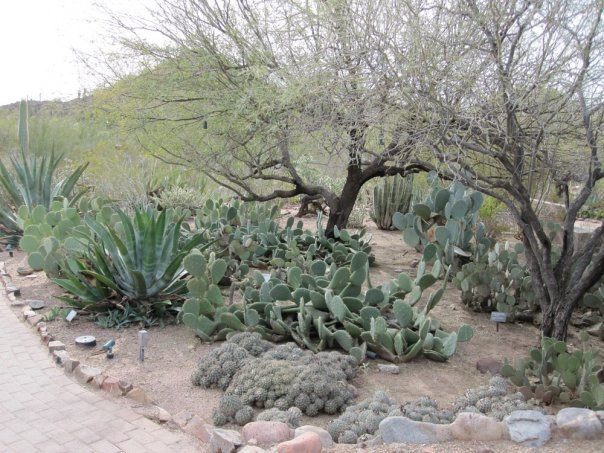
Ridiculous.  The desert is full of life, and the diversity of plant species is staggering. There are about 2,000 different kinds of cacti alone.  The six cactus genera with the largest number of plants, and hence most likely to be encountered, are cereus, cylindropuntia, echinocereus, ferocactus, mammillaria and opuntia. In addition to cacti, there are grasses, shrubs, trees, and wildflowers.  One of the best places to get a clear picture of the desert’s splendor is the Desert Botanical Garden in Phoenix, Arizona.  With more than 4,000 species and approximately 27,650 individual plants, the Desert Botanical Garden is home to one of the world’s most spectacular living collections of the world’s desert plants.

Desert Botanical Garden
Desert Botanical Garden, Phoenix, Arizona

We spent some time several years ago during a visit to Phoenix to wander through the Garden.  Perhaps the most striking feature is the endless forms and shapes that the plants in the desert take.  They have evolved over millions of years to take full advantage of the limited resources available, and water conservation dictates so much of the characteristics of desert flora.  Flowers tend to be less numerous but so much more striking in color, shape, and size than those found in other environments.  The Garden offers permanent trailside exhibits, temporary art exhibitions, and seasonal activities too.

Desert Botanical Garden
Desert Botanical Garden, Phoenix, Arizona

Sometimes it’s difficult to look beyond the familiar and seek the undiscovered, and I certainly found that to be true about the desert.  There’s green everywhere!  I have visited the Southwest several times now, and I am always ready to return.  It is wild, rugged, and even harsh, but it possesses a charm that can be found nowhere else in the country.  The Desert Botanical Garden is not to be missed.

Desert Botanical Garden
Desert Botanical Garden, Phoenix, Arizona

Grand Doesn’t Touch It

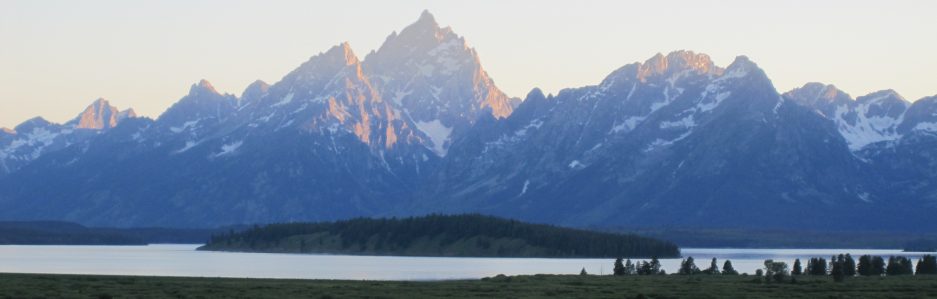
They call the range of mountain peaks at Jackson Hole the Grand Tetons, although there is actually one peak in the range that is identified as “Grand Teton.”  Whether you choose to believe the name is derived from the French term for large breasts or the Native-American Teton Sioux tribe, the adjective is about the best we can come up with to describe this majestic geological feature — GRAND.  But when you are standing on the deck of Jackson Lake Lodge, or sitting inside the lobby with its 60-foot tall windows, peering across the great expanse of land and water at those rocky crags rising thousands of feet into the sky, you soon realize that a word like “grand” doesn’t touch it.  Somehow, this is one of those sights, for me at least, that language fails to describe, that photographs cannot completely reproduce, that videos do not totally capture.  Of course, recognizing all of this did not stop me from making video clips and taking photographs, like the one here.  Grand Teton National Park is another one of those places I have had the joy of visiting where I am reminded how small I am and just how magnificent the natural world is.  Put it on your bucket list.

Grand Tetons from Jackson Lake Lodge

Little Rock Creek Falls

My wife loves adventures, and she has had quite a few.  My life is all the more richer because of the adventures we have shared in the eight years we have been married.  There have been times when I have “caused” adventures for which we didn’t necessarily make plans, but she has usually faced the challenges with enthusiasm and determination.  She is a gracious soul.  One such occasion happened about five years ago when I decided to search for a hiking trail that terminated at a waterfall — one of my favorite outdoor experiences.  I searched through a trail guide and selected one in north central Georgia in the Chattahoochee National Forest.  Little Rock Creek Falls looked beautiful in all the photographs I saw, which perhaps encouraged me to be a bit too dismissive about the descriptions of the trail leading to the falls that described it as being difficult and dangerous with thick underbrush.

Little Rock Creek
Little Rock Creek

For young folks or very athletic, experienced hikers, this trail would not be a problem.  My wife and I are casual hikers.  We are occasional hikers.  We are quite often paved-trail hikers.  Little Rock Creek trail has no pavement.  The length of the trail from the road to the falls is a little less than a mile, and the elevation is consistent; however, the terrain is quite steep and rocky as the trail makes its way along a sharp embankment following the creek.  The understory is beautiful and thick with mountain laurel and rhododendron.  At this stage of our hiking careers, we were not yet using sticks of any kind (we each have two now).  Under normal conditions, we would have considered this to be a moderately difficult hike, but alas, I had the audacity to take my dear wife on this excursion not too long after she had broken her shoulder, which she guarded carefully along the way.  I was nervous the whole time, fearing that she would slip and reinjure her shoulder or break something else trying to protect it as she fell.

Although we should have waited until she was in better shape to make this hike, I can state with certainty that neither of us was disappointed with the terminus of this trail.  It was one of the most secluded and enchanting waterfalls I have ever seen in Georgia.  We did the obligatory selfie shot with the falls behind us, which became profile pictures for both of us on social media for several months.  I apologized to her profusely for selecting such a treacherous trail, especially considering that she was still recovering from an injury.  As usual, she simply said, “I’m fine.”  She is indeed.

Little Rock Creek big falls

Panther Creek Falls

I have expressed my appreciation for waterfalls in previous posts, and we are fortunate to live in an area of the country where creeks, lakes, and waterfalls are abundant.  Even better, many of these features are freely accessible at state parks, national forests, and recreational areas.  One of the most popular waterfalls close to our home is Panther Creek Falls, located a few miles south of Tallulah Gorge in northeast Georgia.  This waterfall is located in the Panther Creek Recreation Area at the end of a 3.5-mile moderate walk along Panther Creek. The National Forest parking area is located on old U.S. Highway 441 north of Clarkesville.

Panther Creek Falls Trail is 5.5 miles long and follows Panther Creek through stands of hemlock and white pine along steep, rocky bluffs of the creek. The trails passes a series of cascades as well as Panther Creek Falls. It terminates where Davidson Creek joins Panther Creek.  When my younger son and I explored the trail last February, we decided to take the 3.5-mile hike to the falls and return to the parking area for a 7-mile excursion.  We had plenty of company on that mild winter day, with other hikers and campers all along the path.  The trail is noted for its beautiful variety of wildflowers and ferns. The stream offers excellent opportunities for trout fishermen too.  Some rock scrambling is required, and there are some steep sections, but much of the hike is relatively flat.  Erosion has caused several trail sections to drop sharply and suddenly to the creek below, demanding extra caution.  I was amazed at how many families with small children were there when we hiked the trail — some were even carrying strollers with them!

Panther Creek Falls
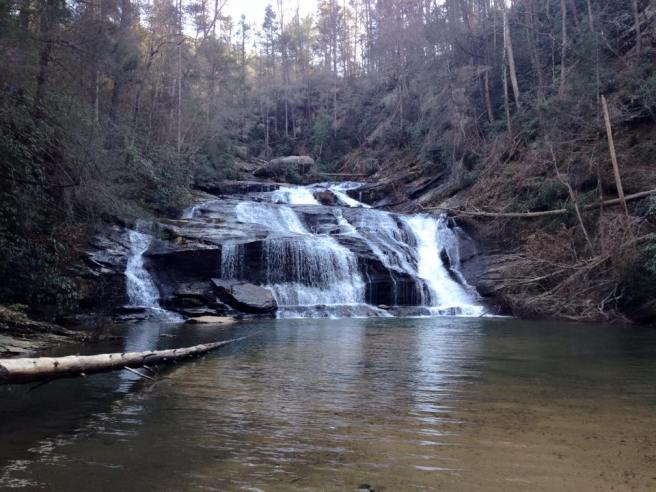
Panther Creek Falls

I was so enamored with the trail that I took my wife back at a later date, and while we only hiked in and out about a mile or so, she could appreciate the beauty of the forest and the creek without seeing the falls.  A large, shallow pool forms at the base of the falls, which is a wonderful destination for families and hiking groups.  The setting is beautiful, surrounded by hills covered in trees and laurel.  For those who like seclusion and privacy when they commune with nature, this recreation area is probably not a good choice.  In the warmer parts of the year, I’m sure it gets quite crowded.

Panther Creek Falls
View from the top of Panther Creek Falls

The naming of the creek is a source of curiosity for me.  I have not read anything official that links the name to animals that may have inhabited the area in the past.  According to some sources, a subspecies of the puma, the Florida panther, survives in a small, isolated and precarious population at the rapidly urbanizing southern tip of Florida. However, these animals were once widespread, even inhabiting portions of Georgia.  Another subspecies, the eastern puma (also known as cougar or mountain lion) may have once occupied regions of north Georgia.  Although in recent years there have been claims of sightings in north Georgia and South Carolina, the U.S. Fish and Wildlife Service has declared the eastern puma extinct and removed it from the list of protected wildlife and plants under the Endangered Species Act.  Regardless of nomenclature of the falls, this trail offers a great opportunity to get outside and enjoy the natural resources that are so abundant in the hills and mountains of north Georgia.  We will definitely return.

In Living Color

One of the passions I developed as a fairly young man was ornamental gardening and light landscape designing. I have lived at four different houses over the last thirty years, from the most southern to the most northern sections of the 7b agricultural zone, and have had the opportunity to experiment with a wide variety of plants.  My wife and I currently live in the foothills of the Appalachian mountains where the Piedmont shifts into the Blue Ridge.  The southern Appalachian region is one of the most diversified botanical places on the planet, with rich soil and enough rainfall to support lush, thriving ecosystems.

Flower garden
Flower garden

We were fortunate to find a house two years ago with previous owners who were just as passionate as we are about surrounding the house with beautiful plants.  They had done a lot of work with the structure of the property, especially in the front of the house.  They had established two beds in front of the porch, split by a brick walkway and steps.  Short to medium-sized shrubs are spread out on either side to complete the dressing of the house, and a large island is positioned between the house and the street, which has a nice and expanding collection of trees, shrubs, ornamental grasses, and perennials.  Among our own additions to that island is our favorite container, the large concrete planter with a “face” in full relief (visible in the background of the photo above).  We call her Annabel, named after Annabel Lee, the poem composed by Edgar Allan Poe, because she has a melancholy face reminiscent of the poem’s theme.  We usually plant something each year in Annabel that will make her look like she has hair growing from the top!

I am by no means a Master Gardener, nor am I much of a purist when it comes to plant selection.  I have a growing appreciation for native plants and received a book on native plants of the southeast as a Christmas gift.  I hope to incorporate more native species in our garden in the years ahead.  I love annuals and typically fill the front porch beds with New Guinea impatiens and coleus.  We have to be very diligent in spraying most of the plants in the yard with deer repellent, and non-native plants are much more susceptible to damage from animals.  Still, I love the big bang of color provided throughout the growing season by imported and hybrid annual cultivars.

For Father’s Day many years ago, my sons gave me a mortar-fabricated flat stone engraved with the following words: “Gardening comes second only to reading.”  The stone is still a permanent fixture in our garden, as it has been in every garden I have tended.  In many ways, this statement could easily be adopted as my philosophy, with the possible addition of family, music, and a few other passions.  I have savored countless hours in planning, designing, planting, and maintaining shrub and flower gardens.  It is another one of those activities that is so restorative for me.  It grounds me, with no pun intended.  Ralph Waldo Emerson once wrote that “the earth laughs in flowers.”  What a wonderful way to express the joy experienced in nature’s palette displayed in the beauty of plants.