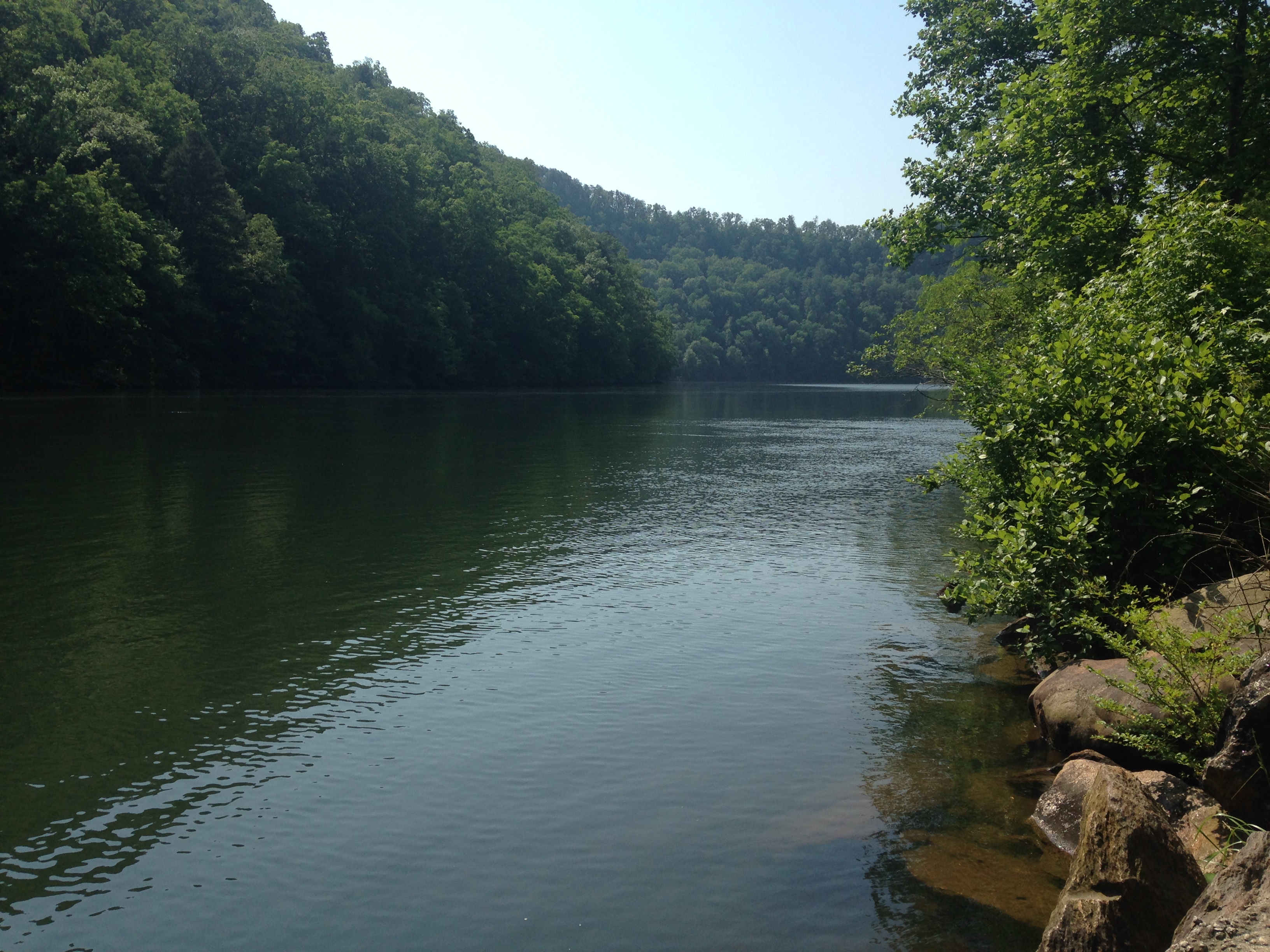
My younger son and I went out on the Hobie kayaks for the first time this season. We explored a lake in northeast Georgia that we’ve never visited before: Yonah Lake. We accessed the lake at Georgia Power Company’s campground, Tugaloo Park. The lake is more like a very wide river winding its way between the hills near Tallulah Gorge. The mountain laurel around the shoreline is still in bloom and quite beautiful. There is at least one brook that feeds into the lake in a great little shady cove that we could reach with our yaks. We also saw a guy skiing on a device that looked like a ski on top of an underwater blade. He was obviously training, performing some pretty impressive flips on the wakes. We will definitely come back to this spot again, perhaps to fish.
There are still plenty of outdoor places in America you can visit that are protected enough to offer a glimpse at how the landscape on this continent may have appeared to early native inhabitants and explorers. A prime example are some of the national parks. I think the National Park Service is one of the best government programs of all, and I wish our federal leaders would find some other areas to cut funding and leave this division alone. We have some incredible treasures around the country, several of which I have visited. I have never been disappointed.
One of the best parks to visit to experience what I am describing is Yosemite National Park in the High Sierra region of California. First protected in 1864, Yosemite is best known for its waterfalls, but within its nearly 1,200 square miles, you can find deep valleys, grand meadows, ancient giant sequoias, a vast wilderness area, and much more. There are so many places in this park where you can stand, and for as far as the eye can see, there is no sign of civilization. The vistas are absolutely breathtaking, including perhaps the most photographed view of all from just beyond the tunnel on Wawona Road, where the valley opens up and welcomes you to what many people refer to as God’s Cathedral. Indeed, the scene is like a place of worship on a monumental scale, and for those who have any appreciation at all for the beauty of the natural world, it invokes a sense of reverence and awe.
Yosemite Valley from Tunnel View on Wawona Road
My wife and I joined up with a good friend of ours there in July, 2013, staying several nights in a cabin and spending our days hiking along the valley floor and up to one of the high spots overlooking the valley. Yosemite is another one of those places that reminds me just how small I am and how magnificent this planet is. John Muir, the famous naturalist who helped draw up the proposed boundaries of the park in 1889, described Yosemite as being “full of God’s thoughts, a place of peace and safety amid the most exalted grandeur and enthusiastic action, a new song, a place of beginnings abounding in first lessons of life, mountain building, eternal, invincible, unbreakable order; with sermons in stone, storms, trees, flowers, and animals brimful with humanity.”
One of my favorite pastimes is feeding birds. I have had bird feeders close to my windows since I was a young boy, and I never tire of watching them gather around a feeder, flitting about to get the best position or to carry a seed to a nearby tree to eat in a more secure location. I am no bird specialist and can only identify the most common species that inhabit or pass through my part of the world. I don’t know their calls or that much about their habitats or characteristics. I am not a birder as such and have never gone out of my way to search for particular species. I can count on one hand how many times I’ve used a set of field glasses or binoculars to look at them. I simply enjoy watching them around my house and feel good about providing them food, water, and shelter, especially during the colder months. Their colors, designs, sounds, and antics fascinate me.
One of my favorite species that graced our feeders about this time last year are the Rose-Breasted Grosbeaks. They have that stark contrast of red, white, and black that you often find in some woodpeckers, but these are more like finches and frequent the feeders in the spring on their way to or from their nesting areas. I was able to peer at them through one of the doors that leads out to our deck where the feeder is hanging.
In the open feeders, I use safflower seed exclusively because the squirrels don’t like it and won’t take over the feeders as they do with sunflower seed. I also have a suet-cake feeder attached to a tree in front of the house. It is one of those feeders that is caged to allow only small birds in and keeps out larger birds, squirrels, possums, and raccoons. I don’t have anything particularly against the furry critters, but I am partial to the birds, and I have a soft spot for the small ones too. There’s something so magical to me about these little creatures, graced with the exceptional gift of flight, and clothed in so much beauty.
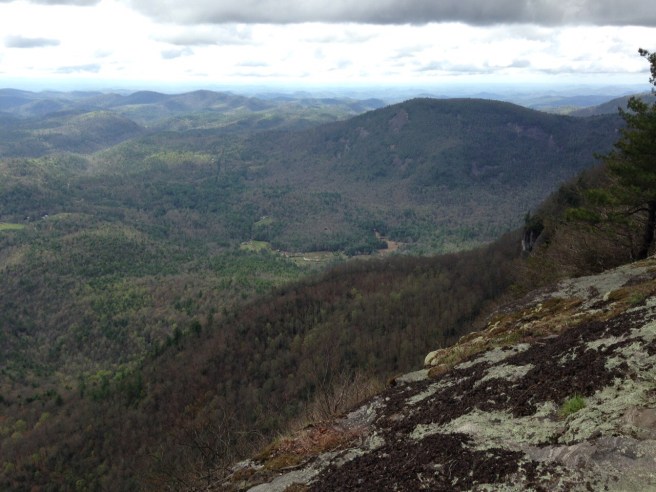
My wife and I really love to hike, and we have had the opportunity to hike in some beautiful spots: along the Pacific coast, in the desert, at Yosemite, and many other lesser known spots. Some of the greatest rewards of hiking are the vistas that some trails include, and some of the best I have ever seen are on mountain trails. Today, we hiked along the ridge that goes to the summit of Whiteside Mountain just outside Highlands, NC. The view from 4,800 feet was breathtaking. We have certainly been at higher elevations in other places, but the view today was spectacular, probably because of the mix of sun and clouds and the multiple shades of green introduced by the onset of spring.
I cannot understand people who have no appreciation for the outdoors — for the majestic presence of mountains and seashores, the mighty rumbles of thunder, the magnificent beauty of an ancient tree, a field in bloom, or a rushing river. I look forward to more excursions to follow trails like the one on this mountain, to see open sky and miles and miles of the earth below.
Of all the plants I see on my excursions through the forest, I think some of the most beautiful to me are among the most primitive — ferns. With origins going back anywhere from 300 to 400 million years, ferns have been around as long as reptiles and were spreading across the planet at least 100 million years before mammals arrived. By contrast, the primates only showed up about 60 million years ago, and the species we know as modern human beings have only been here for about 250,000 years.
Today, there are literally thousands of species of ferns growing in various habitats all around the world. They flourish mainly in places where flowering plants can’t grow because it is too wet or too shady. In other words, they have evolved to take advantage of habitats that the more dominant seed-bearing plants can’t handle. Instead of becoming extinct, they adapted. There seems to be a philosophical message there.
I think my attraction to ferns comes from the delicate fronds that are characteristic of so many of the species. In America, they are often found in shady, moist places that are cooler then the surrounding area, and their lush, green color implies fertility and vitality. The way they pulsate with the slightest breeze has such a calming effect on me. Apparently, my interest in ferns is shared by quite a few folks in this country, illustrated by the existence of an organization devoted to studying the plants. You can find out so much more information about ferns at the website of the American Fern Society.
When I tell people that my wife and I like to take our kayaks out and do a little peddling, they usually want to correct me by saying, “You mean paddling, right?” Actually, with our kayaks we can do both. We discovered about three years ago the Hobie line of kayaks equipped with foot-driven flippers called the Mirage Drive. These kayaks are larger and heavier than the standard sit-on-top crafts, and they are definitely pricier. However, if you enjoy getting out on large water — deep rivers and canals, lakes, and even the ocean — then peddling has such an advantage over paddling, especially for speed, distance, and longevity. You can still use a paddle to propel the kayak if you prefer, and at times you need to, such as in tight spots and shallow water or for docking. If you’re really athletic or feel the need for a total-body workout, you can do both. But, in open water using just the Mirage hyper-drive paddles, the Hobie will cruise at about 5 mph with little more effort that riding a bicycle. In a three-hour excursion you can cover quite a bit of water. The length and width of the Hobie kayaks make them more stable than standard models, so you can stay dry during most if not all of your trip, especially if you enter and exit the craft from a dock ladder. The only major disadvantage is transporting the Hobies. They can be strapped to the top of a car, but getting them up there is almost impossible without two people or a very complicated lift system. We use a pickup truck with a bed extender — works like a charm. I have seen some of the most beautiful sunrises and mystical horizons while riding my kayak. I’m always looking forward to the next trip.
If you like hiking, or simply taking a walk on a nature trail, the state parks and national forests in north Georgia are some of the best places to enjoy this activity. The state of Georgia does a fine job, with dwindling resources I am quick to add, with the access to natural resources it provides through the state park system. The trails vary in length and difficulty levels to accommodate almost any age and degree of fitness. Most parks have trails that are wheelchair accessible. The diversity of flora and fauna in the southern Appalachia is unmatched anywhere in the U.S. There are very few weeks out of the year where the weather makes outdoor exploration uncomfortable here. I have spent many hours wandering mountain paths through densely wooded countryside and have always come away restored.





 If You Want My Opinion