
Art and Social Change

Do artists have a social responsibility?  That was the question posed for discussion to participants in lunch breakout sessions at the recent Symposium on Arts and Social Change sponsored by the Lillian E. Smith Center of  Piedmont College, a small private liberal arts college in Demorest, Georgia.  The Symposium, titled “Between Dream and Reality,” focused on public art as an inspiration for social change and was held at the college’s second campus in Athens, a town dominated by the presence of the University of Georgia.  Each breakout session had no more than a dozen people, so the conversations were manageable but lively.

Jen Delos Reyes
Jen Delos Reyes

The Symposium featured keynote speaker Jen Delos Reyes, Associate Director of the School of Art and Art History at the University of Illinois Chicago. Reyes is a creative laborer, educator, writer, and radical community arts organizer. Her practice is as much about working with institutions as it is about creating and supporting sustainable artist-led culture. She is the director and founder of Open Engagement, an international annual conference on socially-engaged art that has been active since 2007 and hosted conferences in two countries at locations including the Queens Museum in New York.  In her early-morning presentation, she highlighted three artists who are also community activists, people who have used creative approaches to address serious challenges in their neighborhoods with projects such as restoring row houses to safe, habitable homes that had become drug-infested death traps.

Other featured speakers at the Symposium included Ellen Elmes, a retired college art instructor who has painted twenty-five plus murals in several different states that celebrate community. Another presenter was Hope Hilton, an Athens-based artist, educator, designer, and writer who works with communities and students of all ages to inspire and facilitate a sense of place, history, and agency.  Broderick Flanigan is a freelance artist in Athens who is a community activist and the founder of Flanigan’s Portrait Studios.  The event was moderated by Barbara Brown Taylor, the Butman Professor of Religion at Piedmont College and author of thirteen books, including the New York Times bestsellers Learning to Walk in the Dark and An Altar in the World.  All of the presenters at this Symposium are devoting significant time and energy in their capacity as artists to promote, encourage, and facilitate positive social change.

Symposium logo
Symposium logo

Throughout her career as a writer and humanitarian, Lillian Smith examined how the arts engage people around issues of social injustice, segregation, and isolation.  Art was her passion, and she held a deep conviction that the artist has a responsibility to engage her audience in the conflicts and struggles of her generation, an opinion not necessarily shared by the students of The New Criticism movement, the literary theory that dominated the mid-20th century.  Smith emerged in the 1940s at the forefront of the Southern debate on segregation, where she was at least a decade ahead of other white liberals and stood virtually alone in calling for an immediate end to segregation laws and practices.

During the tumultuous years of the mid-20th century, when lynching, convict labor, and Jim Crow laws were still casting dark shadows across the South and African-Americans all over the country were pleading for justice and equality, there were plenty of elected officials and prominent leaders who were endorsing a patient, moderate approach in addressing the crisis.  Lillian Smith was not one of them. In a speech prepared for the Institute on Non-Violence and Social Change on the first anniversary of the Montgomery bus boycott in 1956, Lillian Smith wrote these words:  “You have done many good things, down here in Montgomery.  But one of the best, one of the most valuable, has been the fact that you have dramatized, for all America to see, that in times of ordeal, in times of crisis, only the extremist can meet the challenge.  The question in crisis or ordeal is not: Are you going to be an extremist?  The question is: What kind of extremist are you going to be?”

In a powerful essay titled “The Creative Process” written in 1962, James Baldwin made the following observation:

There are, forever, swamps to be drained, cities to be created, mines to be exploited, children to be fed. None of these things can be done alone. But the conquest of the physical world is not man’s only duty. He is also enjoined to conquer the great wilderness of himself. The precise role of the artist, then, is to illuminate that darkness, blaze roads through that vast forest, so that we will not, in all our doing, lose sight of its purpose, which is, after all, to make the world a more human dwelling place.

There can be little doubt that, through her novels and nonfiction works, Lillian Smith was indeed trying “to make the world a more human dwelling place.”  Does art exist in a vacuum?  Should the artist seek to be completely separated from society, unattached and oblivious to the pressing social issues of the day?  The answers to those questions can be debated over and over again with no real resolution.  What is clear, however, is that art has the mysterious power to transform minds and emotions, to spark imagination, to inspire collaboration, and to motivate people to act.  Once the work is done and that power is unleashed, the artist has very little control over the ultimate impact of what she has created.  Perhaps recognizing that indisputable truth is where the responsibility of the artist begins.

“To find the point where hypothesis and fact meet; the delicate equilibrium between dream and reality; the place where fantasy and earthly things are metamorphosed into a work of art . . . this is what man’s journey is about, I think.” –Lillian Smith, The Journey

You Should Write a Book

The title I selected for this post is a phrase often used by friends and colleagues of someone who is going through or has just recovered from an unusual set of circumstances, often stressful and almost always unexpected.  The situation may be a life-threatening, horrifying experience, or it may be extremely bizarre or even comical, at least in hindsight.  At any rate, the event seems to be right on the verge of the unbelievable to the individual in question and certainly to outside observers.  What has happened sometimes illustrates the phrase “truth is stranger than fiction,” thus the idea and suggestion that the experience would make for an entertaining story.  Quite a few people who knew me during my tenure as the director of the Flannery O’Connor-Andalusia Foundation suggested that I should write a book about some of the outrageous things that happened during my thirteen years with the organization.  A question I heard over and over was, “So, do you ever feel like you’re in a Flannery O’Connor story?”  The answer was always the same: “Well, of course.”

Andalusia historical marker and signs

I was hired by two of O’Connor’s first cousins, who had been selected by O’Connor’s mother, Regina, to serve as executors of the estate (both real and intellectual property) and as trustees of the Mary Flannery O’Connor Charitable Trust, which was charged with making distributions from the estate and controlling the copyrights of O’Connor’s work, among other responsibilities.  I worked for them as an independent consultant for two years while a nonprofit foundation was being established to maintain Andalusia, O’Connor’s home in Milledgeville, Georgia.  Once the foundation was established, I became its director.  About one third of the governing board of the foundation was made up relatives of Flannery O’Connor, all on her mother’s side — the Cline family.  O’Connor once wrote in a letter to a friend that irritation was the only respectable emotion in her family, a tradition that continued long after her death.  Irritation was a frequent special guest at foundation board meetings.

The chair of the board was the husband of one of the two executors and trustees mentioned above.  He was a remarkable biomedical engineer and professor who was credited with developing an early prototype of a bionic prosthetic arm.  His wife was a brilliant woman (a trait that did run in O’Connor’s family) with more than one advanced degree.  In addition to serving on the board and fulfilling her roles with the estate, she had worked for NASA for a while during the development of the solid-rocket boosters that would eventually propel the shuttle into space.  Sadly, she passed away shortly after the foundation was established.  As intimidating and as tough as they were, I respected them both and always believed they wanted the foundation to succeed under my leadership.  They were very patient with me and supportive.  Her husband continued in his role as the board chair, and it was a pleasure to work with him until his death several years later.  Her sister became the sole executor after this woman’s death and shared her responsibilities of the Charitable Trust with her brother-in-law, the board chair, who had been named by his wife as her successor for that position.  These two in-laws had a rather contentious relationship.

Main house at Andalusia

I have had many years to think about my interaction with the executor, going all the way back to the time she and her sister hired me in the fall of 2000.  A Harvard-trained lawyer (among the first females to graduate from the institution with a law degree) who had worked almost her entire career for federal government agencies, she was already well known among the scholarly community as being extremely protective with copyrights and permission requests for publications about O’Connor’s work.  She was absolutely devoted to maintaining the reputation of the Cline family, most especially a couple of the patriarchs who had either purchased the Andalusia farm where O’Connor and her mother lived or had helped with its operation as a dairy in the 1950s.  The executor was also highly discriminating when it came to who should be considered a part of the family and who should not, regardless of legal relational status.

Board meetings were usually quite tense, especially interactions between the executor and the board chair.  For the non-family board members, some of whom had impressive credentials, this type of organizational dysfunction was painful to watch.  The executor resisted opening Andalusia farm to the public, and once it was open, she wanted to be directly involved in its daily operation and how the property was interpreted to visitors.  At times, I refused to accommodate her in this regard, which drove a thick wedge between us that would continue and grow during the rest of my tenure at the foundation.  She considered herself an authority about the history of Andalusia farm, but she refused to acknowledge that the real significance of the site was directly related to Flannery O’Connor’s time there as a writer, the very part of the site’s history she admittedly knew less about because she wasn’t a part of it.

Under the leadership of the next board chair (also a family member), the executor resigned from the board; however, she continued to exert her influence on policy and procedure.  In the years that followed, her criticism of my efforts as foundation director became more acute, to the point that she would appear at our public programs or show up unannounced at Andalusia and voice her discontent openly.  Of course, devoted fans of O’Connor were always drawn to her and wanted to meet her and talk with her because she was a relative and a contemporary of the writer.  She could be extraordinarily charming when she wanted to be, and her sense of humor was wicked.  Ironically, she rarely would discuss O’Connor with anyone but elected instead to talk about other family members and her personal memories of the farm going back to her childhood, which had little to do with Flannery O’Connor at all.  She didn’t know Flannery O’Connor very well — they were not close, even though their mothers were sisters and the executor and her sisters spent summers with O’Connor when they were young children.

As they left childhood behind, these two women took very different paths.  In spite of spending time together as children during the summer months, they lived in two different parts of the country for most of their early years.  They earned their respective educations far apart from one another.  This cousin’s career took her to the nation’s capital and elsewhere, while O’Connor’s illness took her back home to live the last thirteen years of her life with her mother on a farm in middle Georgia.  Long after O’Connor died and her mother became a very old and frail woman, this cousin moved to Milledgeville to handle Regina O’Connor’s affairs and supposedly to protect her from threats outside the Cline family.

Here was a woman who was educated at Harvard, who was among the first females to graduate from there with a law degree, who had worked for the federal government and had even argued before the Supreme Court.  Her first cousin happened to be a famous American writer.  Not only was her cousin a great writer, but the characters she created were terribly grotesque and some of them had noticeable similarities to people she knew in real life.  The language, the plots, and the black humor were shocking for polite society of the mid-20th century and a bit embarrassing to readers whose fictional palates were better suited for Jane Austin, Emily Bronte, or even Eudora Welty.

There is no doubt at all that the Cline family members had a difficult time appreciating, much less discussing, Flannery O’Connor’s novels and short stories when they were first published.  It is highly likely that some relatives continued to struggle with her work decades after the author’s death in 1964. The executor made every effort, sometimes successfully, to control how O’Connor’s work was treated, examined, studied, criticized, and made available to the world.  I suspect her appreciation for O’Connor had more to do with the author’s role as an apologist for the Catholic Church. How Flannery O’Connor would have reacted to the way in which her literary legacy was handled is anyone’s guess. Would she be irritated or entertained? (NOTE: The executor died in 2023. I am hopeful that going forward the trustees in charge of O’Connor’s literary estate will be less restrictive and controlling and more willing to work with scholars and writers in further exploring the work of this great American writer.)

Godless Ethics

Good Without God by Greg M. Epstein is a nice overview of how people who do not believe in God live an ethical life, how they are charitable, loving, compassionate, fulfilled, and inspired without religion as their primary motivation. Epstein is obviously trying to soften the message of the irreligious that has been expressed by leading atheists with sarcasm, indignation, and even rudeness. In some sense, he is playing the role of a modern Thomas Aquinas, the Angelic Doctor who is trying to find consensus between the religious and the secular world.

It does seem to me, especially toward the end of the book, that Epstein is attempting to find ways in which humanists can enjoy the worldly fruits of religion through culture and ritual, as if living a humanist life without the type of community that faith offers is empty or disconnected. No doubt, his Jewish heritage is coming into play here, which he fully discloses. Perhaps this perspective also comes out of his role as a humanist chaplain (still an odd title for a humanist in my opinion) at Harvard.

I get the sense that he thinks the creation of humanists organizations that look and function like churches, synagogues, or mosques will somehow make humanism more “competitive” or more attractive or perhaps even more palatable to the skeptics or the indecisive. It reminds me of vegetarians and vegans who eat foods that are considered meat substitutes because they crave meat but won’t eat it. I think humanists can find community and social interaction outside organizations that look and sound like religious ones. In fact, I would venture to say that plenty of believers find their most meaningful connections outside their religious circles.

This is a very accessible book that is well written, thoughtful, and completely unoffensive to left-leaning, progressive readers. Evangelicals and other orthodox or fundamentalist faithful will hate it. There is no doubt that Epstein was very encouraged by the election of Obama, which occurred one year before the book was published. For people who were raised in strong religious environments but now find themselves in the camp with agnostics or even atheists, Epstein’s conclusions can be reaffirming, perhaps even comforting.

.

The Independent Bookstore: A Reader’s Oasis

The last Saturday in April is designated as Independent Bookstore Day, and according to the U.S. Census Bureau, bookstore sales increased 2.5 percent from 2014 to 2015. The American Booksellers Association, which represents independent sellers, reported 1,712 member stores in 2015, up from 1,401 in 2009.  These figures should put to rest the notion that books made of paper are soon to be replaced by electronic forms.  I realize there are plenty of readers who still hold great affection for traditional books — the paper kind.  There are scholars who have argued that reading physical books is a completely different experience than reading eBooks.  Most bookstore owners would probably agree.  Both formats seem to be doing fine, which should be good news to all readers.

Once a medium of information is introduced, it tends to survive no matter what other “new and improved” medium follows.  Some platforms may become obsolete (stone tablets, 8-track tapes, Beta videotape, etc.), but in general, new forms of information delivery don’t dispatch previous ones.  The written word has never stopped people from telling stories or stage acting. Motion pictures certainly didn’t do away with reading.  Radio didn’t destroy movies, television didn’t stop radio broadcasts, and the availability of videos hasn’t destroyed the television industry.  One could argue that computers have only facilitated many of these delivery methods rather than replacing them.  More importantly, none of these has killed the book, regardless of how we decide to read.

There is no question that the last few decades have been tough for small, independent bookstores.  Many of the ones that survived the advent of the mega-bookstores were finally wiped out by the online providers.  Electronic books no doubt delivered another crushing blow to bookstores, but the truly creative entrepreneurs figured out a way to stay relevant and competitive as a niche market.  One approach is to create a salon-type atmosphere that welcomes the reading shopper and provides a sanctuary, a respite from the fast-paced grid that characterizes so much of our society.  Nicole Sullivan, owner of Denver’s BookBar, was quoted in a recent article in The Denver Post.  “As it gets harder for brick-and-mortar businesses, hybrid businesses become more important,” Sullivan said. “It’s either get it fast and cheap online, or come into a store and have an experience. That’s what indies have to offer, a more personalized experience and that sense of community we’ve lost a lot of over the years.”

I have fully accepted the convenience of eBooks and have been an Amazon Kindle customer since the first year they came on the market.  I’m sure some of my library colleagues were horrified by the introduction of virtual books, but now eBooks are a big part of library holdings.  For fiction and other books that rely very little on illustrations or graphics, I actually prefer eBooks.  However, I treasure the large, hardbound gardening, history, and travel books that fill our shelves at home.  Not even iPads or desktops are acceptable for those titles for me.  I also prefer to browse through slick-paper magazines by physically turning pages, not touching a screen.  Because we live in a rural area, the chances of an independent bookstore surviving for very long are slim, so we order many of our books online.  We also go to the web to shop for household goods, clothes, and equipment.  But, when we travel to places like San Francisco, Chicago, and New York, I almost always make a point to visit an independent bookstore.  To me they all seem to have their own “personality” that makes them unique.  If a book is the door that leads to imagination, then a bookstore is a hallway with almost endless possibilities.

Book Lady Bookstore, Savannah, GA

Restoring My Soul

Sometime in February while I was scrolling through Facebook, someone posted a short video of himself playing his guitar.  In the message that accompanied the video, he mentioned that he was on a solo retreat in a cabin.  It had never occurred to me until then that a weekend of solitude and reflection could be so attractive.  A wise scholar and friend recently observed that, like she and her husband, my wife and I are “well married.”  It’s a phrase that we had not used before but now fully embrace.  We are indeed well married.  We have been together nine years and married for eight of them.  We enjoy each other’s company.  We like working at the same place, coming home for lunch together and having dinner together, either at home or at a restaurant.  We love to travel; we love to hike; we love working on projects; we enjoy our time at home, especially our evenings and weekends.  My wife has some friends and colleagues that she will occasionally meet for lunch or dinner, and sometimes she makes it an overnight trip.  It is good and healthy for her to stay connected to these people because they have been so important in her life and her profession.  Sadly, there are more such connections in other parts of the country where she has previously lived, and it is difficult to see them regularly, but she makes an effort to do so when possible.

I have a good friend who lives not too far away from us – someone that I have been close to for over twenty years now.  We see each other about once a year or so, and I enjoy catching up with him.  We also stay in touch by phone, texts, and Facebook.  I don’t have as many good friends as my wife does, that is, people I have maintained a close relationship with through the years.  As gregarious as I probably appear to colleagues and acquaintances, the truth is I am a bit shy around people I don’t know, unless I am speaking to groups professionally or performing music.  I was in a band for ten years, so I’m sure there are folks who would scoff at the idea of my being bashful in any shape or form.  There are times, and only for brief periods, when I truly cherish being alone.

When I saw that Facebook video post, I began to think about what it would be like to have a solo weekend, something I have not done in decades.  I started thinking about what I would do for 36-48 hours away from my bride, my sons, my job, our home – away from anyone I know.  I could read, write, study, play music, think . . . and think some more.  I was a bit nervous about pitching this idea to my wife, because the last thing I wanted her to think was that I don’t adore her company.  This woman who clearly loves me unconditionally thought the idea was marvelous and whole-heartedly supported my decision to find a cabin in the mountains for an early spring mini-sabbatical.  Now, as I write this blog entry, it is Saturday afternoon.  I am looking out the window of my retreat cabin in the high country of North Carolina less than a mile from the Blue Ridge Parkway.

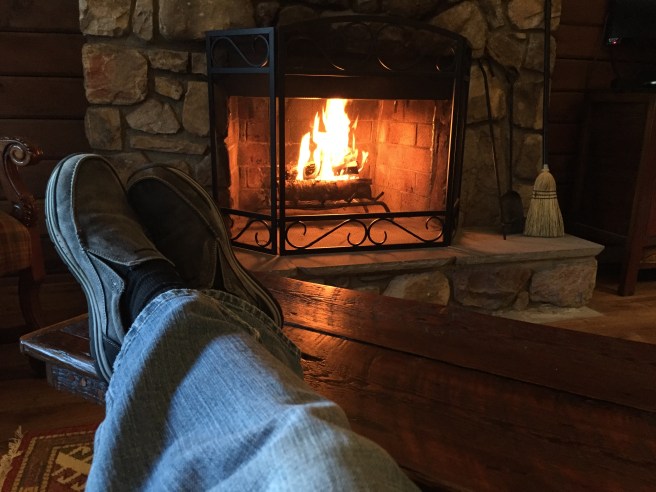
I arrived yesterday afternoon, checked in with the inn keeper in town, drove a few miles to my cabin, settled in quickly, poured a glass of Jack Daniel’s Tennessee Honey and headed to the front lawn to relax in a comfortable chair and take in the view.  I followed the inn keeper’s recommendation for dinner at a local bistro, which was an excellent choice. I bought just enough provisions at the grocery store to keep me satisfied for 24 hours, and then I came back to the cabin and sipped more whiskey.  A storm came through last night and dusted the surrounding hillsides with snow, just enough to make it pretty but not so much to make it a nuisance.  I got up a little before 8:00, put on the coffee, and started reading Fitzgerald’s The Great Gatsby, a novel I read many years ago and have mostly forgotten.  I have been reading news and op-ed pieces from the New York Times.  I have had a fire in the fireplace for the last couple of hours, and I have played songs on my guitar that I haven’t attempted in years.  I don’t intend to leave the cabin until heading out for dinner this evening.  I am enjoying a full earth’s rotation of intense relaxation.

Relaxing by the fire

Just now, as I sat down to reflect on this opportunity and record it, I was reminded with great humility and appreciation of just how fortunate I am.  When people from my past ask me if I’m happy, I usually reply, “I’m the luckiest guy I’ve ever met.”  I am lucky to have a wife who ignores my inadequacies, my rough edges, my occasional crudity, and loves me with a devotion that is almost frightening.  It is also a gift to love her more than I have ever loved another woman.  I am lucky that my sons seem to be stable and healthy in spite of great tragedy and loss they have endured.  I am lucky to have extended family who may not always understand me and perhaps even worry about me, but who also love me deeply and take joy in my happiness. I am lucky to have been raised by parents and grandparents who encouraged creativity, loved to laugh, believed in the virtue of hard work, and exhibited rock-solid faith in their God and their church.  While not having the advantages afforded by a higher formal education, my parents made the necessary sacrifices to ensure that I received the advanced degrees I desired and that have opened up so many possibilities for me through the years.  I have had some incredibly inspiring teachers.

I have lived almost 56 years with few significant health challenges.  I have some modest talents and skills that are fulfilling to me and that I have been able to share with others.  My wife and I have a standard of living that is not enjoyed by a large majority of the world’s population.  We are grateful, even though we know our generosity does not extend as far as it should.  My career path has presented me with so many memorable encounters and experiences, and I know how rare that privilege is.  Lastly, we have the resources that make it possible for me to rent a cabin in the Appalachian Mountains to be self-indulgent for a weekend and to contemplate the precious gift of a good life that I’m sure I don’t deserve but for which I am eternally grateful.  And to my bride, the love of my life: thank you for giving me this place and time.

A Writer By Any Other Name

One of the most gifted short story writers of the 20th century has a name that is rather unusual, although as a tribute to her talent, it is not as uncommon as it was during her lifetime.  There is a growing population of women, most under the age of thirty I would imagine, with the first name Flannery.  Those who are familiar with the life of the famous Georgia writer know that “Flannery” was a family surname and her middle name.  Her full name was Mary Flannery O’Connor.  However, when she went away to graduate school and eventually enrolled in the Writers’ Workshop at the University of Iowa, she decided to drop her first name and began signing all her work simply as “Flannery.”   Further, she requested that friends, relatives, and even her own mother refrain from calling her Mary Flannery, the double-name style that was so typical of women in the early to mid-20th century in the American South.  From that point on, she would be Flannery O’Connor.

It is impossible to know how much thought or even strategy went into Flannery O’Connor’s decision to abandon her first name.  Considering that she was raised a devout Roman Catholic and was a dutiful daughter of the Church, it would not have been a choice made lightly or carelessly.  Indeed, someone so committed to the faith would need a very good reason to drop the name of the mother of Christ, especially considering that she was adopting a much more masculine forename or Christian name — the irony is obvious.  Her mother, Regina Cline O’Connor, resisted for a while but finally gave in to her daughter’s demands.  Years later, O’Connor claimed that she made the name change primarily for the sake of her career as a writer.  She explained to friends that no one would want to read anything written by someone named Mary O’Connor, which to her sounded like the name of an Irish wash woman.

On second thought, readers of O’Connor know that she was incredibly deliberate in her craft as a writer.  By the time O’Connor hands us a story, there is not a single word or mark of punctuation left on the page that doesn’t need to be there.  Those steel blue eyes served as windows into a brilliant mind with a razor-sharp wit.  Flannery O’Connor had wanted to be a writer from a very early age.  As a child, she wrote stories, illustrated them, bound them with yarn, and made multiple copies of them to distribute to friends and family.  She was absolutely fascinated by the whole process of both writing and publishing, which later translated to a keen understanding of writing as a profession.

I am convinced that when O’Connor began writing in Iowa in the mid-1940s, she also started to envision herself as a successful author.  Knowing that she would soon be sending manuscripts off to prospective agents and publishers, she no doubt understood her disadvantage of being a female who wanted to be taken seriously in a male-dominated profession.  To avoid having her manuscripts ignored or trashed immediately, she needed for editors to think they were reading the work of a man, and a name like Flannery gave her that edge.  Certainly the content of her fiction would not have given her gender away!  The strategy worked.  Letters she received from editors in response to her early submissions were addressed “Dear Mr. O’Connor.”  One early editor, upon learning O’Connor’s identity, still doubted that the stories were written by a woman at all.

Beyond the androgyny factor, a name like Flannery O’Connor gave the writer another distinct advantage, one that is often fabricated now by entertainers from a multitude of genres.  Having an unusual name goes a long way toward establishing memorable identity.  After all, how many writers do you know named Twain?  Poe?  Steinbeck?  Faulkner?  Of course, those are last names, and isn’t it amazing how often readers don’t refer to O’Connor by her more common last name, but by her iconic first name?  Fast forward to the age of pop culture.  It isn’t difficult to remember names like Cher, Sting, Madonna, Eminem, T-Pain, or Beyonce.  Who needs a last name?  Atypical works, and it works well.

Flannery O’Connor died at the young age of 39 from complications of lupus, the disease that had taken her father’s life when she was only 15.  Her mother outlived her by about 30 years.  I don’t know if O’Connor chose the wording for her tombstone or not.  Perhaps Regina O’Connor had the last word with her only child this time.  Maybe the inscription was dictated by the custom of the Church, the community, or family tradition. Whatever the case may be, O’Connor is laid to rest with her full name restored as a memorial to a literary genius.  Those of us who admire her work will always respect her wishes and remember her as Flannery O’Connor.  A writer by any other name is, well, someone else entirely.

Flannery O'Connor's grave
Flannery O’Connor’s grave

The Reading Spot

If you are an avid reader, then you most likely have a favorite place to read.  I have certainly had some nice ones over the decades: a legless chair on the floor in the corner of my room as a teen, a library study room in college, an office in my first house, a recliner in my second house, a comfy chair in the loft overlooking the lake in the first house with my wife, and now an even more comfortable chair in our living room where I can watch the birds feeding with the forest as a backdrop.  There are loads of Pinterest pages devoted to reading spots, blogs that explore their enchantment, and even an Annual Unusual Reading Spot Contest .

Designating a space for reading gives the activity a certain reverence, doesn’t it?  Not that we can’t do something else in that space, but we associate it with the pleasure of being immersed in someone else’s imagination (and our own), research, or advice.  The reading spot becomes a type of sanctuary, where the reader deliberately separates herself from her surroundings, and when she leaves the spot, she is not the same ever again.  Alice is indeed in Wonderland.

I also, through the decades, have developed the habit of rising as early as I can to read. That is to say, I get up as early as I can drag out of bed with enough sleep to function for the day.  I am most alert early in the morning and can focus on the words.  A cup of coffee and a book are the most perfect early-morning companions, aside from my wife, that I can imagine.

A Passing Literary Glance

The Georgia Writers’ Association held its 1955 annual meeting in Atlanta in early December.  On this occasion the Association honored Lillian Smith (social justice advocate and author of the controversial works Strange Fruit, Killers of the Dream, and The Journey) as the winner of the Georgia Writers’ Award for the best book of nonfiction with the most literary value written by a Georgian in 1954.  She felt the award was overdue but was proud at any rate that the Association exhibited the courage to recognize her importance as an artist.  Smith was terribly amused by the annual meeting – a sentiment I can almost imagine would have been shared by another Georgia writer named Flannery O’Connor who was also in attendance.

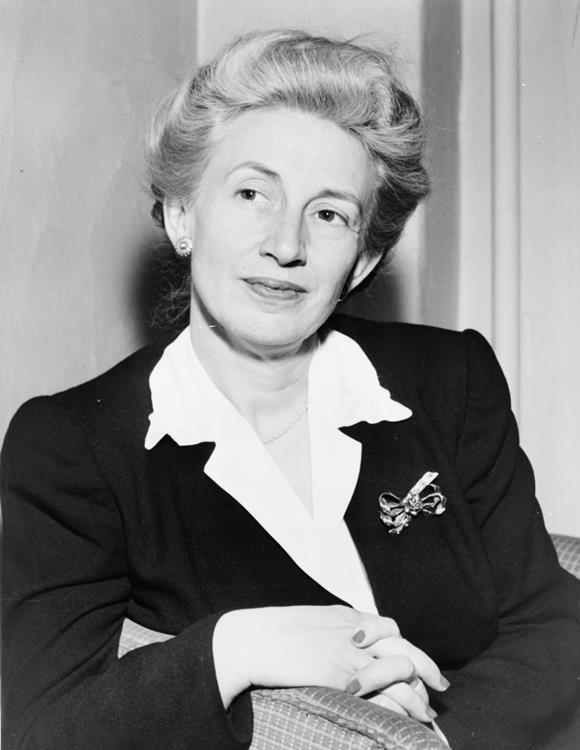
Lillian Smith
Lillian Smith

Lillian Smith was not invited to speak at the award ceremony; however, after meeting her and talking with her, the organizers decided to ask her to give an impromptu speech the next day, which she did.  Afterwards, an elderly woman in the audience came up to compliment the writer on how sweet and well-bred she was, exclaiming that Lillian Smith must have had the best intentions in the world, regardless of what she may have written in her books.  On the previous day, Flannery O’Connor delivered a luncheon address to this convention titled “Some Problems of the Southern Writer.”  Lillian Smith was at the luncheon, and this is what she had to say about O’Connor’s presentation:

Flannery’s talk was one of the funniest things I ever listened to.  Do you know – I don’t believe she had the vaguest notion how she shocked the crowd.  She told em off; told Georgia off; told the South off; told would-be writers off. . . . The stuffed shirts and the would-be writers (the place was full of them) began listening smilingly because they had heard she was “literary” and “talented” and nothing she wrote threatened anybody, certainly not on the conscious levels of their life.  But after about two paragraphs they realized that a nice little snake was sinking her fangs deep into their complacency and they began to look at each other and shake their coiffured heads and whisper, “Well . . . .what do you know . . .”
(all quotations from How Am I To Be Heard: Letters of Lillian Smith, edited by Margaret Rose Gladney; The University of North Carolina Press, Chapel Hill, 1993)

Smith mentioned O’Connor’s presentation in a letter to her editor at Viking Press, Denver Lindley, who also served as an editor for Flannery O’Connor.  There was a tone of bitterness, if not irritation, when Smith wrote that “these young writers can now say things out loud without any realization, actually, of how one or two of us down in the South opened the way for them.”

As far as I know, this was the only time that Lillian Smith and Flannery O’Connor were in the same room together, although they lived only 150 miles apart.  O’Connor confided to her friend Cecil Dawkins that, although she considered Lillian Smith to be a nice person, O’Connor was not impressed with Smith’s writing.  In a letter dated December 2, 1955, to Lon and Fanny Cheney, Flannery O’Connor stated that, at the Association meeting, Lillian Smith invited her for a visit to her home, but O’Connor declined.  In her essay titled “Flannery O’Connor and Lillian Smith: A Missed Opportunity,” published in the 2007 issue of the Flannery O’Connor Review, Virginia Wray observes that O’Connor’s brief remarks about her fellow Georgia writer in this letter carry with them a tone of sarcastic dismissal.  I know those who have studied O’Connor’s life are shocked by this revelation!  It’s no secret that O’Connor reserved some of her most acidic comments for other writers, especially those close to home.  O’Connor’s comments about Smith were rather tame by comparison.

Lillian Smith would go on to publish several more books, fiction and nonfiction, and numerous articles and essays on social justice and racial equality.  The last book published before her death came out in 1964, the year that Flannery O’Connor died; however, she continued to contribute to periodicals and newspapers until her own death on September 28, 1966.  One of the pieces Lillian Smith wrote for publication the year before she died was a book review for the Chicago Tribune.  The title of the review was “With a Wry Smile Hovering Over All.”  As fate would have it, Lillian Smith would get the proverbial last word in this evaluation of Flannery O’Connor’s second collection of short stories, Everything That Rises Must Converge.  It is worth noting that Smith and O’Connor had both developed an admiration for Teilhard de Chardin, although Smith claimed that, in the title story of the collection, O’Connor had twisted the Jesuit priest’s “profound and poetic vision into something small enough for her to smile at wryly.”  With regard to the other stories in the collection, Smith perceived that the author’s point of view lacked compassion and empathy, which should make us all wonder if she read O’Connor’s first collection of short stories.  Still, Lillian Smith considered O’Connor to be a highly gifted writer and described the title story as a masterpiece, where every line counts, every word.  No fan of O’Connor’s work could disagree with that assessment.

A Little Less Anonymity

When I started this blog back in April, I had some misguided notion that I should keep my identity hidden, primarily because I thought that some of the future content would be personal or sensitive, and I feared offending my family, friends, and associates.  What I have come to discover is just how difficult it is to write about my own experiences and opinions while remaining completely anonymous.  There are significant stories and memories that I have had to avoid to stay in hiding.  No more I tell you!

I still prefer not posting my personal information in my profile; however, the stories I tell will definitely reveal my identity to people whom I have encountered over the last few decades.  In so doing, I am accepting a few restrictions: some stories will be better left untold, and I will have to be a bit sensitive and careful in the memories I do elect to share.  Yes, I admit that all of this sounds a tad melodramatic and narcissistic — my arrogance in thinking that this blog will reach such a wide audience that even friends and acquaintances will someday be following my posts.   Even so, getting a little more personal with the details will make for a better journal and, I hope, more engaging narratives.

What Separates Us from Dogs and Cabbage

Advanced communication is one of the achievements of human beings that sets us apart from the rest of the living world.  To paraphrase one of my most influential college professors: “Language is what separates us from dogs and cabbage.”  As humans, we have fairly sophisticated language skills that take the form of speaking, singing, gesturing, signing, etc.  But other members of the animal kingdom possess forms of these skills too, and some of them have surpassed our own capabilities.  What truly distinguishes us intellectually as a species is the higher brain function we have acquired, and I believe the best illustration of that gift is in written communication. The ability to pass along information from one person to another through writing was one of the hallmarks that transformed homo sapiens into civilized human beings and paved the way for rapid advancement.  Sadly, literacy is a privilege that is terribly under appreciated in this country, especially when we consider that 774 million adults around the world cannot read or write.  In the United States, most people over the age of fifteen can read and write at a very basic level, but we live in one of the most advanced countries in the world.  Shouldn’t we expect much more than just basic written communication skills?

Most of us know that, in order to write well, we must read — a lot.  To write better, we need to read more and read good writing (this is beginning to sound like a first-grade reader, in fact).  I think it is at this crucial point that we fail.  I am shining the light primarily on the United States, although this problem likely extends to a good portion of the developed countries around the world.  In this country, the masses don’t spend much time reading at all.  There are far too many other sources of information and entertainment available other than the written word.  I am not referring to the Internet necessarily, because there is plenty of writing, and even good writing, available on the Web.  Then again, the Web offers so many alternatives to writing also, which do present quite a distraction.  I am certainly not referring to e-books either, which in spite of their dubious reputation in the eyes of some traditionalists and obsessive bibliophiles, are another source of writing.

So now let’s narrow it down to the folks who DO like to read.  According to Pew Research Center, as of January 2014 some 76% of American adults ages 18 and older said that they read at least one book in the past year.  The typical American reads about five books a year, which isn’t extremely impressive, but at least they’re reading . . . something.  However, 24% of Americans don’t crack a book at all, and the number of non-book-readers has nearly tripled since 1978.  Again, we have more distractions to pull us away from reading.  As the comedian John Caparulo says in one of his more ridiculous routines, “Books suck!  That’s why they invented movies.  Who the hell reads?”

Now, before the 76% of American readers starts to get too cocky, I will make one final disturbing observation, and it relates to Caparulo’s point.  Most Americans who read do so only for one purpose: to be entertained.  Before going further, let me say that reading should  be entertaining, but if reading is going to continue to raise us above the levels of dogs and cabbage, then what we read should do more than just entertain us.  It should change us, challenge us, move us, and sometimes even call us to action. This standard not only applies to nonfiction — it goes for novels, short stories, poetry, and drama.  The embarrassing truth is that far too many Americans judge the merit of a book by whether or not it has been made into a blockbuster movie. I would venture to say that the majority of people who went to see the movie The Color Purple when it came out in 1985 had not read the Pulitzer-prize winning novel by Alice Walker, but after seeing the movie praised the book as a masterpiece.  One has to wonder if Gone with the Wind would still be the best-selling book of all time if it had not been made iconic by the motion picture that followed.

We have access through numerous vehicles to the world’s greatest works of literature — from ancient sacred texts to modern classics from various cultures.  Why would we waste what little time we have in this life on anything less precious?  Of course, I phrase that question knowing full well that I am guilty of seeking shallow entertainment all the time, but I have not forsaken the pursuit of fine literature in the process.  We can have both.  But, to spend a lifetime completely absent of serious writing seems to me such a tragic existence for a species with the mental capacity to appreciate it and pass it on to the next generation.