Playing With Fire

When I was eleven years old, I got burned. At the time it happened, the injuries seemed horrific, although none of the burns probably exceeded the 2nd degree and covered only a small portion of my body: face, chest, one arm and hand. The incident occurred at my cousin’s house, who lived a few blocks from my house with his maternal grandmother, divorced mother, and a younger brother. My two cousins and another younger neighborhood boy were playing early on a Saturday afternoon in my cousin’s backyard. So many adolescents are mesmerized by fire. Perhaps there is some element born and nurtured deep in our evolutionary past that drives us to create fire, master it, and even flirt with its dangers. Fire is one of the key tools that allowed our genus to survive the Stone Age and to eventually dominate all other animals. My cousins and I were certainly not thinking about paleoanthropology on that particular Saturday, even if “shadows of forgotten ancestors” were influencing our actions.

We decided that afternoon it would be great fun to build a bonfire. Keep in mind this was summer in middle Georgia, where temperatures frequently climb to and above 100 degrees F. In evolutionary terms, we were not exhibiting behavior of a species that is the fittest to survive. We began gathering into a pile an impressive collection of pine straw, leaves, and sticks from around the yard, and for good measure we even threw in a few charcoal briquettes we found in a bag in the crawl space under the house. The heap was probably between two and three feet high.  I don’t remember who had the matches nor who lit one and strategically placed it at the bottom edge of the dry fuel mound we had sculpted. I do remember all four of us standing in a circle watching with giddy anticipation as a thin cloud of blueish-gray smoke began drifting up from the pyre. And then nothing happened. At least, nothing discernible happened. The smoke became thinner until it all but disappeared. There was no cracking or popping sound, no flames dancing toward the sky. We were greatly insulted.

I recalled seeing a can of gasoline next to the lawnmower that was just barely tucked under the backside of the house at the edge of the open crawlspace. I had watched my father pour gasoline on charcoal to start fires for grilling. I was aware of its combustible qualities. We could not stand by patiently and hope that fire would grace us with its presence. We had to summon it with the magic of fossil fuel. I remember the gas can was heavy and thus probably near full. I brought it over to our faux alter, opened the top of the tubular spout, grabbed the handle and lifted the can about chest high in front of me, and then bent straight over to pour gas on the pile.

The combustion was instantaneous and violent, shooting hot flames toward my chest and face. Even a smoldering spark when paired with gasoline can at once be transformed into a raging inferno.  Perhaps the “swooshing” sound of the ignition gave my reflexes a nanosecond of time to tightly shut my eyes, but I could not escape the fumes that had already penetrated my shirt, which immediately burst into flames as a I dropped the gas can. One of the boys had enough presence of mind to grab the can and quickly move it away from the mound, which was now engulfed in flames. We had succeeded with building a fire, but at a considerable cost.  I can still remember turning to run in the opposite direction of the burning pile and hearing the characteristic sound of flames whipping up from my shirt, across the right side of my face, and over my shoulder. And, I distinctly remember hearing my own screams. Then I suddenly stopped, reached down to the bottom of my shirt, and ripped it over my head, throwing it to the ground. I had escaped the fire, but not before it had peeled the skin from my right cheek, the middle of my chest, and several patches on my right arm and hand. My eye lashes and brows and much of my hair were singed.  My right ear managed to catch much of the flame’s wrath and later that evening would swell to almost twice its normal size. I ran over to a water spigot, turned it on, and splashed water on my face, which did not have the soothing effect I had hoped for at all.  It stung like hell.

The entire mishap probably lasted ten seconds, fifteen at the most. The little neighborhood boy left immediately, no doubt horrified. My cousins and I went inside the house where their mother, upon seeing my condition, was visibly frightened and probably concerned that she had somehow failed in keeping me safe while I was visiting their house. Of course, she was not at fault. Children are curious and do dangerous things. Most survive; some sadly do not. I was lucky. My cousin’s mother quickly got on the telephone and called my father, who was at home making lunch for himself. Otherwise, he would have been outside on a Saturday and would not have received the call. My mother, sister, and grandmother were not at home at the time.

My father called our pediatrician, who met us at his office to assess the damage. He decided I could forgo the hospital, and he applied ointment and bandages and sent us home. The women of the house were back home by then, waiting with dread to see how badly scarred the accident had left the youngest child and only boy of our extended family. In fact, I still do have at least one scar from the burns, on the inside of my right arm near the armpit. I suspect the scar was the result of skin that didn’t heal smoothly because the bandage could not be secured well enough in that location. The other scars would eventually fade, although some of them on my arm and hand took years to completely disappear. Other mental scars have perhaps never gone away. I was probably too cautious with my sons out of fear that they might suffer a similar calamity, and that may have made me overprotective at times. I hope my fears didn’t inflict too much hardship on their childhood. I am thankful that my brush with fire never made me fearful of it in general.  In fact, I never stopped being drawn to its light, warmth, sounds, and magical qualities. As an adult, I have never lived in a home without a fireplace or outdoor fire pit.  I respect the potential danger of fire, but I will always like playing with it.

Gardens for Everyone

Thomas Jefferson purportedly wrote these words: “No occupation is so delightful to me as the culture of the earth, and no culture comparable to that of the garden.” Thinking of the word “garden” brings to mind so many different images and activities, probably because there are so many definitions and far too many types to list. A few examples will suffice: flower gardens, vegetable gardens, herb gardens, rock gardens, fairy gardens, cottage gardens, formal gardens, private gardens, and public gardens. It is this final variation that I turn my attention to so many times when I am traveling. Large cities almost always have botanical gardens that are usually enclosed and often charge admission to explore; however, cities also frequently have open access gardens that are situated among the towering buildings or incorporated into larger parks. London, Paris, and other European cities have magnificent public gardens that are as famous as any other attractions, drawing millions of tourists each year. The United States also boasts some splendid examples as well.

Public Garden, Boston, MA

Perhaps the oldest public garden in the country is appropriately called the Public Garden located in the heart of Boston on the southwest side of the famous Boston Commons. Designed by George F. Meacham in the mid-19th century, the Public Garden now has paved trails that wind around the pond, under the trees, and through the floral displays that change with the seasons. We were there in September when the summer blooms were still dazzling. This park is enjoyed by so many people, both Bostonians and visitors to the city. It is a wonderful oasis between the famous historic district and the bustling urban center.

Golden Gate Bridge Park
Golden Gate Bridge Park, San Francisco, CA

Monuments and landmarks present a fine opportunity for the placement of public gardens. The Golden Gate Bridge Park is another example of a space that brings together locals and tourists. The abundance of moisture from the San Francisco Bay and the humid, foggy air sweeping in from the Pacific provides a near-perfect environment for a green-space. We spent several minutes wandering around this garden before taking a trek out on the most recognizable bridge in America.

Opryland Hotel Gardens
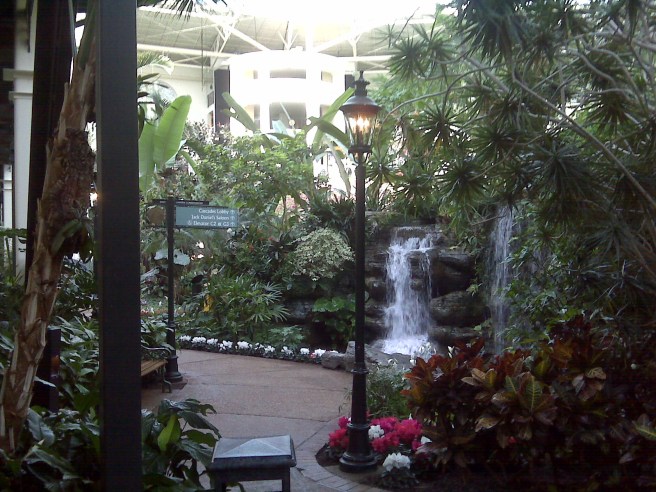
Opryland Hotel Gardens, Nashville, TN

Sometimes gardens that are owned and maintained by private entities are still made available to the public at no charge. Hotels, office complexes, and shopping centers usually have, at bare minimum, some level of landscaping. Occasionally these establishments go far beyond the obligatory curb dressing to create extensive gardens and observatories, such as the Opryland Hotel in Nashville. In tourist towns, several retailers may collaborate to install and maintain plantings, beds, boxes, and pots to attract shoppers to their doors. These private gardens are not only accessible to the public but are specifically designed to attract people passing through the area. I have seen some beautiful examples of this type of garden in destinations such as Gatlinburg (Tennessee), Sedona (Arizona), St. Simons Island (Georgia), and Santa Fe (New Mexico).

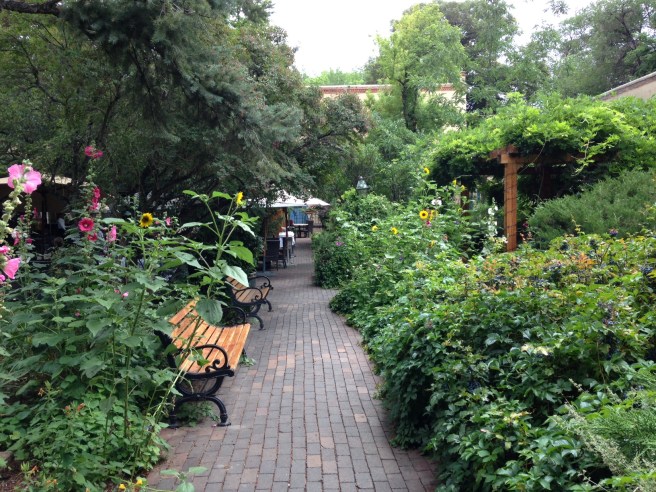
Shopping courtyard garden
Garden at a shopping courtyard in Santa Fe, NM

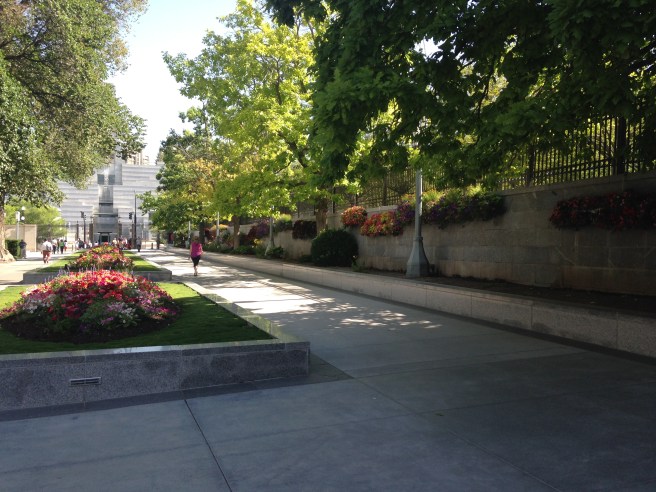
Places of worship are also a good source for gardens that can be enjoyed by everyone.  Usually maintained by a small band of devoted gardeners in the organization, these spaces welcome visitors and encourage them to take a few moments to be still, contemplate,  meditate, or pray. Some of these gardens are small and simple, but still lovely.  Others are huge and elaborate, attracting thousands of visitors each year. Some are not free and open to the general public, such as the Gardens of Vatican City, although guided tours are available. The Gardens at Temple Square of the LDS Church represent an over-the-top horticultural exhibit that is enjoyed by anyone who wants to pass through the church’s massive complex in Salt Lake City, Utah.

Temple Square Gardens
Gardens at Temple Square, LDS Church headquarters, Salt Lake City, UT

As an amateur gardener, I have a deep appreciation for the integration of beautiful plants into the built environment. Public gardens address a basic need that so many people have of staying connected to nature. They are also a haven for birds and other small wildlife that share real estate with humans. They filter the air, enrich it with oxygen, and lace it with their perfumes. They tantalize our eyes with various shades of green and a wide array of vibrant colors. Public gardens tempt us to pause, relax, and reflect. The familiar phrase of “stop and smell the roses” is a cliché for a reason.  It’s based on a fundamental human need to slow down and appreciate very simple pleasures.  Take the opportunity to do so the next time you pass a public garden.

Raccoons Are So Cute . . . and Deadly

What could be more adorable among wild animals than a raccoon?  With that signature black mask that looks like a small child dressed for Halloween and that distinctive striped, bushy tail, these waddling mammals are quite often photographed and recorded on video as they make their way through suburban neighborhoods, and even large cities, looking for an easy meal. Considering how adaptive they have become to residential areas and how broad their diet is, most meals are probably fairly easy indeed.  They are mostly nocturnal, spending the hours after dusk raiding trash cans or prowling around for frogs and crustaceans.  Watching them rub their faces or stand on their hinds legs with their front paws extended forward, observers are lured into thinking that raccoons are practically tame and even friendly.  Plenty of people have made pets of young raccoons, and as long as their diet and other environmental conditions are strictly controlled, they are probably harmless for the most part.  Nevertheless, the raccoon is not a domesticated species — it is wild.  Here lies the problem.

Raccoon at pond
Raccoon at pond

In captivity, raccoons can live up to 20 years; however, in the wild they rarely live more than 3-4 years.  That’s quite a significant spread.  They have very few natural predators, and humans are not as nearly interested in their pelts as was the case several generations ago (alas, Daniel Boone and Fess Parker have been dead for a while).  They are hunted for sport, but not widely.  What accounts for the difference?  Disease and infection are the greatest threat to longevity for raccoons, and because they share environments with humans, they are a greater risk than most people realize.  YouTube is full of videos of raccoons wandering around in backyards, playing in sandboxes, or even swimming in pools.  How cute!  How dangerous!!

The Centers for Disease Control and Prevention (CDC) has an entire section of its website devoted to risks associated with close encounters with raccoons.  In addition to rabies, giardia, and leptospirosis, raccoons also spread the Baylisascaris infection from a specific type of roundworm.  The roundworm eggs are sometimes found in the feces of raccoons, and if ingested, they can cause a deadly infection.  Raccoons need water for digestion, and they also feed on amphibians, so they are naturally drawn to water, even swimming pools.  Frogs often gather along the waterline of pools and in the skimmers, which offers a feeding opportunity for raccoons.  They are creatures of habit, so once they start visiting a pool and find food, they will likely return.  Another habit they have is pooping in water, and they will often do so in the shallow walk-out sections of swimming pools.  If the feces is infected, it can introduce roundworm eggs into the water.  And the real kicker is this: chlorine doesn’t kill the eggs or the parasite!

It is simply not a good idea to attract raccoons to where people live, especially by intentionally feeding them.  Young children have a tendency to place their hands and objects in their mouths, which puts them at significant risk if they are playing in areas where raccoons are roaming around freely.  As cute as they are, raccoons are something you want to see on a hike through the forest, not in your backyard.

Evangelicals and the Problem of Free Will

Having been raised as a Southern Baptist, I was taught from a very early age that the Bible is God’s holy word, that it is infallible, and that it presents humanity with essentially a road map of how to live on earth and how to ensure one’s soul goes to be with God in heaven for all eternity after life on earth is over.  The central truth of the Bible is the work of God’s only son, Jesus, on the cross.  The only source of salvation and forgiveness of sins is through his death and resurrection.  This is still the basic creed of all Christian evangelicals, not just Baptists.  As the Christian fundamentalist movement swept through the South in the 1970s, the dogma became more emphatic, especially the concept of the Bible being inerrant.  I can remember pastors only half-joking when they stood in their pulpits, held the Bible up over their heads, and said, “I believe every word of this book.  Even when it says ‘genuine leather’ on the cover, I believe it!”

Evangelicals believe that God loves his creation and that he also has desires, the strongest of which is for humanity to return his love.  Humans express this love by obeying God’s commandments.  But, above all, humans demonstrate their devotion to God by believing that Jesus is his only son and that accepting his sacrificial death as atonement for their natural sinful state miraculously repairs the fallen relationship with God (Adam, Eve, rotten fruit, etc.).  Again, for evangelicals this part of the plan is crucial.  It is only the cleansing power of the blood of Jesus that can bring God and humanity together, which not only empowers humans to obey God’s commandments but also grants their souls an eternity with Jesus, who is actually God in human form just to complicate matters further.  The alternative is rejecting God and facing an eternity in hell — complete separation from God with a whole lot of torture, anguish, teeth gnashing, ill-tempered serpents, and the like.  God wants humans to love him, and by its very definition, love is something that has to be voluntary.  God doesn’t force humans to love him, which wouldn’t be genuine love.  Humans have the freedom to either love God or reject him, another key component of the whole arrangement.

Another part of the Baptist training was embracing the perfect nature of God.  The Bible is infallible because it is inspired, if not ghost authored, by God himself.  God is omnipotent and omniscient — there is nothing God cannot do, although he certainly elects not to do plenty of things.  All options are open to him.  He knows everything that has ever happened and will happen, past and future.  In fact, everything that happens ultimately conforms to God’s will.  So even the most mortal sins committed by humanity, although contrary to God’s wishes, eventually fold into the greater plan of God for the universe.  God’s will is unavoidable.  When I was growing up, it would have been inconceivable that there could be anything that God didn’t already know.  The evidence for this concept for evangelicals is found in the Bible in Jeremiah 1:5. “Before I formed you in the womb I knew you, before you were born I set you apart; I appointed you as a prophet to the nations.”  Putting aside the fact that this verse refers specifically to the Hebrew prophet Jeremiah, my fellow Baptists cited this verse as proof that God knows individuals, and individual souls, before they are conceived and born.  Remember, time is irrelevant for God. Past, present, and future are all in his command.

Now we come to the problem that is free will.  As stated earlier, evangelicals adhere to the principle that God loves humanity and wants his love returned.  John 3:16 is probably the most important verse in the entire Bible to evangelicals: “For God so loved the world that he gave his one and only Son, that whoever believes in him shall not perish but have eternal life.”  People are given the option to believe that Jesus is God’s son and that his sacrifice is the source of their salvation and relationship with God. However, it is painfully obvious that millions, if not billions, of people do not accept Jesus as their savior and therefore miss the salvation boat altogether.  Which brings us to the troubling question about the true personality of God.  If indeed God knows everything, and if he is not constrained by time, and if he knows all that is going to happen, then it reasonably follows that he knows which individuals will return his love and which ones will reject him, before they are even born.  Given this premise, it follows that the God who can do anything actually chooses to allow people to be born even though he knows they will ultimately reject him and thus be cursed to an eternity in hell.  Is this lais·sez-faire approach the only means by which God can secure the love of humanity?  Do billions of people have to be cast into hell to gather a minority of people who will love God, accept his gift of salvation, and share eternity with him?

Evangelicals who adopt this paradigm are faced with a God who is at once all-loving while also being extremely negligent of the majority of those he apparently loves.  In the case of humanity’s free will, God is obviously electing not to impose his omnipotence and letting humanity chart its eternal course.  Is this a situation where God is simply choosing not to know something?  Keeping secrets from himself?  If we think about this for more than a minute or two, we must come to terms with a God who is “writing off” a significant portion of the population as damned, when he could have easily spared them an eternity of torment by not allowing them to be born in the first place.  As a father, I would do anything within my power to prevent my son from committing suicide, especially if I could ensure that he had a bright future.  What kind of father would I be if I didn’t attempt to intervene?  Given the same circumstances, most fathers would do the same.  If parents could know, without a shadow of a doubt, that they were going to conceive a child who would suffer horrific pain for an entire lifetime, would they elect to have such a child just for the sake of starting a family?  Are we more compassionate than God?  Free will doesn’t seem like such a valuable gift when we consider the stakes.  If this is God’s plan for getting the love he wants, what does this really tell us about God?  Something’s missing here.  It’s a problem.

Building Ponds and Waterfalls

Since starting this blog over a year ago, I have written several posts about waterfalls my family has visited in recent years.  I am attracted to water.  Some of my best memories from childhood through the present involve vacations at the beach, tubing down rivers, kayaking on ponds and lakes, and swimming in pools.  There are very few sounds that are more calming to me than waves crashing against the shore.  I love the music that water makes as it moves in nature — creeks, rivers, cascades, and falls.  I like how water divides land, how it reflects the sky and sparkles like diamonds with bright sunlight.  It is cliche to say that water is the source of life, and yet it is an indisputable fact that life on this planet would be impossible without water.

My appreciation for the gifts of water led me to begin contemplating about ten years ago how I could incorporate water into my garden.  I had seen ponds at homes and in public places, but I had never thought about creating one for myself.  Then I got divorced.  When such an emotional life-changing event occurs, some people turn to abusing alcohol, taking drugs, or other reckless behavior.  But, I have two sons who were both teenagers when my marriage ended.  They needed me to be sober, responsible, and engaged in their lives as much as possible within the limits imposed by the breakup.  Besides, addiction is not a problem for me, nor is it how I combat stress, anger, sadness, or any of the other strong feelings that accompany the dissolution of a marriage.  I needed a distraction, something that could occupy my mind and muscles while getting me out of the house.  So I started digging a hole in the backyard.

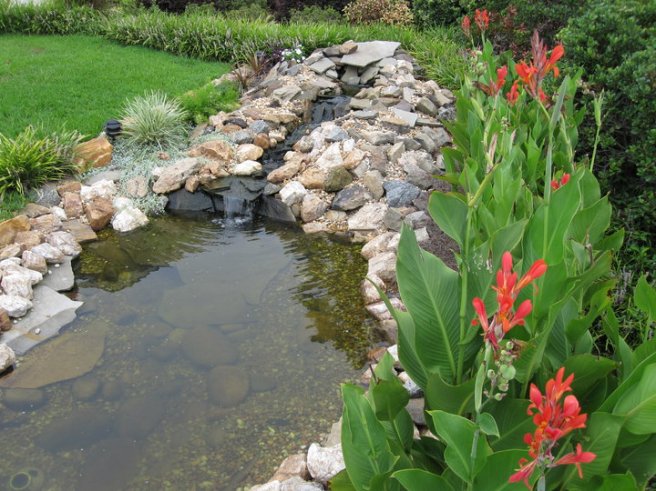
First pond 2006
First pond 2006

It took me several days just to dig the hole, and almost that long to get the sides level.  I read books.  I watched videos.  I drew pictures and diagrams.  I had a fairly steep embankment running down the side of my house (I ended up keeping our house) that extended into the fenced back yard and somewhat leveled out beside the posts of the back deck.  I envisioned a cascading waterfall built into the bank, where I had planted an assortment of shrubs several years earlier.  I consulted with a local landscape supply store about liners, flex hose, pumps, skimmers, and rocks.  The rocks I purchased were generally no larger than a honey dew melon, and I didn’t have a lot of money left after buying the mechanical supplies.  My property was bordered in the back by woods and a small creek.  Fortunately, my younger son was quite enthusiastic about the project as it developed, and was more than willing to help me drag rocks from the creek bed and up the hill to the pond site.  We moved a LOT of rocks, some of which were quite large.  My back will never be the same.  It took several weeks to finish, but the end product was really beautiful.  I even bought a few fish to complete the package.  Furthermore, the process of building the pond gave me the distraction I desperately needed and an opportunity to spend some quality time with my young teenager when he really needed my attention.

Second pond 2008
Second pond 2008

When my second wife and I got married, I moved in with her to a house located on a Georgia Power Company lake.  Even before we got married and I moved away from my house, I was already missing my pond.  Of course, there were several million gallons of water within a stone’s throw of our back door, and we had huge, clear windows looking out on the large cove where we lived.  I could fish in our back yard, climb onto a jet ski right off our dock, and go swimming without leaving home.  We were planning to get married on the patio looking out over the lake, and I was determined the sound of running water was going to be the music for our ceremony.  I went to work a couple of months before the wedding.  This time, I didn’t have a steep slope to work with, so I created a small “hill” for a waterfall using the dirt I removed for the pond.  The setting didn’t look as natural as the first pond, but I was able to landscape and plant sufficiently around the perimeter to make this second pond attractive.

Now we have left the lake house behind, along with our former jobs, and have moved to live and work in the north Georgia mountains.  I’m not sure my body could have taken the punishment of building a third pond.  It is quite grueling, especially digging the hole and then hauling and positioning the rocks.  But my wife and I both love water.  We seek it when we go on hikes.  We soak it up when we make our annual trips to the coast.  We spend many hours during the warmer months on nearby lakes cruising around in our kayaks.  We needed water at our new home, but there were no streams in sight of our property.  So we splurged.  We hired someone to build a pond and a waterfall for us at our new home.  It took the better part of a summer, but our contractor is an artist.  He took great care preparing the location behind our house, even though we were certain there wasn’t enough room for the size project we had in mind.  He made it fit, and he made it magnificent.  Once again, we are mesmerized by the sound of a cascading waterfall for at least seven months out of the year.  True, this third pond doesn’t look quite as authentic or natural as the smaller ones I created, but it has most certainly exceeded all our expectations.

Third pond 2014
Third pond 2014

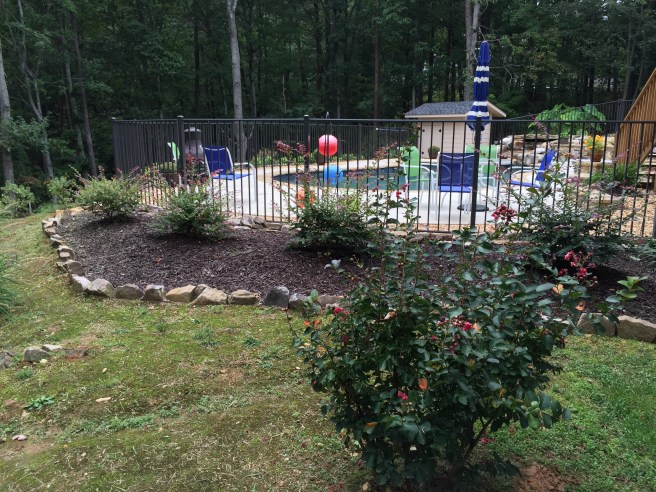
Pool

The Desert Garden

The title of this entry may at first seem like a mistake.  “Perhaps he really meant ‘The Dessert Garden,’ which conjures up images of fruit trees.”  Most people don’t associate gardens with deserts.  By definition, deserts are empty places.  They are barren, usually having sandy or rocky soil and little or no vegetation.  When we say a place is deserted, we mean it is empty or uninhabited.  By contrast, we often think of gardens as lush, green spaces teeming with life.  Until I married someone who had lived for almost two decades in the Southwest, I didn’t think I would like spending much time in that region of the country.  I don’t mind hot weather that much, especially if the humidity is low.  But green is my favorite color, and I love gardening.  Nothing grows in a desert, right?

Ridiculous.  The desert is full of life, and the diversity of plant species is staggering. There are about 2,000 different kinds of cacti alone.  The six cactus genera with the largest number of plants, and hence most likely to be encountered, are cereus, cylindropuntia, echinocereus, ferocactus, mammillaria and opuntia. In addition to cacti, there are grasses, shrubs, trees, and wildflowers.  One of the best places to get a clear picture of the desert’s splendor is the Desert Botanical Garden in Phoenix, Arizona.  With more than 4,000 species and approximately 27,650 individual plants, the Desert Botanical Garden is home to one of the world’s most spectacular living collections of the world’s desert plants.

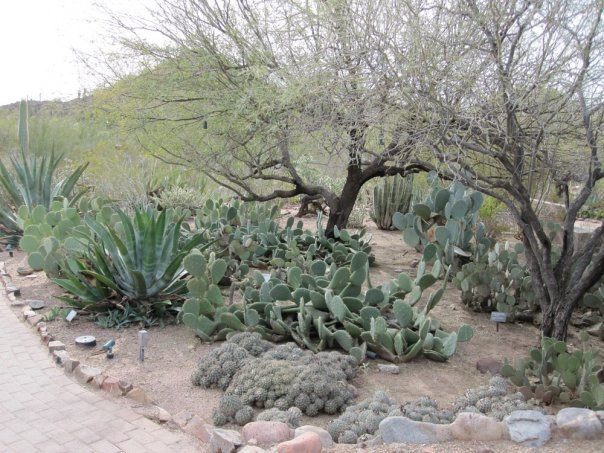
Desert Botanical Garden
Desert Botanical Garden, Phoenix, Arizona

We spent some time several years ago during a visit to Phoenix to wander through the Garden.  Perhaps the most striking feature is the endless forms and shapes that the plants in the desert take.  They have evolved over millions of years to take full advantage of the limited resources available, and water conservation dictates so much of the characteristics of desert flora.  Flowers tend to be less numerous but so much more striking in color, shape, and size than those found in other environments.  The Garden offers permanent trailside exhibits, temporary art exhibitions, and seasonal activities too.

Desert Botanical Garden
Desert Botanical Garden, Phoenix, Arizona

Sometimes it’s difficult to look beyond the familiar and seek the undiscovered, and I certainly found that to be true about the desert.  There’s green everywhere!  I have visited the Southwest several times now, and I am always ready to return.  It is wild, rugged, and even harsh, but it possesses a charm that can be found nowhere else in the country.  The Desert Botanical Garden is not to be missed.

Desert Botanical Garden
Desert Botanical Garden, Phoenix, Arizona

Self Portrait with Tree by Jaume Plensa

Public art is a standard feature in most large cities across the U.S. and in much of the world.  Art that is made freely available for everyone to enjoy in public places takes many forms: painting, photography, architecture, sculpture, graffiti, and even performance.  Like many tourists, I tend to take photographs of public art when I am visiting cities, and I have collected images from New York, San Francisco, Phoenix, Seattle, Washington, D.C., Rome, and London to name a few.  One of the more interesting pieces I found may not be so well known, although the artist is rather prolific.  One evening in 2011 when my wife and I were walking the streets of Chicago headed out for dinner, we wondered through a section of the city known as Streeterville, a neighborhood roughly east of the Magnificent Mile that serves as the gateway to the Navy Pier.  I was struck by a piece of bronze sculpture we saw at the northern end of Streeterville, at E. Chestnut Street next to the landmark Hancock Center.

Self Portrait with Tree, Jaume Plensa

When I first saw Jaume Plensa’s “Self Portrait with Tree” on the sidewalk, my first thought was to make a joke, an annoying habit of mine.  I turned to my wife and said, “Now that is truly a man of letters.”  My apologies — please keep reading.  Plensa is one of the featured artists of the Richard Gray Gallery.  With its main location on North Michigan Avenue and another on Madison Avenue in New York, Richard Gray Gallery is mostly a collector’s gallery and focuses its attention on attracting buyers.  According to the gallery’s website, Plensa is one of the world’s foremost sculptors working in the public space, with over 30 projects spanning the globe in such cities as Chicago, Dubai, London, Liverpool, Nice, Tokyo, Toronto, and Vancouver. He was born in 1955 in Barcelona, where he studied at the Llotja School of Art and Design and at the Sant Jordi School of Fine Art.  A significant part of Plensa’s work is in the field of sculpture in the public space. Installed in cities in Spain, France, Japan, England, Korea, Germany, Canada, USA, etc., these pieces have won many prizes and citations, including the Mash Award for Excellence in Public Sculpture.

Plensa has used the theme of the seated figure for many installments, and he has repeated the tree-hugging sculpture in various locations around the world.  Some of the pieces are colossal.  Another thread running through Plensa’s work is the use of letters and symbols to fabricate the figure.  For these particular pieces, he works in an assortment of materials including bronze, stainless steel, and stone.  The Self Portrait in Streeterville is especially interesting because of the letters in full relief on the seated figure’s body, like the type hammers of an old manual typewriter.  The technique lends a bit of nostalgia to the piece.  You can learn more about the work of Jaume Plensa at his website at http://www.jaumeplensa.com/.

The Independent Bookstore: A Reader’s Oasis

The last Saturday in April is designated as Independent Bookstore Day, and according to the U.S. Census Bureau, bookstore sales increased 2.5 percent from 2014 to 2015. The American Booksellers Association, which represents independent sellers, reported 1,712 member stores in 2015, up from 1,401 in 2009.  These figures should put to rest the notion that books made of paper are soon to be replaced by electronic forms.  I realize there are plenty of readers who still hold great affection for traditional books — the paper kind.  There are scholars who have argued that reading physical books is a completely different experience than reading eBooks.  Most bookstore owners would probably agree.  Both formats seem to be doing fine, which should be good news to all readers.

Once a medium of information is introduced, it tends to survive no matter what other “new and improved” medium follows.  Some platforms may become obsolete (stone tablets, 8-track tapes, Beta videotape, etc.), but in general, new forms of information delivery don’t dispatch previous ones.  The written word has never stopped people from telling stories or stage acting. Motion pictures certainly didn’t do away with reading.  Radio didn’t destroy movies, television didn’t stop radio broadcasts, and the availability of videos hasn’t destroyed the television industry.  One could argue that computers have only facilitated many of these delivery methods rather than replacing them.  More importantly, none of these has killed the book, regardless of how we decide to read.

There is no question that the last few decades have been tough for small, independent bookstores.  Many of the ones that survived the advent of the mega-bookstores were finally wiped out by the online providers.  Electronic books no doubt delivered another crushing blow to bookstores, but the truly creative entrepreneurs figured out a way to stay relevant and competitive as a niche market.  One approach is to create a salon-type atmosphere that welcomes the reading shopper and provides a sanctuary, a respite from the fast-paced grid that characterizes so much of our society.  Nicole Sullivan, owner of Denver’s BookBar, was quoted in a recent article in The Denver Post.  “As it gets harder for brick-and-mortar businesses, hybrid businesses become more important,” Sullivan said. “It’s either get it fast and cheap online, or come into a store and have an experience. That’s what indies have to offer, a more personalized experience and that sense of community we’ve lost a lot of over the years.”

I have fully accepted the convenience of eBooks and have been an Amazon Kindle customer since the first year they came on the market.  I’m sure some of my library colleagues were horrified by the introduction of virtual books, but now eBooks are a big part of library holdings.  For fiction and other books that rely very little on illustrations or graphics, I actually prefer eBooks.  However, I treasure the large, hardbound gardening, history, and travel books that fill our shelves at home.  Not even iPads or desktops are acceptable for those titles for me.  I also prefer to browse through slick-paper magazines by physically turning pages, not touching a screen.  Because we live in a rural area, the chances of an independent bookstore surviving for very long are slim, so we order many of our books online.  We also go to the web to shop for household goods, clothes, and equipment.  But, when we travel to places like San Francisco, Chicago, and New York, I almost always make a point to visit an independent bookstore.  To me they all seem to have their own “personality” that makes them unique.  If a book is the door that leads to imagination, then a bookstore is a hallway with almost endless possibilities.

Book Lady Bookstore, Savannah, GA

A Dining Experience at Casanova

Casanova Restaurant
Casanova Restaurant

I have seen and heard restaurant owners for years use the phrase “dining experience” to describe what it is like to have a meal at their establishment.  For a long time I considered the phrase to be poor marketing at best and false advertising at worst.  If I wanted an experience I would go see a good movie or play, not eat a plate of ravioli with a side Caesar salad.  However, my attitude changed several years ago when my wife and I took a trip to San Francisco, which also included a drive down the coast on Highway 1 to spend a night at Carmel-by-the-Sea.  We were only there for a short time, and we wanted to have a good meal before heading out the next day.  We began searching for restaurants online and decided on a place called Casanova in the little village of Carmel.  Nestled among the shops and galleries there, Casanova is a quaint, unassuming place with a simple façade that would be easy to walk past unnoticed.  And that would be a mistake.

Casanova is a family owned and operated restaurant that serves rustic and classic cuisine, obviously with an Italian flavor.  Ingredients come from local, small organic farms and fisheries.  The world-class wine cellar is managed by a certified wine educator.  The chef’s menu selections range from veal dishes to lamb, beef, and seafood.  They have inside and outside seating.  We were seated outside in a small courtyard area with plastic sheeting and heaters.  It wasn’t closed off enough to keep small birds from flitting in and out looking for crumbs on the ground left by diners, which we decided was charming instead of a deterrent or distraction.

Our meal was exquisite, from appetizers all the way through the courses to dessert.  We were there for almost two hours but never once felt like the evening was dragging.  We were not in a secluded, dimly-lit corner of a dining room, but the setting was still completely romantic.  We could easily forget that there were other diners around us, which was made possible by the most professional waiter I have ever had the pleasure of meeting.  I don’t recall his name. I do remember that he was a middle-aged man who was extremely well-spoken, impressively knowledgeable about the restaurant’s offerings and specialties, and very skilled at his profession.  He was attentive without hovering, interesting but not intrusive.  The food and our waiter turned that dinner into a true dining experience that I will not forget.  I never had a meal in Rome, Italy, that was better than what we had at Casanova.

The restaurant’s website now announces that they have acquired the table at which Vincent Van Gogh enjoyed his meals at the Auberge Ravoux.  The arrival of the table marks the beginning of a cultural exchange between these two artistic communities: Carmel-by-the-Sea and Auvers-sur-Oise, France, where Van Gogh spent the last days of his life.  Dining at Casanova involves much more than just enjoying a delicious meal.  It is about being transported from the malaise to the magnificent!  As they say in the book reviews: “highly recommended.”

Restoring My Soul

Sometime in February while I was scrolling through Facebook, someone posted a short video of himself playing his guitar.  In the message that accompanied the video, he mentioned that he was on a solo retreat in a cabin.  It had never occurred to me until then that a weekend of solitude and reflection could be so attractive.  A wise scholar and friend recently observed that, like she and her husband, my wife and I are “well married.”  It’s a phrase that we had not used before but now fully embrace.  We are indeed well married.  We have been together nine years and married for eight of them.  We enjoy each other’s company.  We like working at the same place, coming home for lunch together and having dinner together, either at home or at a restaurant.  We love to travel; we love to hike; we love working on projects; we enjoy our time at home, especially our evenings and weekends.  My wife has some friends and colleagues that she will occasionally meet for lunch or dinner, and sometimes she makes it an overnight trip.  It is good and healthy for her to stay connected to these people because they have been so important in her life and her profession.  Sadly, there are more such connections in other parts of the country where she has previously lived, and it is difficult to see them regularly, but she makes an effort to do so when possible.

I have a good friend who lives not too far away from us – someone that I have been close to for over twenty years now.  We see each other about once a year or so, and I enjoy catching up with him.  We also stay in touch by phone, texts, and Facebook.  I don’t have as many good friends as my wife does, that is, people I have maintained a close relationship with through the years.  As gregarious as I probably appear to colleagues and acquaintances, the truth is I am a bit shy around people I don’t know, unless I am speaking to groups professionally or performing music.  I was in a band for ten years, so I’m sure there are folks who would scoff at the idea of my being bashful in any shape or form.  There are times, and only for brief periods, when I truly cherish being alone.

When I saw that Facebook video post, I began to think about what it would be like to have a solo weekend, something I have not done in decades.  I started thinking about what I would do for 36-48 hours away from my bride, my sons, my job, our home – away from anyone I know.  I could read, write, study, play music, think . . . and think some more.  I was a bit nervous about pitching this idea to my wife, because the last thing I wanted her to think was that I don’t adore her company.  This woman who clearly loves me unconditionally thought the idea was marvelous and whole-heartedly supported my decision to find a cabin in the mountains for an early spring mini-sabbatical.  Now, as I write this blog entry, it is Saturday afternoon.  I am looking out the window of my retreat cabin in the high country of North Carolina less than a mile from the Blue Ridge Parkway.

I arrived yesterday afternoon, checked in with the inn keeper in town, drove a few miles to my cabin, settled in quickly, poured a glass of Jack Daniel’s Tennessee Honey and headed to the front lawn to relax in a comfortable chair and take in the view.  I followed the inn keeper’s recommendation for dinner at a local bistro, which was an excellent choice. I bought just enough provisions at the grocery store to keep me satisfied for 24 hours, and then I came back to the cabin and sipped more whiskey.  A storm came through last night and dusted the surrounding hillsides with snow, just enough to make it pretty but not so much to make it a nuisance.  I got up a little before 8:00, put on the coffee, and started reading Fitzgerald’s The Great Gatsby, a novel I read many years ago and have mostly forgotten.  I have been reading news and op-ed pieces from the New York Times.  I have had a fire in the fireplace for the last couple of hours, and I have played songs on my guitar that I haven’t attempted in years.  I don’t intend to leave the cabin until heading out for dinner this evening.  I am enjoying a full earth’s rotation of intense relaxation.

Relaxing by the fire

Just now, as I sat down to reflect on this opportunity and record it, I was reminded with great humility and appreciation of just how fortunate I am.  When people from my past ask me if I’m happy, I usually reply, “I’m the luckiest guy I’ve ever met.”  I am lucky to have a wife who ignores my inadequacies, my rough edges, my occasional crudity, and loves me with a devotion that is almost frightening.  It is also a gift to love her more than I have ever loved another woman.  I am lucky that my sons seem to be stable and healthy in spite of great tragedy and loss they have endured.  I am lucky to have extended family who may not always understand me and perhaps even worry about me, but who also love me deeply and take joy in my happiness. I am lucky to have been raised by parents and grandparents who encouraged creativity, loved to laugh, believed in the virtue of hard work, and exhibited rock-solid faith in their God and their church.  While not having the advantages afforded by a higher formal education, my parents made the necessary sacrifices to ensure that I received the advanced degrees I desired and that have opened up so many possibilities for me through the years.  I have had some incredibly inspiring teachers.

I have lived almost 56 years with few significant health challenges.  I have some modest talents and skills that are fulfilling to me and that I have been able to share with others.  My wife and I have a standard of living that is not enjoyed by a large majority of the world’s population.  We are grateful, even though we know our generosity does not extend as far as it should.  My career path has presented me with so many memorable encounters and experiences, and I know how rare that privilege is.  Lastly, we have the resources that make it possible for me to rent a cabin in the Appalachian Mountains to be self-indulgent for a weekend and to contemplate the precious gift of a good life that I’m sure I don’t deserve but for which I am eternally grateful.  And to my bride, the love of my life: thank you for giving me this place and time.