The Sky Is Falling

World leaders are meeting for the next week or so in Paris to discuss ways in which the major countries around the globe can reduce carbon emissions in hopes of warding off catastrophic effects from global warming.  How serious this problem is has become a topic of “heated” debate in this country, just like almost everything else, from Starbucks holiday coffee cups to Syrian refugees coming to America.  A handful of scientists (about 3% worldwide) are not convinced that the current climate changes we are experiencing are caused by human activity, which is all the evidence needed to call the whole idea a scam by a growing minority of people in this country who completely distrust any message coming from the federal government or the research of individuals, institutions, agencies, and organizations funded by federal tax dollars.  They are convinced that restrictions imposed by governments due to climate change will result in onerous taxes, economic ruin, burdensome regulations, dictatorial bureaucrats, and higher energy costs.

It would appear that the denial of climate change issues has moved into the realm of conspiracy theory.  Some of my friends argue that scientists are lying and falsifying data to appeal to liberal policy makers who pay them and who seek even further control over our lives and property.  They point to the changes in terminology — moving away from phrases like global warming and toward phrases like climate change — as an indication that the science is not solid and that climatologists are not to be trusted.   Here’s a flash.  What we are seeing around the planet IS global warming, but we have folks who can’t understand that global warming is NOT a term to describe weather.  There is a difference between climate and weather, so the vocabulary was modified in an attempt to increase understanding about the problem, which obviously failed.

Frankly, I don’t feel qualified to speak too much about climate change from a scientific standpoint, so I have to trust the consensus of opinion of the majority of climatologists around the world, just like I feel compelled to trust the vast majority of doctors who believe immunization is more helpful than harmful. I could list many other examples. I can remember a time when conservatives thought that recycling was a trick on dumb liberals, that is, until they discovered there is plenty of money to be made in the recycling business. Then it became desirable. I suspect we will eventually see this same pattern evolve with the reduction of carbon emissions, sustainable energy sources, and other similar initiatives.  I believe in being skeptical, but skepticism on the level of global scientific opinion of such a large majority seems unreasonable.

The Mountains Are Calling . . .

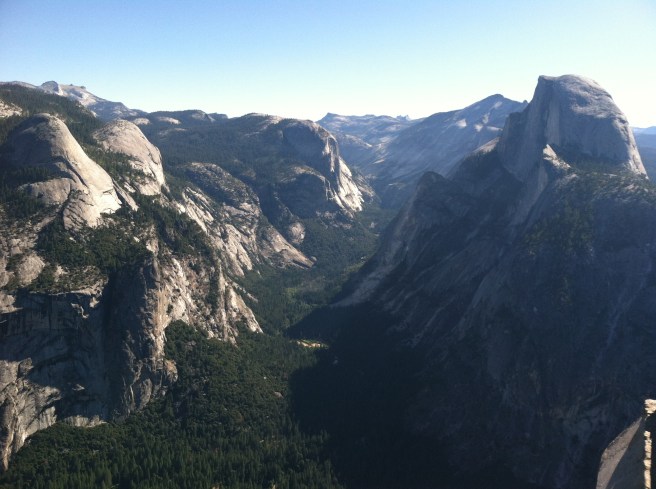
One of the most magnificent places I have ever visited is Yosemite National Park in California.  Ancient glacier activity in this region of the High Sierra left behind enormous rock formations that created a natural cathedral unsurpassed by anything ever designed by human minds or hands.  One of the early Europeans to explore the valley described it in these same terms.  John Muir visited Yosemite several times in the 19th and early 20th centuries, spending several years there in spite of the fact that he had a wife and children in San Francisco.  His appreciation for the beauty and wildness of Yosemite drove him to fight for its long-term preservation.  Some battles he lost, but by and large, his petitions to government officials are responsible for the establishment of the national park there.

Yosemite Valley
Yosemite Valley from Glacier Point

Lately I have been reading Muir’s descriptions of the land forms, his detailed identification of the flora and fauna, and his natural history of Yosemite in selections from the e-book, The Collected Works of John Muir.  I am amazed at how much ground he was able to cover and the extent to which he cataloged so many of the species in the area.  Without the aid of modern equipment or the assistance of the infrastructure later installed for hikers, Muir explored parts of the valley and surrounding region that only the most experienced hikers and climbers would attempt today. He craved the wilderness almost like a lover.  In the mountains and forests he found adventure, inspiration, stimulation, and peace.  For those who have visited Yosemite and were left speechless by its wonders, I highly recommend John Muir’s works — he manages to articulate what I could not put into words when I first saw this marvelous spectacle.

Southern Word of the Day

For the last couple of years, I have been entertaining myself (not difficult) and my Facebook Friends with posts that I have coined “The Southern Word of the Day.”  Obviously, this gig is a direct rip-off of the comedian Jeff Foxworthy’s redneck words, and there is certainly some overlap.  However, I have imposed some rules on myself that Foxworthy didn’t always follow. For instance, I only use legitimate English-language words, which includes the occasional place name but mostly just regular words.  So I would never use Foxworthy’s “widgedidga” because it isn’t a legitimate word, even though it clearly is a phonetically-correct Southern word that translates to “with you did you.”  So Foxworthy’s word “mayonnaise” as a substitute for “man there is” serves as a good example of my method.  I also try to stay away from the simple two-syllable rip-offs like aster = asked her, or cider = beside her, or otter = ought to, or stark = it’s dark.

I have decided to put together a list of my favorite Southern words that I have posted, and perhaps Jeff Foxworthy has used these too.  No plagiarism is intended here; I can only plead ignorance, which for me is not a stretch at all.

Fornication.  Usage: “Charlene’s dress is perfect fornication like tonight.”

Covetous.  Usage: “It was so cold that Momma pulled out a blanket and covetous up with it.”

Quesadilla.  Usage: “You need to have your brights on in quesadilla runs out in front of us.”

Spectators.  Usage: “Broccoli is fine, but I spectators would taste a whole lot better with that steak.”

Anemone.  Usage: “I was running just fine anemone started hurting, and I had to stop.”

Ammonia.  Usage: “Would you come open the door?  Ammonia front porch!”

Motif.  Usage: “Billy Bob would smile more if he just had motif.”

Enema.  Usage: “My mother-in-law is always sticking her nose enema business.”

Pasteurize.  Usage: “I walked right pasteurize, and you didn’t even see me!”

September.  Usage: “We have grown everything on that 40 acres you can imagine September.”

Annuity.  Usage: “He was having trouble getting it out, but annuity was trying to say.”

Annihilator.  Usage: “We got stuck in traffic and ended up getting there annihilator than we thought we would.”

Opportunity of a Lifetime

As I have indicated before, I began my career as a librarian in a medium-sized public library in a small county of around 42,000 people.  As is typical in small communities, there were plenty of personal interconnections.  When I graduated with an MA in History in 1985 from a state college in this same county, I started work shelving and cataloging books in the public library.  With the encouragement, patience, and generous assistance from the library director, I and another worker in the library commuted to Emory University twice a week for two years to complete our Masters degrees in Librarianship (MLn).  I served as a reference librarian for most of my fifteen years there, but when the director left during my twelfth year, I was offered the position.  I served as the library’s director for three years.

One morning, during the spring of my last year, the husband of our children’s librarian walked into my office to say he had a proposition for me.  His wife was serving in this position at the library before I began there.  Her husband was a local attorney.  I knew them both very well — we attended social events and my first wife and I had even house-sat for them and had taken care of their two children for a weekend.  As it happened, he was the lawyer for the estate of a major American writer, who also was (and still is) one of my favorite authors: Flannery O’Connor.  She had lived a good portion of her life in this town where her family had deep roots going back to the early 19th century.  She spent the last thirteen years of her life at the family’s farm, called Andalusia, located on the north end of town.

foc_eberhart_photo
Flannery O’Connor
His clients were two sisters who were also first cousins of O’Connor.  Flannery O’Connor died in 1964, but her mother, Regina, lived until 1995.  As executors of Regina O’Connor’s estate, these two women were also in charge of Flannery O’Connor’s literary estate, which was primarily administered through a trust that had been established by Regina O’Connor’s will.  As co-executors and co-trustees, one of their responsibilities was to establish a non-profit foundation to maintain Andalusia as a proper memorial to O’Connor and also to perpetuate her legacy as a writer.  They needed someone to help establish this organization.  They also needed someone to work with a sizable archive of personal papers, correspondence, writings, photographs, memorabilia, and artifacts belonging to Flannery O’Connor.  The archive needed to be organized, cataloged, and properly stored for preservation purposes.  The co-executors asked the lawyer to find someone who might be interested and capable of doing both of these tasks.  He came to my office in the library that spring day, explained the proposition from the estate, and asked me if I would consider taking the job as an independent consultant working for the co-executors.  I accepted, which changed almost everything for me.

I will no doubt dedicate several future posts recounting my experiences as a consultant and then later the director of the Flannery O’Connor-Andalusia Foundation that I assisted in establishing.  I was there for thirteen years — as long as Flannery O’Connor lived there.  That was long enough, or arguably, a bit too long.  While I can look back and think about plenty of mistakes I made and how I should have made different decisions, I don’t have any real regrets.  With a BA in English, an MA in History, and an MLn, I don’t think I could have been any better suited for the job with regard to my education and training.  I had the help of some talented and dedicated mentors, board members, volunteers, colleagues, and for a few years, a trusted co-worker and friend.  What I can state with absolute certainty is that this path that departed from my expected trajectory led me to some of the richest experiences I have ever had and offered me opportunities that other people with my education and training will, sadly, never enjoy.  I am humbly grateful, and hope that Flannery O’Connor would be pleased with the work we accomplished at Andalusia.

A Little Less Anonymity

When I started this blog back in April, I had some misguided notion that I should keep my identity hidden, primarily because I thought that some of the future content would be personal or sensitive, and I feared offending my family, friends, and associates.  What I have come to discover is just how difficult it is to write about my own experiences and opinions while remaining completely anonymous.  There are significant stories and memories that I have had to avoid to stay in hiding.  No more I tell you!

I still prefer not posting my personal information in my profile; however, the stories I tell will definitely reveal my identity to people whom I have encountered over the last few decades.  In so doing, I am accepting a few restrictions: some stories will be better left untold, and I will have to be a bit sensitive and careful in the memories I do elect to share.  Yes, I admit that all of this sounds a tad melodramatic and narcissistic — my arrogance in thinking that this blog will reach such a wide audience that even friends and acquaintances will someday be following my posts.   Even so, getting a little more personal with the details will make for a better journal and, I hope, more engaging narratives.

Right of Way

Before my wife, younger son, and I made our trip to Yellowstone this summer, we did like so many other families do before major trips and spent some time reading about the park, its unique features and characteristics, places of particular interest, and potential hazards to avoid.  I even watched a few videos about Yellowstone, both professionally-produced and amateur.  Of course, one of the major elements that brings millions to this park every year is the wildlife, and for most visitors, the principle of “the bigger the better” holds true.  Most of us want to see a bear, at least from a safe distance, but they tend to stay away from the roadways — we were lucky enough to see a mother and her cub the last day we were there.  The elk and moose are quite impressive in the size category too.  We saw several elk but not a moose.

The largest creature in the park, at least by weight, is one that is not very shy at all.  According to the National Park Service website about Yellowstone, this park “is the only place in the United States where bison have lived continuously since prehistoric times. Yellowstone bison are exceptional because they comprise the nation’s largest bison population on public land and are among the few bison herds that have not been hybridized through interbreeding with cattle. Unlike most other herds, this population has thousands of individuals that are allowed to roam relatively freely over the expansive landscape of Yellowstone National Park and some nearby areas of Montana. They also exhibit wild behavior like their ancient ancestors, congregating during the breeding season to compete for mates, as well as migration and exploration that result in the use of new habitat areas. These behaviors have enabled the successful restoration of a population that was on the brink of extinction just over a century ago.”

We knew that bison often made their way to the major roadways in the park and that traffic could be stopped for significant periods of time for herds of the animals to pass.  What we didn’t expect was that sometimes the bison actually use the roads as a path, slowly ambling their way along the pavement, almost as if they are curious about the visitors and have arrived for an inspection.  There are close to 5,000 bison in the park, so sightings of large herds are frequent.  Professional and amateur photographers come out before daybreak to claim their favorite spots on small hills in the bison hotspots, such as Hayden Valley, to get the best shots of the beasts in their natural environment.  However, as we discovered on our first day at Yellowstone, you can get a pretty good close-up photograph of a bison from the window of your car, as so many visitors have been doing for years.  I took this one from my window as we waited for a group of the animals to clear the road.

Bison
Yellowstone bison

Notice that these hooved creatures are following the center yellow line, almost as if it were a trail marker.  They were walking along slowly, seemingly with no fear or even regard for the nearby vehicles and their occupants.  The dangerous assumption by some park visitors is that these are harmless animals, but as calm as they seem to be, they can become extremely aggressive and dangerous if approached or if they feel threatened.  Park literature and signs are abundant warning people to stay a very safe distance from all wild animals in the park , especially bears and bison.  Several visitors are seriously injured each year from foolish encounters with bison.

As these massive animals passed our car, I was taken with how they brought everything to a standstill, commanding the right of way.  They marched through like royalty participating in a parade — the trooping of the colors as it were.  In many ways, the park is theirs, along with the other multitude of species that call Yellowstone home, as it should be.  I wish people would always keep in mind that we are only visitors, and as such, we should be on our best behavior to ensure that places like Yellowstone are preserved and treasured.

Of Beauty and Bridges

I took a recent business trip to Connecticut, a state I had never visited.  I flew into Hartford and drove an hour or so to the charming little hamlet of Cornwall in the northwest part of the state.  I stayed overnight in a garage apartment of the across-the-street neighbor of the person I was there to see.  This was late September and a chill was starting to settle in the air, though the leaves showed not much sign of color yet.  I had just enough free time while I was there to spend a few hours driving around the countryside and was delighted by the abundance of forests and hills in which the small towns in that portion of the state are nestled.

Covered Bridge in West Cornwall

Again, I found myself wandering around in places where it is nearly impossible to take a bad photograph.  I somewhat regret that wall calendars are no longer very useful in this age where today’s date is so easily ascertained with a mobile device regardless of one’s whereabouts.  The vistas afforded me on this trip could fill up the top half of wall calendars for decades to come.  This covered bridge, which I crossed a few times, is a perfect example, along with the river that flows to and under it.  The bridge was built in 1841 in Litchfield County, in the Berkshires region of Connecticut, to cross the Housatonic River.  With the last remaining fog of morning rising from the water and through the trees, the image below looks more like a painting than a photograph.

Housatonic River in West Cornwall, CT

Free at Last

I made the final visit to my orthopedic surgeon today, who said my x-rays from my broken ankle look fine and that I am good to go.  He actually said I can even try to jog a mile to see how the ankle behaves.  I’m not exactly anxious to start jogging, but the walking is getting better every day.  I still have a bit of tightness, mostly in my lower leg muscles, and the swelling hasn’t completely gone.  At any rate, I don’t have to go back unless I have a real problem.  It was just under two months ago when I broke the ankle, and I am very relieved to be at the end of the initial recovery period of 6-8 weeks.  I shook my doctor’s hand, thanked him, and told him he is the best doctor I have ever had.  In his typical self-deprecating manner he said, “I didn’t do anything!”  I respectfully disagree.  He was wonderful.

It is a little embarrassing how carefully I walk now, especially on grass.  I hope my fear will subside as I get more strength in the left leg and gain more confidence about walking.  I need to be in shape for next spring, when I plan to hike to the top of one of the highest hills near our home.  And, I certainly want to be ready to get back in the Hobie kayak when the weather turns warm again in 2016.  Don’t let anyone tell you that grass isn’t harmful — it will knock you off your feet!

Christianity Is Alive and Kicking in the U.S.

The latest crusade to save Christians from persecution in the United States is now focused on Kim Davis, the Rowan County, Kentucky, clerk who refused to issue marriage licenses to same-sex couples according to the law as defined by a recent U.S. Supreme Court decision.  She was eventually found in contempt because of her continued refusal to obey the law and carry out her responsibilities as an officer of the court based on her religious beliefs, nor would she allow her employees to issue licenses with her signature, which is required.  Rather than comply or step down from her position, she stood her ground and was arrested and jailed on contempt charges.

First of all, I can’t imagine how unfulfilled Ms. Davis’s life must be to go through with this defiant stance against the State of Kentucky and ultimately the Supreme Court.  Her actions seem to be that of a self-imposed martyr.  Given her past personal relationships that have been broadcast for all to read about over the last week or so, perhaps we shouldn’t be surprised.  In some ways, she is a bit pathetic.  Apparently, she is convinced that this is indeed what Jesus would do, because Jesus didn’t like same-sex marriage.  Of course, there is no hint that Jesus ever said anything negative about homosexuality, but there are plenty of passages condemning it in the Old Testament and several in the New.  That’s all Kim Davis and millions of other Christians need to know.  If attention is what she needed, she certainly succeeded in getting it.  And she is returning the favor to someone who needs it even worse and is very vocally supportive of her actions: Mike Huckabee, a minister and also a Republican candidate for President, who can’t get the media’s attention because EVERYBODY is waiting to hear the next outrageous phrase coming out of Donald Trump’s mouth, who is the current top contender for the White House for the Republicans.  Yes, we are all in shock.  I don’t know a fiction writer today with enough imagination to come up with something this rich.

Evangelicals across the nation are crying out again that there is a war on Christianity.  Religious liberties are at stake.  The liberals are forcing the silent majority to conform to the sinful culture of a nation that is turning its back on God.  They claim that Kim Davis has been thrown in jail simply because of her faith, and before long, it will happen to all Christians.  Really?  Does Ms. Davis’s refusal to carry out her duties as a government official not warrant repercussions, such as arrest (she is an elected official, and therefore cannot simply be terminated — she must resign or be impeached)?  Southern Baptists who were completely against drinking alcohol routinely issued liquor licenses to businesses in their counties and municipalities in their capacity as public officials. And speaking from experience, I can testify that it is difficult to find a more conservative religious person with deeper convictions than a Southern Baptist.  Apparently, serving or drinking booze does not offend God as much as two men who are in love and want to get married.

So how oppressed are Christians in America?  Are they indeed in danger for expressing their beliefs?  Is the government trying to stamp out Christianity and move toward a totalitarian secular society?  If the entertainment industry is representative of the cultural landscape, and I think it is, then Christians can relax.  The faith-based movie, “The War Room,” is the top box office hit this week, and it isn’t being banned or boycotted anywhere that I have seen. It follows the success of another Christian movie last year, “Heaven Is Real.” Both movies were released by mainstream Hollywood studios. The Supreme Court hasn’t ruled them unconstitutional. The President hasn’t issued an executive order shutting down theaters showing them. No one is going to jail for showing them or watching them. In fact, this latest one is taking the nation by storm. So for those who constantly preach about the war on Christianity in this country, please rest assured that your faith is alive and well and still one of the most influential forces in our society, for better or worse.

Phoenix Mountains Preserve

I have written several blog entries about hiking, an activity that my wife and I so enjoy and one that I am missing terribly since I broke my ankle last month.  I have also written about some of our favorite places to hike, which are often located in areas that offer distant vistas, most particularly mountains and valleys.  Truly one of the most spectacular places we have hiked is in Phoenix, Arizona, the city where my wife lived for nineteen years, before we met.  She has told me about how, when she lived in the area, she regularly drove to the Phoenix Mountains Preserve to hike the trails on over 6,000 acres of land owned by the city and managed by the Phoenix Mountains Preservation Council.  The network of trails in the Preserve winds up through small mountains and hills that reach about 2,000 feet above the desert floor and about 3,000 feet above sea level.  These elevations, combined with the mostly treeless landscape, provide hikers with incredible views of the enormous valley below and the vast sprawl of the metropolitan city and suburbs.

View from one of the trails

I traveled to Arizona for the first time in 2008 with my wife, and while we were there, she took me to the Preserve.  We hiked up one of the hills, not to the top but far enough to take some great photos that I have used on occasion as computer wallpaper, like the one above.  Somehow the mountains in the distance look so much higher than they are because they soar up from the flat, desert floor.  There is a very definite contrast between earth and sky in many portions of the west, and this is one of those places.  The diversity of plant life in the desert is far greater than most people who have not seen it can imagine.  The terrain is rocky and sandy but not too difficult to maneuver.  The Preserve is well used and a wonderful recreational asset for the people of Phoenix.