

The Omega Point: Where Science and Religion Converge

I just finished reading The Luminous Web by Barbara Brown Taylor. This is the fourth book I have read by Taylor, and although it is not her best-known work, I think this short essay collection is very fine. Admittedly, my praise of the book comes out of my deep interest in the intersection (or polarization) of science and religion. Most scientists will not find it as compelling as those who are sympathetic to religious belief or even spirituality. Published in 2000, the book is perhaps somewhat dated now, but the principle thesis and the keen observations are still perfectly relevant. Taylor is a priest and a professor of religion with a sincere interest in science, which places her in good company with some of the greatest minds in history, going back to the Middle Ages with Thomas Aquinas and up to the 20th century with people like Pierre Teilhard de Chardin, who was both a priest and a scientist. I think Rev. Dr. Taylor believes in and is always searching for what Teilhard de Chardin named the “Omega Point,” that evolutionary conclusion where God and the physical universe are united, or as some have phrased it, a “divine unification.” To Taylor, God is not superseded by science nor is God made irrelevant by the scientific method.  She clings to the idea that science and religion are equally in pursuit of the truth — the former in its exploration and explanation of the physical universe and the latter in its attempts to find meaning and purpose.
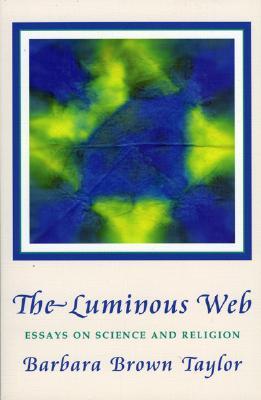
The Luminous Web by Barbara Brown Taylor

I have been reading popular books on science and religion for about thirty years. I am drawn to authors who tend to challenge or even shatter long-held assumptions about religion, mainly Christianity since that is the faith of my heritage. In addition to Barbara Brown Taylor, a few that come to mind are Marcus Borg, John Dominic Crossan, Bart D. Ehrman, Philip Gulley, and James Mulholland. In recent years I have also been reading books by the modern atheists and humanists, like Carl Sagan, Stephen J. Gould, Richard Dawkins, Christopher Hitchens, Greg M. Epstein, Edward O. Wilson, Eugenie C. Scott, and Jerry A. Coyne. All of these writers have addressed the friction created where science and religion meet.

I certainly have issues with organized religion, although I am a member of the Episcopal Church. I am repelled by evangelical Christianity, fundamentalist factions across the globe, radical sects of all faiths, and any religious practice that results in division, discrimination, sexism, racism, and superiority. At the same time, I cannot agree with some of the modern atheists who have decided that all religion is superstitious nonsense with no purpose, no value to humanity. Some of these scholars claim that religion is not just a benign fantasy but a dangerous threat to the survival of humanity.  To judge religion based on the manner in which it is too often adulterated by immoral clergy, zealots, dictators, and politicians, to my way of thinking, is similar to faulting science when technology is used by power-hungry leaders to make weapons of mass destruction.

Some scientists posit that, since the beginning of the Enlightenment, science has been rapidly replacing religion as a unified explanation for all existence. In other words, we don’t need religion anymore. As much as Dawkins and others have tried to make the case of science’s ability to answer all our questions, I believe there will always be significant gaps. My argument for the existence and validity of religion is primarily built on its longevity, that it has been a hallmark of hominids at least as far back as the Neanderthals. Evolutionary theory teaches us that nature selects what will and will not survive based on characteristics such as fitness, adaptability, necessity, and the ability to pass on vital information from one generation to the next.  It works for genes, language, technology, and yes, religion. Humans have passed down faith and myth for thousands of years, not because they are entertained by them, but because they need them.

As contemplative animals who are consciously aware of their existence, their past, and their possible future, humans have evolved a thirst for answers to questions about our place in the universe, how it all began, and the meaning of life. But, we also need a practice to help us appreciate and absorb emotion, beauty, and a whole host of other experiences. Sometimes science falls short, not because of what is yet undiscovered, but because so many people need the most treasured part of life to remain a mystery. Is religion nothing more than a panacea? Is it “the opium of the people” as Karl Marx observed? Is it a vestige that we will eventually slough off like dead skin? I suppose it’s possible, but I don’t think that we will see that next stage in our evolutionary development nearly as soon as some of our atheist friends are predicting.

Godless Ethics

Good Without God by Greg M. Epstein is a nice overview of how people who do not believe in God live an ethical life, how they are charitable, loving, compassionate, fulfilled, and inspired without religion as their primary motivation. Epstein is obviously trying to soften the message of the irreligious that has been expressed by leading atheists with sarcasm, indignation, and even rudeness. In some sense, he is playing the role of a modern Thomas Aquinas, the Angelic Doctor who is trying to find consensus between the religious and the secular world.

It does seem to me, especially toward the end of the book, that Epstein is attempting to find ways in which humanists can enjoy the worldly fruits of religion through culture and ritual, as if living a humanist life without the type of community that faith offers is empty or disconnected. No doubt, his Jewish heritage is coming into play here, which he fully discloses. Perhaps this perspective also comes out of his role as a humanist chaplain (still an odd title for a humanist in my opinion) at Harvard.

I get the sense that he thinks the creation of humanists organizations that look and function like churches, synagogues, or mosques will somehow make humanism more “competitive” or more attractive or perhaps even more palatable to the skeptics or the indecisive. It reminds me of vegetarians and vegans who eat foods that are considered meat substitutes because they crave meat but won’t eat it. I think humanists can find community and social interaction outside organizations that look and sound like religious ones. In fact, I would venture to say that plenty of believers find their most meaningful connections outside their religious circles.

This is a very accessible book that is well written, thoughtful, and completely unoffensive to left-leaning, progressive readers. Evangelicals and other orthodox or fundamentalist faithful will hate it. There is no doubt that Epstein was very encouraged by the election of Obama, which occurred one year before the book was published. For people who were raised in strong religious environments but now find themselves in the camp with agnostics or even atheists, Epstein’s conclusions can be reaffirming, perhaps even comforting.

.

Slavery by Another Name by Douglas Blackmon

In his Pulitzer-prize-winning book, Slavery by Another Name: The Re-Enslavement of Black Americans from the Civil War to World War II, historian Douglas Blackmon brings to light one of the most shameful chapters in American history—an “Age of Neoslavery” that thrived from the aftermath of the Civil War through the dawn of World War II.  Having been raised in the Southeast where these atrocities flourished in the decades leading up to the time I was born in 1960, reading this exposé was both painful and illuminating for me — it is one of the best works of nonfiction I have read in many years.

2319745

Under laws enacted specifically to intimidate blacks, tens of thousands of African- Americans were arbitrarily arrested, hit with outrageous fines, and charged for the costs of their own arrests. With no means to pay these ostensible “debts,” prisoners were sold as forced laborers to coal mines, lumber camps, brickyards, railroads, quarries, and farm plantations. Thousands of other African-Americans were simply seized by southern landowners and compelled into years of involuntary servitude. Government officials leased falsely imprisoned blacks to small-town entrepreneurs, provincial farmers, and dozens of corporations—including U.S. Steel—looking for cheap and abundant labor. Armies of “free” black men labored without compensation, were repeatedly bought and sold, and were forced through beatings and physical torture to do the bidding of white masters for decades after the official abolition of American slavery.

This book is a moving, sobering account of a little-known crime against African-Americans, and the insidious legacy of racism that reverberates today.  In light of events involving law enforcement and the legal system with regard to black people over the past year, this book is extremely relevant.  It should be required reading in most southern history college courses, and it should be considered strongly for most advanced American history courses. It is well researched, thoroughly documented, and extremely compelling.  Blackmon is such a good writer.

John Irving – A Prayer for Owen Meany

If you haven’t read at least one book by John Irving, then you are missing out on one of the best modern American novelists.  I have read a few of Irving’s works, but none was as brilliant to me as A Prayer for Owen Meany.  A tragic accident brings the two main characters together and links them in a mystery that defines their lives.

I read this novel many years ago, and like many other books from my past, I have forgotten so much of it.  Prolific readers have to come to terms with this unavoidable reality — most of us simply can’t retain the vast majority of what we read.  And, I don’t read all that much.  What is encouraging to me is the side benefit of reading, especially serious fiction.  I may not remember character’s names, specific events, or even the story line, but I know that great books have an impact on my way of thinking and the way I view the world and my own journey.  Sometimes, they alter my path and help me find new avenues that I had no idea existed.

I really wasn’t looking for Christian symbolism when I read this book, but by the time I finished, I had decided that Owen Meany WAS Christ.  Someday I want to return to this novel to see how different my reaction to it will be.  In fact, I would like to do the same thing with several other titles.  So many books, so little time . . . .

4473

Carl Sagan and Ann Druyan – Shadows of Forgotten Ancestors

Reading is easily one of my favorite activities.  Outside of newspapers, magazines, and websites, I tend to read more novels than anything else.  I like the immersion experience and the sense of accomplishment after finishing a well-written novel.  However, I do enjoy nonfiction works, and I gravitate toward works on history, religion, and natural science.  I am also fascinated by human origins, evolution, and anthropology.  There are a few books I can recall that truly had a life-altering effect on my way of thinking.  One of those was Shadows of Forgotten Ancestors by the late Carl Sagan and co-authored by Ann Druyan.

First published in 1992, this book is an exploration of who we are and how human beings have been shaped by the development of the planet over millions of years.  The authors explore origins of traits central to our current predicament: sex and violence, love and altruism, hierarchy, consciousness, language, technology, and morality.  It is easily the best book on human origins and anthropology for the lay-reader that I have ever read. I’m sure some scholars in the field are still not fond of Sagan’s work, but he really did a good job of making science accessible and fascinating for the rest of us.  For that effort and accomplishment, I am grateful.