The Ozarks in DC: 2023 Smithsonian Folklife Festival

I had the privilege of being directly involved in the planning and implementation of the 2023 Smithsonian Folklife Festival, an annual event that takes place on the National Mall in Washington, DC. With a history going back over fifty years, the festival is usually scheduled over a ten-day period roughly encompassing the last week in June and the first week of July. It is produced by the Smithsonian’s Center for Folklife and Cultural Heritage and honors living cultural traditions while celebrating those who practice and sustain them. One of the programs selected for the 2023 festival was focused on the Ozarks, a region of the U.S. that is centered in southern Missouri and northwest Arkansas but also includes small portions of northeast Oklahoma, southeast Kansas, and extreme southwest Illinois. 

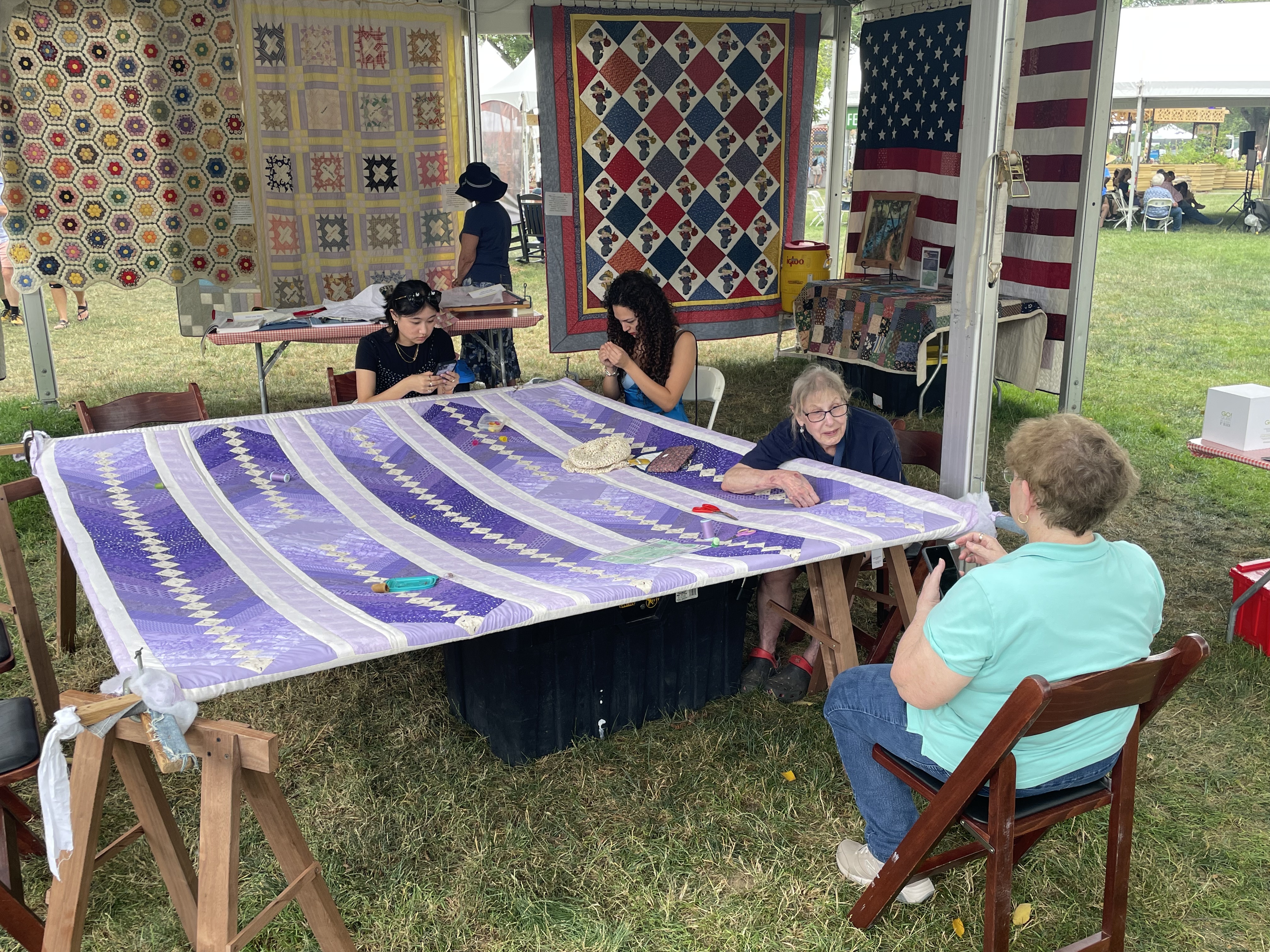
Smithsonian Folklife Festival 2023

I began working in 2019 for Missouri State University Libraries on a part time basis, assisting with projects sponsored by the Ozarks Studies Institute, an initiative of the Libraries. A fortunate turn of events led to the Smithsonian partnering with the Libraries for the Ozarks program of the 2023 festival, with the Dean of Libraries serving as a curator. The Dean offered me a full-time position eighteen months prior to the event to serve as an associate director for the university’s participation in the festival. 

The Dean and I teamed up with another part-time employee of the Libraries who has written two books about the Ozarks and has extensive cultural knowledge of the region. Our trio served as the core planning committee for the university to collaborate with the festival organizers from the Smithsonian. One of the first jobs we tackled was coming up with a name for the program. After considerable deliberation, we decided on “The Ozarks: Faces and Facets of a Region.” Our trio made numerous trips to visit with people and organizations throughout the region, in all five states, to spread the word and generate excitement about the festival. A small group of Ozarkers, including our planning trio, visited the National Mall in the summer of 2022 to get a clearer picture of how the event looks and works. We took two musical acts with us to perform as a preview of the 2023 Ozarks program.

Smithsonian Folklife Festival 2023

Over the course of a year, we worked with the Smithsonian staff to identify key stakeholders from the Ozarks who could assist with fundraising, program content, identifying other curators and participants, and overall planning of the festival. We had Zoom meetings almost every week for over a year to hammer out all the details, and several festival organizers from the Smithsonian visited the Ozarks multiple times to get a better sense of the region and to meet with our team. 

Using artists from the Ozarks and from the DC area, the larger planning team came up with design features for the festival that would reflect the natural beauty of the region. We had to decide on color schemes, fonts for signage, layout of the festival grounds, daily schedules of events, and a whole host of other elements. In early 2023 we began meeting with the festival logistics staff to work on structural and mechanical requirements for the site. We also met with interns and volunteers who are brought on each year to help the Smithsonian with festival participants’ needs regarding transportation, lodging, meals, and a wide variety of other accommodations. By the time June arrived, there were over 150 people involved in either planning or implementation. It is a massive effort.

Smithsonian Folklife Festival 2023

The festival was open each day, June 29 through July 9 (with the exception of July 5), from 11:00 a.m. to 5:00 p.m., followed by evening concerts most nights running from around 6:30 to 8:00 p.m. The Ozarks program site was situated under the trees on the south side of the Mall, just east of 14th Street SW. On the opposite north side of the Mall was the other program for the 2023 festival, which was called “Creative Encounters: Living Religions in the U.S.” Each year the festival is open on Independence Day, where people gather by the hundreds of thousands along the corridors, paths, and grassy fields extending from the Potomac River all the way to the Capitol to await the spectacular fireworks display at dusk between the Lincoln and Washington Memorials. I don’t typically go out of my way to see firework displays, but the colorful explosions that serve as a backdrop for the imposing Washington Monument are mighty impressive.

Smithsonian Folklife Festival 2023

The Ozarks program was divided into four major themes: celebrations and gatherings; stories, sounds, and show business; migrations, movements, and pathways; and connections to land and place. The site featured large-scale murals and a mountain-bike trail build, music jam sessions and performances, dance and plant-knowledge workshops, food and craft demonstrations, and curated discussions. The Ozarks program included multiple theaters. There was a theater for discussions and demonstrations of plant knowledge, one for cooking demonstrations, one called the “Pickin’ Porch” mostly for music during the day, and one called “The Front Porch” for panel discussions. Both festival programs shared a large main stage out in the middle of the Mall that was reserved for musical workshops and performances during the day and for the larger evening concerts.
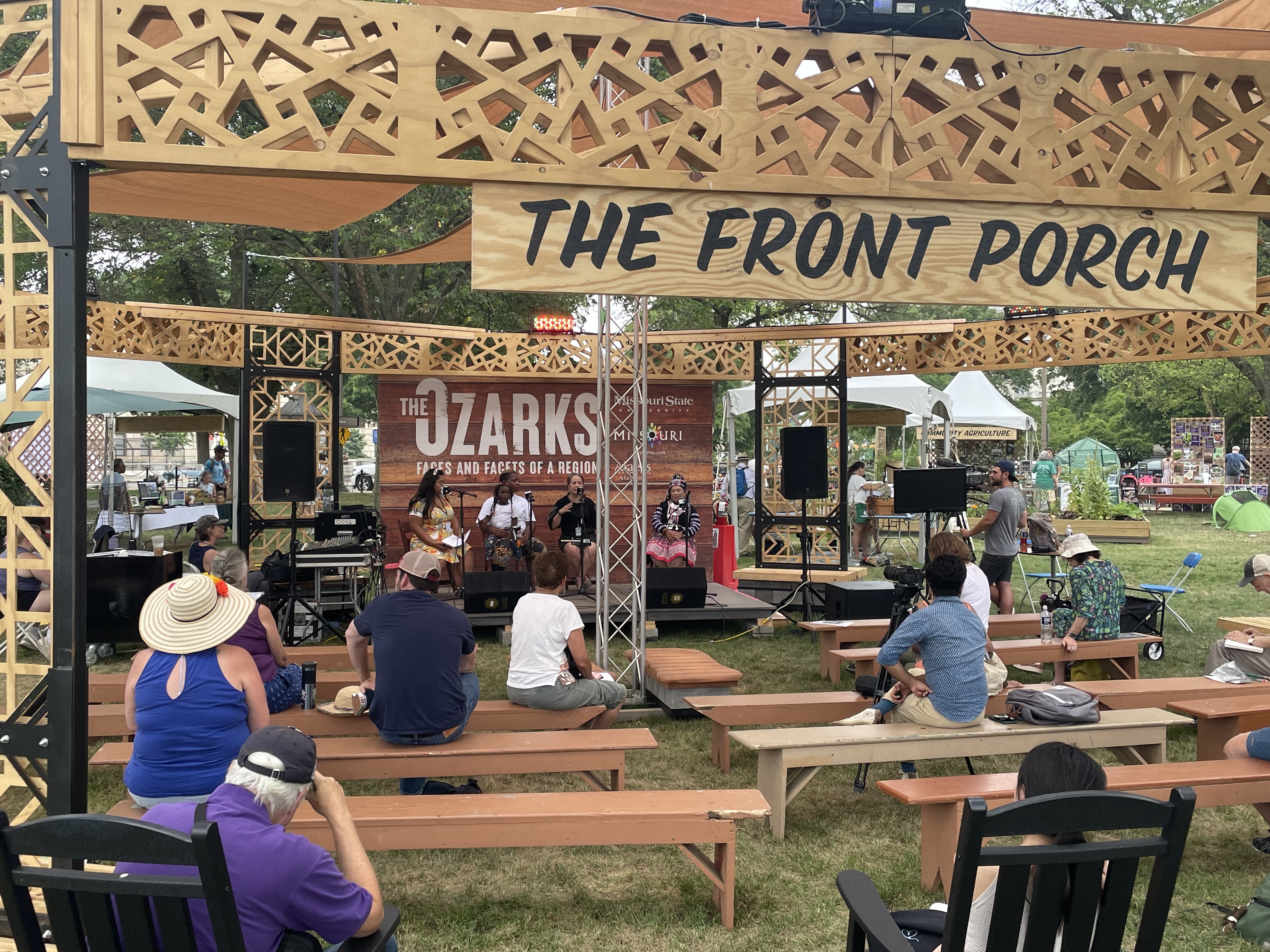
Smithsonian Folklife Festival 2023

The Ozarks program brought close to 60 musicians to the festival, which is a clear indication of how important musical traditions are to the culture of the region. There were at least eleven different ensembles of varying sizes, along with many individual musicians, specializing in several different genres including Native American music, traditional old time music, bluegrass, folk, country, gospel, and contemporary. Foodways, plant knowledge, arts, crafts, and storytelling were demonstrated by white Ozarkers but also by many other ethnic groups that call the Ozarks home, including Native Americans, African Americans, people of Hispanic and Latino heritage, Marshallese, Hmong, Khmer, and Syrian. Contrary to much of its history over the last 200 years, some of the “faces and facets” of the Ozarks show remarkable diversity in race, ethnicity, and culture.

Smithsonian Folklife Festival 2023

The largest and most recognizable musical group that the Ozarks program sponsored played on the main stage for the July 4 evening concert. The Ozark Mountain Daredevils is a band that originated out of Springfield, Missouri, in 1972. The group had several hits in their early years including “Jackie Blue” and “If You Want to Get to Heaven.” The band has evolved over the decades, losing and replacing band members and even going into a type of semi-retirement in the early 21st century. In recent years the Daredevils have enjoyed a bit of a resurgence, appearing on the Grand Ole Opry in Nashville on two occasions in 2023. They put on a hell of a show for the DC festival and for hundreds of people within earshot of the main stage that evening.

Ozark Mountain Daredevils

My primary job during the days of the festival was to occupy the Missouri State University Libraries table set up near the main entrance of the Ozarks program. With the help of one of our student workers, I was selling several books about the Ozarks and answering questions about the festival program and the region in general. I was surprised by how many festival visitors told us they were either from the Ozarks, had lived in the Ozarks, or had fond memories of visiting the region. Many of these folks have lived and worked in the DC area for years, and they were so happy to see the Ozarks featured on the National Mall. We could definitely detect a sense of pride in their voices when they talked about their connection to the region.
Smithsonian Folklife Festival 2023

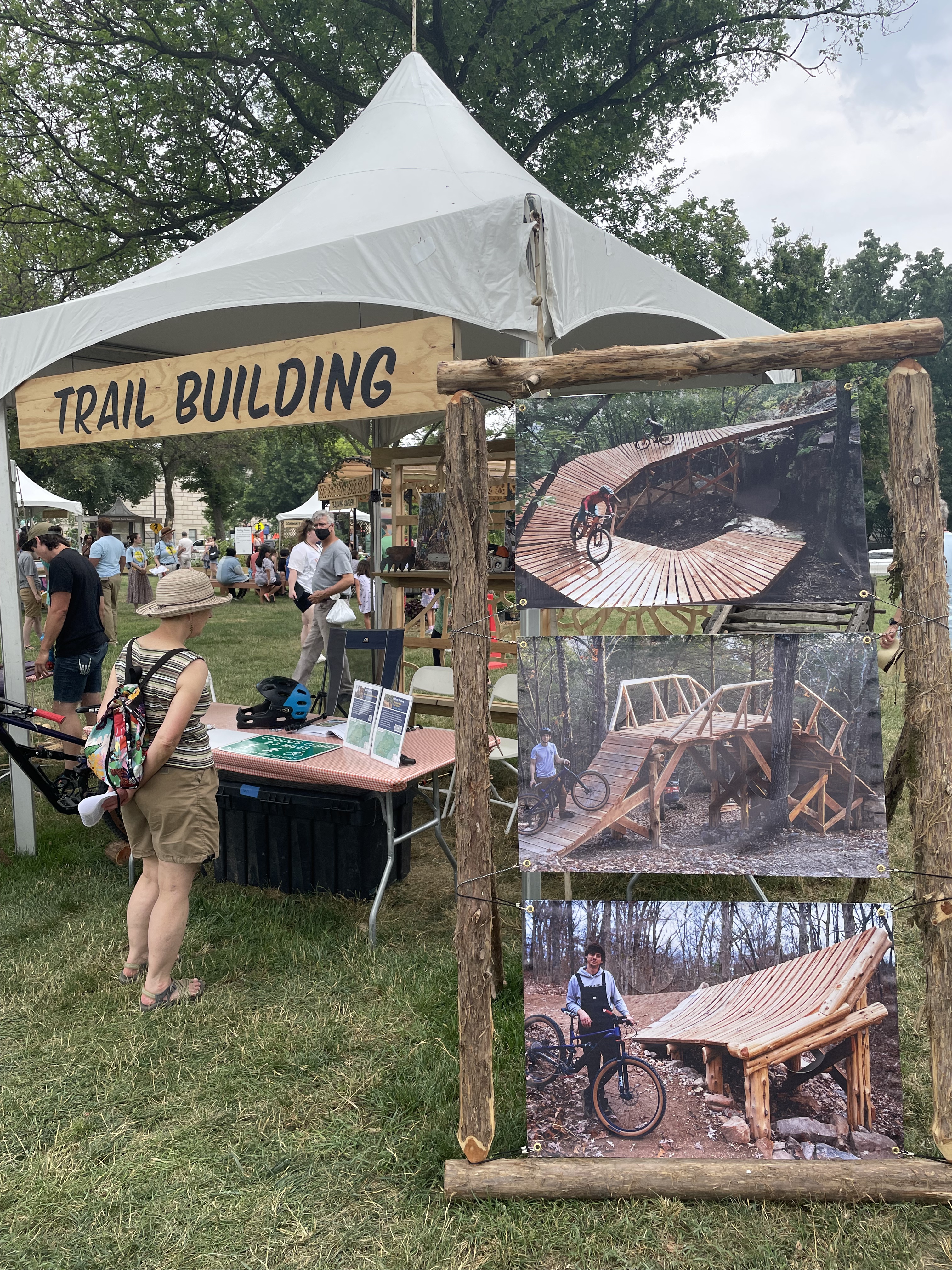
Perhaps the most enjoyable connection I made during the time of the festival was with the two guys representing mountain biking, one of the fastest-growing forms of recreation in the Ozarks, especially in northwest Arkansas and Missouri. Seth Gebel is a young entrepreneur who owns Backyard Trail Builds. He goes out into the forest armed with only hand tools and cuts down cedar trees, trimming them out to create bridges, ramps, and runs for biking trails. He designed and built a short, curved and banked track at the entrance to the Ozarks site at the festival. Dave Schulz works within a nonprofit organization to help community leaders in revitalizing their towns by developing bicycle-focused public parks and sustainable trail systems, preserving natural environments while drawing tourism from around the world. Both of these guys gave daily riding demonstrations on the track that Seth built for the festival.

Smithsonian Folklife Festival 2023

The most magical moment for me came on the final evening of the festival in the dining room of the host hotel. A group of Ukranian vocalists from the Creative Encounters program stood up and began singing a traditional folk song in their native tongue. They were followed by several other individuals and groups from both programs, standing to sing and inviting others in the room to participate through responsive chanting, vocalizations, and clapping. As I witnessed what happened, I recognized that this festival offers us a snapshot of the best of humanity, the wonders we are capable of producing when we embrace our differences and come together to learn from each other.

Smithsonian Folklife Festival 2023

The Beautiful Annabel Lee

Visitors to this blog are no doubt aware that one of my passions is landscape gardening. My love for flowering plants, shrubs, ornamentals, and trees has grown for over thirty years as I’ve experimented with many different species and multiple gardening designs. This avocation has given my wife and me countless hours of pleasure, along with way too many sore muscles and aching joints. In previous posts, I have highlighted some of the side benefits of gardening, such as attracting wildlife. I have also discussed pond construction projects at three different homes.

One of my posts featured the technique of stacked container plantings, which combine vertical interest with the opportunity to group many different plants together compactly. Over the years, I have really come to appreciate container gardening, which has several distinct advantages. Containers are a great option where there is no soil for planting, such as decks, patios, porches, baloneys, steps, paved walkways, or pool decking. They also work well integrated with flower or shrub beds, adding vertical and visual interest with a variety of shapes, sizes, textures, and materials. What can be used as a growing container is only limited by the gardener’s imagination.

In our gardens, we have had a plethora of containers of all shapes and sizes: red clay, glazed ceramic, plastic, coconut husk, peat, wood, metal, glass, and more. Some of these came in bright, cheerful colors. Our most substantial containers, not to mention the heaviest, are made of concrete. Their edges are at least an inch thick, and they can withstand temperatures that dip down in the single digits if they are mostly emptied in the winter and don’t hold much moisture. This feature is especially advantageous as they are much too heavy for us to move once they are in place.

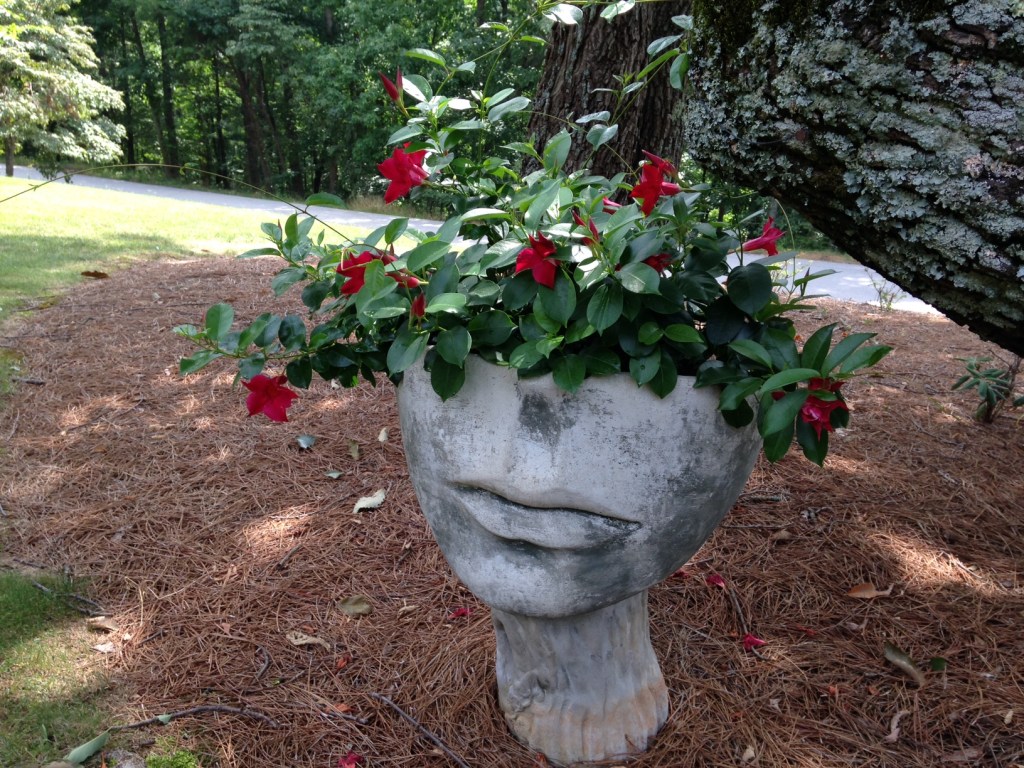
Our absolute favorite concrete planter is one made of the gray cement that is typical of most driveways and foundation walls. Sounds about as basic and boring as you can get, right? What makes this offset cup-shaped planter special is how the side is sculpted in the shape of the lower half of a human face, complete with a chin, lips, philtrum, and just a hint of the lower nose. It usually sits atop a short pedestal made of the same concrete that is sculpted into the shape of a stump, but it looks more like a neck for the face planter.

Annabel Lee 2009
Annabel Lee 2009


The first time we saw the planter in 2009 in a garden center in north Georgia, we were smitten. We backed our pickup truck to a retaining wall with the tailgate down, and the woman running the place helped us gently roll the planter from the berm into the bed of the truck. Once we got it home, we carefully rolled it off the tailgate down a 2×12-inch board, strapped the planter to a set of hand trucks, and wheeled it around the house to its place in our patio garden.

Annabel Lee 2011
Annabel Lee 2011


We both observed that the face looked female and had a rather pensive expression, even without eyes. During the next rain shower, as water streamed down her cheeks, we watched the mood turn to melancholy. In all conditions, her face presents a haunting countenance, perhaps because it is lifeless. It is literally and figuratively like stone, which helped us decide on a name for the planter. “Annabel Lee” is the name of Edgar Allan Poe’s final poem, which is about the death of a beautiful woman. Now, we have our very own Annabel Lee, not “in her sepulchre there by the sea,” but in our garden for all to see.

Annabel Lee 2014
Annabel Lee 2014


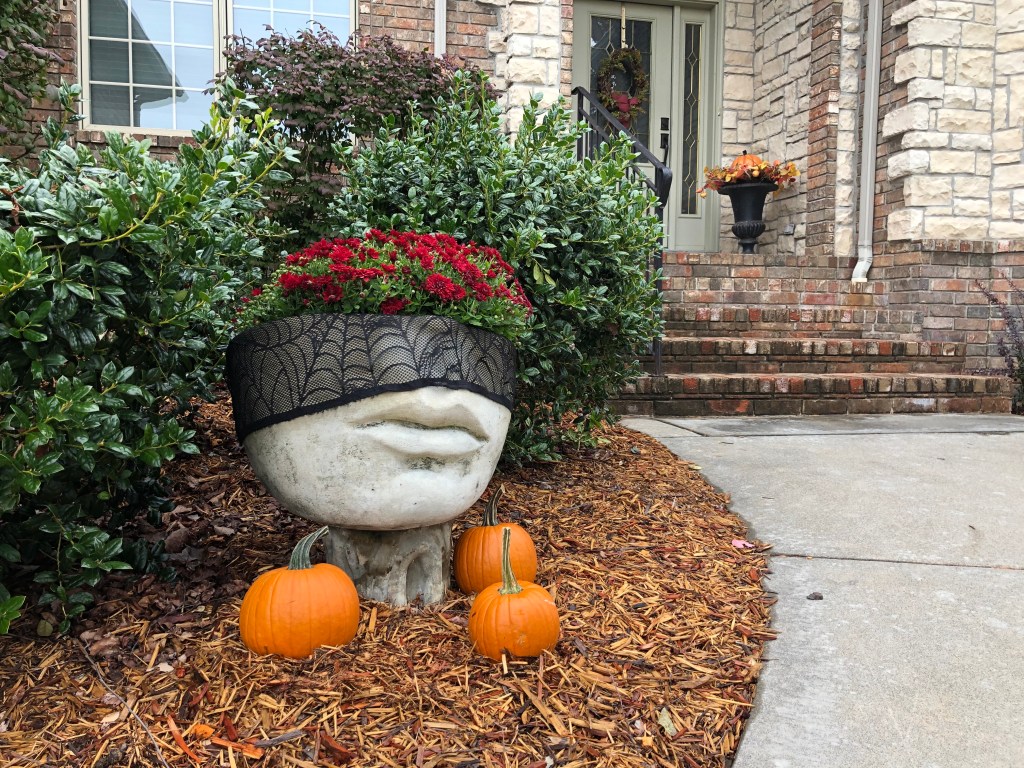
Over the years, we have changed up the plants that finish off the top part of Annabel Lee’s face and provide her with hair. Sometimes she has locks draping down the side of her face or the back of her head. Some seasons she has a more punk, spiked look. Once or twice she has channeled Medusa, that Gorgon of Greek mythology that turns everyone else to stone! She makes a wonderful lawn decoration for Halloween and is a year-round centerpiece to the hardscape of the garden. But, at night when her very own spotlight illuminates her cheek and casts shadows across her face, Annabel Lee almost comes to life. It’s a vision powerful enough to inspire Edgar Allan Poe to write just one more verse.

Annabel Lee 2016
Annabel Lee 2016
Annabel Lee 2017
Annabel Lee 2017
Annabel Lee 2019
Annabel Lee 2019
Annabel Lee 2019 Halloween
Annabel Lee 2020
Annabel Lee 2020

Getting There Is Half the Fun: An Adventure Deep in the Ozarks

One of the more interesting responsibilities of my current job is participating in an oral history project exploring the history and culture of the Ozarks, a physiographic region of the country located in portions of southern Missouri, northern Arkansas, and small portions of eastern Kansas and Oklahoma. I have solicited interviews from several people so far including a retired NASA astronaut; a farmer who moonlights as a musician; a folklorist and musician; and most recently, a woman who is a visual artist, a writer, and a horticulturist growing ginseng in the hills of northwest Arkansas. Since this is a personal blog, I won’t reveal her identity but will call her Ms. Ozart for the sake of convenience.

Ms. Ozart had a career in environmental science, but she also pursued artistic endeavors from an early age. Now that she is no longer working away from home, she can focus most of her time and energy on what she loves most: growing native plants, gardening, painting, and writing. She was not raised in Arkansas but lives here now with her husband, a couple of horses, and a dog who at one time kept her chickens safe from predators. The dog is old, deaf, and retired. Ms. Ozart no longer has chickens.

It was her fascination with one specific plant that attracted Ms. Ozart to this part of the country. Ginseng is a perennial herb native to deciduous forests, especially in places like Appalachia and some parts of the Ozarks. It thrived in these locations and throughout many other areas of the country until it was grossly overharvested in the 1970s, mainly because of the purported medicinal benefits of the root. It is now considered an endangered species. The demand for the plant’s root has been high in China for centuries, and plants from the U.S. are still routinely shipped there. Ms. Ozart isn’t interested in harvesting the roots or selling them. It takes anywhere from 10 to 15 years for the root to develop to a marketable size. She is much more interested in propagating the plant and selling the seeds so other people can do the same.

At her invitation, I had the distinct pleasure of interviewing Ms. Ozart at her beautiful property. Because ginseng is rather valuable, and poaching is a constant threat, she prefers to keep her exact location as private as possible. Respectfully, I have included no photographs of the area with this post. In our preliminary correspondence, Ms. Ozart asked me if I would prefer to meet her in the nearby town and have her drive me to her home. She told me if I had a nice car, I probably wouldn’t want to go far beyond the town. Images of being blindfolded in the trunk of a large sedan came to mind. She warned me that my phone’s GPS app may have trouble finding the address, especially if I happened to exit the program in route from the nearby town. Cell service doesn’t exist this deep in the Ozarks – no bars . . . nada. I am fortunate to have a Ford F-150 pickup, so I decided to take my chances and trust my phone to get me there.

I have spent most of my life in rural areas. The last town where we lived in the northeast Georgia mountains was in a county with several small towns and a total population of just over 40,000. It was a booming metropolis compared to where Ms. Ozart resides. The “little town” several miles north of her location where she offered to meet me consisted of a tiny square that was like an appendage off the side of the two-lane state road. There were about six buildings housing such enterprises as a bank, a café, a feed store, and an art gallery where some of Ms. Ozart’s work is on exhibit and for sale. I continued farther out into the countryside until my riding companion, Siri, instructed me to turn left onto a dirt and stone road – not gravel, large stones. Sometimes, the rocks were semi-submerged boulders. The shocks on my truck will no doubt need to be replaced soon.

Ms. Ozart had warned me that it would take about 15 minutes or more to travel from the paved road to the base of her driveway where she would meet me. When I looked at the map and discovered the distance was only a few miles, I thought she was exaggerating. She wasn’t. Had I attempted to ramp up my speed to over 20 mph, my truck and I would have been launched airborne into either a tree or flowing water, both of which were in abundance on either side of the wide path that was given the designation of the county name followed by a four-digit number. The transportation department didn’t even bother with naming it for a prominent family that had carved out a living here generations ago, which is a common practice for farm roads in Georgia. I crossed over the same river twice and a few tributaries on surprisingly sturdy concrete bridges that were more like large culverts. I was expecting rickety wooden structures, which of course would never be able to support farm equipment and heavy trucks that undoubtedly traverse this byway every day.

I was traveling through a rather mountainous terrain compared to much of the Ozarks, with high ridges rising from rolling valleys fully furnished with fence lines, crumbling rock walls from long-abandoned structures, small creeks and branches, clusters of trees and shrubs, rock outcroppings, and grazing cows — lots of cows. I am convinced the livestock in northwest Arkansas have social security numbers. Even in December with the predominant hardwood trees undressed for the approaching winter, it was like an opening scene from the Daniel Boone television program from the late 1960s. Aside from the occasional power lines, the countryside probably looks much as it did in frontier days.

Notwithstanding the absence of cell service, most of the folks living along this county road are not really off the grid. They have electricity, running water, propane gas, satellite television, perhaps even slow and spotty satellite Internet service, and other amenities that people enjoy in the most remote parts of the country. Although Ms. Ozart has dreams of someday being a true homesteader, she freely admits that most of her provisions these days come from Walmart and the occasional delivery truck whose drivers risk life and limb to reach her door.

When I arrived at the base of her driveway — the cross section of a creek, a road intersection, and a pasture gate — Ms. Ozart was waiting for me in her small, well-seasoned red pickup truck. “You might want to ride the rest of the way with me,” she said. “Your truck probably doesn’t have four-wheel drive, does it?” And here I was, thinking the wagon trail that had gotten me this far was hazardous. I transferred my recording equipment to her truck, and we headed up the ridge on a rutted, winding trail just wide enough for one vehicle.

We stopped after about 100 yards to look at one of the locations where ginseng is growing on a raised plateau just across the creek from the “driveway.” The plants are dormant this time of year, and the leaves are gone, but she wanted to show me the spot just the same. She gingerly scampered across several rocks to reach the other side, warning me to secure my footing on the slippery surfaces as I followed. I could just imagine conducting the interview in blue jeans soaked in icy creek water. Luck was on my side. I remained high and dry.

We safely made it back to her truck and continued our trek toward her house located about a half mile up the hill. We were no longer crossing creeks and branches. We were going through them. She was describing the habitat for ginseng and its companion plants while showing me the more interesting features of her property, including lovely cascading waterfalls and massive rock outcroppings in tall ravines. At one point she stopped the truck to point out another hillside where she had discovered ginseng growing wild. I admit it was difficult for me to concentrate as I was keenly aware that she had parked the truck directly in the middle of a flowing creek. I kept waiting for the sensation of sinking and drifting as we sat there, but after she finished her story, she simply engaged the four-wheel drive and slowly maneuvered forward out of the water. I was thankful for her truck. I was more thankful I wasn’t driving.

We arrived at Ms. Ozart’s house and set up at her kitchen table for the interview. The room was comfortably warm with the help of a gas space heater. She had chili bubbling in a slow cooker that filled the house with a mouthwatering aroma. She put on a pot of coffee, graciously served me a cup, and sat across the table from me and my video camera for a 45-minute conversation that was fascinating and entertaining. She pulled out of her refrigerator seedlings of ginseng and other native herbs she overwinters packed in moss in plastic storage bags. She demonstrated how she makes pigments for paint by grinding rocks from the local creeks into powders of various hues and textures and mixing them with oil, honey, and other suspending agents.  She talked about how the Ozarks region is an inspiration for her writing and her visual art. She and her husband have built a rich life in this isolated slice of wilderness, which I find quite remarkable and admirable.

After we finished and I packed my equipment in her pickup, she drove me back to my truck. “Do you really get supplies delivered to you out here?” I asked as we bumped our way down the hill. “Oh sure,” she said. “Lowes delivered my washer and dryer too.” Admittedly, I was a bit surprised by this news, given how narrow and rugged her driveway is. When we reached a sharp curve where the creek widens next to the road, she pointed toward the stream and said, “I came down early one morning and found a FedEx truck tilted sideways and halfway in the creek right there. The driver had made a delivery to my house the night before, and lost control going back down on this turn. He showed up later that morning with a wrecker. It took the better part of the day for them to get his truck out of the creek, but they did it.”

When we reached my truck, I thanked her for her hospitality and told her how grateful I was that she drove the last leg up to her house. She chuckled a bit and said, “I thought that would work best.” I watched her from my rearview mirror retrieve the mail from her mailbox at the driveway entrance and then climb back in her truck to head home again. Somehow the rocky road leading back to the state highway didn’t seem quite as treacherous this time. The cows appeared just as disinterested as they had earlier. I recognized a few landmarks that I had remembered to look for on the way back to make sure that I wasn’t lost. I allowed myself to look around and soak up the pastoral vistas along the way, but I slowed down considerably and took great care crossing the bridges.

Irma, the Unsolicited Landscape Designer

Homeowners go to great lengths and expense to harness nature and control their environments in order to create their own versions of paradise in the form of landscape gardening. These efforts may include grading, building retaining walls, terracing, hardscaping, designing planting beds, installing shrubs and trees, trimming tree limbs, or removing trees altogether. It can take months or even years to alter the property and establish the desired effect . . . or, nature can make the decision to completely change it all in a matter of minutes. Such was the case in our front yard in September, 2017, courtesy of Hurricane Irma.

Georgia is a state that experiences extreme weather conditions, from sub-zero temperatures in the mountainous regions to weeks of mid-day temperatures exceeding 100 degrees in the southern and coastal areas. A soaking wet spring and summer may easily be followed by six years of very little rainfall at all. Dry conditions can lead to horrible wildfires, especially in south Georgia, while heavy rainfall frequently brings flash floods to the streams and rivers that carve through the hills of the Piedmont region. The influx of warm, wet air from the Gulf creates an unstable atmosphere over the state that results in severe electrical storms, strong winds, and heavy downpours, even if this activity is isolated. In the late spring and early summer, tornados are an ever-present threat. The greatest risk of widespread destruction comes in late summer and early fall — hurricane season. Catastrophic hurricane damage in the state is rare and limited to the coast for Atlantic storms and southwest Georgia for storms that come into the panhandle of Florida from the Gulf.

As is always the case with hurricanes, wind is typically a secondary problem to the primary issue of either storm surge or torrential rains and flooding. On rare occasions, high winds and rain from hurricanes come together in a deadly combination that inland forested areas are not able to withstand. Such was the case with Hurricane Irma. With the strongest winds ever recorded of any storm in the open Atlantic, Irma caused incredible damage in the Caribbean then crossed the Straits of Florida to eventually make landfall on September 10 in the Keys with sustained winds at 130 mph before swirling up the west coast of Florida towards Alabama. This was a huge hurricane with outer bands that spread out over several states at once: Florida, Alabama, and Georgia. The outer bands on the east side of the storm ended up causing the most damage to inland areas, such as the mountains of northeast Georgia where we live. In fact, we heard reports in the weeks that followed the storm that our county suffered more damage from Irma than any other in the state outside the coastal counties.

The worst weather from the outer bands hit our county between 5:00 p.m. and midnight on September 11. The wind began to pick up that afternoon around 3:00 p.m. Within an hour we were hearing the characteristic howling of the gusts as they came through in waves. The electricity went off at about 4:30 p.m. Over the next three hours the wind continued to build in intensity and the gusts were almost becoming sustained. We were most concerned about the large oaks closest to our house, located in the front yard in a landscaped “island” of mulch planted with an understory of shrubs and perennials. Every few minutes we would walk to the front windows and shine our flashlights out toward the trees to check on them. At about 8:00 p.m., we noticed that one of the oaks was starting to lean with the force of the wind, and the ground around the trunk was beginning to bulge as the roots were being pulled toward the surface. It was a frightening spectacle. By 8:15 p.m., two of the trees were uprooted and fell across the front yard, completely missing the house. We were sad to lose the trees but thankful the house was spared. The wind got stronger, and then it got dark. Not being able to see out the windows to tell how far the wind was bending the trees in the forest surrounding us was quite disconcerting.

First trees fallen
First trees fallen

Less than 30 minutes later, we heard a loud crash and felt the whole house shudder. We knew we had lost another tree, but this time, it fell on the house. I sprinted upstairs to look for holes in the ceiling or broken windows in the front dormers. I was greatly relieved to find that the roof had apparently not been breached, but all I could see out of the front second-story windows were the leaves and branches of the tree’s canopy resting against the roof over the front porch. Then I heard my wife shouting from downstairs, “The tree is in the house!” I rushed back down to find her at our open front door in a desperate struggle against tree branches that looked like a horticultural monster invading our foyer. A portion of the tree canopy had spilled onto the front porch, and when my wife opened the front door, the bent limbs sprang inside and almost knocked her down. It was like a scene out of Jumanji.

Downed trees on the house

We managed to push the limbs back outside and close the door, realizing in the process that two trees had actually fallen on the house, for a total of four lost trees. Each of these oaks was over thirty feet tall with combined canopies covering an area over 1,000 square feet. The fallen trees caused damage to the porch, roof, and brick walkway, and completely demolished a light post. The destruction could have been much worse in that regard, as it was for so many people in our part of the state. The downed trees were removed two days later by a local tree company with some of the fastest and most efficient workers I have ever seen. Within a few weeks all the damage to the house was repaired as well. What Hurricane Irma left behind for us, however, was a completely altered landscape for our front yard and gardens. What had been a sheltered area for shrubs and shade-loving annuals and perennials was now exposed to full sun.

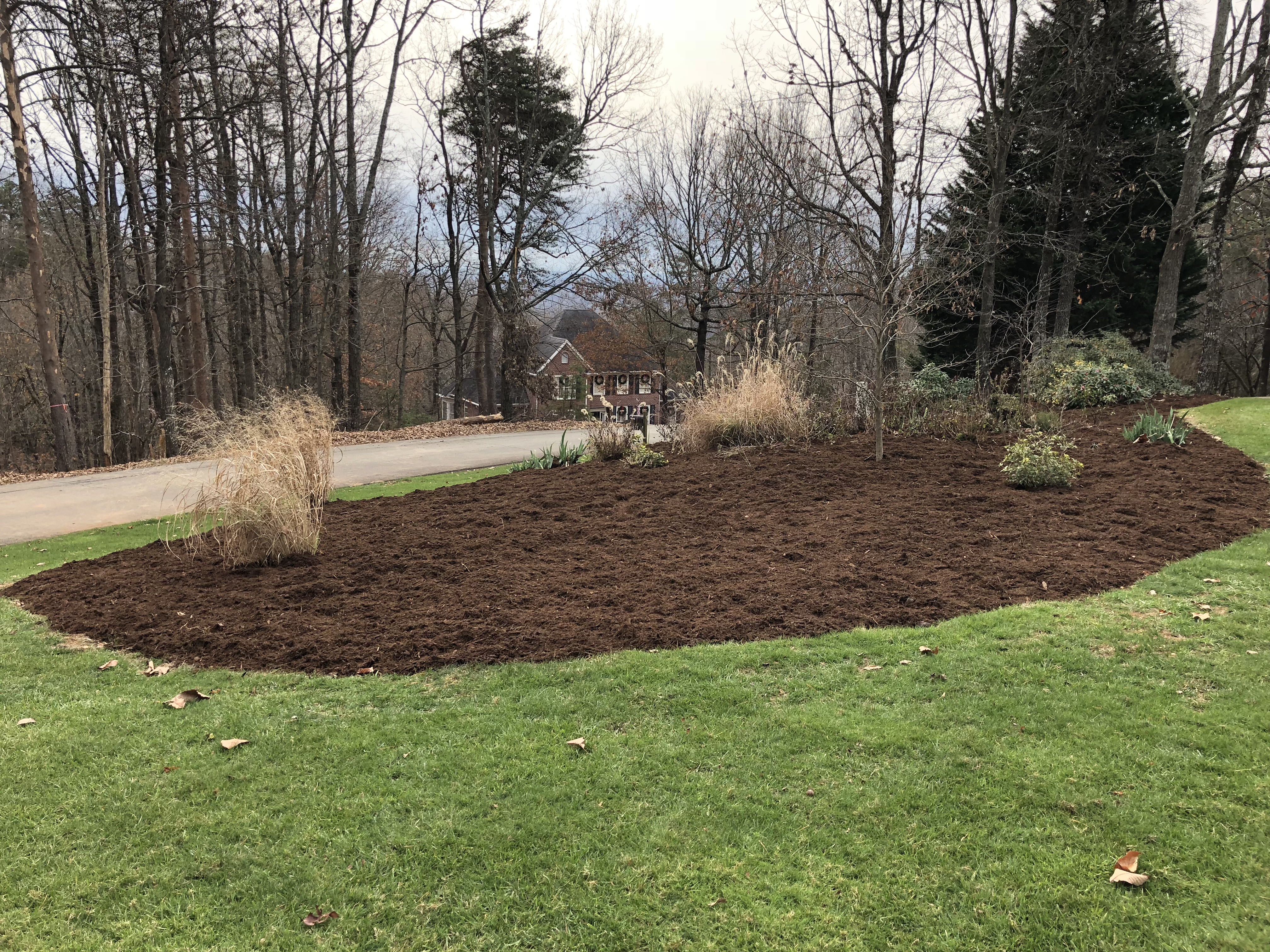
Post-storm island
Post-storm island

After our contractor removed the stumps and most of the roots of the extracted trees and smoothed over the scars in the ground, we brought in a fresh load of mulch to dress the area and replanted the under-story plants that had been temporarily removed to a safe location at the edge of the yard. The existing dogwood and redbud trees under the big oaks came out remarkably unharmed. Surprisingly enough, when the trees fell they completely missed our two large (and expensive) planters, and they only slightly injured the smaller plants in the island. We did purchase some ornamental grasses to fill in some of the new space, and we transplanted a red-blooming crepe myrtle from the backyard where it had been under-performing due to lack of sunlight.

Island in bloom for spring

For the 2018 season, we had to totally rethink our flower beds at the front porch. In the past, these beds were filled with impatiens, caladiums, coleus, and other shade-loving annuals. We switched to impatiens, Mexican heather, begonias, zinnias, and other annuals and perennials that enjoy morning and early afternoon sun. These beds were beautiful before, and as we learn more about what will thrive there with the new conditions, they will be just as handsome. Where we once depended more on foliage than blooms for color, now we have just the opposite situation. I wouldn’t say they look better, just different. I must admit, in the days following the storm I was a bit worried about how our front yard gardens were going to suffer with the loss of the trees. I think we are comfortably acclimated to the new look now. It’s going to be just fine. One thing I know for certain. I will not miss for a second spending hours of time in the late fall picking up large acorns before they have the chance to burrow and sprout. For that little gift from Irma, I am quite grateful.

Sunny front flower beds

Pool Landscaping

One of the most satisfying aspects of home ownership that I have experienced is designing and maintaining our landscape and gardens. All properties present their own challenges, some more extreme than others. For over fifteen years I struggled with a yard that sloped at about 35 degrees, from the street all the way to a small creek that served as the back property border. Most of the top soil had washed away long before I ever began working in that yard. At first I was attempting to plant in clay that was more like a brick patio than dirt. However, I also built my first and most natural-looking pond in a portion of that hillside behind the house with lush ornamental shrubs, perennials, and annuals surrounding the area. Of course, it took nearly ten years for my back to heal from that project.

Water features have always been a landscaping necessity for me, a subject I have covered before in this blog. My wife and I are currently living in a house in north Georgia in the foothills of the Appalachian Mountains. We are fortunate to have national forest land in front and behind our house. It’s an ideal setting for various gardens within the landscape, as long as I keep spraying Liquid Fence to keep the deer from eating everything in sight. When we first moved to this location, I knew I wanted to incorporate a water feature. In an effort to avoid traction or surgery for me, we elected not to build a pond at this house. Instead, we contracted with someone to build a pool — not so natural in appearance but infinitely more versatile than a garden pond.

Pool waterfall plantings

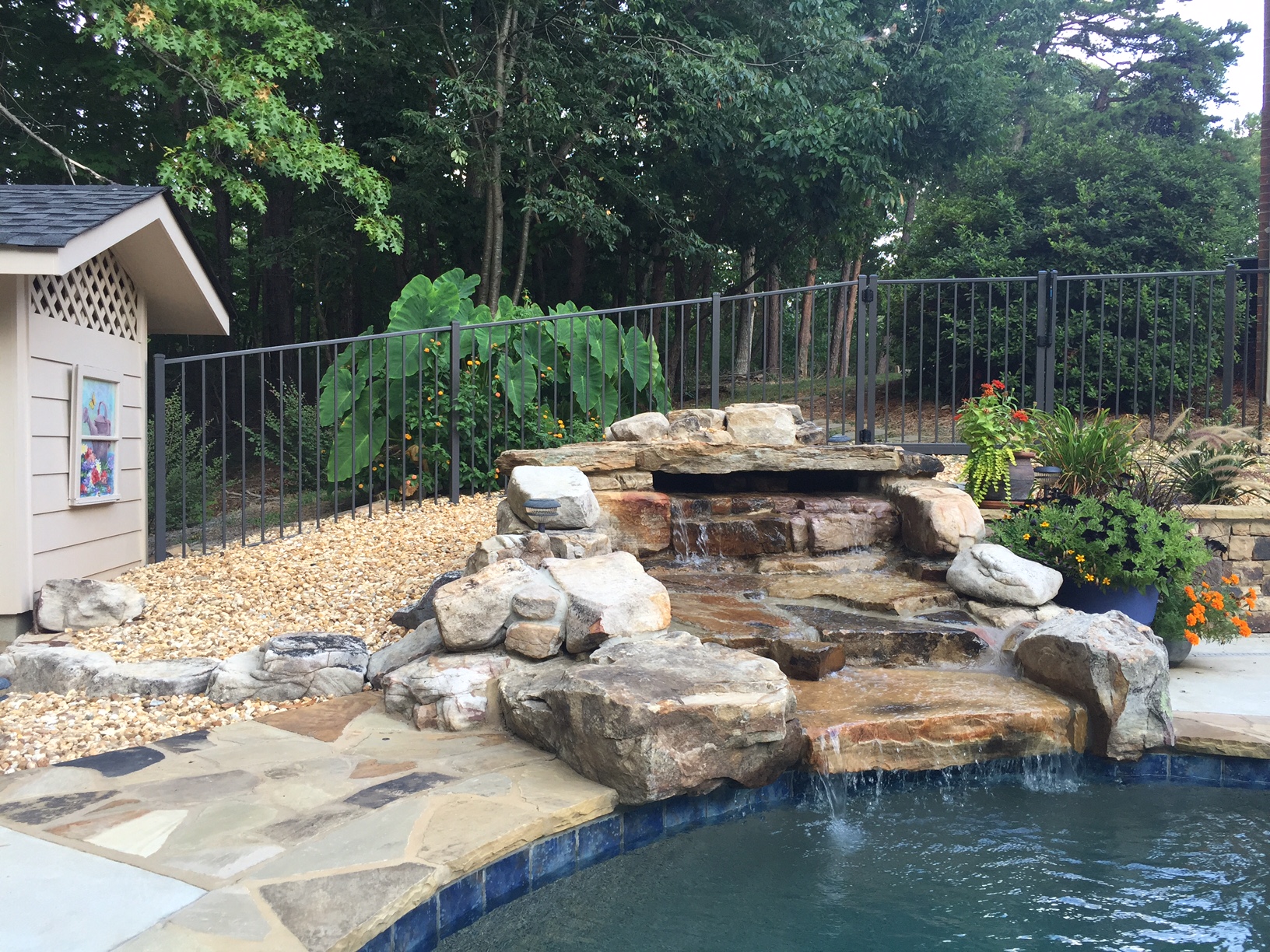
We splurged on the pool project with the use of natural stone around the border and in the retaining wall and by installing a waterfall made with boulders. We covered the ground inside the fenced area with river rock, and for the first year, the pool was functional but not necessarily attractive. What ultimately enhanced the backyard project and made the space come alive was the addition of a few decorations and some plants. We started with some containers next to the waterfall, which added bright color and contrast with the earth tones of the stone. Over the next few years, we added Knockout Roses along the edges of the pool decking. We also added more containers with annuals near the steps leading up to the deck above the pool level. A collection of large-leaf hostas fill a corner just beyond the table, chairs, and shade umbrella. A chimenea, globe lanterns, and landscape lights complete the accessories for the pool.

Poolside Knockout Roses

On the side of the pump house we hung an antique window that has a watering pot and flowers painted on the glass panes. This modest piece of art reflects our love for gardening and adds interest even during the off season. Just beyond the fence behind the waterfall we planted elephant ears, which create a tropical atmosphere close to the sound of running water. There is a row of dwarf nandina along the outside of the long section of the fence running the length of the pool, and they turn a deep shade of red and green during the winter. On the slope just beyond this section of fence, we have large clumps of ornamental grasses, several mountain laurel shrubs, taller nandina, and an expanding collection of butterfly bushes that attract their namesake, along with a few hummingbirds, all summer long. Finally, a row of loropetalum shrubs serves as a tall screen just beyond the fence next to the carport entrance to the pool. In less than four years, we have been able to create a little oasis in our backyard — a place of rest, relaxation, and escape. It was worth every penny.

Pool pump house art
Pool pump house art

Stacked Container Planting

I incorporate no less than twenty containers in our garden every season. They decorate the back deck, which is visible through french doors in our living room. I place pots on the stone retaining wall that borders our pool in the backyard. A couple of large, colored concrete pots are nestled at the edge of our evergreen shrub bed in front of our kitchen windows. There are a few pots of different sizes in the annual and perennial beds at the entrance to our front porch. One particular container that I enjoy planting each year is on the brick walkway leading up to that same front entrance.

Stacked container planting

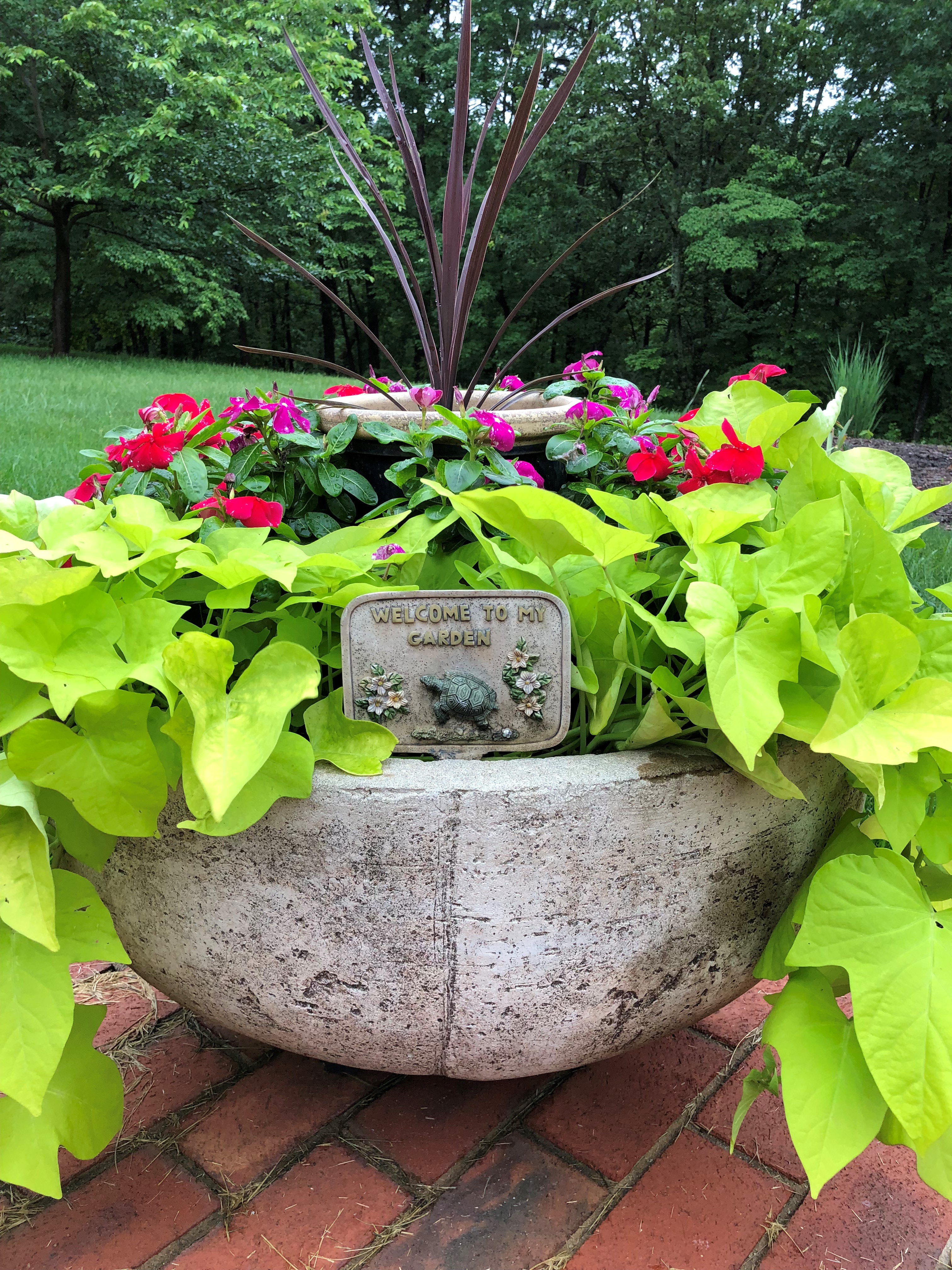
This planter is almost like a separate garden to itself because it is actually a collection of three containers. The base is a large, artificially-aged concrete bowl that we purchased in Cherry Log, a little hamlet in the hills of north Georgia, when we were still living on a lake near the center of the state. Its shell is thick enough that the pot can be overwintered outside, even when temperatures dip down close to zero degrees Fahrenheit. We decorate it for several holidays during the off-season. It is quite heavy, even when empty. I fill this container with potting soil up to about two inches from the rim. On top of the soil in the center, I place a shallow blue glazed pot with a cream-colored interior and matching rim. It is almost completely filled with soil, and on top of it I place a matching blue pot that is taller and narrower than the one below it.

The plants I use in this terraced garden vary from one season to the next. Typically I use annuals that flower profusely and don’t require deadheading (self-cleaning), such as vinca or begonia. In the top pot I almost always plant something with vertical interest, like ornamental grass. Along the edge of the base bowl that faces the house and the entrance from the driveway, I always plant two green potato vines that will trail over the side and down to the brick walkway. Between these two vines I insert one of my favorite “inorganic” elements of our landscape: the little sign that greets us and all our guests to our garden. Have you tried a stacked container garden? They add so much interest and are fun to experiment with year after year.

Gardening Comes Second Only to Reading

Many years ago, my two sons gave me a special gift for Father’s Day that I am still using now, all the time, 365 days out of the year.  The gift was a fabricated flat, natural-looking stone that is engraved with the sentence: GARDENING COMES SECOND ONLY TO READING.  It was the perfect present because, for me at least, that declaration is quite true.  I would argue that my family actually comes first (I hope they would agree!), and I could certainly make the case for several more seconds and thirds, with music taking a prominent place near the top of the list.  Both of my boys knew then, as they still recognize now, that gardening is a passion for me — something on which I am willing to spend plenty of hard-earned dollars.  I have lived in three different locations since they presented me with that engraved stone, and it is still part of the hardscape of my gardens today.

Entry way garden
Entry way garden

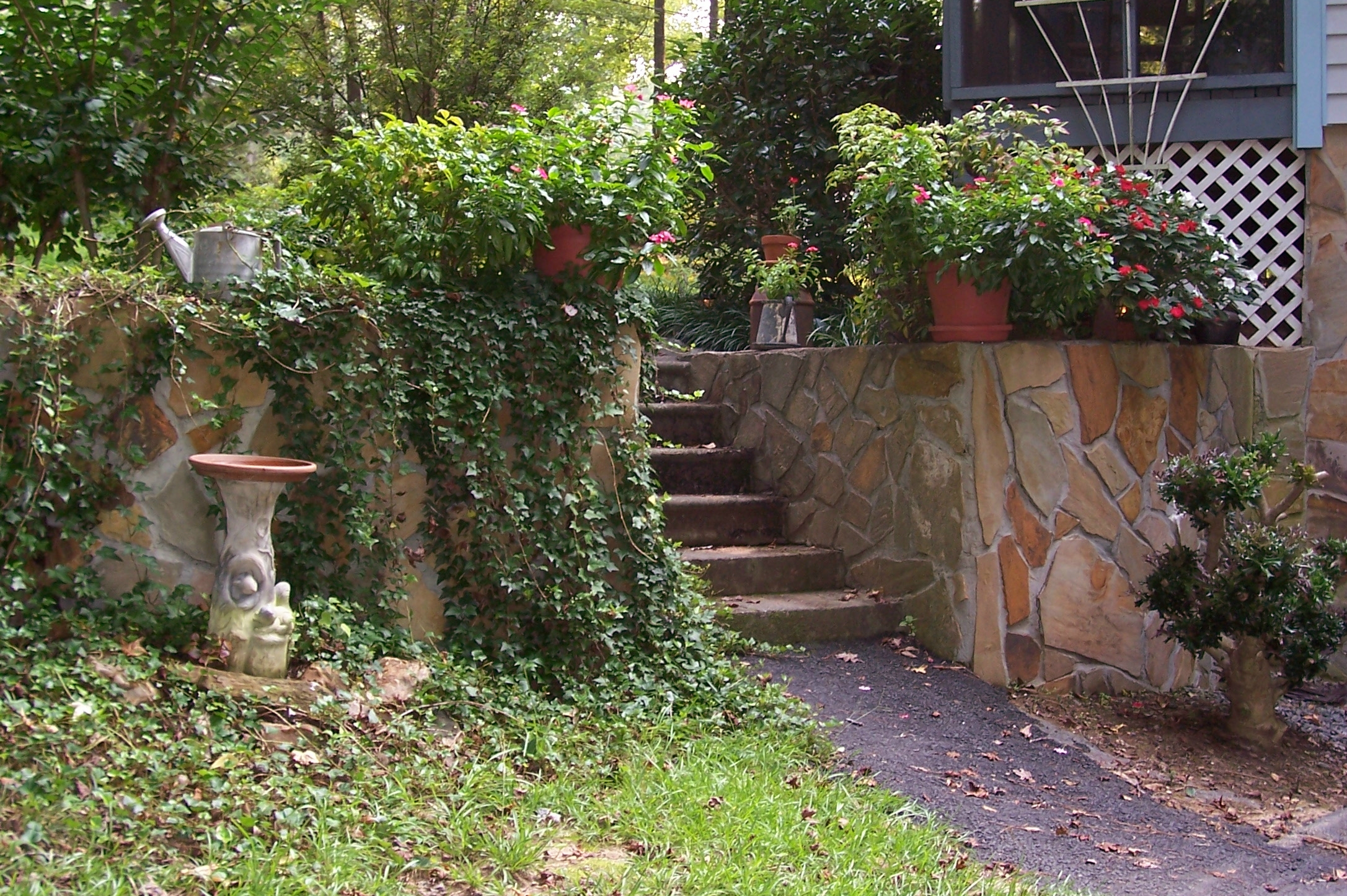
I became interested in landscaping and ornamental gardening in 1987, shortly after my sons’ mother and I bought our first house.  I had started working in a public library two years earlier, and I was fascinated by gardening magazines and books that I was cataloging.  I wanted to have a yard with more than just an expanse of grass and a few foundation shrubs around the house.  I wanted to create a little oasis!  I started building my own personal library of gardening books, learning as much as possible about soil condition, hardiness zones, watering, fertilizing, and plant identification.  I didn’t have much disposable income in those years, so I started out small and concentrated on a few specific areas, such as the side entrance to our house that we used most often.  A few years later we started a family and moved into a larger house on a steeply sloping lot.  It was a challenging yard, but over the years I began to mold it into something that I could work with and make attractive.  One of the most successful projects was the creation of a lush entry-way garden leading from the parking area to the front door, which is pictured in the photograph above.  Before moving away from that house, I also created two azalea islands under oak and sweet gum trees in the front yard, a pathway leading through ornamental trees and shrubs in the backyard, and my first small pond with a waterfall. (See my post from May 17, 2016 to learn more about the waterfalls and ponds I have designed through the years.)

Pond garden at sunrise

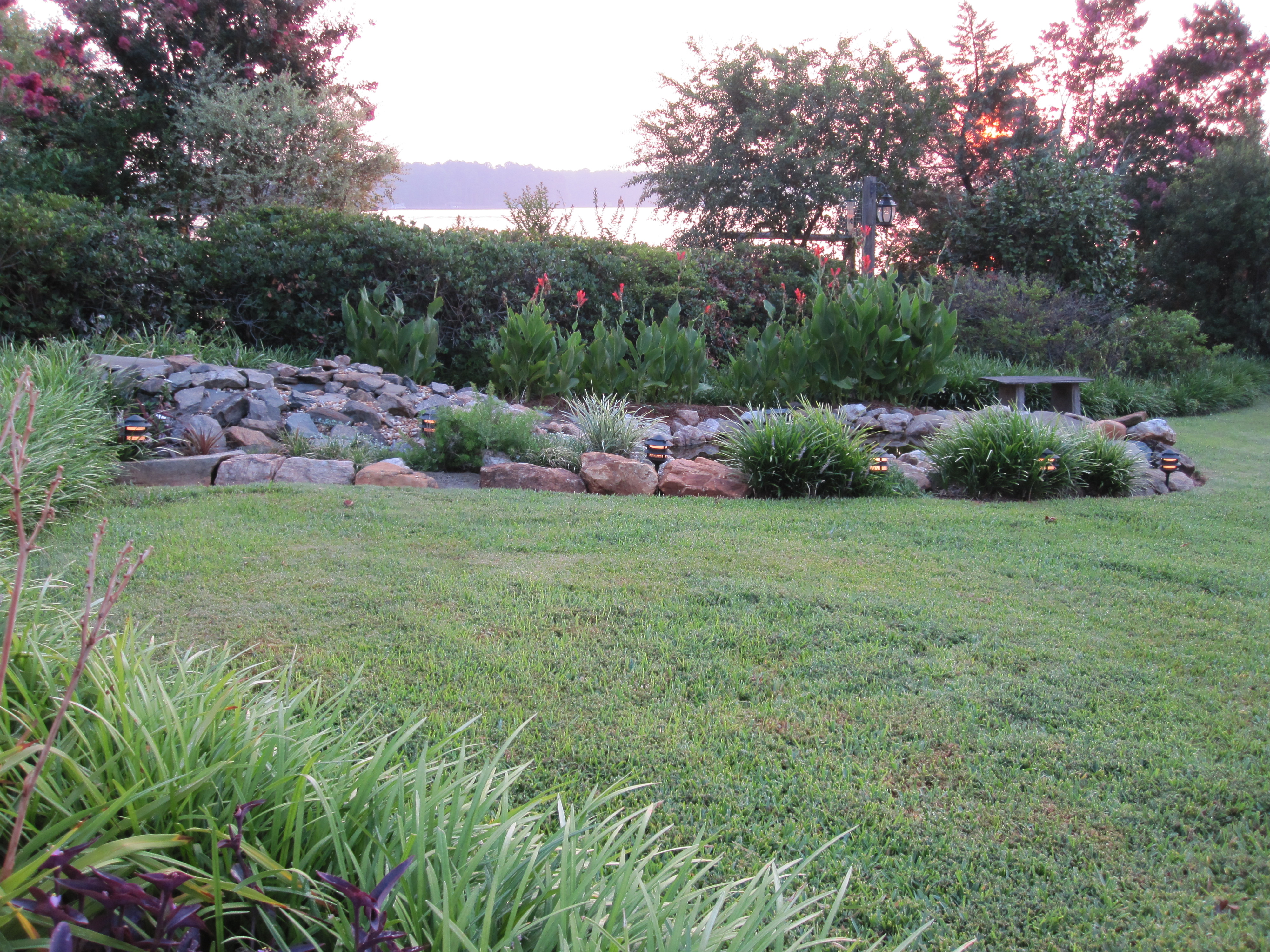
When I met my second wife, she was living on a lake in central Georgia.  When we married, I moved in with her.  The previous owners of this lake house had invested considerably in the landscape, but my wife had made several improvements before we were married including upgrading the irrigation system, replacing an old patio, removing pine trees, and installing ornamental shrubs and trees.  We decided to have our wedding ceremony on the patio overlooking the lake and a small pond and waterfall that I finished just a few days before the big day.  Over the next two years I added plants and landscape lights around the pond to make the area into a separate garden spot, complete with a bird feeder and a bench.

Patio lake garden
Patio lake garden

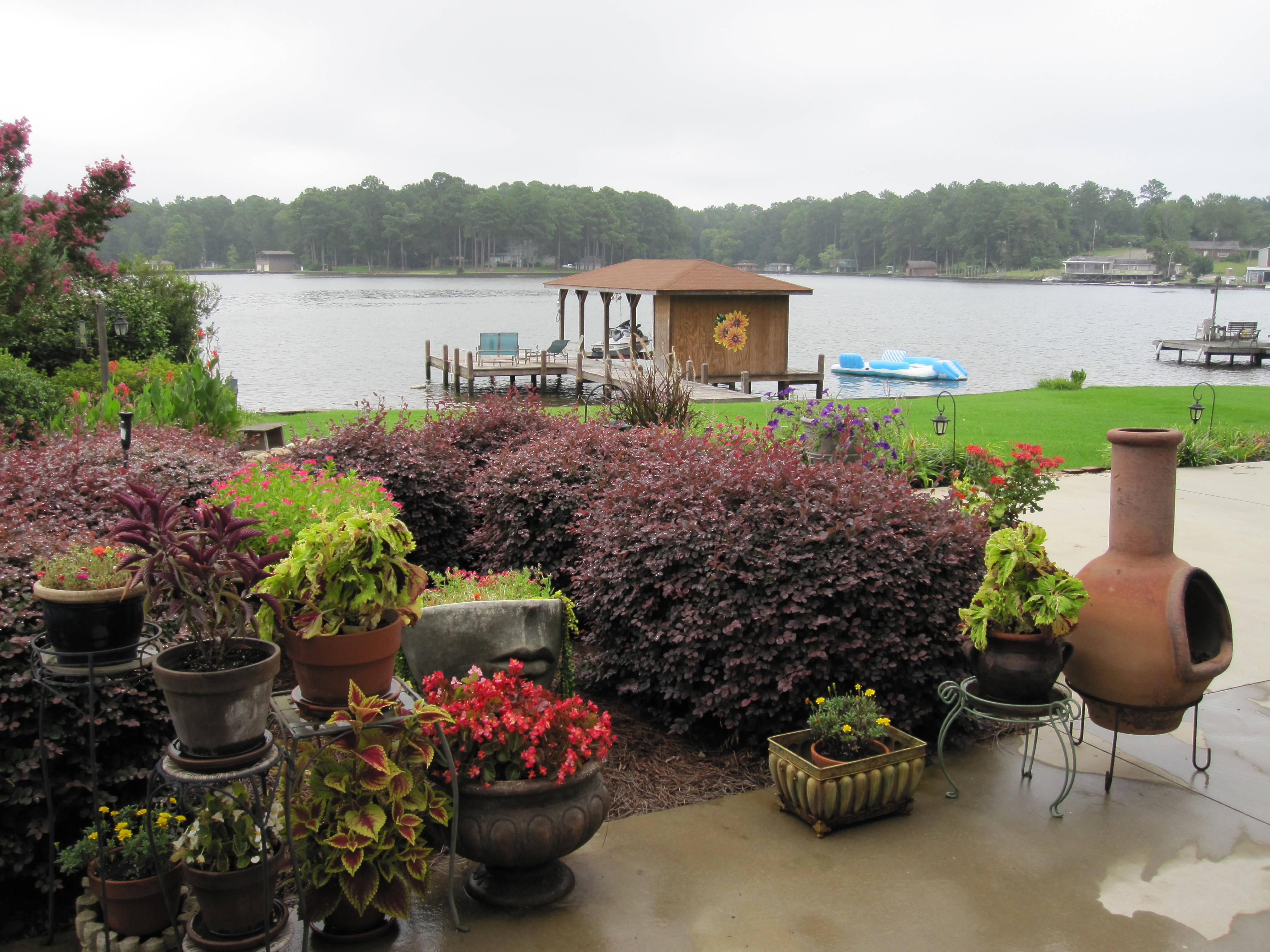
The new and expanded patio was a perfect place to add a container garden, so we began looking for interesting pots, such as the sculpted face pot and stand that we affectionately named Annabel — the face on the pot looks melancholy and reminds us of the subject of the poem by Edgar Allan Poe, “Annabel Lee.”  The patio container garden was framed by a beautiful stand of Loropetalum shrubs that my wife had planted shortly after she moved into the house.  This garden was completed by a chiminea and a hot tub, which is just out of view at the lower left corner of the photo above.  The gently sloping grass of the yard and the view of the large cove beyond were a perfect backdrop to this little slice of paradise just outside the sliding glass doors leading from our master bedroom.

Front island garden
Front island garden

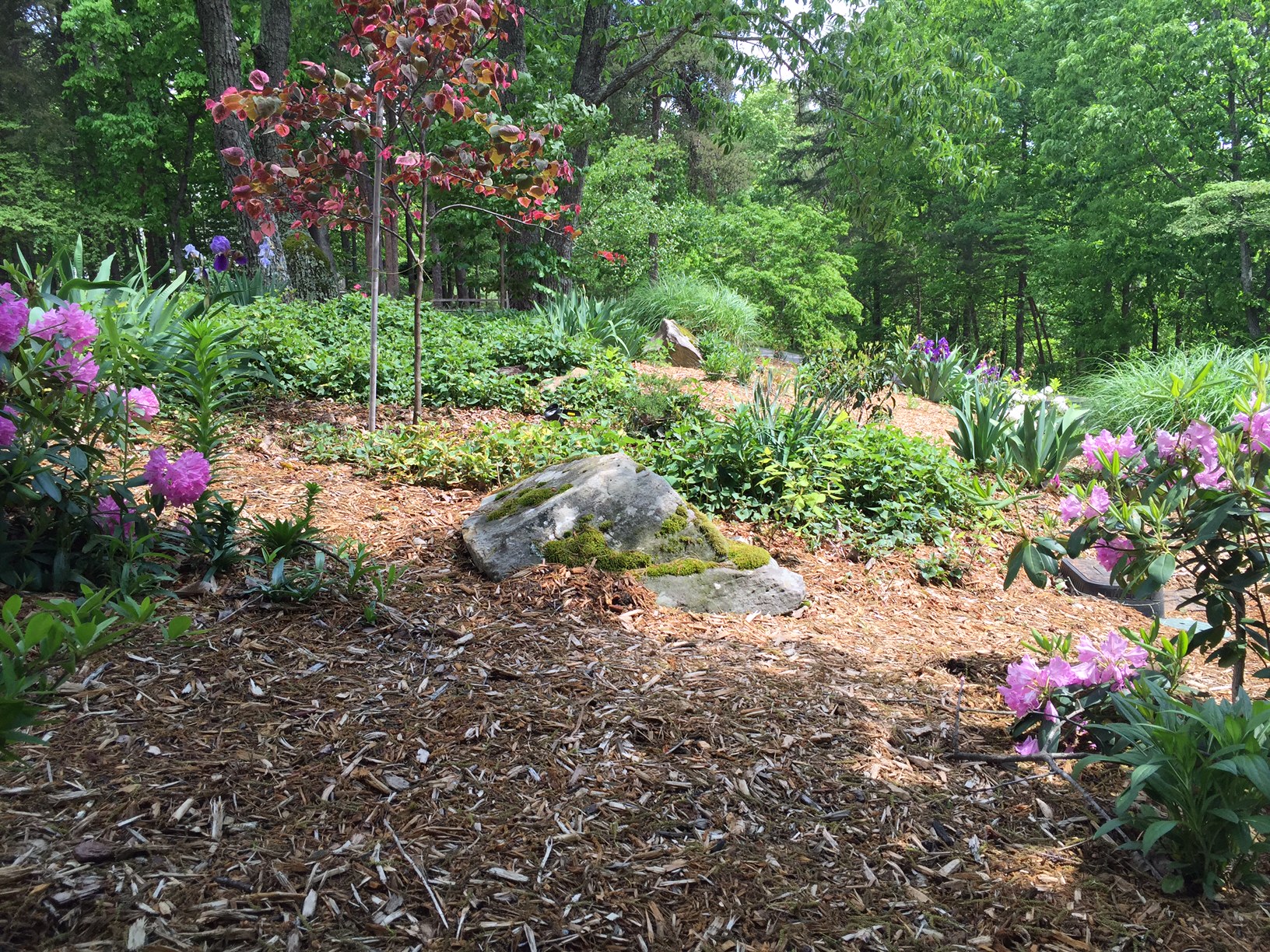
In 2013 we moved to the foothills of the Appalachian Mountains in northeast Georgia.  This part of the state is in a different plant zone than our previous location.  As such there are some semi-tropical species that we can no longer have in our yard, but other ornamentals that need cooler temperatures are perfectly at home here.  Our growing season is a week or two shorter also, but climate change is bringing earlier springs and extended autumns as the years go by.  The previous owners of this house did a fine job of building the “bones” of this property, with a large planting island in the front yard and a fairly deep shrub bed in front of the house.  We have made a few changes, such as adding some annual planting beds and thinning some of the dwarf Nandina on the side of the house.  We have also added to the plants in the front island (pictured above) and covered it all with a healthy layer of wood chips.  The greatest addition we have made to the property is the installation of an in-ground swimming pool with a waterfall, providing us with yet another opportunity to create a new garden oasis.  Although I did not build this “pond,” my wife and I did help with the design.  We have worked very hard over the last two years on the landscaping around the pool by installing a river rock border, bringing in new plants, and arranging container plantings around the decking. The sound of running water is such a pleasant feature of this space, which of course, is also a perfect area for enjoying my first passion . . . reading.

Pool waterfall garden

In Living Color

One of the passions I developed as a fairly young man was ornamental gardening and light landscape designing. I have lived at four different houses over the last thirty years, from the most southern to the most northern sections of the 7b agricultural zone, and have had the opportunity to experiment with a wide variety of plants.  My wife and I currently live in the foothills of the Appalachian mountains where the Piedmont shifts into the Blue Ridge.  The southern Appalachian region is one of the most diversified botanical places on the planet, with rich soil and enough rainfall to support lush, thriving ecosystems.

Flower garden
Flower garden

We were fortunate to find a house two years ago with previous owners who were just as passionate as we are about surrounding the house with beautiful plants.  They had done a lot of work with the structure of the property, especially in the front of the house.  They had established two beds in front of the porch, split by a brick walkway and steps.  Short to medium-sized shrubs are spread out on either side to complete the dressing of the house, and a large island is positioned between the house and the street, which has a nice and expanding collection of trees, shrubs, ornamental grasses, and perennials.  Among our own additions to that island is our favorite container, the large concrete planter with a “face” in full relief (visible in the background of the photo above).  We call her Annabel, named after Annabel Lee, the poem composed by Edgar Allan Poe, because she has a melancholy face reminiscent of the poem’s theme.  We usually plant something each year in Annabel that will make her look like she has hair growing from the top!

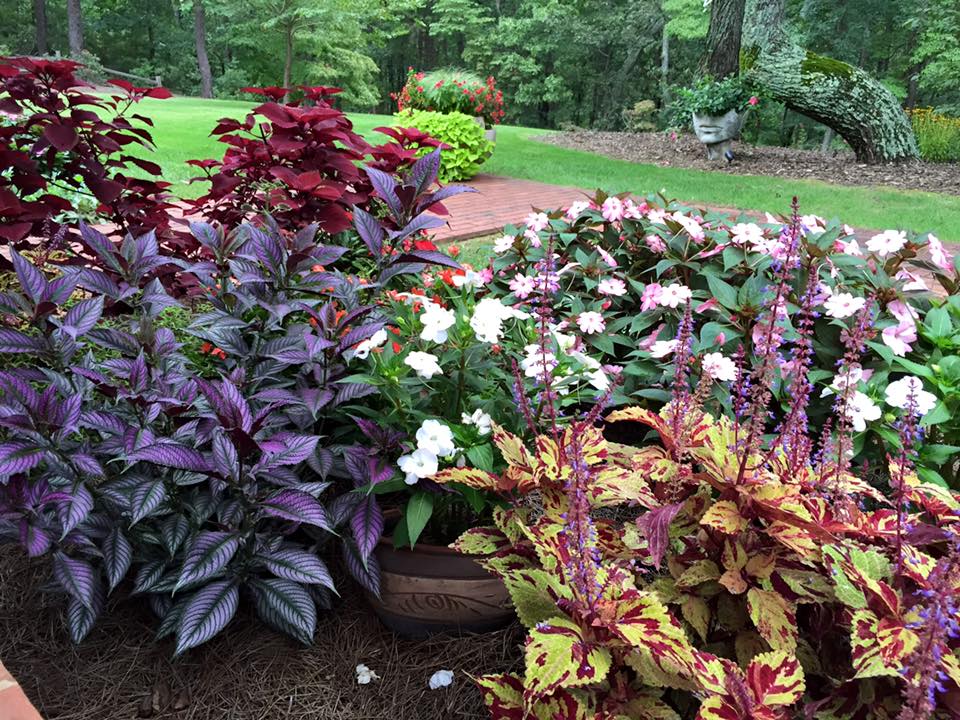
I am by no means a Master Gardener, nor am I much of a purist when it comes to plant selection.  I have a growing appreciation for native plants and received a book on native plants of the southeast as a Christmas gift.  I hope to incorporate more native species in our garden in the years ahead.  I love annuals and typically fill the front porch beds with New Guinea impatiens and coleus.  We have to be very diligent in spraying most of the plants in the yard with deer repellent, and non-native plants are much more susceptible to damage from animals.  Still, I love the big bang of color provided throughout the growing season by imported and hybrid annual cultivars.

For Father’s Day many years ago, my sons gave me a mortar-fabricated flat stone engraved with the following words: “Gardening comes second only to reading.”  The stone is still a permanent fixture in our garden, as it has been in every garden I have tended.  In many ways, this statement could easily be adopted as my philosophy, with the possible addition of family, music, and a few other passions.  I have savored countless hours in planning, designing, planting, and maintaining shrub and flower gardens.  It is another one of those activities that is so restorative for me.  It grounds me, with no pun intended.  Ralph Waldo Emerson once wrote that “the earth laughs in flowers.”  What a wonderful way to express the joy experienced in nature’s palette displayed in the beauty of plants.