Little Rock Creek Falls

My wife loves adventures, and she has had quite a few.  My life is all the more richer because of the adventures we have shared in the eight years we have been married.  There have been times when I have “caused” adventures for which we didn’t necessarily make plans, but she has usually faced the challenges with enthusiasm and determination.  She is a gracious soul.  One such occasion happened about five years ago when I decided to search for a hiking trail that terminated at a waterfall — one of my favorite outdoor experiences.  I searched through a trail guide and selected one in north central Georgia in the Chattahoochee National Forest.  Little Rock Creek Falls looked beautiful in all the photographs I saw, which perhaps encouraged me to be a bit too dismissive about the descriptions of the trail leading to the falls that described it as being difficult and dangerous with thick underbrush.

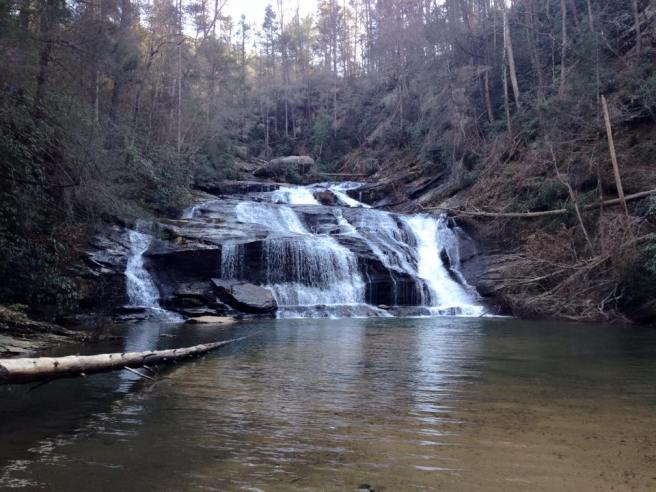
Little Rock Creek
Little Rock Creek

For young folks or very athletic, experienced hikers, this trail would not be a problem.  My wife and I are casual hikers.  We are occasional hikers.  We are quite often paved-trail hikers.  Little Rock Creek trail has no pavement.  The length of the trail from the road to the falls is a little less than a mile, and the elevation is consistent; however, the terrain is quite steep and rocky as the trail makes its way along a sharp embankment following the creek.  The understory is beautiful and thick with mountain laurel and rhododendron.  At this stage of our hiking careers, we were not yet using sticks of any kind (we each have two now).  Under normal conditions, we would have considered this to be a moderately difficult hike, but alas, I had the audacity to take my dear wife on this excursion not too long after she had broken her shoulder, which she guarded carefully along the way.  I was nervous the whole time, fearing that she would slip and reinjure her shoulder or break something else trying to protect it as she fell.

Although we should have waited until she was in better shape to make this hike, I can state with certainty that neither of us was disappointed with the terminus of this trail.  It was one of the most secluded and enchanting waterfalls I have ever seen in Georgia.  We did the obligatory selfie shot with the falls behind us, which became profile pictures for both of us on social media for several months.  I apologized to her profusely for selecting such a treacherous trail, especially considering that she was still recovering from an injury.  As usual, she simply said, “I’m fine.”  She is indeed.

Little Rock Creek big falls

Panther Creek Falls

I have expressed my appreciation for waterfalls in previous posts, and we are fortunate to live in an area of the country where creeks, lakes, and waterfalls are abundant.  Even better, many of these features are freely accessible at state parks, national forests, and recreational areas.  One of the most popular waterfalls close to our home is Panther Creek Falls, located a few miles south of Tallulah Gorge in northeast Georgia.  This waterfall is located in the Panther Creek Recreation Area at the end of a 3.5-mile moderate walk along Panther Creek. The National Forest parking area is located on old U.S. Highway 441 north of Clarkesville.

Panther Creek Falls Trail is 5.5 miles long and follows Panther Creek through stands of hemlock and white pine along steep, rocky bluffs of the creek. The trails passes a series of cascades as well as Panther Creek Falls. It terminates where Davidson Creek joins Panther Creek.  When my younger son and I explored the trail last February, we decided to take the 3.5-mile hike to the falls and return to the parking area for a 7-mile excursion.  We had plenty of company on that mild winter day, with other hikers and campers all along the path.  The trail is noted for its beautiful variety of wildflowers and ferns. The stream offers excellent opportunities for trout fishermen too.  Some rock scrambling is required, and there are some steep sections, but much of the hike is relatively flat.  Erosion has caused several trail sections to drop sharply and suddenly to the creek below, demanding extra caution.  I was amazed at how many families with small children were there when we hiked the trail — some were even carrying strollers with them!

Panther Creek Falls
Panther Creek Falls

I was so enamored with the trail that I took my wife back at a later date, and while we only hiked in and out about a mile or so, she could appreciate the beauty of the forest and the creek without seeing the falls.  A large, shallow pool forms at the base of the falls, which is a wonderful destination for families and hiking groups.  The setting is beautiful, surrounded by hills covered in trees and laurel.  For those who like seclusion and privacy when they commune with nature, this recreation area is probably not a good choice.  In the warmer parts of the year, I’m sure it gets quite crowded.

Panther Creek Falls
View from the top of Panther Creek Falls

The naming of the creek is a source of curiosity for me.  I have not read anything official that links the name to animals that may have inhabited the area in the past.  According to some sources, a subspecies of the puma, the Florida panther, survives in a small, isolated and precarious population at the rapidly urbanizing southern tip of Florida. However, these animals were once widespread, even inhabiting portions of Georgia.  Another subspecies, the eastern puma (also known as cougar or mountain lion) may have once occupied regions of north Georgia.  Although in recent years there have been claims of sightings in north Georgia and South Carolina, the U.S. Fish and Wildlife Service has declared the eastern puma extinct and removed it from the list of protected wildlife and plants under the Endangered Species Act.  Regardless of nomenclature of the falls, this trail offers a great opportunity to get outside and enjoy the natural resources that are so abundant in the hills and mountains of north Georgia.  We will definitely return.

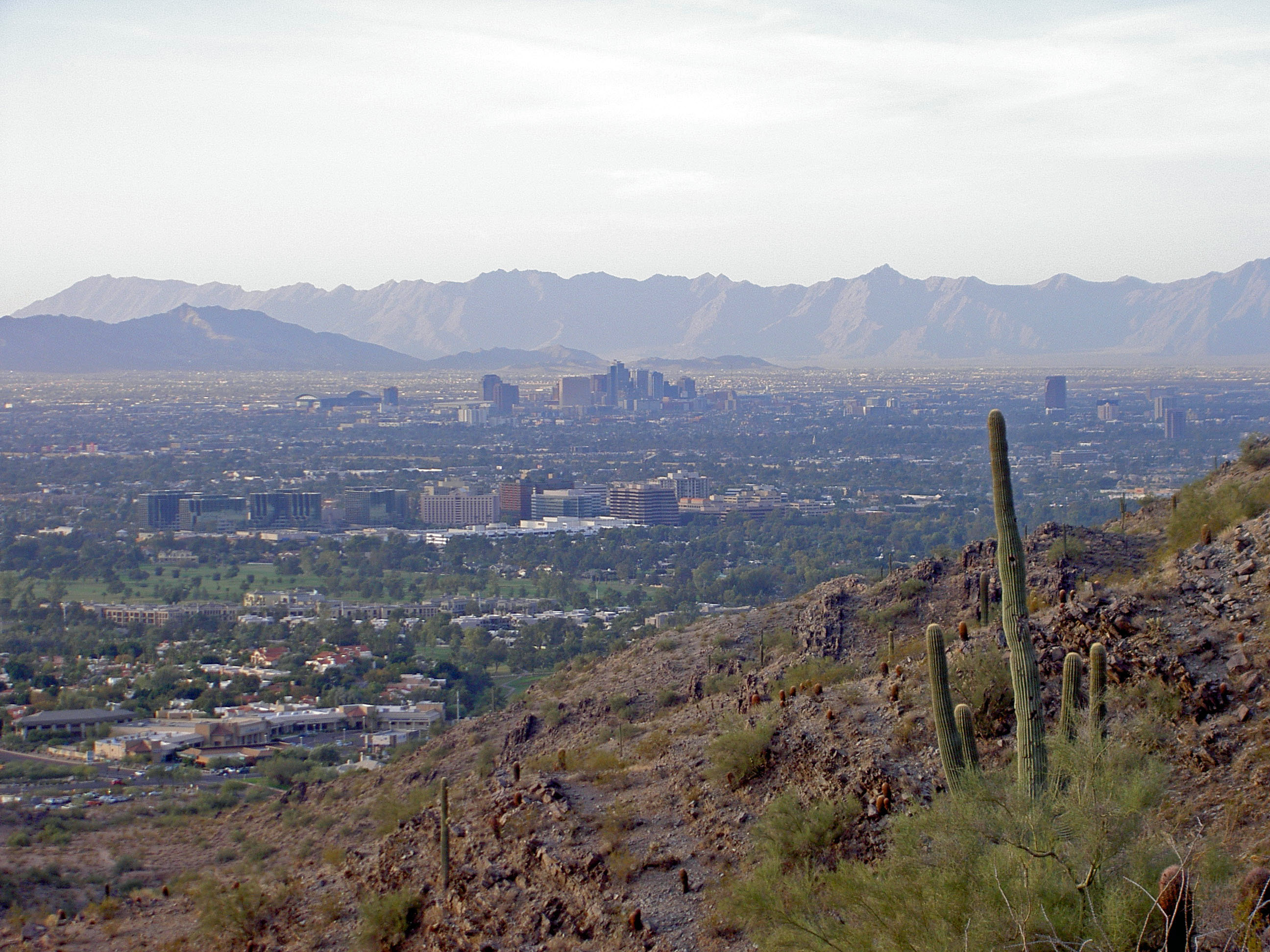
Phoenix Mountains Preserve

I have written several blog entries about hiking, an activity that my wife and I so enjoy and one that I am missing terribly since I broke my ankle last month.  I have also written about some of our favorite places to hike, which are often located in areas that offer distant vistas, most particularly mountains and valleys.  Truly one of the most spectacular places we have hiked is in Phoenix, Arizona, the city where my wife lived for nineteen years, before we met.  She has told me about how, when she lived in the area, she regularly drove to the Phoenix Mountains Preserve to hike the trails on over 6,000 acres of land owned by the city and managed by the Phoenix Mountains Preservation Council.  The network of trails in the Preserve winds up through small mountains and hills that reach about 2,000 feet above the desert floor and about 3,000 feet above sea level.  These elevations, combined with the mostly treeless landscape, provide hikers with incredible views of the enormous valley below and the vast sprawl of the metropolitan city and suburbs.

View from one of the trails

I traveled to Arizona for the first time in 2008 with my wife, and while we were there, she took me to the Preserve.  We hiked up one of the hills, not to the top but far enough to take some great photos that I have used on occasion as computer wallpaper, like the one above.  Somehow the mountains in the distance look so much higher than they are because they soar up from the flat, desert floor.  There is a very definite contrast between earth and sky in many portions of the west, and this is one of those places.  The diversity of plant life in the desert is far greater than most people who have not seen it can imagine.  The terrain is rocky and sandy but not too difficult to maneuver.  The Preserve is well used and a wonderful recreational asset for the people of Phoenix.

I Love Waterfalls

As I have mentioned before on this blog, I enjoy hiking.  I am also attracted to water – mostly water that is moving fast enough to make sound.  I have hiked along the coast, through the mountains, in the desert, in deep forests, along rocky peaks, and in suburban areas.  More often than not, I select a place to hike that is either in sight of water or has running water as a destination.  My family takes advantage of state park trails which are frequently near the shoreline of a lake or wind along a creek or river.

The ultimate culmination of a hike to me is a waterfall — the bigger and louder the better.  One of the tallest I have seen recently is just outside Cherokee, North Carolina.  Mingo Falls is on the Cherokee Indian Reservation (Qualla Boundary), just outside Great Smoky Mountains National Park.   At 120 feet tall, the waterfall is one of the tallest and most spectacular in the southern Appalachians.  The hike on Pigeon Creek Trail to the waterfall is only 0.4 miles in length, but is considered moderate in difficulty because it is largely composed of steps and a fairly steep climb up to the falls.

2014-12-27 14.40.15

I took this photograph in December, just after Christmas.  It was a great time to get a shot because the foliage was gone from most of the trees, which revealed a good portion of the width of the falls as well as the vertical expanse.  I was standing on the small bridge at the base of the falls where the creek continues cascading down the hillside.  The sound is mighty but not deafening.  I love waterfalls, and this is one of my favorites.  In fact, it is currently the home-screen photo on my iPhone.

God’s Cathedral

There are still plenty of outdoor places in America you can visit that are protected enough to offer a glimpse at how the landscape on this continent may have appeared to early native inhabitants and explorers.  A prime example are some of the national parks.  I think the National Park Service is one of the best government programs of all, and I wish our federal leaders would find some other areas to cut funding and leave this division alone.  We have some incredible treasures around the country, several of which I have visited.  I have never been disappointed.

One of the best parks to visit to experience what I am describing is Yosemite National Park in the High Sierra region of California.  First protected in 1864, Yosemite is best known for its waterfalls, but within its nearly 1,200 square miles, you can find deep valleys, grand meadows, ancient giant sequoias, a vast wilderness area, and much more.  There are so many places in this park where you can stand, and for as far as the eye can see, there is no sign of civilization.  The vistas are absolutely breathtaking, including perhaps the most photographed view of all from just beyond the tunnel on Wawona Road, where the valley opens up and welcomes you to what many people refer to as God’s Cathedral.  Indeed, the scene is like a place of worship on a monumental scale, and for those who have any appreciation at all for the beauty of the natural world, it invokes a sense of reverence and awe.

Yosemite Valley
Yosemite Valley from Tunnel View on Wawona Road

My wife and I joined up with a good friend of ours there in July, 2013, staying several nights in a cabin and spending our days hiking along the valley floor and up to one of the high spots overlooking the valley.  Yosemite is another one of those places that reminds me just how small I am and how magnificent this planet is.  John Muir, the famous naturalist who helped draw up the proposed boundaries of the park in 1889, described Yosemite as being “full of God’s thoughts, a place of peace and safety amid the most exalted grandeur and enthusiastic action, a new song, a place of beginnings abounding in first lessons of life, mountain building, eternal, invincible, unbreakable order; with sermons in stone, storms, trees, flowers, and animals brimful with humanity.”

Mountain Hiking

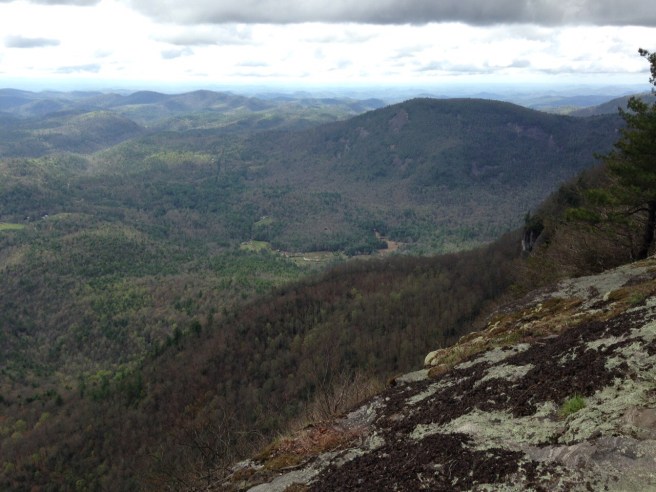
My wife and I really love to hike, and we have had the opportunity to hike in some beautiful spots: along the Pacific coast, in the desert, at Yosemite, and many other lesser known spots.  Some of the greatest rewards of hiking are the vistas that some trails include, and some of the best I have ever seen are on mountain trails.  Today, we hiked along the ridge that goes to the summit of  Whiteside Mountain just outside Highlands, NC.  The view from 4,800 feet was breathtaking.  We have certainly been at higher elevations in other places, but the view today was spectacular, probably because of the mix of sun and clouds and the multiple shades of green introduced by the onset of spring.


I cannot understand people who have no appreciation for the outdoors — for the majestic presence of mountains and seashores, the mighty rumbles of thunder, the magnificent beauty of an ancient tree, a field in bloom, or a rushing river.  I look forward to more excursions to follow trails like the one on this mountain, to see open sky and miles and miles of the earth below. 

A Wooded Path

If you like hiking, or simply taking a walk on a nature trail, the state parks and national forests in north Georgia are some of the best places to enjoy this activity.  The state of Georgia does a fine job, with dwindling resources I am quick to add, with the access to natural resources it provides through the state park system.  The trails vary in length and difficulty levels to accommodate almost any age and degree of fitness.  Most parks have trails that are wheelchair accessible.  The diversity of flora and fauna in the southern Appalachia is unmatched anywhere in the U.S.  There are very few weeks out of the year where the weather makes outdoor exploration uncomfortable here.  I have spent many hours wandering mountain paths through densely wooded countryside and have always come away restored.

Visit Georgia State Parks website

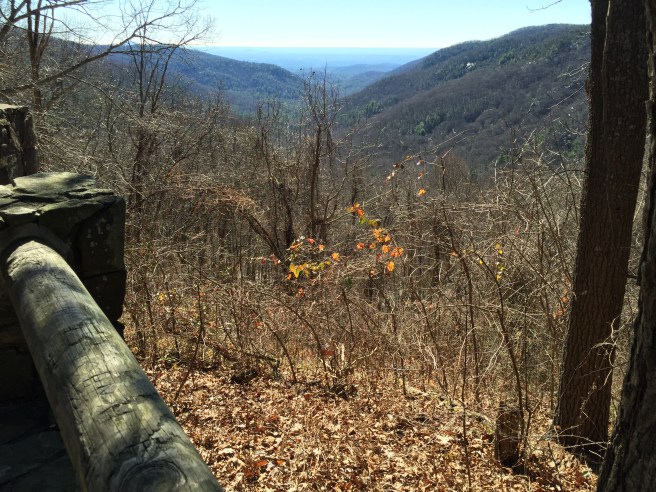
View from Black Rock Mountain State Park visitor center