
My Best Books of 2024

Book shelves
Book shelves

Admittedly, I let this month slip up on me and am rushing to get a post in today before December and 2024 are gone for good. So, here is a list of my favorite books from the past year. Who knows, this year-end review may become a tradition, not as a substitute for a monthly post but perhaps as an addition.

The Nickel Boys by Colson Whitehead

Based on an actual reform “school” for juvenile boys in Florida during the Jim Crow era, Whitehead’s prize-winning novel is a heartbreaking, maddening story told by one of the most talented young American writers. It is not just a story about racial discrimination and inequality, but both loom large in the plot. The backstory of the protagonist, Elwood Curtis, is touching and sets the stage for the tragic turn of events that leads to his incarceration. With emotional integrity that never even gets close to being sentimental, the author takes the reader on a horrifying tour of the school’s campus: dormitories, cafeteria, utility facilities, and the one building where unbearable acts of cruelty occur. I get the sense that Whitehead may have conflicting feelings about the passivity of early civil rights leaders, most especially Martin Luther King, Jr., who is heroic and inspirational to Elwood, especially as a young boy. I like this book much better than Whitehead’s other blockbuster hit, The Underground Railroad, which was a fine book but allegorical and thus not as engaging for me as this powerful story.

Dear Regina: Flannery O’Connor’s Letters from Iowa edited by Monica Carol Miller

I worked for almost two years as a consultant, hired by the literary estate of Flannery O’Connor, to create an inventory of the archive of her manuscripts, letters, photos, journals, and other personal effects. During the course of that project, I read each of the letters included in this collection, and it was a real treat to go back and read them again. The relationship between Flannery and her mother is complex, unusual, and in so many ways fascinating, especially considering the number of stories the author wrote where the main characters are a mother and a child.

Among the most interesting developments we find in these letters is how, in a matter of only two years, Flannery becomes much more independent and driven. In the beginning, the young graduate student seems to be nervous about being so far away from home and family for the first time in her life. As time goes by and Flannery is introduced to established writers and publishers who admire her work as a student at Iowa, she becomes more confident in her abilities, which results in a more bold attitude toward Regina. She is willing to rebuke her mother if she senses that Regina is overstepping her bounds or commenting inappropriately about matters she doesn’t understand.

On the darker side, readers can’t help seeing O’Connor’s deeply ingrained racism, her sense of moral superiority, her callous reaction to the suffering of others, and sometimes a general misanthropic nature. Some would argue that she simply resisted the social conventions of her time, especially expectations of young “ladies.” I think it’s more than that. I think she felt terribly awkward in most social situations and preferred to limit human interaction with only a few people. This personality trait may have helped her in the end as a writer and even on a more personal level when her lupus diagnosis forced her to live the last third of her life with her mother in the rural Deep South of middle Georgia.

Miller provides some commentary in her introduction to the book and at the beginning of the phases of Flannery’s tenure at Iowa. I think the book could have been stronger with a deeper analysis of the correspondence, but perhaps the literary estate placed restrictions on the editor. Given the executor’s reputation for such tight control on what has been published in the past, this is a valid speculation. Nevertheless, the estate did permit the letters to be published, which means they are now widely available to readers and scholars of O’Connor’s work. That’s a good thing.

Eve: How the Female Body Drove 200 Million Years of Evolution by Cat Bohannon

What a valuable book that almost serves as an updated edition of Natalie Angier’s classic study titled Woman: An Intimate Geography. Bohannon comes out swinging from the first page, observing how medical science has committed egregious errors and arrived at faulty conclusions because it has considered the needs of males and females to be the same when it comes to developing pharmaceuticals and treatments. The differences between the sexes go far beyond their genitals and mammary glands. The author explains why the most common use of male subjects only (human or other animals) for medical research is terribly shortsighted, sometimes resulting in catastrophic and even deadly consequences. And that’s just the first chapter!

Building on the complexities of the female body (while also giving plenty of attention to the difference between sex and gender along the way), Bohannon traces millions of years of evolution to draw some startling and perhaps controversial conclusions about human origins, female anatomy, reproduction, childbirth and child rearing, language, sociological patterns, human achievement, and so much more. The chapter on breastfeeding alone is worth the price of the book — good heavens, I learned so much! 

She makes solid arguments for why some of the great discoveries and advances in early human development may be attributed to women as opposed to men, who have historically taken the credit. Her practice of demonstrating the similarities and intersections of female characteristics across species in the animal kingdom – from orcas to mice, from ducks to our primate cousins — helps to reinforce the evolutionary evidence she produces to explain why women are specifically equipped for all the roles they fill as an equal half of homo sapiens.

I highly recommend it to just about everyone. Women will benefit from knowing more about what makes them tick and how they became the marvelous wonders they are. Men NEED to read it to better appreciate all the women in their lives, beginning with the ones that brought them to life and gave them a fighting chance to survive.

Shakespeare and Company by Sylvia Beach

What a delicious book! I have known about the importance of Sylvia Beach’s little American bookstore in Paris for a while but was not aware that she wrote such a wonderful memoir about her experiences as the owner and storekeeper of Shakespeare and Company. Her membership-supported enterprise was so much more than just a bookshop. It served as a refuge and haven for some of the most gifted expatriates and writers of the early 20th century, including Ernest Hemingway, F. Scott and Zelda Fitzgerald, Ezra Pound, T. S. Eliot, and most especially James Joyce. I had no idea that she was the first publisher of Joyce’s monumental novel, Ulysses. She really was a remarkable human being, one who made great sacrifices to support an amazing and historical intellectual community. She even risked her own life during the Nazi occupation of Paris by refusing to compromise her standards or cater to the monstrous regime that swept across Europe before and during World War II.

Grandma Gatewood’s Walk: The Inspiring Story of the Woman Who Saved the Appalachian Trail by Ben Montgomery

For anyone who needs a story of inspiration, endurance, and good old fashion intestinal fortitude, look no further than Ben Montgomery’s well written account of Emma Gatewood’s adventures on the Appalachian Trail and her other treks across the country on foot. It is estimated that this grandmother and great-grandmother ended up walking more than 14,000 miles, the distance of half the globe, all after she turned 67 years old. Included in these pedestrian journeys were two thru-hikes on the Appalachian Trail and a third time in sections, back in the late 1950s when the trail was not so popular or populated by hikers. Oh, and she also walked the Oregon Trail, literally, from Independence, Missouri to Portland, Oregon. She was in her seventies when she completed that one. Anybody want to complain about being tired now? Ever again?

Grandma Gatewood overcame terrible conditions on the Appalachian Trail, from rattlesnake encounters to raging storms, from extreme temperatures to blown out shoes (she wore only sneakers!), from fallen trees to flooded creeks, and injuries to her feet, ankles, and knees that would have spelled defeat for most men half her age attempting what she succeeded in doing several times. Her amazing stamina was born out of tragic circumstances: years of mental, emotional, and physical abuse from a monster of a husband.

Walking in the forest in solitude gave Emma Gatewood great joy and satisfaction, although she struggled to remain alone in her quest many times as her story spread during the months she was on the trails. She became a celebrity, and her time walking was interrupted more and more by journalists, photographers, and curious onlookers. For the most part she remained humble and patient, although she did lose her temper a few times with the rudest of the bunch. And then she felt remorse and asked them to forgive her! What an example she set for just about everyone on how to pursue dreams, overcome adversity, and live your best life.

If Beale Street Could Talk by James Baldwin

This is a powerful novel for several reasons, not the least of which is how it captures the sense of despair among African Americans over injustice from the legal system specifically and from the society at large. The narrative is impressive to me considering it is written by someone who lived his later life as a gay man but elected to employ a first-person voice of a young woman. The family dynamics and conflicts that drive the story are made more intense by Baldwin’s skill with descriptive language and dialogue. It’s all so believable. Along the way, he inserts little nuggets of gold that transform this book from a good to a great novel. Here is one fine example.

“Only a man can see in the face of a woman the girl she was. It is a secret which can be revealed only to a particular man, and, then, only at his insistence. But men have no secrets, except from women, and never grow up in the way that women do. It is very much harder, and it takes much longer, for a man to grow up, and he could never do it at all without women.”

The remainder of that paragraph is just as profound as this passage. There is a lot going on in this novel, including the tension that exists among the sexes and how love is exhibited and expressed in such diverse ways. If Beale Street could indeed talk, it would testify to the struggles of black America, as would the streets of Harlem, Birmingham, Montgomery, Atlanta, Detroit, and Tulsa, just to name a few. Baldwin was so familiar with such places, and he courageously explored every square foot of them.

Grace Saves All: The Necessity of Christian Universalism by David Artman

I have read other books on Christian Universalism, but this is the best so far. Artman is a minister who has struggled with the concept of hell and eternal damnation for most of his life, but in recent years he has found a spiritual path that changed his perspective on the Christian faith. He was able to do so with plenty of evidence from Biblical scripture and the guidance of some of the pioneers in the theological study of universal salvation or the idea that, in the end, God saves all humanity. No one is punished forever and ever in the lake of fire, gnashing their teeth, so forth and so on.

Artman explains early on in his book that Christian Universalism is nothing new and that many early Christians embraced this theological position and promoted it. Once he began to look at universalism closely, it just made sense in the context of a loving creator God. For Artman, “it is the only approach to Christian theology which can successfully defend the goodness of God; and therein lies its necessity.” In some ways, Artman and his readers come to universalism through the back door, as if it is the only option left. As he explains it: “Once someone fully grasps the concept that God knows the end from the beginning and is not controlled or regulated by any outside forces, the following realization strikes home – the outcome of all things will inevitably be what God intended from the beginning.”

Artman still believes in the free will of humanity. He just posits that ultimately God will win over even the strongest deniers, the faithless, the atheists, criminals, etc. Now, it may take a very long time to bring them back into the fold, but Artman’s God is more patient than Job, and will not stop pursuing the lost until they are found. The one issue I have with this concept is the admission by universalists that punishment is still very much a part of God’s plan, and God will use it if necessary to bring the wayward back to God, where they belong. The punishment is not forever and it isn’t revenge. It is just a tool God uses to achieve the goal. Artman believes “there is coming a time envisioned in which everyone will happily acknowledge the salvation of God which has come through Christ.” I’m not sure that punishment through torture is ever effective in producing true repentance, and certainly not a happy acknowledgement.

Artman remains close to his Christian faith with his belief that Jesus Christ is still the proper pathway to salvation. He doesn’t directly address how unfair it may be for people who live outside the boundaries of Christian tradition to find and board the Jesus bus headed to heaven. This is a book of Christian Universalism, and therefore, very Jesus centered, which may prove frustrating to those outside that faith tradition. To his credit, Artman recognizes there is scriptural evidence that contradicts some of his findings and conclusions. “Since all theologies end up facing passages of Scripture which are hard to deal with, the question is not if these passages will be dealt with, but how. All theological approaches must face this dilemma. No theology gets a free pass.” He reconciles scriptural contradictions wearing “Jesus-colored glasses,” taking comfort in the fact that Jesus ate with criminals and refused to throw stones at adulterers, so he cannot imagine that God doesn’t possess the same compassion and forgiveness.

In the end, Artman looks at the spirit of the Bible and the life of Jesus to reach a rational theory of how God operates, and universal salvation is the only outcome that makes sense. For those who would question his rationale, he replies: “Making an overall interpretation of the Bible is a difficult thing to do. There is no single biblical approach that doesn’t run into scriptural problems. And so, we must finally ask which biblical approach aligns most closely with the goodness of God, the character of Jesus, and the overall narrative arc of the Bible. On the whole I believe the Inclusive approach offers the best solution.” Good answer, Dr. Artman. Good answer.

Flannery at the Grammys by Irwin H. Streight

Professor Streight has written a very fine and thoroughly researched study of Flannery O’Connor’s impact and influence on songwriters in the pop music genre. I have long been interested in this topic, and I frequently made mention of those connections to visitors at Andalusia, O’Connor’s farm home in Milledgeville, Georgia, during my 13-year tenure as the director there. I still remember vividly sitting in a rocking chair on the front porch at Andalusia the day singer/songwriters Jim White and Mary Gauthier made their field recording of “Fruit of the Vine,” which Streight mentions in this book. They both exhibited such a sense of reverence during their visit.

O’Connor’s body of work is a Comstock Lode for songwriters, composers, playwrights, screenplay writers, and visual artists, which I consider a testament to her genius and durability as a writer. Streight focuses most of his attention on the more familiar and acclaimed rock and folk artists/groups who have paid homage to O’Connor in their work, such as Bruce Springsteen, R.E.M., U2, Lucinda Williams, Mary Gauthier, and Kate Campbell. But he digs even deeper to discuss songwriters in the alternative genres of metal, punk, and a few other less definable types.

Streight pushes toward the exhaustive in his study as he devotes a chapter to how often O’Connor’s themes and language show up in song lyrics, even though there may be no direct correlation between the author and the lyricist. He admits to the stretch in these cases, but the observations are interesting, and the connections are certainly worth acknowledging. The “Bonus Track” chapter on stage names from O’Connor’s novel, Wise Blood, and her characters is fascinating although probably not a strong connection to the author in most cases. All in all, Streight’s book should be of great interest to anyone interested in how pop culture reflects and reacts to serious fiction. This is a valuable contribution to O’Connor scholarship.

A Reading List for Library Nerds

The reason I can get away with such a derogatory title for this post is because I am a librarian, or at least I am by training, and for much of my career, by practice as well. Over the last few years, I have picked up several books, both fiction and nonfiction, that feature libraries or librarians as the primary subject. Here is an annotated list of these books, which I highly recommend to librarians, library patrons, or bibliophiles in general. Enjoy!

Library stacks
Library stacks

Nonfiction

The Library: A Fragile History by Andrew Pettigrew

In this dense and comprehensive history of libraries, the author also tells the story of the evolution of the book: its creation, distribution, preservation, and impact on civilization. He devotes considerable time discussing how private collections were the norm for libraries during most of recorded history and that public access is a relatively new phenomenon.

The fragile part of the history is illustrated by the many threats to books and the libraries that contain them, from natural disasters to warfare, from censorship to reduced support by private and government sources. The book begins and ends with perhaps the most famous library of the ancient world at Alexandria, which in some ways serves as a model for all libraries that followed. Written language is one of the hallmarks that separates our species from all the rest; therefore, the institutions that serve as repositories of written language must be considered as instrumental in documenting and preserving that distinction.

One of the more interesting takeaways from this book is how, at least until the modern era, fiction was held with such little regard by the literate elite of western society (and this book focuses on libraries of western civilization). Novels were even considered a corruptive force, especially as they were in such demand by women as a form of escape from the drudgery of living in subservience to their husbands, taking care of children, and maintaining the home.

The author contemplates the impact the digital age will have on books, which could be perceived as another threat to the library. It is reassuring that he observes how radio, movies, television, and computers may have competed for the attention of readers, but books and libraries continue to survive and at times even thrive in the age of mass media.

Overdue: Reckoning with the Public Library by Amanda Oliver

Public libraries and the services they provide usually reflect the communities where they are located. The public library where I was the director was medium sized in a county of about 43,000. We had our share of quirky folks, unruly adolescents, crusty curmudgeons, and houseless citizens among the day-to-day users who came in regularly to check out books or bring their children to story time. Also, our town had the state’s mental institution, which had been decentralized in the 1960s resulting in plenty of mentally ill people in government subsidized houses, or sometimes, just wandering the streets. As expected, many of them found their way to the library.

My public library was probably typical for a rural community in central Georgia — plenty of challenges but nothing too much out of the ordinary. By contrast, Amanda Oliver spent several years working in a public library in one of the toughest trenches a government employee can work: Washington DC. If there is a common thread running through her book, it is a sense of conflict the author feels about knowing how desperate many of her patrons were for help just to survive and trying to preserve her own mental health and physical safety while trying to assist them with their needs. She bemoans the fact that this country is woefully unable to take care of the poor and mentally ill, who have to rely on help wherever they can find it.

By their very nature, public libraries are places of refuge for the marginalized, and librarians are first responders, sometimes in the most literal sense. Oliver shares stories of having to administer first aid and other medical procedures for people with addiction and a whole host of health problems. She calls into question the role of the public library in a society that has abandoned those who are at most risk from economic insecurity and mental illness, including those with violent tendencies. She offers some chilling reports about librarians who have been injured or killed by crazed individuals who come through their doors. She reports how installing security equipment and hiring public safety personnel have become top priorities in many public libraries around the country.

On the bright side, it is clear that Oliver believes strongly in the mission of the public library to provide information services, very broadly defined, and to assist patrons with needs that have little or nothing to do with reading. In spite of how difficult her job was, she stayed committed to directing people to information, resources, and agencies they needed, sometimes just to survive. She effectively offers her readers a healthy, though not copious, collection of statistics to drive home her points. Perhaps the most encouraging stat of all for me was that the number of public libraries in America is greater than the number of Starbucks. We must be doing something right here.

The World’s Strongest Librarian by Josh Hanagarne

Hanagarne managed to write the funniest and the saddest book in this category at the same time. It is sad because the author has struggled so many years with a disorder that is so misunderstood and at times terribly debilitating. It is funny because Hanagarne manages to find humor even in the worst circumstances. His comic timing is quite good, with prose that reminds me so much of David Sedaris. Hanagarne makes his father sound remarkably similar to the way Sedaris makes his father sound. They both come off as crusty, no-nonsense guys who were forever trying to toughen up their children to face the “real world.”

Hanagarne’s memoir doesn’t focus nearly as much attention on his work as a librarian as it does his upbringing in a Mormon family facing the embarrassing and humiliating symptoms of Tourette Syndrome, which he personified by giving it a name – Misty (as in Miss T). His determination and tenacity in wrestling with his condition is inspiring. He never gave up. On the contrary, he often pushed himself into situations that anyone else with Tourette Syndrome would avoid, like choosing a profession that is traditionally associated with being quiet. And then he continued to bust open stereotypes by being a librarian AND a fitness enthusiast. It is not surprising that Hanagarne has found fitness regimens to be among the most successful tools in battling Tourettes.

From a confused childhood to the discovery and love of reading, from the awkwardness of making friends and dating to pushing through as a high school athlete, from pulling away from the faith of his parents to finding happiness in marriage and being a father, Hanagarne’s story is touching, heart wrenching, fascinating, and funny. And his use of Dewey Decimal System call numbers and subject headings as chapter leads is brilliant. Josh Hanagarne is a remarkable human being.

The Library Book by Susan Orlean

The author cleverly uses the Los Angeles Central Library fire in 1986 as her main hub to explore the history and culture of libraries. Her focus is generally on the Los Angeles system, but throughout the book she takes a few side roads to include libraries, past and present, in other locations in this country and around the world. Her deep appreciation of this ancient institution is abundantly evident throughout the book. She manages to take what so many people would consider a deadly boring topic and make it intriguing, fascinating even. Although at times the chapters read more like separate essays, some of which could easily stand alone, Orlean manages to make them flow together and connect as she unravels the mysteries surrounding the disaster in L.A. However, the real reason the book is a bestseller is because Orlean is such a good writer. The Library Book is a wonderful combination of biography, history, mystery, and investigative reporting.

I Was a Stripper Librarian by Kristy Cooper

Okay, yes, the title is titillating, the cover looks just a tad risque, and this is a self-published book. But, let’s immediately set aside our bibliographic elitism, decide we are NOT going to judge a book by its cover, and take an honest look at this memoir from someone who worked in two professions that, at least on the surface, seem like polar opposites. Kristy Cooper argues that being a stripper and a librarian are not nearly as different than most of us would think, and she provides enough examples to be convincing. Admittedly, this book cannot be taken as seriously as some of the other titles in this list — the authors are not trying to do the same thing here.

I suspect most Americans would be surprised to learn how many women and men enter the sex industry, as the author labels it (although stripping seems to stretch the definition to my way of thinking), in order to make ends meet or to get out of debt, especially student loans. A simple Google search on the topic brings up numerous TV spots and articles posted over the last few years about young folks who pay their way through college by stripping. Cooper is unapologetic about her decision to do the same — it was simply pragmatic. She tried other more conventional jobs, but none paid as well for the amount of time and labor required.

This book is well-written and interesting. Cooper does not come across as some bubble-headed babe trying to impress us with her lap-dancing talents, although some of the stories she shares are fascinating, troubling, and at times hilarious. Her vocabulary is impressive. Her writing style is rather simple and straightforward, but it works fine for this type of book. She assures her readers that there are plenty of people in the adult entertainment industry who are extremely intelligent, some of whom have advanced degrees like she does. Although she is no longer in the industry, she certainly advocates for it. She is also a remarkable champion for the library profession and has even established a nonprofit organization to facilitate her philanthropic work, especially for librarians.

Ultimately, readers will either approve or disapprove of Cooper’s dual occupational choice, but no one can deny that she made it work for her circumstances. She implies that stripping never made her feel dirty or immoral, but I have to wonder if the objectification factor eventually did a number on her. The best example, and perhaps the saddest to me, was when she was considering whether or not to get implants because her breasts were smaller than that of the average female strippers with whom she worked. Even though some of her male customers recommended she leave them alone, she knew that a bigger chest in a topless bar translated to more income. At one point she decided that her breasts were not really a part of her body as much as they were a commodity or resource for her craft. As true as that may be, I hated to hear it.

Fiction

The Midnight Library by Matt Haig

I read this book for an online book club I helped moderate for the university where I work, but I was intrigued by it when I first saw it reviewed in the New York Times Book Review. My honest assessment of this novel is that it is entertaining, but it still has more of a juvenile style to it, probably because Haig has written several books for children. The subject matter and language are clearly for an adult audience, but the plot and rhythm still feel more like a fairy tale to me, perhaps like a C. S. Lewis children’s novel.

The premise of The Midnight Library is very similar to the film “It’s a Wonderful Life.” The name of the town in the timeless holiday classic film is Bedford Falls; Nora’s album is called Pottersville; a character in the novel has the last name Bailey. (The author tweeted about this to a fan.) If we give too much thought to the mechanics behind the story – the impossible challenges presented by being inserted into the middle of an unfamiliar life – the novel doesn’t exactly “work” so well. I had to employ a type of dissociation to make it through.

Nora and Hugo discuss Schrödinger’s cat, the popular thought experiment that illustrates an apparent paradox of quantum superposition – alternate possibilities happening simultaneously. Is there a deeper meaning that Haig is trying to get at with this novel or is it just supposed to be an entertaining read? Is this a story that explores the concept of quantum mechanics and string theory? At any rate, Haig’s novel prompts readers to think (or rethink) how different their lives might have been had they made different choices along the way.

I am surprised at how much attention it received from major review sources, but then again, Haig is a journalist too, so there could be some professional courtesy going on as well. Haig does a good job of pulling the reader into the story. Most of us can imagine ourselves in Nora’s shoes and are compelled to speculate what decisions we would make given the circumstances.

The Personal Librarian by Marie Benedict and Victoria Christopher Murray

This may not be a great novel, but it is a good story based on the life of a real person. Belle da Costa Greene was J. P. Morgan’s personal librarian, an amazing African-American woman who was forced to hide her true identity and pass as white in order to succeed at an incredibly important job. Using biographies, personal papers, and secondary sources, the authors attempt to recreate the life and accomplishments of Greene, complete with her romantic relationships, her hardships, her family life, her savvy business dealings, and the struggles she faced through it all in keeping such a huge secret. In the category of historical fiction, this novel ranks among the best I have read. 

So Many Books, So Little Time

The title of this post is familiar to reading enthusiasts. We have seen it on mugs, posters, social media memes, etc. I once had a tee-shirt with the slogan printed in multiple colors on navy blue fabric. Serving as a professional librarian for fifteen years of my career, peddling books was my trade. Librarians everywhere through the years have repeatedly attempted unsuccessfully to dispel a popular myth about the profession: librarians spend all their time reading. Nothing could be further from the truth. We have no more time to devote to reading than most other professionals. We spend our time, talents, and energy making sure that our patrons have what they want to read. Libraries have certainly undergone major changes in recent decades, but the central mission of making information available to users is still the same as it was when the Library at Alexandria was established over 2,000 years ago.

I was fortunate to have family members who read to me as a small child and instilled within me an appreciation for books. We had a set of the World Book Encyclopedia even before I started school, and as I learned to read, I spent an increasing number of hours browsing through the volumes. In elementary school, my teachers appointed me as a student library assistant, which probably gave me an early understanding of the importance of libraries.  I was turned on to reading on my own with our Weekly Reader elementary magazines in school. I went through the comic book phase that most young boys did during the 1960s but eventually moved on to science fiction novels as I moved into adolescence. The first lengthy novel I can remember reading in high school was Jaws by Peter Benchley, published in 1974. From that point on, I began to move away from science fiction and toward mainstream fiction. I am forever thankful to my mother for driving me to the central branch of the public library and allowing me to spend so much time perusing the shelves for the next reading adventure.

In addition to three wonderful English teachers in high school, I had several professors in college who helped me develop a thirst for literature. My undergraduate degree was in English, and after going on to get an MA in history, I started my first full-time job in a public library. A few years later, I earned a degree in librarianship. I continued to read classics in literature while also adding works by contemporary writers of serious fiction, with the occasional nonfiction book thrown in as well. It was during this period of my life that I made a conscious decision to devote most of my valuable reading time with either literary classics or contemporary award-winning books. I am willing to spend two or three hours watching a movie just for fun, but typically I want more than just entertainment when committing over ten hours to a book. The major exceptions to this rule are audiobooks and titles associated with my profession, gardening, religion, and science.

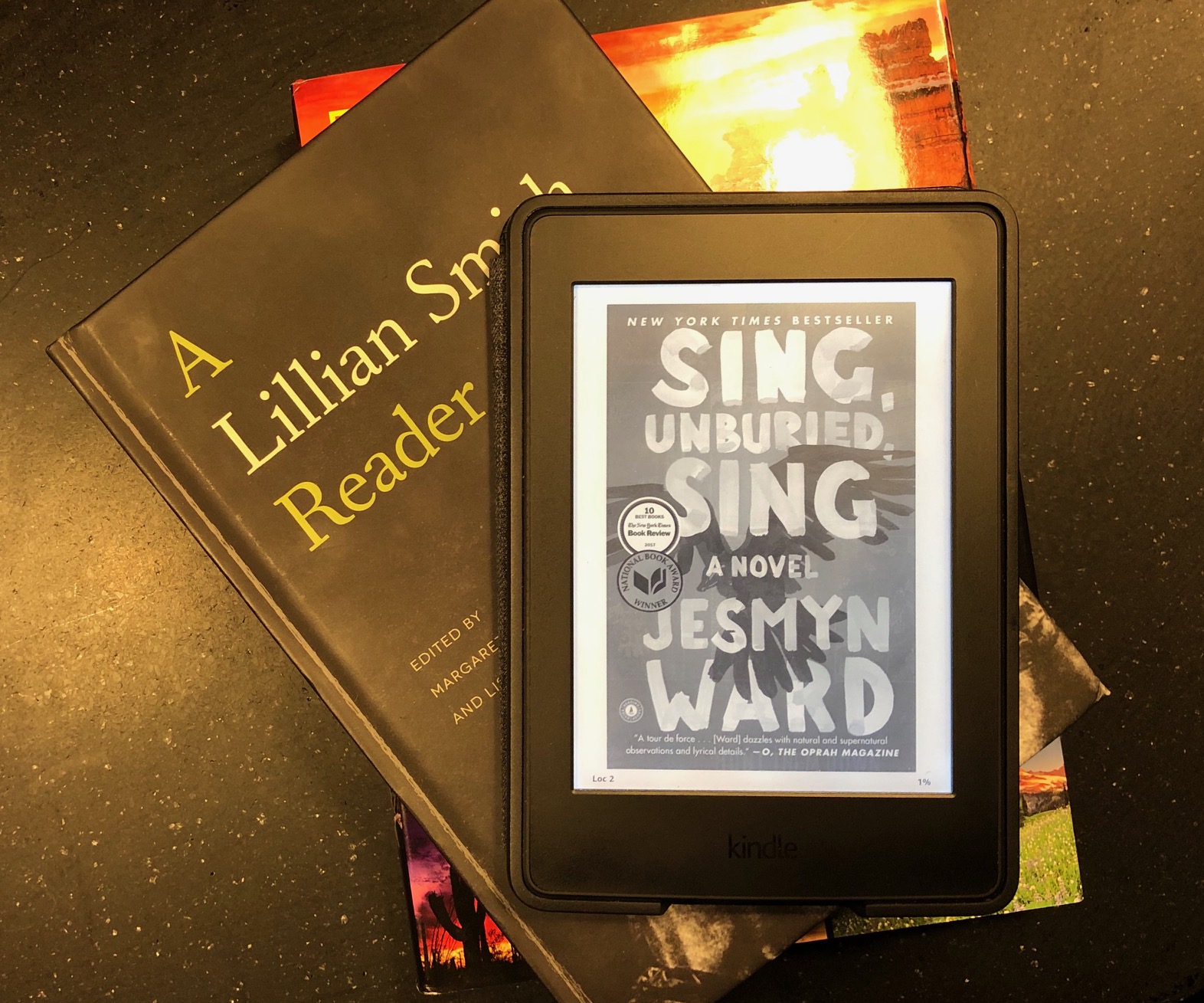
As is true with so many aspects of our lives, modern technology has had a tremendous impact on the practice of reading. From the early experiments with electronic books in the 1970s to the e-readers of today, the definition of the book is constantly evolving. My wife bought my first Kindle in 2008, and as much as I love bound pages of print, I was enamored with the device from the moment I downloaded a title, which was The Road by Cormac McCarthy. To read a review of a new book and have it in my hands ready to read in less than 60 seconds is miraculous to me. Yes, there are some disadvantages to e-readers, but to my way of thinking, the benefits far outweigh the shortcomings. For readers who also enjoy traveling, the ability to carry multiple books in the palm of your hand is just about perfect. I am on my fourth Kindle so far.

Book collection
Book collection

In 2010, a dear friend introduced me to Goodreads, my first social media site for readers. To date I have added to my profile 559 books completed over my lifetime, 190 of those since I joined the site. Goodreads is a web community that allows members to share with Friends what they are reading, look at book descriptions, read and write reviews, and see author’s profiles. The site boasts 80 million members worldwide. I primarily use Goodreads to track my own books and to write reviews of what I have read. I also share my reviews and recommendations on other social media sites, primarily Twitter.

I have never been ambitious enough nor had the attention span to have two books going at once — until last year, when I became an Audible subscriber. A subsidiary of Amazon, Audible is an online portal for purchasing, downloading, and listening to audiobooks. It allows customers to search for or browse a large collection of audiobooks, which they can buy using money or membership credits. Users can listen to downloaded titles on computers or mobile devices. I spend a significant amount of time driving, and my car is equipped to play audio files from my phone through its speakers. Now, while I am reading a book in print or on my Kindle at home, I am also listening to an audiobook when I am away from the house. With this new reading approach, I have drastically increased the number of books I am completing. From 2010 to 2017, I was averaging about fifteen books per year. In 2018 alone, I read or listened to 63 books.

According to Forbes magazine, there are anywhere from 600,000 to 1,000,000 books published in the United States each year. Only a small percentage of those will become best-sellers. A much smaller fraction will win the most prestigious awards in the publishing industry, such as the National Book Award, the Pulitzer Prize, the National Book Critics Circle Award, and the PEN/Faulkner Award. Even with the expanded capacity provided by audiobooks, I struggle to keep up with reading each year what I consider the best books published that interest me. I have to pick and choose from the award-winners and highly-recommended titles, while working through classics from the past that I still haven’t read. This is a frustrating process for everyone who loves books, but it is a sweet dilemma that comes with the passion.


Books for Critical-Thinking Christians

Does the title of this post sound a tad arrogant? Intellectually elitist even? Arrogance is not my intent, and I don’t have an elite intellect. I do have a keen and personal interest in religion generally and Christianity specifically. I was raised on conservative Christian values — the Southern Baptist variety, which is quite fierce. Over the years, my beliefs, practices, and worldview have changed considerably due to education, travel, social interaction, and perhaps above all, reading. The following is an annotated bibliography of authors and books that have influenced my thinking about religion. I offer this suggested reading list for those who want to approach faith from a critical and thoughtful perspective that does not always confirm but instead challenges traditional assumptions about religion.

I have read all or parts of numerous books on world religions, and there are plenty of good introductions by major publishers, especially academic presses like Oxford, Yale, and Cambridge. A book I read not too long ago that addresses religious faith in general is Why Religion Matters: The Fate of the Human Spirit in an Age of Disbelief by Huston Smith. No one would question how influential Huston Smith was (he died in December, 2016) in the study of world religions. His book on the subject has sold over 2 million copies since it was first published in 1958. In 2000 he wrote this apologia for religion in the face of the growing post-modern position that faith is no longer necessary in the age of enlightenment. He is a skilled writer, and his prose is certainly accessible, even entertaining. In Why Religion Matters, Smith lays out his case for why religion exists, why it has survived for tens of thousands of years, and why it will continue in spite of opposition from the agnostic and atheistic sector of the scientific community.

I think Smith makes some good arguments, and I tend to agree with him that there is evolutionary evidence for the necessity of religious faith for humans. Where I question Smith is on the broad assumptions and emphatic stands he takes along the way. I also take issue when Smith seems to resort to tired religious clichés and platitudes. As an example, Smith writes: “Scientists would give their eye-teeth to know what the non-material component of photons is. For religionists, it is Spirit.” With this type of dismissive assumption, Smith is falling into the “god of the gaps” trap that atheists so often describe.  At any rate, this book is a good source for lay people (like me) who want to hear justification of faith by someone who spent a lifetime studying the subject.

CHRISTIAN HISTORY

It is probably my interest in history that has attracted me to books on early Christianity, so I add here several titles from well-respected scholars. The Historical Figure of Jesus by E. P. Sanders studies the relationship between Judaism and Christianity, distinguishing the certain from the improbable, and assessing the historical and religious context of Christ’s time. In Jesus of Nazareth, King of the Jews: A Jewish Life and the Emergence of Christianity, Paula Fredriksen explores the religious worlds, Jewish and pagan, of Mediterranean antiquity, through the labyrinth of Galilean and Judean politics, and on into the ancient narratives of Paul’s letters, the gospels, the Dead Sea Scrolls, and Josephus’ histories. Both of these books are dated now but are fine contributions to our understanding of the social and religious contexts within which Jesus of Nazareth moved, and to our appreciation of the mission and message that ended in the proclamation of Jesus as Messiah. For a less traditional perspective on the historical Jesus, I recommend The Misunderstood Jew: The Church and the Scandal of the Jewish Jesus by Amy-Jill Levine, who has dedicated her career to helping Christians and Jews understand the Jewishness of Jesus, thereby deepening the understanding of him, and facilitating greater interfaith dialogue.

One of my favorite scholars who enjoyed studying the life and legacy of Jesus is Marcus Borg. He apparently also enjoyed stirring up controversy, along with his frequent co-author, John Dominic Crossan. It isn’t really necessary to provide details of these books here because the subtitles are fairly descriptive. I freely admit a significant bias toward Borg and his approach toward examining the Gospels in a historical context, and I know that many readers will criticize him for recycling material in his books. The man was a master book salesman, and his prose is accessible and thought-provoking.

  • The First Christmas: What the Gospels Really Teach About Jesus’s Birth
  • The Last Week: What the Gospels Really Teach About Jesus’s Final Days in Jerusalem
  • Meeting Jesus Again for the First Time: The Historical Jesus and the Heart of Contemporary Faith
  • Jesus: A New Vision: Spirit, Culture, and the Life of Discipleship
  • The First Paul: Reclaiming the Radical Visionary Behind the Church’s Conservative Icon

A recent title by another scholar whom I respect is The Triumph of Christianity: How a Small Band of Outcasts Conquered an Empire. Bart D. Erhman doesn’t break any new ground here, but as in previous works, he manages to make early Church history more palatable for a large audience. He writes well and can manage to find opportunities to be witty with a subject that is not inherently humorous. Most of what we read here is generally covered in any survey of world civilizations, except in far more detail, which is why the book is worth reading for those of us who are not scholars but are nevertheless interested in history, religion, and the evolution of Christianity. Ehrman takes a direct and well-documented approach to explain why Christianity did indeed triumph over all the long-held religious traditions of the classical world.

THEOLOGY

Again, the titles in this category are not necessarily complex nor heavy. My intent is to introduce books that the rest of us can grasp and appreciate. Some of these would be considered more like apologies than theology, but subject headings are not my focus either. Here are a few books that have had the greatest impact on my thinking.

  • Mere Christianity by C. S. Lewis
  • The Seven Storey Mountain by Thomas Merton
  • Mystery and Manners by Flannery O’Connor
  • Waiting for God by Simone Weil
  • Heart of Christianity: Rediscovering a Life of Faith by Marcus Borg (I told you I was a fan)

I will add a couple of books here that are much more recent than the previous selections. These two titles by Philip Gulley and James Mulholland changed the way I thought about some fundamental tenants of Christian theology. If Grace Is True: Why God Will Save Every Person presents a radical departure from traditional teaching for most Christians. The element of this book I found most interesting was the authors’ belief in the bodily resurrection of Jesus, which begs the question: do they believe in the supernatural traditions of other major religions, like the stories surrounding Muhammad or Siddhartha Gautama? I decided to email Philip Gulley and put the question directly to him, and he wrote back! He responded, “Yes, bodily resurrection is an issue with which we both continue to struggle.” I truly admire his honesty. The other book by Gulley and Mulholland I recommend is If God Is Love: Rediscovering Grace in an Ungracious World. As idealistic as the premise of this book is (and perhaps a bit naïve in places), these guys make a compelling argument for how challenging it is to truly embrace the teachings of Jesus and the basic tenants of the major world religions.

RELIGION AND SCIENCE 

In so many ways, the last 250 years of religious thought and practice have been defined by the conflict between religion and science.  My intellectual interests as an adult have been concentrated in these two areas resulting from my heritage and a childhood curiosity about the natural world. Much of my reading that touches on both topics has been in the area of anthropology and evolution. Here are two titles that take a more general and conciliatory approach, one from a scientist and one from a minister. Stephen Jay Gould’s Rocks of Ages: Science and Religion in the Fullness of Life allows science and religion to coexist peacefully in a position of respectful noninterference. Science defines the natural world; religion our moral world in recognition of their separate spheres of influence. More recent scholars have scoffed at Gould’s compromise, especially scientists and humanists, but I still believe the concept is worth considering.

Luminous Web: Essays on Science and Religion is the fourth book thus far that I have read by Barbara Brown Taylor. It is actually a collection of essays from 2000 that predates the bestsellers by this Episcopal priest who left the ministry to finish her career teaching in the small liberal arts college where I am working now. Taylor was named by TIME magazine as one of the most influential people in the world in 2014. The principle thesis and the sharp observations in this book are still perfectly relevant. Taylor is a priest with a sincere interest in science, which places her in good company with some of the greatest minds in history going back to the Middle Ages with Thomas Aquinas and up to the 20th century with people like Pierre Teilhard de Chardin, who was both a priest and a scientist. I think Taylor believes in and is always searching for what Teilhard de Chardin named the “Omega Point,” that evolutionary conclusion where God and the physical universe are united, or as some have phrased it, a “divine unification.” To Taylor, God is not superseded by science nor is God made irrelevant by the scientific method. She clings to the idea that science and religion are equally in pursuit of the truth — the former in its exploration and explanation of the physical universe and the latter in its attempts to find meaning and purpose.

AGNOSTICISM AND ATHEISM

A critical study of Christianity is incomplete without the most challenging opinions of all. My fascination with science has led me to scholars and writers who completely dismiss religion as supernatural nonsense at best and dangerous, manipulative propaganda at worst. On any given day, I may find myself in sympathy with their judgments, but I still embrace mystery in the universe that I am not yet convinced science can explain nor dismiss. Good Without God: What a Billion Nonreligious People Do Believe by Greg M. Epstein is a nice overview of how people who do not believe in God live an ethical life, how they are charitable, loving, compassionate, fulfilled, and inspired without religion as their primary motivation. Epstein is obviously trying to soften the message of the irreligious that has been expressed with sarcasm, indignation, and even rudeness by leading atheists. It does seem to me, especially toward the end of the book, that Epstein is attempting to find ways in which humanists can enjoy the worldly fruits of religion through culture and ritual, as if living a humanist life without the type of community that faith offers is empty or disconnected. No doubt, his Jewish heritage is coming into play here, which he fully discloses. Perhaps this perspective also comes out of his role as a humanist chaplain (still an odd title for a humanist in my opinion) at Harvard.

In his cleverly-spelled title, god is Not Great: How Religion Poisons Everything, Christopher Hitchens is just a bit too unreasonable about the evils of religion in general. Of course, he is correct about so many of the atrocities committed in the name of religion, and I certainly wouldn’t dispute his calculated and logical arguments dispelling the myths that are at the center of religion. However, I maintain that religion seems to be a necessary component for so many humans, as history and other social sciences have firmly demonstrated. He thinks because he has successfully faced facts, reality, mortality, and the cosmos apart from the supernatural, that everyone else should be able to do so as well. Obviously, he is mistaken. And frankly, no amount of evidence or persuasion on his part or that of any other atheist will likely win over the multitudes around the globe who prefer supernatural beliefs about the universe instead of rational, scientific explanations. I suppose he is, nevertheless, compelled to keep trying. Hitchens is as brilliant as any of his contemporaries who have presented the case of atheism.

Speaking of brilliant, it is probably good form to give the last word on critical thinking to one of the leading evolutionary biologists in the world, who also happens to be the most outspoken and popular atheists of the 21st century. In The God Delusion, Richard Dawkins asserts the irrationality of belief in God and the grievous harm religion has inflicted on society, from the Crusades to 9/11. As much as I respect Dawkins as a scientist, scholar, and writer, I think he overstates the danger of religious practice. I prefer the more mellow and considerate position of humanists like Greg M. Epstein. However, anyone who truly wants to cover the range of opinions about religion, from pure devotion to intransigent denial, should consider reading this and other books by Richard Dawkins. Oh, and you can’t insult him by calling him the Devil’s advocate — he doesn’t believe in Him either.

(Note: some of the book descriptions in this post were lifted from the Goodreads website.)

Gardening Comes Second Only to Reading

Many years ago, my two sons gave me a special gift for Father’s Day that I am still using now, all the time, 365 days out of the year.  The gift was a fabricated flat, natural-looking stone that is engraved with the sentence: GARDENING COMES SECOND ONLY TO READING.  It was the perfect present because, for me at least, that declaration is quite true.  I would argue that my family actually comes first (I hope they would agree!), and I could certainly make the case for several more seconds and thirds, with music taking a prominent place near the top of the list.  Both of my boys knew then, as they still recognize now, that gardening is a passion for me — something on which I am willing to spend plenty of hard-earned dollars.  I have lived in three different locations since they presented me with that engraved stone, and it is still part of the hardscape of my gardens today.

Entry way garden
Entry way garden

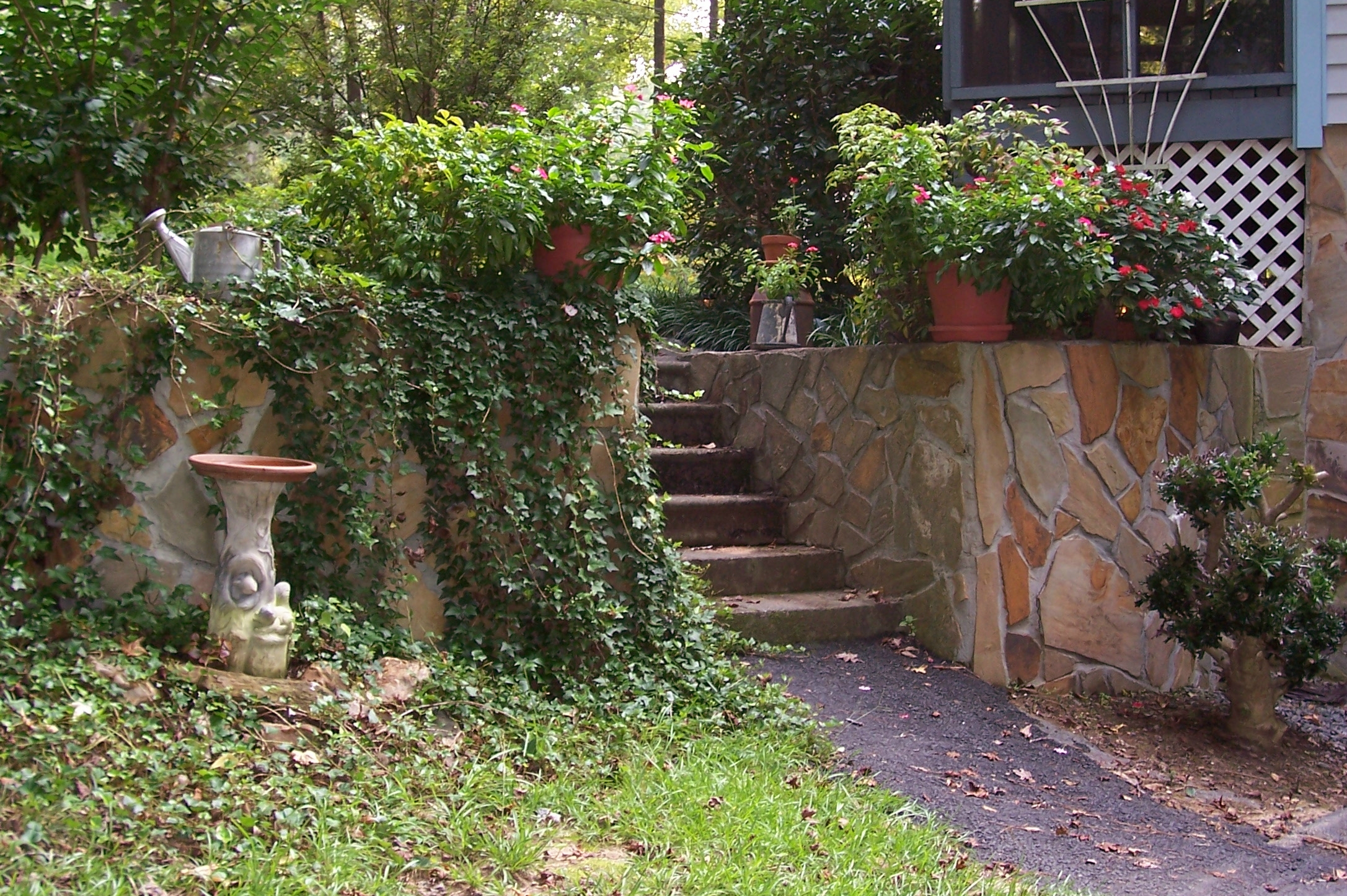
I became interested in landscaping and ornamental gardening in 1987, shortly after my sons’ mother and I bought our first house.  I had started working in a public library two years earlier, and I was fascinated by gardening magazines and books that I was cataloging.  I wanted to have a yard with more than just an expanse of grass and a few foundation shrubs around the house.  I wanted to create a little oasis!  I started building my own personal library of gardening books, learning as much as possible about soil condition, hardiness zones, watering, fertilizing, and plant identification.  I didn’t have much disposable income in those years, so I started out small and concentrated on a few specific areas, such as the side entrance to our house that we used most often.  A few years later we started a family and moved into a larger house on a steeply sloping lot.  It was a challenging yard, but over the years I began to mold it into something that I could work with and make attractive.  One of the most successful projects was the creation of a lush entry-way garden leading from the parking area to the front door, which is pictured in the photograph above.  Before moving away from that house, I also created two azalea islands under oak and sweet gum trees in the front yard, a pathway leading through ornamental trees and shrubs in the backyard, and my first small pond with a waterfall. (See my post from May 17, 2016 to learn more about the waterfalls and ponds I have designed through the years.)

Pond garden at sunrise

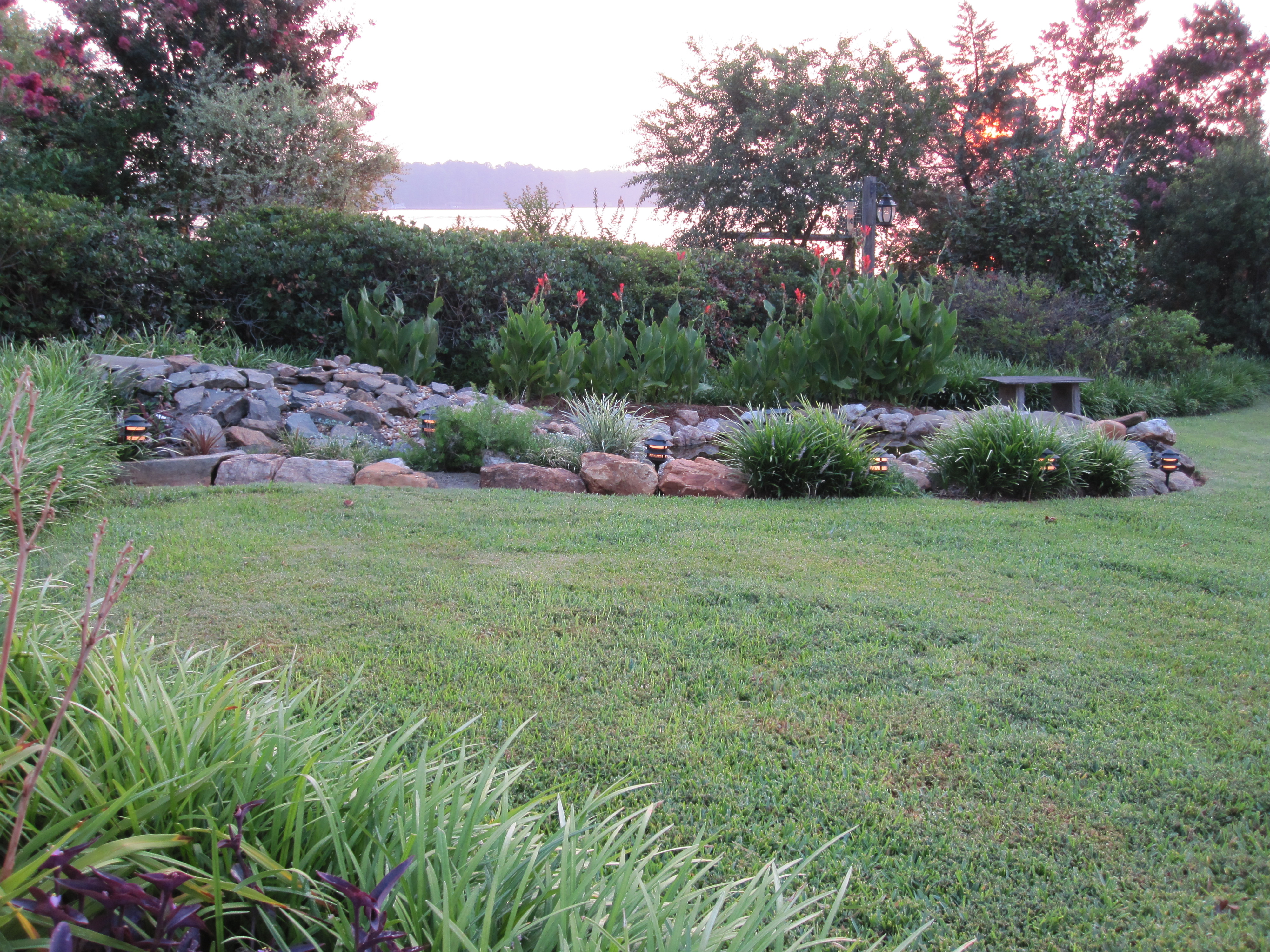
When I met my second wife, she was living on a lake in central Georgia.  When we married, I moved in with her.  The previous owners of this lake house had invested considerably in the landscape, but my wife had made several improvements before we were married including upgrading the irrigation system, replacing an old patio, removing pine trees, and installing ornamental shrubs and trees.  We decided to have our wedding ceremony on the patio overlooking the lake and a small pond and waterfall that I finished just a few days before the big day.  Over the next two years I added plants and landscape lights around the pond to make the area into a separate garden spot, complete with a bird feeder and a bench.

Patio lake garden
Patio lake garden

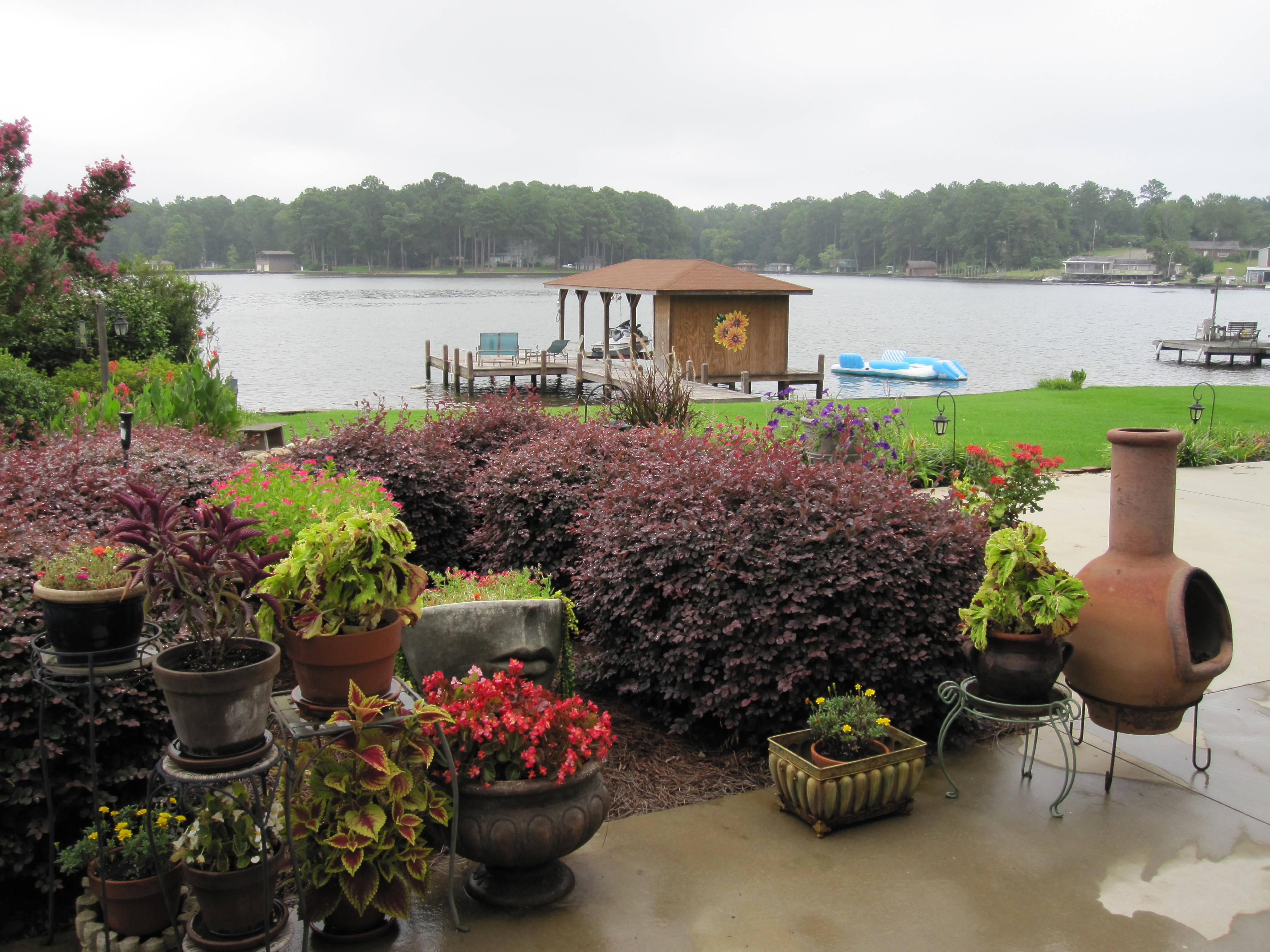
The new and expanded patio was a perfect place to add a container garden, so we began looking for interesting pots, such as the sculpted face pot and stand that we affectionately named Annabel — the face on the pot looks melancholy and reminds us of the subject of the poem by Edgar Allan Poe, “Annabel Lee.”  The patio container garden was framed by a beautiful stand of Loropetalum shrubs that my wife had planted shortly after she moved into the house.  This garden was completed by a chiminea and a hot tub, which is just out of view at the lower left corner of the photo above.  The gently sloping grass of the yard and the view of the large cove beyond were a perfect backdrop to this little slice of paradise just outside the sliding glass doors leading from our master bedroom.

Front island garden
Front island garden

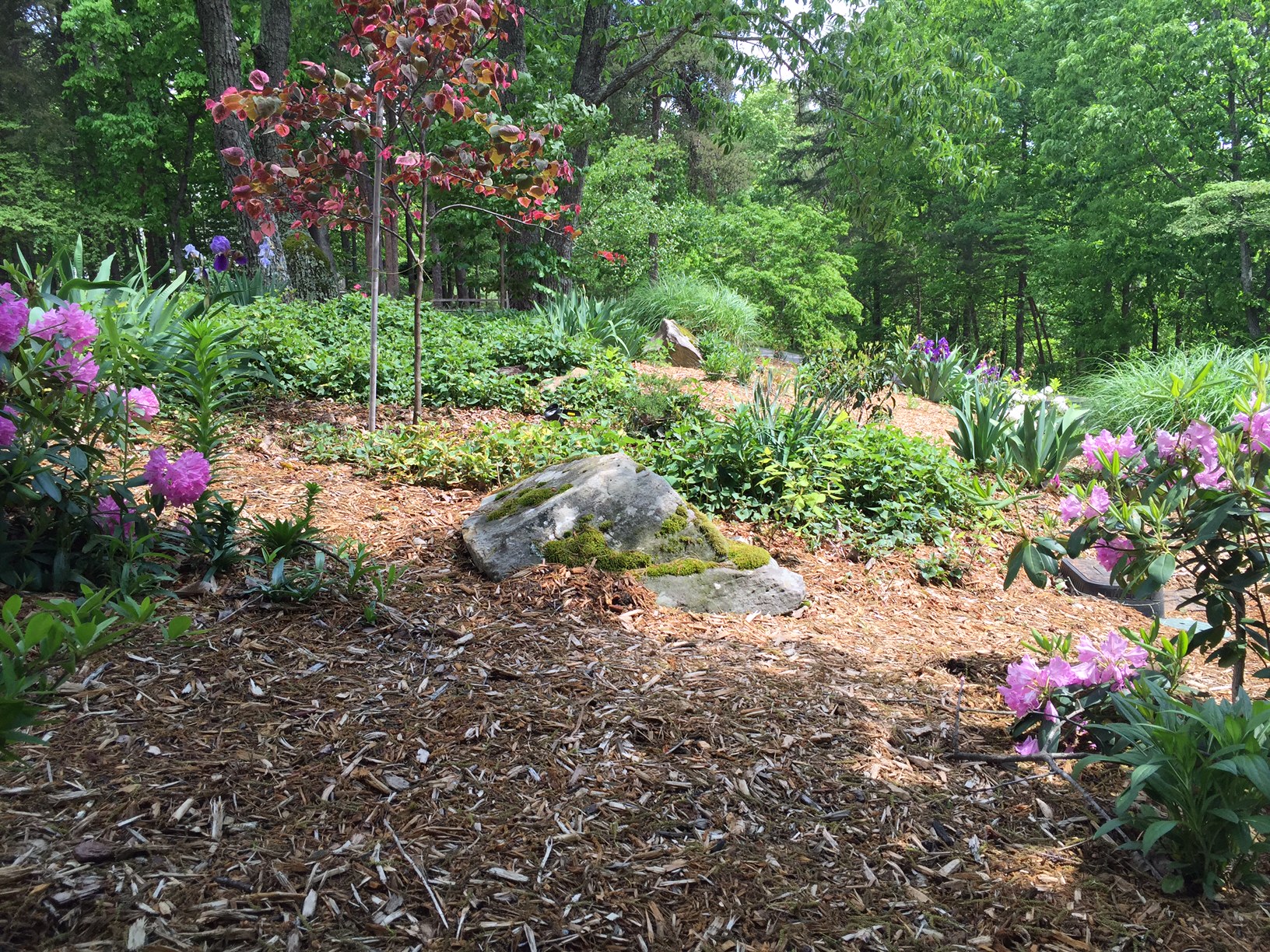
In 2013 we moved to the foothills of the Appalachian Mountains in northeast Georgia.  This part of the state is in a different plant zone than our previous location.  As such there are some semi-tropical species that we can no longer have in our yard, but other ornamentals that need cooler temperatures are perfectly at home here.  Our growing season is a week or two shorter also, but climate change is bringing earlier springs and extended autumns as the years go by.  The previous owners of this house did a fine job of building the “bones” of this property, with a large planting island in the front yard and a fairly deep shrub bed in front of the house.  We have made a few changes, such as adding some annual planting beds and thinning some of the dwarf Nandina on the side of the house.  We have also added to the plants in the front island (pictured above) and covered it all with a healthy layer of wood chips.  The greatest addition we have made to the property is the installation of an in-ground swimming pool with a waterfall, providing us with yet another opportunity to create a new garden oasis.  Although I did not build this “pond,” my wife and I did help with the design.  We have worked very hard over the last two years on the landscaping around the pool by installing a river rock border, bringing in new plants, and arranging container plantings around the decking. The sound of running water is such a pleasant feature of this space, which of course, is also a perfect area for enjoying my first passion . . . reading.

Pool waterfall garden

The Independent Bookstore: A Reader’s Oasis

The last Saturday in April is designated as Independent Bookstore Day, and according to the U.S. Census Bureau, bookstore sales increased 2.5 percent from 2014 to 2015. The American Booksellers Association, which represents independent sellers, reported 1,712 member stores in 2015, up from 1,401 in 2009.  These figures should put to rest the notion that books made of paper are soon to be replaced by electronic forms.  I realize there are plenty of readers who still hold great affection for traditional books — the paper kind.  There are scholars who have argued that reading physical books is a completely different experience than reading eBooks.  Most bookstore owners would probably agree.  Both formats seem to be doing fine, which should be good news to all readers.

Once a medium of information is introduced, it tends to survive no matter what other “new and improved” medium follows.  Some platforms may become obsolete (stone tablets, 8-track tapes, Beta videotape, etc.), but in general, new forms of information delivery don’t dispatch previous ones.  The written word has never stopped people from telling stories or stage acting. Motion pictures certainly didn’t do away with reading.  Radio didn’t destroy movies, television didn’t stop radio broadcasts, and the availability of videos hasn’t destroyed the television industry.  One could argue that computers have only facilitated many of these delivery methods rather than replacing them.  More importantly, none of these has killed the book, regardless of how we decide to read.

There is no question that the last few decades have been tough for small, independent bookstores.  Many of the ones that survived the advent of the mega-bookstores were finally wiped out by the online providers.  Electronic books no doubt delivered another crushing blow to bookstores, but the truly creative entrepreneurs figured out a way to stay relevant and competitive as a niche market.  One approach is to create a salon-type atmosphere that welcomes the reading shopper and provides a sanctuary, a respite from the fast-paced grid that characterizes so much of our society.  Nicole Sullivan, owner of Denver’s BookBar, was quoted in a recent article in The Denver Post.  “As it gets harder for brick-and-mortar businesses, hybrid businesses become more important,” Sullivan said. “It’s either get it fast and cheap online, or come into a store and have an experience. That’s what indies have to offer, a more personalized experience and that sense of community we’ve lost a lot of over the years.”

I have fully accepted the convenience of eBooks and have been an Amazon Kindle customer since the first year they came on the market.  I’m sure some of my library colleagues were horrified by the introduction of virtual books, but now eBooks are a big part of library holdings.  For fiction and other books that rely very little on illustrations or graphics, I actually prefer eBooks.  However, I treasure the large, hardbound gardening, history, and travel books that fill our shelves at home.  Not even iPads or desktops are acceptable for those titles for me.  I also prefer to browse through slick-paper magazines by physically turning pages, not touching a screen.  Because we live in a rural area, the chances of an independent bookstore surviving for very long are slim, so we order many of our books online.  We also go to the web to shop for household goods, clothes, and equipment.  But, when we travel to places like San Francisco, Chicago, and New York, I almost always make a point to visit an independent bookstore.  To me they all seem to have their own “personality” that makes them unique.  If a book is the door that leads to imagination, then a bookstore is a hallway with almost endless possibilities.

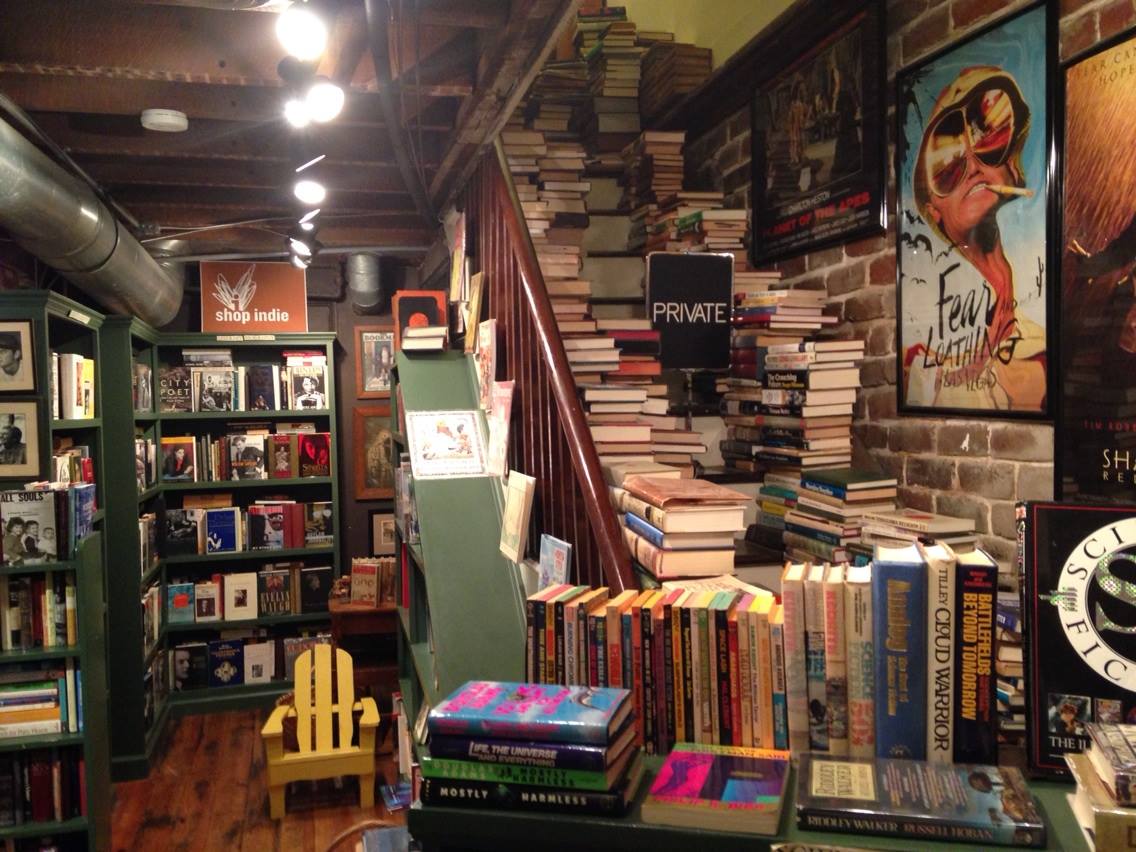
Book Lady Bookstore, Savannah, GA

The Reading Spot

If you are an avid reader, then you most likely have a favorite place to read.  I have certainly had some nice ones over the decades: a legless chair on the floor in the corner of my room as a teen, a library study room in college, an office in my first house, a recliner in my second house, a comfy chair in the loft overlooking the lake in the first house with my wife, and now an even more comfortable chair in our living room where I can watch the birds feeding with the forest as a backdrop.  There are loads of Pinterest pages devoted to reading spots, blogs that explore their enchantment, and even an Annual Unusual Reading Spot Contest .

Designating a space for reading gives the activity a certain reverence, doesn’t it?  Not that we can’t do something else in that space, but we associate it with the pleasure of being immersed in someone else’s imagination (and our own), research, or advice.  The reading spot becomes a type of sanctuary, where the reader deliberately separates herself from her surroundings, and when she leaves the spot, she is not the same ever again.  Alice is indeed in Wonderland.

I also, through the decades, have developed the habit of rising as early as I can to read. That is to say, I get up as early as I can drag out of bed with enough sleep to function for the day.  I am most alert early in the morning and can focus on the words.  A cup of coffee and a book are the most perfect early-morning companions, aside from my wife, that I can imagine.

What Separates Us from Dogs and Cabbage

Advanced communication is one of the achievements of human beings that sets us apart from the rest of the living world.  To paraphrase one of my most influential college professors: “Language is what separates us from dogs and cabbage.”  As humans, we have fairly sophisticated language skills that take the form of speaking, singing, gesturing, signing, etc.  But other members of the animal kingdom possess forms of these skills too, and some of them have surpassed our own capabilities.  What truly distinguishes us intellectually as a species is the higher brain function we have acquired, and I believe the best illustration of that gift is in written communication. The ability to pass along information from one person to another through writing was one of the hallmarks that transformed homo sapiens into civilized human beings and paved the way for rapid advancement.  Sadly, literacy is a privilege that is terribly under appreciated in this country, especially when we consider that 774 million adults around the world cannot read or write.  In the United States, most people over the age of fifteen can read and write at a very basic level, but we live in one of the most advanced countries in the world.  Shouldn’t we expect much more than just basic written communication skills?

Most of us know that, in order to write well, we must read — a lot.  To write better, we need to read more and read good writing (this is beginning to sound like a first-grade reader, in fact).  I think it is at this crucial point that we fail.  I am shining the light primarily on the United States, although this problem likely extends to a good portion of the developed countries around the world.  In this country, the masses don’t spend much time reading at all.  There are far too many other sources of information and entertainment available other than the written word.  I am not referring to the Internet necessarily, because there is plenty of writing, and even good writing, available on the Web.  Then again, the Web offers so many alternatives to writing also, which do present quite a distraction.  I am certainly not referring to e-books either, which in spite of their dubious reputation in the eyes of some traditionalists and obsessive bibliophiles, are another source of writing.

So now let’s narrow it down to the folks who DO like to read.  According to Pew Research Center, as of January 2014 some 76% of American adults ages 18 and older said that they read at least one book in the past year.  The typical American reads about five books a year, which isn’t extremely impressive, but at least they’re reading . . . something.  However, 24% of Americans don’t crack a book at all, and the number of non-book-readers has nearly tripled since 1978.  Again, we have more distractions to pull us away from reading.  As the comedian John Caparulo says in one of his more ridiculous routines, “Books suck!  That’s why they invented movies.  Who the hell reads?”

Now, before the 76% of American readers starts to get too cocky, I will make one final disturbing observation, and it relates to Caparulo’s point.  Most Americans who read do so only for one purpose: to be entertained.  Before going further, let me say that reading should  be entertaining, but if reading is going to continue to raise us above the levels of dogs and cabbage, then what we read should do more than just entertain us.  It should change us, challenge us, move us, and sometimes even call us to action. This standard not only applies to nonfiction — it goes for novels, short stories, poetry, and drama.  The embarrassing truth is that far too many Americans judge the merit of a book by whether or not it has been made into a blockbuster movie. I would venture to say that the majority of people who went to see the movie The Color Purple when it came out in 1985 had not read the Pulitzer-prize winning novel by Alice Walker, but after seeing the movie praised the book as a masterpiece.  One has to wonder if Gone with the Wind would still be the best-selling book of all time if it had not been made iconic by the motion picture that followed.

We have access through numerous vehicles to the world’s greatest works of literature — from ancient sacred texts to modern classics from various cultures.  Why would we waste what little time we have in this life on anything less precious?  Of course, I phrase that question knowing full well that I am guilty of seeking shallow entertainment all the time, but I have not forsaken the pursuit of fine literature in the process.  We can have both.  But, to spend a lifetime completely absent of serious writing seems to me such a tragic existence for a species with the mental capacity to appreciate it and pass it on to the next generation.

Carl Sagan and Ann Druyan – Shadows of Forgotten Ancestors

Reading is easily one of my favorite activities.  Outside of newspapers, magazines, and websites, I tend to read more novels than anything else.  I like the immersion experience and the sense of accomplishment after finishing a well-written novel.  However, I do enjoy nonfiction works, and I gravitate toward works on history, religion, and natural science.  I am also fascinated by human origins, evolution, and anthropology.  There are a few books I can recall that truly had a life-altering effect on my way of thinking.  One of those was Shadows of Forgotten Ancestors by the late Carl Sagan and co-authored by Ann Druyan.

First published in 1992, this book is an exploration of who we are and how human beings have been shaped by the development of the planet over millions of years.  The authors explore origins of traits central to our current predicament: sex and violence, love and altruism, hierarchy, consciousness, language, technology, and morality.  It is easily the best book on human origins and anthropology for the lay-reader that I have ever read. I’m sure some scholars in the field are still not fond of Sagan’s work, but he really did a good job of making science accessible and fascinating for the rest of us.  For that effort and accomplishment, I am grateful.