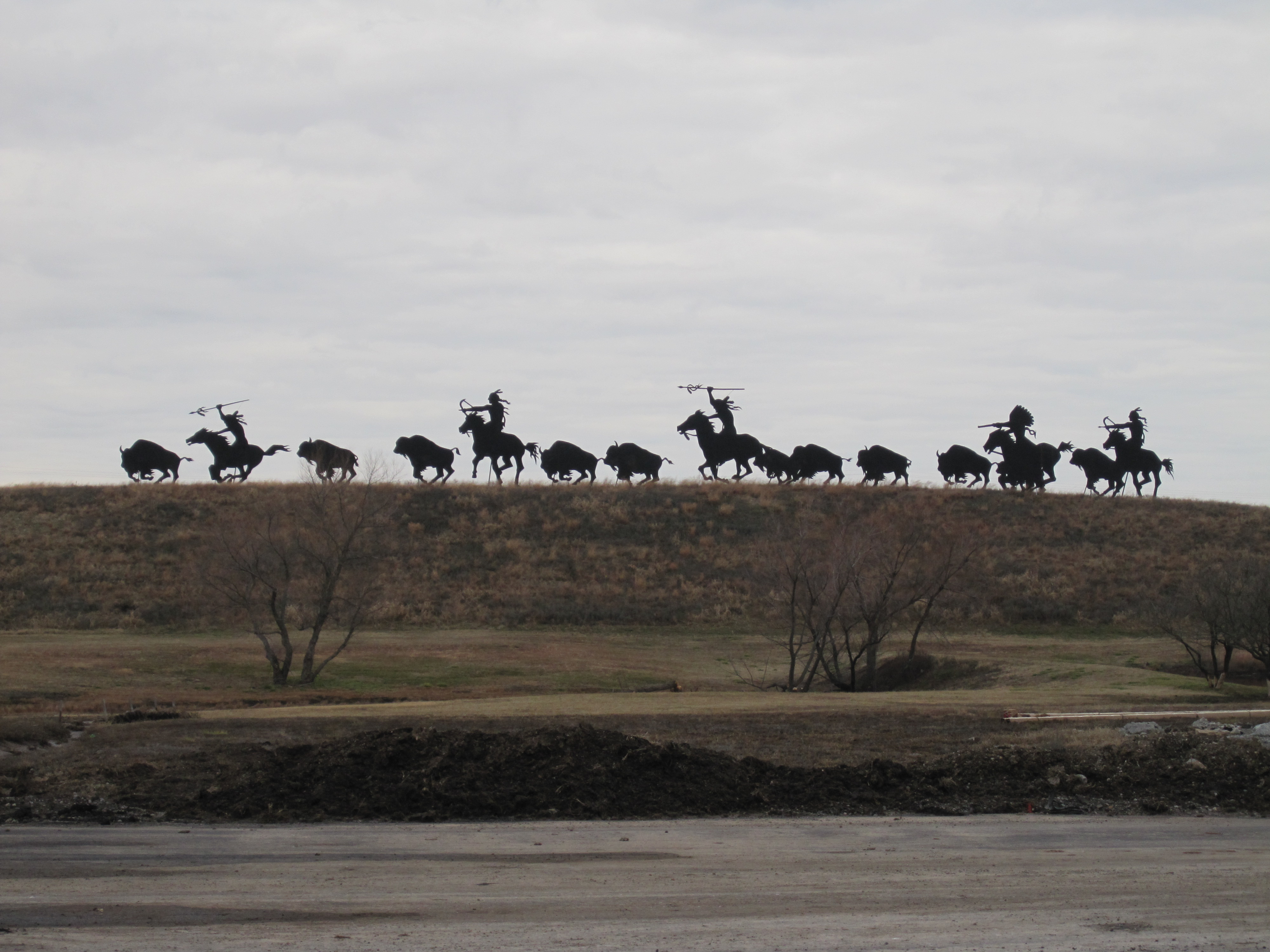
Otoe-Missouria Buffalo Hunt in Silhouette

Buffalo Hunt Silhouette

This metal sculpture is on a hillside behind one of the new casinos in northern Oklahoma, just south of Arkansas City, Kansas.   The Otoe-Missouria Tribe was encountered by Lewis & Clark on their epic expedition of 1804, when the inhabitants were still living in their Nebraska tribal home.  So the story goes, the tribe was on a buffalo hunt, making Lewis & Clark wait on them to return to their village.  There are statues in front of the casino commemorating that “First Council” meeting.  The metal outdoor artwork obviously recalls the hunt.

I find the sculpture particularly striking because it produces a silhouette effect regardless of the outdoor lighting.  On an overcast day, like the one when I took this photo, the effect is quite pronounced.  The individual pieces are large, and in a photograph, you can almost be convinced that they are real.  I gasped when I first saw it and wondered why it was visible only from the back parking lot of the casino.  I think it is magnificent.  I hope that this fine display of art is not offensive to Native Americans, especially those in this particular area near the northern border of Oklahoma.  I hope it is considered a tribute to a culture and way of life now buried deeply in our country’s past, with all its beauty and its scars.

Bad News

I’m not quite sure when it happened, but somehow over the last few decades, news has become a commodity that is invented, developed, marketed, and sold much like a sports drink or a hair product.  The transformation seems most apparent in television network and cable news outlets.  It has been argued that the round-the-clock cable news companies completely changed the way the public thinks about information and how it is delivered.  And then there is the Internet.  Regardless of the origins, so much of our news is now completely consumer driven, and our consumers consist of a whole lot of people who are not so well educated and who crave entertainment.  Sensationalism is entertaining — give ’em what they want!  But what they want is certainly not what we all need to be truly informed.

Americans who get their news from the mainstream sources will likely be able to tell you how many people died in the latest plane crash, the identity of the latest victim kidnapped and/or murdered by ISIS, what Kim Kardashian was wearing at the Grammy Awards, which presidential candidate is ahead in the polls, and how many times a police officer shot an unarmed African-American man yet again.  What they probably won’t be able to tell you is the impact that drought is having on farmers in California that will adversely affect food prices across the country.  It is doubtful they will know anything about the violence raging in Libya and other areas of Africa, which is increasing the number of people fleeing to Europe via the Mediterranean Sea.  They will likely be unaware of a new type of blood test that is starting to transform cancer treatment, sparing some patients surgical and needle biopsies.

I’m not trying to unfairly pick on CNN, but they are the leader in world news.  Yet, they have fallen into the sensational trap of providing shallow news.  A quick look at today’s headlines on their website reveals these tasty stories:

  • Johnny Depp’s dogs face deportation or death
  • Ex-NFLer accused of murdering prison cellmate
  • Rock singer discloses mental disorder
  • ‘Simpsons’ stalwart rejects $14M deal

And the top three stories are about the Amtrak train crash, which will probably dominate CNN and the other outlets for several weeks, leaving behind the search for more clues in the German airline crash into the Alps a few weeks ago — old news now.

Checking out other outlets like FOX News, CNBC, ABC, CBS, and NBC will result in much the same material.  In addition to giving us bad news, the providers are also constantly trying to test the political, ideological, moral, and religious climate of their viewership.  Since the country is so deeply divided along those lines these days, we find the media organizations making choices about coverage and slanting their editorial content accordingly.  On top of sensationalism, we are also fed a steady diet of partisanship and divisiveness.  This isn’t comprehensive news — it’s very carefully selected information designed to keep the customer happy and coming back for more.  It’s like abandoning fresh fruit, vegetables, bread, and meat for fast food and convenience-store snacks.  Some of like burgers while others like fried chicken, but none of it is very good for us.

Slavery by Another Name by Douglas Blackmon

In his Pulitzer-prize-winning book, Slavery by Another Name: The Re-Enslavement of Black Americans from the Civil War to World War II, historian Douglas Blackmon brings to light one of the most shameful chapters in American history—an “Age of Neoslavery” that thrived from the aftermath of the Civil War through the dawn of World War II.  Having been raised in the Southeast where these atrocities flourished in the decades leading up to the time I was born in 1960, reading this exposé was both painful and illuminating for me — it is one of the best works of nonfiction I have read in many years.

2319745

Under laws enacted specifically to intimidate blacks, tens of thousands of African- Americans were arbitrarily arrested, hit with outrageous fines, and charged for the costs of their own arrests. With no means to pay these ostensible “debts,” prisoners were sold as forced laborers to coal mines, lumber camps, brickyards, railroads, quarries, and farm plantations. Thousands of other African-Americans were simply seized by southern landowners and compelled into years of involuntary servitude. Government officials leased falsely imprisoned blacks to small-town entrepreneurs, provincial farmers, and dozens of corporations—including U.S. Steel—looking for cheap and abundant labor. Armies of “free” black men labored without compensation, were repeatedly bought and sold, and were forced through beatings and physical torture to do the bidding of white masters for decades after the official abolition of American slavery.

This book is a moving, sobering account of a little-known crime against African-Americans, and the insidious legacy of racism that reverberates today.  In light of events involving law enforcement and the legal system with regard to black people over the past year, this book is extremely relevant.  It should be required reading in most southern history college courses, and it should be considered strongly for most advanced American history courses. It is well researched, thoroughly documented, and extremely compelling.  Blackmon is such a good writer.

My Grandmother’s Raunchy Side

I was raised in a morally-conservative Southern Baptist home.  Most of the cousins that I knew best were all Southern Baptists, as well as many of my friends, mainly because my circle of friends largely came from our church.  Drinking alcohol was a sin, plain and simple.  Dancing was frowned upon but tolerated by the time I was a teenager in the 1970s.  My mother was not fond of playing cards, unless they were game-specific like Old Maids, and much later, Uno.  She was suspicious of regular playing cards because she associated them with gambling, another sin of the infidels.  Most of all, sex was something extremely private and reserved ONLY for the sanctity of marriage — end of discussion.  There was no wiggle room on this point at all.  And it was not a topic of conversation in our home, instructional or otherwise.

My maternal grandmother was also a strong Southern Baptist and beloved by many in our church.  She lived with us through all of my childhood and most of my adolescence.  My mother worked outside the home, so my sister and I were largely raised by our grandmother.  She held many of the same convictions that my mother did; however, there were times that her rural upbringing emerged, sometimes in irreverent ways.  She had some wonderful little “sayings” that verged on being nasty, which made her giggle to the point of losing her breath.  I always thought they were rather inconsistent with our family’s moral code, and I loved them.  Here are a few examples.

If someone in the room exclaimed that somebody “tooted,” she would rattle off this zinger: “The fox is the finder, the stink lays behind her!” Of course, this is an old variation of the later line: “The one who smelt it is the one who dealt it.”  Coming from my sweet grandmother, it was hilarious.  Speaking of farting, she did it quite often in our home and found it to be quite entertaining.

Another even more priceless example to me was what I heard my grandmother say one time when she saw a very tall woman with a very short man.  I will never forget it.  “Well, when they’re nose to nose his toes is in it, and when they’re toes to toes his nose is in it.”  Now that’s mighty raunchy humor coming from a Southern Baptist grandmother in the 1970s.  I have so many more wonderful memories about my grandmother that I intend to document in this blog at some point.  She inspired a song that I wrote and have performed many times, mostly because it has been requested so often, especially by seniors at gatherings where I have entertained.  It never fails to bring laughter, just like my grandmother did for us so many times.

The Little Girl in the White Dress

Isn’t it odd what scares us?  Oh, this is not to be a discourse about death, doctors, dentists, or dogs (some folks seem to be horrified of them).  I am fascinated and quite intrigued by the unusual things that scare us, especially harmless ones that, under just the right circumstances, can be bone chilling.  You know what I mean.  A perfect example?  Clowns.  What could be more cheerful and fun than a clown?  Unless, of course, the clown has daggers for teeth and lives in a neighborhood sewer.  Even the most innocent clown can be frightening, particularly to small children at birthday parties.  Must be all that makeup.  There are plenty of full-grown adults who shiver at the sight of a clown.

Then there is the terror that is invoked by certain elements of situations, environments, or settings.  An illustration is the best way I can describe what I mean here.  A colleague and I were riding home one night through the dark countryside.  It must have been overcast, because the only thing we could see was the portion of the road illuminated by his headlights.  For some reason it occurred to me that seeing something on the side of road in the headlights for a brief moment could be terrifying, like a little girl in a white dress, all alone, just standing there watching us as we pass by her.

Why should a little girl like the one pictured here in this 1935 oil painting by Rose Trellis Caracciolo be so frightening, standing on the side of the road on a pitch-black night, perhaps with even a faint smile on her face?  I asked my colleague, the driver, that very question.  I will never forget his answer, and it is as good an explanation as I have ever heard for the situation.  “Because you know she ain’t supposed to be there.”

No Easy Way to Say It

Losing a family member to death leaves a significant empty space for those left behind.  The death of a parent summons feelings of vulnerability and a sense of one’s own mortality.  Even when death is an end to suffering, there is a certain finality to it that brings sadness.  However, even in the darkness of these times, there is plenty of humor that always accompanies the human comedy, and the recent death of my father is no exception.

I wrote last week about “the call” I received from the nursing home informing me that my father had passed away.  The words spoken by the facility’s representative reminded me of other testimonies I have heard from people who have received “the call.”  A couple of weeks before he died, my father had suffered from an infected lymph gland in his neck that was very inflamed and painful.  He was on some very strong antibiotics that zapped what little energy he had left at age 94, but it appeared that he was getting better and was strong enough to get out of bed.  His nurse told me that he had actually eaten dinner only an hour or so before he died.  So the representative who called had the unpleasant task of giving me news that by no means was a surprise but was nevertheless not altogether expected either.

Herein lies the comedy.  You have to wonder how nursing home personnel are trained to deliver such bad news to loved ones.  In this case, the voice on the other end of the phone said, “Mr. ————? I was calling to let you know there’s been a change in your father’s condition,” to which I replied, “Okay.”  And then she handed it to me: “He passed away this evening.”  Now, at this point, I began asking the predictable questions about how he was found, how he died, what time it happened, etc.  What I really wanted to say was, “Why yes, I would say that is a fairly significant change in his condition.”  It would be hard to immediately come up with a better example of the understatement of the year.

My wife has told many people the story of “the call” she received about her mother’s death, which occurred while she was in a rehab center only a day or so after my wife had been with her.  The nurse who called and delivered the message told my wife that her mother had “expired.”  Really?  Expired?  I realize now that this is a technical term used in the geriatric healthcare industry, but I can’t imagine why you would use that term when talking to the daughter of the deceased.  Expired?  Can we renew her?  Did we not put down a large enough deposit?  It makes the deceased sound more like a library card or a driver’s license.

The truth is that there is no easy way to tell a person that someone they love has died.  It’s bitter and heartbreaking.  It is so precise and final.  It defies couching or masking.  There is no sufficient euphemism, although we certainly do our best with words like “passed” or “passed away” or “crossed over.”  I don’t envy those who are charged with the duty of bearing the saddest news of all, but I can’t help but find the humor in delivery methods like these.  Expired?  Really?

God’s Cathedral

There are still plenty of outdoor places in America you can visit that are protected enough to offer a glimpse at how the landscape on this continent may have appeared to early native inhabitants and explorers.  A prime example are some of the national parks.  I think the National Park Service is one of the best government programs of all, and I wish our federal leaders would find some other areas to cut funding and leave this division alone.  We have some incredible treasures around the country, several of which I have visited.  I have never been disappointed.

One of the best parks to visit to experience what I am describing is Yosemite National Park in the High Sierra region of California.  First protected in 1864, Yosemite is best known for its waterfalls, but within its nearly 1,200 square miles, you can find deep valleys, grand meadows, ancient giant sequoias, a vast wilderness area, and much more.  There are so many places in this park where you can stand, and for as far as the eye can see, there is no sign of civilization.  The vistas are absolutely breathtaking, including perhaps the most photographed view of all from just beyond the tunnel on Wawona Road, where the valley opens up and welcomes you to what many people refer to as God’s Cathedral.  Indeed, the scene is like a place of worship on a monumental scale, and for those who have any appreciation at all for the beauty of the natural world, it invokes a sense of reverence and awe.

Yosemite Valley
Yosemite Valley from Tunnel View on Wawona Road

My wife and I joined up with a good friend of ours there in July, 2013, staying several nights in a cabin and spending our days hiking along the valley floor and up to one of the high spots overlooking the valley.  Yosemite is another one of those places that reminds me just how small I am and how magnificent this planet is.  John Muir, the famous naturalist who helped draw up the proposed boundaries of the park in 1889, described Yosemite as being “full of God’s thoughts, a place of peace and safety amid the most exalted grandeur and enthusiastic action, a new song, a place of beginnings abounding in first lessons of life, mountain building, eternal, invincible, unbreakable order; with sermons in stone, storms, trees, flowers, and animals brimful with humanity.”

The Legend of Bob Dylan

My older son and I recently saw Bob Dylan and his band in concert.  My son is quite the connoisseur of classic pop music going back to before he was born, and to some extent, before I was born.  Going to this show was what he requested for his birthday because he feels certain that there won’t be too many more chances to see Dylan live, and judging from how frail the aging rocker looked on stage, I would agree.  While 73 doesn’t seem so old when considering how many of his contemporaries are still touring extensively, Dylan doesn’t seem to “get around” with the same agility of guys like Mick Jagger or Paul McCartney.

Just before the show began, the house lights went out and the stage was dark.  A single member of his band came out in the dark, picked up a guitar, and started playing a gentle, folksy tune.  It was like being in church.  When the lights went up, the rest of the band was in place, wearing matching outfits.  I leaned over to my son and said, “How often do you see band members dressed alike?”  He replied, “I never have.”  They were definitely representing a different era, when rock-n-roll was reaching adolescence and getting more rebellious, but there was still a touch of class and style left over from the very early days of the bands that accompanied Buddy Holly and Elvis.


President Barack Obama presents Bob Dylan with a Medal of Freedom (May 29, 2012)

Most people don’t become legends during their lifetimes, nor do they become iconic.  Bob Dylan is an exception.  Some of his songs clearly define the rock-n-roll era, especially the elements in the genre that are most significant historically: protest, reflection, freedom, and change.  More than any other popular musician and songwriter from my generation that I can recall, Bob Dylan has proven over and over again that rock-n-roll was never just about the music, and certainly not about beautiful voices.  Hell, he never even tried to make pretty sounds with his voice, that is, on the occasions that he decided to sing instead of speak his songs.  But I would argue with anyone that his lyrics were some of the most powerful and moving of that generation.

At this particular show, Bob Dylan sang an incredible variety of music in a short time. He was probably on stage for less than two hours altogether, but during that time, we heard folk, blues, country, reggae, and rock.   He never picked up a guitar, but he played a miniature grand piano, and of course, the harmonica.  The instrumental variety from his band was impressive, including tunes using a violin and a huge string bass.  It was clear that he was playing what he wanted to play, not what the crowd expected or necessarily wanted.  He didn’t include “Like a Rolling Stone,” which no doubt irritated some of the audience.  But he did play “Tangled Up In Blues” and “Blowing In the Wind.”  Dylan performed that last song as his finale for the single encore he gave, and true to form, he used a variation so different from the original recorded version that I didn’t even recognize it until he was into the chorus.  I leaned over to my son and said, “I almost didn’t recognize this one, the way he’s playing it.”  Looking straight ahead to the stage, admiring the legend, my son replied, “He’s earned the right to do it anyway he wants.”  I couldn’t agree more.

The Call

On Saturday evening, I got the call.  Actually, the call came in the form of three voice mails left on my cell phone because I was at a musical event and had my phone turned completely off.  The calls and messages left were from the nursing home, where my father has spent that last five years of his life.  Most of those years could not really be characterized as “living” in the sense that most of us use the word.  Oddly enough, I just posted a few days ago about my sorrow in watching my dad’s recent, rapid decline.

Getting one voice mail from the nursing home is common; getting three back-to-back in a matter of a few minutes indicated something serious.  I have been expecting this call for quite a long time.  At times I have dreaded it, at others I have longed for it, which has been the case recently.  Had the call been to inform me that, due to either illness or accident, my father had been taken to the hospital, it would certainly have anguished me.  The last thing I wanted, any of us who knew him really wanted, was for him to go through the agony of multiple trips to the hospital for procedures to prolong a life not worth living anymore.

There is a certain finality to the words “Your father passed away this evening.”  At the age of 94, the phrase is not unexpected, and as I have indicated in this case, it has quietly been hoped for by friends and family.  He certainly was ready to go and had been for a few years.  He frequently expressed his astonishment that he was still alive. “I never dreamed I’d live this long,” he said many times when we visited him.  “I don’t know why the Lord is keeping me here.”  Good question.  I don’t know the answer.  I can’t say for certain, but maybe he knows the answer . . . now.

You Can’t Run Away from a Bad Diet

For years my wife has been telling me that, while she knows we need to exercise for our health and well-being, exercise won’t help her shed the pounds she wants to lose (she doesn’t have that much to shed truly).  I have always resisted her on this point, thinking that burning off calories with vigorous exercise has to eventually result in weight loss.  While that still may be true with a sensible diet, the fact remains that exercise without cutting back portions and watching the amount of calories and fat we take in will not result in any serious weight loss.  Such are the findings of a team of British cardiologists in a recent study, which they explain in an editorial in the British Journal of Sports Medicine.  In essence, they are claiming that even though regular exercise reduces the risk of developing a number of health issues such as heart disease, dementia, some cancers, and type 2 diabetes, it doesn’t promote weight loss.

Once again, my wife is smarter than I.  This information that she knew and that I was slightly skeptical about is even more troubling for her than it is for me because she also knows that, as we both age, her metabolism as a woman slows down at a much faster rate than mine does as a man.  This means that I can take in more calories than she, and with everything else being equal, my weight remains stable.  No, it certainly isn’t fair and is another example of how women get the shaft from nature.  I’m not so concerned about how my wife’s body looks (well, yes it does matter, but it isn’t my main concern), but I do want her to be healthy and well as we march toward retirement in the next ten years.  I am convinced that avoiding obesity is essential in achieving that goal, for both of us.  Beyond that extreme though, I hope we can both eat well, exercise regularly, and maintain our fitness as we age so we can enjoy that retirement by traveling around and exploring, relatively free of pain and with as much physical flexibility and stability as possible.